Selective attention modulates temporal processing
Poppy Sharp
Doctor of Philosophy
Doctoral School, 31st Cycle
CIMeC - Center for Mind/Brain Sciences
University of Trento
January 2019
Abstract
A near continuous stream of information reaches our eyes and the task of the visual system is to make sense of it. Visual stimuli arrive in quick succession: sometimes it is necessary to integrate stimuli over time, but other times it is necessary to segregate them. These opposing processes of integration and segregation are two forms of temporal processing, a topic which is underrepresented in the literature as compared to spatial processing. In particular, there is limited understanding about how temporal processing is influenced by selective attention. Selective attention refers to a family of mechanisms by which the limited resources of our mental architecture are diverted to preferentially process stimuli more likely to be relevant.
Here, a number of empirical investigations into the effect of endogenous, covert spatial attention on temporal processing are presented. This includes use of a task in which visual stimulation is held constant and only the temporal processing goal (integration versus segregation) and the spatial location of attention are manipulated. There were strong spatial cueing effects: a benefit to performance when validly cued and a cost when invalidly cued. These attentional effects are reliable for both opposing processes of temporal integration and segregation. Furthermore, these spatial cueing effects are robust even when the cues provide no implicit temporal expectations. We used magnetoencephalography and the same task to measure changes in the brain signal associated with these effects, namely shifts in peak alpha frequency for integration as compared to segregation, as well as spatially specific modulations
in this metric relative to the locus of attention.
These findings of robust spatial cueing effects on temporal processing and of strategic
attention are discussed within a temporal windows framework and in the context of other
candidate mechanisms. The empirical evidence reported here can be accounted for by the idea
of a flexible adaptation of the size of temporal windows, essentially changing the sampling rate
Contents
Abstract 2
Contents 4
Acknowledgements 7
Author’s declaration 9
List of Figures 10
List of abbreviations 12
Chapter 1: General Introduction 13
Temporal processing 13
Rhythmicity in perception 13
Types of temporal processing 14
Temporal integration and segregation 16
Paradigms probing temporal processing 17
Selective attention 19
Types of selective attention 19
Proposed mechanisms of endogenous spatial attention 20
Attention and temporal processing 21
Attention to temporal processing: candidate mechanisms 23 Other types of selective attention and temporal processing 24
Neural correlates 26
Measuring neural oscillations 26
Functional roles of neural oscillations 27
Alpha and spatial attention 29
Alpha and temporal processing 30
Chapter summary and thesis outline 31
Chapter 2: Endogenous attention improves temporal resolution 34
Abstract 34
Introduction 34
Method 35
Participants 35
Stimuli and experimental design 35
Behavioural data analysis 37
Results 39
Discussion 40
Chapter 3: Endogenous attention modulates temporal integration and segregation 41
Abstract 41
Introduction 42
Experiment 1 48
Method 48
Participants 48
Experimental design and stimuli 49
Task 51
Behavioural data analysis 51
Results 52
Experiment 2 55
Method 55
Power analysis 55
Participants 56
Experimental design, stimuli & task 56
Eye tracking apparatus 56
Behavioural data analysis 56
Results 57
Experiment 3 61
Method 61
Participants 61
Experimental design, stimuli & task 61
Results 63
Experiment 4 65
Method 65
Power analysis 65
Participants 66
Experimental design, stimuli & task 66
Eye tracking apparatus 66
Behavioural data analysis 66
Results 67
Discussion 69
Chapter 4: Different effects of spatial and temporal attention on temporal processing 75
Abstract 75
Method 80
Participants 80
Experimental design and stimuli 80
Task 84
Behavioural data analysis 86
Results 87
Discussion 91
Chapter 5: Changes is brain oscillation frequency subserve temporal processing at
attended visual locations 96
Abstract 96
Introduction 97
Method 99
Participants 99
Stimuli 99
Task 102
MEG apparatus 103
Eye tracking apparatus 104
EOG and Eyetracker preprocessing and data analysis 104
MEG data preprocessing and analysis 104
Instantaneous frequency estimation 105
Experimental design and Statistical Analysis 106
Results 107
Discussion 110
Chapter 6: General Discussion 114
Discussion of findings 115
Wider relevance 120
Future directions 121
La ricerca in breve / The research in brief 123
Acknowledgements
My great thanks go to my advisors Clayton Hickey and David Melcher, whose guidance and support ensured the success of the project. I’m delighted to say that through working with them, the last three years were exactly the kind of challenging and rewarding experience I was hoping for. The best indicator of the quality of their supervision is that I always left our meetings feeling enthusiastic about the science and the work to be done, even if beforehand I had had doubts or concerns about any given details. Thanks gents!
For their mental fortitude while watching circles flashed up onscreen over and over again, I thank the participants in all my experiments. I’m also grateful to my lab mates and colleagues at CIMeC for providing a collaborative and fun place to work. Special thanks to Kaela Venuto who has helped me navigate the idiosyncrasies of an Italian university from literally the moment I first stepped foot in Rovereto.
Many other friends have supported me. Hannah Tickle and her astute questions form part of an unbeatable problem solving strategy in which, during the process of explaining to her how totally stuck I am with some bit of data analysis or coding, I realise a potential solution is staring me in the face. A nod to Yara Rassi for being the model for the head, cortex and parietoccipital alpha in the title image of the thesis.
As with my every endeavour, putting the work in and getting the thesis down on paper was made much easier by knowing that behind me I have the boundless love and encouragement of my parents, Lindsey and Peter. I’m also lucky to have other family like my sister Chloe always looking out for me. And to get occasional well-timed boosts to my self-confidence by way of messages from my old friend Ruairidh Stagg.
Thank you to all my lovely flatmates over the years for a harmonious home life, with coffee and chats in the kitchen. Or rather endless cups of tea if Mine Arayic ı was the one pouring. Or balcony barbecues with my favourite Malteaser Simone Scicluna. Four new flatmates in the final months of the PhD could have been less than ideal, but luckily those four were the lovely Marco Colnaghi, Giovanni Battaglia, Maria Ferrari and Chiara Fornari, who brought warmth and laughter. Every time I enter the kitchen I seem to be handed some piece of cheese, bread or biscuit, and even being holed up in my bedroom doesn’t preclude the offering of a spoonful of homemade tomato sauce. And thank you to Angiola from downstairs (a.k.a. ‘nonna’), for the frequent and stealthy supply of baked goods.
As well as my flatmates, several other masochists have let me speak terrible Italian to them, and in the process become friends: Andrea Beretta, Michele Gianotte, La Giulia di Puglia, and more recently Emilia Campagna (who also helped me correct the more glaring errors from my attempt to write a summary of the thesis, found at the end of this document).
Author’s declaration
I declare that this thesis has not be submitted for any other degree or professional
qualification. I confirm that I composed the thesis, and that the work included is my own,
with the exception of chapters which are jointly-authored publications. These
contributions are indicated indicated at the beginning of the chapters. Where reference
List of Figures
Figure 1.1 Temporal processing across different scales Figure 1.2 Spatial cueing can increase temporal resolution
Figure 1.3 Alpha oscillations are influence by endogenous factors Figure 2.1 Trial structure
Figure 2.2 Results
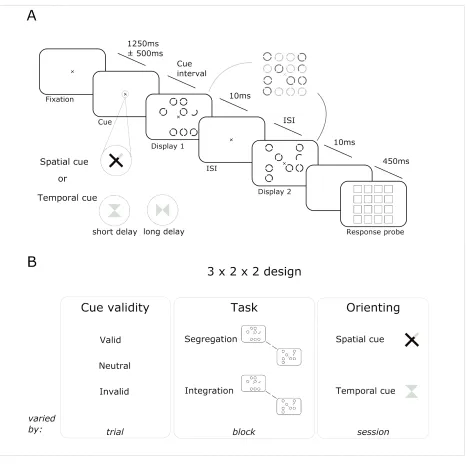
Figure 3.1 Trial structure
Figure 3.2 Results of Experiment 1 Figure 3.3 Results of Experiment 2 Figure 3.4 Results of Experiment 3 Figure 3.4 Results of Experiment 4
Figure 3.5 Theoretical schematic of temporal integration windows Figure 4.1 Paradigm and design
Figure 4.2 Main findings
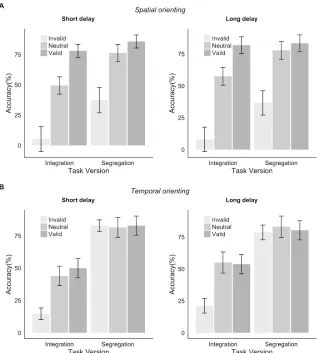
Figure 4.3 Results of main experiment split by cue and stimulus onset Figure 5.1 Trial structure
Figure 5.2 Behavioural results
Figure 5.3 Modulation of alpha frequency by task
List of abbreviations
CRT Cathode Ray Tube
D1 / D2 First display / Second display
DLP Digital Light Processing
EEG / MEG Electroencephalography / Magnetoencephalography
EOG Electrooculogram
ERF / ERP Event-Related Potential / Event-Related Field
HPI Head position indicator
Hz Hertz
ICA Independent Component Analysis
ISI Inter-stimulus interval
LED Light emitting diode
LGN Lateral Geniculate Nucleus
NT Near-threshold
RANOVA / ANOVA Analysis of Variance (repeated-measures)
SEM Standard Error of the Mean
SD Standard Deviation
SOA Stimulus Onset Asynchrony
SQUID Superconducting quantum interference device
Chapter 1: General Introduction
A rich and changeable stream of visual information flows in through the eyes near-constantly during our waking hours. Limited processing resources mean the visual system must prioritise some information over others, selectively attending to elements in the visual stream that may be more relevant to goals and behaviour. Much work has been done to broaden our understanding of how selective attention modulates spatial processing, from influencing behavioural performance to altering the responses of neurons in the brain. Typically in this previous work, the focus has been on single stimuli or sets of stimuli that are not extended in time. But in real life, stimuli arrive rapidly one after another in the visual stream, and our understanding of how this temporal processing is modulated by selective attention is more limited.
Temporal processing
Rhythmicity in perception
windows has a long history in psychological research, supported by studies of psychophysics (Allport, 1968; Shallice, 1964; Stroud, 1955), optical illusions (Simpson, Shahani, & Manahilov, 2005; VanRullen & Koch, 2003) , somatosensory processing (Baumgarten, Schnitzler, & Lange, 2015), sensorimotor synchronization (Mates, Müller, Radil, & Pöppel, 1994) , and human electrophysiology (Samaha & Postle, 2015; VanRullen, 2016) . The idea of perception as sampling with base units of temporal windows can thus be a useful framework for driving forward study of temporal processing.
Types of temporal processing
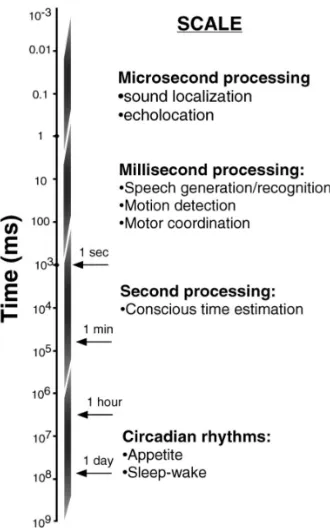
Figure 1.1: Temporal processing is important across different scales. The focus in this thesis is on temporal processing at the millisecond level, within the visual system. Figure adapted from (Mauk & Buonomano, 2004)
Temporal processing is a term used in different ways to refer to a whole host of phenomena, as can be seen from the variety of example processes in Figure 1.1. Multiple aspects of temporal processing have been investigated, such as judging the duration of (visual) stimuli or the interval of time separating stimuli (Divenyi & Danner, 1977; Grondin,
Temporal integration and segregation
Temporal processing comprises two processes opposite in nature: temporal integration and segregation. We often need to segregate visual input over time so that the visual scene can be parsed into separate features and events, but another common necessity is to integrate strongly related stimuli so that they are perceived as unitary phenomena (Pöppel, 2009; Stroud, 1955). There must be high enough temporal resolution to react to relevant environmental changes, but also integration of related features and objects over time. Perception requires a balance between these opposite temporal processes in line with current goals, akin to the wider tenet of functional organisation that representations must be precise and robust, yet also flexible(Deco, Tononi, Boly, & Kringelbach, 2015).
Paradigms probing temporal processing
The majority of investigations into temporal processing use tasks that probe temporal resolution, where good performance is dependent on the ability to segregate incoming sequential stimuli into separate percepts. These include the two flash fusion paradigm (Purcell & Stewart, 1971) : two stimuli - usually Gaussian-enveloped luminance patches - are quickly flashed on screen one after the other in the same location. Participants then report the number of perceived flashes. If the two flashes are inappropriately integrated together this will be detrimental to performance. Performance depends on the ability to segregate for another task: the Temporal Order Judgement (TOJ) paradigm, in which the two stimuli appear in different locations (e.g. to the left and right of fixation) and participants must report which came first (Hirsh, E., & Sherrick, 1961). For both of these tasks other factors could lead to erroneously reporting one stimulus, such as missing either stimulus through inattention. Furthermore, for TOJ it is possible to successfully segregate the stimuli but then fail to identify which came first.
Selective attention
Types of selective attention
Our ability to attend to some things selectively over others is a fundamental aspect of cognition and information processing, and one that has been studied since the earliest forays into psychology and neuroscience. We can pay attention to specific points in space, to different points in time, to specific features of the visual scene, and to specific objects (Carrasco, 2011; Coull & Nobre, 1998; Olson, 2001; Treisman & Gelade, 1980) . These different types of selective attention share the commonality that they are the solution to the problem of limited metabolic resources (Treisman, 1969). The visual system must prioritise processing of some pieces information over others, thus more relevant or salient stimuli are preferentially processed while the processing of other stimuli is inhibited (Beck & Kastner, 2009) . Here, we focus on spatial attention, which can be further subdivided in terms of whether attention is allocated in an overt or covert fashion.
We can shift the focus of attention by moving our eyes to move our gaze. But as well as these overt shifts of attention, we can covertly shift our attention in space while maintaining fixation with the eyes (Sheliga, Riggio, & Rizzolatti, 1995) . Evidence suggests that the mechanisms and neural architecture supporting overt and covert attention overlap to some extent (Hunt & Kingstone, 2003) . The experiments presented in this thesis all use paradigms in which participants are maintaining fixation, and thus allocation of spatial attention is covert.
exogenous refers to an automatic orienting in response to a stimulus (Carrasco, 2011). These two attentional systems thus differ with respect to the direction of origin in the processing hierarchy: endogenous attention is a top down process, exogenous attention a bottom up process.
Cueing paradigms offer a controlled setting to study an operationalized version of attention. Posner cueing paradigms probe allocation of endogenous spatial attention: typically a predictive, symbolic cue (such as an arrow) is presented at fixation to indicate a position in space where a target will likely appear (Posner, 1980). Equivalent paradigms exist for exogenous attention in which a cue appears peripherally at the same location where a target will likely appear (Carrasco, 2011). These paradigms allow investigation of the effects of attention on behaviour, and elucidation of the underlying mechanisms.
Proposed mechanisms of endogenous spatial attention
A rich body of literature supports the idea that endogenous spatial attention allows flexible adaptation of spatial resolution, including evidence from psychophysics (Montagna, Pestilli, & Carrasco, 2009; Yeshurun & Carrasco, 1999), neuroimaging (Fischer & Whitney, 2009),
single-unit recording (Anton-Erxleben, Stephan, & Treue, 2009; Womelsdorf, Anton-Erxleben, & Treue, 2008) and human electrophysiology (Müller & Kleinschmidt, 2007) studies. A number of candidate underlying mechanisms have been proposed.
within it. Other putative mechanisms of attentional allocation include gain enhancement,
sharpening of neural tuning, and adjusting the weighting of subpopulations preferentially driven by higher spatial frequencies (Carrasco, 2011).
Some of these mechanisms are compatible with one another. One way to inform
arbitration between these accounts and understand how they relate to each other is to generate new constraints through new empirical evidence of how attention is allocated during different types of processing. The case of attention and temporal processing is a good example.
Attention and temporal processing
effects for some tasks such as texture segmentation(Yeshurun & Carrasco, 1998) . It appears that capture of attention by exogenous factors leads to shifts in the resolution of the system both in time and in space, likely because these resolution increases are useful for many perceptual tasks. This may be especially pertinent when a change has occurred in the visual environment, recruiting exogenous attention. A central question of this thesis is whether in the case of endogenous attention modulation of temporal resolution is instead flexibly and dependent on what is most appropriate in the current situation.
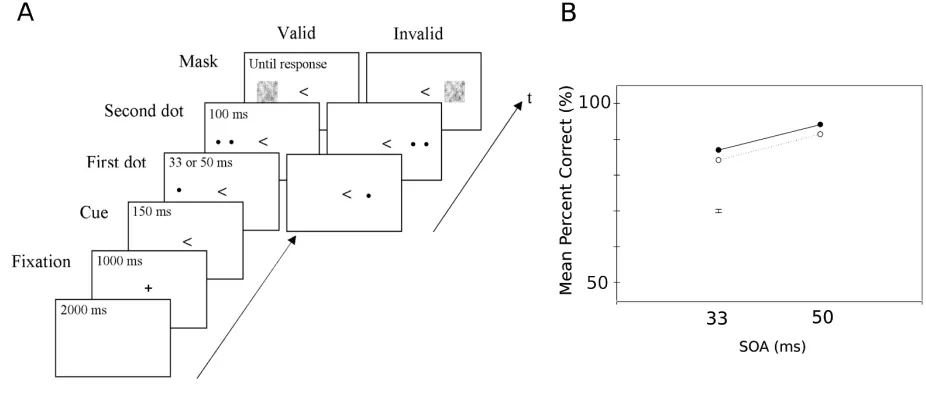
Figure 1.2: Spatial cueing can increase temporal resolution. A Paradigm used to assess
effect of spatial cueing on temporal segregation, participants indicated number of dots seen. B
Performance at task shown in A, SOA: stimulus onset asynchrony. Black solid line: valid, dotted
line: invalid. Both panels adapted from (Hein et al., 2006)
degradation caused by exogenous cues. For example, Hein, Rolke, and Ulrich (2006) used a temporal order judgement paradigm in which participants were endogenously cued to a hemifield where they would see two rapid sequential stimuli, finding that valid endogenous cues improved performance at identifying the order in which stimuli had arrived, as shown in Figure 1.2. A gap in our understanding remains as to whether this benefit of endogenous spatial cueing for segregation will replicate and whether endogenous spatial cueing will also benefit integration. It is also unclear how this cueing effect is instantiated in the brain.
Attention to temporal processing: candidate mechanisms
What specialised attentional mechanisms might subserve flexible temporal processing? One account from the literature refers to the differences between magnocellular and parvocellular pathways in visual processing. Spatial attention is thought to act in large part through emphasis and modulation of input from parvocellular neurons, which have small receptive fields (e.g. Schiller & Logothetis, 1990). However, because magnocellular neurons have better temporal resolution, a relative down-weighting of magnocellular input could come at the cost of temporal sensitivity. Evidence for this explanation is mixed, with some support from work in which the relative luminance of stimuli were matched (Yeshurun, 2004), but conflicting results showing survival of the cueing effect under conditions which should have mitigated the magno-parvo difference (Akyürek & van Asselt, 2015; Yeshurun & Levy, 2003).
framework, if they fall within the same temporal window, a single stimulus is perceived. There is evidence suggesting the result can be a single integrated percept – as opposed to a preferential processing of the first stimulus over the second – even when there is no benefit of integration, for example in reversal of reported target order in rapid serial visual presentations (Akyürek et al., 2012; Akyürek & Wolff, 2016) . In other circumstances, a pair of stimuli separated by the same delay are perceived as two distinct percepts if they fall in different temporal windows, which can occur both on account of the phase of sampling of the visual environment or the size of these windows. Allocation of attention could modulate sampling to use shorter temporal windows when the task required segregation of temporally separate stimuli, but by biasing the system to longer temporal windows when success depended on integration of temporally disparate stimuli (Wutz, Melcher, & Samaha, 2018; Wutz et al., 2016) . In this way the temporal window size could influence the perceptual outcome, independent of any effects (such as gain or tuning) on the low-level representation of the stimulus.
Other types of selective attention and temporal processing
Enns, 2001) and one unique study shows that accurate temporal processing depends on whether or not participants could see their own hands (Bush & Vecera, 2014).
Neural correlates
Measuring neural oscillations
Some of the most powerful tools at our disposal to gain insights into neural correlates in humans are noninvasive electrophysiological recordings using electroencephalography (Berger, 1935) and magnetoencephalography (Cohen, 1972), also known as EEG and MEG. These measures exploit the fact that neurons communicate with each other using electrochemical signalling to propagate messages downstream. We can measure electrical potentials at the scalp with EEG electrodes, or measure the small associated magnetic fields with the sensors in an MEG system (called superconducting quantum interference devices or SQUIDS) in a magnetically shielded room. These currents and fields are thought to reflect currents in post-synaptic dendrites, allowing us to characterise brain activity with EEG and MEG. These measures are invaluable in understanding the dynamics of brain activity and their functional relevance, since they provide very high resolution in the time domain (Lopes da Silva, 2013). MEG also offers better spatial resolution than EEG since the signal is less smeared by factors such as conduction differences of electrical potentials through the skull and scalp (Hämäläinen, Hari, Ilmoniemi, Knuutila, & Lounasmaa, 1993). The signals recorded with EEG and MEG are otherwise broadly similar.
One of the main characteristics of the neural signal recorded with MEG is oscillatory activity, reflecting rhythmic fluctuations in the postsynaptic membrane potentials of many neurons (Buzsaki, 2006). An oscillation can be described in terms of its three main features: frequency, power, and phase. The frequency is the speed with which the oscillation is changing, the power is the amplitude of the oscillation, and the phase is the angle or starting point of the oscillation. These interrelated features can be quantified after a mathematical transformation of the MEG signal such as the Hilbert transform (Cohen, 2014) or Fourier transform (Bertrand, Tallon-Baudry, & Pernier, 2000) , depending on the purpose of the analysis. Initially dismissed as epiphenomena of human brain activity, neural oscillations have more recently come to be regarded as having a vital functional role in processing cognition throughout multiple areas and systems(Sadaghiani & Kleinschmidt, 2016) . Moreover, recent evidence suggests that amplitude fluctuations in prestimulus oscillatory activity can explain the generation of post stimulus ERFs (Mazaheri & Jensen, 2008; Nikulin et al., 2007).
Functional roles of neural oscillations
2006). The role of oscillations in supporting this functional organisational principle of the brain means that oscillatory rhythms can be used to index a broad range of functions.
Alpha and spatial attention
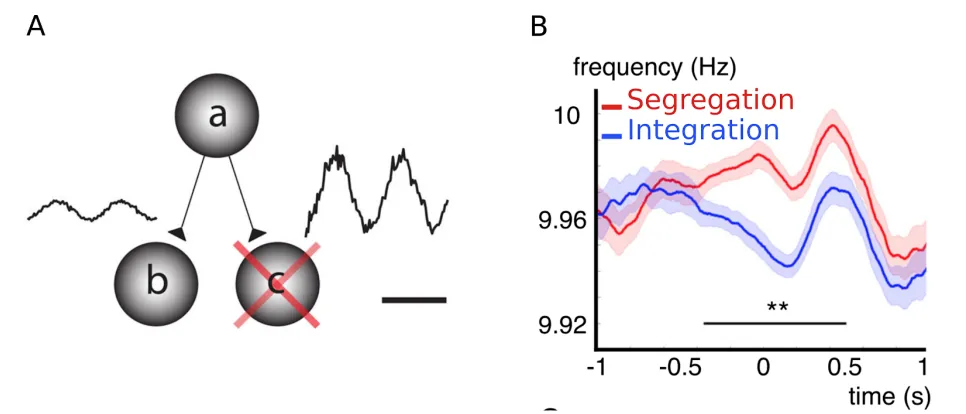
Figure 1.3 Alpha oscillations are influenced by endogenous factors such as spatial
attention and temporal processing goal. A The gating by inhibition account holds that alpha oscillations allow restriction of information flow from areas not relevant to the current task
through pulsed inhibition. Suppression of activity in task irrelevant area ‘c’ by higher area ‘a’ is
reflected in higher alpha power. Panel adapted from(Jensen & Mazaheri, 2010) . B.Prestimulus alpha frequency is higher when the goal is segregation than when the goal is integration. Panel
adapted from (Wutz et al., 2018).
Alpha and temporal processing
oscillations, both by sensory entrainment (Ronconi et al., 2018) and electrical stimulation (Cecere, Rees, & Romei, 2015).
Task-dependent fluctuations in frequency within the alpha band have also been found to be functionally relevant, particularly for temporal processing(Babu Henry Samuel, Wang, Hu, & Ding, 2018; Drewes, Zhu, Muschter, & Melcher, 2017) . Instantaneous alpha frequency provides a useful time-resolved index of functional changes (Cohen, 2014), which may average out in a related metric such as alpha power (Nelli, Itthipuripat, Srinivasan, & Serences, 2017) . Wutz, Melcher and Samaha (2018) tracked prestimulus differences in instantaneous alpha frequency during a task in which the goal was either to integrate or segregate rapid sequential stimuli, as shown in panel C of Figure 3 . Instantaneous alpha frequency was higher in the prestimulus period when the goal was to segregate, and lower frequency when the goal was to integrate, as would be expected if this metric was indexing the sampling rate of the visual system. A crucial question remains as to whether these changes to temporal processing and sampling rate can be flexibly modulated by spatial selective attention.
Chapter summary and thesis outline
In this chapter I introduced the broad topic area of the thesis: the influence of covert selective attention on temporal processing in the visual system. Chapter 2 details evidence replicating and extending previous findings showing endogenous spatial attention improves temporal resolution (segregation of rapid sequential stimuli into separate percepts).
the mechanisms of spatial attention were summarised, and I noted that probing the effects of spatial attention on temporal processing can provide useful constraints for informing arbitration between these accounts. Chapter 3 provides empirical evidence that strong endogenous spatial cueing effects emerge for both opposing temporal processes of integration and segregation, indicating that spatial attention operates in a flexible manner. I present characterizations of these behavioural effects: how performance is influenced by cue validity, and how these cueing effects interact with task difficulty and stimulus eccentricity.
Other types of selective attention are discussed, including the importance of temporal attention in both normal vision and the lab environment. In chapter 4 I provide evidence that these spatial cueing effects on temporal processing occur emerge even in the absence of any implicit temporal expectations about when stimuli will appear. The effects of temporal cueing on temporal integration and segregation are differentiated between.
Chapter 2: Endogenous attention improves temporal
resolution
Abstract
Selective spatial attention has been demonstrated to improve spatial resolution, yet our understanding of how allocation of attention affects temporal processing remains sparse. We used an adapted version of the two-flash fusion paradigm with endogenous spatial cues, where participants’ temporal resolution was measured as their ability to successfully segregate the percepts of the two flashes separated by a varying inter stimulus interval (ISI). There was a significant interaction between cueing and ISI driven by a valid cueing benefit at longer ISIs. This evidence suggests that endogenous spatial cueing boosts temporal resolution.
Introduction
cueing. Our expectation was that validly cued trials would lead to better temporal segregation, and thus that participants would report two-flash stimuli with greater accuracy.
Method
Participants
Thirty-nine healthy participants (11 male; age 22.24 ± 3.32 years, mean ± SD) gave informed consent before completing the experiments. All had normal or corrected-to-normal vision and reported right-handedness. All experiments were carried out in accordance with the Declaration of Helsinki and with the approval of the local ethical committee.
Stimuli and experimental design
The stimuli and task were generated with Psychophysics Toolbox (Brainard, 1997) in MATLAB (MathWorks) and presented on a CRT monitor with a 60Hz refresh rate. The experiment started with a short staircase procedure (Watson & Pelli, 1983) to determine the contrast at which their perception of the experimental stimulus was near threshold (NT). We operationally defined this as the contrast at which they could discern whether the stimulus was presented to the left or right of fixation with 60% accuracy. This threshold was based on piloting of the staircasing procedure: 60% was the lowest threshold at which the staircasing procedure provided a contrast value for which performance remained stable.
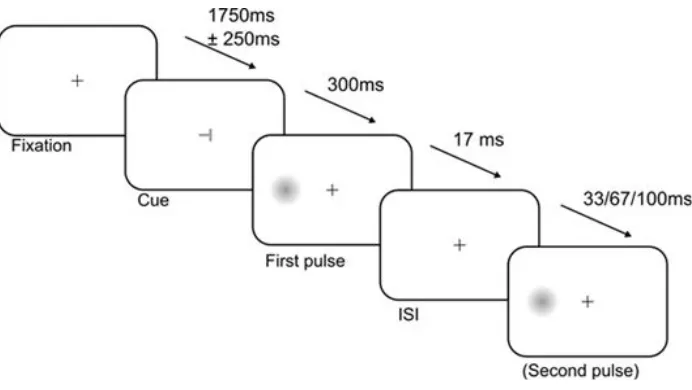
to use non-arrow cues here in order to ensure that the cue was truly endogenous; arrow stimuli are known to induce non-strategic shifts of spatial attention (Ristic & Kingstone, 2006) but this does not appear to be the case for spatial indicators that have not acquired social significance. The cue remained onscreen for 300 milliseconds, after which the fixation point appeared again and the first stimulus was presented. The first target was a Gaussian-enveloped luminance patch approximately 1.75° (visual angle) in diameter, at either maximum contrast, or of contrast determined by the adaptive staircase procedure described above. It was presented either to the left or right of fixation at an eccentricity of approximately 11.34° (visual angle), and appeared for only one frame. In approximately 66% of trials, a second target was presented in the same position as the first. There were five visual stimulation conditions: presentation of a single target stimulus at near-threshold contrast (NT), presentation of a single stimulus at suprathreshold (ST), and three ‘double pulse’ conditions in which one NT stimulus was followed by one ST stimulus after an interstimulus interval (ISI) of 33 milliseconds, 66 milliseconds, or 100 milliseconds. Participants completed five blocks of 100 trials (each comprising 20 neutral trials, 20 invalid trials, and 60 valid trials, with randomized order). Participants were informed that the cue would be valid around 75% of the time.
Task
Figure 2.1: Trial structure. On trials with a single pulse, this pulse was either near detection threshold or suprathreshold. On trials with two pulses, the first pulse was always at near-threshold. Stimulus size magnified for illustration. The neutral cue was an upright ‘T’ providing no information. Participants gave two responses: which hemifield the stimulus/stimuli appeared in, and whether there were one or two stimuli.
Behavioural data analysis
integration performance and the possibility of distinct subgroups in the population at large (Drewes et al., 2017).
Accuracy for position (stimulus/stimuli on the left vs right) in NT trials was compared by one-way paired t test, using valid vs. neutral and invalid vs. neutral contrasts. This was repeated on the pooled trials from all other conditions. The main analysis tested accuracy at determining the number of pulses as a function of cue type and ISI. Only double pulse trials were included in this analysis. Percentage accuracy was calculated for each condition and these data were subjected to a two way repeated measures ANOVA with factors for cue validity (valid, neutral, invalid) and ISI (33ms, 67ms, 100ms). Post hoc testing was conducted by Bonferroni-corrected pairwise comparisons.
Results
Figure 2.2. Results. A. Results from excluded participants. Chance performance is at 30%.
Error bars here and in subsequent panels indicate within-subjects 95% confidence interval (Morey, 2008). B. Accuracy for position by cue type for single near-threshold (NT) pulse trials only. C. Accuracy for position (left/right) by cue type. All trials except single NT pulse trials. D.
Data after exclusions: accuracy for number of pulses as a function of cue type and ISI. E.
Centred data: difference in accuracy from neutral cue case for valid and invalidly cued trials, as a function of ISI. Valid cue: solid line, square markers. Neutral: dotted line, diamond markers. Invalid: dashed line, triangle markers.
We first tested whether cueing influenced participants’ accuracy in determining whether the pulse(s) were on the left or the right. Results are illustrated in Figure 2.2B and C. On trials with a single NT pulse, difference scores were reliably greater in the valid cue condition than the invalid cue condition (t(24) = 4.21, p <.001). When all other trial types were pooled (single ST pulse and the three double pulse conditions), the difference between the valid and invalid cue conditions was not significant (t(24) = 1.76, p =.05).
For the main analysis of effect on accuracy, a significant interaction was found between cue and ISI (F(2,48) = 5.69, p = .006). Figure 2E suggests the interaction was driven by greater accuracy in validly cued trials with longer ISIs (67 and 100ms); however, Bonferroni-corrected post hoc pairwise comparisons did not show a significant difference in mean performance as an effect of cue type at any ISI. No significant main effects were found for cue or ISI (Fs < 1).
Discussion
The significant interaction suggests that the cue boosted the detectability of the near-threshold pulse at long ISIs. This supports other extant demonstrations of a cueing benefit to temporal segregation. However, one potential criticism of this experiment is that the cue may have increased participant ability to perceive the first near-threshold pulse. If this were the case, the cue should have had a static impact across the ISIs, but the significant interaction in fact demonstrates an effect that is greatest at longer ISIs. But there remains a viable possibility that the cue had an impact on perception of the first NT pulse.
Chapter 3: Endogenous attention modulates
temporal integration and segregation
A version of this chapter was published in March 2018:
Sharp, P., Melcher, D., & Hickey, C. (2018). Endogenous attention modulates the temporal
window of integration. Attention, Perception, & Psychophysics, 1-15.
Abstract
Introduction
Goal-directed behaviour requires that visual input be integrated into representations that emphasize task-relevant information. A wealth of evidence demonstrates that this is achieved in part through the deployment of selective attention in space. The spatial deployment of attention strongly impacts visual representations, leading to faster and more accurate target processing (Posner, 1980) and improved perceptual representations at attended locations (Carrasco, Loula, & Ho, 2006; Yeshurun & Carrasco, 1999) . However, our understanding of the effect of spatial attention on temporal processing is more limited. Temporal processing has two apparently opposing requirements: we often need to segregate visual input over time so that the visual scene can be parsed into separate features and events, but another common necessity is to integrate strongly-related stimuli so that they are perceived as unitary phenomena (Deco et al., 2015; Pöppel, 2009; Stroud, 1955).
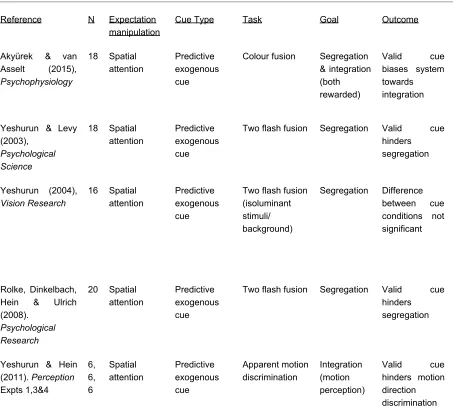
Here, we investigate the possibility that the strategic deployment of spatial attention has a flexible impact on both these temporal processes, depending on task confines. This possibility has not been addressed in extant literature, in large part because existing work has focussed on the effect of attentional capture on temporal segregation. This literature has thus employed exogenous cues that involuntarily draw attention to a location, either by virtue of their raw physical salience or through their correspondence to current attentional control settings. Rather than exhaustively discussing this literature in the body of the manuscript, we summarize representative findings in Table 1. Clearly demonstrated here is the predominant use of exogenous cues and temporal segregation tasks in this literature.
series of experiments using a version of the two flash fusion paradigm with exogenous cues and forward masked stimuli (Yeshurun, 2004; Yeshurun & Levy, 2003) . In this paradigm, a small disk is presented either slightly to the left or right of fixation after the presentation of a preceding cue. In many trials, a second disk is presented after a brief delay at the same location, and participants are asked to report the number of disks they perceive. Participants’ ability to accurately report the number of disks is better following the neutral cue condition than the valid cue, suggesting that the valid cue degrades the ability to parse two percepts. This idea is consistent with findings from other experiments using various common temporal processing paradigms (Akyürek & van Asselt, 2015; Hein et al., 2006; Rolke et al., 2008; Yaffa Yeshurun & Hein, 2011).
Table 1
Summary of key published findings on attentional manipulation of temporal processing.
Reference N Expectation manipulation
Cue Type Task Goal Outcome Akyürek & van
Asselt (2015),
Psychophysiology
18 Spatial attention
Predictive exogenous cue
Colour fusion Segregation & integration (both rewarded) Valid cue biases system towards integration Yeshurun & Levy
(2003),
Psychological Science
18 Spatial attention
Predictive exogenous cue
Two flash fusion Segregation
Valid cue hinders segregation Yeshurun (2004), Vision Research
16 Spatial attention
Predictive exogenous cue
Two flash fusion (isoluminant stimuli/ background) Segregation
Difference between cue conditions not significant Rolke, Dinkelbach, Hein & Ulrich (2008).
Psychological Research
20 Spatial attention
Predictive exogenous cue
Two flash fusion Segregation Valid cue hinders segregation
Yeshurun & Hein (2011). Perception
Hein, Rolke & Ulrich (2006),
Visual Cognition
Expt 1
22 Spatial attention
Predictive exogenous cue Temporal Order Judgement Segregation
“Automatic” allocation of attention hinders segregation
Bush & Vecera (2014), Cognition
60 Implicit biasing of attention Whether or not their hands were visible
Two flash fusion Segregation
Segregation facilitated when two hands visible (vs not) Opposite pattern for one hand
Visser and Enns (2001), Perception
20 Implicit biasing of ‘attentional availability’
No cueing - demanding task at different latencies prior to main task
Missing dot task Integration
Integration facilitated when more attentional resources available Goodhew, Shen &
Edwards (2015),
Journal of Vision
41 Spatial attention
Implicit biasing towards ‘focal or diffuse attentional spotlight’
Two flash fusion Segregation
Difference between focal and diffuse conditions not significant for temporal processing Yeshurun & Hein
(2011), Perception
Expt 2
6 Spatial attention Non predictive endogenous cue Apparent motion discrimination Integration (motion perception) Cue hinders motion direction discrimination Hein, Rolke &
Ulrich (2006),
Visual Cognition
Expt 2
25 Spatial attention Predictive, endogenous cue Temporal Order Judgement (TOJ) Segregation
‘Voluntary’ attention facilitates segregation Hein, Rolke &
Ulrich (2006),
Visual Cognition
Expt 3
23 Spatial attention
Non predictive endogenous cue
TOJ Segregation
Akyürek, Riddell, Toffanin & Hommel (2007),
Psychophysiology
30 Temporal attention
Implicit manipulation of expectation of ‘fast’ or ‘slow’ events Parsing and separate identification of two rapidly presented targets Segregation
Integration facilitated by expectation of slow events (longer integration window) Correa, Sanabria, Spence, Tudela & Lupiáñez (2006), Brain Research
46 Temporal attention
Predictive, endogenous cue for ‘short’ or ‘long’ delay
TOJ Segregation
Valid cue facilitates segregation
N.B. Typical characteristics of task types: Colour fusion - participants see two rapidly presented colour patches in succession and report individual or fused colours; two flash fusion - participants report seeing either one brief stimulus or two rapidly presented stimuli; apparent motion discrimination - participants report the perceived direction of motion; TOJ - participants report which of two rapid sequential stimuli was presented first (for a review of the related literature on prior entry see (Spence & Parise, 2010) ; missing dot task - two rapid sequential grid displays with complementary dot elements are presented, participants must identify the grid space with no dot in either of the displays.
In the few studies that have directly investigated endogenous cueing effects on temporal processing, results tend to show an improvement of resolution that is in contrast to the degradation caused by exogenous cues, as presented in summary in Table 1. For example, Hein, Rolke, and Ulrich (2006) used a temporal order judgement paradigm in which participants were endogenously cued to a hemifield where they would see two rapid sequential stimuli, finding that valid endogenous cues improved performance at identifying the order in which stimuli had arrived.
A further pattern in this small literature is that the experimental task has nearly exclusively required the segregation of temporal events. The general paucity of investigation into the effect of endogenous cueing on segregation leads to an ambiguity in interpretation: does the cueing effect reflect a reconfiguration of the system that biases temporal acuity specifically? Or is it rather that endogenous attention benefits temporal processing broadly? If the latter, this should become evident in a benefit for temporal integration when task confines require this process.
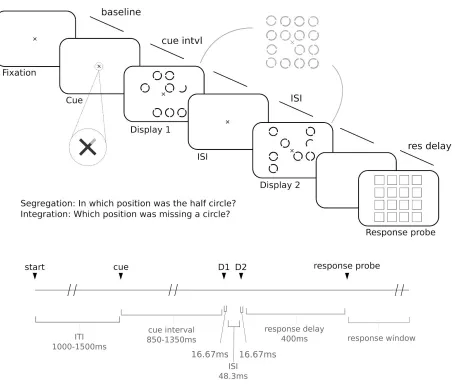
were presented in a 4 x 4 grid. In each trial one location in the grid was unfilled, while in another location the complementary halves of the circle were presented across two temporally-separated frames (Wutz et al., 2016) . As in the canonical missing dot paradigm, locating the missing circle required integration of the two displays. Locating the ‘half circle’, in contrast, required that the two frames be temporally segregated. In all experiments, we cued target location with a 75% valid cue while participants completed separate integration and segregation versions tasks across blocks.
We approached results with two exclusive hypotheses. If endogenous spatial cueing acts to increase temporal resolution, we expected to find a benefit of cueing when the task required temporal segregation, but a cost when it required integration. If endogenous attention instead is able to flexibly reconfigure temporal processing, cueing benefits should emerge in both integration and segregation conditions.
Experiment 1
Method
Participants
Experimental design and stimuli
The stimuli and task were generated with Psychophysics Toolbox (Brainard, 1997) in MATLAB (MathWorks). Stimuli were presented on an LED backlit monitorspecialized for psychophysics experiments (VPixx Technologies, grey-to-grey response time of 7 ms) with a refresh rate of 100Hz.
The basic trial structure is shown in Figure 3.1. A small fixation cross in the form of a red ‘X’ was present throughout the presentation of stimuli. This cross measured approximately 0.2° (visual angle). At the beginning of each trial, one of the arms of the cross changed from red to green to provide the cue that the target for that trial would likely appear in the indicated quadrant. Participants were instructed that the cue usually indicated the correct quadrant and would help them with the task. In approximately 22% of trials the cue was invalid, in 53% of trials the cue was valid, and in 25% of trials a neutral cue was shown. The neutral cue took the form of a colour change of the tips of all four arms of the cross, such that a similar number of pixels changed from red to green as in the valid/invalid cue condition.
After a fixed interval of 500 milliseconds following the cue, the fixation cross became entirely red again, and the first display appeared on screen for 10 milliseconds. This display comprised a circle at seven locations out of a possible sixteen (on a four by four grid of locations), and each circle was formed from two arc elements. At one position in the display there was a half circle (i.e. a single arc). Each circle was 1.2° (visual angle) in diameter, the grid of possible locations measured 8.4° by 8.4°. Each circle within the display had an irrelevant random orientation selected from the possible orientations of 45°- 315°.
comprised a circle at seven locations and a half circle at one location. Crucially, the half circle in the second display was the corresponding arc element at the same location as the half circle location from the first display, such that if the two displays were superimposed the two arc elements formed a standard circle stimulus. As illustrated in Figure 3.1, the locations of the seven circles for each display never overlapped, such that if the two displays were superimposed one of the sixteen possible locations remained empty.
After 500 milliseconds, a response probe screen appeared. This comprised a grid of squares where each square identified one of the sixteen possible target locations. Participants indicated, by mouse click, at which location they had perceived the target.
Task
There were two versions of the task: stimulus presentation was the same in both but task instructions were varied across blocks. In one version of the task, the target was the half circle. Successful identification of the half circle requires parsing of the two displays, therefore this is referred to as the segregation task. In the other version, the target was the location in which there was no circle in either display. Successful identification of this location requires a combined percept of the two displays, therefore this is referred to as the integration task. Participants completed 1800 trials total (30 blocks of 60 trials), over two sessions each lasting approximately 90 minutes. Participants were explicitly instructed to fixate the cross in the centre of the screen throughout stimulus presentation.
Behavioural data analysis
Behavioural data were analysed using Matlab2013a (Mathworks) and R (R Foundation for Statistical Computing).
Where assumptions of sphericity were not met, reported statistics areResults
Figure 3.2: Results of Experiment 1. A. Group average accuracy as a function of task version and ISI. Error bars here and in panel B indicate within-subjects 95% confidence interval (Morey, 2008). B. Group average accuracy by cue type for each task version, difference of (in)valid cue from neutral cue condition. C. Psychophysical curves for each participant as function of cue type and ISI for the integration task and, D. segregation task. Valid cue: solid line, square markers.
Neutral: dotted line, diamond markers. Invalid: dashed line, triangle markers.
invalid cues on performance in each of the segregation and integration tasks in reference to the neutral condition; these are plotted for each of the ISIs in Figure 3.2B. Evident here is a performance benefit of the valid cue and performance cost of the invalid cue in both tasks. In addition to this, the results suggest that cues are more effective as a function of task difficulty: valid cues have the greatest benefit on performance when the task is hard and invalid cues have the greatest cost when the task is easy. Thus when integration is required, the valid cue benefits performance at long ISIs and the invalid cue degrades performance at short ISIs, whereas when segregation is required, the valid cue benefits performance at short ISIs and the invalid cue degrades performance at long ISIs.
Results for each of the participants are illustrated in Figure 3.2C and D. Generally, the pattern of cue effect for a participant appears comparable across task versions. For example, one participant (P04) showed a disproportionately large effect of the invalid as compared to the valid and neutral cue condition for both the integration and segregation task versions. Inspection of panels C and D indicates that there is some degree of individual differences in magnitude of the invalid cueing effect as compared to the valid cueing effect.
Statistical analysis began with a repeated measures ANOVA (RANOVA) with factors for cue (valid, neutral, invalid), task (segregation, integration), and ISI (10 ms, 30 ms, 50 ms, 70 ms, 100 ms). Importantly, this identified a main effect of cue (F(2,10) = 13.30, p = .011,ηP2 = .727
, =
ηG2= .478), reflecting the consistent benefit of valid cues and cost of invalid cues in both tasks.
The effect of the cue did not reliably differ across the tasks, as reflected in a non-significant task by cue interaction (F(2, 10) = 3.51, p = .070, ηP2 = .413, = ηG
2= .019). Also important is the
emergence of an interaction between task and ISI (F(4,20) = 40.02, p < .001,ηP2 = .889, = ηG
2
accentuated in the valid cue condition, but the 3-way interaction did not reach significance (F(8,40) = 2.11, p = .058,ηP2 = .297
, = ηG2= .031). An effect of ISI (F(4,20) = 5.33, p = .025,ηP
2
= .516, = ηG2= .044) also emerged, as did the interaction between cue and ISI (F(8,40) = 3.23,
p = .04,ηP2 = .393
, = ηG2= .015), but there was no effect of task (F(1,5) = 1.95, p = .226,ηP
2 =
.280, = ηG2 = .066).
Pairwise comparisons between means provided further insight on these results. For the integration task, cue validity (valid, invalid) had an effect at longer ISIs (with corrected alpha of .01; 10ms: t(5) = 7.79, p <.001; 50ms: t(5) = 3.68, p = .007; 70ms: t(5) = 4.53, p = .003; 100ms: t(5) = 5.17, p = .002), whereas for the segregation task, cue validity had an effect at shorter ISIs (t(5) = 7.79, p <.001; 30ms: t(5) = 6.52, p = .001; 50ms: t(5) = 3.85, p = .006). For completeness, comparisons were also made for valid and invalid cueing as compared to the neutral cueing at each ISI, for each task version. Mean performance in the valid cue condition was better than in the neutral cue condition for the 10ms ISI in the segregation version (t(5) = 3.72, p = .007). Effects at the longer ISIs did not reach significance (all other p values > .01). The valid cueing effect for the integration task was significant at longer ISIs (50ms: t(5) = 4.98, p= .002; 70ms: t(5) = 4.98, p= .002; 100ms: t(5) = 6.25, p= .001; all other ps > .01). Similarly, the cost of the invalid cue was significant at shorter ISIs in the segregations version (10ms: t(5) = 5.81, p= .001; 30ms: t(5) = 4.74, p= .003). Effects at the longer ISIs did not reach significance (all other ps > .01). For the integration task, differences between the invalid and neutral results were not significant at corrected alpha.
consistent with broader theoretical understanding of the role and function of spatial attention (Luck, Girelli, McDermott & Ford, 1997).
Though participants in Experiment 1 were explicitly instructed to maintain fixation, eye movements were not monitored and so it is theoretically possible that participants may have moved their eyes in response to cue stimuli. To address this possibility and to reproduce the pattern of results observed in Experiment 1 we conducted an expanded replication in which gaze position was monitored.
Experiment 2
Method
Power analysis
Participants
Twelve healthy participants (3 female; age 25.17 ± 5.95 years, mean ± SD; 2 left-handed) gave informed consent before completing the experiment. All participants had normal or corrected-to-normal vision and none had taken part in Experiment 1.
Experimental design, stimuli & task
The design and stimuli were as in Experiment 1. In addition, gaze position was recorded in order to exclude from analysis those trials where participants inappropriately broke fixation. One participant completed 27 rather than 30 blocks due to time constraints.
Eye tracking apparatus
A tower-mounted Eyelink 2000 eye tracker (SR Research, Ontario, Canada) was used to record the gaze position of the left eye at a sampling rate of 1000Hz.
Behavioural data analysis
Results
As illustrated in Figure 3, Experiment 2 replicated the results from Experiment 1. The valid cue benefitted performance in both the segregation and integration tasks and the invalid cue degraded performance in both tasks. The valid cue once again appeared to have the greatest benefit when the task was difficult (i.e. at shorter ISIs for segregation, longer ISIs for integration).
In a RANOVA with factors for cue (valid, neutral, invalid), task (segregation, integration) and ISI (10 ms, 30 ms, 50 ms, 70 ms, 100 ms) these patterns emerged in a main effect of cue (F(2,22) = 28.53, p < .001,ηP2 =.722
, = ηG2= .274) and an interaction of task and ISI (F(4,44) =
40.71, p < .001, ηP2 =.787
, = ηG2 = .201). A three-way interaction emerged reliably in
Experiment 2 (F(8,88) = 5.63, p = .007, ηP2 =.338, = ηG
2= .011), driven by a pattern in the
segregation task in which the valid cue had a larger effect at short ISIs but the invalid cue had a larger effect at long ISIs. A significant interaction of task and cue (F(2,22) = 3.48, p = .048, ηP2 =.240, = ηG2= .005) reflected a slightly larger cueing effect in the integration task. An additional
main effect of ISI (F(4,44) = 10.38, p < .001, ηP2 =.486
, = ηG2= .024) appeared, as did a
significant interaction of cue and ISI (F(8,88) = 3.21, p = .003, ηP2 =.226, = ηG
2= .003), but no
effect of task was detected (F<1, ηP2 =.0003, = ηG
2 = .0001).
the five ISIs (10ms: t(11)=5.10, p < .001; 30ms: t(11)=5.57, p < .001; 50ms: t(11)=3.05, p = .005; 70ms: t(11)=2.88, p = .008; 100 ms: t(11) = 2.20, p = .025). Invalid cueing effects were significant for all ISIs (10ms: t(11)=3.40, p = .003; 30ms: t(11)=4.25, p = .001; 50ms: t(11)=4.55, p < .001; 70ms: t(11)=3.46, p = .003; 100ms: t(11)=4.75, p < .001).
Experiment 2 confirms the observations drawn from Experiment 1. Firstly, the valid endogenous cue benefitted task performance and the invalid cue degraded performance in both segregation and integration tasks, despite these tasks involving opposing temporal operations. Secondly, the benefit of the valid cue was greatest when the task was hard and the cost of the invalid cue was greatest when the task was easy.
Figure 3.3: Results of Experiment 2. A. Accuracy as a function of task version and ISI. Error bars here and in all panels indicate within-subjects 95% confidence interval (Morey, 2008). B.
The current results suggest that endogenous spatial attention must differ fundamentally from exogenous spatial attention because the endogenous deployment of attention benefits temporal segregation, whereas the exogenous deployment of attention degrades it (Yeshurun & Levy, 2003). However, the idea that effects of spatial attention on temporal processing are instantiated through a bias toward parvocellular or magnocellular input remains compelling. It may be that exogenous spatial attention necessarily biases perception toward parvocellular input, but that endogenous attention is able to flexibly emphasize either stream as a function of task requirements. In order to gain some perspective on this issue, we conducted a third experiment examining the impact of target eccentricity.
periphery than near-foveal locations on account of the proportion of fast magnocellular cells at these retinotopic locations. This would therefore lead to greater opportunity for spatial cueing effects at near foveal locations as compared to peripheral ones.
To test these hypotheses, Experiment 3 was identical to preceding experiments with one exception: sequential stimulus displays were separated by a consistent ISI of 70 ms. This reduced the dimensionality of the design and resulted in an increased number of trials per condition, which allowed us to introduce a new analytic factor representing retinal eccentricity.
Experiment 3
Method
Participants
Twenty healthy participants (4 male; age 21.53 ± 3.64 years, mean ± SD) gave informed consent before completing the experiment. All had normal or corrected-to-normal vision and reported right-handedness.
Experimental design, stimuli & task
Results
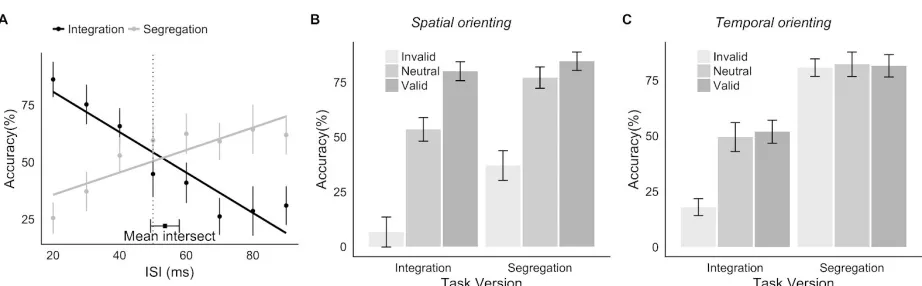
Figure 3.4: Results of Experiment 3. A. Results of pre-experiment task. Dotted vertical line indicates fixed ISI used for the main blocks. Error bars here and in panel C indicate within-subjects 95% confidence interval (Morey, 2008). Intersect error bars indicate SEM. B.
Illustration of stimulus locations comprising each of the three proximity conditions. C. Results of main experiment. Accuracy for each task as a function of cue type and target eccentricity.
As can be seen in Figure 3.4A, mean accuracy in the pre-experiment was better for longer ISIs for the segregation task but better for shorter ISIs for the integration task, as expected. The mean intersect was 52ms ± 36ms (mean ± SD) – slightly shorter than the fixed ISI of 70ms used in the primary experiment.
Figure 3.4C illustrates how Experiment 3 again replicates the core finding from Experiment 1: valid cues benefited performance in both the integration and segregation task and invalid cues degraded it. The results suggest that performance in the integration task was strongly impacted by the eccentricity of the target, but that this was not the case in the segregation task. In the integration task the efficacy of the valid cue appears to be accentuated for targets in the periphery.
In line with these impressions, a RANOVA with factors for task (segregation, integration), cue (valid, neutral, invalid) and target proximity to fixation (near, mid, far: see Figure 3.4B) identified a main effect of cue (F(2,38) = 78.33, p < .001,ηP2 = .805, = ηG
2= .485) and a cue by
proximity interaction (F(4,76)= 8.47, p < .001, ηP2= .308, ηG
2= .022). Variance in cue efficacy
across levels of proximity was further modulated by task, as reflected in a significant three-way interaction (F(4,76)= 6.176, p < .001,ηP2= .245, ηG
2= .015). A reliable cue by task interaction
(F(2,38)= 8.72, p < .001, ηP2 = .315,
ηG2= .028) reflects an accentuated cueing effect in the
integration task (alongside a shift in accuracy in the neutral cue condition across the tasks), and a reliable proximity by task interaction (F(2,38)= 47.85, p < .001,ηP2= .716,ηG
2= .104) reflects
an increased impact of target eccentricity in the integration task. A main effect of task (F(1,19) = 14.31, p = .001, ηP2 = .430, = ηG
2= .122) was driven by better performance in the segregation
task, reflecting our use of a fixed ISI that favoured segregation, and a main effect of target
proximity (F(2,38) = 24.848, p < .001, ηP2