Is virtual clinic follow-up of hip and
knee joint replacement acceptable to
patients and clinicians? A sequential
mixed methods evaluation
Rebekah J Parkes,1 Joanne Palmer,2 Jennifer Wingham,3 Dan H Williams1
To cite: Parkes RJ, Palmer J,
Wingham J, et al. Is virtual
clinic follow-up of hip and knee joint replacement acceptable to patients and clinicians? A sequential mixed methods
evaluation. BMJ Open Quality
2019;8:e000502. doi:10.1136/
bmjoq-2018-000502
►Additional material is
published online only. To view please visit the journal online (http:// dx. doi. org/ 10. 1136/ bmjoq- 2018- 000502).
Received 10 August 2018 Revised 16 January 2019 Accepted 29 January 2019
1Orthopaedic Department, Royal
Cornwall Hospitals NHS Trust, Truro, UK
2Academic Vascular Surgical
Department, Hull Royal Infirmary Postgraduate Medical Education Centre, Hull, UK
3Primary Care Research Group,
Institute of Health Research, University of Exeter - Saint Lukes Campus, Exeter, UK
Correspondence to
Rebekah J Parkes; r. j. parkes@ smd14. qmul. ac. uk © Author(s) (or their employer(s)) 2019. Re-use permitted under CC BY-NC. No commercial re-use. See rights and permissions. Published by BMJ.
AbstrAct
Objective To evaluate the acceptability to key stake holders of a newly introduced virtual clinic follow-up pathway for hip and knee joint replacement.
Design A service evaluation comprising a questionnaire sent electronically to 115 patients and interviews with 10 individuals.
Setting A newly introduced virtual clinic follow-up pathway for hip and knee replacement patients in a district general hospital.
Participants The electronic questionnaire was distributed to all patients treated under the virtual clinic service over a 5-month period (n=115). Purposive sampling from volunteers among respondents, leading to semi-structured interviews with eight patients. Two orthopaedic consultants were also interviewed.
Intervention Consultant review of web-based patient reported outcome measures and digital radiographs, with feedback to patients via letter, replacing face-to-face outpatient appointments for the follow-up of hip and knee joint replacement.
Results The response rate to the questionnaire was 40%. 44% indicated they would prefer a virtual appointment over a face-to-face consultation in future. The most common word in the free text comments was ‘good’ (n=107). Seven main themes were identified from the patient interviews: patient understanding and expectations, patient confidence, patient voice, managing deterioration of condition, patient benefit, patient satisfaction using technology and navigating the website. Two main themes were identified from the staff interviews: the adapting patient pathway and project management. Combined analysis elucidated that patients who were doing well liked the ‘click and go’ approach but those with problems were concerned about how to report these and were therefore less satisfied.
Conclusion The virtual clinic process appears to be well accepted by both patients and clinicians. However, appropriate patient selection and clear pathways of communication to address patient concerns are pivotal to success.
InTroducTIon
A total of 101 651 hip replacements and 108 713 knee replacements were recorded in the UK in 2016 representing an increase of 3.5% and 3.8%, respectively compared with
the previous year.1 This increase is reflected
globally and is predicted to continue, precip-itated by an ageing population and growing rates of obesity.2 3 One projection from the
USA estimates increased rates of primary procedures of 174% and 673% for hip and knee joint replacements, respectively, between 2005 and 2030.4 Cost-effective and efficient
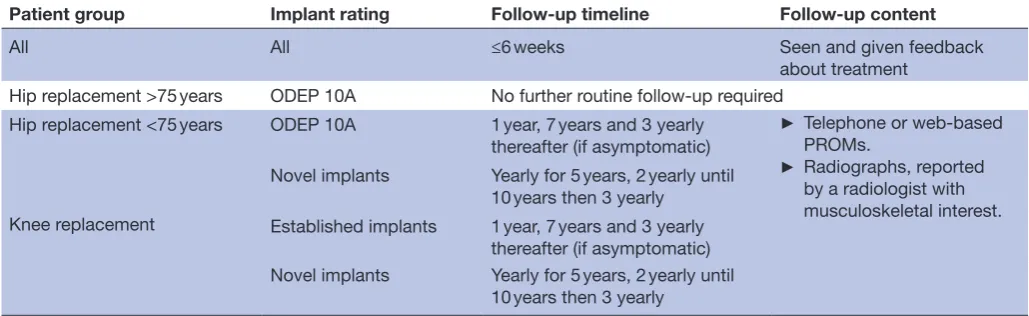
follow-up is therefore required to keep pace with demand and to comply with evidence based national guidelines, for example, British Orthopaedic Association (BOA) guid-ance (see table 1).5 6 The National Institute
for Health and Care Excellence are under-taking a consultation to explore the options for monitoring and surveillance, which may not necessarily require face-to-face appoint-ments and can be undertaken remotely with clinicians reviewing radiographs and vali-dated Oxford pain and function scores.1 7
Virtual clinics appear to be gaining popu-larity and in various forms have been applied across many specialties and contexts but concerns remain around both logistical and technical issues, and acceptability to patients and staff.8 In 2014, with support from the
Health Foundation (Shine initiative), the orthopaedic team at our district hospital introduced a virtual clinic model for the follow-up of hip and knee joint replacement. Here the acceptability to patients and consul-tants is evaluated.
ParTIcIPanTs and meThods The clinic
The virtual clinic involved the treating consultant reviewing up-to-date radiographs and the trends in validated patient reported outcome measures (PROMs), using the My Clinical Outcomes (MCO) web-based system, at the intervals set down by the BOA
(table 1).9 10
To achieve this the MCO platform is auto-mated to request completion of PROMs by
on September 12, 2020 by guest. Protected by copyright.
patients at 3-month intervals and patients are also invited to attend for an X-ray appointment at their local hospital.
The outcome of the clinic is relayed to the patient and their general practitioner via letter and can result in ongoing virtual clinic monitoring or recall for face-to-face review.
Patients were recruited to the virtual clinic either preoperatively or at a face-to-face follow-up by the clinical team and were supported in completing the process by an administrator.
The study
A sequential mixed methods evaluation was performed. Data were collected using a questionnaire followed by semi-structured interviews.
All patients had completed at least one follow-up appointment for their hip or knee joint replacement, using the virtual clinic pathway.
Questionnaire
The questionnaire was initially piloted being sent to 70 patients, 29 returning responses in a group treated prior to February 2015. It was then administered formally with all patients (n=115) reviewed through the virtual clinic over a 5-month period (February–June 2015) being invited, via email, to complete an online questionnaire (online supplementary appendix 1), using Survey-Monkey, about their experience.11 The questionnaire was
available online for 1 month. Demographic information was collected and a mixture of Likert-based questions and free text responses were used to assess experience; a final question asked for consent to further contact.
Interviews Patients
A sub-sample of eight people (among 15 volunteers) were purposively selected based on age, employment status, education and satisfaction of the virtual clinic experi-ence. The topic guide (online supplementary appendix 2) included questions about expectations of using the virtual clinic, experience of the virtual clinic pathway,
what was liked and disliked about the service and any recommendations for future development. All interviews were recorded using an Olympus recording device and transcribed for analysis.
Consultants
To provide a fuller appreciation of the obstacles and benefits it was felt important to also explore consultants’ views. Two out of three consultants approached agreed to audio-recorded face-to-face interview. A topic guide (online supplementary appendix 3) included: experi-ence of the introduction and training on using the virtual clinic web-based platform, expectations and experience of following-up patients using the virtual clinic, barriers and facilitators to using the service, and recommenda-tions for future implementation.
ethics
This study was carried out as a service evaluation and therefore did not require formal ethical review.
data analysis
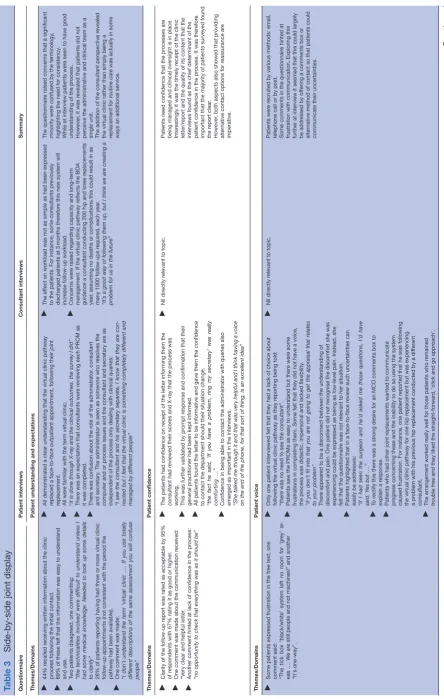
A hybrid between explanatory and convergent methods was used. Preliminary results of the questionnaires were used to inform development of the topic card to confirm relevant areas were being discussed and therefore elab-orated (explanatory element). However, all three data sources were analysed independently and then combined in a side-by-side joint display (convergent).
All patient data was anonymised and every effort was made to anonymise staff.
The questionnaire results were analysed in Microsoft Excel and NVivo V.12 was also used to perform a word frequency analysis of the free text comments (including stemmed words).
All interviews were transcribed using UK transcription services following a confidentiality agreement. Analysis of the interviews was conducted independently by the two qualitative researchers (JP and JW) and once completed, agreement was reached through discussion. A simple descriptive thematic analysis was performed with each
Table 1 British Orthopaedic Association advised follow-up5 6
Patient group Implant rating Follow-up timeline Follow-up content
All All ≤6 weeks Seen and given feedback
about treatment
Hip replacement >75 years ODEP 10A No further routine follow-up required
Hip replacement <75 years ODEP 10A 1 year, 7 years and 3 yearly
thereafter (if asymptomatic)
► Telephone or web-based PROMs.
► Radiographs, reported by a radiologist with musculoskeletal interest. Novel implants Yearly for 5 years, 2 yearly until
10 years then 3 yearly
Knee replacement Established implants 1 year, 7 years and 3 yearly
thereafter (if asymptomatic) Novel implants Yearly for 5 years, 2 yearly until
10 years then 3 yearly
PROMs, patient reported outcome measures. ODEP, orthopaedic data evaluation panel rating
on September 12, 2020 by guest. Protected by copyright.
transcript read a minimum of three times prior to coding. Extracts of the transcripts were coded; codes with similar meaning were allocated to categories before the final descriptive themes were identified.12 This resulted in an
overall descriptive thematic synthesis which produced the final overarching themes. The qualitative interview data was treated as the dominant method and the themes were used as domains under which the results of the interviews and questionnaire findings were synthesised (Qual-Quant).
resulTs
online questionnaire
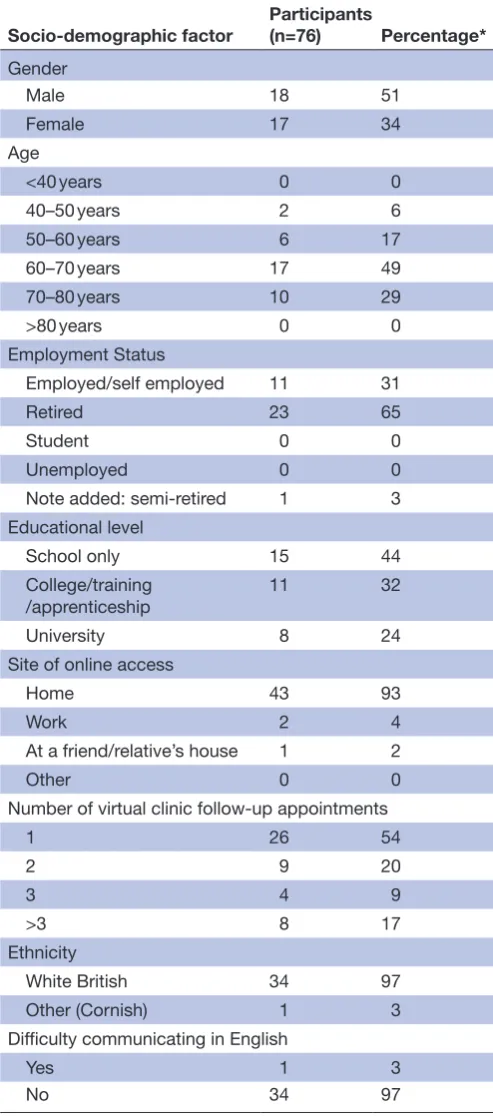
Of the patients approached (n=115) to give their views of the virtual clinic service, 40% (n=46) responded to at least part of the online questionnaire. Those responding represented a wide age range (mode 60–70 years). Fifty-one per cent of respondents were male (n=18), 31% (n=11) were in employment and 65% (n=23) were retired (see table 2 for demographics).
Several patients indicated they had had three or more virtual clinic follow-up appointments which would not have been consistent with the period the clinic had been running raising concern that patients may not be using the same definition as those providing the clinic. Radiographs were undertaken at a variety of hospitals and many indicated they had made savings. The most common free text word was ‘good’ (n=107) but several comments indicated a degree of disquiet among some individuals, requiring further elucidation. For full results see online supplementary appendix 4 and figure 1.
Patient interviews
In total there were seven interviews conducted face-to-face or by telephone, three participants were female, three were male and there was one husband and wife team. The interviews lasted between 8 and 25 min.
The following age categories were represented: 50–60 years, 60–70 years and 70–80 years. There were two people still in employment with the rest being retired, some participants had undergone formal education such as college or university and one person had not under-taken any further education after leaving school. Seven main themes were identified: patient understanding and expectations, patient confidence, patient voice, managing deterioration of condition, patient benefit, patient satis-faction, using technology and navigating the website. These themes/domains are analysed alongside the other two data sources in table 3.
clinician interviews
Two consultant clinicians were interviewed. Two main themes were identified from the data. These are the adapting patient pathway and project management.
Consultants highlighted that prior to the introduction of the virtual clinics, they had autonomy to determine follow-up patterns. They recognised that although this had enabled patient focused practice there may be efficiencies
to be gained by streamlining services. Cautious initial patient selection was discussed and it was voiced that as few as 10% of patients may be suitable. However, there were concerns that with the recommended frequency of follow-up even with adopting a virtual clinic pathway
Table 2 Demographic breakdown of patients responding to
online survey
Socio-demographic factor Participants (n=76) Percentage*
Gender
Male 18 51
Female 17 34
Age
<40 years 0 0
40–50 years 2 6
50–60 years 6 17
60–70 years 17 49
70–80 years 10 29
>80 years 0 0
Employment Status
Employed/self employed 11 31
Retired 23 65
Student 0 0
Unemployed 0 0
Note added: semi-retired 1 3
Educational level
School only 15 44
College/training /apprenticeship
11 32
University 8 24
Site of online access
Home 43 93
Work 2 4
At a friend/relative’s house 1 2
Other 0 0
Number of virtual clinic follow-up appointments
1 26 54
2 9 20
3 4 9
>3 8 17
Ethnicity
White British 34 97
Other (Cornish) 1 3
Difficulty communicating in English
Yes 1 3
No 34 97
*Percentages are calculated based on only those who responded to that question.
on September 12, 2020 by guest. Protected by copyright.
the workload may prove unmanageable. This workload perception could represent either a driver for, or barrier to, change.
There was also suggestion of another barrier to change within the department in the form of fear of conflict of interest:
"My underlying feeling was that because this was Dan’s business there was a little bit of antagonism"
summary of main findings
Patients found the virtual clinic relatively easy to engage with and some found it helpful in self-management. Pref-erence for face-to-face appointments appears multi-fac-torial, possibly dependent on past experience and personal circumstances. Frustrations with the virtual clinic surrounded the restrictive nature of using scoring systems and concerns over how best to report concerns and deterioration between appointed review points. In order for the patient voice to be successfully heard it must be clear that the consultants have responded to any issue raised. Indeed, the key theme underpinning all the others is patient voice. Satisfaction is very closely tied to knowing you are heard and it is in times of deterioration that this is most crucial, while understanding the process and mastering the technology and other benefits simply facilitate this.
Consultants raised concerns about workload manage-ment and appropriate identification of suitable patients for the virtual clinic pathway. No harm was identified from the introduction of the virtual clinic, in either direct questioning in the interviews or through the free text question asking about difficulties and concerns in the questionnaire (see online supplementary appendix 4 Q15). However, a clear strategy is needed to balance the service needs with the needs of the patients to inform future implementation of virtual clinics.
dIscussIon
strengths and limitations
This is the first service evaluation that we are aware of which examines the experience and perceptions in moving from a traditional follow-up clinic to a virtual clinic pathway. The views of both patients and clinicians have been considered.
However, only patients who had used the virtual clinics pathway have been consulted. These patients had been screened for suitability and therefore were computer literate. However, many patients are not computer literate or do not have access to a computer. In addition, it is likely to be patients and staff who have engaged with the process that submit to interview and may not be a true representation of the wider population. Further it is not possible to elucidate which patients made comments in the questionnaire or whether they were later interviewed. Similarly, the sample is not large enough to allow for subgroup analysis of questionnaire results.
With interviewees being selected from those completing the questionnaire it has allowed for exploration in rich-ness and depth including misunderstandings. However, all the data is from a similar time meaning that analysis of how attitudes evolve, as the service becomes established, remains unknown.
Only two clinicians were interviewed so the full spectrum of opinions is not captured. Other staff were impacted by the introduction of the virtual clinic pathway such as administrative staff and management but reporting on this is beyond the scope of this paper.
The context is that of a district general hospital covering a large rural area therefore, some benefits (eg, travel time saved) may not be generalisable to an urban setting.
Formal economic assessment is not addressed here. However, local commissioners have established an ongoing £45 tariff for virtual clinic appointments making the pathway sustainable. Between April 2017 and March 2018 there were a mean of 30 such appointments each month and the clinic remains ongoing.
comparison with existing literature
National joint registry data indicates that the two most common reasons for revision in both hip and knee joint replacement are aseptic loosening and pain.13 Therefore,
joint replacement follow-up processes need to encompass assessments that pick up both the symptomatic patient and those at risk of periprosthetic fracture as a result of osteolysis before they become symptomatic.2 Loosening
and polyethylene wear presents between 7 and 20 years postoperatively in 72.6% of total hip replacement and aseptic loosening is the main reason for late revision in knee replacement.14 15 A robust system is therefore
required to follow-up patients in the longer term. A virtual clinic pathway allows for long-term monitoring, screening for symptomatic patients using web-based outcome scores and signs of asymptomatic loosening on interval X-ray films. Others have found a reduced administra-tive burden, high acceptance and potential cost savings
Figure 1 Word cloud of free text responses from patient
questionnaire.
on September 12, 2020 by guest. Protected by copyright.
Table 3
Side-by-side joint display
Questionnair e Patient interviews Consultant interviews Summary Themes/Domains
Patient understanding and expectations
►
44% r
ecalled r
eceiving written information about the clinic
pr
ocess following the initial contact.
►
89% of these felt that the information was easy to understand and use.
►
Two patients disagr
eed, one commenting:
“the technicalities involved wer
e difficult to understand unless I
had some medical knowledge. Needed to look up some details to clarify”
►
26% of patients r
eporting having had thr
ee or mor
e virtual clinic
follow-up appointments (not consistent with the period the pathway had been available).
►
One comment was made: “I don't understand the ter
m 'virtual clinic ….
If you use totally
differ
ent descriptions of the same assessment you will confuse
people”
►
All demonstrated a clear understanding that the virtual clinic pathway replaced a face-to-face outpatient appointment, following their joint replacement.
►
All wer
e familiar with the term virtual clinic:
“
it is done through X-ray and the clinical outcomes, the sur
vey I did”
►
Ther
e was an expectation that consultants wer
e r
eviewing each PROM as
it was completed.
►
Ther
e was confusion about the r
ole of the administrator
, consultant
and secr
etary
. The administrator is seen as someone who r
esolves the
computer and or pr
ocess issues and the consultant and secr
etary ar
e as
independent of the pr
ocess only dealing with clinical queries:
“I see the consultant and his secr
etar
y separate, I know that they ar
e con
-nected but I feel that the virtual clinic is something completely differ
ent and
managed by differ
ent people”
►
The ef
fect on workload was not as simple as had been expr
essed
to the patients. For instance, some consultants pr
eviously
dischar
ged patients at 3
months ther
efor
e this new system will
incr
ease follow-up workload.
►
Concer
ns wer
e raised r
egar
ding capacity and long-term
management. If the virtual clinic pathway r
eflects the BOA
guidance a consultant conducting 200 hip and knee r
eplacements
year
, assuming no deaths or complications this could r
esult in as
many 1000 follow-ups r
equir
ed, each year
.
“It’
s a good way of following them up, but I think we ar
e cr
eating a
problem for us in the futur
e”
The questionnair
e raised concer
ns that a significant
minority wer
e confused by the terminology
,
highlighting the need for consistency
.
While at interview patients wer
e seen to have good
understanding of the pr
ocess.
However
, it was r
evealed that patients did not
per
ceive the administrative and clinical team as a
single unit. The addition of the consultant perspective r
evealed
the virtual clinic rather than simply being a replacement for r
outine car
e was actually in some
ways an additional service.
Themes/Domains
Patient confidence
►
Clarity of the follow-up r
eport was rated as acceptable by 95%
of r
espondents with 67% rating it as good or higher
.
►
One comment was made about the communication r
eceived:
“V
ery clear and helpful letter
.
►
Another comment hinted at lack of confidence in the pr
ocess:
“no opportunity to check that ever
ything was as it should be”
►
The patients had confidence on r
eceipt of the letter informing them the
consultant had r
eviewed their scor
es and X-ray that the pr
ocess was
working.
►
This was further validated by pr
ompt r
esponse and confirmation that their
general practitioner had been kept informed.
►
All patients found the letter to be informative and gave them the confidence to contact the department should their situation change. “the fact he said, ‘If you have a problem, ring my secr
etar
y’ was r
eally
comforting ….”
►
Confidence in being able to contact the administrator with queries also emer
ged as important in the interviews.
“She talked me through it and that was ver
y helpful and I think having a voice
on the end of the phone, for that sort of thing, is an excellent idea”
►
Nil dir
ectly r
elevant to topic.
Patients need confidence that the pr
ocesses ar
e
being managed and clinical oversight is in place. Inter
estingly it was the timely r
eceipt of the clinic
letter/r
eport and the quality of its content that the
interviews found as the chief determinant of the patient confidence in the pr
ocess. It was ther
efor
e
important that the majority of patients surveyed found the r
eport clear
.
However
, both aspects also showed that pr
oviding
alter
native contact options for r
eassurance ar e imperative. Themes/Domains Patient voice ►
Some patients expr
essed frustration in the fr
ee text, one
comment said: “The tick box ‘black/white’ system left no r
oom for ‘gr
ey’ ar
-eas …. W
e ar
e still people and not machines!” and another
“It's one-way”.
►
Only one patient interviewed felt that they had a lack of choice about following the virtual clinic pathway as they r
eporting being told:
“ther
e was no need to see the consultant”.
►
Patients saw the PROMs as easy to understand but ther
e wer
e some
frustrations in completing them. Some felt that they did not have a voice, the pr
ocess was didactic, impersonal and lacked flexibility
.
“if you don’
t fit into that you ar
e not going to get the appraisal that r
elates
to your problem”
►
Ther
e appear
ed to be a disconnect between the understanding of
discomfort and pain. One patient did not r
ecognise the discomfort she was
experiencing could be expr
essed as being as low-level pain. Instead, she
felt that the questionnair
e was not r
elevant to her situation.
►
Patients highlighted that in a face-to-face r
eview such uncertainties can
easily be addr
esses:
“if I had seen the surgeon and he’d asked me those questions, I’d have said, Y
es but ….”
►
To r
ectify this ther
e was a str
ong desir
e for an MCO comments box to
explain a r
esponse.
►
Patients who had other joint r
eplacements wanted to communicate
pr
ogr
ess concer
ning these and the inability to do so using the system
caused frustration. For instance, one patient r
eported that he was following
the virtual clinic pathway for one hip r
eplacement but was experiencing
a pr
oblem with his pr
evious hip r
eplacement conducted by a dif
fer
ent
consultant.
►
The arrangement worked r
eally well for those patients who r
emained
tr
ouble fr
ee and they liked the straight-forwar
d, ‘click and go appr
oach’.
►
Nil dir
ectly r
elevant to topic.
Patients wer
e r
ecruited by various methods: email,
telephone call or by post. Some comments in the questionnair
e hinted at
frustration with communication. Exploring this further at interview it seemed that this could lar
gely
be addr
essed by of
fering a comments box or
alter
native method of contact so that patients could
communicate their uncertainties.
Continued
on September 12, 2020 by guest. Protected by copyright.
Themes/Domains
Managing deterioration of condition
►
Four (9%) r
espondents indicated that they felt their joint
replacement was being followed up inef
fectively
.
►
Two wor
ds that had r
elatively high fr
equency in the fr
ee text of
the questionnair
e wer
e pr
oblems (n=28), questions (n=24) and
issues (n=19).
►
The patients acknowledged and demonstrated self-management opportunities within the virtual clinic pr
ocess.
►
The tracking of scor
es over time graphically demonstrated pr
ogr
ess or
deterioration, thus enabling the patient to manage their physical condition, such as incr
easing pain medication or seeking physiotherapy support.
►
Patients expected that if the scor
es wer
e deteriorating over time this would
be picked up by the consultant between virtual clinic appointments.
►
Ther
e was some uncertainty how to r
eport deterioration with some people
unsur
e who to contact.
►
The two patients fully cognisant of the pathway had both worked in healthcar
e.
►
Nil dir
ectly r
elevant to topic.
Although some patients used the scor
es as an
opportunity for self-management, ther
e was a mislead
expectation that if the scor
es wer
e deteriorating
over time this would be picked up by the consultant automatically (between virtual clinic appointments). It is important that patients ar
e informed what action
to take in the case of deterioration.
Themes/Domains
Patient benefit
►
Radiographs wer
e obtained widely acr
oss the county and 98%
reported the scheduling as convenient.
►
Most patients (91%) indicated the ease of setting up the follow- up appointment was either very good or good.
►
Fr
ee text comments commonly included the wor
ds: time (n=97),
saves (n=56), easy (n=27), money (n=24) and travel (n=22) suggesting such concer
ns/benefits wer
e important to patients.
►
86% of r
espondents indicated they had made financial savings
with the most fr
equently attributed category being travel costs
(39%).
►
One patient commented: “It saved the time of travelling to and waiting at the hospital”
►
Practical and personal benefits wer
e r
eported. The pr
ocess appear
ed time
saving by r
educing travelling distance, time taken of
f work and not having
to wait to see a consultant in the outpatient department in addition to the availability of local X-ray seen in the questionnair
e.
►
The patients found the service to be convenient and enabled them to complete the PROMs at their own convenience.
►
Some experienced a financial benefit thr
ough cost savings in fuel,
transport, meals and parking fees. “W
ell, it’ s probably half to thr ee quarters of an hour each way and then you
have got to pay for parking, haven’
t you? It’
s a chunk of your day
, isn’
t it?”
►
Patients also found it helpful and motivating to see their pr
ogr
ess in the
graph enabling them to self-manage their condition: “I found it r
eally inter
esting because when I first went on it was befor
e the op
-eration so it would have been ver
y low then, just to see it jump right up after
the operation, … It went down slightly but then I thought it might because I was in a bit mor
e pain then. I just took some tablets”.
►
Consultants per
ceived considerable benefits for the patients’
convenience and being able to monitor their own pr
ogr
ess.
►
They also dr
ew a comparison with r
outine car
e sitting the new
pathway as an impr
ovement: “I think they probably get a better long-ter m follow-up than we
do at pr
esent because at pr
esent at 6
months or a year they ar
e
discharged”.
The questionnair
e demonstrated the expected
changes of patients choosing to use peripheral hospitals to have their radiographs. The pr
ocess was
reported as straight forwar
d and both time and money
saving. These findings wer
e confirmed at interview
.
However
, the it was only in the interviews that the
benefit of self-management became evident. A further element was commented on by the consultants in that the follow-up would be available mor
e long term than pr
eviously
.
Themes/Domains
Patient satisfaction
►
When asked to compar
e the car
e r
eceived via the virtual clinic
with a face-to-face appointment, 59% did not expr
ess an
opinion either way
, 21% of people rated this as worse and 21%
rated it as better
.
►
Fr
ee text answers suggested quite polarised views:
“I did not r
eceive car
e at all” verses:
“Easy to follow and no concer
ns”.
►
9% of patients surveyed felt that their joint r
eplacement was not
being followed-up ef
fectively
. With 12% feeling that they would
be less likely to comply with the virtual clinic pr
ocess than
attend a face-to-face consultation.
►
Satisfaction depended on whether the pr
ocess had worked for them and
on delivery of person-centr
ed car
e.
►
Fr
om a functional point of view
, such as using the computer and attending
a local hospital for an X-ray
, the system rated very highly
.
►
Even if computer pr
oblems existed, the way they wer
e managed by the
administrator was highly satisfactory to all.
►
Ther
e was a comment of mild irritation when a pr
oblem needed to be
resolved via the MCO website, such as passwor
d r
esets, as patients had to
wait between 24 and 48
hours for a r
esponse.
►
Patients who wer
e doing well, appr
eciated the ‘click and go’ aspect that
the virtual clinic of
fer
ed. When asked how they rated the system:
“Oh 100%, 100%”
►
Several expr
essed a sense of satisfaction of being able to give something
back to the system, in particular
, acknowledging that the virtual clinic was
fr
eeing up the consultant’
s time to see those in need.
►
Patients experiencing a concer
n wer
e less satisfied with the r
emoval of the
personal face-to-face interaction: “People who ar
e following up, mustn’
t persuade themselves they’ve got a
patient now who is wholly satisfied”
►
Nil dir
ectly r
elevant to topic.
The questionnair
e had unearthed quite diverse
opinions about whether the virtual clinic was better or worse than having a face-to face consultation. Exploring this in the interviews it depended how well the pr
ocess had worked for them and whether
they wer
e worried about their joint that caused this
division. Inter
estingly some wer
e r
elatively altruistic wanting
the consultants to spend time with those in need.
Table 3
Continued
Continued
on September 12, 2020 by guest. Protected by copyright.
associated with electronically captured PROM data.16 17
Patients’ positive experiences of the online platform and the cost savings they have personally experienced poten-tially facilitated our local transition.
The barriers to change in the more elderly patients were highlighted in the consultant interviews with concern more widely that those over 80 years will not be able to use a virtual clinic and may be lost to follow-up if their health or cognition deteriorate. However, internet use in elderly age groups is increasing and follow-up in patients over the age of 75 years at operation is not required long term.5 Patients having a joint replacement
over the age of 70 years have a lifetime risk of requiring revision of between 1% and 6% for hip and knee, respec-tively, compared with 29.6% and 35% in men aged 50–54 years.18 In the more elderly, frailer group of patients the
symptomatic thresholds for revision surgery are likely to be higher reflected in less stringent requirements for follow-up.
Two studies have examined the introduction of virtual clinics for joint replacement follow-up using radiographs and web based questionnaires.2 A Canadian virtual clinic
pilot in a mixed cohort of 40 patients with a mean age of 40 years undergoing hip and knee replacement found that men were significantly more likely to agree to partic-ipate than women (p=0.010) and that those having hip replacements were less likely to engage than those having knee replacements (p=0.019). Patients experienced prob-lems logging on (22.5%) and with case sensitive passwords (7.5%).19 Interestingly radiograph assessment was found
to be significantly more thorough when performed inde-pendently of a face-to-face appointment.19 By working
closely with MCO in the early stages these electronic issues proved less of an issue in our cohort helping to facilitate the change.
In the same region of Canada 256 patients with a mean age of 68 years (closer to the ‘typical’ patient) a hip or knee replacement were randomised to either virtual follow-up or usual care. In addition to completing PROMs and undergoing X-ray films patients were asked two questions. (1) Do you have any pain or symptoms in your replacement joint? (2) Do you have any problems in your other hip or knee? A face-to-face appointment was provided if patients answered ‘yes’ to either question. Fourteen per cent of those who declined to take part did so because they preferred to have a face-to-face consul-tation; 10% declined based on being symptomatic. Satis-faction while good was not as high as in the routine care group (although this was not quantified).20
Our interviews also found satisfied patients who missed the personal touch of a face-to-face interaction. This may be related to the wider, still not fully appreciated, interac-tions of emotional and physical support affecting patient outcomes.2
Dual assessment of 599 patients in England by a face-to-face Arthroplasty Care Practitioner appointment and by remote surgeon review of X-ray film and paper-based PROMs showed good agreement between the outcomes.
Themes/Domains
Using technology and navigating the website
►
The majority (93%) accessed the website at home.
►
Comparing the virtual clinic to a face-to-face appointment 70% found it an easier pr
ocess, while 9% found it har
der
.
►
It took 70% of patients less than 10 min to r
egister online
and complete their assessments and no one took longer than 20 min.
►
100% of patients gave a neutral or positive r
esponse when
asked about the usability of the website.
►
All interviewees wer
e comfortable and competent users of technology
.
►
Some of the patients have expectations that in futur
e the NHS will use
mor
e technology
.
“Brilliant idea”
►
Most found the website easy to navigate to complete their scor
es.
►
Ther
e wer
e minor dif
ficulties logging in, which wer
e r
esolved.
►
The patients appr
eciated the update r
eminders telling them they needed to
complete their next scor
e. They also all liked having the personal feedback,
via the graphs, over time.
►
One person would have liked to r
eceive an acknowledgement fr
om the
website of a change in the scor
es but instead just got a generic thank you
message.
►
One patient raised her concer
ns over security in general but not r
elating to
this website specifically
.
►
Patients ar
e scr
eened by clinicians and the administrator
considering frailty
, access to technology
, computer skills and
compatibility of inter
net br
owsers with the MCO platform. It was
felt that mor
e elderly patients wer
e less likely to be suitable for
virtual clinics. “A lot of patients ar
e over 80. Some of them ar
e absolutely fantastic
and do it but they’r
e a minority”.
►
The per
ceived pr
oportion of patients suitable for virtual clinic was
appr
oximately 10%.
►
Despite this r
elatively low pr
oportion it was a believed that this
number was now rising as mor
e people ar
e becoming computer
literate.
►
Concer
ns wer
e raised ar
ound patients who needing assistance
with using MCO. Per
ceived pr
oblems wer
e the ethical questions
of confidentiality (though necessitating thir
d parties having access
to the information) and that r
eporting may not be r
eliable:
“Friends doing it, again, it’
s done once and it’
s never updated”.
Most patients wer
e able to access the web fr
om
home and many found the virtual pr
ocess easier than
attending a traditional clinic. The patient interviews pointed to specific technical dif
ficulties and wer
e
generally positive about the technology
. However
,
the consultant interview highlighted the need for appr
opriate patient selection and per
ception that this
pathway is suitable only so a specific sub population of those under
going joint r
eplacement.
BOA, British Orthopaedic Association; MCO, My Clinical Outcomes; NHS, National Health Service; PROM, patient r
eported outcome measur
es.
Table 3
Continued
on September 12, 2020 by guest. Protected by copyright.
However, some cases of ‘potential problems’ were not identified by the remote assessment.2 21 Both the patients
and staff interviewed locally agreed with a recent review, that those with symptoms must have easy access to face-to-face review, at whatever stage these symptoms occur.2
Virtual clinics potentially free up face-to-face clinic capacity to see those patients who need it most.
conclusIon
Although barriers to change were identified and areas of the process require refinement, the virtual clinic process appears to be well accepted by at least some selected patients and consultant clinicians. The ‘click and go’ format seems most suited to those patients who are not experiencing problems with their joint replacement. In developing such systems, it must be recognised that people value the personal interaction of face-to-face appointments and that clear pathways of communica-tion are essential, especially when a problem or concern is identified. These findings align with the intention of virtual clinics to provide cost effective follow-up and face-to-face capacity for those patients that need it.
Contributors DHW clinically oversaw the study design and implementation of the new virtual clinic. JP and JW conducted the interviews and initial analysis. RJP undertook the wider analysis and wrote the paper with JP, JW and DHW all making contributions to the drafts and approving the final version.
Funding Shine funding from the Health Foundation. MCO provided their platform free of charge to the Trust.
Competing interests DHW is co-founder of MCO. There are no other competing interests.
Patient consent for publication Not required.
Provenance and peer review Not commissioned; externally peer reviewed.
Data sharing statement No additional data are available.
Open access This is an open access article distributed in accordance with the Creative Commons Attribution Non Commercial (CC BY-NC 4.0) license, which permits others to distribute, remix, adapt, build upon this work non-commercially, and license their derivative works on different terms, provided the original work is properly cited, appropriate credit is given, any changes made indicated, and the use is non-commercial. See: http:// creativecommons. org/ licenses/ by- nc/ 4. 0/.
references
1. National Institute for Health and Clinical Excellence. NICE guideline: Hip, knee and shoulder joint replacement draft scope for
consultation. 2018 https://www. nice. org. uk/ guidance/ GID- NG10084/ documents/ draft- scope
2. Lovelock TM, Broughton NS. Follow-up after arthroplasty of the hip and knee: are we over-servicing or under-caring? Bone Joint J
2018;100-B:6–10.
3. Cross M, Smith E, Hoy D, et al. The global burden of hip and knee osteoarthritis: estimates from the global burden of disease 2010 study. Ann Rheum Dis 2014;73:1323–30.
4. Kurtz S, Ong K, Lau E, et al. Projections of primary and revision hip and knee arthroplasty in the United States from 2005 to 2030. J Bone Joint Surg Am 2007;89:780–5.
5. British Orthopaedic Association. Pain arising from the hip in adults – Commissioning guide. 2014 https://www. boa. ac. uk/ pro- practice/ pain- arising- from- the- hip- in- adults- commissioning- guide/ 6. Guide C. British Orthopaedic Association. Painful osteoarthritis of
the knee. 2015 http://www. boa. ac. uk/ pro- practice/ commissioning- guide- painful- osteoarthritis- knee/
7. British Hip Society. Primary total hip replacement: a guide to good practice. 2012 https://www. britishhipsociety. com
8. Greenhalgh T, Vijayaraghavan S, Wherton J, et al. Virtual online consultations: advantages and limitations (VOCAL) study. BMJ Open
2016;6:e009388.
9. Griffiths-Jones W, Norton MR, Fern ED, et al. The Equivalence of Remote Electronic and Paper Patient Reported Outcome (PRO) Collection. J Arthroplasty 2014;29:2136–9.
10. Monitor Progress. My Clinical Outcomes. http://www. myclinicaloutcomes. com
11. SurveyMonkey Inc. San Mateo, California, USA. www. surveymonkey. com
12. Braun V, Clarke V. Using thematic analysis in psychology. Qual Res Psychol 2006;3:77–101.
13. The NJR Editorial Board. 14th Annual Report 2017. National Joint Registry for England, Wales, Northern Ireland and the Isle of Man. 2017 http://www. njrreports. org. uk
14. Wroblewski BM, Siney PD, Fleming PA. Charnley low-friction arthroplasty: survival patterns to 38 years. J Bone Joint Surg Br
2007;89:1015–8.
15. Khan M, Osman K, Green G, et al. The epidemiology of failure in total knee arthroplasty: avoiding your next revision. Bone Joint J 2016;98-B:105–12.
16. Coons SJ, Eremenco S, Lundy JJ, et al. PRO) Data Electronically: The Past, Present, and Promise of ePRO measurement in clinical trials. The Patient 2015;8:301–9.
17. Jayaram PR, Bhattacharyya R, Jenkins PJ, et al. A new "virtual" patient pathway for the management of radial head and neck fractures. J Shoulder Elbow Surg 2014;23:297–301.
18. Bayliss LE, Culliford D, Monk AP, et al. The effect of patient age at intervention on risk of implant revision after total replacement of the hip or knee: a population-based cohort study. The Lancet
2017;389:1424–30.
19. Wood G, Naudie D, MacDonald S, et al. An electronic clinic for arthroplasty follow-up: a pilot study. Can J Surg 2011;54:381–6. 20. Marsh JD, Bryant DM, MacDonald SJ, et al. Feasibility,
effectiveness and costs associated with a web-based follow-up assessment following total joint arthroplasty. J Arthroplasty
2014;29:1723–8.
21. Kingsbury SR, Dube B, Thomas CM, et al. Is a questionnaire and radiograph-based follow-up model for patients with primary hip and knee arthroplasty a viable alternative to traditional regular outpatient follow-up clinic? Bone Joint J 2016;98-B:201–8.
on September 12, 2020 by guest. Protected by copyright.