The ORBIT Self-Assessment Tool
Bernd Carsten Stahl
De Montfort University, Centre for Computing and Social Responsibility
Corresponding Author: [email protected]
Abstract: The self-assessment tool is one of the services provided by the ORBIT project. This editorial explains the background and principles of implementation and discusses the current state of development. It reviews possible strengths and weaknesses and charts the course of further development.
ORBIT, self-assessment tool, RRI, responsible research and innovation Citation: Stahl, B. (2017). The ORBIT Self-Assessment Tool. ORBIT Journal, 1(2). https://doi.org/10.29297/orbit.v1i2.59
The ORBIT Journal: Current Status and Next Steps
The ORBIT journal was officially launched in October 2017. I am delighted to announce that we have in place an editorial team consisting of four associate editors in addition to the two main editors of the journal. We furthermore have started to recruit members of the editorial board. For a current list of the entire editorial team please check
https://www.orbit-rri.org/ojs/index.php/orbit/editorial-board. The process of recruiting editorial board members is ongoing and we continue to look for individuals who are in-terested in the area of RRI and who would like to contribute to the shaping of the journal and the wider debate.
we cover which will allow us to publish high-quality papers that are academically sound and of interest to readers.
In addition to the social side of the journal, i.e. developing a community of potential au-thors and reviewers and setting up workflows that ensure a quick and rigorous review process, there are a number of further steps that we will need to take. In order to ensure that papers can easily be shared and cited and be integrated in existing databases and ref-erence management systems, it will be important to provide all papers with a digital ob-ject identifier (DOI). We are investigating methods of achieving this including an affilia-tion with the CrossRef system. A further key concern is to establish a reliable and long-term archiving process. For this purpose we are currently investigating the CLOCKSS and LOCKSS systems. Once concluded these activities will need to be represented in the Journal and in the papers themselves. That means all papers will need to show the ISSN as well as the DOI.
Once we have fulfilled all the basic requirements we intend to apply to be listed in the
Directory of Open Access Journals. This will signal further legitimacy and hopefully at-tract additional authors and reviewers. At that point we were then aim to be included in a range of academic databases such as Scopus or the Web of Knowledge. Eventually we aim for having an impact factor and compete with older and more established journals. This is a journey that will take time. However, I am very optimistic that we will be able to achieve all these aims, given the quickly increasing interest in the topic area and the support that RRI as a topic as well as ORBIT are already receiving from key funding agencies, notably the EPSRC, but also others, such as the European commission.
ORBIT Journal Issue 1:2
Following this brief update of the development of the ORBIT journal, I would like to point to the papers that constitute the second issue. This issue contains the second batch of papers that were part of the 2017 ETHICOMP conference. These papers continue to reflect the breadth of issues that constitute the body of work in the field. As our recent review of the computing-oriented literature has shown (Stahl, Timmermans, & Mittel-stadt, 2016), privacy and data protection remain the biggest topic in the area. This is re-flected in the second issue of the ORBIT journal which carries several papers that look at privacy in social networks (Chutikulrungsee & Burmeister, 2017), brain-computer inter-faces (Wahlstrom, Fairweather, & Ashman, 2017), cultural differences in data sensitivity (Fukuta, Murata, Adams, Orito, & Palma, 2017) and legal aspects of privacy in US law (Robison, 2017).
(Persson & Kavathatzopoulos, 2017), wearable devices (Murata et al., 2017) and conver-sational agents (Miller, Wolf, & Grodzinsky, 2017).
A further stream of research and reflection refers to the way in which ethical issues can be integrated into research methods, such as netnography (Tuikka, Nguyen, & Kimppa, 2017) and, more prominently, which methods can be used to integrate ethics in ICT de-sign and use, for example through value dede-sign engineering (Lilley & Moras, 2017), but also through well-established approaches such as codes of ethics (Brinkman et al., 2017). One interesting stream of activity is the use of alternative and non-traditional ways of exploring ethical issues (Jensen, 2017; Jensen & Vistisen, 2017).
Overall, this second issue shows the breadth of issues and ways of dealing with them that responsible research and innovation in ICT requires. This is a sign of the vitality of the field and the need for the ORBIT journal
Having provided an update of the progress of the journal and the content of the second issue, I would like to use the remainder of this editorial to introduce and discuss another key component of the ORBIT services, namely the self-assessment tool.
The ORBIT Self-Assessment Tool
The self-assessment tool (https://www.orbit-rri.org/self-assessment/) is part of the suite of services that the ORBIT project offers to its users and stakeholders. In order to explain its principles and development, it is important to quickly outline the rationale for providing such a tool and its role in the overall RRI debate. This document will use a set of ques-tions and answers to highlight key features of the tool.
Why do we need a self-assessment tool in ORBIT?
However, there is also a legitimate place for individual reflection of current practices. The EPSRC has put forward the AREA acronym as a way of approaching RRI (https://www.epsrc.ac.uk/research/framework/). The R in this acronym stands for reflec-tion. Reflection can take many forms and in most cases when we think about reflection is probably in terms of the process of thinking about a particular subject. And this will in many cases be exactly what RRI calls for. The problem with this approach to reflection is that it requires the individual or collective undertaking the reflection to have a significant body of knowledge to be able to reflect in a purposeful manner. In the case of RRI, which to the majority of the individual working in ICT is still relatively unknown concept, this is unlikely to be particularly helpful or lead to the desired outcomes. This means that the process of reflection in RRI is likely to benefit from a more clearly defined structure. And this is exactly what the ORBIT self-assessment tool is meant to provide. It is a tool which guides somebody interested in reflecting on a research or innovation activity through a set of steps with the aim of highlighting potential areas of relevance and thereby trigger-ing ideas for actions that will help put RRI in practice.
In addition to this individual benefit of the ORBIT self-assessment tool, there is a second purpose that it is hoped to achieve. This is the development of a baseline that will allow the comparison of RRI between projects, users, technologies or sub-disciplines. The idea here is not so much that it would be possible to identify objective measures or metrics of RRI but rather that an attempt to quantify stages of RRI development will provide an input into discussions about areas worth developing further.
What is the basis of the self-assessment tool?
The idea of a self-assessment tool is by no means novel, not even in the context of RRI. There is a number of projects in the area of RRI that have developed either full-blown self-assessment tools or documents or other activities that serve a similar purpose. The first one was probably developed by the Karim project which went under the name of responsible innovation diagnosis in ICT (http://test4.net/cfi/). This project focused in par-ticular on small and medium-sized enterprises active in the area of ICT. The probably most prominent example of such a tool is the RRI-tools self-reflection tool (https://www.rri-tools.eu/self-reflection-tool). A third example is the responsibility navi-gator that was a result of the ResAgorA project ( http://responsibility-navigator.eu/navigator/).
All of these existing tools and approaches have gaps or blind spots that make them diffi-cult to simply use for the purposes required by the UK ICT community. Some of them are too generic and do not allow for a specific reflection of issues related to ICT. Others are broadly discursive and predominantly qualitative, which renders them difficult to use for some of the purposes described earlier, such as developing a quantitative baseline or providing automated feedback. A key weakness that several of them share is that they are linked to funded projects and the organisational and intellectual support ceased with the end of project funding.
The ORBIT self-assessment tool draws on all of these sources and rich discourse around RRI to provide the foundation of a system that can specifically address the needs of its user base.Its theoretical underpinning is the RRI maturity model (Stahl, Obach, et al., 2017) which explicitly set out to synthesise different perspectives on RRI with a view to providing an overarching perspective on the level of RRI maturity across projects or or-ganisations. Crucially, it combines the EPSRC vision of RRI as expressed in the AREA framework with the highly influential view of RRI as proposed by the European commis-sion that emphasises six different keys (gender, science education, open access, ethics, public engagement and governance).
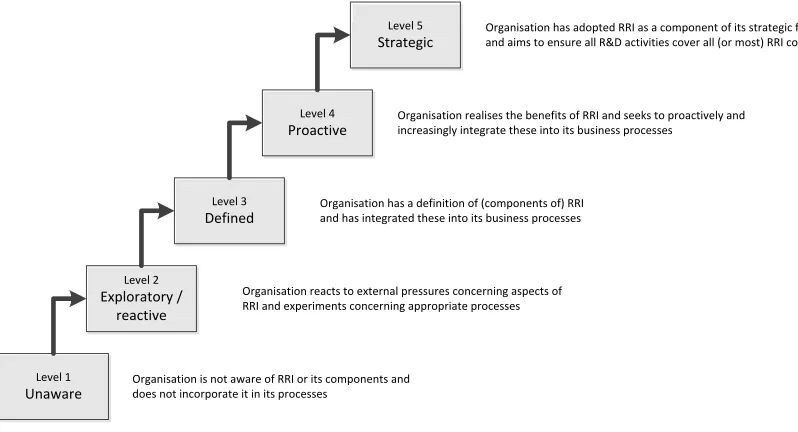
Very briefly, the RRI maturity model, which is based on an existing discourse around maturity models in other areas, such as the capability maturity model (Paulk, 2002), pos-tulates that there are components of RRI that can develop in terms of their maturity from unaware, where the concept is not even discussed, all the way to strategic, where RRI becomes a key aspect of a project or organisation. This idea is expressed in the following figure:
Level 1
Unaware
Level 2
Exploratory / reactive
Level 3
Defined
Level 4
Proactive
Level 5
Strategic
Organisation is not aware of RRI or its components and does not incorporate it in its processes
Organisation reacts to external pressures concerning aspects of RRI and experiments concerning appropriate processes
Organisation has a definition of (components of) RRI and has integrated these into its business processes
Organisation realises the benefits of RRI and seeks to proactively and increasingly integrate these into its business processes
Organisation has adopted RRI as a component of its strategic framework and aims to ensure all R&D activities cover all (or most) RRI components
This principle of the RRI maturity is then to be applied to the various components of RRI. One way of categorising these components is to use the AREA-4P version of RRI (Jirotka, Grimpe, Stahl, Hartswood, & Eden, 2017), with its focus on purpose (motiva-tion), process and product (outcome) of research and innovation. These can then be bro-ken down in more detail as shown below.
• Motivation (purpose)
o Motivation for doing the research
o Motivation for engaging with RRI
o Ethics (intended outcomes)
• Process
o Anticipation
o Engagement
o Reflection
o Governance
o Ethics (research ethics)
o Responsiveness
• Outcomes (product)
o Gender / equality and diversity
o Open access
o Social justice / inclusion
o Sustainability
o Science education
Figure 2: Representation of RRI maturity of three case studies, adopted from (Stahl, Obach, et al., 2017)
The ORBIT RRI self-assessment tool is based on these ideas, but it goes further than the one originally suggested by offering more specific insight for particular issues related to ICT in general, application areas or technologies.
Who can use the tool and for which purposes?
The ORBIT self-assessment tool will be openly available on the ORBIT website and therefore be open to be used by anybody. However, there are certain types of users and interests which we assume are likely to represent the bulk of likely uses. The following three indicated use cases represent the ORBIT team’s assumptions about such likely use.
1. A researcher (either publicly or privately funded) is working on a proposal for a publicly funded project. This proposal is linked to RRI requirements (e.g it is a H2020 proposal or a UK EPSRC proposal) and the proposer has to ensure that funding requirements are met.
2. A leader of an R&D department wants to find out whether the work undertaken in the department conforms to existing standards and reflects good practice. They want to persuade the organisation to invest into more R&D and therefore want to make sure its processes are optimised.
3. An organisation that claims to be socially responsible wants to ensure that this claim is reflected in all of its activities, including R&D. They are looking for a way to test this with regards to their R&D activities
0 1 2 3 4 5
Motivation …
Motivation …
Ethics …
Anticipation
Engagement
Reflection
Governance Ethics …
Responsiven… Gender / … Open access
Social … Sustainability
Science …
It is important to see that in principle the tool should be relevant for both individual re-searchers and organisations. It should cover both publicly and privately funded research and innovation activities.
What is the content of the self-assessment tool?
In practice they ORBIT self-assessment tool is implemented in the form of an online sur-vey. In order to allow the identification of the level of achievement of RRI in a particular aspect by a particular user, the majority of the questions of the survey take the form of a five point Likert scale comment on a statement provided in the question, ranging from fully disagree to fully agree.
In order to achieve the aim of covering both the EPSRC and the EU views of RRI as well as more specific questions around ICT, it's technologies and applications, the ORBIT self-assessment tool is structured in the following sections:
1. Front End
the starting point of the survey is a data use agreement where the user agrees to the use of the data they provide for the purposes of the self-assessment tool. This is predominantly the provision of services to the user, but it explicitly also covers the use of abstract and anonymous data for the purpose of doing research on RRI and establishing baselines. The user is then asked questions about their work and experience, the practices in their organisation and/or project.
2. Awareness of RRI
the first main section covers the awareness of RRI by the user and their organisa-tion as well as the purpose and motivaorganisa-tion for engaging with RRI and the self-assessment tool.
3. Basic EPSRC - AREA-4P
in the subsequent section the tool deals with the main components of RRI accord-ing to the EPSRC AREA framework, namely anticipation, reflection and engage-ment.
4. EU topics not yet covered
in order to ensure that the self-assessment tool is of value with regards to the EU framework of RRI, those topics that are not already covered, namely research governance, gender equality, open science, science education and research ethics are included.
5. ICT general
following the generic aspects of RRI, the tool then focuses on ICT specific issues, such as data protection, data storage, consequences for employment or machine autonomy.
items relating to applications or technologies will be asked. This section of the tool is yet to be developed, which requires drawing on the expertise of the various sub-communities working on particular applications or technologies, such as arti-ficial intelligence, big data analytics, robotics, autonomous systems etc.
7. Feedback on the survey
the final section will allow users to give feedback on the survey itself, identify whether it met their needs and highlight where it needs to be improved and devel-oped.
For each of these components and subcomponents, a number of statements was devel-oped, based on existing tools in the RRI literature that represent particular aspects of RRI and that allow assessing the level of maturity with regards to this particular component. What is the output of the tool, which feedback do users receive?
Upon completion of the survey the user will be provided with an automatically generated overview of their RRI maturity, based on the score that was recorded in their answers. This initial feedback which will take the form of a radar diagram as indicated earlier will be supplemented with a set of links to further help and support that users can make use of, to ensure that they undertake their research or innovation activities responsibly.
In addition, the self-assessment tool will also point to the various other services that are provided by the ORBIT project, which covers most of the aspects of RRI.
Finally, the survey will encourage users to make contact with other members of the OR-BIT community, to foster the development of an RRI culture and the sharing of good practice.
What are the limits of the tool?
The purpose of the self-assessment tool is to provide a quick overview of the various components involved in RRI. It therefore and by necessity simplifies potentially compli-cated relationships and reduces them to quantitative scores. Such quantification of com-plex social relationships is always misleading and cannot capture the nuance of the un-derlying reality. In addition the scores that are produced by the ORBIT self-assessment survey are initially based exclusively on self-evaluation. This means that it is possible that the respondent did not fully understand the question or interpreted it in a way con-trary to its original meaning. By relying on self-evaluation it is furthermore difficult to directly compare individual scores, as these will be based on the perceptions of the re-spondents.
with the tool lies less in the answers that the individual user provides and more in the process of engaging with it. At the same time the quantification of the responses has the advantage that the user can compare his or her own initial scores with scores generated at a later point or with regards to different projects. It is furthermore reasonable to assume that once the tool has been used a significant amount of time, the average scores will rep-resent a widespread view of particular items and the comparison of individual scores can at least give an indication of where a particular respondent or project is located with re-gards to the majority of comparable projects.
With this in mind it is important to underline that the scores generated by the self-assessment tool need context and detail and require critical reflection. This means that even a perfect score in the self-assessment tool does not guarantee that the researcher innovation activities undertaken in response manner and, vice versa, i.e. a low score does not necessarily imply lack of responsibility.
What is the status of the tool?
The self-assessment tool was developed during the first nine months of 2017. Initial rounds of review and feedback be undertaken during the summer of 2017 and it was im-plemented as an online survey on the ORBIT system from October 2017. We expect the tool to develop based on feedback from users. The online survey contains questions that allow users to provide feedback with regards to further development of the tool which we expect to be used and lead to further refinement of the ideas and principles.
In addition to this development based on user feedback, there will be specific areas which will be developed in more detail. In its first iteration the self-assessment tool will be iden-tical for all users and focus on generic issues of RRI as well as ICT. It is intended to de-velop the tool to become more specific by integrating particular items and issues that are specific to particular applications or technologies. This will require input from the ICT community to firstly identify which areas are most in need of further reflection and sec-ondly to then identify which issues they raise and how these can be represented in the self-assessment tool.
Overall we expect the tool to continue to develop and not to be used as a static instru-ment. There may be scope for a more interactive and user-friendly implementation be-yond a simple online survey. Again, feedback from the ICT research community is wel-come to stimulate the development of the tool.
Funding:The work of the ORBIT project is funded by the EPSRC. In addition, the re-search leading to these results has received funding from the European Community's Seventh Framework Programme (FP7/2007-2013) under grant agreement n° 609817 (Re-sponsible-Industry).
Acknowledgements: The work on the self-assessment tool described here is indebted to the various self-assessment or self-check tools in a range of RRI-related projects, notably RRI-Tools, ResAgora, KARIM and COMPASS. Much of the work on the self-assessment tool was undertaken in the context of the Responsible-Industry project (www.responsible-industry.eu). The author acknowledges the contribution of the consor-tium members to this work.
Copyright:Copyright remains with the authors. This is an openaccess article distributed under the terms of the Creative Commons Attribution License, which permits unrestricted use, distribution, and reproduction in any medium, provided the original author and source are credited.
References
Brinkman, B., Flick, C., Gotterbarn, D., Miller, K., Vazansky, K., & Wolf, M. J. (2017). Dynamic Technology Challenges Static Codes of Ethics. ORBIT Journal, 1(2). Retrieved from https://www.orbit-rri.org/ojs/index.php/orbit/article/view/37 Chutikulrungsee, T. T., & Burmeister, O. K. (2017). Interdependent Privacy. ORBIT
Journal, 1(2). Retrieved from
https://www.orbit-rri.org/ojs/index.php/orbit/article/view/38
Expert Group on Policy Indicators. (2015). Indicators for promoting and monitoring Re-sponsible Research and Innovation (No. EUR 26866 EN). European Commission
- DG Research and Innovation. Retrieved from
http://ec.europa.eu/research/swafs/pdf/pub_rri/rri_indicators_final_version.pdf Flick, C., Dennis, L. M., & Reinhard, A. (2017). Exploring simulated game worlds.
OR-BIT Journal, 1(2). Retrieved from
https://www.orbit-rri.org/ojs/index.php/orbit/article/view/46
Fukuta, Y., Murata, K., Adams, A. A., Orito, Y., & Palma, A. M. L. (2017). Personal Data Sensitivity in Japan. ORBIT Journal, 1(2). Retrieved from https://www.orbit-rri.org/ojs/index.php/orbit/article/view/40
Iatridis, K., & Schroeder, D. (2015). Responsible Research and Innovation in Industry: The Case for Corporate Responsibility Tools. Heidelberg: Springer.
Jensen, T. (2017). By Design. ORBIT Journal, 1(2). Retrieved from https://www.orbit-rri.org/ojs/index.php/orbit/article/view/47
Jensen, T., & Vistisen, P. (2017). Ethical Design Fiction. ORBIT Journal, 1(2). Retrieved from https://www.orbit-rri.org/ojs/index.php/orbit/article/view/56
Lilley, S., & Moras, A. (2017). Callisto As a Value Agent. ORBIT Journal, 1(2). Re-trieved from https://www.orbit-rri.org/ojs/index.php/orbit/article/view/41
Miller, K. W., Wolf, M. J., & Grodzinsky, F. S. (2017). Why We Should Have Seen That Coming. ORBIT Journal, 1(2). Retrieved from https://www.orbit-rri.org/ojs/index.php/orbit/article/view/49
Murata, K., Adams, A. A., Fukuta, Y., Orito, Y., Arias-Oliva, M., & Pelegrin-Borondo, J. (2017). From a Science Fiction to the Reality. ORBIT Journal, 1(2). Retrieved from https://www.orbit-rri.org/ojs/index.php/orbit/article/view/42
Paulk, M. (2002). Capability Maturity Model for Software. In Encyclopedia of Software Engineering. John Wiley & Sons, Inc. https://doi.org/10.1002/0471028959.sof589 Persson, A., & Kavathatzopoulos, I. (2017). How to make decisions with algorithms.
ORBIT Journal, 1(2). Retrieved from
https://www.orbit-rri.org/ojs/index.php/orbit/article/view/44
Robison, W. L. (2017). Digital Privacy: Leibniz 2.0. ORBIT Journal, 1(2). Retrieved from https://www.orbit-rri.org/ojs/index.php/orbit/article/view/54
Stahl, B. C., Flick, C., & Timmermans, J. (2017). Ethics of Emerging Information and Communication Technologies-On the implementation of RRI. Science and Public Policy, 44(3), 369–381. https://doi.org/10.1093/scipol/scw069
Stahl, B. C., Obach, M., Yaghmaei, E., Ikonen, V., Chatfield, K., & Brem, A. (2017). The Responsible Research and Innovation (RRI) Maturity Model: Linking Theory and Practice. Sustainability, 9(6), 1036. https://doi.org/10.3390/su9061036
Stahl, B. C., Timmermans, J., & Mittelstadt, B. D. (2016). The Ethics of Computing: A Survey of the Computing-Oriented Literature. ACM Comput. Surv., 48(4), 55:1– 55:38. https://doi.org/10.1145/2871196
Tuikka, A.-M., Nguyen, C., & Kimppa, K. K. (2017). Ethical questions related to using netnography as research method. ORBIT Journal, 1(2). Retrieved from https://www.orbit-rri.org/ojs/index.php/orbit/article/view/50