DOI: 10.22075/JRCE.2017.11047.1180
journal homepage: http://civiljournal.semnan.ac.ir/
Predicting Hydraulic Jump Length on Rough Beds
Using Data-Driven Models
P. Khosravinai1*, H. Sanikhani1 and Ch. Abdi2
1. Assistant Professor, Water sciences and Engineering Department, University of Kurdistan, Sanandaj, Iran 2. Former MSc., Water sciences and Engineering Department, University of Kurdistan, Sanandaj, Iran
Corresponding author:[email protected]
ARTICLE INFO ABSTRACT
Article history:
Received: 15 April 2017 Accepted: 31 October 2017
The hydraulic jump can be used for some purpose such as dissipating the flow energy in order to prevent bed erosion; aerating water and facilitating the mixing procedure of chemical that used for water purification. In this paper, various artificial intelligence (AI) models including gene expression programming (GEP), adaptive-neuro-fuzzy inference system with grid partition (ANFIS-GP), and neural networks (ANNs) were used to estimate developed and non-developed hydraulic jump length. Four various GEP, ANFIS-GP and ANN models including different combinations of Froude number, bed roughness height, upstream and downstream flow depth based on measured experimental data-set were developed to estimate hydraulic jump length variations. The root mean squared error (RMSE) and determination coefficient (R2) indices were applied for testing models’ accuracy. Regarding the comparison results, it was seen that the ANFIS-GP, ANN, and GEP models could be employed successfully in estimating hydraulic jump length. The comparison between three AI approaches emphasized the superiority of ANNs and ANFIS-GP over the other intelligent models for modeling developed and developed hydraulic jump length, respectively. For non-developed hydraulic jump, the R2 and RMSE values obtained as 0.87 and 2.84 for ANFIS-GP model.
Keywords:
Hydraulic Jump, Rough Bed ,
Neural Networks,
Grid Partition,
Gene Expression Programming.
1. Introduction
Changing the supercritical flow to subcritical condition leads to occurr a standing wave phenomenon (i.e. hydraulic jump). Hydraulic jumps mostly can be seen in nature and
aerating water flow and facilitating the mixing procedure of chemical that used for water purification (Gumus et al., 2015).
Applying continuity and momentum equations, we can drive a formula for the sequent depths ratio for classical hydraulic jump (i.e. smooth bed) than has been widely investigated as follow:
2
2
1 1
1
1 8 1
2 r
h
F
h
(1)
Where, refers to Froude number; h1and
2
h indicated initial and sequent water depths,
respectively. Fr1is the Froude number. A
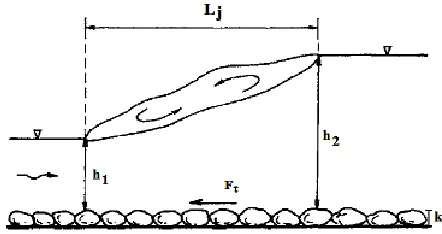
hydraulic jump with related parameters is presented in Fig. 1.
Fig. 1. Hydraulic jump on the smooth bed. The literature reported that the length and tail water depth of basin are critical variables for optimal design of stilling basin. One of the most effective parameter for stilling basin designing is the length of hydraulic jumps. In order to decrease the stilling basin length some measures have already been taken such as installing blocks at the end and middle parts of the chutes and the artificial roughness on the bed.
1.1. Analysis of hydraulic jump on rough beds
The rough bed can reduce the length of jump and depth of tail-water. In this regard, the bed
shear stress increased based on the interaction of flow with the rough bed. So, regarding increasing of energy dissipation leads to deceasing in the length of jump that can be need for performance of basin design. In order to evaluate the performance of rough beds on hydraulic jump, many releavant studies are available (Hughes and Flack, 1984; Mohamed Ali, 1991; Ead and Rajaratnam, 2002; Carollo et al., 2007; pagliara et al., 2008; Dey and Sarkar, 2008; Barahmand and Shamsai, 2010; Afzal et al., 2011, Hager, 2013; Pagliara and Palermo, 2015).
Considering Fig. 2, Rajaratnam (1965) presented an equation for accounted the effect of boundary resistance in momentum equation as follow:
1 M1 2 M2 F
(2)
in which 1 and 2are hydrostatic forces at
sections 1 and 2, respectively. h1and h2refer
to initial and sequent water depths, respectively. Furthermore, is integrated bed shear stress; M1 and M2 indicate momentum fluxes related to sections 1 and 2, respectively.
Fig. 2. Schematic illustration of hydraulic jump for rough bed.
integrated bed shear stress can be defined using following equation:
1 2
F M M (3)
1 r F
where β refer to a positive constant (i.e. less than 1 to state Eq. (2). For a rectangular channel, Eqs. (2) and (3) can be combined and presented as following equation:
2 2 2
2 1
1 2
1 1 1 1
1
2 2
q h h
h h
(4)
in which and q are the density of water and is the discharge per unit width of channel, respectively (Carollo and Ferro 2004b)
The following positive symmetrical solution can be presented for Eq. (4):
2 2
1 1
1
1 1 8 1
2 r
h
F
h
(5)
Finally, the following empirical equation can be derived between β and the relative roughness ks /h1:
1
0.42ks
h
(6)
Where, ks is the roughness height (Carollo and Ferro (2004).
We have two different two types of hydraulic jumps, including developed and non-developed roller flow (Hager et al., 1990). For developed hydraulic jump water depth increase gradually in and the water depth and quasi-steady. In the downstream of the toe, that the water depth is h1, the forward flow was near the bed and diverged further downstream. The stagnation point is located at the end of the developed roller and the surface waves in the downstream tail-water have a negligible height.
For the non-developed roller with the developed roller, the hydraulic jump is unstable and the toe was moved to downstream. The incoming supercritical flow
was occasionally diverted to the water surface, the roller length is extremely reduced, and surface waves are generated into the tailwater, significantly.
A non-developed hydraulic jump for a clockwise roller is shown in Fig. 3. According to this figure, Lj refer to the length between the two cross sections with the sequent depths (i.e. h1 and h2). Also, Lr (i.e. the roller length) is the horizontal distance between the roller end and the toe section with the flow depth h1. This length can be calculated using visualization technique such as with a float to localize the stagnation point.
Fig. 3.Non-developed hydraulic jump with a clockwise roller.
Recent advancement in data driven models (i.e. gene expression programming (GEP), adaptive neuro-fuzzy inference systems (ANFIS) and artificial neural networks (ANN),) and and its application in hydraulics engineering have challenged the conventional techniques of the analysis. Diffrent hydraulics engineering phenomena are now being modeled using various artificial intelligence (AI) methods. Several researches have shown that soft computing techniques are more feasible and accurate than conventional techniques.
Many applications of ANN in different areas of water resources engineering and hydraulics were reported (Liriano and Day,
2001; Nagy et al., 2002; Raikar et al., 2004; Azmathullah et al., 2005; Naderpour et al., 2010; Ansari and Athar, 2013 and Ansari, 2014). Recently Naseri and Othman (2012) used ANN for the determination of length of hydraulic jump on smooth beds. Omid et al. (2005) developed ANN models for estimating jump length and sequent depths of gradually expanding hydraulic jumps in trapezoidal and rectangular channels.
The main object of current paper is to present a model for prediction of the length of hydraulic jump in rectangular channel with a horizontal apron having rough beds. In this regard some AI models including gene expression programming (GEP), adaptive neuro-fuzzy inference system based on grid partitioning method (ANFIS-GP), and artificial neural networks (ANN) were employed.
2
.
Materials and Methods
2.1. Hydraulic Jump on Rough Bed
Hydraulic jump characteristics over a rough bed are dependent on hydraulic condition of flow, dimensions of roughness and properties of fluid. The length of roller (Lr) along a rough bed depends on gravitational acceleration (g), roughness height (ks) and depth of flow at upstream (h1), depth of flow at downstream (h2), upstream flow velocity (v1) and kinematic viscosity of fluid ():
, , ,1 2, ,1
r s
L f k g h h v (7)
The following equation can be obtained using the principles of dimensional analysis (DA):
1 1 2 1
1 1 1 1
, , ,
s
r k
L v h h v
f
h h h gh
(8)
Where, 1 1 v
gh
is upstream Froude number at
the starting location of the hydraulic jump
and v h1 1
refer to Reynolds number of the approaching flow. The viscous effects can be ignored for the large value of the Reynolds number (Abbaspour et al., 2009). Finally the following equation can be derived:
2 1
1 1 1
, ,
s r
r
k
L h
f F
h h h
(9)
2.2. Used Data and Dataset
In this study, the experimental dataset provided by Carollo et al. (2007) was utilized to evaluate the efficiency of different AI methods in estimation of hydraulic jump length. The experiments were conducted in a rectangular flume that that dimensions included 14.4 m long, 0.6 m wide, and 0.6 m deep. Five rough beds made up of closely packed crushed gravel particles cemented to the bottom were evaluated. The grain size distribution of each gravel bed was obtained using a sample of 100 particles. Three axial sizes were measured for each particle, and the diameter was calculated as the average value. The characteristics of grain-size distributions were as d50=0.46, 0.82, 1.46, 2.39, and 3.20 cm that d50 refer to the diameter of the bed particles for which 50% were finer. The median diameter d50 was utilized as roughness height (ks).
rough bed. Among total experiments, 189 and 181 dataset considered as developed and non-developed hydraulic jump, respectively. For each type of hydraulic jump, 75 and 25% of total data used for train and test phase, respectively. The variation ranges of experiments database including upstream and downstream flow depth, Froude number, bed roughness height and the length of hydraulic jump for developing AI models is presented in Table 1.
2.3. Soft Computing Models
2.3.1. Artificial Neural Networks (ANNs)
The basic of ANNs model is similar to the framework of human brain. The ANNs have been used for different reason such simulation, clustering and pattern recognition. ANNs learned intelligently for mapping a set of input/output data and finding function approximators. Various type of ANNs based on different structure can be considered. Multilayer perceptron (MLP) as a static ANN is the most applied method in various filed of engineering (Araghinejad, 2013). MLP as a usual ANNs model can be applied successfully to solve various problems in different field of studies. MLP has three specified properties. The first, the model of each neuron consist of a nonlinear activation function in the network. The second is that the network includes one or more layers of hidden neuron that help to network to learn complex task. The third one is that network exhibits a high degrees of
connectivity. Various training algorithms can be applied in the structure of MLP model. In this study, the most popular Levenberg– Marquardt (LM) algorithm was used. More details about MLP can be found in Haykin (1999). In this study, for application of ANNs, a code written in MATLAB (based on nntool toolbox) by the authors was used.
2.3.2. Adaptive Neuro-Fuzzy Inference System (ANFIS)
ANFIS as a combination of an adaptive neural network and a fuzzy inference system was invented by Jang (1993). ANFIS combined the principles of neural networks and fuzzy logic. Thus, ANFIS has potential to capture the benefits of both neural networks and fuzzy logic in a single model and have the advantages of both fuzzy systems (humanlike IF-THEN rules thinking and ease of incorporating expert knowledge) and neural networks (such optimization abilities, learning abilities, and connectionist structures) (Jang, 1993).
ANFIS as a network structure includes of a number of nodes connected through directional links that each node consist of a node function comprising fixed or adjustable parameters. The parameters related to the fuzzy inference system are calculated using neural networks learning algorithms (Brown and Harris, 1995). ANFIS has the capability to approximate any real continuous function on a compact set to any degree of accuracy (Jang et al., 1997).
Table 1. The variation of experimental database used in this study.
Type Fr h1(cm) h2(cm) ks(cm) Lj(cm)
Developed hydraulic jump 1.87-8.47 1.11-7.09 8.98-23.45 0-1.46 18-90
The set of parameters related to ANFIS is obtained applying the hybrid learning algorithms (i.e. combination of least squared error method and back-propagation gradient descent error digestion). In current paper, the Sugeno's fuzzy method was used to obtain the values for the output variable based on input variables. A typical architecture of an ANFIS model with two inputs is shown in Figure 4. Further details about ANFIS can be found in Jang (1993).
Fig. 4. The schematic structure of ANFIS model with two inputs.
ANFIS can be applied with different identification approaches of Sugeno model including grid partitioning (GP) and subtractive clustering (SC). Regarding ANFIS-GP, the input space divided into rectangular subspaces by applying a number of local fuzzy regions. In order to calculate fuzzy sets and parameters, the least square method according to the MF type and partition was utilized. (Abonyi et al. 1999). For utilizing ANFIS-GP, the number of input variables should be less than 6. In this paper, four variables are used for hydraulic jump length modeling and thus ANFIS-GP can be used successfully. For application of ANFIS-GP, the code written using MATALAB by the authors was utilized.
2.3.3. Gene Expression Programming (GEP)
GEP includes both the ramified structures of different sizes and shapes such as the parse
trees in genetic programming (GP) and the simple, linear chromosomes of fixed length such as the ones applied in genetic algorithms (GA) (Ferreira, 2001). According to the ramified structures of different shapes and sizes that totally encoded in the linear chromosomes of fixed length, we can say in GEP, the genotype and phenotype are finally separated from one another and the model can now benefit from all the evolutionary advantages this brings about (Ferreira, 2006).
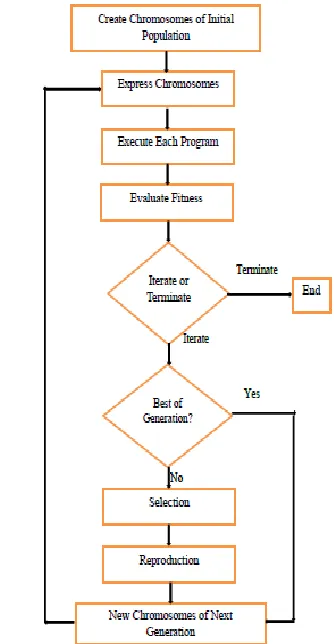
Fig. 5. The flowchart of the gene expression algorithm (Ferreira, 2006).
The procedure for hydraulic jump length estimation by GEP are consist five major steps. At the first, the fitness function was selected. In this study, Root relative squared error (RRSE) was chosen as the best fitness function. In the second step, the set of terminals (T) and functions (F) were selected.In this stuy, the terminal set including.
the bed roughness height, Froude number, upstream and downstream flow depths. The function set is chosen regarding to the complexity and nature of the phenomena. In this paper, different functions were used, including basic arithmetic operators
, , ,
as well some of othermathematical functions as follow:
2 3 3
ln ,
,
,
,
,
,sin ,
cos ,arctan
xx e x x
x
x
x
x
x
Selecting the chromosomal architecture was considered in the third step. In the fourth step, the kind of linking function was selected. Finally, the set of genetic operators and their rates considered for GEP model (Ferreira, 2006).
For application of GEP model, the computer program namely GeneXpro Tools 4.0 has been applied to estimate hydraulic jump length.
The summary of GEP parameters were as follow: number of genes: 3, head size: 8, Number of chromosomes: 30, one point recombination rate: 0.3, two point recombination rate: 0.3, mutation rate: 0.044, inversion rate: 0.1, gene recombination rate: 0.1, gene transposition rate: 0.1, IS transposition rate: 0.1, RIS transposition: 0.1.
2.4. The Performance of Models
The performance of applied models was evaluated using two different criteria consisting of root mean square error (RMSE) and coefficient of determination (R2). RMSE can be calculated as follow:
2 11
o e
N
j j i
RMSE L L
N
(10)where, N is the number of data-sets, Ljo and
Lje are the observed and simulated hydraulic jump length values, respectively.
3. Results and Discussion
ANN, ANFIS-GP, and GEP techniques were employed for assessing prediction of developed and non-developed hydraulic jump length. Froude number, deb roughness height, upstream and downstream flow depth data were used as inputs to the models.
3.1. ANNs Models
iteration number equals to 1000 was selected in this study.
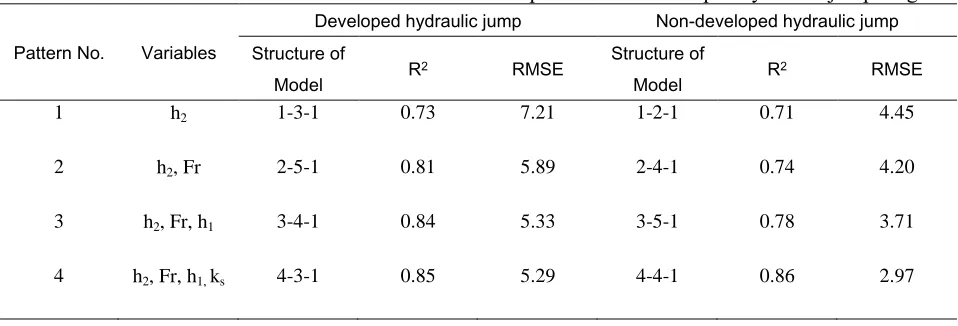
It is obvious from the table that input combination No. 4 has a superior exactness (lower RMSE and higher R2) than the other patterns for both type of hydraulic jump (i.e. developed and non-developed). The results showed that the Froude number and bed roughness height has important role in prediction of hydraulic jump length for developed and no-developed hydraulic jumps, respectively. It is found that by adding Froude number in developed hydraulic jump (Pattern No. 2) the RMSE value decreased as 18.3%. Furthermore, by adding ks in the case of non-developed hydraulic jump (pattern No. 4) REMSE decreased as 20% in comparison with the pattern No. 3. The scatterplot of predicted and measured hydraulic jump length for optimal ANNs model during the test period, was presented in Fig. 6. This figure shows the capability of ANNs in prediction of hydraulic jump length. The results revealed that ANNs can be used an alternative of empirical equations to simulate the characteristics of hydraulic jump.
3.2. ANFIS Models
In table 3, structure and statistical measures of ANFIS-GP model for prediction of
developed and non-developed hydraulic jump length using different input combinations is presented. It can be seen from the table, for both hydraulic jump types (i.e. developed and non-developed), the input combination No. 4 that includes all of variables gives the best prediction with the lowest RMSE. By application of input combination No. 4 for developed hydraulic jump, the R2 and RMSE were obtained as 0.84 and 5.35, respectively. In the case of non-developed condition, the R2 and RMSE were calculated as 0.87 and 2.84, respectively. For both types of hydraulic jump, the triangular membership function with 2 memberships corresponds to downstream flow depth, Froude number, bed roughness height and upstream flow depth was selected as the best one. It is notable that for determine the optimal architecture of ANFIS-GP model for a given input combination; different type of membership functions (i.e. triangular, Gaussian, trapezoidal and etc.) was tried. Furthermore, different numbers of memberships (i.e. 2, 3 and etc.) for each type of membership function was evaluated and finally the best structure with respect to minimum value of RMSE was selected.
Table 2. The test results of ANNs for simulation of developed and non-developed hydraulic jump length.
Pattern No. Variables
Developed hydraulic jump Non-developed hydraulic jump
Structure of
Model R2 RMSE
Structure of
Model R2 RMSE
1 h2 1-3-1 0.73 7.21 1-2-1 0.71 4.45
2 h2, Fr 2-5-1 0.81 5.89 2-4-1 0.74 4.20
3 h2, Fr, h1 3-4-1 0.84 5.33 3-5-1 0.78 3.71
Table 3. The test results of ANFIS-GP for simulation of developed and non-developed hydraulic jump length.
Developed hydraulic jump Non-developed hydraulic jump
Pattern
No. Variables
Type of MFs
Number
of MFs R2 RMSE
Type of MFs
Number
of MFs R2 RMSE
1 h2 triangular 2 0.74 7.13 triangular 4 0.75 3.99
2 h2, Fr Gaussian 3,2 0.78 6.22 triangular 2,2 0.76 3.84
3 h2, Fr, h1 triangular 2,3,2 0.83 5.71 Gaussian 3,3,2 0.79 3.65
4 h2, Fr, h1, ks triangular 2,2,2,2 0.84 5.35 triangular 2,2,2,2 0.87 2.84
The results indicated that the utilization of triangular and Gaussian memberships functions are preferred to other types for prediction of hydraulic jumps length. The scatterplots of observed and simulated hydraulic jump length for developed and non-developed hydraulic jump based on optimal inputs (No. 4) is presented in figure 7. This figure confirms the results presented in table 3. The results showed that the performance of ANFIS-GP in prediction of hydraulic jump length is promising. However the performance of ANFIS-GP in prediction of hydraulic jump length for non-developed hydraulic jump was better that the developed type and RMSE value was improved as 46% in this regard.
3.3. GEP Models
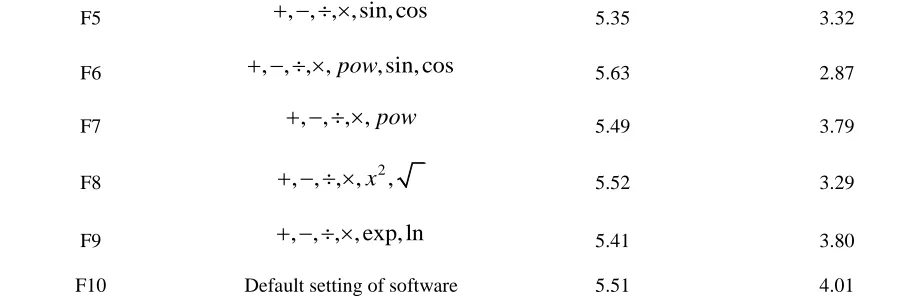
Similar ANN and ANFIS-GP models, the same the input combinations were used for developing GEP models. As mentioned earlier, several steps were considered for applying GEP. In this research, the RRSE fitness function was selected. Then, different function set (Table 4) was evaluated for obtaining the parse tree. As can be seen from the table, for developed and no-developed hydraulic jump F3 and F6 selected, respectively. After selecting function set, we tried to finding the suitable linking function that among several linkage functions, the addition ones chosen in order to link sub-trees.
Table 4. The results of various GEP function set for the parse tree during test phase.
Functions set No. Definition RMSE
Developed type Non-developed type
F1 , , , 5.31 3.41
F2 , , , , , exp, ln, sin, cos 5.38 3.39
F3 , , , , , exp, ln,pow 5.32 3.90
F5 , , , , sin, cos 5.35 3.32
F6 , , , ,pow, sin, cos 5.63 2.87
F7 , , , ,pow 5.49 3.79
F8 , , , ,x2, 5.52 3.29
F9 , , , , exp, ln 5.41 3.80
F10 Default setting of software 5.51 4.01
Table 5. The test results of GEP for simulation of developed and non-developed hydraulic jump length.
Developed hydraulic jump
Non-developed hydraulic jump
Pattern
No. Variables R2 RMSE R2 RMSE
1 h2 0.74 7.13 0.75 4.12
2 h2, Fr 0.82 5.78 0.77 3.88
3 h2, Fr, h1 0.83 5.42 0.78 3.71
4 h2, Fr, h1, ks 0.85 5.32 0.86 2.87
Table 6 The results of optimal AI models in train-test phases.
Model
Developed hydraulic jump Non-developed hydraulic jump
Train phase Test phase Train phase Test phase
R2 RMSE R2 RMSE R2 RMSE R2 RMSE
ANNs 0.90 4.65 0.85 5.29 0.90 2.53 0.86 2.97
ANFIS-GP 0.88 4.79 0.84 5.35 0.89 2.61 0.87 2.84
The procedures that mentioned before were implemented for different input combinations in hydraulic jump length prediction.
The results of GEP models based on defined input combinations (i.e. i–iv) in terms of suitable function set have reported in Table 5. It is seen from Table 5 that the pattern No. 4 gives the best results for the hydraulic jump length forecasting.
The observed and modeled hydraulic jump length scatterplots during test phase has shown in Fig. 8. The high generalization capacity of the GEP model (i.e. high correlation and relatively low error) demonstrated based on comparing the GEP estimations with the observed data during test phase. By considering the straight line equations in the scatterplots (i.e. the equation as y=ax) shows the a coefficient is close to 1for GEP model. Also, for the ANFIS-GP and ANNs models the similar results can be seen. The results showed that the input combination (iv) increase the accuracy of the ANN, ANFIS-GP and GEP models compared to the other input combinations. The input combination (iv) consist of complete and total input variables and it seems this is the reason behind the accuracy of models compared to other input combinations. The expression tree of the final GEP model for developed and non-develop hydraulic jump length prediction is presented in Fig. 9. The Eq. 11 and 12 refer to mathematical formula of the GEP model for developed and non-develop hydraulic jump, respectively.
1 2 1
1 2
1 1
1
3 2 0.998
sin 18.87
7.512
s
s
k f h h
f h k f h h (11)
1 12 1 1
1 1 1
sin sin
1.66
2 cos 1.3
2 0.13
s
s
s
s
k h h
h h k k
k
k h f h
(12)
Table 6 presented the summary of and comparison results of optimal AI models (i.e. ANN, ANFIS-GP and GEP) for prediction hydraulic jump length. It should be noted here that the obtained results are evaluated by using t test (i.e. at 95% significance level) in order to verify and checking the robustness of the applied models. The results indicated that p values were calculated <0.001 for all AI applied models.
Table 6 showed that the ANNs and ANFIS-GP outperform the other AI methods models for developed and no-developed hydraulic jump, respectively. The differences among the results of different AI models are somewhat low based on the comparison results.
Finally, the results indicated that ANNs, ANFIS-GP and GEP models selected as the most powerful tools for the estimation of hydraulic jump length, respectively.
4. Conclusion
In this study, GEP, ANFIS-GP and ANN methods were applied in estimating the length of hydraulic jump values has been investigated. Bed roughness height, Froude number, upstream and downstream flow
(b) (a)
Fig. 6. The scatterplot of simulated and observed hydraulic jump length using ANNs for test period a) developed b) non-developed.
(b) (a)
Fig. 7.The scatterplot of observed and simulated hydraulic jump length using ANFIS-GP for test period a) developed b) non-developed.
y = 0.9366x + 3.7736 R² = 0.8639
40 50 60 70 80
40 50 60 70 80
Sim
ula
ted
-ANNs
Observed
y = 0.8757x + 7.0375 R² = 0.8458
0 20 40 60 80 100
0 20 40 60 80 100
Sim
ula
ted
-ANNs
Observed
y = 0.8738x + 7.9138 R² = 0.8731
40 45 50 55 60 65 70 75 80
40 50 60 70 80
Sim
ula
ted
-ANF
IS
-GP
Observed
y = 0.8065x + 10.668 R² = 0.8429
25 35 45 55 65 75 85 95
20 40 60 80 100
Sim
ula
ted
-ANF
IS
-FP
(b) (a)
Fig. 8.The scatterplot of observed and simulated hydraulic jump length using GEP for test period a) developed b) non-developed.
Fig. 9. Siscription of expression tree of optimal GEP model for Hydraulic jump length estimation a) developed b) non-developed.
*Function set: +, *, -, 3Rt, x2. *
Terminal set: d0, d1, d2, d3 refer to h2, Fr, h1 and ks, respectively. y = 0.8589x + 8.5089
R² = 0.857
40 45 50 55 60 65 70 75
40 50 60 70 80
Sim
ula
ted
-G
E
P
Observed
y = 0.8858x + 6.7058 R² = 0.8455
20 30 40 50 60 70 80 90 100
20 40 60 80 100
Sim
ula
ted
-G
E
P
The results indicated that the performance of the suggested AI methods in modeling the nonlinear behavior of hydraulic jump length values based on different statistical indices. In general, the ANNs model performs better than the other AI methods in estimation of hydraulic jump length for developed and no-developed hydraulic jump. The differences among several AI methods were quite low. For all of applied models, the best result was obtained by application of
The input combination (iv) including upstream and downstream flow depths, Froude number and bed roughness height provide the best gives the best results for all of applied models. It should be noted here that GEP, ANFIS-GP and ANN methods can be applied as promising models for predicting hydraulic jump length values, based on hydraulic variables. It can be concluded that increasing the number of input combinations, increases the prediction accuracy of all AI models. According to the aim of this study that is evaluating the feasibility of AI models for prediction hydraulic jump length variations, it should be noted that the results obtained in current study are for research intention. Using the current results for field and real world application required sophisticated steps and rebuilding-reevaluating the AI models regarding to available dataset and variables maybe influence on the hydraulic jump length data.
REFERENCES
[1] Abbaspour, A., Dalir, A.H., Farsadizadeh, D. and Sadraddini, A.A., 2009. Effect of sinusoidal corrugated bed on hydraulic jump characteristics. Journal of Hydro-environment Research, 3(2), pp.109-117.
[2] Abonyi, J., Andersen, H., Nagy, L. and Szeifert, F., 1999. Inverse fuzzy-process-model based direct adaptive control. Mathematics and Computers in Simulation, 51(1), pp.119-132.
[3] Afzal, N., Bushra, A. and Seena, A., 2011. Analysis of turbulent hydraulic jump over a transitional rough bed of a rectangular channel: universal relations. Journal of Engineering Mechanics, 137(12), pp.835-845.
[4] Ansari, M.A., 2014. Sediment removal efficiency computation in vortex settling chamber using artificial neural networks. Water and Energy International, 71(1), pp.54-67.
[5] Ansari, M.A. and Athar, M., 2013. Artificial neural networks approach for estimation of sediment removal efficiency of vortex settling basins. ISH Journal of Hydraulic Engineering, 19(1), pp.38-48.
[6] Araghinejad, S., 2013. Data-driven modeling: using MATLAB® in water resources and environmental engineering (Vol. 67). Springer Science & Business Media. [7] Azmathullah, H.M., Deo, M.C. and
Deolalikar, P.B., 2005. Neural networks for estimation of scour downstream of a ski-jump bucket. Journal of Hydraulic Engineering, 131(10), pp.898-908.
[8] Barahmand, N. and Shamsai, A., 2010. Experimental and theoretical study of density jumps on smooth and rough beds. Lakes & Reservoirs: Research & Management, 15(4), pp.285-306.
[9] Brown, M. and Harris, C.J., 1994. Neurofuzzy adaptive modelling and control. Prentice Hall.
[10] Carollo F.G., Ferro V., 2004. “Determination of Conjugated Heights Emphasis on Free Smooth Surface and Rough”, Journal of Agricultural Engineering, Vol. 4, pp. 1-12.
[11] Carollo, F.G., Ferro, V. and Pampalone, V., 2007. Hydraulic jumps on rough beds. Journal of Hydraulic Engineering, 133(9), pp.989-999.
rough beds. Journal of engineering mechanics, 134(1), pp.49-59.
[13] Ead, S.A. and Rajaratnam, N., 2002. Hydraulic jumps on corrugated beds. Journal of Hydraulic Engineering, 128(7), pp.656-663.
[14] Ferreira, C., 2001. Gene Expression Programming: A New Adaptive Algorithm for Solving Problems. Complex Systems 13 (2): 87-129.
[15] Ferreira, C., 2006. Gene expression programming: mathematical modeling by an artificial intelligence (Vol. 21). Springer.
[16] Gumus, V., Simsek, O., Soydan, N.G., Akoz, M.S. and Kirkgoz, M.S., 2015. Numerical modeling of submerged hydraulic jump from a sluice gate. Journal of Irrigation and Drainage Engineering, 142(1), p.04015037.
[17] Hager, W.H., 2013. Energy dissipators and hydraulic jump (Vol. 8). Springer Science & Business Media.
[18] Hager, W.H., Bremen, R. and Kawagoshi, N., 1990. Classical hydraulic jump: length of roller. Journal of Hydraulic Research, 28(5), pp.591-608.
[19] Haykin, S. (1999). Neural Networks: A Comprehensive Foundation. Printice-Hall. Inc., New Jersey.
[20] Hughes, W.C. and Flack, J.E., 1984. Hydraulic jump properties over a rough bed. Journal of Hydraulic engineering, 110(12), pp.1755-1771.
[21] Jang, J.S., 1993. ANFIS: adaptive-network-based fuzzy inference system. IEEE transactions on systems, man, and cybernetics, 23(3), pp.665-685.
[22] Jang, J. S. R., & Sun, C. T. (1997). Neuro-fuzzy and soft computing: a computational approach to learning and machine intelligence. Prentice-Hall, Upper Saddle River.
[23] Liriano, S.L. and Day, R.A., 2001. Prediction of scour depth at culvert outlets using neural networks. Journal of hydroinformatics, 3(4), pp.231-238. [24] Mohamed Ali, H.S., 1991. Effect of
roughened-bed stilling basin on length of
rectangular hydraulic jump. Journal of Hydraulic Engineering, 117(1), pp.83-93. [25] Naderpour, H., Kheyroddin A., Ghodrati
Amiri, G. (2010). Prediction of FRP-confined compressive strength of concrete using artificial neural networks. Composite Structures, Vol. 92, pp. 2817–2829.
[26] Nagy, H.M., Watanabe, K.A.N.D. and Hirano, M., 2002. Prediction of sediment load concentration in rivers using artificial neural network model. Journal of Hydraulic Engineering, 128(6), pp.588-595.
[27] Naseri, M. and Othman, F., 2012. Determination of the length of hydraulic jumps using artificial neural networks. Advances in Engineering Software, 48, pp.27-31.
[28] Omid, M.H., Omid, M. and Esmaeeli Varaki, M., 2005, June. Modelling hydraulic jumps with artificial neural networks. In Proceedings of the Institution of Civil Engineers-Water Management (Vol. 158, No. 2, pp. 65-70). Thomas Telford Ltd.
[29] Pagliara, S., Lotti, I. and Palermo, M., 2008. Hydraulic jump on rough bed of stream rehabilitation structures. Journal of Hydro-Environment Research, 2(1), pp.29-38. [30] Pagliara, S. and Palermo, M., 2015.
Hydraulic jumps on rough and smooth beds: aggregate approach for horizontal and adverse-sloped beds. Journal of Hydraulic Research, 53(2), pp.243-252. [31] Raikar, R.V., Kumar, D.N. and Dey, S.,
2004. End depth computation in inverted semicircular channels using ANNs. Flow Measurement and Instrumentation, 15(5), pp.285-293.