*Department of Social Science, College of Kinesiology, University of Saskatchewan, Saskatoon, SK, Canada Correspondence: [email protected]
University of Saskatchewan Undergraduate Research Journal
Volume 3, Issue 1, 2017
Self-Compassion in an Evaluative
Dance Environment
Lauren Tarasoff,* Leah Ferguson, Kent Kowalski
Abstract
Common characteristics of the dance environment, including mirrored settings, tight-‐fitting clothing, and evaluation by others create an atmosphere that can negatively influence a ballet dancer’s body image and act as a barrier to participation (Radell, Adame, Cole, & Blumenkehl, 2011; Tiggemann & Slater, 2001). Thus, it is important to identify resources that can buffer against negative self-‐perceptions in an evaluative dance environment. The purpose of this study was to explore self-‐ compassion in relation to self-‐evaluative thoughts and behaviours in an evaluative ballet environment. Participants (n = 57 women undergraduate students; Mage = 20.59 years, SD = 3.81) completed an online questionnaire containing measures of self-‐compassion, social physique anxiety (trait and state versions), fear of negative evaluation (trait and state versions), as well as reactions, thoughts, and emotions to a hypothetical first day of beginner ballet class scenario consistent with the common characteristics of the dance environment. Self-‐compassion was negatively related to trait and state social physique anxiety, trait and state fear of negative evaluation, total negative affect, personalizing thoughts, and catastrophizing thoughts, as well as positively associated with behavioural equanimity. Finding self-‐compassion to be associated with lower negative self-‐perceptions within the context of an evaluative beginner ballet class replicates past correlational research and advances the literature by contextualizing self-‐compassion to a specific evaluative environment.
Keywords: self-‐compassion, dance, anxiety, evaluation
Various components in the dance environment, such as mirrors, dance attire (e.g., tight-‐fitting leotard), and individual performances, may elicit negative perceptions of one’s body, which can translate into anxiety (Cassady, Clarke, & Latham, 2004; Tiggemann & Slater, 2001). Given that negative self-‐perception can play a prominent role in dancers’ experiences, it is important to identify resources or tools, such as self-‐compassion (Neff 2003a, 2003b), that may help dancers cope with evaluative dance environments, especially those that might prevent them from participating and/or continuing their involvement. In this study, we consider self-‐compassion as a potential
resource to deal with negative self-‐perceptions that commonly occur in an evaluative dance environment. After introducing self-‐compassion and reviewing relevant literature on self-‐compassion in exercise contexts, we identify a gap in the literature and explore self-‐compassion in relation to self-‐evaluative thoughts and behaviours that can occur as a result of an evaluative dance environment.
components that combine and mutually interact to create a healthy way of relating to the self: (1) self-‐kindness involves being kind and understanding toward oneself, rather than judgmental, when faced with suffering or failure; (2)
common humanity emphasizes that suffering, failure, and imperfection are not isolating experiences; rather, they are shared experiences that everyone encounters; and (3)
mindfulness entails taking a balanced approach to the negative emotions that one experiences, rather than exaggerating or ignoring them (Neff, 2003a).
Self-‐compassion has been shown to have numerous benefits and is associated with less anger, anxiety, depression, rumination, self-‐consciousness, self-‐esteem instability, social comparison, and self-‐worth based on external standards (Neff, 2003a; Neff, Kirkpatrick, & Rude, 2007; Neff & Vonk, 2009). Extending compassion toward the self also reduces negative reactions to unpleasant life events (Leary, Tate, Adams, Allen, & Hancock, 2007); is related to positive emotions such as happiness and optimism (Neff & Vonk, 2009); and results in having fewer body-‐related concerns (Wasylkiw, MacKinnon, & MacLellan, 2012). Despite the growing body of research on the advantages of self-‐compassion, relatively little research has explored this construct in exercise settings.
To the best of our knowledge, only two published studies have investigated self-‐compassion specifically in the exercise domain. Berry, Kowalski, Ferguson, and McHugh (2010) conducted a qualitative study with women exercisers to understand their experiences of body self-‐compassion, which can be defined as extending a kind, understanding, and non-‐judgmental attitude toward one’s body in response to perceived physical imperfections, limitations, and failures. They found that women exercisers who appreciated their body developed an understanding of their body, took responsibility to care for their body, engaged in less social comparison, and tended to experience more feelings of compassion toward their body. Their research also showed that the presence of others can impact perceptions of one’s own body; women who surrounded themselves with supportive, non-‐judgmental, and accepting individuals were more likely to be compassionate toward their own bodies (Berry et al., 2010). A study by Magnus, Kowalski, and McHugh (2010) demonstrated that women exercisers with higher levels of self-‐compassion have healthy exercise-‐related outcomes (e.g., intrinsic motivation) and lower self-‐evaluative thoughts and behaviors (e.g., external motivation, ego goal orientation, obligatory exercise behavior, and social physique anxiety; Magnus et al., 2010). Although this evidence suggests that adopting a compassionate self-‐attitude may be advantageous for women exercisers, to the best of our knowledge, there have been no previous studies that have focused on self-‐compassion within a dance environment, a gap that we begin to address with the present research.
Because unhealthy self-‐evaluations can result in self-‐ presentational concerns such as social physique anxiety, resources like self-‐compassion are needed to help women manage evaluative experiences in physical activity contexts (Mosewich et al., 2011). Social physique anxiety is a subtype of social anxiety that results from the perceived evaluation of one’s physique by others (Hart, Leary, & Rejeski, 1989). Women have previously tended to report higher levels of social physique anxiety compared to men (Hart et al., 1989; Kowalski, Mack, Crocker, Niefer, & Fleming, 2006; Kruisselbrink, Dodge, Swanburg, & MacLeod, 2004). Another potential self-‐presentational concern that can result from evaluative environments is fear of negative evaluation (Mosewich et al., 2011), which is the apprehension and distress that result from concerns about being harshly judged by others (Carleton, McCreary, Norton, & Asmundson, 2006). Fear of negative evaluation is associated with increased anxiety (Mesagno, Harvey, & Janelle, 2012) and decreased perceived competence (Ridgers, Fazey, & Fairclough, 2007). Specifically, ballet dancers experience greater negative self-‐evaluations than both modern dancers and non-‐dancers (Clabaugh & Morling, 2004; Druss & Silverman, 1979). As individuals tend to avoid situations in which they may be evaluated negatively, ballet dancers’ heightened threat of negative self-‐evaluation may have unfavorable implications on their commitment to and participation in dance (Ridgers et al., 2007). The threat of being negatively evaluated may even deter individuals from beginning to participate in dance as previous research has found that the threat of evaluation can dissuade individuals from exercising (Raedeke, Focht, & Scales, 2007; Spink, 1992).
University of Saskatchewan Undegraduate Research Journal form of anxiety (Speilberger, 1966). In addition to exposure
and evaluation resulting from mirrors and dance attire, dancers are consistently judged during their individual performances in dance class. Dancers feel the need to be in control of their bodies during a performance, and the desire to present the ideal image to others, such as judges, dance instructors, and fellow dancers, may lead to more negative self-‐evaluations, resulting in body image concerns (Hart et al., 1989; McAuley & Burman, 1993). Thus, it is not surprising that dancers indicate greater dislike for several body parts than non-‐dancers, including their height and elements of the face such as their eyes and teeth (Ravaldi et al., 2006). The combined effects of mirrors, tight-‐fitting clothing, and individual performances contribute to the highly evaluative nature of dance. Self-‐compassion might be an important resource for young women who endure evaluative dance experiences, particularly when attending a dance class for the first time.
The purpose of this study was to explore self-‐ compassion in relation to self-‐evaluative thoughts and behaviours for women in a hypothetical, evaluative ballet environment. Given that extending compassion toward the self is negatively associated with self-‐evaluative processes (Mosewich et al., 2011); can diminish negative consequences of evaluations; and can allow for the disregard of social comparisons (Neff, 2003b), it was hypothesized that (1) self-‐compassion would be negatively related to trait social physique anxiety and trait fear of negative evaluation (Hypothesis 1), and (2) self-‐compassion would be negatively related to negative state variables (i.e., state social physique anxiety, state fear of negative evaluation, total negative affect, catastrophizing, personalizing thoughts) and positively related to positive state variables (i.e., behavioural equanimity, thoughts of humor and equanimity) in reaction to a hypothetical, evaluative ballet scenario (Hypothesis 2). The scenario depicted attendance at an introductory ballet class, so a background in ballet was not required in order for participants to imagine themselves in the scenario. If these hypotheses are supported, it would provide initial evidence for the potential role of self-‐compassion as protecting against self-‐evaluative thoughts and behaviours in a dance setting.
Method
Participants
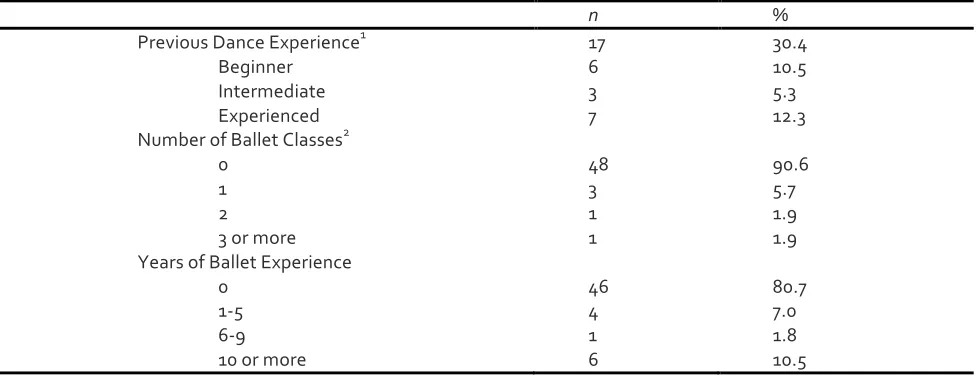
Participants were 57 female undergraduate students with a mean age of 20.59 years (SD = 3.81), mean height was 167.66 cm (SD = 7.63), mean weight of 63.05 kg (SD = 13.03), and mean body mass index of 22.43 kg/m2 (SD = 3.70). The majority of participants self-‐identified as Caucasian (94.7%), and less than one third had previous
dance experience (30.4%). Among those participants who self-‐reported previous dance experience, the most commonly identified dance styles were hip hop, lyrical, jazz, and ballet. Information pertaining to dance history appears in Table 1.
Measures and Materials
Demographics. A general demographics measure was used to collect information on age, height, weight, sociocultural information, as well as previous dance and ballet experience.
Self-‐compassion. The 26-‐item Self-‐Compassion Scale (SCS; Neff, 2003a) was used to measure the degree to which individuals extend compassion toward the self. The SCS includes six subscales: Self-‐Kindness (5-‐items; e.g., “I’m tolerant of my own flaws and inadequacies”), Self-‐Judgment (5-‐items; e.g., “When I see aspects of myself that I don’t like, I get down on myself”), Common Humanity (4-‐items; e.g., “I try to see my failings as part of the human condition”), Isolation (4-‐items; e.g., “When I fail at something that's important to me, I tend to feel alone in my failure”),
Mindfulness (4-‐items; e.g., “When I'm feeling down I try to approach my feelings with curiosity and openness”), and Over-‐Identification (4-‐items; e.g., “When something painful happens I tend to blow the incident out of proportion”). Responses are based on a 5-‐point scale ranging from 1 (almost never) to 5 (almost always). An overall self-‐ compassion score (total self-‐compassion) is determined by reverse coding responses to negatively worded items before calculating a total mean (Neff, 2003a). Scores on the SCS have demonstrated evidence of validity and reliability (Leary et al., 2007; Neff, 2003a; Neff, Hseih, & Dejitthirat, 2005).
Social physique anxiety. The Social Physique Anxiety Scale (SPAS; Hart et al., 1989) is a 12-‐item measure of the degree of anxiety that people experience in response to others’ evaluations of their physiques (e.g., “In the presence of others, I feel apprehensive about my physique/figure”). The measure is rated on a 5-‐point scale ranging from 1 (not at all) to 5 (extremely). Responses to each item are summed to create an overall SPAS score, with higher scores indicating greater social physique anxiety. Scores on the SPAS have demonstrated evidence of validity, internal consistency, and test-‐retest reliability (Crawford & Eklund, 1994; Diehl, Johnson, Rogers, & Petrie, 1998; Hart et al., 1989; Reel & Gill, 1996). Martin Ginis, Rejeski, Leary, McAuley, and Bane (1997) recommended r
educing the SPAS to a nine-‐item measure by removing three statements, as modification does not compromise the reliability or validity of the scale. The relationship between the 12-‐ and 9-‐item versions was r
= .96, indicating that both versions of the SPAS are valid and reliable (Thompson & Chad, 2002). The 9-‐item version of the scale was used in the current study.
Fear of negative evaluation. The brief version of Watson and Friend’s (1969) Fear of Negative Evaluation scale (FNE; Leary, 1983a) was used to measure the degree to which individuals experience apprehension of the possibility of being negatively evaluated (e.g., “I am concerned about other people’s opinions of me”). The brief FNE scale is a 12-‐item measure with a 5-‐point scale ranging from 1 (not at all) to 5 (extremely). Eight of the scales’
negatively worded items were replaced with
straightforward worded items, as recommended by Carleton et al. (2006). Scale items are summed to obtain the total score, with higher scores signifying greater fear of negative evaluation (Leary, 1983a). The original 30-‐ item measure and brief version of the FNE scale correlate strongly (r = .96; Leary, 1983a), and scores on the brief version have demonstrated evidence of validity, internal consistency, and test-‐retest reliability (Collins, Wetra, Dozois, & Stewart, 2005; Leary, 1983a, 1983b; Watson & Friend, 1969).
Self-‐compassionate reactions, thoughts and emotions. The self-‐compassionate reactions, thoughts, and emotions scales developed by Leary et al. (2007) measure cognitive and emotional processes by which self-‐ compassionate people deal with unpleasant life events.
Seven behavioral reaction items measured how participants were likely to react to a hypothetical scenario (e.g., “I would remain relatively calm and unflustered”; Leary et al., 2007) on a 5-‐point scale from 1 (not at all) to 5 (extremely). Ratings of the Self-‐Compassionate Reactions (SCR) for highly reactive statements were reverse-‐scored, followed by summing all reactions to achieve an index of behavioural equanimity (Leary et al., 2007).
Six items assessed how likely participants would be to think Self-‐Compassionate Thoughts (SCT; Leary et al., 2007) on a 5-‐point scale from 1 (not at all) to 5 (extremely). Similar to Leary et al. (2007), the items were placed into four subscales: catastrophizing (1 item; i.e., “This is awful”); personalizing (2 items; e.g., “I am such a loser”); equanimity (2 items; e.g., “Everybody goofs up now and then”); and, humor (1 item; i.e., “This is sort of funny”). Higher scores on positive thoughts (i.e., humor and equanimity) and lower scores on negative thoughts (i.e., catastrophizing and personalizing) indicated greater self-‐compassionate thoughts in reaction to the hypothetical scenario.
The measure of Self-‐Compassionate Emotions (SCE) began with the question, “How good or bad would you feel about what happened?”, and participants rated their response on a 12-‐point scale from 1 (extremely bad) to 12 (extremely good; Leary et al., 2007). Participants then rated the degree to which they would experience 20 different feelings across five emotions on a 7-‐point scale ranging from 1 (not at all) to 7 (extremely): sadness (4 items; e.g.,
”depressed”); anxiety (4 items; e.g., “nervous”); anger (4 items; e.g., “irritated”); embarrassment (4 items; e.g.,
“humiliated”); and, incompetence (4 items; e.g.,
“worthless”). Items within each subscale were averaged before summing the subscales to achieve a total negative affect score (Leary et al., 2007).
State social physique anxiety. State social physique anxiety in the context of the hypothetical ballet scenario was measured by the State Social Physique Anxiety Scale (S-‐SPAS), which is a modified version of the 9-‐item (Martin Ginis et al., 1997) SPAS (Hart et al., 1989). Responses are made on a 5-‐point scale from 1 (not at all) to 5 (a great deal), and are summed to achieve a total score, where higher
n %
Previous Dance Experience1 17 30.4
Beginner 6 10.5
Intermediate 3 5.3
Experienced 7 12.3
Number of Ballet Classes2
0 48 90.6
1 3 5.7
2 1 1.9
3 or more 1 1.9
Years of Ballet Experience
0 46 80.7
1-‐5 4 7.0
6-‐9 1 1.8
10 or more 6 10.5
Note. 1 Based on the past 12 months. 2 Based on the past week.
University of Saskatchewan Undegraduate Research Journal
Variable # Items RangeScale a Mean SD Reliability α
Self-‐Compassion (SCS) 26 1-‐5 3.05 0.65 .88
Social Physique Anxiety (SPAS) 9 9-‐45 27.49 8.06 .90
State Social Physique Anxiety (S-‐SPAS) 9 9-‐45 26.96 9.18 .93
Fear of Negative Evaluation (FNE) 12 12-‐60 34.46 10.57 .94
State Fear of Negative Evaluation (S-‐FNE) 12 12-‐60 31.54 11.90 .96
Behavioural Equanimity (SCR) 6 6-‐30 19.18 3.66 .69
Self-‐Compassionate Thoughts (SCT)
Catastrophizing 1 1-‐5 2.65 1.22 N/A
Personalizing 2 1-‐5 1.68 0.80 .60
Equanimity 2 1-‐5 3.12 1.11 .84
Humorous 1 1-‐5 3.01 1.11 N/A
Total Negative Affect (SCE) 20 5-‐35 14.43 5.71 .92b
Table 2: Descriptive statistics and scale reliabilities for self-‐compassion, social physique anxiety, state social physique
anxiety, fear of negative evaluation, state fear of negative evaluation, behavioural equanimity, self-‐compassionate thoughts, and total negative affect.
scores indicate greater state social physique anxiety. Scores on the S-‐SPAS have demonstrated evidence of validity and internal consistency (Martin Ginis, Murru, Conlin, & Strong, 2011). The items were modified slightly to be relevant to a ballet situation (e.g., “When wearing a leotard and a pair of tights in ballet class, I would feel nervous about the shape of my body”).
State fear of negative evaluation. Currently, there is no situational measure of fear of negative evaluation, so the State Fear of Negative Evaluation scale (S-‐FNE) was adapted from the brief 12-‐item FNE scale (Leary, 1983a). Items on the S-‐FNE scale were modified from the original FNE to be relevant to a ballet situation (e.g., “I would worry that I would say or do the wrong things in ballet class”).
Hypothetical scenario. The hypothetical ballet scenario was developed in consultation with members of the sport, health, and exercise psychology lab in the College of Kinesiology at the University of Saskatchewan. Lab members consisted of graduate students and faculty members with experience in scenario-‐based research. The scenario specifically referred to three evaluative components of dance: a mirrored environment, dance attire, and an individual performance (i.e., “It is your first day of beginner ballet class. You come to class dressed in a tight leotard [similar to a one-‐piece bathing suit] and a pair of tights. As you walk into the studio, you notice an entire wall is covered in floor-‐to-‐ceiling mirrors and there are many other beginner dancers present. At the start of class, the dance instructor begins to teach a routine, which you are expected to
perform individually in front of the group at the end of class”).
Design and Procedure
After receiving institutional ethical approval, participants were recruited from two undergraduate Kinesiology classes at the University of Saskatchewan to participate in this cross-‐sectional study. Participants were emailed a secure link to an online survey, which included informed consent, the demographics measure, the SCS, the SPAS, and the FNE scale. The hypothetical ballet scenario was then presented followed by the remaining measures (SCR, SCT, SCE, S-‐SPAS, and S-‐FNE scale) representing the participants’ responses to the scenario. The participants also rated “how bad” they would perceive the hypothetical experienced it on a 12-‐point scale from 1 (extremely bad) to 12 (extremely good).
Data Analysis
Prior to hypothesis testing, the data were inspected for normality (i.e., skewness and kurtosis values), and internal consistency of scales was examined via Cronbach’s alpha. Pearson correlations were used to examine trait-‐level relationships between self-‐compassion, social physique anxiety, and fear of negative evaluation (Hypothesis 1), as well as relationships between self-‐compassion and state-‐ level self-‐evaluative processes (i.e., state social physique anxiety, state fear of negative evaluation, total negative affect, and catastrophizing personalizing thoughts) in
Note. SCS = Self-‐Compassion Scale. SPAS = Social Physique Anxiety Scale. S-‐SPAS = State Social Physique Anxiety Scale. FNE = Fear of Negative Evaluation.
S-‐FNE = State Fear of Negative Evaluation. SCR = Self-‐Compassionate Reactions. SCT = Self-‐Compassionate Thoughts. SCE = Self-‐ Compassionate
Emotions. aScale range refers to the lowest and highest possible score on each scale. bTotal negative affect reliability was reported by the total of the
Variable 1 2 3 4 5a. 5b. 5c. 5d. 6 7
1. Self-‐compassion (SCS) -‐-‐-‐
2. Social Physique Anxiety (SPAS) -‐.67* -‐-‐-‐
3. Fear of Negative Evaluation (FNE) -‐.69* .59* -‐-‐-‐
4. Behavioural Equanimity (SCR) .46* -‐.29* -‐.43* -‐-‐-‐
5. Self-‐Compassionate Thoughts (SCT)
a. Catastrophizing -‐.39* .25 .33* -‐.68* -‐-‐-‐
b. Equanimity .35 -‐.20 -‐.15 .40* -‐.28* -‐-‐-‐
c. Personalizing -‐.50* .30* .37* -‐.44* .58* -‐.28* -‐-‐-‐
d. Humorous .25 -‐.27* -‐.13 .25 -‐.23 .68* -‐.25 -‐-‐-‐
6. Total Negative Affect (SCE) -‐.61* .46* .50* -‐.69* .74* -‐.38* .67* -‐.38* -‐-‐-‐ 7. State Social Physique Anxiety (S-‐SPAS) -‐.60* .85* .51* -‐.31* .41* -‐.11 .45* -‐.20 .54* -‐-‐-‐ 8. State Fear of Negative Evaluation
(S-‐FNE) -‐.67* .60* .81* -‐.51* .49* -‐.24 .53* -‐.20 .73* .63*
Table 3: Pearson correlations for self-‐compassion, social physique anxiety, fear of negative evaluation, behavioural
equanimity, self-‐compassionate thoughts, total negative affect, state social physique anxiety, and state fear of negative evaluation.
Note. Degrees of freedom = 55. SCS = Self-‐Compassion Scale. SPAS = Social Physique Anxiety Scale. FNE = Fear of Negative Evaluation. SCR = Self-‐
Compassionate Reactions. SCT = Self-‐Compassionate Thoughts. SCE = Self-‐Compassionate Emotions. S-‐SPAS = State Social Physique Anxiety Scale.
S-‐FNE = State Fear of Negative evaluation.
*p < .005
response to a hypothetical evaluative ballet scenario (Hypothesis 2). Due to multiple correlations examined on the same sample, a Bonferonni adjustment was used to adjust the alpha level during hypothesis testing to reduce the probability of type I errors (Vincent, 1999).
Results
Scale Reliabilities and Descriptive Statistics
Table 2 contains scale reliabilities and descriptive statistics for all study variables. The low internal consistency (i.e., α = .60) of the 2-‐item personalizing subscale of SCT is likely an artifact of the reliability of each item significantly influencing the other item. The initially low internal consistency of SCR (i.e., α = .45) was improved (i.e., α = .69) after deleting item three1 and creating a new composite.
Missing Data and Evaluation of Assumptions
Prior to statistical analysis, nine participants were removed from the data set due to incomplete data (i.e., missing more than one data point on the same subscale), resulting in the final sample size of 57 participants. An additional 17 participants were missing data. Specifically, eleven participants were missing one data point, five
participants were missing two data points (i.e., not from the same subscale), and one participant was missing four data points on different subscales. Within-‐person mean replacement was used to substitute the missing data.
Test of Hypotheses
Hypothesis 1. As hypothesized, total self-‐compassion was negatively correlated (all p < .005) with both social physique anxiety, r (55) = -‐.67, and fear of negative evaluation r (55) = -‐.69. Correlations among all study variables are presented in Table 3.
Hypothesis 2. Self-‐compassion was correlated with participants’ responses to the hypothetical scenario in hypothesized ways. Specifically, total self-‐compassion was negatively correlated (all p < .005) with state social physique anxiety, r (55) = -‐.60, and state fear of negative evaluation, r
(55) = -‐.67. Self-‐compassion was also negatively correlated with total negative affect, r (55) = -‐.61, personalizing thoughts, r (55) = -‐.50, and catastrophizing thoughts, r (55) = -‐.39, as well as positively correlated with behavioural equanimity, r (55) = .46. The only hypothesized relationships that were not supported was between self-‐ compassion and thoughts of equanimity, p = .008, and humorous thoughts, p = .07.
1 Item three on the SCR (Leary et al., 2007) measured how
University of Saskatchewan Undegraduate Research Journal
Discussion
The current study supports the position that self-‐ compassion might help women better manage evaluative processes in the physical activity domain (Mosewich et al., 2011). Negative relationships between self-‐compassion and both trait social physique anxiety and fear of negative evaluation (i.e., Hypothesis 1) have previously been reported with women exercisers (Magnus et al., 2010) and athletes (Mosewich et al., 2011). Our results support a growing body of literature that extending compassion toward the self is associated with lower negative outcomes that rely heavily on self-‐evaluative processes (Magnus et al., 2010). Given that self-‐presentation concerns, such as social physique anxiety, originate from self-‐evaluative concerns, extending compassion toward oneself might offer young women a sense of self-‐worth that is not based on external standards or evaluations (Crawford & Eklund, 1994; Magnus et al., 2010; Neff et al., 2005).
One way that self-‐compassion might reduce the harmful effects of self-‐evaluation and promote a healthy self-‐attitude is by neutralizing negative emotional patterns and transforming them into positive states of mind (Neff et al., 2005). In a series of studies, Leary et al. (2007) found that self-‐compassion moderates reactions to distressing situations and negative life events, including situations involving failure, rejection, and embarrassment. Pertinent to our research, Leary et al. found that self-‐compassionate people accept responsibility for negative life events, yet are less likely to ruminate about unpleasant evaluations or experience negative affect about their mistakes. Our research is consistent with and extends the findings from Leary et al., as having greater self-‐compassion was associated with less negative affect, as well as state social physique anxiety, state fear of negative evaluation, and personalizing and catastrophizing thoughts in response to the hypothetical evaluative ballet scenario (i.e., Hypothesis 2). Moreover, positive relationships between self-‐ compassion and behavioural equanimity support the position that self-‐compassionate individuals tend to react to negative events in ways that reduce their impact (Leary et al., 2007). Taken together, the pattern of findings suggest that women who extend compassion toward the self might be better equipped to deal with the evaluative components in an introductory ballet class environment.
Self-‐compassionate individuals understand that their weaknesses and failings do not have to define them, and that their self-‐worth is not dependent on evaluations and outcomes (Leary et al., 2007). Applying this logic to the current study, and specifically within the confines of the hypothetical ballet scenario, women with greater self-‐ compassion may not base their self-‐worth on their appearance and performance in a ballet class. For example, if one’s self-‐worth were not dictated by the outcome of an
individual ballet performance, decreased negative self-‐ evaluative thoughts and emotions would likely be evident. Extending compassion toward the self provides a safe and nonjudgmental context to confront negative aspects of the self (Breines & Chen, 2012), allowing for greater kindness and acceptance of the self aside from the outcome of the ballet performance. This conclusion is supported by our findings (i.e., Hypothesis 2), as women with greater self-‐ compassion exhibited lower levels of negative self-‐ evaluations in response to an evaluative ballet scenario. Finding that self-‐compassion is related to lower negative self-‐evaluations and their consequences in dance may even have implications on young women not yet participating in ballet. Rather than evade an evaluative environment (Raedeke et al., 2007), self-‐compassion may offer young women the kind, understanding, and nonjudgmental attitude needed to protect against the perceived threat of evaluation in dance.
Our study contributes to an emerging body of literature suggesting that self-‐compassion contributes to positive body image. Wasylkiw et al. (2012) found that women who reported being self-‐compassionate tended to report greater satisfaction with their physical selves in the form of decreased body preoccupation, fewer concerns about weight, and increased body appreciation. Our results suggest that self-‐compassionate women experience lower anxiety around their physique and fear of being negatively evaluated both generally and in response to an evaluative ballet scenario. Although the cross-‐sectional design of our research precludes implications of directionality of relationships between study variables, our findings contribute to previous conclusions that self-‐compassion is associated with reduced negative or difficult body-‐related emotions and experiences (Wasylkiw et al., 2012). The process of being self-‐compassionate lends itself to buffering a potentially threatening body image experience. Individuals who extend compassion toward the self are likely aware of the evaluative experience, recognize that other individuals encounter similar situations, and respond with acceptance and kindness rather than being harshly self-‐critical. Indeed, Berry et al. (2010) explored women exercisers’ experiences of self-‐compassion toward the physical self and found that consciously taking responsibility to take care of one’s body, engaging in less social comparison, and appreciating one’s unique beauty and unique body type are indicative of body self-‐ compassion.
developed Compassionate Mind Training as a therapeutic technique for individuals to overcome habitual self-‐attacks; and, Neff and Germer (2013) designed a Mindful Self-‐ Compassion program to promote well-‐being. Most pertinent to the current study, Mosewich, Crocker, Kowalski, and DeLongis (2013) developed a seven-‐day self-‐ compassion in sport intervention that focused on processing negative events in sport with a self-‐ compassionate mindset. Through psychoeducation and writing modules, the intervention was shown to be effective in managing women athletes’ self-‐criticism, rumination, and concern over mistakes. Mosewich et al. (2013) concluded that promoting self-‐compassionate mind-‐frames seems to hold merit in helping women athletes manage difficult sport experiences. However, the application of any of these interventions specifically to dance is currently unknown.
As with all research, our study has its limitations. The inclusion of a hypothetical scenario might not have as much of an impact on an individual compared to personal recollections or real life events. However, the use of a hypothetical scenario provided systematic consistency in our research, and the scenario had some evaluative features as indicated by the participants’ rating of “how bad” the scenario was (M = 6.63, SD = 2.53). The cross-‐sectional study design limited hypothesis testing, which resulted in utilizing Pearson correlations to test for relationships between study variables as opposed to changes in study variables. Furthermore, the amount of shared variance among study variables ranged from 15% between self-‐ compassion and thoughts of equanimity (r2 = .15) and 48% between self-‐compassion and fear of negative evaluation (r2 = .48), which represent small and moderate effect sizes in
our study (Cohen, 1988). The study design, and subsequent statistical analysis, precludes any indication of cause and effect. Interpretation of our study findings is premised on a theoretical understanding that having a compassionate self-‐attitude can transform difficult and negative thoughts and behaviours (Neff, 2003b), and our implied directionality is informed by previous research showing that self-‐ compassion is modifiable and can influence psychosocial processes (Leary et al., 2007; Mosewich et al., 2013). However, given our cross-‐sectional study design, it is possible that, in contrast to our interpretation, individuals with lower self-‐evaluative thoughts and behaviours have corresponding higher levels of self-‐compassion. Another limitation pertains to the dance demographics of our sample, as the hypothetical scenario may have had different meaning and relevance to women with different levels of dance experience. However, previous self-‐ compassion research has included hypothetical scenarios that participants may or may not have personally experienced (e.g., Ferguson, Kowalski, Mack, & Sabiston, 2015; Leary et al., 2007).
To address study limitations, future research with advanced designs could examine if a similar pattern of findings emerges in a real life dance environment, as well as study designs that permit causal inferences through an experimental design (e.g., pretest-‐posttest design control-‐ group design; Creswell, 2014). Investigating the role of self-‐ compassion on self-‐evaluative thoughts and behaviours in different levels of dance would also provide insight into which dancers may benefit the most from self-‐compassion. Identifying who would benefit most from adopting a compassionate self-‐attitude to cope with evaluative experiences is imperative in developing self-‐compassion interventions and programs that target the most appropriate audience. In conclusion, the results from our study provide further support for the promise of self-‐ compassion as a way to cope with emotionally painful experiences in evaluative environments. We have provided empirical evidence that suggests self-‐compassion may protect against the evaluative components of the dance environment by better equipping young women to deal with the unhealthy and evaluative thoughts and emotions they may experience.
References
Berry, K.-‐A., Kowalski, K. C., Ferguson, L. J., & McHugh, T.-‐ L. F. (2010). An empirical phenomenology of young adult women exercisers’ body self-‐compassion.
Qualitative Research in Sport and Exercise, 2(3), 293-‐ 312. doi:10.1080/19398441.2010.517035
Breines, J. G., & Chen, S. (2012). Self-‐compassion increases self-‐improvement motivation. Personality and Social Psychology Bulletin, 38, 1133-‐1143.
doi:10.1177/014616721244 5599
Carleton, R. N., McCreary D. R., Norton, P. J., & Asmundson, G. J. G. (2006). Brief Fear of Negative Evaluation Scale – revised. Depression and Anxiety, 23, 297-‐303. doi:10.1002/ da.20142
Cassady, H., Clarke, G., & Latham, A. M. (2004).
Experiencing evaluation: A case study of girls’ dance.
Physical Education and Sport Pedagogy, 9(1), 23-‐36. doi:10.1080/17408980 42000208106
Clabaugh, A., & Morling, B. (2004). Stereotype accuracy of ballet and modern dancers. Journal of Social
University of Saskatchewan Undegraduate Research Journal Collins, K. A., Westra, H. A., Dozois, D. J. A., Stewart, S. H.
(2005). The validity of the brief version of the Fear of Negative Evaluation Scale. Anxiety Disorders, 19, 345-‐ 359. doi:10. 1016/j.janxdis.2004.02.003
Crawford, S., & Eklund, R. C. (1994). Social physique anxiety, reasons for exercise, and attitudes towards exercise settings. Journal of Sport & Exercise Psychology, 16, 70-‐82.
Creswell, J. W. (2014). Research design: Qualitative, quantitative, and mixed methods approaches (4th ed.). Thousand Oaks, CA: Sage.
Dearborn, K., Harring, K., Young, C., & O’Rourke, E. (2006). Mirror and phrase difficulty influence dancer attention and body dissatisfaction. Journal of Dance Education, 6(4), 116-‐123. doi:10.1080/15290824.2006.10387324
Diehl, N. S., Johnson, C. E., Rogers, R. L., & Petrie, T. A. (1998). Social physique anxiety and disordered eating: What’s the connection? Addictive Behaviors, 23(1), 1-‐6. doi:10.1016/ S0306-‐4603(97)00003-‐8
Druss, R. G., & Silverman, J. A. (1979). Body image and perfectionism of ballerinas: Comparison and contrast with anorexia nervosa. General Hospital Psychiatry, 1(2), 115-‐121. doi:10.1016/0163-‐8343(79)90056-‐2
Ferguson, L. J., Kowalski, K. C., Mack, D. E., & Sabiston, C. M. (2015). Self-‐compassion and eudaimonic well-‐being during emotionally difficult times in sport. Journal of Happiness Studies, 16, 1263-‐1280. doi:10.1007/s10902-‐ 014-‐9558-‐8
Gammage, K. L., Martin Ginis, K. A., & Hall, C. R. (2004). Self-‐presentational efficacy: Its influence on social anxiety in an exercise context. Journal of Sport & Exercise Psychology, 26, 179-‐190.
Gilbert, P., & Procter, S. (2006). Compassionate mind training for people with high shame and self-‐criticism: Overview and pilot study of a group therapy approach.
Clinical Psychology and Psychotherapy, 13, 353-‐379. doi:10.1002/cpp.507
Hart, E. A., Leary, M. R., & Rejeski, W. J. (1989). The measurement of social physique anxiety.
Journal of Sport & Exerci.se Psychology, 11(1), 94-‐104.
Katula, J. A., McAuley, E., Mihalko, S. L., & Bane, S. M. (1998). Mirror, mirror on the wall… exercise environment influences on self-‐efficacy. Journal of Social Behavior and Personality, 13, 319-‐332.
Kowalski, K. C., Mack, D. E., Crocker, P. R. E., Neifer, C. B., & Fleming, T. L. (2006). Coping with social physique anxiety in adolescence. Journal of Adolescent Health, 39, 275-‐275. doi:10.1016/j.jadohealth.2005.12.015
Kruisselbrink, L. D., Dodge, A. M., Swanburg, S. L., & MacLeod, A. L. (2004). Influence of same-‐sex and mixed-‐sex exercise settings on the social physique anxiety and exercise intentions of males and females.
Journal of Sport & Exercise Psychology, 26(4), 616-‐622.
Leary, M. R. (1983a). A brief version of the Fear of Negative Evaluation Scale. Personality and Social Psychology Bulletin, 9, 371-‐375. doi:10.1177/0146167283093007
Leary, M. R. (1983b). Social anxiousness: The construct and its measurement. Journal of Personality Assessment, 47, 66-‐75. doi:10.1207/s15327752jpa4701_8
Leary, M. R., Tate, E. B., Adams, C. E., Allen, A. B., & Hancock, J. (2007). Self-‐compassion and reactions to unpleasant self-‐relevant events: The implications of treating oneself kindly. Journal of Personality and Social Psychology, 92(5), 887-‐904. doi:10.1037/0022-‐ 3514.92.5.887
Magnus, C. M. R., Kowalski, K. C., & McHugh, T.-‐L. F. (2010). The role of self-‐compassion in women’s self-‐ determined motives to exercise and exercise-‐related outcomes. Self and Identity, 9, 363-‐382.
doi:10.1080/15298860903135073
Martin Ginis, K. A., Murru, E., Conlin, C., & Strong, H. A. (2011). Construct validation of the state version of the Social Physique Anxiety Scale among young women.
Body Image, 8, 52-‐57.
doi:10.1016/j.bodyim.2010.10.001
Martin Ginis, K. A., Prapavessis, H., & Haase, A. M. (2008). The effects of physique-‐salient and physique non-‐ salient exercise videos on women’s body image, self-‐ presentational concerns, and exercise motivation.
Body Image, 5, 164-‐172. doi:10.1016/j.bodyim.2007. 11.005
Martin Ginis, K. A., Rejeski, W. J., Leary, M. R., McAuley, E., & Bane, S. (1997). Is the Social Physique Anxiety Scale really multidimensional? Conceptual and statistical arguments for a unidimensional model. Journal of Sport & Exercise Psychology, 19(4), 359-‐367.
Mesagno, C., Harvey, J. T., & Janelle, C. M. (2012). Choking under pressure: The role of fear of negative evaluation.
Psychology of Sport and Exercise, 13(1), 60-‐68. doi:10.1016/j.psych sport.2011.07.007
Mosewich, A. D., Crocker, P. R. E., Kowalski, K. C., & DeLongis, A. (2013). Applying self-‐compassion in sport: An intervention with women athletes. Journal of Sport & Exercise Psychology, 35, 514-‐524.
Mosewich, A. D., Kowalski, K. C., Sabiston, C. M., Sedgwick, W. A., & Tracy, J. L. (2011). Self-‐compassion: A
potential resource for young women athletes. Journal of Sport & Exercise Psychology, 33, 103-‐123.
Neff, K. D. (2003a). Development and validation of a scale to measure self-‐compassion. Self and Identity, 2, 223-‐ 250. doi:10.1080/15298860390209035
Neff, K. D. (2003b). Self-‐compassion: An alternative conceptualization of a healthy attitude toward oneself. Self and Identity, 2, 85-‐102.
doi:10.1080/15298860390129863
Neff, K. D., & Germer, C. K. (2013). A pilot study and randomized controlled trial of the mindful self-‐ compassion program. Journal of Clinical Psychology, 69, 28-‐44. doi:10.1002/jclp.21923
Neff, K. D., Hseih, Y., & Dejitthirat, K. (2005). Self-‐ compassion, achievement goals, and coping with academic failure. Self and Identity, 4, 263-‐287. doi:10.1080/13576500444000317
Neff, K. D., Kirkpatrick, K., & Rude, S. S. (2007). Self-‐ compassion and its link to adaptive psychological functioning. Journal of Research in Personality, 41, 139-‐ 154. doi:10.1016/ j.jrp.2006.03.004
Neff, K. D., & Vonk, R. (2009). Self-‐compassion versus global self-‐esteem: Two different ways of relating to oneself. Journal of Personality, 77, 23-‐50.
doi:10.1111/j.1467-‐6494.2008. 00537.x
Price, B. R., & Pettijohn, T. F. II. (2006). The effect of ballet dance attire on body and self-‐perceptions of female dancers. Social Behavior and Personality, 34(8), 991-‐ 998.
Radell, S. A., Adame, D. D., Cole, S. P., & Blumenkehl, N. J. (2011). The impact of mirrors on body image and performance in high and low performing female ballet students. Journal of Dance Medicine and Science, 15(3), 108-‐115.
Raedeke, T. D., Focht, B. C., & Scales, D. (2007). Social environmental factors and psychological responses to acute exercise for socially physique anxious females.
Psychology of Sport and Exercise, 8, 463-‐476. doi:10.1016/j.psychsport.2006.10.005
Ravaldi, C., Vannacci, A., Bolognesi, E., Mancini, S., Faravelli, C., & Ricca, V. (2006). Gender role, eating disorder symptoms, and body image concern in ballet dancers. Journal of Psychosomatic Research, 61, 529-‐ 535. doi:10.1016/j.jpsychores.2006.04.016
Reel, J. J., & Gill, D. L. (1996). Psychosocial factors related to eating disorders among high school and college female cheerleaders. The Sport Psychologist, 10, 195-‐ 206.
Ridgers, N. D., Fazey, D. M. A., & Fairclough, S. J. (2007). Perceptions of athletic competence and fear of negative evaluation during physical education. British Journal of Educational Psychology, 77(2), 339-‐349. doi:10.1348/026151006X128909
Spink, K. (1992). Relation of anxiety about social physique to location of participation in physical activity.
Perceptual and Motor Skills, 74, 1075-‐1078. doi:10.2466/pms.1992.74. 3c.1075
Speilberger, C. D. (1966). Theory and research on anxiety. In C. D. Speilberger (Ed.), Anxiety and behavior (pp. 3-‐22). New York: Academic.
Thompson, A. M., & Chad, K. E. (2002). The relationship of social physique anxiety to risk for developing eating disorder in young females. Journal of Adolescent Health, 31(2), 183-‐189. doi:10.1016/S1054-‐ 139X(01)00397-‐4
Tiggemann, M., & Slater, A. (2001). A test of objectification theory in former dancers and non-‐dancers. Psychology of Women Quarterly, 25(1), 57-‐64. doi:10.1111/1471-‐ 6402.00007
Vincent, W. J. (1999). Statistics in kinesiology (2nd ed.). Champaign, IL: Human Kinetics.
Wasylkiw, L., MacKinnon, A. L., & MacLellan, A. M. (2012). Exploring the link between self-‐compassion and body image in university women. Body Image, 9, 236-‐245. doi:10.1016/ j.bodyim.2012.01.007