Vol. 48, No. 2, Fall 2016, pp. 93-101
Please cite this article using:
Kazemi, A., Talebi, A., and Oroojeni Mohammad-Javad, M., 2016. “Analysis of Critical Paths in a Project Network with Random Fuzzy Activity Times”. Amirkabir International Journal of Modeling,
Identification, Simulation and Control, 48(2), pp. 93–101. DOI: 10.22060/miscj.2016.831
URL: http://miscj.aut.ac.ir/article_831.html
*Corresponding Author, Email: [email protected]
Analysis of Critical Paths in a Project Network with Random
Fuzzy Activity Times
A. Kazemi1,*, A. Talebi2, M. Oroojeni Mohammad-Javad3
1- Assistant Professor, Faculty of Industrial and Mechanical Engineering, Islamic Azad University (Qazvin Branch) 2- M.Sc., Faculty of Industrial and Mechanical Engineering, Islamic Azad University (Qazvin Branch) 3- Ph.D., Department of Mechanical and Industrial Engineering, Northeastern University, Boston, USA
(Received 19 March 2016, Accepted 12 July 2016)
In this paper, a new approach for the critical path analyzing a project network with random fuzzy activity times has been proposed. The activity times of a project are assumed to be random fuzzy. Linear pro-gramming formulation has been applied to determine the critical path. The critical path method (CPM) problem has been solved using the expected duration optimization model and the mean-variance model along with Liu’s definition for random fuzzy variables. Furthermore, a numerical example problem is solved to illustrate the proposed method.
KEYWORDS:
Critical Path Method (CPM), Activity Times, Random Fuzzy Time, Triangular Fuzzy Numbers, Normal Distribution
1- I
NTRODUCTION
Completing a project in its scheduled time is a critical issue for project managers. When the activity times are deterministic and known, critical path method (CPM) has been demonstrated to be a useful tool in managing projects in an efficient manner (Chen, 2007; Hillier and Liberman, 2003).
The critical path method calculates the theoretical early start and finish dates for all activities without regard to any resource limitations, by performing a forward and backward pass analysis through the schedule network (PMBOK guide, 2012). The resulting early and late start and finish state the time periods for the activity scheduling, given activity durations, logical relationships, lead, lags, and other known constraints (PMBOK guide, 2012).
In the CPM method, it is essential to have deterministic and known durations. Since activities are often uncertain and variable, these hypotheses are seldom satisfied (Zammori et al., 2009). Malcolm et al. were the first who discussed this issue and presented their method as the program evaluation and review the technique or PERT. They assumed pessimistic, most likely and optimistic times for each activity and applied Beta random variables for the activity durations, in order to handle the skewness of the project activity times (Malcolm et al., 1959; Zammori et al., 2009). In 1963, the MonteCarlo simulation methodology was also employed for the approximation of Activity Critical Indexes in a project (Van Slyke, 1963; Elmaghraby, 2000).
There are several studies which deal with the case in which the activity times in a project are not precisely known and are represented with fuzzy sets, instead of crisp numbers.
In particular, problems related to computing possible values of the latest starting times’ intervals and activities’ floats with imprecise durations represented by fuzzy or interval numbers. These studies have attracted intensively attentions and many solution methods have been proposed (Chen, 2007).
These studies replaced deterministic time activities with the fuzzy ones and the forward and backward recursions were applied based on the CPM method. However, the backward recursion fails to compute the sets of possible values of the latest starting times and floats of activities (Zielinski, 2005; Chen, 2007).
Moreover, for the same path, different definitions of the fuzzy critical path give different estimations
of the degree of criticality. Zielinski developed new polynomial algorithms for determining the intervals of the latest starting times in the general network and computed floats of activities in a network with imprecise durations (Zielinski, 2005; Chen, 2007).
Chanas and Kamburowski (1981) presented a method called Fpert for estimating a project completion time with fuzzy activity duration times in the project. Chanas and Zielinski (2001) suggested an effective new graphical method to compute total float, earliest and latest fuzzy interval times of activities in a fuzzy project network. They found the critical path of a fuzzy project network. Chanas and Zielinski (2002) discussed the complexity of criticality in a network with interval activity times. Chanas and Zielinski (2001) proposed a natural generalization of the criticality concept for project networks with interval and fuzzy time activity and some results are provided. However, as generally known, in deterministic environments, the critical path can be varied as activity times are varied in an interval. Clearly, this is indeed true under different possibility levels in fuzzy environments and it is possible that more than one critical path should be found at a certain possibility level (Chen, 2007).
project critical path problem in an environment with hybrid uncertainty. They considered that the duration of activities as random fuzzy variables that have probability and fuzzy natures, simultaneously. To solving the problem, they converted the problem into a deterministic model into two stages. Hassanzadeh et al. (2013) proposed a genetic algorithm and a model for solving fuzzy shortest path problems considering a network with mixed and various fuzzy arc lengths. Madhuri et al. (2013) developed a new fuzzy linear programming model to find a fuzzy critical path and the fuzzy completion time of a fuzzy project. They considered trapezoidal fuzzy numbers for all activities in the project network. Kaur and Kumar (2014) suggested a solution method to find the fuzzy optimal solution of fully fuzzy critical path (FFCP) problems with flat fuzzy numbers. Lin et al. (2014) used the chance theory to introduce project scheduling problem with uncertain variables. Ding and Zhu (2015) established two types of models for uncertain project scheduling problems according to different management requirements and solved them by classical optimization methods after transforming them into their crisp forms. Tseng and KO (2016) proposed a scenario-based approach with utility-entropy decision model to measure the uncertainty related to the evolution of a resource-constrained project scheduling problem with uncertain activity durations.
The rest of the paper is organized as follows. Firstly, the definition of random fuzzy variables will be explained. Then, the random fuzzy critical path formulation will be presented and the proposed model for identifying the fuzzy critical path is developed. Since it is difficult to find optimal solutions for nonlinear programming problems, the problem is transformed into a deterministic equivalent nonlinear programming problem. The problem is converted into a parametric quadratic problem using the mean-variance model and the expected duration model. Furthermore, an example with random fuzzy activity times is solved successfully to illustrate the validity of the proposed method. In culmination, future research problems will be discussed.
2- R
ANDOM
F
UZZY
V
ARIABLE
In this section, some basic concepts of the random fuzzy theory are stated before modeling random
fuzzy CPM problem. More concepts and important properties of random fuzzy theory can be found in (Liu, 2004).
At first, the concepts of possibility, necessity, and credibility of a fuzzy event are recalled. Let ε
be a fuzzy variable with membership function l (Ke and Liu, 2007). Then the possibility, necessity, and credibility of a fuzzy event are defined as follows (Ke and Liu, 2007):
(1)
(2)
(3) Note that a fuzzy event may fail even though its possibility achieves 1 and holds even though its necessity is 0. However, the fuzzy event must hold if its credibility is 1 and fails if its credibility is 0 (Ke and Liu, 2007). Based on a credibility measure, the concept of the expected value of a fuzzy variable can be given as follows:
Definition 1: Let ε be a fuzzy variable. The expected value of ε is defined by (Ke and Liu, 2007):
(4)
provided that at least one of the above two integrals is finite.
Before stating the concept of a random fuzzy variable, the definition of a possibility space is given.
Definition 2: Let θ be a nonempty set, ρ(θ) the power set of θ and Pos a possibility measure. Then the triplet (θ, ρ(θ) , pos) is called a possibility space (Ke and Liu, 2007).
Definition 3: A random fuzzy variable ε is a function from the possibility space (θ, ρ(θ) , pos) to the set of random variables (Ke and Liu, 2007).
In a project, some activity duration time ε may be known as a random variable with normal distribution
N(ρ,r) except that the mean ρ is unknown. With the knowledge of some experts, ρ can be estimated and given as a fuzzy variable and activity duration time ε
is a random fuzzy variable.
(5)
provided that at least one of the above two integrals is finite (Ke and Liu, 2007).
Definition 5: Let ε be a random fuzzy variable on the possibility space (θ, ρ(θ) , pos), and B a Borel set of
R. Then the chance of random fuzzy event εϵB is a function from (0,1] to [0,1], defined as (Ke and Liu, 2007):
(6)
Definition 6: Let ε be a random fuzzy variable, and
γ,δϵ(0,1]. Then (Ke and Liu, 2007):
(7) is called the (γ,δ) – optimistic value to ε, and:
(8) is called the (γ,δ) – pessimistic value to ε. With the above concepts, we can model the random fuzzy CPM problems.
3-
R
ANDOM
F
UZZY
C
RITICAL
P
ATH
F
ORMULATION
Consider a project network S=[V,A,t] consisting of a finite set V of nodes (events) and a set A⊂V×V of arcs with crisp activity times, which are determined by a function t: A→R+ and attached to the arcs.
Denote tij as the time period of activity (i,j)ϵA. The CPM is a network-based method designed to assist in the planning, scheduling, and controlling of the project (Chen, 2007).
(9)
Consequently, in a project with random fuzzy activity times, the sum of all tij which are the coefficients of the objective function of (9) would make the total duration time D random fuzzy. Then by using this aspect, the CPM problem is modified with random fuzzy parameters in the objective function (Chen, 2007).
Therefore, in this study, we deal with the problem (10) which is based on the conventional CPM problem in (9) to maximize the total duration time. In this research, the proposed model is suggested as follows:
(10)
where:
xij: The decision variable denoting the amount of flow in activity (i,j)ϵA
T̃̅ij: Random fuzzy duration of activity (i,j)ϵA n: Number of nodes in the projects network
4-
T
HE
P
ROPOSED
A
PPROACH
In this study, the random distribution is assumed to be Normal.
However, lacking efficient information, an ambiguity for durations is assumed. The probability function of each duration is represented by the following form based on the introduction obtained by (Hasuike et al., 2010):
(11)
(12)
where L(x) and R(x) both are functions of strictly decreasing and continuous. L(0)=R(0)=1,
L(1)=R(1)=0 and the parameters αij and βij represent the spreads corresponding to the left and the right sides, respectively. Also, both parameters are positive (Hasuike et al, 2010). When the duration T̃̅ij is a random fuzzy variable characterized by µMij
( )
t , the(13)
where Γ is a universal set of normal random variable. Each membership function value µ τTij
( )
ij isinterpreted as a degree of possibility or compatibility that T̃̅ij is equal to τ̄ij (Hasuike et al., 2010). Then, the objective function
1 1
n n
ij ij
i j
Z T x
= =
=
∑∑
is defined as a
random fuzzy variable characterized by the following membership function on the fixed parameters xij
(Hasuike et al, 2010):
(14) where τ̅=(τ1,τ2,...,τn) and Y is defined by (Hasuike et al., 2010):
(15)
From these two equations, we obtain (Hasuike et al., 2010):
(16)
where S= (S1,…,Sn).
In this model, the problem (10) is not a well-defined problem because of including random fuzzy variable durations. Thus, we need to set a criterion with respect to probability and possibility of future returns for the deterministic optimization (Hasuike et al., 2010). In general, decision cases with respect to CPM Defining problems, a project owner usually focuses on completing the project in the defined time or earlier than that time. Therefore, we propose a single criteria random fuzzy CPM problem introducing the chance constraint, the expected duration maximization model, and the mean-variance model.
(17)
In this problem, Ẽ(z) means an expected duration
derived from the following expression (Hasuike et al., 2010):
(18)
This means that Ẽ(z) is expressed with a fuzzy set. Consequently, problem (17) is a fuzzy optimization problem or critical path definition problem and is solved by using the results of previous studies on fuzzy portfolio selection models carried out by Hasuike et al. (Hasuike et al., 2010). The following mean-variance model is also introduced:
This means dα is the fuzzy critical path that is determined by the α defined by the project owner. V(z)
means a variance and ( ) 2
1 1
n n ij ij i j
V z x σ
= =
=
∑∑
due to excluding random and fuzzy variables in each variance (Hasuike et al., 2010). Therefore, problem (18) is equivalently transformed into the following problem (Hasuike et al., 2010):(19)
This problem is also a fuzzy CPM problem due to Ẽ(z) involving fuzzy numbers. In this method, the deterministic duration of a project and its variance could be determined according to different values of
α defined by the project owner.
5-
N
UMERICAL
E
XAMPLE
Now let us consider a project network as shown in Fig. 1. (Liu, 2007)
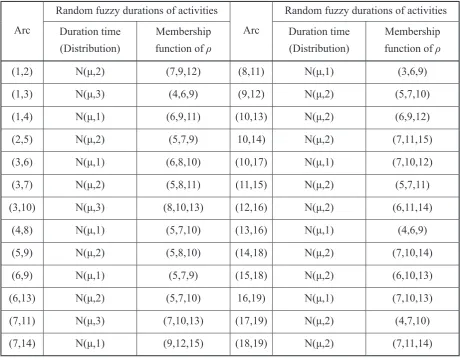
The activity durations in this project are assumed random fuzzy. The duration times for the activities are presented and denoted by a form of normal distribution N(ρ,s) where s is a given crisp number and
Fig. 1. A project
Table 1. Random fuzzy duration times of activities
Arc
Random fuzzy durations of activities
Arc
Random fuzzy durations of activities Duration time
(Distribution)
Membership function of ρ
Duration time (Distribution)
Membership function of ρ
(1,2) N(μ,2) (7,9,12) (8,11) N(μ,1) (3,6,9)
(1,3) N(μ,3) (4,6,9) (9,12) N(μ,2) (5,7,10)
(1,4) N(μ,1) (6,9,11) (10,13) N(μ,2) (6,9,12)
(2,5) N(μ,2) (5,7,9) 10,14) N(μ,2) (7,11,15)
(3,6) N(μ,1) (6,8,10) (10,17) N(μ,1) (7,10,12)
(3,7) N(μ,2) (5,8,11) (11,15) N(μ,2) (5,7,11)
(3,10) N(μ,3) (8,10,13) (12,16) N(μ,2) (6,11,14)
(4,8) N(μ,1) (5,7,10) (13,16) N(μ,1) (4,6,9)
(5,9) N(μ,2) (5,8,10) (14,18) N(μ,2) (7,10,14)
(6,9) N(μ,1) (5,7,9) (15,18) N(μ,2) (6,10,13)
(6,13) N(μ,2) (5,7,10) 16,19) N(μ,1) (7,10,13)
(7,11) N(μ,3) (7,10,13) (17,19) N(μ,2) (4,7,10)
(20)
By employing the procedure explained in section 4, we have:
(21)
which Ẽ(z)≤dα is defined by the value of α defined by the project owner. This LP problem is written as follows:
Min X12+ 3X13+ 1X14+ 2X25+ 1X36+ 2X37+ 3X3,10+ 1X48+ 2X59+ 1X69+ 2X6,13+ 3X7,11+ 1X7,14+ 1X8,11+ 2X9,12+ 2X10,13+ 2X10,14+ 1X10,17+ 2X11,15+ 2X12,16+ 1X13,16+ 2X14,18+ 2X15,18+ 1X16,19+ 2X17,19+ 2X18,19
Subject to:
Ẽ(z)≤dα X12+X13+X14=1
X12–X25=0
X13–X36–X3,10–X37=0
X14–X48=0
X25–X59=0
X36–X69–X6,13=0
X37–X7,11–X7,14=0
X48–X8,11=0
X59+X69–X9,12=0
X3,10–X10,13–X10,14–X10,17=0
X7,11+X8,11–X11,15=0
X9,12–X12,16=0
X6,13+X10,13–X13,16=0
X7,14+X10,14–X14,18=0
X11,15–X15,18=0
X12,16+X13,16–X16,19=0
X10,17–X17,19=0
X14,18+X15,18–X18,19=0
X16,19+X17,19+X18,19=1
Xij=0 or 1, (i, j)ϵA
By applying LINDO 6.1 software to solving this problem, the random fuzzy critical path {1–3–6–13– 16–19} with a fuzzy duration equal to (26, 37, 51)
and a variance equal to 8.0 is defined. Rfcpα~N(µ,8) , µ=(26,37,51).
6- C
ONCLUSION
In this study, by assuming the activity times as random fuzzy variables, a linear programming formulation has been applied and the critical path of the project has been determined by employing variable changes and the mean-variance model. Then, using a standard computer software, the model has been solved. Also, an example in a random fuzzy environment has been presented and solved. The results reveal the fact that by reducing the variance of the variables in the random fuzzy environment, the solution would be closer to the fuzzy critical path, but the reverse of this result is not essentially true. The proposed model also shows some similarities to the PERT method.
Future works could be carried out by determining the critical path of a project in probabilistic fuzzy or fuzzy random environments. The method proposed by Chanas and Zielinski in 2011 could be developed in a project with random fuzzy variables. Metaheuristic methods may be applied for projects with high numbers of activities, as the proposed method in this research would result in a complicated network with an NP-Hard solving method.
R
EFERENCES
[1] Chanas, S.; Dubois, D. and Zielin´-Ski, P.; “On the Sure Criticality of Tasks in Activity Networks with Imprecise Durations,” IEEE Transactions on
Systems, Man and Cybernetics–Part B: Cybernetics,
Vol. 4, No. 32, pp. 393–407, 2002.
[2] Chanas, S. and Zielin´-Ski, P.; “Critical Path Analysis in the Network with Fuzzy Activity Times,”
Fuzzy Sets and Systems, Vol. 122, No. 2, pp. 195–204,
2001.
[3] Chanas, S. and Zielin´-Ski, P.; “The Computational Complexity of the Criticality Problems in a Network with Interval Activity Times,” European Journal of
Operational Research, Vol. 136, No. 2, pp. 541–550,
2002.
[4] Chanas, S. and Zielin´-Ski, P.; “On the Hardness of Evaluating Criticality of Activities in a Planar Network with Duration Intervals,” Operations
[5] Chanas, S. and Kamburowski, J.; “The Use of Fuzzy Variables in PERT,” Fuzzy Set Systems, Vol. 5, No. 1, pp. 11–9, 1981.
[6] Chen, S. P.; “Analysis of Critical Paths in a Project Network with Fuzzy Activity Times,” European
Journal of Operational Research, Vol. 183, No. 1, pp.
442–459, 2007.
[7] Tseng, C. and KO, P.; “Measuring Schedule Uncertainty for a Stochastic Resource-Constrained Project Using Scenario-Based Approach with Utility-Entropy Decision Model,” Journal of Industrial and
Production Engineering, pp. 1–10, 2016.
[8] Ding, C. and Zhu, Y.; “Two Empirical Uncertain Models for Project Scheduling Problem,” Journal of
the Operational Research Society, Vol. 66, No. 9 , pp.
1471–1480, 2015.
[9] Elmaghraby, S.; “On Criticality and Sensitivity in Activity Networks,” International Journal of
Production Research, Vol. 127 No. 2, pp. 220–38,
2000.
[10] Hassanzadeh, R.; Mahdavi, I.; Mahdavi-Amiri, N. and Tajdin, A.; “A Genetic Algorithm for Solving Fuzzy Shortest Path Problems with Mixed Fuzzy Arc Lengths,” Mathematical and Computer Modelling, Vol. 57, No. 1, pp. 84–99, 2013.
[11] Hasuike, T.; Katagiri, H. and Ishii, H.; “Portfolio Selection Problems with Random Fuzzy Variable Returns,” Fuzzy Sets and Systems, Vol. 160, pp. 2579–2596, 2009.
[12] Hillier, F.S. and Lieberman, G. J.; “Introduction to Operations Research,” McGraw-Hill, Singapore, 7th ed., 2001.
[13] Kaur, P. and Kumar, A.; “Linear Programming Approach for Solving Fuzzy Critical Path Problems with Fuzzy Parameters,” Applied Soft Computing, Vol. 21, pp. 309–319, 2014.
[14] Ke, H. and Liu, B.; “Project Scheduling Problem with Mixed Uncertainty of Randomness and Fuzziness,” European Journal of Operational
Research, Vol. 183, No. 9, pp. 135–147, 2007.
[15] Kelley, J. E.; “Critical Path Planning and Scheduling–Mathematical Basis,” Operational
Research, Vol. 9, No. 3, pp. 296–320, 1961.
[16] Li, X. and Liu, B.; “New Independence
Definition of Fuzzy Random Variable and Random Fuzzy Variable,” World Journal of Modelling and
Simulation, Vol. 2, No. 5, pp. 338–342, 2006.
[17] Li, X.; Qin, Z. and Kar, S.; “Mean-Variance-Skewness Model for Portfolio Selection with Fuzzy Returns,” European Journal of Operational Research, Vol. 202, No. 1, pp. 239–247, 2010.
[18] Lin, L.; Lou, T. and Zhan, N. “Project Scheduling Problem with Uncertain Variables,” Applied
Mathematics, Vol. 5, pp. 685–690, 2014.
[19] Liu, B.; “Theory and Practice of Uncertain Programming,” Physica-Verlag, Heidelberg, 2002. [20] Liu, B.; “Uncertainty Theory: An Introduction to its Axiomatic Foundations,” Springer-Verlag, Berlin, 2004.
[21] Madhuri, K. U.; Saradhi, B. P. and Shankar, N. R.; “Fuzzy Linear Programming Model for Critical Path Analysis,” Int. J. Contemp. Math. Sciences, Vol. 8, No. 2, pp. 93–116, 2013.
[22] Malcolm, D. G.; Roseboom, J. H.; Clark, C. E. and Fazar, W.; “Application of a Technique for Research and Development Project Evaluation,”
Operational Research, Vol. 7, pp. 646–69, 1959.
[23] Guide, A.; “Project Management Body of Knowledge (PMBOK® GUIDE),” Project
Management Institute, 2001.
[24] Sadjadi, S. J.; Pourmoayed, R. and Aryanezhad, M. B.; “A Robust Critical Path in an Environment with Hybrid Uncertainty,” Applied Soft Computing, Vol. 12, No. 3, pp. 1087–1100, 2012.
[25] Van-Slyke, R. M.; “Monte-Carlo Method and the PERT Problem,” Operational Research, Vol. 11, No. 5, pp. 839–60, 1963.
[26] Yakhchali, S. H. and Ghodsypour, S. H.; “On the Latest Starting Times and Criticality of Activities in a Network with Imprecise Durations,” Appllied
Mathemathical Modelling, Vol. 34, No. 8, pp. 2044–
2058, 2010.
[27] Zadeh, L. A.; “The Concept of a Linguistic Variable and its Application to Approximate Reasoning,” Information Sciences, Vol. 8, No. 3, pp. 199–249, 1975.
Path Definition,” International Journal of Project
Management, Vol. 27, No. 3, pp. 278–291, 2009.
[29] Zareei, A.; Zaerpour, F.; Bagherpour, M.; Noora, A. and Vencheh, A.; “A New Approach for Solving Fuzzy Critical Path Problem Using Analysis of Events,” Expert Systems with Applications, Vol. 38,
No. 3, pp. 87–93, 2011.