Physicochemical Changes of Impacted Tomatoes with
Pendulum Mechanical Forces
Sh. Jahanfar1; H.Fatemian2; E. Hosseini1*; GH.Asadi1 ; F.Darvish3
1: Department of Food Science and Technology, Sciences and Research Branch, Islamic Azad University, Tehran, Iran
2: Department of Food Science and Agricultural Engineering Research, Ministry of Jahad-e-Agriculture, Karaj, Iran
3: Department of Agronomy, Sciences and Research Branch, Islamic Azad University Tehran, Iran
Received: July, 18, 2011 Accepted: September, 26, 2011
ABSTRACT
Tomato is one of the sensitive fruits to mechanical impacts and physical tensions. The most mechanical damages arise from handling which results in reducing tomato quality. in this study, impact energy effect has been studied in 3 different levels 0, 0.14 and 0.25 J by a pendulum impact apparatus, on changes of physicochemical properties of tomato, hybrid variety Shiva F1, including ripening factor, wet content physical properties such as texture resistance versus shearing force , color and shelf life during a period of shelf life for 20 days in Temperature 11±1°C and relative humidity 94±2 percent. It is found that when mechanical energy increase, like something results from increasing shelf life, texture resistance decrease versus shearing force. However increasing impact energy not only reduces firmness texture and wet content in production but also increasing ripening factor and its color during storing time. Results show the least shelf life and most unsuitable changes in 0.25 J samples.
Keyword: Tomato; Impact; Mechanical injury; Storage.
INTRODUCTION
From production to consumption, horticultural products are prone to the action of static and dynamic forces during the operation and to processing to which they are submitted (Couto et al., 2002). Mechanical damage is extremely common during fruit handling (Sanches et al., 2008; Arazuri et al., 2007).
Tomato (Lycopersicon esculentum Mill.) is one of the most important vegetable crops in the world of horticultural economy. Tomato is one of susceptible fruits to mechanical forces. Its Postharvest losses are estimate 30 percent. The major cause of these losses is mechanical damage (bruising) due to impact (Idah et al., 2007). Bruising begins when the shear stress reaches a certain value. Because of this the critical shear stress may be defined as the current bruising strength. The bruising mechanism is a result of both physical injury and the subsequent breakdown of the cell wall components by the action of cell wall related proteins (Bennett, 2002; Van Linden & De Baerdemaeker, 2005). The ripeness rate at harvesting has a high influence on the rate of produt losses. The higher the ripeness rate the greater the losses (Macua et al., 2003). Studman (1997) mentioned that a loss in cell wall strength will increase the bruise susceptibility of fruit. The cells of riper fruit are less able to withstand external loading and will more easily yield. Sargent et al. (1992) observed that tomato fruit at the breaker stage were more susceptible to internal bruising that fruit at the mature-green stage. One of the ways in which tomato quality can be kept is by controlling storage temperature. Temperature greatly influences the rate of respiration of fruits and vegetables, and is undoubtedly one of the most important factors in maintaining post harvest quality of tomato fruits. It was reported that a storage temperature of 10-15°C and 85-95 percent relative humidity could extend the postharvest life of fruits. At these temperatures chilling injury and ripening rate are minimal (Znidarcic et al., 2006).
Ball (1997) suggested that a postharvest change in firmness can occur due to the loss of moisture through transpiration, as well as enzymatic changes. In addition, hemicelluloses and pectin become more soluble, which resulted in to disruption and loosening of the cell walls.
Znidarcic et al. (2010) were harvested Tomato fruits (cv. Belle) at the middle-red ripe stage and exposed at 5oC and 10oC for up to 28 days. They founded that at both temperatures and at every stage of storage time pericarp firmness decreased as storage time increased. The decrease in firmness was delayed by the lower temperature.
Van linden et al. (2006) proposed an appropriate method to evaluate bruise damage and to determine tomato susceptibility to bruises. They used an instrumented pendulum to apply controlled impact energy in a dynamic way. The resulting damage was assessed a few days after impact on a sensory basis. Clearly, the impact energy and its interactions have a substantial effect on the bruise susceptibility of a tomato.
Desmet et al. (2003) a pendulum was designed to evaluate the puncture injury susceptibility of tomato cultivars in an objective way. This methodology was applied to two cultivars with different susceptibilities to puncture injury, ‘Tradiro’ (less susceptible) and ‘Blitz’ (very susceptible). Their susceptibilities to puncture injury were measured as a function of storage time and colour stage. It was found that: (i) tomatoes at harvest were less susceptible to puncture injury than after storage for several days; and (ii) colour at harvest had no effect on the susceptibility for puncture injury.
Mechanical forces are effective on physicochemical properties. The main modification resulted from impact on the fruit, were losses of citric acid and soluble solids, which increased the solid: acid ratio, that this ratio is ripening factor (Montero et al., 2009). As well as, In tomato a decrease of 17 percent in vitamin C was determined in injured fruit (Moretti et al., 1999). Nagy (1980) reported most of the ascorbic acid is lost after harvest due to aerobic reaction. Tomato skin (a*) and flesh colour (b*) greatly affect bruise susceptibility. A change in a value indicates fruit ripening. The colour evaluation in fruits corresponds to a fall in chlorophyll and an increase in carotenoid accumulation, reflecting the transformation of chloroplasts to chromoplasts. The colour development rate of fruits increased with increasing maturation (Znidarcic et al., 2006).
this research project was Study the effects of pendulum mechanical forces on the quantitative and qualitative characteristics of tomato.
MATERIAL AND METHODS Tomato fruits
160 tomatoes (Lycopersicon esculentum Mill.) cultivar Shiva F1 were purchased free from disease and injury and uniform in shape and size at the day of harvest, from growers situated in the Chaharbagh region of Karaj. Tomatoes were harvested at red ripeness. Measurements were carried out at harvest day (day 0) and after 5, 10, 15 and 20 days of storage at 11±1°C and 85 percent RH. For each treatment 3 replications were utilized.
Pendulum
In order to objectively determine the susceptibility of tomatoes to mechanical injury, a pendulum was chosen as an instrument to simulate impacts and apply controlled impact on tomatoes (Desmet
et al., 2002; Van linden et al., 2006).160 tomatoes were impacted after harvest at three levels of impact energies by releasing the arm of the pendulum from several impact angles 0◦, 15◦, 30◦ (table 1). Impactor weight of pendulum was 955g and length of its wire was 100 cm.
Table 1: Different impacts levels and their mean values used in the experiments Impac Energy (N) Drop Height (mm)
Level Energy
70 180
Level 1
125 300
Level 2
The energy at impact (E) is the potential energy of the pendulum (Mohsenin, 1986):
(1)
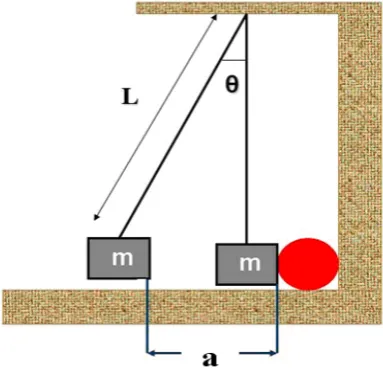
Where m is the mass of the pendulum, g is the acceleration due to earth΄s gravity (9.81 m / s²), L is length of the pendulum wire and θ is the pendulum angle.
Fig.1: simple pendulum
For more accuracy in practice, pendulum angle changed by following formulation to length (Fig. 1):
(2)
(3)
Because of sin is the rib in front of chord, therefore :
(4) Where a is pendulum displacement.
Analytical methods
Ripening Factor
Ripening factor is solid: acid ratio (Montero et al., 2009).
Moisture Content
The moisture contents of the tomatoes were determined by keeping the samples in a thermostatically controlled electric oven at 96°C for five hour (AOAC, 1976).
Texture
Texture was measured using a Texture Analyzer (HOUNSFIELD-H5K5) with 6.4mm penetration probe and was determined as: (Mohsenin, 1986).
SS= texture resistance (N/mm²), F= impact force (N), d= diameter of prob (mm), l= tomato thickness in zone of applying maximom force(mm).
Color
Color measurements were conducted using a colorimeter HUNTERLAB-D25-9000 to obtain CIElab values (L (illuminance), a (red-green index), b (yellow-blue index)). The decrease of parameter L* and the increase of a* were considered as browning indices (Riva et al., 2005).
Statistical Analysis
The experiment was conducted according to a completely randomised design. Data were evaluated by analysis of variance (ANOVA) and Duncan test, using SPSS16 software version 16.0.
sin²θ + cos²θ = 1
Cosθ = √ 1- sin²θ
E = m × g × L ( 1- √1- sin²θ)
SS = F / ח .d . l
RESULTS AND DISCUSSION Ripening Factor
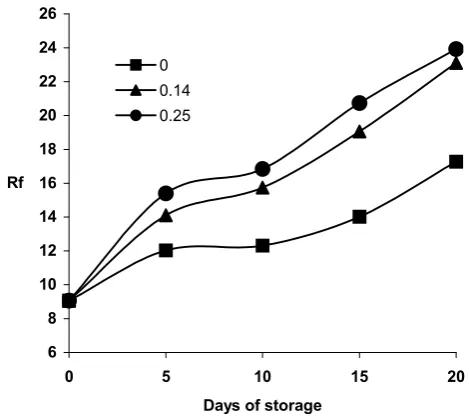
Ripening factor is solid:acid ratio (Montero et al., 2009). As shown in Figure 2 during time of storage countinously increased the solid: acid ratio, because acids are a great energy source for the oxidation process in the Krebs cycle. Organic acids are usually reduced with maturation due to respiration and are converted into suger (Mattiuz et al., 2003). Soluble solids content increases with fruit maturity through biosynthesis process or degradation of polysaccharides (Salunkhe et al., 1974) resulted increase ripening factor with the increase in impact energies (Table 2).
Fig.2: Effect impact energy and time of storage on Rf in tomato cv. Shiva F1.
Table 2: Chemical and physical propertiese of tomatoes
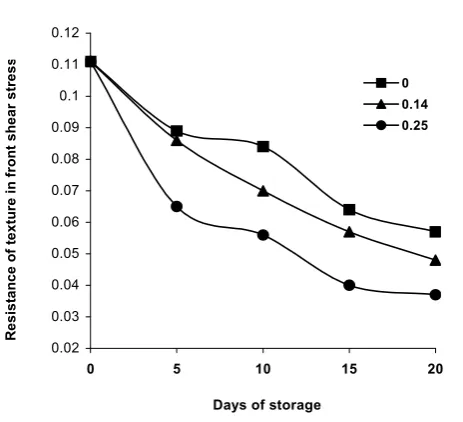
a SS M.C Rf Storge Impact Energy 31.63 0.111 93.6 9.06 0 0 32.937 0.089 93.61 12.027 5 0 37.477 0.084 93.42 12.31 10 0 38.353 0.064 93.267 14.013 15 0 39.34 0.057 92.8 17.27 20 0 31.63 0.111 93.65 9.06 0 0.14 37.283 0.086 93.547 14.1 5 0.14 38.807 0.07 93.323 15.737 10 0.14 39.247 0.054 92.353 19.06 15 0.14 40.05 0.048 91.15 23.1 20 0.14 31.63 0.111 93.65 9.06 0 0.25 38.487 0.065 93.13 15.397 5 0.25 39.317 0.056 92.303 16.85 10 0.25 39.85 0.04 92.167 20.733 15 0.25 40.17 0.037 91.06 23.923 20 0.25 6 8 10 12 14 16 18 20 22 24 26
0 5 10 15 20
Days of storage Rf
Moisture Content
The evolution of moisture content is presented in Figure 3. The initial level of moisture content was about 93.6. The moisture content change was negatively related to the period of storage (Table 2). It is also noticeable that moisture content reduced with increasing impact energy. Moisture content are reduced due to the loss of moisture through transpiration. Storage and impact energy contributed to a significant reduction of moisture amount found in our study. However, higher impact energy increased the rate of moisture loss compared to the lower impact energy. It was suggested by Ball (1997) that increasing storage period causes a decrease of moisture content in fruits and vegetables.
Fig.3: Effect impact energy and time of storage on moisture content in tomato cv. Shiva F1.
Firmness of texture
The development of pericarp firmness, i.e. the softening of the fruits, was significantly affected by storage time (Figure 4). Firmness decreased notably at during the storage period. In contrast, firmness decreased sharply the first 5 days of storage (Table 2).It was suggested by Ball (1997) that a postharvest change in firmness can occur due to the loss of moisture through transpiration, as well as enzymatic changes. In addition, hemicelluloses and pectin become more soluble, which resulted in to disruption and loosening of the cell walls (Paul,1999). Time had significant effect on fruit firmness. Fruits softened during the storage period. A close relationship between the softening of the fruits, extension of storage time was described by Gomez and Camelom (2002).
90.5 91 91.5 92 92.5 93 93.5 94
0 5 10 15 20
Days of storage
M
o
istu
re co
n
ten
t (%
)
Fig.4: Effect impact energy and time of storage on Firmness of texture in tomato cv. Shiva F1.
Colour of Pericarp
Fig. 5shows the changes of colour in tomato skin as illustrated by the a value. A change in a
value indicates fruit ripening. The initial fruit colour was 32.1 (a value). The a value increased with fruit maturity. Ripe tomato colour continued to increase clearly by 35.9 (at 0 J), by 37.8 (at 0.14 J) and by 38.8 (at 0.25 J) (Table.2).Carotenes and xanthophylls, especially lycopene, oxidized during the storage and gradually changed the colour from bright red to dark brown. However, after 20 days fruits reached their minimum of b value (data not shown). The tomatoes reached the full red stage at day 20 of storage. The findings of Znidarcic et al. (2006) supported our results. The colour evaluation in fruits corresponds to a fall in chlorophyll and an increase in carotenoid accumulation, reflecting the transformation of chloroplasts to chromoplasts(Pretel et al., 1995). The colour development rate of fruits increased with increasing maturation (Batu, 1998).
Fig. 5: Effect impact energy and time of storage on value a in tomato cv. Shiva F1
30 32 34 36 38 40 42
0 5 10 15 20
Days of storage
Va
lue
a 0
0.14 0.25
0.02 0.03 0.04 0.05 0.06 0.07 0.08 0.09 0.1 0.11 0.12
0 5 10 15 20
Days of storage
R
esist
an
ce o
f t
extu
re in
fro
n
t s
h
ear stres
s
CONCLUSION
Studies have been done in this case display the fact, that increasing impact energy decreasing shelf life. it results from stimulating reactions which are related to ripening , increasing respiration enhancing enzyme activities specially pectin esterase and poly galactronase .wet content of product decreased by increasing impact energy applied to it, because this leads to crack and little gap in product which accelerate wet exiting. Increasing impact energy applied to product ,as a reason of destroying effect and mechanical damage to cell walls, cause to a loss of quality through texture softening ,following by decreasing texture firmness of tomato and producing more red color arising from ripening process, as a result of impact applied to product and rapid accumulation of lycopene .
All results show that impact energy 0.25J was more than tolerance threshold of texture, the most mechanical damages and the least shelf life has been after 20 days of chilling.
REFERENCES
1. AOAC. (1976). Official methods of analysis. 17th edition. W. Horwits, Editor. Association of official analytical chemists. Washington, D.C.
2. Arazuri, S. C., Jaren. J., Arana. J. (2007). Influence of mechanical harvest on the physical properties of processing tomato (Lycopersicon esculentum Mill). Determination of Projects and Rural Engineering Public University of Nararra. Campus Arrosadia. 31006pam plon. Spain 190-198.
3. Ball, J.A. (1997). Evaluation of lipid-based edible coatings for their ability to preserve postharvest quality of green bell peppers. M. Sc. thesis, Blacksburg, Virginia, 89 p.
4. Batu, A. (1998). Some factors affecting on determination anmeasurement of tomato forestry. 22: 411-418
5. Bennett, A.B. (2002). Biochemical and genetic determinants of cell wall disassembly in ripening fruit: A general model. Hort Science 37, 3-6.
6. Couto, S.M., Batista, C. da S., Devilla, I.A., Paim , V.T. (2002). Caracteristicas de frutos de café sob compressao. Revista Brasileira de Engenharia Agricola e Ambiental, V.6,p.117-122.
7. Desmet, M., Lammertyn, J., Verlinden, B.E., Nicola, B.M. (2002). Mechanical properties of tomatoes as related to puncture injury susceptibility. J.Texture Stud., 33, 415–430.
8. Desmet , M.J., Lammertyn. N., Scheerlinck. E., Verlinde, B. (2003). Determination of puncture injury susceptibility of tomatoes. Postharvest Biology and Technology., 27: 293-303.
9. Gomez, P.A., Camelo, A. F. L. (2002). Calidad postcosecha de tomates almacenadas en atmosferas controladas. Horticultura Brasileira., 20:38-43.
10. Idah , P.A. E., Ajisegiri, S.A., Yisa, M.G. (2007). An assessment of impact damage to fresh tomato fruits. AU J.T.1 10(4): 271-275.
11. Kays, S.J.(1991). Postharvest physiology of perishable plant products. AVI pub. Co., Westport, CT.
12. Macua, J.I., Lahoz, I., Garnica, J., Santos, A. (2003).Tomato de inustria. Navarra Agria, 136,13-22.
13. Mattiuz, B.H., Durigan, J.F., Rossi Junior, O.D. (2003). Processamento mínimo em goiabas 'Paluma' e 'Pedro Sato': 2. Avaliação química, sensorial e microbiológica. Ciência e Tecnologia de Alimentos, v.23, p.409-413. 14. Mohsenin, N.N. (1986). Physical properties of plant and animal materials. second ed.
Gordon and Breach, Science Publishers Inc., U.K.
16. Moretti, C.L., Sargent, S.A., Huber, D.J. (1999).Delayed ripening does not alleviate symptoms of internal bruising in tomato fruit. Proceedings of the Florida State Horticultural Society., v.112, p.169-171.,
17. Nagy, S., Vitamine, C. (1980). Contents of citrus fruit and their products: A review.Journal of Agricultural Food Chemistry., v.28, p.8-18.
18. Paul, R. E., Gross, K., Qui, Y. (1999). Changes in papaya cell wallsduring fruit ripening.
Postharvest Biology and Technology., 16:79-89.
19. Pretel, M.T., Serrano, M., Amoros, A., Riquelme, F., Romojaro, F. (1995). Noninvolvement of ACC and ACC oxidase in pepper fruit ripening. Postharvest Biology and Technology., 5:295-302.
20. Riva, M., Campolongo, S., Avitabile Leva, A., Maestrelli, A., Torreggiani, D. (2005). Structure-property relationships in osmo-air-dehydrated apricot cubes., Food Research International., 38 (2005) 533-542.
21. Salunkhe, D.K., Jadhar, S.J., Yu, M. H. (1974). Quality and nutritional composition of tomato fruits influenced by certain biochemical and physiological changes. Qualitas Plantarum., 24:85-113.
22. Sanches, J.J., Durigan, F., Durigan, M.F.B. (2008). Application de Danos Mecanicos em Abacates e Seus Efeitos na Qualidade dos Frutos. Engenharia Agricola., v.28, p.164-175. 23. Sargent, S.A., Brecht, J.K., Zoellner, J.J. (1992). Sensitivity of tomatoes at mature-green and
breaker ripeness stages to internal bruising. J Am. Soc. Hort. Sci., 117, 119–123.
24. Studman, C.(1997). Factors affecting bruise susceptibility of fruit. In: Jeronimidis,G., Vincent, J.F.V. (Eds.), Proceedings of the 2nd International Conference of Plant Biomechanics. 7–12 September, Reading, UK. Centre for Biomimetics, University of Reading, pp. 273–281.
25. Van linden, V., De Baerdemaeker, J. (2005). The phenomenon of tomato bruising: Where biomechanics and biochemistry meet. Acta Hort., 682, 925–932.
26. Van Linden, V.N., Scheerlinck, D., De Baerdemaeker, M.J. (2006). Factors that affect tomato bruise development as a result of mechanical impact. PostharveST Biology and Technology., 42:260–270.