DEMOGRAPHIC RESEARCH
VOLUME 31, ARTICLE 24, PAGES 735756
PUBLISHED 19 SEPTEMBER 2014
http://www.demographic-research.org/Volumes/Vol31/24/ DOI: 10.4054/DemRes.2014.31.24
Descriptive Finding
Race, color, and income inequality across the
Americas
Stanley R. Bailey
Aliya Saperstein
Andrew M. Penner
© 2014 Bailey, Saperstein & Penner.
This open-access work is published under the terms of the Creative Commons Attribution NonCommercial License 2.0 Germany, which permits use, reproduction & distribution in any medium for non-commercial purposes, provided the original author(s) and source are given credit.
1 Introduction 736
2 Data and methods 736
3 Results 737
3.1 Skin color inequality 737 3.2 Self-identified racial hierarchy 738 3.3 Comparing color and self-identification 740
4 Conclusion 744
5 Acknowledgements 745
References 746
Race, color, and income inequality across the Americas
Stanley R. Bailey1
Aliya Saperstein2
Andrew M. Penner3
Abstract
BACKGROUND
Racial inequality in the U.S. is typically described in terms of stark categorical difference, as compared to the more gradational stratification based on skin color often said to prevail in parts of Latin America. However, nationally representative data with both types of measures have not been available to explicitly test this contrast.
OBJECTIVE
We use novel, recently released data from the U.S. and 18 Latin American countries to describe household income inequality across the region by perceived skin color and racial self-identification, and examine which measure better captures racial disparities in each national context.
RESULTS
We document color and racial hierarchies across the Americas, revealing some unexpected patterns. White advantage and indigenous disadvantage are fairly consistent features, whereas blacks at times have higher mean incomes than other racial populations. Income inequality can best be understood in some countries using racial categories alone, in others using skin color; in a few countries, including the U.S., a combination of skin color and self-identified race best explains income variation. CONCLUSIONS
These results complicate theoretical debates about U.S. racial exceptionalism and methodological debates about how best to measure race. Rather than supporting one measure over another, our cross-national analysis underscores race‟s multidimensionality. The variation in patterns of inequality also defies common comparisons between the U.S. on the one hand and a singular Latin America on the other.
1 University of California at Irvine, U.S.A. E-Mail: [email protected]. 2
Stanford University, U.S.A.
1. Introduction
In the Americas, the United States has long been considered unique in terms of race relations – primarily for its norm of hypodescent, which erased mixed-race classifications and assigned black status to anyone with any apparent African ancestry (Davis 1991). At the other end of the stylized regional spectrum are Latin American countries characterized by large mestizo populations and national efforts to promote “whitening” (Schwartzman 2007; Telles and Garcia 2013). Scholars have contrasted these racial schemes as defined, respectively, by ancestry versus phenotype (Nogueira 1985; Davis 1991) and as associated with contrasting systems of racial stratification – racial versus color hierarchies (Skidmore 1993; Bonilla-Silva 2004).
It is also possible that, instead of being the bases for different race paradigms, categorical race and skin color are best viewed as two distinct dimensions of the same race construct. Recent research suggests their utility as analytic concepts may vary across contexts (Ñopo, Saavedra, and Torero 2007; Villarreal 2010; Roth 2010; Telles and Steele 2012; Loveman, Muniz, and Bailey 2012); hence, the appropriateness of using one measure or the other, or both, is an empirical question. However, until recently data limitations have prohibited an explicit comparison of these two approaches in the U.S. versus Latin America. Now, for the first time, nationally representative data including both self-identified race and perceived skin color is available in the U.S. and in similar recent surveys across Latin America. We use these data to provide fresh insight into cross-national patterns of racial inequality by comparing the degree to which per capita household income varies along these two dimensions of race in the United States and 18 countries in Latin America.
2. Data and methods
Our data are from the 2012 General Social Survey (GSS) in the United States (Smith et al. 2013) and the 2012 AmericasBarometer (AB) survey in Latin America. In both surveys, interviewers rated respondent skin color after concluding their interview using similar 10-point (GSS) or 11-point (AB) scales with visual color referents. Respondents provided their racial identification using national categorization schemes. Household income is self-reported in national currencies using a list of 25 (GSS) and 16 (AB) intervals.
serves as our benchmark in each country; we present all other average incomes in relation to the value for that mid-range color point.
To examine whether racial self-identification or skin color best accounts for income inequality in each country, we predict logged per capita household income using the same measures presented in our descriptive analysis. These models use ordinary least squares regression with interviewer fixed effects. Supplementary analysis using household-size adjusted household income (dividing by the square-root of household size) yielded similar results.
In parallel fashion to Figure 1, our regression results are intended to highlight the overall observed level of income inequality. Hence, we do not control for factors through which racial inequality might be mediated or reproduced in a given setting. Those considerations, such as education and region, are important for the purposes of identifying intervening factors, but our aim in this study is not to isolate the country-specific mechanisms through which racial inequalities arise. Rather, we lay the groundwork for such analyses by determining the extent to which skin tone and/or self-identified race best characterize economic inequality across the Americas. To this end we compare three models: one with skin color alone, one with racial categories alone, and one that contains both perceived skin color and self-identification.
In order to discern the preferred of our three models, we focus on the Bayesian Information Criterion (BIC) and the Akaike Information Criterion (AIC), where lower values indicate better fit. AIC generally favors complexity over parsimony, whereas
BIC penalizes additional model parameters more heavily. We follow Raftery (1995) in
determining the strength of evidence in favor of the most parsimonious model, ranging from “weak” (BIC difference of 2 or less) to “very strong” (BIC difference of 10 or more). When the BIC difference is less than two we conclude that the two models fit equally well for our purposes. (See Appendix for full details on data and measures.)
3. Results
3.1 Skin color inequality
disadvantage varies considerably across countries. The largest gaps between the lightest color category and the mid-range category (suggesting extreme light-skinned elitism) are in the Dominican Republic and Guatemala. At the other end of the spectrum, results from El Salvador and Colombia reveal stark disadvantages for those with the darkest skin tones. In some countries such as the United States and Bolivia we find substantial clustering at different points in the color distributions, suggesting that each step along the color scale is not always equally consequential.
Several countries – including Panama and Honduras – appear to complicate the traditional notion of color hierarchy. Panamanians with the darkest skin color have the highest mean income, while those with the lightest skin color that registers in our sample have an average income 25 percentage points lower than the medium color category. The unusually high ranking of dark skin in Panama and Honduras underscores the importance of understanding country-specific histories of how color interacts with social status. The relative advantage of darker skin in these contexts follows in part from selective West-Indian (Afro-Antillean) migration for jobs involving large-scale, transnational enterprises, including the Panama Canal Company and the United Fruit Company (Andrews 1997; Guerrón-Montero 2006). These contrasting cases aside, the overarching pattern is that color hierarchy is a significant aspect of inequality across the Americas, and the United States is no exception.
3.2 Self-identified racial hierarchy
S ou rce : U n ited S tat es – 20 12 Gen er a l S oc ia l S ur vey; a ll ot he rs – 20 12 A m er icasB ar om ete r. Not e s : T h e m e a n p e r ca p ita h o u se h o ld i n c o m e o f sk in co lo r ca te g o ry f ive se rve s a s t h e r e fe re n ce ( 0 % ) f o r e a ch co u n tr y. S k in co lo r p o in ts a re sh a d e d t o m a tch t h e ca te g o ry n u m b e r o n t h e c o lo r sca le s. Raci a l c a te g o ries a re d e n o te d b y le tte rs – W = w h ite /b la n ca , B = b la ck/n e g ra , A = A s ia n /a m a re la , M = m u lti ra c ia l ( US o n ly ), L = L a tin a ( US o n ly ) o r L a d in a ( Gu a te m a la o n ly) , M e = M e st iza , M o = M o re n a , M u = M u la ta ,
I = In
d íg e n a /A m e ri ca n I n d ia n . Cou n tr ie s a re a rr a n g e d a cco rd in g t o t h e p e rce n t o f th e s a m p le t h a t fa lls in to t h e li g h te st 3 sk in co lor ca te g o ri e s (h ig h e s t to l o w e st) . On ly ra ce a n d co lo r ca te g o ri e s w ith 3 0 o r m o re r e sp o n d e n ts a re r e p o rte d .
Samples included sizeable black populations in ten countries, yet self-identified blacks are at the bottom of the hierarchy in just four: Brazil, Ecuador, El Salvador, and Nicaragua. In Ecuador, black racial disadvantage appears especially deep, with average household incomes 36 percentage points lower than Ecuadorians of medium skin color, and well below the indigenous and mulatto categories. In five other countries, the United States, Venezuela, Uruguay, Colombia, and the Dominican Republic, blacks are in positions of disadvantage compared to whites, but have higher incomes than some other racial populations. In Panama and Honduras, blacks rank at the top, as was also suggested by the color measure. In most cases, though, the experience of blackness is one of distinct disadvantage in comparison to whites.
The indigenous category is typically found at the bottom of the racial hierarchy, occupying the lowest position in 9 of the 12 countries with large enough indigenous populations to analyze. This includes the United States, where the extreme disadvantage of self-identified, monoracial American Indians often goes unacknowledged in large national studies of inequality, due to their small numbers and segregation from much of the population (Snipp and Saraff 2011).
Finally, 17 out of the 19 countries include at least one explicit mestizo or “mixed race” category. In most cases, mestizos are disadvantaged compared to whites but have higher mean incomes than any other racial category. The exception is Venezuela where mestizos earn slightly more on average than whites. The relative advantage of mixed-race populations may reflect whitening strategies in Latin America, in which higher status individuals try to distance themselves from blackness and indigeneity (Schwartzman 2007). Notably, in the U.S. racial hierarchy the position of the multiracial category – people who gave two or more responses to the GSS race question – is similar to the general pattern of mestizos throughout Latin America.
3.3 Comparing color and self-identification
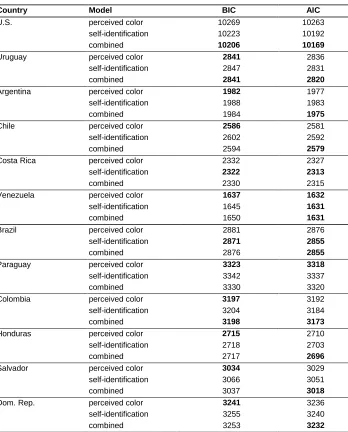
Table 1: Comparing BIC and AIC across models by country, GSS and AB
Country Model BIC AIC
U.S. perceived color 10269 10263
self-identification 10223 10192
combined 10206 10169
Uruguay perceived color 2841 2836
self-identification 2847 2831
combined 2841 2820
Argentina perceived color 1982 1977
self-identification 1988 1983
combined 1984 1975
Chile perceived color 2586 2581
self-identification 2602 2592
combined 2594 2579
Costa Rica perceived color 2332 2327
self-identification 2322 2313
combined 2330 2315
Venezuela perceived color 1637 1632
self-identification 1645 1631
combined 1650 1631
Brazil perceived color 2881 2876
self-identification 2871 2855
combined 2876 2855
Paraguay perceived color 3323 3318
self-identification 3342 3337
combined 3330 3320
Colombia perceived color 3197 3192
self-identification 3204 3184
combined 3198 3173
Honduras perceived color 2715 2710
self-identification 2718 2703
combined 2717 2696
Salvador perceived color 3034 3029
self-identification 3066 3051
combined 3037 3018
Dom. Rep. perceived color 3241 3236 self-identification 3255 3240
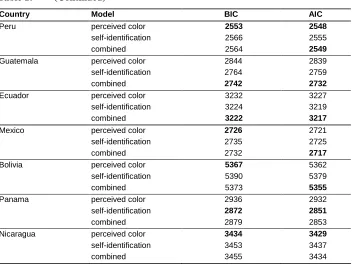
Table 1: (Continued)
Country Model BIC AIC
Peru perceived color 2553 2548
self-identification 2566 2555
combined 2564 2549
Guatemala perceived color 2844 2839
self-identification 2764 2759
combined 2742 2732
Ecuador perceived color 3232 3227
self-identification 3224 3219
combined 3222 3217
Mexico perceived color 2726 2721
self-identification 2735 2725
combined 2732 2717
Bolivia perceived color 5367 5362
self-identification 5390 5379
combined 5373 5355
Panama perceived color 2936 2932
self-identification 2872 2851
combined 2879 2853
Nicaragua perceived color 3434 3429
self-identification 3453 3437
combined 3455 3434
Note: The smallest BIC and AIC statistics, indicating the best model fit, are noted in bold. When the difference between two or more models was less than 2, we concluded the models fit equally well and bolded each.
In Brazil, Panama, and Costa Rica we find that racial identification alone provides an equal or better account of inequality, even when we privilege complexity (using AIC). This finding for Brazil is consistent with claims that color gradations among nonwhites are less important than the categorical divide between whites and nonwhites for understanding racial stratification (Silva 1985, but see Telles and Lim 1998). In Panama, categorical racial divisions were explicitly cultivated in the Canal Zone and by the United Fruit Company (Andrews 1997; Craft 2008); the latter also influenced racial dynamics in Costa Rica (Andrews 1997: 16–18). These results echo previous research suggesting that focusing only on racial categories in the U.S. misses an important dimension of inequality, while privileging gradational color distinctions in Latin America would do the same (c.f. Telles and Murgia 1990; Monk 2013).
from light to dark) is associated with an 11% decline in per capita household income. The model that compares mean income differences by self-identified race indicates that blacks, multiracial Americans, Latinos, and American Indians all have significantly lower household incomes than whites, with disparities on the order of 39% to 66%. In the combined model a significant (8%) income penalty per color category remains, and the inclusion of skin color explains nearly all of the difference in mean income between blacks and whites in the United States, and nearly one-third of the gap between whites and Americans who report multiple races.
Table 2: Income inequality in the United States
Perceived color only Self-id only Combined
Skin color scale -0.116*** - -0.084***
(0.012) (0.023)
Racial categories
Black (non-Latino) - -0.530*** -0.152 (.075) (0.140) Asian (non-Latino) - -0.000 0.123
(.121) (0.128) Multiracial (non-Latino) - -0.498*** -0.356**
(0.114) (0.103) American Indian (non-Latino) - -1.086*** -.988***
(0.270) (.270)
Latino - -0.650*** -0.534***
(0.071) (0.079)
Constant 9.988*** 9.882*** 10.024*** (0.033) (0.017) (0.042)
Observations 3,645 3,645 3,645
BIC 10,269 10,223 10,206
AIC 10,263 10,192 10,169
Source: General Social Survey, 2012.
Notes: Results from three separate ordinary least squares regression analyses on logged per capita household income. Standard errors shown in parentheses. All models include interviewer fixed effects and estimates are weighted to account for sampling and non-response. Both BIC and AIC statistics favor the combined model, as noted in bold.
* p<.05 ** p<.01 *** p<.001
whites. Thus, the disadvantaged position of Latinos in the U.S. racial hierarchy is not well explained by skin color, education, or recent migration.
4. Conclusion
Researchers have long debated the contours of racial inequality in the Americas, with disagreements over whether inequality is structured by rigid categorical divides or by color continua, and even whether race is the right concept to describe the social order in some regions (Degler 1971; Skidmore 1993; Banton et al. 2012). However, until recently most of this scholarship focused on race using a singular lens. Research advocating a multidimensional approach to measuring race has produced theoretical insight in Latin America and the U.S. (Telles and Lim 1998; Saperstein 2006, 2012; Bailey, Loveman, and Muniz 2013). Using this approach and newly available data with both perceived skin color and self-identified race, we show that although all 19 countries in our study are racially stratified, they vary in the extent to which one dimension of race or another most structures a country‟s social inequality. The reasons why a particular measure of race might be more salient in a particular country then become important questions for future research and should facilitate cross-country comparison.
Shifts in racial understandings and demography across the Americas also increase the need for a more flexible, multidimensional approach to racial classification. In the last two decades Latin American policymakers, census bureaus, and scholars of inequality are turning to the more categorical language of race (Santos 2005; Bailey 2008; Paschel 2010; Loveman 2014). At the same time the United States has adopted mixed-race classification and has grown ever more diverse through immigration. Some have speculated these changes will lead to color lines and socioeconomic divides in the United States that will look more variegated and “Latin American-like” (Bonilla-Silva 2004: 931; Lee and Bean 2007; Lichter 2013). The use of multiple dimensions of race will be important in tracking possible shifts in color lines or changes in classification schemes, and will provide a more nuanced comparative lens on racial inequality.
distinctions, or some combination of the two can promote further understanding of this pervasive and stubborn axis of inequality.
5. Acknowledgements
References
Andrews, G.R. (1997). Black Workers in the Export Years: Latin America, 1880–1930.
International Labor and Working-Class History 51: 7–29. doi:10.1017/S014754
7900001964.
Bailey, S.R. (2008). Unmixing for Race Making in Brazil. American Journal of Sociology 114(3): 577–614. doi:10.1086/592859.
Bailey, S.R., Loveman, M., and Muniz, J.O. (2013). Measures of “Race” and the Analysis of Racial Inequality in Brazil. Social Science Research 42(1): 106–119.
doi:10.1016/j.ssresearch.2012.06.006.
Banton, M., Hochschild, J., Martiniello, M., Virdee, S., Fox, J.E., Guimarães, A.S., Telles, E., Wade, P., and van den Berghe, P.L. (2012). The colour line and the colour scale in the twentieth century. Ethnic and Racial Studies 35(7): 1109– 1180. [http://www.tandfonline.com/toc/rers20/35/7].
Bonilla-Silva, E. (2004). From bi-racial to tri-racial: Towards a new system of racial stratification in the USA. Ethnic and Racial Studies 27(6): 931–950. doi:10.10
80/0141987042000268530.
Craft, R.A. (2008). „Una Raza, Dos Etnias‟: The Politics of Be(com)ing/Performing „Afropanameño‟. Latin American and Caribbean Ethnic Studies 3(2): 123–147.
doi:10.1080/17442220802080519.
Darity, W.A. and Mason, P.L. (1998). Evidence on Discrimination in Employment: Codes of Color, Codes of Gender. Journal of Economic Perspectives 12(2): 63–
90. doi:10.1257/jep.12.2.63.
Davis, F. (1991). Who is Black? One Nation’s Definition. University Park: Penn State Press.
Degler, C. (1971). Neither Black Nor White: Slavery and Race Relations in Brazil and the United States. New York: Macmillan.
Guerrón-Montero, C. (2006). Racial Democracy and Nationalism in Panama. Ethnology
45(3): 209–228. doi:10.2307/20456595.
Lee, J. and Bean, F.D. (2007). Reinventing the Color Line Immigration and America's New Racial/Ethnic Divide. Social Forces 86(2): 561–586. doi:10.1093/sf/86.2. 561.
Loveman, M. (2014). National Colors: Racial Classification and the State in Latin America. Oxford: Oxford University Press. doi:10.1093/acprof:oso/9780199337
354.001.0001.
Loveman, M., Muniz, J.O., and Bailey, S.R. (2012). Brazil in Black and White? Race Categories, the Census, and the Study of Inequality. Ethnic and Racial Studies
35(8): 1466–1483. doi:10.1080/01419870.2011.607503.
Monk, E. (2013). Color, Bodily Capital, and Ethnoracial Division in the U.S. and Brazil. [PhD thesis]. Berkeley: University of California, Berkeley, Department of Sociology.
Nogueira, O. (1985). Tanto Preto, Quanto Branco: Estudo de Relações Raciais. São Paulo: EDUSP.
Ñopo, H., Saavedra, J. and Torero, M. (2007). Ethnicity and Earnings in a Mixed-Race Labor Market. Economic Development and Cultural Change 55(4): 709–734.
doi:10.1086/516762.
Paschel, T.S. (2010). The Right to Difference: Explaining Colombia‟s Shift from Color-Blindness to the Law of Black Communities. American Journal of Sociology
116(3): 729–769. doi:10.1086/655752.
Raftery, A.E. (1995). Bayesian Model Selection in Social Research. Sociological Methodology 25: 111–163. doi:10.2307/271063.
Roth, W.D. (2010). Racial Mismatch: The Divergence between Form and Function in Data for Monitoring Racial Discrimination of Hispanics. Social Science Quarterly 91(5): 1288–1311. doi:10.1111/j.1540-6237.2010.00732.x.
Santos, J.A.F. (2005). Efeitos de Classe na Desigualdade Racial no Brasil. DADOS – Revista de Ciências Sociais 48(1): 21–65. doi:10.1590/S0011-5258200500010
0003.
Saperstein, A. (2006). Double-Checking the Race Box: Examining Inconsistency between Survey Measures of Observed and Self-Reported Race. Social Forces
85(1): 57–74. doi:10.1353/sof.2006.0141.
Saperstein, A. (2012). Capturing Complexity in the United States: Which Aspects of Race Matter and When? Ethnic and Racial Studies 35(8): 1484–1502.
doi:10.1080/01419870.2011.607504.
Schwartz, C.R. (2010). Earnings Inequality and the Changing Association between Spouses‟ Earnings. American Journal of Sociology 115(5): 1524–57. doi:10.10
86/651373.
Schwartzman, L.F. (2007). Does Money Whiten? Intergenerational Changes in Racial Classification in Brazil. American Sociological Review 72(6): 940–963. doi:10.
1177/000312240707200605.
Silva, N. (1985). Updating the Cost of Not Being White in Brazil. In: Fontaine, P.-M. (ed.). Race, Class, and Power in Brazil. Los Angeles: Center for Afro-American Studies: 42–55.
Simon, P. (2012). Collecting Ethnic Statistics in Europe: A Review. Ethnic and Racial Studies 35(8): 1366–1391. doi:10.1080/01419870.2011.607507.
Skidmore, T.E. (1993). Bi-Racial U.S. vs. Multi-Racial Brazil: Is the Contrast Still Valid? Journal of Latin American Studies 25(2): 373–386. doi:10.1017/S00222
16X00004703.
Smith, T.W., Marsden, P.V., Hout, M., Kim, J., and Davis, J.A. (2013). General Social Surveys, 1972–2012 [electronic resource]. Chicago: National Opinion Research Center. [http://www3.norc.org/GSS+Website/].
Snipp, M. and Saraff, A. (2011). Sociodemographic Inequalities in AI/AN Communities. In: Spencer, P. (ed.). American Indian & Alaska Native Children and Mental Health. New York: Praeger: 27–42.
Telles, E.E. and Lim, N. (1998). Does it Matter Who Answers the Race Question? Racial Classification and Income Inequality in Brazil. Demography 35(4): 465– 474. doi:10.2307/3004014.
Telles, E.E. and Murguia, E. (1990). Phenotypic Discrimination and Income Differences among Mexican Americans. Social Science Quarterly 71(4): 682– 696.
Telles, E.E. and Steele, L.G. (2012). Pigmentocracy in the Americas: How is Educational Attainment Related to Skin Color? Insights 73: 1–8.
Telles, E.E. and Garcia, D. (2013). Mestizaje and Public Opinion in Latin America.
Latin American Research Review 48(3): 130–152. doi:10.1353/lar.2013.0045. Villarreal, A. (2010). Stratification by Skin Color in Contemporary Mexico. American
Appendix A: Data and measures
This supplement includes additional detail regarding survey design, sample sizes, and coding decisions for both the General Social Survey and AmericasBarometer. We also provide information on the potential for ceiling effects in income in Brazil, the interpretation of results from fixed effect models, and potential issues of endogeneity.
Survey design and measures: GSS
The 2012 GSS is a nationally representative probability sample of U.S. adults aged 18 and over and living in households. Since 2010 the biennial survey has employed a rotating panel design that includes a new cross-sectional sample and re-interviews of randomly selected members of the two previous survey waves. Our analyses include the full sample for 2012, which surveyed 4,820 people. Of these, 4,047 were interviewed in person (as opposed to over the telephone) and our final sample size, taking into account missing data on perceived skin color and our other key variables (described below), was 3,645.
For the first time, the 2012 GSS included the interviewer‟s rating of the respondent‟s skin color. Interviewers were trained to record the respondent‟s skin color after concluding their interview, using a 10-point scale. Interviewer field manuals included a color card with 10 circles of varying skin colors, each corresponding to one of the points on the color scale. The color card was not shown to respondents.
GSS respondents were asked to self-identify their race in response to the question: “What is your race? Indicate one or more races that you consider yourself to be.” Up to three responses were recorded using the 15 categories used in the U.S. Census. Immediately prior to reporting their race, respondents were asked: “Are you Spanish, Hispanic or Latino/a?” Based on responses to these questions, we recoded respondents into the most commonly used, mutually exclusive racial categories for the United States: non-Hispanic white (N=2,411); non-Hispanic black (N=488); non-Hispanic Asian (N=84); Hispanic, or “Latino,” as we refer to it throughout the text (N=424); non-Hispanic multiracial (N=207), and non-Hispanic American Indian (N=32). We dropped all other racial categories that totaled fewer than 30 observations; this included respondents who offered only “Pacific Islander” or “some other race” responses.
sample who reported a Spanish/Hispanic/Latino origin identified as white alone on the race question (N=229). Nevertheless, in line with most research on race in the United States, we included anyone who reported a Hispanic origin in our category “Latino,” regardless of the race or races they may have also mentioned. Limiting Latinos to only self-identified non-white Latinos does not affect our overall conclusions, as the mean incomes of non-white Latinos are lower than when using our more inclusive definition. The same is true for the mean income of self-identified whites when self-identified Latinos are included, though to a lesser degree because of the larger size of the white category overall. The fact that Latinos tend to be overrepresented among the foreign-born also does not affect our conclusions about the relative ranking of Latinos in the U.S. racial hierarchy. Although 45% of Latino respondents are foreign born in the 2012 GSS, and foreign-born Latinos have lower average income than US-born Latinos, self-identified Latinos remain categorically disadvantaged even when we control for nativity, or when we estimate our models only for U.S.-born respondents (results available upon request).
Among the specific Asian response categories (Asian Indian, Chinese, Filipino, Japanese, Korean, and Vietnamese) only Asian Indian included 30 or more respondents, so we present instead a single racial category, “Asian.” The mean per capita household income of $32,000 for “Asians” understates the mean incomes of Asian Indian respondents at nearly $46,000 (N=30), while overstating the incomes of the other Asian origin categories, especially the five Vietnamese respondents who have a mean income under $25,000. It is also worth noting that 74% of self-identified, monoracial Asians in the GSS sample are foreign-born, with per capita household incomes significantly higher on average than their US-born counterparts.
The aggregate category for Americans who gave more than one response to the GSS race question masks similar internal diversity in economic well-being. Nearly half of all multiracial respondents identified as both white and American Indian, while an additional 34 identified as black and American Indian. Black-American Indian respondents have average household incomes most similar to self-identified, monoracial blacks, while the household incomes of white-American Indians are about 15% lower than monoracial whites. However, both of these multiracial populations are better off than their monoracial American Indian counterparts.
are instructed to answer based on their “total family income, from all sources” for the previous calendar year. We recoded each category to its midpoint, with the exception of the open-ended top category, to which we assigned a value of $160,000 based on the same formula, described below, that we applied to each country in the AmericasBarometer data. (This coding will understate self-identified race or color inequality to the extent that “whites” and lighter skinned Americans are overrepresented in the top category and have incomes substantially greater than $160,000.) We then used the count of persons in the respondent‟s household to calculate per capita income. Household sizes ranged from 1 to 10 with an average of 2.6 in our sample.
The GSS is designed to be self-weighting at the household level; however, we employ weighted estimates in all of our analyses to account for both non-response and selection based on the number of adults in the household. Unweighted results were substantively similar to those presented here.
Survey design and measures: AmericasBarometer
AB is part of the Latin American Public Opinion Project (LAPOP). It is the only cross-national survey of public opinion and behavior that covers the Americas (North, Central, South, and the Caribbean). Our analysis focuses on 18 countries from the following regions: Mexico/Central America, Andean/Southern Cone, and the Spanish-speaking Caribbean. The country surveys are nationally representative, face-to-face samples of voting age adults. Sample sizes are approximately 1,500, with the exception of Bolivia, which was approximately 3,000. The full AB survey has 41,632 observations and includes the United States and Canada. However, those two countries employ a web-based design and did not record skin color; hence we excluded them. In addition, we excluded six other countries whose colonial histories differed significantly from those of Ibero-Latin America and whose official languages are Dutch, English, or French: Suriname, Guyana, Haiti, Jamaica, Belize, and Trinidad & Tobago. Samples in each country were developed using a multi-stage probabilistic design, and were stratified by major regions of the country, size of municipality, and by urban and rural areas within municipalities. We use country-specific weights in all of our analyses; in the countries in which the sample is self-weighted (all but Honduras, Nicaragua, Panama, Bolivia, and Chile) the value of the weight for each case is equal to 1.
census categories: white, pardo (brown or mixed), preto (black), amarelo (Asian origin), and indigenous.
The income measure is self-reported using 16 intervals based on each country‟s currency. Respondents were instructed to answer based on “the total monthly income of this household, including remittances from abroad and the income of all the working adults and children.” For each country we assigned midpoint values to the first 15 intervals, and assigned the open-ended top category a value corresponding to the top value of the penultimate category plus half of the penultimate category‟s range. To calculate per capita income we used the count of persons in the respondent‟s household.
Accounting for ceiling effects in income in Brazil
As noted above, the interval coding of household income, with an open-ended top category, likely results in underestimating racial inequality if whites (or other populations) are overrepresented above the value chosen for the highest income interval. This limitation was potentially magnified in Brazil, where 31% of the sample fell into the final open-ended category for household income. In order to ensure that this did not substantively affect our findings for Brazil we also estimated models (not shown) using that country‟s personal income measure, in which truncation in the highest category was much less than in household income (only 16% were in the top category). This replication showed that for both household and personal income, BIC confirmed that the model including only self-identified race categories was the better fit to our data for Brazil (results available upon request).
Interviewer fixed effects models
All models in the paper include interviewer fixed effects, and take the form:
ri i ri
ri x
y 01
where represents the logged per capita household income of respondent r
by that interviewer. By only making comparison within interviewers, we are in essence estimating the relationship between per capita household income and our independent variables separately for each interviewer, and then taking a weighted average of these estimates. To the degree that some interviewers apply the skin color scale differently than others in a manner that is consistent across respondents (such as recording respondents as being lighter or darker than other interviewers would have recorded the same respondents), including interviewer fixed effects will take these differences into account. We believe that these kinds of perceptual differences in assessing skin color are not driving our conclusions about the contours of economic hierarchy in these countries, as our findings with and without interviewer fixed effects are similar.
Missing data on interviewer identification numbers for both Ecuador and Brazil did pose a challenge for including interviewer fixed effects because 87% and 93% of respondents, respectively, were missing information on interviewer identification number. For these countries we opted to group together respondents who were lacking information about their interviewer, which is analogous to estimating models without interviewer fixed effects for those individuals. BIC statistics with and without fixed effects coincide in strongly indicating self-identification categories as the preferred model in Brazil. In Ecuador the fixed effects models suggest that the combined model fits best, while models without fixed effects favor skin color alone. For most countries the preferred model did not differ depending on whether or not interviewer fixed effects were included. In addition to Ecuador, exceptions included Mexico, Bolivia, and Chile, where the top two models had similar model fits both with and without fixed effects, but one was slightly preferred with interviewer fixed effects and the other slightly preferred without the fixed effects. In the case of Mexico the model without fixed effects favored the more complex “combined” model, while the model with fixed effects favored skin color only; Bolivia and Chile both switched from the “self-identification only” model being favored to a “color only” model (results available upon request).
Endogeneity
more likely to record better-off respondents as having lighter skin colors than might be recorded using a measurement from a technical instrument, such as photospectrometer.
Given the range of racial identification and color dynamics that we uncover in this study, it seems plausible that the endogeneity of race and socioeconomic status varies across countries. Thus, future research should compare the extent to which self-identified race, perceived skin color, or both, are endogenous to the status attainment process in different places, or vary in the same place at different points in time.
Descriptive tables
Table A1: Mean per capita household income by country and perceived skin color, in national currencies with sample size in parentheses, 2012.
Skin Color Scale Country and
currency 1 2 3 4 5 6 7 8 9 10 11
USA Dollar 27,946 (1,233) 27,873 (1,202) 22,868 (466) 20,762 (237) 16,805 (143) 15,673 (104) 15,012 (110) 16,952 (116) 15,251
(34) - -
Uruguay Peso 10,102 (34) 7,291 (217) 7,238 (534) 6,318 (317) 6,232 (141) 5,255
(73) - - - - -
Argentina Peso 1,512 (77) 1,526 (119) 1,417 (245) 1,279 (218) 1,019 (158) 1,068 (139) 881
(58) - - - -
Chile
Peso -
144,511 (113) 118,904 (423) 125,242 (398) 120,120 (225) 111,098 (98) 129,201
(47) - - - -
Costa Rica
Colón -
129,802 (106) 112,187 (274) 114,646 (304) 106,427 (211) 98,697 (88) 120,239
(37) - - - -
Venezuela
Bolívar -
928 (83) 733 (220) 708 (202) 718 (168) 668 (181) 593
(61) - - - -
Brazil Real 521 (125) 552 (135) 470 (208) 461 (230) 448 (249) 385 (181) 376 (101) 367 (75) 344 (44) 470 (42) 415 (32) Paraguay Guaraní 721,208 (48) 671,781 (179) 557,911 (204) 551,534 (235) 491,968 (254) 468,473 (250) 468,477 (77) 322,783
(47) - - -
Colombia Peso 255 (43) 354 (96) 404 (230) 306 (340) 281 (259) 258 (187) 200 (68) 165
(39) - - -
Honduras Lempira 2,624 (30) 2,023 (139) 1,802 (223) 1,627 (215) 1,568 (243) 1,470 (211) 1,253 (155) 1,986
(59) - - -
El Salvador
US Dollar - 93 (59) 100 (246) 85 (324) 73 (310) 62 (257) 36
(44) - - - -
Dom. Rep.
Peso -
6,869 (60) 5,004 (183) 4,521 (249) 3,700 (205) 4,139 (233) 4,092 (168) 4,432 (89) 3,122 (36) 2,790 (33) - Peru
Nuevo Sol - 359 (32) 294 (197) 270 (304) 244 (383) 201 (295) 207
(66) - - - -
Guatemala
Quetzal -
794 (38) 610 (183) 515 (269) 397 (377) 404 (225) 424
(31) - - -
Ecuador
US Dollar - 169 (50) 129 (165) 134 (285) 127 (358) 118 (283) 113 (125) 106
(55) - - -
Mexico
Peso -
1,442 (40) 1,589 (136) 1,232 (248) 1,137 (347) 1,111 (277) 903 (116) 914
(45) - - -
Bolivia
Boliviano - 592 (91) 658 (265) 555 (527) 452 (666) 453 (574) 440 (257) 411
(54) - - -
Panama
US Dollar - -
131 (149) 145 (202) 173 (307) 150 (348) 135 (170) 146 (68) 200
(37) - -
Nicaragua
Córdoba - -
1,263 (72) 1,173 (353) 1081 (664) 990 (349) 982
Table A2: Mean per capita household income by country and race category, in national currencies with sample size in parentheses, 2012.
Racial Category Country and currency White/ Blanca Mestiza/
Multiracial Mulata
Black/ Negra
Indígena/
Am. Indian Morena
Latina/ Ladina Asian/ Amarela USA Dollar 26,681 (2,410) 21,570
(207) -
17,695 (488)
9,164
(32) -
15,697 (424) 32,047 (84) Uruguay Peso 7,560 (909) 5,045 (280) 4,168 (35) 6,713
(32) -
Argentina Peso
1,429 (558)
1,104
(396) - - - -
Chile Peso
126,347 (827)
123,201
(444) - -
80,316
(36) - - -
Costa Rica Colón 120,514 (574) 102,746 (365) 86,352
(57) - - - - -
Venezuela Bolívar
783 (293)
786
(210) -
699
(38) -
629
(367) - -
Brazil Real
526
(496) -
415 (632)
384
(206) - - -
447 (49) Paraguay Guaraní 569,194 (451) 518,587
(735) - - - -
Colombia Peso 336 (379) 319 (637) 282 (42) 217 (101) 128
(77) - - -
Honduras Lempira
1,844 (495)
1,531
(719) -
2,555 (59)
1,417
(48) - - -
El Salvador US Dollar 88 (259) 80 (730)
- 66
(35)
72
(41) - - -
Dom. Rep. Peso 5,352 (151) 4,061 (766) 5,032 (136) 4,356
(197) - - - -
Peru Nuevo Sol
276 (114)
250
(1,013) - -
213
(98) - - -
Guatemala
Quetzal - - - -
280
(467) -
616
(657) -
Ecuador US Dollar 137 (118) 128 (1,067) 103 (52) 81 (46) 108
(60) - - -
Mexico Peso
1,472 (192)
1,210
(825) - -
760
(92) - - -
Bolivia Boliviano
657 (116)
533
(1,851) - -
321
(353) - - -
Panama US Dollar 166 (374) 155 (599) 134 (64) 183 (183) 76
(113) - - -
Nicaragua Córdoba 1,195 (326) 1,089 (916) 909 (90) 1,115