in the population sciences published by the Max Planck Institute for Demographic Research Konrad-Zuse Str. 1, D-18057 Rostock · GERMANY www.demographic-research.org
DEMOGRAPHIC RESEARCH
VOLUME 10, ARTICLE 2, PAGES 27-60
PUBLISHED 26 FEBRUARY 2004
www.demographic-research.org/Volumes/Vol10/2/
DOI: 10.4054/DemRes.2004.10.2
Research Article
Marriage in Russia. A reconstruction
Sergei Scherbov
Harrie van Vianen
1 Introduction 28
2 Marriage in Russia: an analysis 31 2.1 Marriage in Russia: histories 32 2.2 Marriage in Russia: statistics 35 2.3 Marriage in Russia, multistate marital tables 43 2.3.1 Time spent in marital states 44 2.3.2 Number of transitions between marital states 46 2.3.3 Age at transition between marital states 49 2.3.4 Conditional probabilities 52
3 Conclusions 57
Notes 59
Research Article
Marriage in Russia
:
A reconstruction
Sergei Scherbov1
Harrie van Vianen2
Abstract
The micro census 1994 of the Russian Federation collected detailed marital histories for all respondents. This information made it possible to construct multistate marital tables for both male and female cohorts born since 1910 for the first time. Continuity and change in marital patterns over a most turbulent of Russian history could be analyzed. Divorce rose monotonously from a quite low level for the cohort of 1910 to the high incidence that is characteristic for modern Russia. The typical Eastern European marriage pattern of early and almost universal marriage was remarkably stable. The major crisis, the Second World War, led to a postponement of marriage, but even in the female cohorts confronted with an extreme unbalanced marriage market the proportion never married was remarkably low.
1
Corresponding Author. Vienna Institute of Demography, Austrian Academy of Sciences. Prinz Eugen-Straße 8-10, A-1040Vienna, Austria. Email: [email protected]
1. Introduction
In his seminal article ‘European marriage patterns in perspective’ Hajnal distinguished an Eastern European pattern that was completely different from the Western European pattern. East from a line that stretched roughly from St. Petersburg to Trieste marriage was very frequent and early. In contrast to the West where the marriage pattern underwent profound changes in Russia early and almost universal marriage have remained typical. According to the latest 1994 micro census only 6 percent of men and 5 percent of women were never married at age 50. The proportion of people getting married at very young ages even has been growing recently. In the 1917 cohort 29 percent of women married before age 20 and 24 percent of men married before age 23. In the cohort 1960 these proportions were 32 percent and 44 percent respectively. This persistence of two of the characteristics of marriage should not make one lose sight of the fact that in Russia as elsewhere marriage is a complex phenomenon in a constant state of flux (Avdeev and Monnier, 1999, 635).
In the twentieth century Russian society made a major transition. At the beginning of the century Russia was still predominantly traditional and rural, but during the century it shifted to an industrialized, urbanized modern highly educated society. This transition did not develop continuously, but was accompanied by severe shocks that completely upset the life of the citizen and had profound effects upon the primary institution of the family. Especially the huge male deficits in the cohorts that were most affected by the Second World War led to substantial adjustments in the patterns of marriage, divorce, widowhood and remarriage. The very small sizes of the cohorts born during the war years and the preference for brides that are at average about two years younger than their grooms should have had sizable effects upon nuptiality in the 1960’s when these cohorts entered the marriage market. Moreover the state tried to intervene decisively into the process of family formation and procreation (for an overview see Avdeev and Monnier 1999, annex 1).
In their recent analysis of various aspects of marriage in Russia, Avdeev and Monnier had to limit themselves essentially to the period since around 1960. After the 1926 census the population registration system in the former Soviet Union collapsed and it is only since 1959 that reliable population figures from censuses and registration are available. Part of the demographic history of Russia in the intervening period was reconstructed recently, using archive materials and demographic estimation (Andreev, Darsky and Kharkova, 1998). Detailed information from official statistics is unavailable but thanks to the possibilities of a retrospective investigation of data collected during the five-percent micro census of 1994 at least some questions can be answered.
Russian Federation published the principal results in aggregate tabular form in 8 volumes (Goskomstat1995). Volkov (1999) discussed the representativeness of the micro census. The detailed nature of the individual data permits for a reconstruction of part of the life course of separate subpopulations and for the calculation of a number of demographic statistics from the past. In two earlier articles we analyzed cohort fertility and female nuptiality (Scherbov and Van Vianen 1999, 2001). A third article reconstructed period fertility since 1930, using a modeling approach (Scherbov and Van Vianen, 2002). In this paper both male and female nuptiality will be analyzed more completely.
With respect to marriage the micro census included a number of questions on marital careers: date of first marriage, date and cause of first marriage termination (divorce, death of spouse), date of second marriage, and total number of marriages. This feature of knowing the date of certain events on an individual basis allows for the construction of multistate marital tables (Willekens 1987, Darsky and Scherbov 1995). The micro census contains all necessary information on first marriages. For men and women widowed or divorced from first marriage we know the date of dissolution and the date of an eventual remarriage. Finally we know the current status, though not the date or cause of subsequent events, but using acceptable hypotheses we can calculate transition probabilities and construct the multistate marital tables. The methodological approach is essentially the same as set out in the paper by Darsky and Scherbov (1995, 35-38), except that in our cohort study we do not have to make the additional assumption of a stationary population, which is necessary in order to apply period rates to a hypothetical cohort.
marital histories of those members of the original birth cohort that were still alive at the date of census taking.
In our analysis we study the marital histories of successive birth cohorts. In an earlier article we underlined the importance of taking a cohort perspective when studying demographic change. Whereas period measures are shaped by conjunctural effects and may behave irregularly because of many factors affecting marital decisions, cohort measures more truly reflect underlying lifetime motivations (Scherbov and Van Vianen 1999). Moreover our data are most applicable for a cohort approach. They of course allow for the calculation of certain age specific period indicators, but information on the size and the age distribution of the population is missing for most of the period between 1926 and 1959 and therefore many period indicators on the population level are unobtainable. We can for instance calculate age specific first marriage rates in a certain year, but in order to obtain the total number of marriages or the crude marriage rate in that year we need the absolute age composition for that year.
Another aspect of our retrospective data set is that all people were born after a certain year. In 1994 there are only few survivors of the oldest generations and their information will certainly not be representative for the cohort experience. In practice this means that for women we can go back until 1900, there being more than 1000 respondents from that year onwards, a number that goes up to 16,000 respondents born in 1910: all succeeding cohorts are larger. Starting from 1900 this implies that for instance for 1935 we only have information for women up to 35 years of age in that year. Consequently our information on a period measure up to age 50 is censored before the year 1950; only from that year onward our period measures would be complete.
Due to the imbalance of the Russian age distribution we only have 180 males born in 1900 in our sample and 4000 born in 1910. Only starting from the cohort of 1922 we have more than 10,000 male respondents in each succeeding cohort. We made the pragmatic decision to limit our study of both male and female nuptiality to cohorts born since 1910.
In the next section we will first show multistate marital tables for some selected cohorts. Multistate marital tables for males are quite unique; we could not find other examples. To a lesser extent this applies to male nuptiality as a whole. In the third section a number of indicators, derived from the multistate tables will be presented for both sexes and for all cohorts for which they can be calculated. In the last section we will draw some conclusions about the changes in Russian nuptiality that can be derived from our analysis.
2. Marriage in Russia: an analysis
2.1. Marriage in Russia: histories
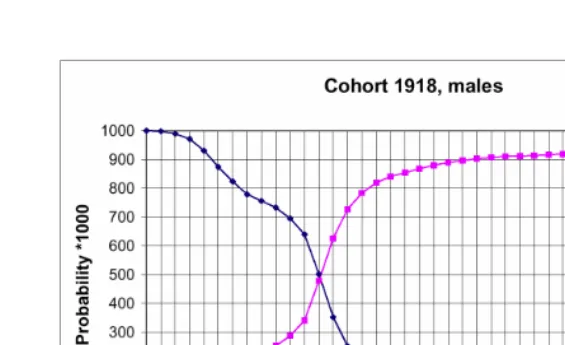
Figure 1a
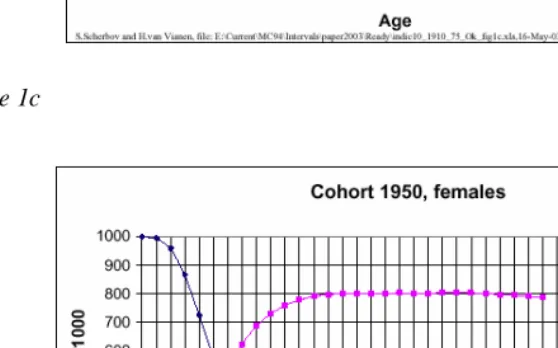
Figure 1c
Figure 1d
In figure 1a to 1d we present multistate marital tables for some selected cohorts. In order to get some insight into the different histories of men and women we will compare the history of a male cohort with the experience of the female cohort that is two years younger. The difference of mean age at marriage is around 2 years for most cohorts, but of course men from a certain cohort can marry women from all cohorts on the marriage market. First we will discuss figure 1a: the male cohort of 1918. At age 23, before the German invasion and the start of the Great Patriotic War nearly 20 percent of men were married. Between age 23 and 27, during the war years, the proportion married rose only slowly, but after 1945 it increased very rapidly till 80 percent at age 31. The proportions widowed and divorced were always very low in this cohort and ultimately only around 4 percent of males was never married at age 50.
Figure 1b: the female cohort of 1920 tells a quite different story. The proportion married rises very rapidly, until at age 21 around 35 percent of women is married. During the war new marriages only compensated for early widowhood and the proportion married in this cohort never is above 70 percent. At age 50 more than 10 percent is never married but 20 percent is widowed, indicating that most women who were widowed at a young age did not remarry.
In figure 1c the male cohort 1948 is shown. It is censored at age 46. At age 23 more than 40 percent is married. There is no delay and at age 31 more than 80 percent is married, a proportion growing slowly afterwards. Only 7 percent is never married at age 46. Widowhood does not amount to anything for this generation, but the proportion divorced at age 46 is higher than the proportion never married.
2.2. Marriage in Russia: statistics
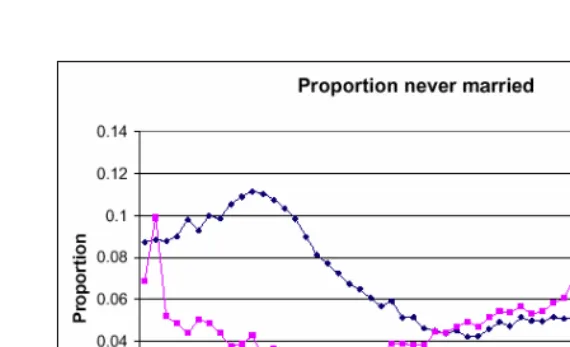
Figure 2: Proportion women and men never married at age 50
In figure 2 we present the proportion women and men never married at age 50 or by the age at censoring by census date for all cohorts born between 1910 and 1960. Note that only the cohorts born before 1944 reached this final age of 50 before the date of the micro census. For women the proportion never married increases from around 6 percent in the oldest cohorts to more than 10 percent in the cohorts most heavily affected by the Second World War. It monotonously declines to around 4 percent in the (very small) cohorts born during the war. Afterwards it slowly increases again, but remains very low until the last cohorts, a first indication of a change in marriage pattern with a decline in the rate of first marriages.
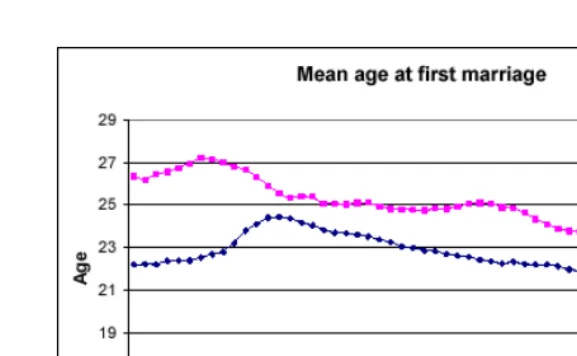
Figure 3: Mean age at first marriage
Figure 3 shows the distribution of the mean age at first marriage for both females and males. For women it goes up from around 22 years in the oldest generations to a maximum of 24.5 years for the generations born in 1922 and 1923. Afterwards it falls off almost linearly. Again this feature is genuine. Due to the very young age at first marriage censoring does not play any role. When combining this result with the foregoing figure we see that there is a decline in the mean age at marriage simultaneous with a decline in the proportions marrying (Avdeeev and Monnier 1999, 637-638)
of 1945-1946 when confronted with the small male cohorts born in 1943.and 1945 does not appear. This asymmetry has to do with the different pattern of age at marriage. For females it is very peaked around the modal age of 20, whereas for males the spread around 23 years is much larger, which implies that for a female there would be more eligible candidates on the marriage market.
Figure 4: Lexis surface of proportions of women first marrying by year of birth, per thousand
cohort 1970. The concentration of marriages around the modal age is distorted by the events of around 1932 and 1933, the Famine. A more normal pattern appears afterwards but another, deeper, trough is caused by the Second World War. In the female births cohorts most heavily affected, those born in 1916-1922, the distribution of age at first marriage becomes bimodal. The shortfall of marriages is made up after the war, but the concentration of marriages, although at a somewhat higher modal age reappears only in the generations born after 1934. In the following generations there is a slight decrease in the age and the distribution becomes more peaked around the modal age. Although the official age at which a woman can marry is 18 years, an appreciable number of marriages before this age are reported.
The same distribution for males is presented in figure 5. Males marry at a higher age and the age at marriage has a wider range. In particular for the oldest cohorts the spread of age at marriage for males is much larger as compared with females, which explains the larger difference of mean age at marriage from figure 2. For males the effects of the war are even more outspoken than for females. For all generations from 1910 until1922 the distribution is bimodal and the concentration of marriages immediately after the war for the generations 1918-1922 is evident. These generations really had to postpone marriage and were small when entering a marriage market with a large imbalanced sex ratio.
Figure 6: Lexis surface of the proportions living in a widowed state by age and cohort for males, per thousand
A different picture arises if we have a closer look at the marital status during the life span between age 18 and age 50 instead. In figures 6 and figure 7 we show a Lexis surface of the proportions living in a widowed state by age and cohort for males and females respectively.
Figure 7: Lexis surface of the proportions living in a widowed state by age and cohort for females, per thousand
Figure 9: Lexis surface of the proportions living in a divorced state by age and cohort for females, per thousand
The same, although to a lesser degree, applies for the divorced state during the marital life span, which is presented in figures 8 and 9. Generally at any age and for any cohort there are about twice as many women in the divorced state. For both sexes the increase in divorce is evident. For the cohorts born before 1920 it was always below 2 percent for males and below 4 percent for females.
2.3. Marriage in Russia, multistate marital tables
is impossible to present the detailed transition probabilities of all the multistate marital tables over such a long period and therefore we limit ourselves to the presentation of a number of indicators from our marital tables for both sexes and for all cohorts. In estimating marital tables we could use data on date of first marriage, date and cause of end of first marriage and date of second marriage for each individual in the micro census. So we could directly estimate the age specific probabilities of first marriage, dissolution of first marriage by divorce, dissolution of first marriage by widowhood, probabilities of second marriage from divorce and probabilities of second marriage from widowhood. Because there are no detailed data on dissolution of remarriages they were modeled as follows: a person who is divorced or widowed can remarry with remarriage probabilities estimated from our data. When remarrying he reenters the state of married and the probabilities of divorce and widowhood are the same as those estimated from the data on first marriages (Darsky and Scherbov 1995, 36,37).
In our cohort analysis we have only complete information from those cohorts that were aged 50 or over at the date of the micro census: the cohorts born before 1944. All later cohorts are censored. The latest cohort in our analysis, the cohort of 1960 was 33 years in 1994. In order to construct multistate tables for these censored cohorts we could impute the last transition probabilities that were observed for the missing probabilities. The transition probabilities at age 49 from the 1943 cohort, those at age 48 from the 1944 cohort etc. This procedure would imply that the completed tables are a mixture of a cohort table up to the age at the micro census and a period table for higher ages. However, transition probabilities at a certain age are dependent upon the foregoing marital history of the cohort and this implies that an uncontrollable bias is introduced by a marital history after the censored age that is a mixture of the marital histories of older cohorts, but that does not describe the history of any ‘real’ cohort. Ultimately, for the cohorts born after 1977 we would end up with a pure period marital table.
We adopted another approach for completing the life table. After the censored age no transition is possible and the distribution over the marital states (never married, married, divorced and widowed) is stationary. In this procedure only observed transitions are taken into account, but a systematic bias of exclusion of transitions at ages after censoring is introduced. This bias will be increase monotonically over the censored cohorts.
Table 1: Number of years spent in different marital states during the reproductive period (16-50 years) by sex and year of birth (1910-1960), Russia.
Females Males
Year Never Married Married Divorced Widowed Year Never Married Married Divorced Widowed
1910 9.07 18.16 0.46 6.30 1910 12.43 20.64 0.35 0.58
1911 9.12 17.71 0.55 6.62 1911 13.00 20.16 0.36 0.47
1912 9.09 17.94 0.55 6.42 1912 12.15 20.99 0.36 0.50
1913 9.30 17.78 0.60 6.32 1913 12.18 20.93 0.39 0.50
1914 9.55 17.53 0.69 6.23 1914 12.25 20.91 0.41 0.42
1915 9.41 17.81 0.69 6.09 1915 12.60 20.60 0.41 0.39
1916 9.71 17.72 0.71 5.85 1916 12.80 20.44 0.38 0.38
1917 9.81 17.95 0.84 5.40 1917 12.62 20.62 0.33 0.43
1918 10.10 18.16 0.85 4.89 1918 12.35 20.93 0.39 0.33
1919 10.57 18.08 0.92 4.43 1919 12.19 21.17 0.35 0.29
1920 11.14 18.29 0.86 3.72 1920 12.13 21.21 0.37 0.29
1921 11.40 18.61 0.93 3.07 1921 11.59 21.79 0.36 0.27
1922 11.60 18.94 1.01 2.45 1922 11.26 22.04 0.43 0.27
1923 11.52 19.36 1.07 2.05 1923 10.89 22.50 0.38 0.23
1924 11.34 19.79 1.10 1.77 1924 10.62 22.65 0.49 0.24
1925 10.95 20.29 1.19 1.57 1925 10.74 22.58 0.45 0.23
1926 10.62 20.67 1.23 1.48 1926 10.65 22.64 0.50 0.22
1927 10.29 21.00 1.26 1.44 1927 10.27 22.97 0.53 0.23
1928 10.07 21.31 1.23 1.40 1928 10.32 22.92 0.56 0.20
1929 9.91 21.51 1.29 1.30 1929 10.32 22.88 0.60 0.20
1930 9.78 21.64 1.28 1.31 1930 10.43 22.75 0.60 0.21
1931 9.58 21.80 1.36 1.26 1931 10.49 22.63 0.68 0.19
1932 9.36 22.03 1.37 1.24 1932 10.28 22.80 0.72 0.19
1933 9.30 21.96 1.45 1.30 1933 10.29 22.70 0.80 0.21
1934 8.90 22.30 1.58 1.23 1934 10.27 22.66 0.88 0.20
1935 8.85 22.26 1.65 1.24 1935 10.22 22.63 0.96 0.19
1936 8.59 22.47 1.74 1.19 1936 10.20 22.53 1.08 0.19
1937 8.54 22.33 1.98 1.15 1937 10.43 22.23 1.14 0.19
1938 8.36 22.50 2.03 1.12 1938 10.41 22.18 1.21 0.20
1939 8.32 22.50 2.07 1.10 1939 10.58 21.97 1.26 0.19
1940 8.19 22.56 2.16 1.08 1940 10.78 21.65 1.38 0.19
1941 8.07 22.60 2.26 1.07 1941 10.76 21.71 1.34 0.19
1942 8.08 22.52 2.36 1.04 1942 10.82 21.63 1.37 0.18
1943 8.07 22.59 2.36 0.98 1943 10.73 21.57 1.53 0.17
1944 8.10 22.41 2.57 0.92 1944 10.68 21.55 1.59 0.18
1945 8.12 22.46 2.52 0.90 1945 10.55 21.70 1.57 0.18
1946 8.05 22.51 2.53 0.91 1946 10.17 22.14 1.54 0.15
1947 8.04 22.58 2.54 0.84 1947 9.99 22.31 1.56 0.15
1948 8.03 22.61 2.58 0.79 1948 9.87 22.44 1.56 0.14
1949 7.85 22.77 2.59 0.79 1949 9.84 22.42 1.60 0.15
1950 7.82 22.88 2.58 0.72 1950 10.07 22.22 1.59 0.12
1951 7.78 22.93 2.61 0.68 1951 9.84 22.41 1.64 0.11
1952 7.73 23.03 2.58 0.66 1952 9.92 22.33 1.64 0.11
1953 7.65 23.20 2.56 0.60 1953 10.01 22.23 1.65 0.11
1954 7.70 23.08 2.62 0.60 1954 10.15 22.12 1.63 0.10
1955 7.60 23.34 2.52 0.54 1955 10.17 22.14 1.59 0.10
1956 7.60 23.35 2.54 0.51 1956 10.32 22.03 1.57 0.08
1957 7.67 23.39 2.48 0.46 1957 10.41 21.98 1.54 0.07
1958 7.73 23.43 2.42 0.42 1958 10.54 21.85 1.54 0.07
1959 7.73 23.42 2.45 0.40 1959 10.71 21.77 1.44 0.07
Only by using the multistate approach it is possible to describe the marital career of a cohort in detail. Table 1 describes how the period of marital life between the ages 16 and 50 is distributed among different marital statuses, conditional that a person survives until age 50. Note that the marital state can be entered more than once by remarriage.
For women the number of years spent in the never married state goes up from 9.1 in the oldest cohorts to 11.6 years in the cohort around 1922 that had to postpone marriage or did not marry at all due to the Second World War. Afterwards it decreases monotonically until around 1955. Note that the decline after 1944 is underestimated in our figures, because women who were not married at the age of censoring stayed in the state of never married. In the oldest cohorts women spent on average more than 6 years of their reproductive period being widowed. This goes down to less than 1 year in the 1943 cohort. Afterwards it declines further but more and more of this decline is due to censoring bias. The number of years spent in a divorced state increases steadily, except for the (biased) youngest generations.
For men differences between the oldest cohorts may be due to the small cohort sizes before 1922. The number of years in the never married state is always higher than for the corresponding female cohorts except for the generations around 1922. The monotonous decline after the war generations that we noted for females is not observed for males. Note the slight increase for the generations 1939-1942, which contrasts with the decrease in the female generations 1940-1943. Years spent in the widowed state are negligible when compared with women and the years spent in a divorced state are systematically less than for women of adjacent generations. Typically men and women of all cohorts spent about the same number of years in the married state: men marry later, but men that are divorced or widowed more often or more quickly remarried. Only in the oldest generations this balancing mechanism did not work due to the large number of females that could not marry or that were widowed during the war and the distorted sex ratio on their marriage market.
2.3.2. Number of transitions between marital states
Females
All First Remarried after Number of times
Year marriages marriages Divorced Widowed Divorced Widowed
1910 0.99 0.91 0.02 0.05 0.04 0.45
1911 0.99 0.91 0.02 0.06 0.05 0.45
1912 1.00 0.91 0.02 0.07 0.05 0.43
1913 1.00 0.91 0.02 0.07 0.05 0.42
1914 1.00 0.90 0.02 0.08 0.06 0.40
1915 1.01 0.91 0.02 0.08 0.06 0.39
1916 1.02 0.90 0.03 0.09 0.06 0.38
1917 1.02 0.90 0.03 0.09 0.07 0.36
1918 1.02 0.89 0.03 0.10 0.07 0.33
1919 1.01 0.89 0.03 0.09 0.07 0.31
1920 1.00 0.89 0.03 0.08 0.07 0.27
1921 0.99 0.89 0.03 0.07 0.08 0.24
1922 0.98 0.89 0.03 0.05 0.09 0.21
1923 0.97 0.90 0.04 0.04 0.09 0.19
1924 0.98 0.90 0.04 0.03 0.10 0.18
1925 0.98 0.91 0.04 0.03 0.11 0.16
1926 0.99 0.92 0.05 0.03 0.11 0.16
1927 1.00 0.92 0.05 0.03 0.12 0.16
1928 1.00 0.93 0.05 0.03 0.12 0.15
1929 1.01 0.93 0.05 0.03 0.12 0.15
1930 1.01 0.94 0.05 0.03 0.13 0.15
1931 1.02 0.94 0.05 0.03 0.13 0.15
1932 1.03 0.94 0.06 0.03 0.14 0.15
1933 1.03 0.94 0.06 0.03 0.14 0.15
1934 1.05 0.95 0.07 0.03 0.16 0.15
1935 1.06 0.95 0.07 0.03 0.17 0.15
1936 1.07 0.95 0.08 0.03 0.18 0.15
1937 1.07 0.95 0.09 0.03 0.20 0.14
1938 1.09 0.96 0.09 0.04 0.21 0.14
1939 1.09 0.95 0.10 0.04 0.21 0.13
1940 1.10 0.96 0.10 0.04 0.22 0.13
1941 1.10 0.96 0.11 0.04 0.23 0.13
1942 1.10 0.95 0.11 0.04 0.23 0.13
1943 1.11 0.95 0.12 0.04 0.24 0.13
1944 1.12 0.95 0.13 0.04 0.26 0.12
1945 1.11 0.95 0.13 0.03 0.25 0.11
1946 1.11 0.95 0.13 0.03 0.25 0.10
1947 1.11 0.95 0.13 0.03 0.25 0.09
1948 1.10 0.95 0.13 0.03 0.25 0.08
1949 1.11 0.95 0.13 0.03 0.25 0.08
1950 1.11 0.95 0.13 0.03 0.25 0.07
1951 1.10 0.95 0.13 0.02 0.25 0.07
1952 1.10 0.95 0.13 0.03 0.24 0.06
1953 1.10 0.95 0.13 0.02 0.24 0.05
1954 1.10 0.94 0.13 0.02 0.24 0.05
1955 1.10 0.94 0.13 0.02 0.24 0.05
1956 1.09 0.94 0.13 0.02 0.23 0.04
1957 1.08 0.94 0.13 0.02 0.23 0.04
1958 1.07 0.93 0.12 0.02 0.22 0.03
1959 1.06 0.93 0.12 0.01 0.22 0.03
Table 2 (continued)
Males
All First Remarried after Number of times
Year marriages marriages Divorced Widowed Divorced Widowed
1910 1.01 0.93 0.04 0.04 0.05 0.08
1911 0.99 0.90 0.04 0.04 0.05 0.07
1912 1.03 0.95 0.04 0.04 0.06 0.07
1913 1.04 0.95 0.05 0.04 0.06 0.07
1914 1.04 0.96 0.05 0.03 0.07 0.06
1915 1.03 0.95 0.05 0.03 0.07 0.05
1916 1.03 0.95 0.05 0.03 0.07 0.05
1917 1.03 0.96 0.04 0.03 0.06 0.05
1918 1.04 0.96 0.05 0.03 0.07 0.05
1919 1.03 0.96 0.05 0.02 0.06 0.04
1920 1.02 0.96 0.04 0.02 0.06 0.04
1921 1.04 0.97 0.05 0.02 0.07 0.04
1922 1.04 0.96 0.05 0.02 0.07 0.04
1923 1.03 0.97 0.05 0.02 0.07 0.04
1924 1.04 0.97 0.06 0.02 0.08 0.04
1925 1.04 0.97 0.05 0.02 0.08 0.04
1926 1.04 0.97 0.06 0.02 0.08 0.04
1927 1.05 0.97 0.06 0.02 0.09 0.04
1928 1.05 0.97 0.06 0.02 0.09 0.04
1929 1.05 0.97 0.06 0.02 0.10 0.04
1930 1.04 0.97 0.06 0.02 0.10 0.04
1931 1.05 0.96 0.07 0.02 0.11 0.04
1932 1.05 0.96 0.07 0.02 0.11 0.04
1933 1.05 0.96 0.08 0.01 0.12 0.04
1934 1.06 0.96 0.08 0.02 0.13 0.04
1935 1.06 0.96 0.09 0.02 0.14 0.04
1936 1.07 0.96 0.09 0.02 0.15 0.04
1937 1.07 0.96 0.10 0.02 0.16 0.03
1938 1.08 0.96 0.11 0.01 0.17 0.03
1939 1.08 0.95 0.11 0.02 0.18 0.04
1940 1.08 0.95 0.12 0.01 0.19 0.03
1941 1.09 0.95 0.12 0.01 0.19 0.03
1942 1.09 0.95 0.13 0.01 0.19 0.03
1943 1.09 0.95 0.13 0.01 0.21 0.03
1944 1.10 0.95 0.14 0.01 0.21 0.03
1945 1.09 0.94 0.14 0.01 0.21 0.03
1946 1.09 0.95 0.13 0.01 0.20 0.02
1947 1.09 0.95 0.13 0.01 0.20 0.02
1948 1.08 0.94 0.13 0.01 0.20 0.02
1949 1.07 0.94 0.13 0.01 0.20 0.02
1950 1.06 0.93 0.13 0.01 0.19 0.02
1951 1.06 0.93 0.12 0.01 0.19 0.01
1952 1.06 0.93 0.12 0.01 0.19 0.01
1953 1.04 0.92 0.12 0.01 0.19 0.01
1954 1.03 0.91 0.11 0.00 0.18 0.01
1955 1.03 0.91 0.11 0.01 0.18 0.01
1956 1.02 0.90 0.11 0.00 0.17 0.01
1957 1.01 0.90 0.11 0.00 0.17 0.01
1958 0.99 0.89 0.10 0.00 0.16 0.01
1959 0.98 0.88 0.09 0.00 0.15 0.01
Note that the number of marriages can be larger than one because of remarriages from divorced or widowed. The way our tables are completed for the censored cohorts guarantees that the number of events in the table is the same as the observed number of events. The tables depict the average number of events per person in a cohort, but an individual person may experience a certain event more than once.
Around 90 percent of women in the oldest cohorts married for the first time, a figure that does not change appreciably for the war cohorts around 1922. After 1926 it goes up to around 95 percent and remains at that high level (except for the youngest generations, but here the number of events is underestimated due to censoring). In the oldest cohorts more than 40 percent experience the event of becoming widowed (it would be more precise to say that 100 women experienced the event of becoming widowed 40 times, because a woman can experience an event more than once between age 16 and age 50), only a fraction remarriages and most women remain widowed. Combining table 1 and 2 we can get an impression of the impact of the war on women’s lives. In the 1914 cohort a woman was widowed on average 0.40 times and, according to table 1, every woman in this generation lived on average for 6.2 years in the widowed state, so that the event of becoming widowed implied on average 15.5 years in the widowed state. The average number of divorces per woman goes up from .04 in 1910 to 0.24 in 1943; afterwards remains at that level. In the youngest generations we only have the number of times divorced up to the age at censoring and the lifetime figure certainly will be higher.
The number of first marriages for males is even higher than for females. Only in the youngest cohorts there is a decline but that may be accounted for by censoring due to the higher age at marriage of males. The number of times males are widowed is always very low. The number of times divorced is systematically lower for males than for females, reflecting the difference in age at marriage, which may lead to more male divorces above age 50 or age at censoring. This effect is particularly clear when we compare the youngest cohorts. Moreover more male divorcees remarry, which corresponds with the finding in table 1 that males spent fewer years in the divorced state than females.
2.3.3. Age at transition between marital states
Females
First Remarried after Age when
Year marriages Divorced Widowed Divorced Widowed
1910 22.2 29.9 35.6 29.5 33.7
1911 22.2 30.7 35.4 29.8 32.9
1912 22.2 30.8 35.0 30.4 32.3
1913 22.4 32.0 34.5 30.1 31.8
1914 22.4 31.9 34.2 29.9 31.2
1915 22.4 32.0 33.6 30.1 30.6
1916 22.5 32.0 33.1 30.2 30.0
1917 22.7 31.9 32.6 29.8 29.9
1918 22.8 32.3 31.8 29.8 29.5
1919 23.2 32.5 31.5 30.4 29.7
1920 23.8 32.8 30.9 31.0 30.5
1921 24.1 33.3 31.4 31.3 31.8
1922 24.4 33.6 31.6 31.8 33.3
1923 24.4 33.9 33.1 32.1 35.2
1924 24.4 33.8 34.7 32.1 36.7
1925 24.2 34.1 36.3 32.3 37.6
1926 24.0 34.1 36.4 32.3 38.0
1927 23.8 34.2 36.8 32.4 38.1
1928 23.7 34.0 37.2 32.6 38.3
1929 23.7 34.3 37.3 32.9 38.6
1930 23.6 34.4 38.0 33.1 38.8
1931 23.5 34.5 38.2 33.3 39.1
1932 23.4 34.4 38.2 33.1 39.2
1933 23.2 34.7 38.5 33.2 39.0
1934 23.0 34.7 37.9 33.1 38.7
1935 23.0 34.6 38.2 33.2 38.6
1936 22.9 34.8 38.1 33.1 38.7
1937 22.8 34.8 37.9 33.0 38.5
1938 22.7 34.9 38.0 33.0 38.4
1939 22.6 34.8 38.4 32.9 38.4
1940 22.6 34.9 38.5 32.9 38.3
1941 22.4 34.8 38.1 32.5 38.4
1942 22.3 35.1 38.2 32.4 38.3
1943 22.2 34.8 38.3 32.1 38.5
1944 22.3 34.5 37.4 32.0 37.8
1945 22.2 34.0 36.9 31.6 37.1
1946 22.2 33.6 36.2 31.2 36.4
1947 22.2 33.5 35.6 31.0 35.9
1948 22.1 32.9 35.1 30.7 35.2
1949 21.9 32.5 34.1 30.2 34.4
1950 21.9 32.2 33.6 29.9 33.7
1951 21.8 31.7 32.9 29.4 33.0
1952 21.8 31.3 32.1 29.2 31.8
1953 21.6 30.7 31.7 28.6 31.4
1954 21.6 30.1 31.0 28.3 30.8
1955 21.5 29.8 30.3 27.9 30.2
1956 21.5 29.3 29.9 27.4 29.4
1957 21.4 28.8 29.3 27.1 28.9
1958 21.4 28.2 28.9 26.6 28.3
1959 21.3 27.8 28.2 26.3 27.8
Table 3 (continued)
Males
First Remarried after Age when
Year marriages Divorced Widowed Divorced Widowed
1910 26.3 36.2 37.7 32.6 36.2
1911 26.2 37.1 37.2 33.2 35.6
1912 26.5 36.0 37.6 33.1 35.9
1913 26.6 35.9 36.6 32.3 35.0
1914 26.8 35.3 36.8 32.4 35.0
1915 27.0 35.5 37.2 32.3 35.2
1916 27.2 34.6 37.4 32.2 35.8
1917 27.1 34.5 36.2 32.4 34.8
1918 27.0 34.9 38.0 32.8 36.7
1919 26.8 35.1 36.7 33.2 35.8
1920 26.6 35.6 37.9 33.6 37.6
1921 26.3 35.6 37.4 34.2 37.4
1922 25.9 36.3 37.5 34.4 37.3
1923 25.5 35.4 38.3 34.0 37.6
1924 25.3 35.6 38.1 33.9 38.0
1925 25.4 35.6 39.1 34.6 38.6
1926 25.4 36.1 38.5 34.6 38.6
1927 25.1 36.1 38.4 34.5 38.1
1928 25.1 35.9 39.0 34.3 38.9
1929 25.0 36.3 38.7 34.8 38.9
1930 25.1 36.3 38.9 34.9 39.2
1931 25.1 36.4 38.9 34.9 39.5
1932 24.9 36.6 39.6 34.8 39.9
1933 24.8 36.7 39.0 34.9 39.6
1934 24.8 36.5 39.3 35.0 39.2
1935 24.8 36.6 39.3 34.7 39.4
1936 24.7 36.9 39.8 34.7 39.7
1937 24.8 36.9 39.5 34.8 39.2
1938 24.8 36.9 39.9 34.5 39.4
1939 24.9 36.9 39.7 34.5 39.9
1940 25.1 37.2 39.6 34.6 39.7
1941 25.1 36.9 40.1 34.4 39.9
1942 25.1 36.6 39.5 34.2 39.8
1943 24.9 36.6 40.1 34.0 40.1
1944 24.9 36.5 39.0 33.5 39.4
1945 24.6 35.9 38.9 33.2 38.7
1946 24.3 35.4 37.6 32.8 37.8
1947 24.1 34.8 36.8 32.3 37.0
1948 23.9 34.5 36.2 31.9 36.4
1949 23.8 33.9 36.2 31.5 35.9
1950 23.7 33.5 34.9 31.0 35.2
1951 23.6 32.8 34.2 30.6 34.1
1952 23.5 32.4 33.8 30.2 33.8
1953 23.4 31.9 33.2 29.7 33.0
1954 23.4 31.3 32.1 29.3 31.7
1955 23.3 30.8 31.7 29.0 31.3
1956 23.3 30.3 30.7 28.5 30.5
1957 23.3 29.9 30.2 28.2 30.0
1958 23.2 29.3 29.9 27.8 29.3
1959 23.1 28.7 29.3 27.3 28.8
Note that mean age at the event of divorce or widowhood may be higher than mean age at remarriage because only part of the divorced or widowed will remarry before age 50 and those remarrying will in general be younger. The mean age at transition will be more and more biased downwards in the cohorts after 1943 due to censoring. For first marriages the bias will be small because Russians marry young, but for the youngest cohort all mean ages will be below 33 due to the method we adopted for completing a censored table.
The mean age at first marriage for women declined from around 22.2 years in the oldest cohorts, which compared with West European patterns is very young, to just above 21 years in the youngest generation. We note the low age when widowed for all cohorts up to 1925. For most cohorts age when widowed is higher than age at remarriage after being widowed. This implies that, taking into account the low remarriage probabilities for widowed women, only women widowed at a young age remarried The difference between age at first marriage and age when divorced is typically around 10 years in the complete tables. Given the very narrow distribution of age at marriage for women, this can be interpreted as the mean duration of marriage at divorce.
Men are on average around 2 years older at first marriage than women from the same generation. This age difference also applies for divorces and remarriages after divorced, which is remarkable, because divorced males not necessarily remarry with divorced females. Surprisingly the age when widowed for males is only slightly higher for males than for females, except, for obvious reasons, in the cohorts most affected by the war. Given the higher age at marriage for males and the higher male mortality we expect a larger difference. According to table 2 the experience if being widowed was very rare for males but when widowed this occurred at a rather early age, this could point to maternal mortality.
2.3.4. Conditional probabilities
Figure 10: Conditional probabilities for the marital state at age 30 for males that
are never married at age 20
Figure 11: Conditional probabilities for the marital state at age 30 for females that are never married at age 20
In figure 11 the same probabilities are shown for females never married at age 20. The most striking difference with the male histories we see for the generations from 1912 to 1921: most affected by the Second World War between their 20th and 30th birthday. Women born in 1915, who were never married in 1935, had a probability of more than 20 percent of being widowed at age 30 in 1945.
Figure 12: Conditional probabilities for the marital state at age 30 for females that are married at age 20
Because more than 30 percent of females marry before age 20 we show in figure 12 the conditional probabilities at age 30 for women married at age 20. In the generations 1915 and 1916 more than 30 percent of these women were widowed at age 30. Again the secular increase of divorce is to be noted.
Figure 13: Conditional probabilities for the marital state at age 50 for males that
are married at age 30
Figure 14: Conditional probabilities for the marital state at age 50 for females that are married at age 30
Again women tell a different story as can be seen from figure 14. In the oldest generations nearly 45 percent is widowed at age 50, but in all cohorts widowhood is significant. A decline of widowhood over the generations is offset by the already noted increase of divorce. In all generations since 1916 around 80 percent of those married at age 30 is married at age 50.
3. Conclusions
Data on the individual life history of 7 million people were collected in the 1994 micro census of the Russian Federation. The large size and the representativeness of the sample guarantees that every age group up to around age 90 years for females and age 80 for males is represented with enough respondents to permit the reconstruction of part of the demographic history, in particular with respect to marital behavior. Given the paucity of reliable demographic data on the U.S.S.R. and Russia during most of the period between 1926 and 1959 the micro census offers the last opportunity to question people who lived through a large part of the most turbulent part of the history of the Soviet empire.
economic or emotional aspects of marriage, divorce and widowhood. There was a tremendous change in education, a growing number of young people got longer schooling in succeeding generations, but the age at first marriage of women, which was already low in the oldest generations went down. From around 1936 to 1966 divorce was very difficult to obtain and the relatively low incidence of divorce in the older cohorts that reached age 50 before or around 1966 therefore cannot be interpreted as an indicator of the stability of the institution of marriage.
These reservations notwithstanding we could assemble the data on individual marital events in multistate marital tables for all cohorts born since 1910. Given the limitations of retrospective data, which only apply for those members of a birth cohort that are still alive at the date of the micro census, our tables offer the most complete description of marriage in Russia during most of the 20th century. As far as we know multistate marital tables for males were not presented before.
The first conclusion that can be drawn is that some aspects of marital behavior were extremely stable over the cohorts we could study. The traditional pattern of early and almost universal marriage did not change. The mean age of marriage even declined from an already very low level. The Second World War led to a postponement of first marriage and to a remarkably slight increase of the proportion of women never marrying in the cohorts most affected.
Divorce became ever more important: in the oldest cohort of 1910 the number of divorces per woman was only 0.04 and for men 0.05, but it increased nearly linearly to 0.24 for women and 0.21 for men in the cohort 1943. In all later cohorts that could not be followed up to age 50 we see an increase of divorce: in every succeeding cohort the number of divorced males or females at a given age increases. Only in the youngest cohorts there is some stabilization or a small decline (figure 8, 9).
Widowhood is of importance for females only, especially and understandingly for the women born before 1923 due to the heavy losses during the Second World. War. For the generations born since 1923 the number of times widowed per woman declines constantly, which of course is an immediate effect of the decline of mortality in Russia, especially since around 1950.
Notes
1. This study was supported in part by the Netherlands Organization for Scientific Research (NWO), Project 047-005-020.
2. All computer programs to extract data from the micro census and to perform multistate marital table analysis were developed by S. Scherbov.
3. One of the authors (H.v.V) thanks the Vienna Institute of Demography (IfD) for its hospitality.
References
Andreev, E.L., L. Darsky and T. Kharkova (1998): Demographic history of Russia. Moscow, Informatika [in Russian].
Avdeev, A. and A. Monnier (1999): La nuptialité russe, une complexité méconnue,
Population, 54(4-5), 635-676. English translation: Marriage in Russia, a
complex phenomenon poorly understood, Population: an English selection, 12, (2000), 7-50.
Darsky, L. and S. Scherbov (1995): Marital status behavior of women in the former Soviet Republics. European Journal of Population 11(1), 31-62.
Goskomstat (1995): Goskomstat of Russia, 1994 Microcensus of Russia, topical results (8 volumes). Goskomstat, Moscow [in Russian].
Hajnal, J. (1965): European marriage patterns in perspective, in: D.V. Glass and D.E.D. Eversley (ed), Population in history: essays in historical demography. London, U.K., Arnold, 101-143.
Philipov, D. (2001): Low fertility in Central and Eastern Europe: culture or economy? Paper presented at the IUSSP seminar on ‘International perspectives on low fertility: trends, theories and policies’, Tokyo, March 21-23, 2001.
Scherbov, S. and H.A.W. van Vianen (1999): Marital and fertility careers of Russian women born between 1910 and 1935. Population and Development Review, 25(1), 129-143.
Scherbov, S. and H.A.W. van Vianen (2001): Marriage and fertility in Russia of women born between 1900 and 1960: a cohort analysis. European Journal of
Population, 17(3), 281-294.
Scherbov, S. and H.A.W. van Vianen (2002): Period fertility in Russia since 1930: an application of the Coale-Trussell fertility model. Demographic Research, 6(16), 454-468.
Volkov, A.G. (1999): Methodology and organization of the 1994 microcensus in Russia. Groningen, Population Research Centre Working Papers 99-5.