in the population sciences published by the Max Planck Institute for Demographic Research Konrad-Zuse Str. 1, D-18057 Rostock · GERMANY www.demographic-research.org
DEMOGRAPHIC RESEARCH
VOLUME 23, ARTICLE 16, PAGES 445-478
PUBLISHED 27 AUGUST 2010
http://www.demographic-research.org/Volumes/Vol23/16/ DOI: 10.4054/DemRes.2010.23.16
Research Article
‘Just Living Together’:
Implications of cohabitation for fathers’
participation in child care
in Western Europe
María-José González
Pau Miret
Rocío Treviño
© 2010 María-José González, Pau Miret & Rocío Treviño.
This open-access work is published under the terms of the Creative Commons Attribution NonCommercial License 2.0 Germany, which permits use, reproduction & distribution in any medium for non-commercial purposes, provided the original author(s) and source are given credit.
1 Introduction 446
2 Theoretical perspectives: Marital status, gender, and child care 447
3 Research hypotheses 452
4 Data, variables, and sample of countries 453
5 Methods 459
6 Main results of the multivariate analysis 463
7 Conclusions and discussion 469
8 Acknowledgements 470
References 471
‘Just Living Together’:
Implications of cohabitation for fathers’ participation
in child care in Western Europe
María-José González1
Pau Miret2
Rocío Treviño3
Abstract
This article tests the assumption that cohabitation makes a difference in the allocation of childcare responsibilities within couples. It has often been assumed that cohabiting individuals are less likely to adhere to traditional gender ideologies than married people, because they tend to have a lower tolerance for poorly functioning relationships, to assign more value to individual freedom, and to base their relationships on egalitarian individualism, rather than on the joint utility maximisation of married couples. So far, however, most studies have focused on the determinants and consequences of being in cohabitation, and have overlooked the gender implications of this living arrangement.
Here we explore whether fathers in consensual unions are more prone than fathers in marital unions to share childcare responsibilities with their female partners. We use multilevel regression models for panel data to analyse ECHP in the period between 1996 and 2001. Our sample included around 13,000 couples living in heterosexual partnerships with small children (at least one child below age 13), and yielded around 45,000 observations over this period of time in 10 Western European nations. We found weak evidence of the influence of cohabitation, relative to marriage, on gender equality, but we also discovered that the diffusion of cohabitation at the societal level is associated with a more equal allocation of child care between partners.
1. Introduction
This paper was inspired by the argument that cohabiters and married people differ substantially in their gender relationships, notwithstanding the fact than increasing proportions of the married population have experiences of previous cohabitation, often with the person they will later marry. The argument is based on the assumption that cohabiters tend to assign more value to egalitarian individualism, personal autonomy, and equity (Lesthaeghe and Surkin 1988, Thomson and Colella 1992, Brines and Joyner 1999, Björnberg 2001); attitudes which may influence the partner's contribution to the household. This assumption is also used to explain the short-lived nature of cohabitation, and the lower rate of marital success among couples who previously cohabited (Teachman and Polonko 1990, Murphy 2000, Smock and Manning 2004). The differences between cohabitation and marriage in Western societies were studied extensively by demographers and social scientists during the 1980s and 1990s, when cohabitation was an emerging living arrangement, and was generally understood to be a prelude to marriage. Today, however, the boundaries between the two types of partnerships are less obvious, as cohabitation progressively becomes a more permanent mode of living across social groups. Marriage is no longer a prerequisite for childbearing, and societies are moving towards more egalitarian gender relationships. As has been proclaimed by several social scientists, “cohabitation is here to stay” (Toulemon 1996, Ermisch and Francesconi 2000, Kiernan 2004a), although the degree of diffusion of this arrangement, and the meaning and implications of cohabitation for the gender division of labour, still vary substantially across European societies.
The study is based on snapshots of cross-national data from 1996 to 2001. The short time span and the limited marital history provided by the ECHP (data on cohabitation prior to marriage is missing) do not allow us to explore the impact of family dynamics. We can only make a comparison between individuals who cohabit and those who are married in any given year. This may be somewhat problematic, since marriage is not a stable and homogeneous category, especially in countries where cohabitation is highly diffused and frequently precedes marriage. Unfortunately, we cannot detect whether married couples who cohabited before marriage divide up household tasks in the same way as they did before getting married. Nevertheless, the data allow us to explore possible differences in the proportion of child care responsibilities assumed by fathers across union types.
The structure of this paper is as follows. In the next section, we discuss the potential differences between cohabiting or consensual unions (we use both terms interchangeably) and marital unions. We then connect the theories on the transformation of living arrangements with the explanations for the increase in men’s participation in child care activities, and derive the main working hypotheses. In the following section,we describe the survey, variables, and models used to deal with the hierarchical structure of the panel data (respondents observed across waves and countries). The final section presents the results and main implications of cohabitation for the gender division of child care activities.
2. Theoretical perspectives: Marital status, gender, and child care
Cohabitation is becoming a popular living arrangement among young cohorts in most Western European countries (Bumpass and Lu 2000, Murphy 2000, Raley 2001, Heuveline and Timberlake 2004, Kiernan 2004a, Kiernan 2004b, Baxter 2005, Castro and Domínguez 2008). According to Festy (1980), the so-called “golden age of marriage” prevailed in Western European nations from the 1950s to the early 1970s, and marriage rates have declined ever since: the average age at marriage has increased, the stability of relationships has decreased, and non-marital cohabitation is increasingly accepted—albeit with large differences among countries in the prevalence of cohabitation. This living arrangement has become especially prevalent among divorced people, either as an alternative or a prelude to remarriage, and among young people marking the formation of a union (Bumpass and Lu 2000, Kiernan 2000 and 2004a, Ermisch 2005).
Marriages that began with cohabitation also seem to be more prone to breaking up than marriages with no history of cohabitation (Smock and Manning 2004), although this depends on the level of cohabitation in the country (Liefbroer and Dourleijn 2006). Cohabitation has also been related to a higher proportion of childlessness and births outside of marriage (Bachrach 1987; Raley 2001; Baizán, Aassve, and Billari 2003; Ermisch 2005), higher levels of educational homogamy (Schoen and Weinick 1993), more hours in paid work for women (Abroms and Goldscheider 2002, Kalmijn 2007), and a higher proportion of rented dwellings (Murphy 2000, Raley 2001). Additionally, cohabitation has been linked to more distant father-child relationships and to fathers spending less time with their children (Hofferth and Anderson 2003). Cohabiting couples also experience disadvantages in some countries where legal traditions and family ideologies favour marital unions in matters of social security and in the recognition of certain legal rights (Bradley 2001, Le Goff 2002). Demographic and legal differences notwithstanding, the growing prevalence and acceptance of consensual unions across Europe makes a reexamination of differences between cohabiting and marital unions potentially important, especially regarding the division of family responsibilities, and specifically of child care. In exploring these issues, we need to undertand the context in which cohabitation has come to exist. We will attempt to do this by looking at the recent transformation of cohabiting and marital unions in Western societies, and by analysing why cohabitation may have implications for the gender division of labour.
Austria. The lowest level is found in Southern European countries and Ireland, where cohabitation is, even today, only practised by a minority.
In the above-mentioned diffusion process, Sweden is an extreme case: in this country, it appears that no specific characteristics are attached to either type of union, whether marital or consensual. On average, cohabiting relationships in Sweden last nearly as long as marriages, and they even display similar fertility patterns (Bracher and Santow 1998). However, researchers such as Björnberg (2001) argue that, even in Sweden, cohabiting couples are indeed very heterogeneous; and that, despite the relative importance of this arrangement in society, cohabitation has not replaced marriage as an institution. Björnberg portrays cohabitation among young people as a practical solution in romantic relationships of uncertain duration, or in relationships in a “trial phase,” and concludes that many of these unions eventually convert into marriage or separation.
Another contrasting model is found in the U.S., where living together without being married is mainly meant to occur during the last stage of the courtship process, before the union is legalised by a “proper contract.” Although cohabiting is gradually becoming a more permanent arrangement, Heuveline and Timberlake (2004) conclude that cohabiting individuals are more similar to single individuals than to married ones, as far as behaviour and expectations are concerned. Oppenheimer (2003), however, attributes the rise of cohabitation in the U.S. to increasing employment instability among young men, for whom this type of arrangement is best understood as an “adaptive strategy” during a period of career immaturity. Smock and Manning (2004) also observe that, although cohabitation has become a common arrangement throughout the socioeconomic spectrum, it plays different roles for different social classes. They find that cohabitation is more prevalent among those with fewer economic resources (i.e., low income or high poverty rates), and thus represents a sort of “poor man’s marriage;” while those with higher education and good economic prospects are more likely to become married, to stay married, and to have children within marriage.
women are either the primary wage earners or have more education than their male partner) may be associated with more flexible living arrangements, such as cohabition (Miret-Gamundi 2007).
Previous examples suggest that family models are in a constant process of transformation, while even marital unions have transformed substantially, with many married couples holding less traditional gender role attitudes than in the past (Rogers and Amato 2000). It is difficult to provide a single, yet multifaceted portrait of cohabitation and marriage within Western societies. It remains unclear whether cohabiting couples are a distinct group as far as gender relations are concerned, or whether they are different due to composition effects (i.e., whether they represent a selective group of individuals). To that end, it is important to understand the main factors that influence the gender division of child care, and, in particular, the role of cohabitation in fostering more egalitarian gender relationships.
Before embarking on our analysis of the factors that influence the gender division of labour, we should point out that, so far, only a few studies have analysed the gender implications of forming a marital or consensual union, particularly in the area of child care. Most studies have focused on the gender division of domestic work (Shelton and John 1993, Fuwa and Cohen 2007), and the effect of premarital cohabitation on the division of household labour (Gupta 1999, Batalova and Cohen 2002, Fuwa 2004). Furthermore, child care has been frequently analysed within the general notion of “household chores” (which may include, for example, cooking, cleaning, laundry, and other routine domestic activities) using samples of married couples (South and Spitze 1994; Gupta 1999; Bianchi, Milkie, and Sayer 2000), even though recent studies have shown that the determinants of parents’ participation in child care and housework activities are very different (Deding and Lausten 2004). For example, caring for offspring is usually ranked very highly in importance by both parents, but this does not necessarily apply to household chores (Juster and Stafford 1991, Bianchi et al. 2004). Caring for offspring is also particularly valued among more educated parents (Meil-Landwerlin 1997; Sayer, Bianchi, and Robinson 2004), who are more aware of the long-term consequences of care for child development and well-being (Deutsch, Lussier, and Servis 1993, Bronte-Tinkew et al. 2008).
couples. Consensual unions are based on more individualised lifestyles, which reflect both a lower degree of commitment to their families, and a lower tolerance for poorly functioning relationships; while married men and women tend to embrace more traditional views on the family, as well as a gendered division of labour (Björnberg 2001). All in all, it is plausible to expect that men living in consensual unions will display more egalitarian gender behaviour, and that they have a greater willingness than married men to share equally in daily domestic and child care activities. This argument may be particularly relevant in countries where cohabitation is relatively uncommon, and is therefore practised by a rather select group of individuals. In these contexts, marital and cohabiting unions may have substantially different meanings. However, a study by Kalenkoski, Ribar, and Stratton (2007) on the United Kingdom and the United States found no evidence that cohabiting and married parents allocated different amounts of time to child care.
Gender differences in the division of time dedicated to child care and housework have traditionally been interpreted using economic and rational choice theories (i.e., Becker 1981). From this perspective, time allocation for housework and paid work have nothing to do with the type of union, but with the relative efficiency of husbands and wives in the market and household sectors. A similar approach is represented by the so-called “time availability hypothesis” (Gupta 1999, South and Spitze 1994), which asserts that time devoted to paid work fully determines the gender division of housework in couples, and that only the time remaining after paid work is bargained for between the partners. However, bargaining process or relative resource theories view the division of domestic labour as a negotiation between partners (Stancanelli 2003, Geist 2005), in which those individuals with the better bargaining position (i.e., earning capacity) reduce their share of time devoted to domestic work.
Micro-level processes, such as time availability, relative resources, and gender ideologies are important determinants of the division of housework, but contextual factors can also influence couples’ behaviour in different ways (Geist 2005). Contextual factors can be of a cultural nature, such as the gender ideology that prevails in a given society, or the degree of women’s empowerment in the public sphere (Fuwa 2004); or of a political nature, such as the work-family policies embedded in different welfare state regimes (Geist 2005). Fuwa and Cohen (2007) have demonstrated that housework activities are more equally shared between the genders in countries with an absence of discrimination against women in access to employment, as well as in countries with entitlement to long parental leaves. Geist (2005), on the other hand, identifies different levels of equal sharing of housework according to welfare state regimes, while controlling for micro-level processes. In this model, conservative regimes (e.g., Japan, Italy, and Austria), which support traditional gender relations, display lower levels of equal sharing, while social democratic regimes (e.g., Sweden and Norway) display higher levels. Liberal regimes (e.g., Australia, New Zealand, Great Britain, the United States, and Canada) provide heterogeneous results. The study of the specific mechanisms that operate at the macro level to influence couples’ allocation of time to child care is very promising, but more research is needed on the topic.
3. Research hypotheses
As described above, it is well-established in the literature that relative resources, time availability, and women’s bargaining power determine the gendered partitioning of child care and domestic activities. It is also clear that the institutional context and prevailing gender values may influence women’s abilities to negotiate family matters within the partnership, although, thus far, there is little evidence suggesting that there is a direct connection between national policies and couples’ sharing of domestic and caring activities. In this study, we aim to test additional hypotheses relating to the motivations for consensual unions that may have implications for parental participation in child care activities:
1. The couples’ homogamy hypothesis: It is not the condition of living in a consensual union that explains more egalitarian gender roles, but rather the fact that the union is between equals (educational homogamy).
3. The selection effect hypothesis: In countries with a low prevalence of cohabiting unions, there will be a higher selection effect. Individuals who are more committed to gender equality are more prone to be in consensual unions. Therefore, cohabiting men in countries where cohabitation is not yet widespread will spend more time caring for children,
4. The alternative hypothesis: None of the above statements are true, since cohabitation is simply a matter of fashion among young adults, and does not necessarily entail more egalitarian relationships (i.e., an equal share of child care).
In the next sections, we describe the survey, the samples, and the method used to capture the hierarchical structure of the data, which consists of repeated observations (panel data) of respondents nested within countries.
4. Data, variables, and sample of countries
Our empirical research is based on the European Community Household Panel (ECHP). The ECHP is a survey consisting of eight waves, running from 1994 to 2001, and is based on a standardised questionnaire involving annual interviews of a representative panel of households and individuals in each country. The topics covered include income, health, education, housing, demographic, and employment characteristics. Here, we explore whether the share of child care responsibilities assumed by fathers varies according to whether the fathers are married or cohabiting. The response variable, based on the survey question (“Roughly how many hours per week do you spend looking after children?”), was not incorporated into the survey until 1995. Moreover, Austria did not join the survey until 1996. For these reasons, only the third through the eighth waves (years 1996-2001) are included in the study. Individuals who are not in a union are excluded.
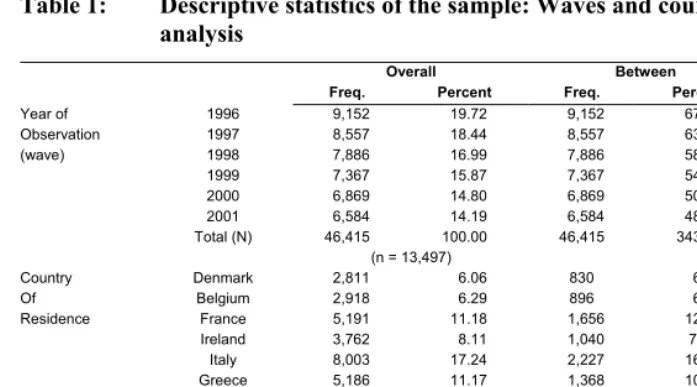
The period considered in this study covers six years of panel data (see Table 1). The sample consists of fathers and their female partners (observed annually during the period 1996-2001) living in heterosexual partnerships, with at least one child under age 13, and who declared that they made weekly time investments in child care within the nuclear family (i.e., those who answered the question: “Do your present daily activities include looking after children, whether your own or other, without pay?”). Couples were checked wave by wave, and they were included in the study for the years when they met the requirement of having at least one child under age 13.
Table 1: Descriptive statistics of the sample: Waves and countries included in analysis
Overall Between Within
Freq. Percent Freq. Percent Percent
Year of 1996 9,152 19.72 9,152 67.81 38.12
Observation 1997 8,557 18.44 8,557 63.40 29.14
(wave) 1998 7,886 16.99 7,886 58.43 24.90
1999 7,367 15.87 7,367 54.58 24.07
2000 6,869 14.80 6,869 50.89 25.19
2001 6,584 14.19 6,584 48.78 31.11
Total (N) 46,415 100.00 46,415 343.89 29.08
(n = 13,497)
Country Denmark 2,811 6.06 830 6.15 100.00
Of Belgium 2,918 6.29 896 6.64 100.00
Residence France 5,191 11.18 1,656 12.27 100.00
Ireland 3,762 8.11 1,040 7.71 100.00
Italy 8,003 17.24 2,227 16.50 100.00
Greece 5,186 11.17 1,368 10.14 100.00
Spain 6,786 14.62 1,974 14.63 100.00
Portugal 4,655 10.03 1,419 10.51 100.00
Austria 3,363 7.25 928 6.88 100.00
Finland 3,740 8.06 1,159 8.59 100.00
Total 46,415 100.00 13,497 100.00 100.00 (n = 13,497)
Source: ECHP 1996-2001 (unweighted data).
Apart from the type of union (married or cohabiting), the following independent variables have been included in the analysis at the individual level (see also Appendix 1 for further details):
• Sociodemographic variables: Men’s age (simple and squared factors to reflect the age exponential distribution), men’s employment status (a dummy variable), household composition measured by the number of children living at home and the age of the youngest child, men’s education (three main categories included in the models as a dummy variable), and the availability of intergenerational support (a dummy variable accounting for the presence of someone from a third generation, a grandparent, at home).
• Control for the time availability argument: Mothers’ working hours (continuous variable), including paid overtime, in the main job or business. • Control for the women’s relative resources argument: Mothers’ contributions
• Control for the couples’ homogamy hypothesis: A dummy variable for a match between the mothers' and the fathers' educational levels, which serves as a proxy for a “union between equals.”
• Control for the “marriage with the loan” hypothesis: A dummy variable indicating whether the dwelling is owned, rented, or provided free of charge. Housing tenancy is also introduced in the model according to the type of partnership.
Country of residence and year of observation (Waves 1996-2001) are random variables in Models 1 and 2. Country is also included as a fixed dummy variable in Model 3 to test for the net effect of country of residence, and a continuous variable indicating the percentage of cohabiting couples at the country level is included in Model 4 to test for “the selection effect hypothesis.” Thus, the extent to which the diffusion of cohabitation at the societal level influences the father’s share of time spent on child care is investigated.
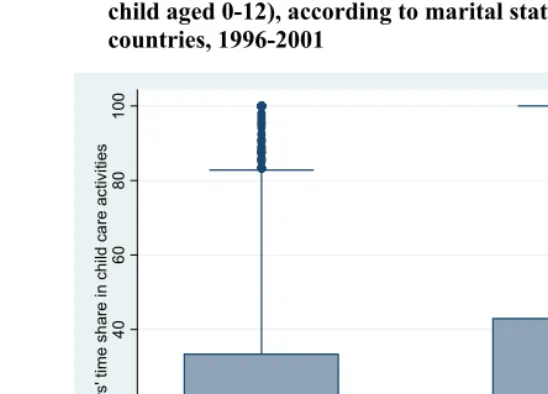
Figure 1 illustrates the first empirical evidence of the main differences between the two types of unions with respect to the share of child care activities assumed by fathers. As illustrated in the box-plot, this simple descriptive statistic (quartiles) indicates that fathers in consensual unions take on a greater share of the total time spent caring for children than fathers in marital unions. Nonetheless, there may be many composition effects producing this outcome, such as the fact that more homemaking women may be found within married couples.
Figure 1: Box-plot of fathers’ share of time spent on child care (at least one child aged 0-12), according to marital status: Selected European countries, 1996-2001
0
20
40
60
80
10
0
Fa
th
e
rs'
tim
e
sh
ar
e
in
c
hi
ld
c
a
re
a
cti
vi
tie
s
marriage consensual union
Figure 2: Fathers’ share of time spent on child care (at least one child aged 0-12) and the proportion of consensual unions by country, 1996-2001
Denmark Belgium France Ireland Italy Portugal Austria Finland Greece Spain 0.00 5.00 10.00 15.00 20.00 25.00 30.00 35.00 40.00
0.00 5.00 10.00 15.00 20.00 25.00 30.00
Consensual unions (%)
Me n' s s ha re in c hi ld c ar e ( m ea n hour s)
Source: ECHP 1996-2001
France holds a position similar to that of the Nordic countries in the diffusion of cohabitation, yet maintains a medium position on the share of time fathers spend on child care. This may be explained by the fact that France has traditionally had a supportive policy framework for working mothers with young children, but lacks specific policies for developing more equal parenting roles between men and women (Windebank 2001). Windebank (2001) has suggested that French fathers do not participate in domestic labour and parenting work, as would have been expected given the rise of female employment rates, because of the persistance of patriarchial attitudes, which has resulted in a “double burden” of paid and unpaid work for women.
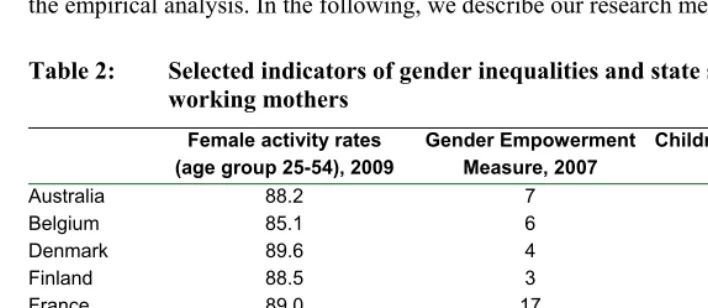
between men's and women's opportunities in a country. Austria, Belgium, and France have mixed indicators: the GEM rankings of these countries are somewhere in the middle, female activity rates are around or above those of the EU-15, and child care provision levels for children under age three are relatively high (30%), with the exception of Austria (15%). In contrast, Denmark, closely followed by Finland, is the country that scores highest in female activity rates, child care coverage, and GEM. After looking at this sample of countries, a question arises: To what extent is the participation of fathers in child care influenced by living in a particular type of union in a country with specific levels of cohabitation? This is an issue that will be addressed in the empirical analysis. In the following, we describe our research methodology.
Table 2: Selected indicators of gender inequalities and state support for working mothers
Female activity rates
(age group 25-54), 2009
Gender Empowerment Measure, 2007
Children in child care (%)- age group 0-2
Australia 88.2 7 13 (2001)
Belgium 85.1 6 30 (2000)
Denmark 89.6 4 64 (1999)
Finland 88.5 3 25 (2003)
France 89.0 17 30 (2001)
Greece 82.9 28 3 (2000)
Ireland 80.8 22 12 (1997)
Italy 77.5 21 6 (1998)
Portugal 88.1 19 22 (2002)
Spain 84.7 11 10 (2002)
EU-15 85.4 -- --
Sources: Female activity rates were provided by EUROSTAT (online statistics); GEM (this is an average index for political participation and decision-making power, economic participation, and power over economic resources) was provided by the United Nations Development Programme (UNDP) (available online: http://hdr.undp.org/en/statistics/indices/gdi_gem/); child care rates were provided by Immervoll and Barber (2005); data for Spain were obtained from González (2005).
5. Methods
of no time at all dedicated to child care activities. This variable is based on responses to “Number of hours (per week) spent looking after children (PR007A),” in which individuals reported one to 96 hours, -8 (not looking after any children) and -9 (missing). Those reporting -8 were included in the analysis as equivalent to zero hours. It should be noted that care is measured in a very broad sense; we only capture the number of hours, without distinguishing the type of activities fathers perform with children.
The multilevel approach takes advantage of both the hierarchical structure of the ECHP, in which individuals are nested within countries, and the longitudinal structure of the ECHP, in which observations are clustered in respondents. First, we take a sample of units from the higher level (i.e., countries); second, we sample the subunits from the available units (i.e., we sample individuals from the countries). In this type of sample, individual observations are generally not completely independent. The average correlation (expressed in the so-called “intra-class correlation”) between variables measured with individuals from the same country will be higher than the average correlation between variables measured with individuals from different countries. Standard statistical tests lean heavily on the assumption of the independence of the observations. If this assumption is violated (and this is usually the case in multilevel data) the estimates of the standard errors of conventional statistical tests are much too small, resulting in many spuriously “significant” results. The same applies to multiple observations for a single individual in panel data. Consequently, multilevel modelling is the appropriate approach for dealing with the ECHP data. We are concerned, however, by the fact that we rely on a reduced number of cases, as it is desirable to have as many units as possible at the top level of the multilevel hierarchy (i.e., country level).
) 3 ( k ζ ) 2 ( jk ζ ) 2 ( jk ζ k ζ
We first fit a three-level variance-component model with a random intercept for each respondent-country combination ( ), and another random intercept for country
k ( ). We accommodate heterogeneity between respondents in each of the six waves with (see Table 3).
) 2 (
jk ζ
4 This three-level model without covariates can be written as:
ijk k jk ijk
y =β +ζ(2)+ζ(3)+ε
1
where the index i is for waves, j is for respondents, and k is for countries. is the random intercept for respondent j and country k, and (3) is the random intercept for
country k. The random effect for a respondent is nested within countries, which means that it takes on a different value for each combination of respondent and country.
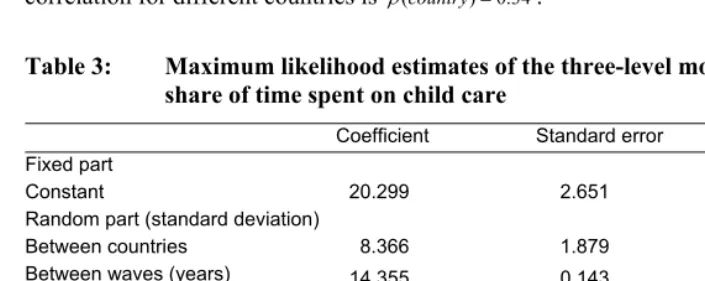
As seen in Table 3, the standard deviation between countries, ψ(3) , is estimated at 8.34, and the standard deviation between waves, ψ(2) , is estimated at 14.35. Finally, the θ , estimated at 18.36, displays the estimated standard deviation of the overall error term. The estimated intra-class correlation between waves in the same country for the same individual is , and the corresponding estimated intra-class correlation for different countries is .
45 . 0 ) , (
ˆsubjectcountry = ρ
34 . 0 ) (
ˆ country = ρ
Table 3: Maximum likelihood estimates of the three-level model for fathers’ share of time spent on child care
Coefficient Standard error P>z
Fixed part
Constant 20.299 2.651 0.000
Random part (standard deviation)
Between countries 8.366 1.879
Between waves (years) 14.355 0.143
θ 18.362 0.071
Log likelihood -208,123
Correlation: Between waves within countries 0.450
Between countries 0.336
Source: ECHP 1996-2001.
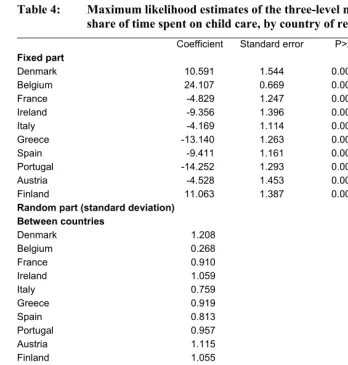
Table 4: Maximum likelihood estimates of the three-level model for fathers’ share of time spent on child care, by country of residence
Coefficient Standard error P>z % Fathers' time
Fixed part
Denmark 10.591 1.544 0.000 34.698
Belgium 24.107 0.669 0.000 24.107
France -4.829 1.247 0.000 19.278
Ireland -9.356 1.396 0.000 14.751
Italy -4.169 1.114 0.000 19.938
Greece -13.140 1.263 0.000 10.967
Spain -9.411 1.161 0.000 14.696
Portugal -14.252 1.293 0.000 9.856
Austria -4.528 1.453 0.002 19.580
Finland 11.063 1.387 0.000 35.170
Random part (standard deviation) Between countries
Denmark 1.208
Belgium 0.268
France 0.910 Ireland 1.059 Italy 0.759 Greece 0.919 Spain 0.813 Portugal 0.957 Austria 1.115 Finland 1.055
Total (between countries) 9.063
Between waves 14.359
θ 18.3584
Log likelihood -208,097
Correlation 10.591 1.544 0.000 34.698
Between waves, within countries 24.107 0.669 0.000 24.107
Between countries -4.829 1.247 0.000 19.278
Source: ECHP 1996-2001.
Austria, and Italy are somewhere in the middle, with fathers taking on around 20%-25% of child care hours. Finally, countries such as Ireland, Portugal, Spain, and especially Greece are at the bottom, with fathers handling around 10%-15% of childcare responsibilities. These results are not surprising given the low rates of women’s labour force participation in countries such as Greece or Spain. Women’s labour force participation clearly influences differences between countries in men’s levels of participation in child care activities. Next, we analyse the extent to which differences in the amount of time fathers spend on child care are attributable to personal characteristics, such as the type of partnership, or to contextual specificities within countries.
6. Main results of the multivariate analysis
We now turn to the multivariate analysis in order to test the implications of the explanatory variable “living in cohabitation” for the response variable “fathers’ time share in child care activities” across a sample of Western European countries. It should be noted that cohabiting fathers with at least one child under age 13 are a minority in the sample: they only represent 8.3% of all unions (average prevalence between 1996 and 2001), while the other 91.7% of the sample are in marital unions.
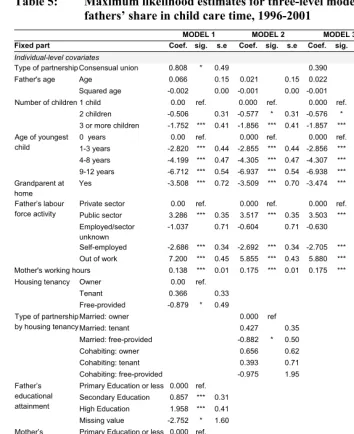
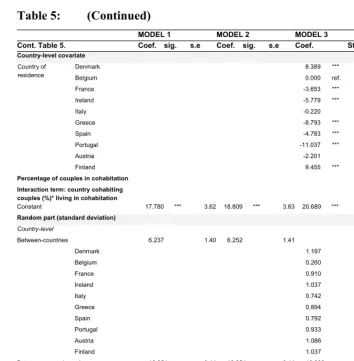
Results of the multivariate analysis are summarised in Table 5, which contains four statistical models. All models include sociodemographic variables, such as the father’s age and household composition. Model 1 also includes fixed-effect coefficients on the father’s employment and education, housing tenancy, and the mother’s working hours and education. Model 2 includes the income contribution of the mother to the household economy, the couple’s educational homogamy, and a composed variable capturing the effect of housing tenancy by type of living arrangement. There are two models, including variables at Level 3 (macro variables): these are Model 3, in which the country of residence is a categorical variable; and Model 4, which contains an interaction term of the percentage of cohabiting couples in the country (macro variable) and the type of union (micro variable). In contrast to the null model, the inclusion of new variables in consecutive models partially reduces country level variance, while other component variances remain at quite similar levels.
demanding, but they reduce their share afterwards, particularly when children are nine years old or older. The effect of the number of children should, however, be interpreted with caution, due to endogeneity arising from the fact that large families may have more traditional family values, and display a more rigid gender division of child care. Results also indicate that the presence of a grandparent at home discourages fathers from spending more time on child care; a finding which is especially relevant in certain countries, in particular in Southern Europe, where the extended family may play a major role in child care provision.
Moreover, we have controlled for the effect of time availability, measured as the number of hours spent by female partners in paid work. In line with theoretical models (South and Spitze 1994, Stancanelli 2003), the number of hours mothers spend working appears to be positively associated with an increase in the share of child care time assumed by fathers with small children. The more women are absent from the household, the higher the proportion of child care time taken up by fathers. The relationship of fathers to the labour market is also a relevant factor in understanding degrees of participation in child care. Fathers employed in the public sector are far more likely to share child care time than fathers employed in the private sector. Thus, it appears that public sector employment continues to be the best option for balancing family-work responsibilities for mothers and fathers alike (Meil-Landwerlin 1997). The opposite applies to self-employed fathers, who are much less likely to share time spent on child care than fathers employed in the private sector, probably due to their greater difficulties in reconciling paid and family responsibilities.
Model 1 also shows the net effect of father’s and mother’s education on sharing child care. As predicted by authors like Bianchi et al. (2004), there is a strong correlation between parents’ educational attainment and the time spent caring for children. Thus, the higher the educational level of the father, the more time he is likely to spend on child care. Interestingly, the educational attainment of mothers appears to have an even stronger effect on fathers’ behaviour (see coefficients in Model 1) than men’s education. Thus, living with a highly educated mother increases a typical man’s share by 3.69 (at p<0.001), whereas the effect of a father being highly educated is only 1.95 (at p<0.001). In Model 2, we additionally control for the effect of mothers’ bargaining power, measured as women’s contributions to the family income. As was found to be the case for time availability, mothers’ income contributions is also shown to have a clear effect: i.e., the greater the mother’s contribution, the greater the father’s share of child care. This confirms that women’s bargaining power in the household contributes to a more equitable sharing of family responsibilities.
fathers will spend more time on child care. We only find significant, although weak, results among fathers in dwellings provided for free, as they appear to be less likely to share time spent on child care than fathers in owned dwellings. The idea behind the variable of housing tenancy was that joint homeownership, irrespective of marital status, will resemble marital unions in that purchasing a home also entails accepting a long-term commitment. In order to test this hypothesis, we tested in Model 2 the joint effect of being married or cohabiting by housing tenancy. In contrast to our expectations, the coefficients indicate that fathers living in marital unions in dwellings provided for free are less prone to sharing child care responsibilities than married homeowners, whereas we do not find significant differences between cohabiting and married couples in owned and rented dwellings. We therefore reject the marriage with the loan hypothesis. It should be noted, however, that there is a methodological shortcoming in capturing this effect, owing to the fact that partnership formation and homeownership may occur almost simultaneously. Actually, most of the couples with small children in our sample were either homeowners or lived in rent-free housing (80%).
Model 2 tests the extent to which a union between equals positively affects fathers’ share of time spent on child care (i.e., couples’ homogamy hypothesis). This is a measure of partners’ relative resources, which may influence family issues, such as the question of who will take care of the children. It should be noted that the effects of variables already present in Model 1 do not change much in Model 2, in which other explanatory variables have been added. The results for educational homogamy are straightforward. In contrast to more traditional couples, in which men tend to have higher educational levels than women (our reference category), those couples in which women have higher educational attainment (β= 1.49***), and especially highly educated couples with education parity (β= 3.46***), tend to share time spent on child care more equally. In contrast, couples in which both partners have low levels of education show the lowest proportion of child care time assumed by fathers (β =-1.38***), indicating that only parity in higher education fosters a more equal sharing of family responsibilities.
matters for gender relations, and, more specifically, for fathers’ participation in child care. What other factors may encourage fathers to spend more time on child care?
Model 3 includes the country of residence, and reveals that the contextual level significantly influences the likelihood that a father will spend time caring for his children. Denmark is the country where fathers assume the greatest share of child care, while Portugal and Greece are the countries where fathers spend the least amount of time looking after their children As noted previously, studies such those by Geist (2005), Fuwa (2004), and Fuwa and Cohen (2007) have shown that differences in social policy design embedded in the nature of a welfare state regime, gender values, and gender empowerment at the societal level may lie behind these country effects. The study of the institutional context is, however, beyond the scope of this analysis. Instead, Model 4 analyses the selection effect hypothesis by including an interaction term with a macro-level variable, or the percentage of cohabiting couples across countries; and an individual-level variable, or the type of union. Contrary to our expectations, we do not find a selection effect. The results reveal that it is not the living arrangement type, but the diffusion of cohabitation in a society that matters for fathers’ participation in child care. We may hypothesise that countries with a large prevalence of cohabiting couples, indicating a growing pluralisation of family life and flexible gender arrangements, may have also experienced other changes at the cultural and institutional levels which have led to a greater gender equity. This is only a hypothesis, since the short time span of the ECHP data does not allow for a proper assessment of the causality of the process, particularly not to the extent that would enable us to discern whether the increase in cohabitation produces greater demands for gender equity within the family, or if the inverse is true. The results simply indicate that forming a union without papers, or “just living together,” is not as important in predicting the division of child care between partners as the societal context in which they organise their family life.
Table 5: Maximum likelihood estimates for three-level models predicting fathers’ share in child care time, 1996-2001
MODEL 1 MODEL 2 MODEL 3 MODEL 4
Fixed part Coef. sig. s.e Coef. sig. s.e Coef. sig. Std. Coef. sig. s.e Individual-level covariates
Type of partnership Consensual union 0.808 * 0.49 0.390 0.49 0.328 1.00
Father's age Age 0.066 0.15 0.021 0.15 0.022 0.15 0.025 0.15
Squared age -0.002 0.00 -0.001 0.00 -0.001 0.00 -0.001 0.00
1 child 0.00 ref. 0.000 ref. 0.000 ref. 0.000 ref.
2 children -0.506 0.31 -0.577 * 0.31 -0.576 * 0.31 -0.577 * 0.31
Number of children
3 or more children -1.752 *** 0.41 -1.856 *** 0.41 -1.857 *** 0.41 -1.860 *** 0.41
0 years 0.00 ref. 0.000 ref. 0.000 ref. 0.000 ref.
1-3 years -2.820 *** 0.44 -2.855 *** 0.44 -2.856 *** 0.44 -2.855 *** 0.44
4-8 years -4.199 *** 0.47 -4.305 *** 0.47 -4.307 *** 0.47 -4.309 *** 0.47
Age of youngest child
9-12 years -6.712 *** 0.54 -6.937 *** 0.54 -6.938 *** 0.54 -6.941 *** 0.54
Grandparent at home
Yes -3.508 *** 0.72 -3.509 *** 0.70 -3.474 *** 0.70 -3.484 *** 0.70
Private sector 0.00 ref. 0.000 ref. 0.000 ref. 0.000 ref.
Public sector 3.286 *** 0.35 3.517 *** 0.35 3.503 *** 0.35 3.504 *** 0.35
Employed/sector unknown
-1.037 0.71 -0.604 0.71 -0.630 0.71 -0.625 0.71
Self-employed -2.686 *** 0.34 -2.692 *** 0.34 -2.705 *** 0.34 -2.705 *** 0.34
Father’s labour force activity
Out of work 7.200 *** 0.45 5.855 *** 0.43 5.880 *** 0.43 5.887 *** 0.43
Mother's working hours 0.138 *** 0.01 0.175 *** 0.01 0.175 *** 0.01 0.175 *** 0.01
Owner 0.00 ref.
Tenant 0.366 0.33
Housing tenancy
Free-provided -0.879 * 0.49
Married: owner 0.000 ref
Married: tenant 0.427 0.35
Married: free-provided -0.882 * 0.50
Cohabiting: owner 0.656 0.62
Cohabiting: tenant 0.393 0.71
Type of partnership by housing tenancy
Cohabiting: free-provided -0.975 1.95
Primary Education or less 0.000 ref.
Secondary Education 0.857 *** 0.31
High Education 1.958 *** 0.41
Father’s educational attainment
Missing value -2.752 * 1.60
Primary Education or less 0.000 ref.
Secondary Education 1.848 *** 0.32
High Education 3.695 *** 0.42
Mother’s educational attainment
Missing value 1.630 1.59
He has higher education 0.000 ref. 0.000 ref. 0.000 ref.
She has higher education 1.490 *** 0.41 1.494 *** 0.41 1.494 *** 0.41
Both low-educated -1.377 *** 0.38 -1.348 *** 0.38 -1.372 *** 0.38
Both secondary-educated 1.099 *** 0.39 1.092 *** 0.39 1.098 *** 0.40
Both highly-educated 3.463 *** 0.46 3.456 *** 0.47 3.459 *** 0.47
Couples’ educational homogamy
Other -1.111 1.20 -1.092 1.20 -1.115 1.20
Table 5: (Continued)
MODEL 1 MODEL 2 MODEL 3 MODEL 4
Cont. Table 5. Coef. sig. s.e Coef. sig. s.e Coef. Std. Coef. sig. s.e Country-level covariate
Denmark 8.389 *** 8.39
Belgium 0.000 ref.
France -3.653 *** -3.65
Ireland -5.779 *** -5.78
Italy -0.220 -0.22
Greece -8.793 *** -8.79
Spain -4.783 *** -4.78
Portugal -11.037 *** -11.04
Austria -2.201 -2.20
Country of residence
Finland 9.455 *** 9.45
Percentage of couples in cohabitation 0.572 *** 0.19 Interaction term: country cohabiting
couples (%)* living in cohabitation
0.004 0.06
Constant 17.780 *** 3.62 18.809 *** 3.63 20.689 *** 3.09 13.171 *** 3.55
Random part (standard deviation)
Country-level
Between-countries 6.237 1.40 6.252 1.41 3.462 1.11
Denmark 1.197
Belgium 0.260
France 0.910
Ireland 1.037
Italy 0.742
Greece 0.894
Spain 0.792
Portugal 0.933
Austria 1.086
Finland 1.037
Between waves (years) 12.254 0.14 12.254 0.14 12.282 12.263 0.14
Interaction 0.214 0.14
Residual 18.084 0.07 18.052 0.07 18.043 18.051 0.07
Log likelihood -202,265 -201,626 -201,605 -201,625
Number of countries 10 10 10 10
Number of individuals 13,286 13,325 13,325 13,325
Number of observations 45,513 45,382 45,382 45,382
Chi2(2)= 2508.06 2506.26 3038.62 2512.21
Prob > chi2 = 0.0000 0.0000 0.0000 0.0000
Legend: * p<0.05. ** p<0.01. ***p<0.001. Ref.: reference category.
7. Conclusions and discussion
Most studies show that mothers are the primary caregivers in the family, although men are slowly shifting towards a “new fatherhood,” characterised by a greater involvement in child care activities. In this context, we have sought to examine the extent to which the spread of consensual unions produces an equalising effect on the gender division of time invested in child care activities in Western societies. Obviously, behind the research question lies a strong assumption: the belief that individuals in consensual unions tend to be more concerned about individual freedom and egalitarian values than married individuals. Indeed, as described in Section 1, it was assumed that individuals in consensual unions tend to adhere to common sociodemographic patterns, such as shorter union durations, higher female employment, lower fertility, higher prevalence of childlessness, educational homogamy, and/or a higher likelihood of renting rather than owning a dwelling. Therefore, we considered plausible that consensual unions could represent a new setting in which mothers and fathers negotiate the share of family responsibilities on more equal terms than within marital unions.
In our research, we studied the share of time fathers, relative to mothers, spent on child care activities in the late 1990s, drawing upon a sample of 10 Western European countries using the ECHP (waves 1996-2001). The main explanatory variable was living in a consensual union, instead of a marital union. After adjusting for the nested-level structure of the data (with observations nested within respondents and respondents nested within countries), and controlling for the main compositional effects, such as household structure, fathers’ employment and education, and partners’ characteristics, we find weak evidence that fathers living in consensual unions account for a slightly higher proportion of the time parents spend on childcare activities than fathers in marital unions. Instead, the diffusion of cohabitation at the societal level appears to matter for fathers’ participation in child care activities.
Results at the individual level indicate that mothers’ employment, educational attainment, working hours, and income contributions are key factors associated with men’s levels of participation in child care. In other words, the “new fatherhood” is strongly associated with the time squeeze of dual-earner couples, as well as women’s improved position in the labour market. There are, however, other positive signs of changes among men associated with the expansion of education. Well-educated fathers and highly educated couples seem to be more committed to the sharing of time spent caring for small children. Here, education may reflect the emergence of new values in favour of a more engaged fatherhood, as well as a higher awareness of and motivation for the production of “quality” children among educated fathers.
which is indirectly captured by the diffusion of cohabitation at the societal level, positively contributes to a higher probability that a father will engage in child care. There are still other factors operating in the national context which remain unexplored. National differences in family policies and social norms certainly may determine the time constraints and cultural barriers that fathers encounter in seeking to spend more time with their children. The ECHP data may, however, not be suitable for conducting such a study due to the small sample sizes (i.e., few countries and few cases of partnered individuals with small children). Future research should reexamine these findings based on larger samples or individual case studies.
8. Acknowledgements
References
Abroms, L.C. and Goldscheider, F.K. (2002). More Work for Mother: How Spouses, Cohabiting Partners, and Relatives Affect the Hours Mothers Work. Journal of Family and Economic Issues 23: 144-166.
Bachrach, C.A. (1987). Cohabitation and reproductive behavior in the U.S.
Demography 24(4): 623-637. doi:10.2307/2061397.
Baizán, P., Aassve, A., and Billari, F. (2003). Cohabitation, Marriage and First Birth: the Interrelationship of Family Formation Events in Spain. European Journal of Population 19: 47-169.
Batalova, J. and Cohen, P.N. (2002). Pre-Marital Cohabitation and Housework: Couples in Cross National Perspective. Journal of Marriage and Family 64: 743-755.
Baxter, J. (2005). To Marry or Not To Marry. Marital Status and the Household Division of Labor. Journal of Family Issues 26(3): 300-321. doi:10.1177/ 0192513X04270473.
Becker, G. (1981). A Treatise on the Family. Chicago: University of Chicago.
Bianchi, M., Milkie, M., and Sayer, L. (2000). Is Anyone Doing Housework? Trends in the Gender Household Labor. Social Forces 79(1): 191-228.
doi:10.2307/2675569.
Bianchi, S., Cohen, P., Raley, S., and Nomaguchi, K. (2004). Inequality in Parental Investment in Child-Rearing: Expenditures, Time and Health. In: Neckerman, K. (ed.). Social Inequality. New York: Russell Sage Foundation: pp. 189-219. Björnberg, U. (2001). Cohabitation and Marriage in Sweden – Does Family Form
Matter? International Journal of Law, Policy and the Family 15(3): 350-362.
doi:10.1093/lawfam/15.3.350.
Bracher, M. and Santow, G. (1998). Economic Independence and Union Formation in Sweden. Population Studies 52(3): 275-294. doi:10.1080/0032472031000150 466.
Bradley, D. (2001). Regulation of Unmarried Cohabitation in West-European Jurisdictions: Determinants of Legal Policy. International Journal of Law, Policy and the Family 15(1): 22-50. doi:10.1093/lawfam/15.1.22.
Brines, J. (1994). Economic Dependence, Gender, and The Division of Labor At Home.
Brines, J. and Joyner, K. (1999). The Ties That Bind: Principles of Cohesion in Cohabitation and Marriage. American Sociological Review 64(3): 333-355.
doi:10.2307/2657490.
Bronte-Tinkew, J., Carrano, J., Horowitz, A., and Kinukawa, A. (2008). Involvement among Resident Fathers and Links to Infant Cognitive Outcomes. Journal of Family Issues 29(9): 1211-1244. doi:10.1177/0192513X08318145.
Bumpass, L. and Lu, H.-H. (2000). Trends in Cohabitation and Implications for Children’s Family Contexts in the United States. Population Studies 54(1): 29-41. doi:10.1080/713779060.
Castro, T. and Domínguez, M. (2008). Matrimonios ‘sin papeles’: perfil sociodemográfico de las parejas de hecho en España según el Censo de 2001.
Política y Sociedad 45(2): 49-71.
Cunningham, M. (2001). Parental Influences on the Gendered Division of Housework.
American Sociological Review 66(2): 184-203. doi:10.2307/2657414.
Deding, M. and Lausten, M. (2006). Choosing between His Time or Her Time: The Dual Labour Supply of Danish Couples. International Journal of Time Use Research 3(1): 28-48.
Deutsch, F.M., Lussier, J.B., and Servis, L.J. (1993). Husbands at Home: Predictors of Paternal Participation in Childcare and Housework. Journal of Personality and Social Psychology 65(6): 1154-1166. doi:10.1037/0022-3514.65.6.1154.
Ermisch, J. (2005). The Puzzling Rise in Childbearing Outside Marriage. In: Heath, A., Ermisch, J. and Duncan, G. (eds.). Understanding social change. Oxford: Oxford University Press: pp. 23-53.
Ermisch, J. and Francesconi, M. (2000). Cohabitation in Great Britain: Not for Long, But Here to Stay. Journal of the Royal Statistical Society 163(2): 153-171.
doi:10.1111/1467-985X.00163.
Festy, P. (1980). Data and Perspectives on the New Context of Marriage in Western Europe. Population and Development Review 6(2): 311-315.
Fuwa, M. (2004). Macro-Level Gender Inequality and the Division of Household Labor in 22 Countries. American Sociological Review 69(6): 751-767. doi:10.1177/ 000312240406900601.
Geist, C. (2005). The Welfare State and the Home: Regime Differences in the Domestic Division of Labor. European Sociological Review 21(1): 23-41.
González, M.J. (2005). Igualando por la base: oportunidades de educación y cuidado de la primera infancia en España. In: Navarro, V. (ed.). La situación social en España. Madrid: Biblioteca Nueva-Fundación Largo Caballero: pp. 415-446. Gupta, S. (1999). The Effects of Transitions in Marital Status on Men's Performance of
Housework. Journal of Marriage and the Family 61(3): 700-711. doi:10.2307/ 353571.
Heuveline, P. and Timberlake, J. (2004). The Role of Cohabitation in Family Formation: the United States in Comparative Perspective. Journal of Marriage and Family 66(5): 1214-1230. doi:10.1111/j.0022-2445.2004.00088.x.
Hoem, B. and Hoem, H.M. (1988) Swedish Family: Aspects of Contemporary Developments. Journal of Family Issues 9(3): 397-424. doi:10.1177/019251388 009003007.
Hofferth, S.L. and Anderson, K.G. (2003). Are all dads equal? Biology versus Marriage as a Basis for Paternal Investment. Journal of Marriage and the Family 65(1): 213-232. doi:10.1111/j.1741-3737.2003.00213.x.
Immervoll, H. and Barber, D. (2005). Can Parents Afford to Work? Childcare Costs, Tax-Benefit Policies and Work Incentives. OECD: Social, Employment and Migration, Working Paper, 31.
Jurado-Guerrero, T. (2001). Youth in Transition: Housing, Employment, Social Policies And Families in France and Spain. Aldershot: Ashgate.
Juster, T.F. and Stafford, F.P. (1991). The Allocation of Time: Empirical Findings, Behavioural Models and Problems of Measurement. Journal of Economic Literature 24(2): 471-522.
Kalenkoski, C., Ribar, D., and Stratton, L. (2007). The Effect of Family Structure on Parents’ Child Care Time in the United States and the United Kingdom. Review of Economics of the Household 5(4): 353-384. doi:10.1007/s11150-007-9017-y. Kalmijn, M. (2007). Explaining Cross-National Differences in Marriage Cohabitation
and Divorce in Europe. Population Studies 61(3): 243-263. doi:10.1080/ 00324720701571806.
Kiernan, K. (2000). European Perspectives on Union Formation. In: Waite, L.J. (ed.).
Kiernan, K. (2004a). Cohabitation and Divorce across Nations and Generations. In: Chase-Lansdale, P.L., Kiernan, K., and Friedman, R.J. (eds.). Human Development across Lives and Generations: The Potential for Change. New York: Cambridge University Press: pp. 139-170.
Kiernan, K. (2004b). Redrawing the Boundaries of Marriage. Journal of Marriage and Family 66(4): 980-987. doi:10.1111/j.0022-2445.2004.00068.x.
Le Goff, J.M. (2002). Cohabiting Unions in France and West Germany: Transitions to First Birth and First Marriage. Demographic Research 7(18): 593-624.
doi:10.4054/DemRes.2002.7.18.
Lesthaeghe, R. and Surkyn, J. (1988). Cultural Dynamics and Economic Theories of Fertility Change. Population and Development Review 14(1): 1-45. doi:10.2307/ 1972499.
Liefbroer, A.C. and Dourleijn, E. (2006). Unmarried Cohabitation and Union Instability: Testing the Role of Diffusion Using Data from 16 European Countries. Demography 43(2): 203-221.
Martin, C. and Théry, I. (2001). The Pacs and Marriage and Cohabitation in France.
International Journal of Law, Policy and the Family 15(1): 135-158.
doi:10.1093/lawfam/15.1.135.
Meil-Landwerlin, G. (1997). La participación masculina en el cuidado de los hijos en la nueva família urbana española. Papers: Revista de Sociología 53: 77-99.
Miret-Gamundi, P. (2007). ¿Son diferentes las uniones consensuales y los matrimonios? Comparación de los censos españoles de población de 1991 y 2001. Revista Internacional de Sociología (REIS) 48: 55-74.
Murphy, M. (2000). The Evolution of Cohabitation in Britain, 1960-95. Population Studies 54(1): 43-56. doi:10.1080/713779062.
Nazio, T. (2008). Cohabitation, Family and Society. New York and London: Routledge. Nazio, T. and Blossfeld, H.P. (2003). The Diffusion of Cohabitation among Young Women in West Germany, East Germany and Italy. European Journal of Population 19(2): 47-82.
Ostner, I. (2001). Cohabitation in Germany - Rules, Reality and Public Discourses.
International Journal of Law, Policy and the Family 15(1): 88-101.
doi:10.1093/lawfam/15.1.88.
Pasquini, L. and Samoggia, A. (2007). The Determinants of Marriage and Cohabitation in Europe. Bologna: Quaderni dipartimento Scienze Statistiche. Serie Ricerche. Raley, K. (2001). Increasing Fertility in Cohabiting Unions: Evidence for the Second
Demographic Transition in United States. Demography 38(1): 56-66.
doi:10.1353/dem.2001.0008.
Risman, B.J. (1998). Gender Vertigo: American Families in Transition. New Haven, C.T.: Yale University Press.
Rogers, S.J. and Amato, P. (2000). Have Changes in Gender Relations Affected Marital Quality? Social Forces 79(2): 731-753. doi:10.2307/2675515.
Sayer, L.C. (2005). Gender, Time and Inequality: Trends in Women’s and Men’s Paid Work, Unpaid Work and Free Time. Social Forces 84(1): 285-303. doi:10.1353/ sof.2005.0126.
Sayer, L., Bianchi, S., and Robinson, J. (2004). Are Parents Investing Less in Children? Trends in Mothers’ and Fathers’ Time with Children. American Journal of Sociology 110(1): 1-43. doi:10.1086/386270.
Schoen, R. and Weinick, R.M. (1993). Partner Choice in Marriages and Cohabitations.
Journal of Marriage and the Family 55(2): 408-414. doi:10.2307/352811. Shelton, B. and John, D. (1993). Does Marital Status Make a Difference? Housework
among Married and Cohabiting Men and Women. Journal of Family Issues
14(3): 401-420. doi:10.1177/019251393014003004.
Smock, P.J. and Manning, W.D. (2004). Living Together Unmarried in the United States: Demographic Perspectives and Implications for Family Policy. Law and Policy 26(1): 87-117. doi:10.1111/j.0265-8240.2004.00164.x.
South, S.J. and Spitze, G. (1994). Housework in Marital and No Marital Household.
American Sociological Review 59(3): 327-347.
Stancanelli, E. (2003). Do Fathers Care? Documents du travail, 2003-08. Observatoire Francais des Conjonctures Economiques (OFCE).
Thomson, E. and Colella, U. (1992). Cohabitation and Marital Stability: Quality or Commitment? Journal of Marriage and the Family 54(2): 259-267.
doi:10.2307/353057.
Toulemon, L. (1996). La cohabitation hors mariage s’installe dans la durée. Population
3: 675-716. doi:10.2307/1534489.
Appendix: Descriptive statistics of explanatory variables (panel data)
Mean Std. dev. Min. Max. Obs.
Overall 19.14 24.36 0 100 46,415
Fathers’ share of time spent
on child care Between 20.74 0 100 13,497
Overall 38.33 6.93 17 74 46,415
Men's age Between 7.22 18 73 13,497
Overall 2.09 1.00 1 12 46,415
Number of children Between 0.99 1 12 13,497
Overall 19.13 19.30 0 96 45,717
Women's working hours
Between 17.81 0 96 13,419
Overall 5.27 3.56 0 12 46,415
Age of youngest child
Between 3.67 0 12 13,497
Overall 27.32 24.04 0 100 45,926
Women's contribution
to family income Between 22.27 0 100 13,368
Overall Between Within
Freq. % Freq. % %
Type of partnership Married 42,558 91.69 12,276 90.95 98.54
Cohabiting 3,857 8.31 1,618 11.99 86.51
Male activity Employed private sector 21,517 46.36 7,446 55.17 84.59
Employed public sector 9,427 20.31 3,182 23.58 84.11
Employed unknown sector 1,000 2.15 706 5.23 41.17
Self-employed 10,286 22.16 3,342 24.76 85.33
Out of work 4,119 8.87 2,171 16.09 62.54
Missing 66 0.14 64 0.47 34.24
Number of children 1 child 13031 28.07 5447 40.36 82.12
2 children 21448 46.21 6915 51.23 83.95
3 or more children 11936 25.72 3610 26.75 89.17
Age of youngest child 0 years 2,419 5.21 2,233 16.54 31.12
1-3 years 15,647 33.71 7,129 52.82 68.89
4-8 years 17,716 38.17 7,290 54.01 58.75
9-12 years 10,633 22.91 5,013 37.14 71.97
Grandparent at home No 44651 96.20 12982 96.18 99.61
Yes 1764 3.8 628 4.65 90.01
Housing tenancy Owner 34,091 73.45 10,368 76.82 93.21
Tenant 9,279 19.99 3,538 26.21 83.55
Free-provided 3,038 6.55 1,315 9.74 66.46
Missing 7 0.02 7 0.05 51.19
Educational attainment Less than secondary edu. 19,341 42.12 6,391 47.89 88.57
of male partner Secondary level 16,317 35.53 5,711 42.79 82.22
Third level 10,021 21.82 3,282 24.59 88.42
Missing 240 0.52 131 0.98 67.26
Total (N) 45,919 100.00 15,515 116.25 86.02
Educational attainment Less than secondary edu. 18,542 40.08 6,081 45.17 88.87
of female partner Secondary level 16,852 36.42 5,797 43.06 83.25
Third level 10,628 22.97 3,597 26.72 87.44
Missing 244 0.53 131 0.97 65.81
Total (N) 46,266 100.00 15,606 115.93 86.26
Couples' He has higher education 8,437 18.18 3,368 24.95 74.38
educational She has higher education 9,051 19.50 3,477 25.76 76.95
homogamy Both low-educated 13,344 28.75 4,523 33.51 85.34
Both secondary-educated 9,122 19.65 3,345 24.78 76.53
Both highly-educated 6,036 13.00 2,036 15.08 85.78
Other 425 0.92 229 1.70 65.44
Total 46,415 100.00 16,978 125.79 79.50
Source: ECHP 1996-2001 (unweighted data).