www.theoryofgroups.ir
ISSN (print): 2251-7650, ISSN (on-line): 2251-7669 Vol. 9 No. 2 (2020), pp. 69-80.
c
⃝2020 University of Isfahan
www.ui.ac.ir
CATALAN FRAGILE WORDS
DANIELE D’ANGELI, ALFREDO DONNO∗AND EMANUELE RODARO
Communicated by Patrizia Longobardi
Abstract. Fragile words have been already considered in the context of automata groups. Here we focus our attention on a special class of strongly fragile words that we call Catalan fragile words.
Among other properties, we show that there exists a one-to-one correspondence between the set of
Catalan fragile words and the set of full binary trees.
1. Introduction
In this paper we are interested in the description of the so called strongly fragile words that were
defined in [4] in the context of automata groups, more precisely about the possibility of generating
free groups by means of automata. Examples of automata generating non abelian free groups were
constructed by Al¨eshin [1]. M. Vorobets and Y. Vorobets first proved the correctness of Al¨eshin’s
examples and then generalized them to a class of bireversible automata generating free non-abelian
groups (see [11,12,10]). Fragile words appear in the context of finding examples of non-bireversible
automata generating free groups. More precisely, in the rather broad class of (co-accessible) invertible
transducers having a sink-state (shortly sink), one wonders if there exists the possibility of generating
a non abelian free group. This problem has a simple solution, but for the transitive case it appears
more difficult [4] (see also, [3,7,8] for more details on automata groups). In this setting (strongly)
fragile words correspond to non-trivial relations of minimal length in the group. Although the
MSC(2010): Primary: 20F10; Secondary: 20F05, 68Q70.
Keywords: Automata group, Catalan number, Fragile word, Full binary tree. Received: 03 October 2018, Accepted: 07 March 2019.
∗Corresponding author.
http://dx.doi.org/10.22108/ijgt.2019.113180.1506
motivation for the introduction of such words comes from Group Theory, and more specifically from
the theory of automata groups, fragile words seem to have interesting combinatorial properties in
their own right. Behind their straightforward description, there is no characterization of the language
that they generate (see, for instance, [5], for more details on languages). Here, we focus our attention
on a particular class of strongly fragile words, that comes up to have a nice correspondence with the
famous Catalan numbers [9].
2. Fragile words and rooted trees
The easiest description of fragile words can be given as follows: let Q be a finite set and let
e
Q∗ = (Q∪Q−1)∗ be the associated free monoid, i.e., the set of all reduced finite words in the alphabet Q∪Q−1. We denote by 1 the empty word. Let FQ be the free group generated by Q. Given q ∈ Q, we denote by ϵq the endomorphism of Qe∗ that erases the occurrences of q and q−1 from w∈Qe∗. Moreover, w denotes the unique reduced representative inFQ corresponding to w. A non-trivial word w ∈ Qe∗ is called f ragile if there exists q ∈ Q such that ϵq(w) = 1. A non-trivial word w∈Qe∗ is called strongly fragile if, for every q ∈Q, one has ϵq(w) = 1. A natural question to ask is about the structure of the set of (strongly) fragile words.
Example 2.1. Let Q = {a, b, c} and w = a−2bb−1a3ba−2ab−2. Then we have w = aba−1b−2. Moreover wis fragile since ϵb(w) = 1 but not strongly fragile sinceϵa(w) =b−1 ̸= 1and ϵc(w) =w̸= 1.
In this paper we describe a method to generate a family of strongly fragile words by using rooted
trees. This description makes a bridge between strongly fragile words and Catalan numbers, and it
leads to the definition of Catalan fragile words.
2.1. A group theoretical interpretation. In this section we give a deeper algebraic motivation
for the study of (strongly) fragile words. Let us start by recalling the definition of automaton (see,
for instance, [6]).
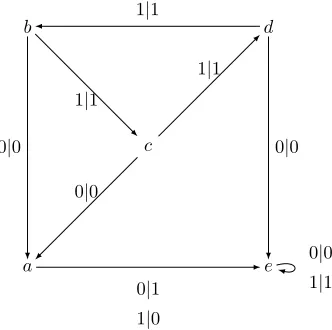
A (finite)automaton (or a transducer) is a quadrupleA= (Q, A, µ, λ), where: • Qis a finite set, called the set of states;
• Ais a finite set, called the alphabet;
..
c.
a
.
b
.
d
.
e
.
0|1
1|0 . 0|0 .
1|1
.
0|0 .
1|1
. 0|0 .
1|1
.
0|0
1|1
Figure 1. The automaton generating the Grigorchuk group.
A very convenient way to represent an automaton is through its Moore diagram: this is a directed
labelled graph whose vertices are identified with the states of A(See Fig. 1, whereQ={a, b, c, d, e}
and A = {0,1}). For every state q ∈ Q and every letter a ∈A, the diagram has an arrow from q
to µ(q, a) labelled bya|λ(q, a). The automaton A contains asink e∈Q, if one hasλ(e, a) =aand
µ(e, a) =efor anya∈A.
The automaton A is said to be invertible if, for all q ∈ Q, the transformation λ(q,·) : A → A
is a permutation of A. If A is invertible, one can define the maps λ and µ on Q−1, the set of formal inverses of Q, by exchanging the input and the output in the automaton, i.e., for every state
q−1 ∈ Q−1 and every letter a ∈ A, the diagram has an arrow from q−1 to (µ(q, a))−1 labelled by
λ(q, a)|a.
Finally, the mapsλand µ can be naturally extended toQ∗×A∗ by using the following recursive rules:
λ(q, aw) =λ(q, a)λ(µ(q, a), w), λ(qq′, a) =λ(q, λ(q′, a)) (2.1)
µ(q, aw) =µ(µ(q, a), w), µ(qq′, a) =µ(q, λ(q′, a))µ(q′, a)
for all q ∈ Q, q′ ∈ Q∗, and a ∈ A, w ∈ A∗. In this paper, when the automaton has a sink, it is supposed to be reachable from any state, i.e., for every q∈Qthere isu∈A∗ such thatµ(q, u) =e.
Definition 2.2. The automaton group G =G(A) is the permutation group of A∗ generated by the states {q : q ∈ Q} with the operation defined by (2.1), where two elements g, h ∈ Qe∗ represent the same element in Gif
λ(g, u) =λ(h, u)
The following proposition shows the crucial role that fragile words play in automata group theory
(see [4] for more details). The idea is to extend the alphabetA toA∪Q and add a sink in case the automaton does not have any (we write Q∪ {e}). The mapsλand µ keep the original action onA
and they are defined onQ∪ {e} as follows
λ(q, p) =p ∀q, p∈Q∪ {e},
∀q∈Q µ(q, q) =e and µ(q, p) =q ∀p∈(Q∪ {e})\ {q}.
(2.2)
If the automaton A is invertible, the new automaton A′ that we get with this construction is still invertible. Moreover, given a subset Q′ ⊆ Q and a wordw ∈fQ′∗, we say that w is strongly fragile with respect to Q′ ifϵq(w) = 1 for everyq ∈Q′.
Proposition 2.3. If G(A′) is not free, then there exist Q′ ⊆Q and a shortest non-trivial relation w∈Qf′∗ such that w is a strongly fragile word with respect to Q′.
Proof. First of all we claim that, ifwis a relation of an automata groupG(A) then µ(w, u) is also a relation for every u∈A∗. In fact λ(w, v) =v for everyv∈A∗ and so, in particular
λ(w, uv) =uλ(µ(w, u), v) =uv.
This implies λ(µ(w, u), v) =v for every v∈A∗, and proves the claim. Now in the groupG(A′) take any shortest non-trivial relation w∈fQ′∗, for someQ′. By Equation (2.2) we have
µ(w, q) =ϵq(w),
and ifq orq−1 appears in w, the length of µ(w, q) is shorter than the length ofw and so ϵq(w) = 1
for anyq ∈Q′ because of the minimality ofw. □
From Proposition 2.3 we can deduce that a relation w of minimal length in G(A′) is a strongly fragile word that is also a relation inG(A). For this reason, the previous construction has been used in [4] to construct examples of non-bireversible free automata groups.
2.2. Catalan numbers. Catalan numbers owe their name to the mathematician E. C. Catalan,
who worked in the nineteenth century in several areas of Mathematics, including Combinatorics,
Continued Fractions, Number Theory. Catalan showed in 1838 that then-th Catalan number
Cn= 1
n+ 1
(
2n n
)
counts the number of ways to fully parenthesize a string of n+ 1 letters. The first values of this
sequence are
C0 = 1;C1 = 1;C2 = 2;C3= 5;C4= 14;C5= 42;C6 = 132;. . . .
The sequence of Catalan numbers has many other interesting properties and applications, for instance,
number of chords in a given polygon satisfying some prescribed intersection conditions (the reader
can refer to the monograph [9] for more details and properties).
In this paper, we are interested in the application of Catalan numbers concerning the enumerations
of some families of trees. We briefly recall the definition of rooted tree, binary tree and full binary
tree.
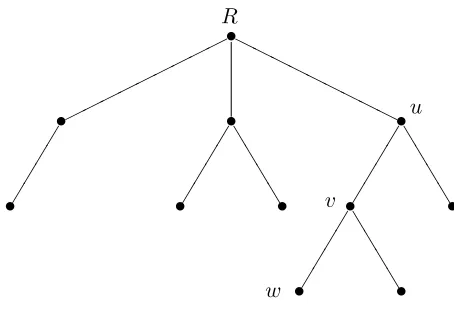
Rooted trees are trees where a special vertex, called the root, has been chosen. Rooted trees are
usually represented as in Fig. 2, where R denotes the root, the vertex u is said to be the parent of
the vertex v, the vertex v is said to be a child of the vertex u, and w is said to be a descendant of
the vertices uand v (observe that each vertex different from the root is a descendant of the root).
In a rooted tree, the degree of the root is the number of its children, and for any other vertex
different from the root the degree is equal to the number of its children +1. In particular, a vertex
with no children is called a leaf, and so each leaf has degree 1. We say that the level i of a rooted
tree consists of all vertices having geodesic distance ifrom the root. In Fig. 2, the root is the unique
vertex at level 0; the level 1 contains 3 vertices, the level 2 contains 5 vertices, and the level 3 contains
2 vertices, and we say that the rooted tree has depth 3.
Finally, if in a rooted tree we consider a vertex which is not a leaf, that is, it has at least one
descendant, then the subgraph consisting of a single child of that vertex, together with all the
descendants of that child, is call a subtree of the whole tree.
•
• • •
• • • • •
• •
HHHH
HHHH H
TT T
T T
T T
T
TT T T
R
u
v
w
Figure 2. An example of a rooted tree.
A binary tree is by definition a rooted tree for which every vertex has at most 2 children. In this
binary case, one distinguishes between left and right subtrees. The set of all binary trees with 3
• • • • • • • • • • • • • • •
AAA AAA A A A A A A AAA
Figure 3. The five binary trees with 3 vertices.
Finally, a binary tree where each vertex which is not a leaf has exactly two children is said to be
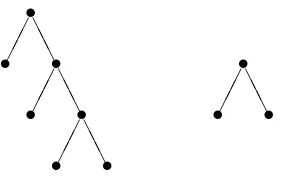
a full binary tree. A full binary tree on 3 vertices is called caret. Two examples of full binary trees
are depicted in Fig. 4.
• • • • • • • • • • AAA
A A A AAA AAA
Figure 4. A full binary trees with 7 vertices and a caret.
The proof of the following proposition can be found, for instance, in [9].
Proposition 2.4. The Catalan numberCncounts the number of binary trees withnvertices, as well
as the number of full binary trees with 2n+ 1vertices.
3. An explicit construction of strongly fragile words
Observe that, from what said above, a full binary tree is a graph without cycles where there is
a distinguished vertex with degree 2 (the root), a set of vertices with degree 1 (the leaves) and any
other vertex has degree 3.
Lemma 3.1. Let T be a full binary tree with nleaves. Then T has 2n−1 vertices.
Proof. Assume thatT hasnleaves, and let mbe the number of the remaining vertices: notice that
each leaf has degree 1, whereas m−1 vertices have degree 3, and only one vertex (the root) has degree 2. Then the Handshaking Lemma (e.g. [2]) gives:
n+ 3(m−1) + 2 = 2(n+m−1),
Notice that, by virtue of Lemma 3.1and Proposition 2.4, the number of rooted binary trees with
n leaves is exactlyCn−1.
In the sequel we want to construct strongly fragile words over an alphabet Q starting from full
binary trees with |Q|leaves.
With every full binary binary tree T on |Q|leaves, we associate a strongly fragile wordu(T)∈Qe∗
defined recursively by an iterated caret reduction process as follows:
• choose a labeling bijection between the set of leaves andQ;
• ifqi andqj belong to the same caret, remove it from the tree and get a new treeT′; • label the new produced leaf (the root of the removed caret) by [qi, qj] :=q−i 1q−
1 j qiqj; • proceed in the same way with the treeT′.
After a finite number of steps, we end up with the empty tree (consisting of just one vertex) and a
word which is an iterated nesting of commutators. We denote by DT the word constructed from T
by using the method described above.
Example 3.2. Consider the tree on the left hand side of Fig. 4 and label q1, q2, q3 and q4 the four leaves (from left to right). After the first step of the above process, we remove the rightmost caret
and get three leaves, labelled by q1, q2 and [q3, q4]. After the second step, we get just two leaves labelled byq1 and [q2,[q3, q4]]. Finally, we have
DT = [q1,[q2,[q3, q4]]] =q1−1q4−1q3−1q4q3q−12 q−13 q4−1q3q4q2q1q2−1q−14 q−13 q4q3q2q−13 q−14 q3q4.
Another way to get the same word is by starting from the top instead that from the bottom of the
tree: letT be a full binary tree containing |Q|leaves and fix a labeling bijection between the leaves and Q. LetT1, T2 be the two subtrees rooted at the two vertices of the first level of T; then define
u(T) = [u(T1), u(T2)],
where u(Tk) = q when Tk reduces to the leaf labelled by q ∈ Q. We denote by UT the word constructed fromT by using this second recursive method.
The two methods give rise to the same word, as the following lemma shows.
Lemma 3.3. Let T be a full binary tree on |Q|leaves. Then DT =UT.
Proof. By induction on the depth (number of levels)d(T) of the treeT. Ifd(T) = 1, thenQ={q1, q2} and the two definitions coincide, giving rise to the commutator [q1, q2]. Suppose nowd(T)>1. Then, at least one of the subtrees T1, T2 rooted at the first level does not reduce to a leaf. However, the depth ofT1 andT2 is at mostd(T)−1, so that we can apply the induction. We get u=DT1 =UT1
and v=DT2 =UT2. This impliesDT =UT = [u, v]. □
We call such kind of wordsCatalan fragile words for a reason that will be clear later. The following
Lemma 3.4. Let T be a full binary binary tree onQ leaves, with|Q| ≥2. Then the Catalan fragile word u(T) is strongly fragile (onQ).
Proof. Let us prove the statement by induction on the depthd(T) of the tree T. If d(T) = 1, then
u(T) = [v, v′], where v, v′ are the leaves ofT, that is clearly a strongly fragile word on the alphabet {v, v′}. Now suppose that u(T) = [u(T1), u(T2)], where at least one of the subtreesT1,T2 has depth at least 1. We have two cases. If only one among T1, T2 has depth at least 1, then we can suppose without loss of generality that T1 has this property, andT2 consists of just one vertex v. Therefore
u(T) =u(T1)vu(T1)−1v−1
that is strongly fragile on the leaves of T by induction, since the claim is true for T1. Otherwise, if both T1 and T2 have depth at least 1, one has:
u(T) =u(T1)u(T2)u(T1)−1u(T2)−1
where, by induction hypothesis,u(T1),u(T2) are strongly fragile. Hence, it is easy to check that also
u(T) is strongly fragile on the set of leaves of T. □
In what follows, we denote by λ(T) the number of leaves of the full binary tree T and by |u(T)| the length of the strongly fragile word u(T). Moreover, we put:
φ(m) = min{|u(T)|:T is a full binary tree on m leaves}.
The following lemma holds.
Lemma 3.5. One hasφ(m) = 2 minn+k=m{φ(n) +φ(k)}.
Proof. We have:
φ(m) = min{|[u(T1), u(T2)]|: λ(T1) =n, λ(T2) =kand k+n=m}
= 2 min
n+k=m{|u(T1)|+|u(T2)|:λ(T1) =n, λ(T2) =k}) = 2 min
n+k=m{φ(n) +φ(k)}.
□
The following theorem provides an upper bound forφ(m).
Theorem 3.6. We haveφ(m)≤m2. Moreover, the bound is sharp.
Proof. Let us prove the statement by induction on m. For m = 2, we have φ(2) = 4. Now, by
Lemma 3.5, we have:
φ(m) = 2 min
n+k=m{φ(n) +φ(k)} ≤2 minn+k=m{n
Minimize n2 +k2 subject to the condition n+k = m is equivalent to minimize 2n2 −2mn+m2. A direct computation shows that such a minimum is reached for n =k= m2 and it is equal to m22, which gives φ(m)≤m2. Moreover, the previous bound is sharp. Indeed, by takingm= 2h, we may consider the “balance” binary treeB, that is, the tree with 2h leaves and depth equal toh, in which
the simple path connecting the root with any leaf has lengthh. In this case, by a direct computation
by induction onh, one gets |u(B)|=m2. □
In the next theorem we provide an explicit computation of |u(T)| in terms of the length of the paths connecting each leaf of T to the root.
Let Q ={q1, . . . , qm}. For each i= 1, . . . , m, we denote by di the length of the path connecting the root of the full binary tree to its leaf identified with the letter qi.
Theorem 3.7. Let T be a full binary tree with m leaves. Then
|u(T)|= m
∑
i=1 2di.
Proof. By induction on the maximal distance di. If d1 = d2 = 1 we have u(T) = 4. Otherwise, let q1, . . . , qn be the leaves of the subtree T1 rooted at the left vertex of the first level of T, and let
qn+1, . . . , qm be the leaves of the subtree T2 rooted at the right vertex of the first level. We have |u(T)|= 2(|u(T1)|+|u(T2)|) = 2
( n ∑
i=1
2di−1+
m
∑
i=n+1 2di−1
) .
The last term is exactly ∑mi=12di. □
Corollary 3.8. Let T be a full binary tree with m leaves. Then
|u(T)| ≤2m+ m∑−2
i=1 2i.
In particular |u(T)| ≤ |u(T′)|, where T′ is the full binary tree with m leaves, with exactly two leaves at depth m−1 and one leaf at each depth i, withi= 1, . . . , m−2.
Proof. Consider the full binary tree withmleaves, having two leaves at depthm−1 and one leaf at each depthi, withi= 1, . . . , m−2 (the tree on the left hand side of Fig. 4is an example form= 4). It follows from Theorem 3.7that the associated strongly fragile word has length
l= 2m+ m∑−2
i=1 2i.
to 1. Suppose that T has m leaves, with n leaves belonging to T1 and k belonging to T2, where
m=n+k. By induction, we have:
|u(T1)| ≤2n+ n−2
∑
j=1
2j |u(T2)| ≤2k+ k−2
∑
j=1 2j.
This implies
|u(T)|= 2(|u(T1)|+|u(T2)|)≤2n+1+ 2k+1+ n−2
∑
j=1
2j+1+ k−2
∑
j=1 2j+1.
We need to show, that
2n+1+ 2k+1+ n−2
∑
j=1
2j+1+ k−2
∑
j=1
2j+1≤l= 2n+k+ n+k−2∑
j=1 2j.
Suppose, without loss of generality, that n ≥ k. We can rewrite the left side of the inequality as follows
2n+1+ 2k+1+
(k−1 ∑
i=2
(2n−i+1+ 2k−i+1) + n−1
∑
i=k 2n−i+1
) .
We have, for m, n≥2
2n+1+ 2k+1 ≤2n+k,
in fact the functionf(x, y) = 2x+y−2x+1−2y+1on the domainD={(x, y) : x, y≥2}has minimum in (x, y) = (2,2) and f(2,2) = 0. Analogously, one can check that
2n−i+1+ 2k−i+1 ≤2n+k−i, for each i= 2, . . . , k−1,
and
2n−i+1 ≤2n+k−i, for each i=k, . . . , n−1.
The sum over the right hand sides of the previous inequalities is smaller or equal tol (we only have
the terms with indexj fromnton+k−2). This concludes the proof. □ LetT be a full binary tree, and letv be a leaf of T; if H is another full binary tree, we denote by
T ◦vH the new full binary tree obtained by attaching the root ofH at the leaf v of T. The inverse of this operation is the deleting of a subtree: if v is a vertex of the full binary treeT and it is not a
leaf of T, then Tv denotes the full binary tree obtained from T by deleting the subtree rooted at v;
in this way, v becomes a leaf of the resulting treeTv.
We want to show that, with each Catalan fragile word, we may uniquely associate a full binary
tree. We first need the following lemma.
Lemma 3.9. A commutator [a, b] is a factor of a Catalan fragile word u(T) ∈ Qe∗ if and only if there is a vertex v of T such thata, b are two leaves that are children ofv. Moreover, if we substitute
Proof. Since u(T) = [u(T1), u(T2)], where T1, T2 are the two subtrees rooted at the two children of the root of T, we claim that [a, b] is a factor of u(T) if and only if [a, b] is a factor of either u(T1) or
u(T2). Indeed, this is a consequence of the fact thatu(T1)∈Qe∗1 and u(T2)∈Qe∗2, whereQ1 is the set of leaves of the left subtreeT1, andQ2 is the set of leaves of the right subtreeT2, so thatQ1∩Q2 =∅ and Q1∪Q2 is the set of leaves of the whole treeT.
Thus, we cannot have that [a, b] =ww′, wherewis a proper suffix ofu(T1) andw′is a proper prefix ofu(T2) (orwis a proper suffix ofu(T1)−1andw′ is a proper prefix ofu(T2)−1, or the last case where
w is a proper suffix of u(T2)−1 and w′ is a proper prefix of u(T1)). Now, the first statement of the lemma follows by induction on the depthd(T). Let us prove the second statement of the lemma. Note
that, by definition of u(T), the letters a, b appear in u(T) just in the commutator [a, b]. Therefore,
if we consider Tv, then the associatedu(Tv) belongs to H∗ withH =Q\ {a, b} ∪ {v}. Furthermore, by definition of u(T), it is easy to see thatu(T) is obtained by substituting each occurrencev, v−1 in
u(Tv) with [a, b],[a, b]−1, respectively. This is equivalent to the fact that the wordwin the statement
is exactly u(Tv). □
If a, b are two leaves of T having the same father v, we denote by (a, v, b) the caret rooted at v
and having a, bas children.
Theorem 3.10. If u(T) =u(T′), then T =T′.
Proof. Let us prove the statement by induction on the cardinality of the setQsuch thatu(T)∈Qe∗. If Q ={a, b}, then the statement is clear sinceu(T) = [a, b] =u(T′) and T = (a, r, b) = T′, where
r is the root of T. Suppose u(T) ∈Qe∗, with |Q|>2. By Lemma 3.9there exist a, b∈Qsuch that [a, b] is a factor ofu(T), and if we substitute the occurrences of [a, b],[a, b]−1 withv, v−1, respectively, then we obtain a new word w=u(Tv) =u(Tv′) ∈Q\ {a, b} ∪ {v}. By the induction hypothesis, we get Tv =Tv′. Hence,T =Tv◦v(a, v, b) =Tv′◦v(a, v, b) =T′. □
From the previous result we deduce the following corollary.
Corollary 3.11. The Catalan fragile words on an alphabet Qare in one-to-one correspondence with
the full binary trees with set of leaves Q. In particular, if |Q|=m, there exist exactlyCm−1 Catalan
fragile words on Q, where Cn is the n-th Catalan number.
The problem of giving an explicit and complete characterization of all strongly fragile words is still
open. Moreover, from an algebraic point of view, one can take the set Q and the set of all Catalan
fragile words onQ. There is no explicit description of the group freely generated by the elements in
Qwhose relations are generated by the Catalan fragile words onQ. Notice that, since Catalan fragile
Acknowledgments
The first author acknowledges support from the FWF Project P 29355-N35.
References
[1] S. V. Al¨eshin, A free group of finite automata,Mosc. Univ. Math. Bull.,38(1983) 10–13.
[2] B. Bollob´as,Modern graph theory, Graduate Texts in Mathematics,184, Springer-Verlag, New York, 1998.
[3] L. Bartholdi, R. Grigorchuk and V. Nekrashevych, From fractal groups to fractal sets, Fractals in Graz 2001,
Trends Math., Birkh¨auser Basel, (2003) 25–118.
[4] D. D’Angeli and E. Rodaro, Fragile words and Cayley type transducers, Int. J. Group Theory, 7 no. 3 (2018)
91–109.
[5] S. Eilenberg, Automata, Languages and Machines, A, Pure and Applied Mathematics, 58, Academic Press [A
subsidiary of Harcourt Brace Jovanovich, Publishers], New York, 1974.
[6] R. Grigorchuk, V. Nekrashevych and V. Sushchanskii, Automata, dynamical systems and infinite groups, Proc.
Steklov Inst. Math.,231(2000) 134–214.
[7] R. Grigorchuk, Some topics of dynamics of group actions on rooted trees,Proc. Steklov Inst. Math.,273(2011)
64–175.
[8] V. Nekrashevych, Self-similar groups,Mathematical Surveys and Monographs,117, American Mathematical
Soci-ety, Providence, RI, 2005.
[9] S. Roman,An introduction to Catalan numbers, Compact textbooks in Mathematics, Birkhauser, Basel, 2005.
[10] B. Steinberg, M. Vorobets and Y. Vorobets, Automata over a binary alphabet generating free groups of even rank,
Int. J. Algebra Comput.,21(2011) 329–354.
[11] M. Vorobets and Y. Vorobets, On a free group of transformations defined by an automaton,Geom. Dedicata,124
(2007) 237–249.
[12] M. Vorobets and Y. Vorobets, On a series of finite automata defining free transformation groups,Groups Geom.
Dyn.,4(2010) 377–405.
Daniele D’Angeli
Institut f¨ur Diskrete Mathematik, Technische Universit¨at Graz, Steyrergasse 30, 8010, Graz, Austria
Email: [email protected]
Alfredo Donno
Dipartimento di Ingegneria, Universit`a degli Studi Niccol`o Cusano, Via Don Carlo Gnocchi, 3, 00166, Roma, Italy
Email: [email protected]
Emanuele Rodaro
Dipartimento di Matematica, Politecnico di Milano, Piazza Leonardo da Vinci, 32, 20133, Milano, Italy