RESEARCH ARTICLE
Determination of appropriate compression rate for developing
the Persian version of time compressed sentence test
Maedeh Alishahnejad1, Fahimeh Hajiabolhassan1,2*, Shohreh Jalaie3, Jay Lucker4, Farzaneh Zamiri Abdollahi1, Nematollah Rouhbakhsh1
1- Department of Audiology, School of Rehabilitation, Tehran University of Medical Sciences, Tehran, Iran 2- Department of Audiology, University of Social Welfare and Rehabilitation Sciences, Tehran, Iran 3
- Biostatistics, School of Rehabilitation, Tehran University of Medical Sciences, Tehran, Iran 4- Department of Communication Sciences & Disorders, Howard University, Washington, D.C., USA
Received: 11 May 2019, Revised: 16 Jun 2019, Accepted: 24 Jun 2019, Published: 15 Oct 2019
Abstract
Background and Aim: Time compressed spe-ech test is one of the most useful monaural tests for evaluation of central auditory processing disorder. For developing the time compressed sentences test, the compression rate of the sen-tences must be set so that the average speech comprehension score is about 90% in normal individuals and can challenge central auditory processing system sufficiently so subjects with auditory processing disorders could be identi-fied. Therefore, the aim of the present study was finding the appropriate compression rate for developing compressed sentences test in Persian.
Method: Initially, two 10-sentence lists were prepared based on the experts’ opinion and were compressed by the amount of 60, 65, 70, 75 and 80% using Praat software. Compressed sentences were tested on twelve 18–25 year-old normal individuals and the speech comprehen-sion score in different comprescomprehen-sion rates was compared and the compression rate in which the average score was approximately 90% was
reported as an appropriate compression rate for developing time compressed sentences test in Persian.
Results: 70% compression rate was able to cre-ate an average score of 95.27% (± 3.31) and 93.6% (± 7.17) in the right and left ear, res-pectively.
Conclusion: Results showed that the compre-ssion rate of 70% was appropriate rate for dev-eloping the test in the Persian language.
Keywords: Central auditory nervous system; psychometric properties; central auditory perceptual disorder
Citation: Alishahnejad M, Hajiabolhassan F, Jalaie S, Lucker J, Zamiri Abdollahi F, Rouhbakhsh N. Determination of appropriate compression rate for developing the Persian version of time compressed sentence test. Aud Vestib Res. 2019;28(4):249-255.
Introduction
Central hearing processing is defined as the effectiveness of the central nervous system in using auditory information. It includes skills such as sound localization and lateralization, auditory discrimination, auditory pattern rec-ognition, auditory temporal aspects, auditory
* Corresponding author: Department of Audiology,
performance in the presence of competitive or and degraded signals. Any difficulty in auditory comprehension associated with a deficit in one or more of these skills is known as the central auditory processing disorder (CAPD) [1].
Owning to the complex nature of this disorder, people with normal peripheral hearing sensi-tivity may also show CAPD; therefore, common auditory tests such as pure tone audiometry and tympanometry cannot be trusted as the only diagnostic tools. In this regard, a set of special hearing tests have been developed to diagnose CAPD [2]. These tests are categorized into five groups; dichotic speech tests, monaural low-redundancy speech tests, binaural intervention tests, auditory temporal processing tests, and electroacoustic and electrophysiologic assess-ment tests [3]. Monaural auditory central pro-cessing tests are, in fact, the audiometric ass-essments of speech that have become more sen-sitive with some alterations to challenge the central auditory system. One of these tests is time-compressed speech test. In this test, the ability to understand the speech message dec-reases by increasing the time compression rate of speech [4].
Compressed speech has been studied since the early 1950s by Garvey, in 1953 [5] and suggested as a tool for the diagnosis of CAPD since 1977 [6]. Time-compressed speech test is one of the most commonly used tests for patients with CAPD [7,8]. As a monaural low-redundancy speech test, time-compressed speech test is used to assess the ability of auditory closure [8]. In some studies, the time-compressed speech test is considered as a tem-poral processing test [9]. Generally, the speech redundancy is altered in this test. For auditory processing, both extrinsic and intrinsic redun-dancy are required. Extrinsic redunredun-dancy invol-ves acoustic and linguistic clues in speech sig-nals, and intrinsic redundancy includes the inter-nal capacity of the central auditory nervous sys-tem to transmit auditory information [2]. Time-compressed speech is created by manipulating the extrinsic redundancy of speech materials, such that the speech rate increases without dis-torting the signal intensity and frequency [10].
seconds, and the duration of the test is less than 10 minutes. In this test, each sentence has three non-words, each with a separate score. The total score of the test is 150. The subject should repeat all non-words in the sentences. The number of test errors due to not repeating the non-words is deducted from the total score, and the final score is converted into the percentage [13].
No study was found in Persian on evaluating the effect of different time compression ratios on TCST. This study aimed to determine an app-ropriate time compression ratio for creating a Persian version of the TCST. The appropriate compression ratio is the ratio in which all the normal participants do not earn 100% points. In addition, the average obtained score should not be below the normal average area (90%) [7].
Methods
This research is an analytical cross-sectional study. This study had two steps. First, two lists of sentences were designed, and their validity was determined. Then, they were recorded and underwent time compression, and finally digi-tized to a hard disc. In the second step, the recorded sentences were examined on the heal-thy subjects to determine the best time comp-ression ratio for preparing the Persian version of TCST. These two steps are described in detail in the next sections.
Designing sentences and testing their content and face validity
In this study, the sentences with simple and natural syntactic and semantic structure, 3–8 syllables and 3–5 words length were used. The reason for using short sentences is that long sentences are problematic for auditory memory [14,15]. Also, the sentences were simple and composed of words such that they were some-what predictable [13]. For this purpose, sen-tences from story books were used. The non-words used in the sentence had preferably 1 to 2 syllables [14], and the number of non-words in each sentence was 3, according to the original version of TCST [13].
After preparing sentences, their content and face
validity were evaluated, taking into account the desired properties for TCST. To assess the con-tent validity, the sentences were presented to 17 experts, including audiologists, speech the-rapists, children's book writers, and primary school teachers. They assessed the sentences with regard to properties such as appropri-ateness of words, natural sound of the sentence, and their predictability. The face validity of sentences was evaluated in terms of grammar and length of the sentences by the same experts plus a group of non-specialist subjects partici-pating in the research. Each of them rated the sentences on a scale from 1 to 5 (5-point Likert scale). The content validity ratio (CVR) was determined by Lawshe Table and found as 0.49 (sentences with CVR > 0.49 were selec-ted). Also, the content validity index (CVI) was obtained as 0.87. Based on face validity, sen-tences that received scores 4 and 5 were veri-fied. In the end, the validity of 20 out of 30 sentences was confirmed. These sentences were recorded using a male professional speaker having loud and distortion-free sound and with a general Persian dialect in the studio of Virtual School of Tehran University of Medical Sciences (TUMS). After recording, their audio peak was normalized using Adobe Audition software, and one list for presenting to the right ear and another list for the left ear were pre-pared. Afterward, the sentences went under time compression at different ratios of 60%, 65%, 70%, 75%, and 80% by employing PRAAT software. After compression, the interstimulus interval was set to 5 seconds so that the subjects have enough time to repeat the heard sentences [13]. Moreover, a 1000-Hz calibration tone at 71 dB SPL level was added at the beginning of the recorded audio using the Adobe Audition software. In the end, the recorded materials were presented to four audiologists. After their confirmation, the sentences were digitized to a hard disc.
Study subjects
Rehabilitation using convenience sampling technique. The inclusion criteria were right-handedness (based on the Edinburgh Handed-ness Inventory), no hearing loss (having hearing threshold of 15 dB or less at octave frequency of 250–8000 Hz measured by the AC40 clinical audiometer, Interacoustics Co., Denmark), no disease in the ear transmission system ( Type A tympanogram measured by a tympanometer, Zodiac 901, Madsen Co., Denmark), no history of head trauma; no history of otologic and neurological disorders, no CAPD problems (ass-essed by double dichotic digit test with the nor-mal average set according to Shahmir et al. study [16] and TCST with the normal average set according to Jafari et al. study [17]), and no cognitive disorders (based on the scores of Mini-Mental State Examination [MMSE] with a mean ± SD score of 29 ± 1.3) [18]. Those who were unwilling to continue the study were exc-luded.
The Research Ethics Committee of TUMS app-roved the study (Code: IR.TUMS.FNM.REC. 1397.156). Written informed consent was obt-ained from all subjects, and then, they comp-leted a demographic form. The tests were con-ducted in the Audiology Clinic of the School of Rehabilitation, Tehran University of Medical Sciences.
Time-compressed sentence test
TCST was performed by employing an HP laptop connected to the AC40 clinical audio-meter with TDH-39 headphone. Before the test, the calibration was performed by measuring the 1000-Hz pure tone existing at the beginning of the recorded audio file. Using a sound level meter (model B&K 2235), the sound level was determined as 71 dB SPL. For calibration, when the 1000-Hz tone was played, the input in VU Meter was set to zero. A hearing level of 58 dB HL determined by audiometer and equal to 71 dB SPL was observed on the sound level meter. The subjects were instructed to repeat all of the words in the sentences, and if they were not sure about what they heard, they could take a guess [13]. In this study, we had 2 lists of 10 sen-tences, and each sentence had three non-words,
each received one score. The number of cor-rectly repeated non-words was noted, and at the end, scores for each list were converted to the equivalent percentage [13].
Data analysis
The obtained data were analyzed in SPSS 23 by using descriptive statistics such as mean and standard deviation. Since the data distribution was not normal, nonparametric tests of Mann-Whitney U for examining the effect of gender, and Wilcoxon test for comparing the scores of right and left ears were used. In all tests, the significance level was set at 0.05.
Results
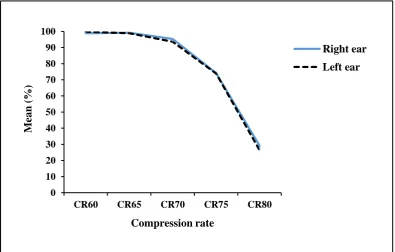
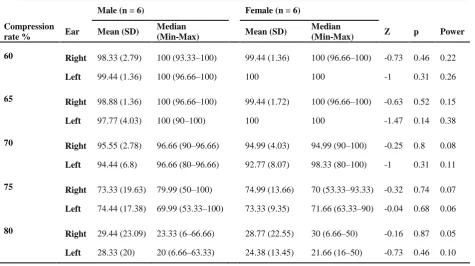
Of 12 subjects, 6 were male (mean ± SD age: 20.33 ± 1.86 year) and 6 female (mean ± SD age: 21.16 ± 2.13 year). Table 1 presents their average TCST score at different compression ratios and comparison for both ears. According to the results of the Wilcoxon test, there was no significant difference between TCST scores of the right and left ear in any time compression ratios (p > 0.05). It should be noted that the test power was low. However, the difference may become significant with larger samples. Figures 1 illustrate the average TCST score reported in different time compression ratios for the right and left ears, respectively. As can be seen, the highest score was obtained at the compression ratio of 60%, while the lowest score was obtained at the time compression ratio of 80%. The first fall in the number of correct responses was observed at 70% time compression ratio. The results for the effect of gender on the mean intelligibility score of time-compressed senten-ces for both ears are presented in Table 2 at time compression ratios of 60%, 65%, 70%, 75%, and 80%. According to the results, there was no significant difference between male and female subjects in mean scores (p > 0.05). Of course, the test power was low in all compression ratios that a significant difference may be seen with larger sample size.
Discussion
the time compression ratio of sentences increa-ses, their intelligibility decreases. This finding is consistent with the results of studies conducted on TCST in other languages and with the results of Jafarlou et al. [19] study on the Persian version of TCST. According to the results of studies on the English version of TCST, the
reduction in performance from 0% to 60% time compression ratio is gradual; at 60% level, the intelligibility of words for normal subjects is acceptable, and it is a stable time compression ratio. At 70% level, however, a sudden fall in the number of correct responses occurs such that the average correct score of normal subjects was
Table 1. Mean (standard deviation) of time compressed sentences test and comparison of the scores in right and left ears by Wilcoxon test (n = 12)
Right ear Left ear
Compression rate %
Mean (SD)
Median (Min-Max)
Mean (SD)
Median
(Min-Max) Z p Power
Right > Left (n)
Left > Right (n)
Right = Left
80 29.1
(21.67) 23.33 (6–66.66)
26.35 (16.38)
20
(6.66–63.33) -0.53 0.59 0.09 6 5 1
75 74.16
(16.15) 73.33 (50–100)
73.38 (13.32)
76.66
(53.33–100) -0.35 0.72 0.05 5 3 4
70 95.27
(3.31)
96.66 (90–100)
93.60 (7.17)
96.66
(80–100) -0.37 0.35 0.17 4 3 5
65 99.16
(1.51) 100 (96.66–100)
99.88 (2.95)
100
(90–100) -0.93 0.70 0.08 2 2 8
60 98.88
(2.17) 100 (93.33–100)
99.72 (0.96)
100
(96.66–100) -1.34 0.18 0.33 2 0 10
0 10 20 30 40 50 60 70 80 90 100
CR60 CR65 CR70 CR75 CR80
Me
an
(%
)
Compression rate
Right ear Left ear
82%, which is lower than the normal range [7]. Based on our results for the Persian version, the average intelligibility score was near to 100% up to 60% time compression ratio and a sudden fall in scores observed when it increased to 70%. Despite this fall, the score of healthy sub-jects was still within the acceptable range, but with increasing compression ratio to 75%, a higher fall rate was observed such that the scores of the healthy subjects were lower than the normal range. On the other hand, contrary to other studies conducted in other languages that reported the compression ratio of 60% as a suitable level for the construction of TCST [4,7,20], in our study, 70% level was reported as the adequate compression ratio. This discre-pancy is probably due to linguistic differences. In our study, most of the subjects obtained an intelligibility score of 100% at 60% time com-pression ratio. In Brazilian Portuguese, the obt-ained score using two-syllable words at this level was 92% [7]. In Chinese, the mean recog-nition score of samples at 65% level was repor-ted as 95.1% [2]. In English, the mean ± SD
correct scores of the group with 10 and 11 years old at 60% level was 92 ± 3.5% for the right ear and 90.4 ± 6.5% for the left ear [13]. In our study, the average ± SD obtained score at 70% compression ratio for the right and left ears were 95.27 ± 3.31% and 93.6 ± 7.71%, res-pectively which are almost equal to the recog-nition scores of time-compressed words in the mentioned studies. For comparing the results, the higher linguistic information of sentences relative to the words should also be considered. At 70% compression ratio, the central auditory system in subjects was challenged in using audi-tory recognition skills, but their score was not lower than the normal range. Our study also reported that gender had no effect on TCST score which was in agreement with other studies [2,19], and there was no significant difference between TCST score at different time compre-ssion ratios (p > 0.05). Because of the low pow-er of the Mann-Whitney U test, it is suggested that this test be conducted on a larger number of samples to examine the effect of gender on TCST score. In consistent with other studies
Table 2. Mean (standard deviation) of time compressed sentences test and comparison of the scores in men and women (n = 12) by Mann Whitney U test
Male (n = 6) Female (n = 6)
Compression
rate % Ear Mean (SD)
Median
(Min-Max) Mean (SD)
Median
(Min-Max) Z p Power
60 Right 98.33 (2.79) 100 (93.33–100) 99.44 (1.36) 100 (96.66–100) -0.73 0.46 0.22
Left 99.44 (1.36) 100 (96.66–100) 100 100 -1 0.31 0.26
65 Right 98.88 (1.36) 100 (96.66–100) 99.44 (1.72) 100 (96.66–100) -0.63 0.52 0.15
Left 97.77 (4.03) 100 (90–100) 100 100 -1.47 0.14 0.38
70 Right 95.55 (2.78) 96.66 (90–96.66) 94.99 (4.03) 94.99 (90–100) -0.25 0.8 0.08
Left 94.44 (6.8) 96.66 (80–96.66) 92.77 (8.07) 98.33 (80–100) -1 0.31 0.11
75 Right 73.33 (19.63) 79.99 (50–100) 74.99 (13.66) 70 (53.33–93.33) -0.32 0.74 0.07
Left 74.44 (17.38) 69.99 (53.33–100) 73.33 (9.35) 71.66 (63.33–90) -0.04 0.68 0.06
80 Right 29.44 (23.09) 23.33 (6–66.66) 28.77 (22.55) 30 (6.66–50) -0.16 0.87 0.05
[2,7], we found no significant difference in TCST scores of right and left ears (p > 0.05). Due to the low Wilcoxon test power in this study, a larger sample size could bring a signi-ficant difference between the scores of two ears in the subjects.
Conclusion
According to the average score obtained at a time compression ratio of 70%, it is an app-ropriate compression ratio for assessing auditory closure in the Persian language. This compre-ssion ratio is suggested as a suitable ratio for preparing compressed sentences in Persian.
Acknowledgment
This study is the result of the research project No. 39681-32-01-98. The authors would like to thank all participants and experts for their valu-able cooperation in completing validity forms.
Conflict of interest
The authors declared no conflicts of interest.
References
1. Medwetsky L. Mechanisms underlying central auditory processing. In: Katz J, Medwetsky L, Burkard R, Hood L, editors. Handbook of clinical audiology. 6 th ed. Baltimore: Williams & Wilkins; 2009. p. 712-25. 2. Lau CTL, McPherson B, Fuente A. Cantonese
time-compressed speech test: normative values for young adults. Asia Pacific Journal of Speech, Language and Hearing. 2012;15(3):197-210. doi:
10.1179/136132812805253587
3. Baran J. Test battery considerations. In: Musiek FE, Chermak GD, editors. Handbook of (central) auditory processing disorder. 1st ed. San Diego: Plural Publishing Inc; 2007. p. 291-324.
4. Keith RW. Diagnosing (central) auditory processing disorder in children. In: Roeser RJ, Valente M, Hosford-Dunn H, editors. Audiology diagnosis. 2 th ed. New York: Thieme; 2007. p. 335-55.
5. Garvey WD. The intelligibility of speeded speech. J Exp Psychol. 1953;45(2):102-8.
6. Beasley D, Freeman B. Time-altered speech as a measure of central auditory processing. In : Keith R. 1st ed . Central Auditory Dysfunction. New York: Grune & Stratton.1977.p.129-76.
7. Rabelo CM, Schochat E. Time-compressed speech test in Brazilian Portuguese. Clinics (Sao Paulo). 2007;62(3):261-72 .DOI: 10.1590/s1807-59322007000300010
8. Chermak GD, Musiek FE. Managing central auditory processing disorders in children and youth. Am J Audiol. 1992;1(3):61-5. doi: 10.1044/1059-0889.0103.61
9. Rawool VW. Temporal processing in the auditory system. In: Geffner D, Ross-Swain D, editors. Auditory processing disorders: assessment, management and treatment. 1st ed. San Diego: Plural Publishing; 2007. p. 227-49.
10. Krishnamurti S. Monaural low-redundancy speech tests. In: Musiek FE, Chermak GD, editors. Handbook of (central) auditory processing disorder. 1st ed. San Diego: Plural Publishing Inc; 2007. p. 349-67.
11. Friedman HL, Johnson RL. Compressed speech: correlates of listening ability. J Commun. 1968; 18(3):207-18.
12. Wingfield A, Nolan KA. Spontaneous segmentation in normal and in time-compressed speech. Percept Psy-chophys. 1980;28(2):97-102.
13. Keith RW. Standardization of the time compressed sentence test. Journal of Educational Audiology. 2002; 10:15-20.
14. Perrachione TK, Ghosh SS, Ostrovskaya I, Gabrieli JDE, Kovelman I. Phonological working memory for words and nonwords in cerebral cortex. J Speech Lang Hear Res. 2017;60(7):1959-79. doi:
10.1044/2017_JSLHR-L-15-0446
15. Nilsson M, Soli SD, Sullivan JA. Development of the hearing in noise test for the measurement of speech reception thresholds in quiet and in noise. J Acoust Soc Am. 1994;95(2):1085-99. doi: 10.1121/1.408469
16. Shahmir B, Hajiabolhassan F, Mohammadkhani G, Tahaei AA, Jalaie S. Development and evaluation of the reliability of Persian version of double dichotic digit test in girls aged 7 to 11 years. Aud Vestib Res. 2015; 24(3):164-70.
17. Jafari Z, Jafarlou F, Omidvar S, Kamali M, Sabour M. [Time compressed speech perception in elderly people]. Iranian Journal of Ageing. 2012;6(4):58-64 . Persian. 18. Crum RM, Anthony JC, Bassett SS, Folstein MF.
Population-based norms for the mini-mental state examination by age and educational level. JAMA. 1993;269(18):2386-91.
19. Jafarlou F, Jafari Z, Kamali M, Jeddi Z. [The impact of compression rate and sex on the results of time compressed speech test]. Audiol. 2013;22(2):47-54 . Persian.
20. Prabhu P, Seshadri D, Ganeshan A, Babu L. Test–retest reliability of Kannada time-compressed speech test and time-compressed monosyllables test. Hearing Balance Commun. 2016;14(3):111-6. doi;