DEMOGRAPHIC RESEARCH
VOLUME 30, ARTICLE 63, PAGES 1697
−
1732
PUBLISHED 3 JUNE 2014
http://www.demographic-research.org/Volumes/Vol30/63/ DOI: 10.4054/DemRes.2014.30.63
Research Article
Couples’ fertility decision-making
Petra Stein
Sebastian Willen
Monika Pavetic
This publication is part of the Special Collection on “Theoretical Foundations of the Analysis of Fertility,” organized by Guest Editors Johannes Huinink, Jens Ehrhardt, and Martin Kohli.
© 2014 Petra Stein, Sebastian Willen & Monika Pavetic.
This open-access work is published under the terms of the Creative Commons Attribution NonCommercial License 2.0 Germany, which permits use, reproduction & distribution in any medium for non-commercial purposes, provided the original author(s) and source are given credit.
1 Introduction 1698
2 Theoretical considerations regarding the fertility decision-making process of couples
1699
3 Modelling couples’ fertility decisions 1704
3.1 Data and variables 1708
3.2 Model specification 1712
3.3 Inspection of the model fit and interpretation of the results 1715
4 Summary 1721
References 1723
Couples’ fertility decision-making
Petra Stein1 Sebastian Willen2
Monika Pavetic3
Abstract
BACKGROUND
The decision about whether to start a family within a partnership can be viewed as a result of an interaction process. The influence of each of the partners in a couple differs depending on their individual preferences and intentions towards having children. Both of the partners additionally influence each other’s fertility intentions and preferences.
OBJECTIVE
We specify, estimate, and test a model that examines the decision about whether to have a child as a choice that is made jointly by the two partners. The transition to the birth of a (further) child is investigated with the explicit consideration of both the female partner and the male partner in the partnership context.
METHODS
An approach for modelling the interactive influences of the two actors in the decision-making process was proposed. A trivariate distribution consisting of both the female and the male partners’ fertility intentions, as well as the joint generative decision, was modelled. A multivariate non-linear probit model was chosen and the problem of identification in estimating the relative effects of the actors was resolved. These parameters were used to assess the relative importance of each of the partners’ intentions in the decision. We carried out the analysis with MPLUS. Data from the panel of intimate relationships and family dynamics (pairfam) was used to estimate the model.
1 University of Duisburg-Essen, Faculty of Social Sciences, Institute of Sociology. Lotharstraße 65, 47057
Duisburg, Germany. E-Mail: [email protected].
2 University of Duisburg-Essen, Faculty of Social Sciences, Institute of Sociology. Lotharstraße 65, 47057
Duisburg, Germany. E-Mail: [email protected].
3 University of Duisburg-Essen, Faculty of Social Sciences, Institute of Sociology. Lotharstraße 65, 47057
RESULTS
The biographical context of each of the partners in relation to their own as well as to their partner’s fertility intentions was found to be of considerable importance. Of the significant individual and partner effects, the male partner was shown to have the greater influence. But the female partner was found to have stronger parameters overall and she ultimately has a veto power in the couple’s final decision.
1. Introduction
When we look at the literature on family formation and expansion, we find different lines of research. One of these lines focuses on the influence of socio-economic factors. Most of the empirical studies on this topic examine the transition to parenthood exclusively from the perspective of women. There are only a few studies that also take into account the perspectives of the male partners. Researchers have defended this practice, arguing that the degree of agreement between the man and the woman is sufficiently high that there is no need to analyse the responses of both partners. Moreover, the few studies that do take the features of the male partner into account only focus on the level of education or on the employment status of the man (Kreyenfeld 2002; Oppenheimer and Lewin 1999; Thomson and Hoem 1998). However, the decision to start a family and have children is usually not associated with changes in the male partner’s life.
There are relatively few studies that have examined the reproductive behaviour of men, and those that have looked at this issue have done so at a rudimentary level only. Over the past decade, several studies have analysed the transition to fatherhood. The results of this research showed that occupational-biographical factors influence the transition to fatherhood. Occupational uncertainties—such as extended training phases, career interruptions, and self-employment—negatively influence the fertility behaviour of men. Having an adequate financial basis is a pre-condition for the transition to parenthood among men (Tölke and Diewald 2003a). While these authors agree that the woman’s influence is as important as the man’s influence in the transition to parenthood, not all of these studies considered the partner. Moreover, it is unclear whether individual factors that influence the fertility decision have the same weight as factors at the partnership level.
characteristics of the two partners on the generative behaviour: Gebel and Gisecke (2009) and Kurz (2005) focused on the partner’s occupation and labour market participation; Bauer and Jacob (2010), Kreyenfeld (2002), Kreyenfeld and Konietzka (2008), Kreyenfeld (2010), and Wirth (2007) focused on education and the educational constellation; and Croijn et al. (1996) focused on religiosity. These studies showed that the effects of individual factors—such as education, professional position, and employment status—differed based on the level of the partnership and the life courses of the partners.
Another line of research investigates the topic in an international context, looking at the fertility desires, intentions, and preferences of the two partners. The results of these studies have also shown that the individual fertility intentions of women and men contribute to fertility decision-making in partnerships (Beckman 1984; Miller and Pasta 1994, 1996; Thomson 1997). According to this research, the rules of decision-making of the partners determines the fertility outcome. The birth of a child could be the result of consensus in a couple, or it could be the result of only the female partner’s or only the male partner’s intentions. But the few empirical studies on this topic have generated inconsistent findings. Older studies have shown that the female partner is the dominant decision-maker. In a partnership, it is the woman—not the man—who has the power to veto the idea of having a child. A study of American couples showed that the wife’s decision had greater weight than the husband’s (Townes et al. 1980).
Beckman (1984) reported that the wife’s preference has a stronger effect on pregnancy and birth than the husband’s, especially if the wife does not want to have a child. In addition, a number of more recent studies have shown that the preference of each of the partners is equally likely to influence the probability of having a child. Furthermore, they discovered that both of the partners have the power to veto the idea of having a child, which can lead to a partnership without children. These results were based on survey data from the US (Thomson 1997), Sweden (Thomson and Hoem 1998), the Netherlands (Jansen and Lifbroer 2006), and Germany (Bauer and Kneip 2013). In previous studies, Pavetic (2009) and Stein and Pavetic (2011, 2013) concluded that the preference of each of the partners has an equal influence on the subsequent fertility decision, but that the woman has more influence in the bargaining process.
2. Theoretical considerations regarding the fertility decision-making
process of couples
This interaction process may involve either mutual confirmation when the preferences of the partners converge, or an adjustment of individual interests to those of the partner when the preferences of the partners diverge (Borchardt and Stöbel-Richter 2004). Actors who disagree may apply different rules when seeking to make a joint decision (Thomson et al. 1990; Croijn et. al. 1996; Jansen and Lifbroer 2006; Bauer and Kneip 2013). The decision can be made by either the female or the male partner. There are several different rules of decision-making. When the “egalitarian rule” (Thomson et al. 1990; Croijn et. al. 1996), which is also known as the “golden mean rule” (Jansen and Lifbroer 2006) is used, the two partners have equal influence in negotiations. When the “sphere of interest rule” (Croijn 1996; Jansen and Lifbroer 2006) is applied, the woman’s influence is stronger than the man’s because the birth of a child is seen as being in her “sphere of interest.” In case of the “social drift rule” (Jansen and Lifbroer 2006) disagreement leads to a continuation of the status quo. According to Jansen and Liefbroer (2006), couples can also apply a “power rule,” under which the partner with the greater economic resources makes the decision. More detailed versions of these rules have also been identified in dyadic fertility research, according to Bauer and Kneip (2013): e.g., the “sphere of interest rule” has been redefined as the “joint utility model” or the “matriarchal model;” while the “power rule” has been called the “patriarchal model” or the “power rule model.”
The major challenge for couples with corresponding desires is the temporal coordination of parenthood within their own biographies. Thus, the decision within a partnership about whether to start a family can be viewed as a result of an interaction process. The interaction process is a process of influence, agreement, convergence, and divergence (Oppitz 1990; von Rosenstiel et al. 1986). Although it can be assumed that the interdependence of the partners plays a very important role in the decision-making process, until now this factor has not been prominent in the theoretical discussion. As parenthood is the result of a decision that is made within the partnership (Burkart 1994, 2002; Klein 2003; Thomson and Hoem 1998), it incorporates the living conditions and preferences of both partners.
costs and benefits of having children would have to be the same for both partners (Ott 1989a). Auspurg and Abraham (2007) showed that in a heterosexual relationship, both the man and the woman differentiate between their own and their partner’s benefits. They also emphasised that the benefits are not subsumed under common budgetary benefits (Auspurg and Abraham 2007).
It therefore seems both plausible and reasonable to assume that the reproductive decision of the couple is based on the previous individual decisions of both partners (Borchardt and Stöbel-Richter 2004; Burkart 1994). In addition, the couple’s fertility intentions can be understood as a reflection of the individual decisions of each of the partners. This individual-theoretical approach is based on the idea that the preferences can both converge and diverge. The result of the individual decision is itself determined by different factors (Burkart 1994), such as by the individual-rational considerations of parenthood (Beck-Gernsheim 1983, 1997; Huinink 1995, 2000; Schaeper and Kühn 2000; Schmitt 2004).
Like the individual fertility intention, the individual cost-benefit analysis of parenthood is a temporal process subject to changing conditions. The assumption that preferences are stable is therefore untenable. It is necessary to differentiate between the stages in the decision to have a child, especially in the case of parity. The modelling of fertility behaviour as a unique decisive act ignores the possibility of internal dissent as well as the dynamism of the decision-making process, which is implied in each individual biographic change. Therefore, it has been argued that fertility behaviour is the result of a sequential decision-making process, and requires dynamic modelling (Kohlmann and Kopp 1997).
The parenthood decision is made with the input of both of the partners, and the preference of each of the partners should be seen as equally relevant. Hence, dyadic modelling requires the simultaneous consideration of the living conditions of each of the partners, their individual life options, and their individual life plans. In the context of the partnership, these conditions and preferences must be adapted to each other. The dyadic decision therefore shows the result of an internal interaction process.
In addition, there is a number of models which explicitly contain the pair interaction within the scope of a dyadic decision-making process. A good illustration of this is the decision-making process in Hass’ (1974) model. His model contains three successive stages of fertility decisions. The model differentiates between fertility decisions before conception, during pregnancy, and after birth. At each stage the generative decision and the behaviour are modelled as an interaction between the two partners.
The model by Beckman (1977, 1979) defines the interaction process as a bargaining process in which the two partners negotiate on the basis of their individual intentions. Each partner proposes a course of action which may generate consensus or dissent. The bargaining process is defined by the persuasive power of each actor. This power determines the potential for conflict resolution (Borchardt and Stöbel-Richter 2004). Another model is the expansion of the motivation-psychological model of von Rosenstiel et al. (1986). It also examines the couple’s interaction as a dyadic decision-making process. It is the first model to take into account the mutual influence of the two partners on the decision to have a child. Other components of the interaction process include communication, penetration, correspondence, adjustment, and dissociation. These components have effects on the attitudes of the partners. Indeed, the interaction process is examined only implicitly. Thus, the behavioural intentions, but not the attitudes of the partners are considered. The model is therefore only suitable for explaining the dyadic decision-making process of couples who finally agreed.
Attempts have occasionally been made to model and empirically evaluate decisions made by two or more actors from a bargaining perspective (Auspurg and Abraham 2007; Beblo 2001; Bernasco and Giesen 2000; Brines and Joyner 1999; Kohlmann and Kopp 1997). These studies are based on the bargaining model suggested by Ott (1989a, b, 1992, 1995, 2001). In this research the decision to become a parent is discussed as a central theme within the context of the allocation of responsibilities within the partnership, taking into account the individual cost-benefit analysis of both of the partners. The outcome of the negotiation process is determined by the negotiating positions as well as by the negotiating strength of both partners. They essentially depend on external cost-benefit considerations, as well as on the alternative options of action.
The recent changes in fertility behaviour can be linked to increased opportunity costs for women of having children given the improvements in their educational and vocational conditions. On the one hand, the negotiation process suggests that there is a close connection between the decision to become a parent and the extent to which childrearing responsibilities are allocated in a fair way in the relationship. On the other hand, the negotiation process shows that the partners are seeking solutions to minimise the individual economic risks of parenthood.
These factors influence the couple’s intentions, as well as the decision itself. We therefore assume that benefits and costs are linked to parenthood. In addition to the situation-dependent conditions that tend to either encourage or discourage childbearing, each partner’s assessment of the benefits and the costs influence his or her intentions. We also assume that this cost-benefit analysis by each of the partners has an indirect influence on the decision within a partnership. The assessments of each of the partners may generate consensus or dissent at the level of behaviour.
Even if the partners agree that they want to have a child, the optimum timing of parenthood is a central issue that must be addressed. In addition, the biographies of both of the partners and of their aims in life must be negotiated. Diverging views must be resolved with compromise.
The couple’s interactions are important components of their fertility behaviour. The behavioural intentions of both partners must correspond not only in terms of their joint decisions. The decision-making process also implies the reciprocal influence of both of the partners at the intentional level, which leads to a decision being reached. The decision is therefore based on a complex interaction process in which both of the partners exert influence.
The interaction process is integrated into a context. Parenthood implies long-term restrictions in individual life options. The life options of both of the partners are in turn connected to their structural conditions to have a child (Huinink 1995), their individual living conditions, and their personal goals. Previous decisions made in central areas of life are also important, such as educational and occupational choices (Burkart 1994; Huinink 1990; Namboodiri 1979). From an individual point of view, changes in life and in the availability of options affect the desire to have a child. Changes in fertility behaviour and changes in an individual’s living conditions are mutually interrelated, as the person’s fertility intention also may change over time as a function of his or her family situation (Rasaul 1993; Ruokolainen and Notkola 2002; Schoen et al. 1999).
In this research, we estimate a model which considers the mutual and the individual influences of the male partner’s and the female partner’s characteristics on the desire to have a child, and the relative strength of these influences in the decision-making process. The model represents a framework within which this decision-decision-making process is embedded.
3. Modelling couples’ fertility decisions
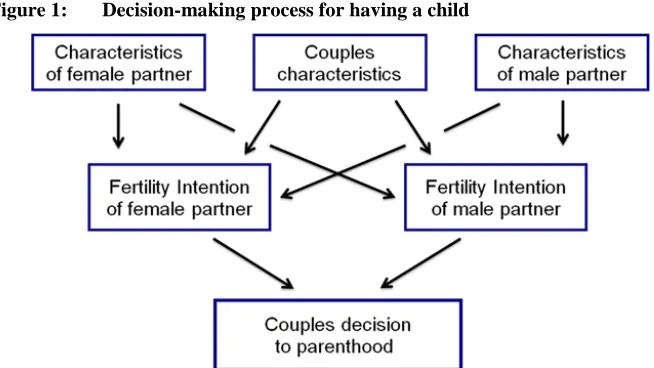
In this paper we model in a dyadic way the family formation and extension process in order to show the attitudes as well as the behavioural intentions of both the female and the male partner. We assume that the fertility intentions of both of the partners influence their joint decision. The transition to having a child will be presented as the result of an interaction process in which the partners influence each other and the result of the decision to varying degrees. Also relevant to the decision-making process is the personal context of a couple, including their individual characteristics, such as the value they assign to children, their education, and the number of hours they work per week; as well as their partnership characteristics, such as the duration of their relationship and their marital status. These characteristics affect the attitudes of individuals, and thus, indirectly, their decision. The couple’s final decision about whether to have a child is a result of the combined fertility intentins of both the man and the woman. Figure 1 shows the components and their (in-) direct relations of the decision-making process.
Up to now there have been few attempts in the empirical literature to model fertility decisions as resulting from an interaction process between two individuals within a partnership. This is because there have only been few datasets which include the changing characteristics of both partners. There are, however, appropriate German-language data from the “Bamberger Married Couple Panel” and the “Panel Analysis of Intimate Relationships and Family Dynamics” (pairfam). Furthermore, from a statistical point of view, modelling of these decision-making processes is difficult, and is associated with a number of problems. First, there are problems related to assessing the relative influence of the fertility intentions of each of the partners. Second, it is difficult to measure the relative influence of common items for each fertility intention . Third, it is hard to assess the extent to which the partners influence each other’s fertility intentions. Finally, it is difficult to determine the influence on the couple’s decision of each of the partners moderated by their characteristics.
The underlying formally specified model for analysing the decision-making process is a multivariate non-linear probit model. Our model specifies three endogenous variables: first, the fertility intention of the female partner; second, the fertility intention of the male partner; and, third, the result of their common decision.
When we examine the process of having a (further) child from a couple’s perspective, the interesting question of how each partner influences the couple’s final decision arises. Thomson (1997:344) outlined two basic options. On the one hand, the female partner may have more influence over the final decision because she bears the physical costs of pregnancy and birth. On the other hand, the man may have more influence because he earns a greater share of the income. It is also possible that the partners have equal levels of influence. Based on data from Sweden and the USA, Thomson and Hoem (1998) found an egalitarian effect on the final decision using a dyadic measurement. However, based on their analyses of the Bamberger married couple panel data, Pavetic (2009) and also Stein and Pavetic (2011, 2013) asserted that the woman dominates the decision-making process. In this study, we also assume that the female partner’s preference is more influential (Hypothesis 1).
persist. We therefore have also to consider the availability of child care. For the most part, having access to a flexible child care arrangement should give the female partner more influence. But if in modern partnerships child care tasks are more equitably distributed, then men may take on a paternal role model that will make reconciling family and work important to them as well (Marbach and Tölke 2007:272). Thus, the availability of child care could have a positive effect on the desire of both men and women to have a child (Hypothesis 2). We therefore assume that as the woman is the partner who bears higher costs associated with pregnancy, she will have the greater influence on the final decision to have a child.
In analysing fertility behaviour we have to distinguish between western and eastern German couples. Following the reunification of Germany, the former German Democratic Republic (GDR) adopted the political system of the Federal Republic of Germany (FRG). Yet more than two decades later, differences in fertility between the eastern and western parts of the country remain. Because of the financial advantages of using the splitting tax rate and the fact that child care is often available on a half-day basis only, the male breadwinner model is still established in West Germany (Konietzka and Kreyenfeld 2005). As a result, many West German women are in part-time employment. In the GDR, by contrast, there was a huge demand for women to work full-time because of a labour deficit. To ensure their integration into the labour market, the government organised a flexible system of full-time child care, often through employers (Bast and Ostner 1992). Thus, the breadwinner model in the GDR was more egalitarian, and even now East German women are more likely than West German women to want to work time (Dorbritz et al. 2005:11). But in order to combine full-time employment and family life after reunification, many women came to prefer having just one child (Ruckdeschel 2004:373). This means that there are more differences between the two parts of Germany to be expected which have varying effect on the desire to have a child. If this assumption is confirmed, we will find differences in preferences even after controlling for work schedule and access to flexible child care (Hypothesis 3).
better his potential wages and the more willing the female partner will be to quit her job during pregnancy. We therefore assume that having a higher education will have a positive effect on the desire of the male partner to have a child (Hypothesis 4b).
Specialisation can occur even in egalitarian partnerships. In line with Schröder and Brüderl (2008:133), we assume that the decision (and maybe the desire) to have a child can affect the work schedules of parents. This means that traditional forms of specialisation, like the male breadwinner model, may be accepted when a couple decide to become parents (again). Pollman-Schult and Diewald (2007) found that men may even intensify their work activities after having children. If this is the case, then the number of hours worked by the male partner should not negatively affect the female partner’s desire to have a child (Hypothesis 5a), and it may even positively affect the male partner’s desire to have a child (Hypothesis 5b).
Most children are born in partnerships. Especially for men it is very difficult to have children without a female partner. If the man wants to realise his desire to have a child, he must be in a solid partnership. For the man, being in a permanent partnership provides him with the opportunity to become a parent (Klein and Eckhard 2008:381). But he is likely aware that if the partnership fails the child(ren) will live primarily with their mother. Thus, we can assume that decreasing pair stability will reduce the man’s desire to have a child (Hypothesis 6a). After a couple separate the children usually stay with the mother, and she is entitled to receive benefits. Thus, we can assume that the effect of pair stability will be lower for the female partner (Hypothesis 6b).
Couples often get married because they want to have a child (Ruckdeschel 2004:366; Eckhard and Klein 2006). Especially for men, entering into marriage is a strong indication of a desire to have a child. We can assume that before getting married the man will have carefully considered the quality of the partnership and decided that it was stable. In case of separation, however, the man’s rights as a father will be better protected if he had been married than if he had been cohabiting. Women’s interests are also better protected following a separation if she had been married. Thus, we assume that being married will have a positive effect on the desire to have a child for both the male and the female partner (Hypothesis 7).
determined by sociocultural factors to a greater extent among women than among men. The stronger the normative and emotional reasons for having a child are, the stronger the woman’s desire to have a child is likely to be. We therefore assume that the female partner’s desire to have a child will have a greater influence than that of the male partner (Hypothesis 8a). We further assume that the less distinctive these characteristics are, the weaker the individual’s intentions will be; and that this effect will be stronger for females than for males (Hypothesis 8b).
For men, the direct costs of parenthood are more immediate. Because men tend to identify with the main breadwinner role, having a higher income may be associated with an increased desire to have a family (Tölke and Diewald 2003b:354; Kühn 2005:130). We therefore expect that having a higher income will positively affect the male partner’s desire to have a child. Thus, we assume that the more income a man has, the stronger his desire to have a child will be (Hypothesis 9).
3.1 Data and variables
For our pair analysis, we needed data in a dyadic structure.4 In 2008, the German Family Panel (pairfam) was launched as a multi-disciplinary, longitudinal study for researching partnership and family dynamics in Germany. Our analyses are based on data from the first four waves of the pairfam, release 4.0 (Nauck et al. 2013). A detailed description of the study can be found in Huininik et al. (2011). The yearly nationwide random sample size started with 12,400 participants for the three birth cohorts of 1971-73, 1981-83, and 1991-93. The pairfam dataset that also includes married and unmarried couples. For our analysis, we matched anchor and partner data from the first two waves of the pairfam sample: i.e., 2008/2009 and 2009/2010.
To measure the individual fertility intention, we used the item: “Do you intend to become a mother or a father (again) in the next two years?” We recoded the four-point response categories from “No, probably not” and “No, definitely not” as zero, and “Yes, definitely” and “Yes, perhaps” as one. The same was done for the partner item. Both were taken from the first wave of the anchor and partner dataset.
To measure the couple’s decisions, we used the following item of the anchor data from the second wave: “Have you tried to sire a child or become pregnant within the past twelve months?” This nominal variable was coded into a dummy. For couples who were about to have a child (i.e., the female partner was pregnant), the decision variable was coded one because a decision had been made.
4 This paper uses data from the German Family Panel pairfam, coordinated by Josef Brüderl, Johannes
Starting with the individual characteristics, we assume that the decision to have a child is based not only economic costs and benefits, but also on emotional and normative motivations. We therefore included the value of children in the item set. We first gave five arguments for having children:
• Having children will help you stay young longer.
• You can have very close emotional relationships with your children.
• Your standing in your social network will increase because of your children.
• Adult children will be there for you when you are in need.
• You will get new ideas from your adult children.
These items were measured on a five-point likert scale from one: “not at all;” to five: “very strongly.” In each case a factor analysis reflects for the actor and for the partner the variation of one unobserved variable with an eigenvalue greater than one. It is therefore advisable to compute the mean indexes.
We then presented five reasons for not having children, measured on the same five-point likert scale:
• You will be able to afford less when you have children.
• Children will add to your psychological stress.
• You will not be able to accomplish your professional goals when you have children.
• Having children can cause you to stand out in a negative way in public.
• Having children will limit your personal freedom.
The factor analyses also reflect one unobserved variable with eigenvalues greater than one. It is therefore consistent to compute two mean indexes for the reasons not to have children.
We assume that the stability of the partnership has an influence on the individual partners’ fertility intentions. This effect was operationalised by computing a sum score out of these three binary nominal variables:
• The partnership (or marriage) was in trouble during the past year.
• A separation or a divorce was considered during the past year.
• A separation or a divorce was seriously proposed during the past year.
In order to measure the individual intensity of employment as an indicator for the specialisation gains for both partners, we took the item that was asking for weekly working hours. To examine the effects of education on fertility shown in many studies, we used the Casmin classification index. We obviously controlled for the male partner’s and the female partner’s age. The variables were scaled in years. To identify the individuals who had already become a mother or a father, a variable was added that specifies the number of existing biological children. Because of the different scaling of the anchor and partner variables, they had to be synchronised. We recoded the categories into: 0 = “no children,” 1 = “one child,” 2 = “two children,” 3 = “three children,” and 4 = “four or more children.”
In addition to these individual characteristics, we assumed that some couple characteristics, like the availability of child care, would affect the individual fertility intention of each partner. We took these characteristics into account by adding the variable “access to flexible child care options.” This item was included as a dummy variable and was taken from the anchor data. As was already mentioned, we assumed a positive effect of marriage on each partner’s preference. The couple characteristic of marital status was therefore included as a dummy variable.
The duration of the relationship is also assumed to affect the particular fertility intention. To control for duration we added this item scaled in months. We also used the household net income to take into account the assumed income effect for the male partner. To allow for a better interpretation of the coefficients, the income was classified in units of 250 euros. To research the potential differences in fertility behaviour between eastern and the western German couples, we used a dummy: currently living in eastern Germany.
In order to meet the requirements of the dyadic design, the actor and the partner data were merged and linked. In this way potential cohort design effects and the unilateral bias was reduced, especially for the couple effects which can only be taken from the anchor data. To estimate a multivariate non-linear probit model, MPLUS forces the user to execute the listwise deletion method for handling the missing data of all of the independent variables. In order to avoid reducing the sample size any more than was necessary before estimating the model, the at-random missing values were imputed. The imputation was done in STATA 12 using the ICE command (Royston 2005). The model estimation is based on 1,938 cases. Due to the dyadic approach, each case is on a pair. The following Tables 1a and 1b give an overview of the distributions of the exogenous and endogenous variables.
Table 1a: Descriptive statistics of the individual variables
Variable Mean female SD female Mean male SD male
Age x1, x13 31.50 5.48 34.32 6.09
Child x2, x14 1.11 1.03 1.10 1.04 Stability of Partnership x3, x15 0.50 0.96 0.42 0.85 VOC positive x4, x16 3.48 0.68 3.48 0.73 VOC negative x5, x17 2.36 0.82 2.19 0.76 Working-time x6, x18 19.38 18.80 38.48 17.82 Education x7, x19 5.76 2.25 5.64 2.35 Intention y1, y2 0.39 0.49 0.39 0.49
Table 1b: Descriptive statistics of the couple variables
Variable Mean SD
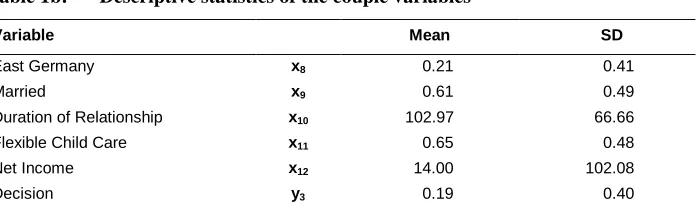
East Germany x8 0.21 0.41
Married x9 0.61 0.49
Duration of Relationship x10 102.97 66.66 Flexible Child Care x11 0.65 0.48 Net Income x12 14.00 102.08
3.2 Model specification
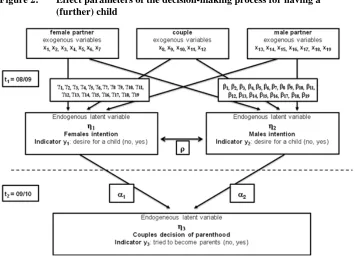
We transfer our previous theoretical assumptions into an empirical model. We model a trivariate distribution consisting of the fertility intention of the female partner (𝛈𝐢𝟏), the fertility intention of the male partner (𝛈𝐢𝟐), and the joint generative decision (𝛈𝐢𝟑). These three characteristics are metrically scaled endogenous latent (response-) variables whose operationalisation is achieved through the binary manifest variables (𝐲𝐢) described above. In addition, a set of exogenous variables (𝐱𝐢) of the female partner, the male partner, and the couple variables (like marital status) are taken into account. Figure 2 shows the model.
Figure 2: Effect parameters of the decision-making process for having a (further) child
partner determine the endogenous variable 𝛈𝐢𝟐 (the fertility intention of the male partner). Moreover, it is assumed that the educational and occupational-biographical characteristics of both partners directly influence their fertility intention. Furthermore, the exogenous couple variables (like the marital status) influence each individual’s desire to have a child. The couple variables are identical for the partners, but the variables could have different effects on the fertility intention of the female partner and the male partner. The effects of the exogenous variables on the attitude of the female partner are represented by the parameter 𝛄𝟏to 𝛄𝟏𝟗. The effects of exogenous variables on the intention to have a child of the male partner are represented by the parameter 𝛃𝟏 to 𝛃𝟏𝟗. The parameters 𝛂𝟏 and 𝛂𝟐 representthe influence of the individual attitudes on the couple’s decision 𝛈𝐢𝟑. The different measurement points (𝐭𝟏= 𝟐𝟎𝟎𝟖/𝟎𝟗 and
𝐭𝟐= 𝟐𝟎𝟎𝟗/𝟏𝟎) legitimize causality modelling. Since the decision to have a child is made by the couple, it is reasonable to assume that the error term 𝛜𝐢𝟏and 𝛜𝐢𝟐 in the male’s and the female’s attitudes are correlated (ρ).
The statistical procedure we use to model the complexity of the decision-making processes in partnerships is based on the research of Sobel and Arminger (1992). A version of their model is applied in the modification here in order to analyse the fertility decision-making process in partnerships. To illustrate the dynamics of the generative decision-making process, we have to solve a number of identification problems. A detailed representation of the problem of identification and its solution can be found in Pavetic (2009), as well as in Stein and Pavetic (2011, 2013).
We start from a standard regression model for the latent intentions:
𝛈𝐢𝟏= 𝛄𝟎+ 𝛄𝟏𝐱𝐢𝟏+ 𝛄𝟐𝐱𝐢𝟐+ (… ) + 𝛄𝟏𝟗𝐱𝐢𝟏𝟗+ 𝛜𝐢𝟏 (1)
𝛈𝐢𝟐= 𝛃𝟎+ 𝛃𝟏𝐱𝐢𝟏+ 𝛃𝟐𝐱𝐢𝟐+ (… ) + 𝛃𝟏𝟗𝐱𝐢𝟏𝟗+ 𝛜𝐢𝟐 (2)
𝛈𝐢𝟑= 𝛂𝟎+ 𝛂𝟏𝛈𝐢𝟏+ 𝛂𝟐𝛈𝐢𝟐+ 𝛜𝐢𝟑 (3)
Here, the parameters are denoted by 𝛄𝐣, 𝛃𝐣, 𝐣 = 𝟎, … , 𝟏𝟗 and 𝛂𝐤, 𝐤 = 𝟎, 𝟏, 𝟐. The errors are normally distributed with 𝛜𝐢𝟏 ~ 𝐍(𝟎, 𝛔𝟏𝟐), 𝛜𝐢𝟐 ~ 𝐍(𝟎, 𝛔𝟐𝟐) and 𝛜𝐢𝟑 ~ 𝐍(𝟎, 𝛔𝟑𝟐). The standard probit model for equation (1), (2) and (3) assumes that:
𝐲𝐢𝟏= � 𝟏 𝐢𝐟 𝛈𝟎 𝐨𝐭𝐡𝐞𝐫𝐰𝐢𝐬𝐞𝐢𝟏> 𝛕𝟏 similarly
and
𝐲𝐢𝟑= � 𝟏 𝐢𝐟 𝛈𝟎 𝐨𝐭𝐡𝐞𝐫𝐰𝐢𝐬𝐞𝐢𝟑> 𝛕𝟑
It is possible to show that identification restrictions have to be placed on equation (1) to (3) to identify the parameters that are of greatest interest; i.e., the regression parameters.
In the standard probit model for (1), the threshold 𝛕𝟏 is set to zero and the standard deviation 𝛔𝟏 is set to one. Similar restrictions are 𝛕𝟐= 𝟎, 𝛕𝟑= 𝟎, 𝛔𝟐= 𝟏and𝛔𝟑= 𝟏.
These identification restrictions yield the standard probit models:
𝛈𝐢𝟏= 𝜸𝟎∗+ 𝜸𝟏∗𝐱𝐢𝟏+ 𝜸∗𝟐𝐱𝐢𝟐+ (… ) + 𝜸𝟏𝟗∗ 𝐱𝐢𝟏𝟗+ 𝝐𝒊𝟏∗ (4)
𝛈𝐢𝟐= 𝜷𝟎∗+ 𝜷𝟏∗𝐱𝐢𝟏+ 𝜷∗𝟐𝐱𝐢𝟐+ (… ) + 𝜷𝟏𝟗∗ 𝐱𝐢𝟏𝟗+ 𝝐𝒊𝟐∗ (5)
𝛈𝐢𝟑= 𝜶𝟎∗+ 𝜶𝟏∗𝛈𝐢𝟏+ 𝜶𝟐∗𝛈𝐢𝟐+ 𝝐𝒊𝟑∗ (6)
with 𝝐𝒊𝟏∗ ~ 𝐍(𝟎, 𝟏),𝝐𝒊𝟐∗ ~ 𝐍(𝟎, 𝟏) and 𝝐𝒊𝟑∗ ~ 𝐍(𝟎, 𝟏).
The relationship between 𝛃𝐣 and 𝛃𝐣∗ is given by 𝛃𝐣∗= �𝛃𝐣
𝛔𝟏�, between𝛄𝐣 and 𝛄𝐣
∗ by
𝛄𝐣∗= �𝛔𝛄𝟐𝐣�, and between 𝛂𝐤 and 𝛂𝐤∗ by 𝛂𝐤∗ = �𝛂𝛔𝐤
𝟑�.
Technically speaking, 𝛄𝐣, 𝛃𝐣, 𝐣 = 𝟎, … , 𝟏𝟗and 𝛂𝐤, 𝐤 = 𝟎, 𝟏, 𝟐 are only identified up to scales 𝛔𝟏,𝛔𝟐, and 𝛔𝟑.
This identification procedure poses some problems when testing the equality of parameters. These problems will be described and dealt with when necessary.
To test the hypothesis that the influence of the female’s and the male’s fertility intentions are equal, i.e., 𝐇𝟎: 𝛂𝟏= 𝛂𝟐, it is necessary to remember that only 𝛂𝟏∗ = �𝛂𝟏
𝛔𝟑�
and that 𝛂𝟐∗ = �𝛂𝟐
𝛔𝟑� are identified. But if we use the formulation 𝐇𝟎:
𝛂𝟏
𝛂𝟐= 𝟏 that is
equivalent to 𝐇𝟎: 𝛂𝟏= 𝛂𝟐 we can see that 𝐇𝟎: 𝛂𝟏
𝛂𝟐 = 𝟏 is equivalent to 𝐇𝟎= �
𝛂𝟏∗ 𝛂𝟐∗� =
�𝛂𝟏⁄𝛔𝟑
𝛂𝟐⁄𝛔𝟑� = 𝟏. Therefore, the non-linear formation 𝐇𝟎= �
𝛂𝟏∗
𝛂𝟐∗� = 𝟏 should be tested. If we want to test the equality of the coefficients across the equation, that is,
𝐇𝟎: 𝛃𝐣= 𝛄𝐣, we have to remember that only 𝛃𝐣∗= �𝛔𝛃𝟐𝐣� and 𝛄𝐣∗= �𝛔𝛄𝟏𝐣� are identified. The hypothesis 𝐇𝟎: 𝛃𝐣= 𝛄𝐣 therefore has to be replaced by the hypothesis 𝐇𝟎: 𝜷𝒋∗=
For analysing this decision-making process, we have calculated a complex multivariate non-linear probit model using MPLUS 7 (Muthén and Muthén 2005).
3.3 Inspection of the model fit and interpretation of the results
Different models tests must be performed for different hypotheses. In the following, we present the results of the nonlinear probit model of Figure 2. Tables 2a and 2b provide a summary of the relevant model tests and the goodness of model fit criteria. We start by proofing the model fit. As can be seen from Tables 2a and 2b below, the root mean square of approximation (RMSEA) coefficient and the comparative fit index (CFI) indicate that the model has an excellent fit (RMSEA = 0.008 and CFI = 0.999). Furthermore, the statistic of the χ2difference test (Bollen 1989:292) indicates a much better model fit compared to the baseline model. The Wald test statistic indicates that the parameters fit the model.
Table 2a: Model fit
Number of Cases 1938 RMSEA Coefficient 0.008 Comparative Fit Index 0.999 R2 Decision 0.623 R2 Fertility Intention Female 0.285 R2 Fertility Intention Male 0.648
Table 2b: Test statistics
Test statistics df p- Value
𝜒2 Test of Model Fit 35.77 38 0.573 𝜒2 Difference Test 3117.56 19 0.000
Wald Test 968.66 40 0.000
Table 3a: Individual effects on the fertility intention of the female partner
Parameter SE
Age 𝛄𝟏 0.040 0.010
Child 𝛄𝟐 -2.053 *** 0.067 Stability of Partnership 𝛄𝟑 0.142 0.037 VOC positive 𝛄𝟒 0.880 ** 0.050 VOC negative 𝛄𝟓 -0.913 *** 0.039 Working Hours 𝛄𝟔 -0.001 0.002 Education 𝛄𝟕 0.153 0.016
Notes: Level of Significance: *** = p < 0.001; ** = p < 0.01; * = p < 0.05; + = p < 0.1.
Table 3b: Individual effects on the fertility intention of the male partner
Parameter SE
Age 𝛃𝟏 0.004 0.009
Child 𝛃𝟐 -1.603 *** 0.068 Stability of Partnership 𝛃𝟑 -0.280 0.045 VOC positive 𝛃𝟒 1.142 *** 0.047 VOC negative 𝛃𝟓 -0.876 ** 0.045 Working Hours 𝛃𝟔 0.030 * 0.002 Education 𝛃𝟕 0.358 *** 0.015
Notes: Level of Significance: *** = p < 0.001; ** = p < 0.01; * = p < 0.05; + = p < 0.1.
A look at the effects of the male partner’s and the female partner’s fertility intentions shows that both are significantly positive.5 When we compare the restricted parameters, it becomes clear that the female partner’s influence on the couple’s final decision to have a (further) child is considerably stronger than the male partner’s influence. This means that the female partner’s intention to have a child has a greater effect on the couple’s decision than the male partner’s intention. We are thus able to confirm the first hypothesis that the female partner’s fertility intention has a stronger effect on the couple’s decision to have a (further) child.
When we compare the individual parameters of the men and the women, we find commonalities in levels of significance due to the effects of the individual exogenous
characteristics on the individual intention to have a child. The participant’s age does not show any confounding effects. When we control for the dependent variable with the number of biological children of both of the partners we can see that the influence is significantly negative at the 0.1% level. As expected, the estimation shows that the number of biological children has a greater individual effect on the female partner’s fertility intention than on the male partner’s fertility intention. Our assumption that the costs to women are higher than those to men due to pregnancy seems to be confirmed.
Concerning the stability of the partnership, we find no significant individual effects for the male partner. As this is not the expected result, we have to reject Hypothesis 6a. The female partner’s influence on the couple’s stability is also insignificant. In Hypothesis 6b, we expected to see a lesser effect on the female partner than on the male partner.
The indicators of the economic, normative, and emotional costs and benefits of having children show differences between the men and women due to their parameter significances and strengths. Starting with the positive values for having children, we notice a slightly more significant parameter for the male partner. Generally speaking, it appears that the higher the positive values attributed to having children, the greater the individual intention to have children is. Contrary to our expectations from Hypothesis 8a, we find a greater effect for males. Hypothesis 8a therefore has to be rejected.
For the negative values attributed to having children, the female partner’s parameter shows a stronger and more significant influence. We are thus able to confirm Hypothesis 8b. It is interesting to note that the indicator for the positive reasons for having children is stronger for the male partner, while the negative value is stronger for the female partner.
We did not assume a specialisation in the amount of time spent working. As was shown by Schröder and Brüderl (2008), such a specialisation must be a consequence of the decision to have a child. By applying controls based on the information on the existing children, a significant but weak effect of the amount of time spent working on the fertility intention of the male partner is found. An increase of 10 working hours per week leads to an increase of 0.3 in the male partner’s fertility intention. The corresponding parameter for the females remains insignificant. An assumed negative effect of fewer working hours on women is not found. As a result, we are able to confirm Hypothesis 5a. The effect of the male partner’s working hours is significant, but we cannot be certain that it is large enough to confirm our expectations from Hypothesis 5b. We suggest that a further analysis should be performed before the hypothesis can be confirmed or rejected.
male partner and a less educated female partner has the highest potential for specialisation. But our model estimates a significant effect for the male partner only. We find a positive effect of education on the man’s desire to have a child. This parameter is significant at the 0.1% level, and a value of 0.358 indicates a major effect of education on the male partner’s fertility intention. As a result, we can confirm Hypotheses 4b, but must reject Hypothesis 4a.
In the next step, we analyse the couple effects on the male partner’s and the female partner’s individual fertility intentions. Tables 4a and 4b show the couple effects of the couple variables on the female partner’s and the male partner’s intentions.
Table 4a: Couples effects on the fertility intention of the female partner
Parameter SE
East Germany 𝛄𝟏𝟓 0.136 0.080
Married 𝛄𝟏𝟔 3.452 *** 0.081
Duration of Relationship 𝛄𝟏𝟕 -0.023 *** 0.001
Flexible Child Care 𝛄𝟏𝟖 1.911 *** 0.069
Net Income 𝛄𝟏𝟗 -0.005 0.004
Notes: Level of Significance: *** = p < 0.001; ** = p < 0.01; * = p < 0.05; + = p < 0.1.
Table 4b: Couple effects on the fertility intention of the male partner
Parameter SE
East Germany 𝛃𝟏𝟓 0.434 0.080
Married 𝛃𝟏𝟔 3.499 *** 0.083
Duration of Relationship 𝛃𝟏𝟕 -0.029 *** 0.001
Flexible Child Care 𝛃𝟏𝟖 2.170 *** 0.069
Net Income 𝛃𝟏𝟗 -0.078 0.008
Notes: Level of Significance: *** = p < 0.001; ** = p < 0.01; * = p < 0.05; + = p < 0.1.
Living in East versus in West Germany does not appear to have much of an effect. Even after we controlled for working time and access to flexible child care, no significant effects were found. We are therefore unable to confirm Hypothesis 3, which suggested that East German couples are less likely to want to have a child than their western counterparts.
The individual fertility intentions of the partners in married couples are found to be stronger than those of the partners in unmarried couples. We assumed that couples marry because they want to realise their desire to have a child. The two effects are almost the same in size, and are therefore very convincing. This finding is in line with the results of a number of studies which showed that a marriage is seen as the best context for having children. We can therefore confirm Hypothesis 7.
The couple’s relationship duration measured in months is formally used as a control variable. For both partners, these negative effects are strongly significant. Thus, the longer a partnership lasts, the less likely it is that the partners will have a (further) child. However, the longer a relationship lasts the more likely it is that the desired number of children will be conceived. It therefore appears that the status quo is maintained.
Finally, on the common pair of variables, the parameters of the household net income shows no effects. Surprisingly, we have to reject Hypothesis 9. We expected our results to correspond to those of Tölke and Diewald (2003b). This unexpected finding might be caused the fact that we estimated the male partner’s effect in the context of a couple.
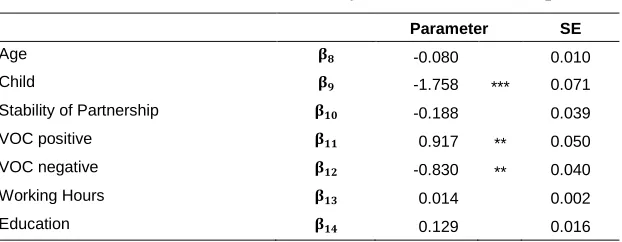
In this research, one of our initial goals was to examine the influence of each partner in a couple on the other partner’s fertility intention. To do this we developed a model which was used to examine these mostly unexplored partner effects on the decision-making process. Tables 5a and 5b show the partner effects of the exogenous variables on the female partner’s and the male partner’s fertility intention.
When comparing the effects it is important to take into account their varying impact. Only the male partner’s assessment of the partnership’s stability influences the partner’s intention to have a child. But this insight is not sufficient to reject Hypothesis 6a. If the male partner reported a decreasing degree of partnership stability, it is not his fertility intention which declines, but rather that of the female partner. It is worth noting that after controlling for marital status, the partner effect of the stability of the partnership continued to influence the woman’s intention to have a child.
partner bears the physical costs of pregnancy; thus, based on the “sphere of least interests” rule, her preference prevails. Among childless individuals, the average desired number of children is 1.13 for western Germans and 1.19 for eastern Germans (Dorbritz and Ruckdeschel 2007:69). As the average numbers of desired children are low, it is not surprising that the estimated effects of our analysis are high. The existence of children may also explain the insignificant age effects.
Table 5a: Partner effects on the fertility intention of the female partner
Parameter SE
Age 𝛄𝟖 -0.063 0.008
Child 𝛄𝟗 -1.211 ** 0.064 Stability of Partnership 𝛄𝟏𝟎 -0.526 * 0.042 VOC positive 𝛄𝟏𝟏 0.671 * 0.045 VOC negative 𝛄𝟏𝟐 -0.028 0.043 Working Hours 𝛄𝟏𝟑 0.020 + 0.002
Education 𝛄𝟏𝟒 0.227 * 0.015
Notes: Level of Significance: *** = p < 0.001; ** = p < 0.01; * = p < 0.05; + = p < 0.1.
Table 5b: Partner effects on the fertility intention of the male partner
Parameter SE
Age 𝛃𝟖 -0.080 0.010
Child 𝛃𝟗 -1.758 *** 0.071 Stability of Partnership 𝛃𝟏𝟎 -0.188 0.039 VOC positive 𝛃𝟏𝟏 0.917 ** 0.050 VOC negative 𝛃𝟏𝟐 -0.830 ** 0.040 Working Hours 𝛃𝟏𝟑 0.014 0.002 Education 𝛃𝟏𝟒 0.129 0.016
Notes: Level of Significance: *** = p < 0.001; ** = p < 0.01; * = p < 0.05; + = p < 0.1.
would serve as a temporary veto. Both the female and the male partner’s inclination to have a (further) child therefore decreases significantly, and the couple maintains the status quo.
The effect of the number of existing children can also represent a temporary veto. Because our analysis focuses on partnerships, we assume it is not possible for an individual to have a child without the cooperation of the partner. Although measured separately, this interpretation of the effect only makes sense if the partners have children in other partnerships. If they do not both want more children, the intention to have a child decreases among both partners. When the two partners are compared, the female effect is found to be stronger.
The female partner’s educational level is shown to have no significant influence on her own or on her partner’s fertility intention. However, the male partner’s educational level is found to have a significant effect on the fertility intentions of both partners. The higher the man’s educational level, the greater the intention of both partners to have a (further) child. Thus, Hypothesis 4b should be provisionally accepted.
The effect of the number of hours the male partner works per week appears to be similar. The more hours a man works, the greater the desire of both partners to have a (further) child. It should, however, be pointed out that the partner effect of male partner’s working hours is only significant at the 10% level.
4. Summary
Our analysis of the decision-making process of couples about whether to have a child using a dyadic model generated the expected results. The individual fertility intention of the male was found to be positively influenced by his weekly working hours and his level of education. The partner effects of the male partner’s working hours and education on the female partner’s intention to have a child were also shown to be significantly positive. In the traditional male breadwinner model, the man is expected to work longer hours and have more education than the woman. In our analysis, we did not attempt to distinguish between starting a family and family extension. However, in a modern fatherhood family model, the male partner is expected to earn most of the family income. Our finding that the traditional male breadwinner model persists among couples who have had children should therefore not be considered evidence that this model is still dominant.
power over the couple’s decision. Which of the two partners has the greater impact in the decision-making process remains unclear.
Particularly remarkable was our finding that the income effect was insignificant. We speculate that the income effect became insignificant in our model estimation because it was measured at the level of household net income, which cannot measure current costs like rent. In future research, the net equivalent income should be used instead. It would also be helpful to generate a variable that identifies the main breadwinner. This could be the couple constellation shown in Bauer and Jacob (2010), enhanced by the income level.
References
Auspurg, K. and Abraham, M. (2007). Die Umzugsentscheidung von Paaren als Verhandlungsproblem. Kölner Zeitschrift für Soziologie und Sozialpsychologie
9(2): 271−293. doi:10.1007/s11577-007-0029-7.
Bast, K. and Ostner, I. (1992). Ehe und Familie in der Sozialpolitik der DDR und BRD – ein Vergleich. In: Schmähl, Winfried (eds.). Sozialpolitik im Prozess der
deutschen Vereinigung. Frankfurt, New York: Campus: 228−270.
Bauer, G. and Jacob, M. (2010). Fertilitätsentscheidungen im Partnerschaftskontext.
Kölner Zeitschrift für Soziologie und Sozialpsychologie 2(1): 31−60.
doi:10.1007/s11577-010-0089-y.
Bauer, G. and Kneip, T. (2013). Fertility from a couple perspective: A test of competing decision rules on proceptive behaviour. European Sociological review 9(3): 535−548. doi:10.1093/esr/jcr095.
Beblo, M. (2001). Bargaining over time allocation: Economic modelling and
econometric investigation of time use over families. Heidelberg: Physica.
doi:10.1007/978-3-642-57579-2
Becker, G.S. (1960). An economic analysis of fertility. In: National Bureau of Economic Research (eds.). Demographic and economic change in developed
countries. Princeton: Princeton University Press: 209−231.
Becker, G.S. (1981). A treatise on the family. Cambridge: Harvard University Press. Beck-Gernsheim, E. (1983). Familie im Modernisierungsprozeß. Zum historischen
neuen Spannungsverhältnis zwischen Elternschaft und eigener Lebensgeschichte von Mann und Frau. In: Bolte, K.M. and Treutner, E. (eds.). Subjektorientierte
Arbeits- und Berufssoziologie. Frankfurt am Main: Campus. 270−292.
Beck-Gernsheim, E. (1997). Geburtenrückgang und Kinderwunsch. Die Erfahrung in Ostdeutschland. Zeitschrift für Bevölkerungswissenschaft 2(1): 59−71.
Beckman, L.J. (1977). Couples’ decision-making process regarding fertility. In: Taeuber, K.E., Bumpass, L., and Sweet, J.A. (eds.). Social Demography. New York: Academic Press: 57−81.
Beckman, L.J. (1979). Fertility preferences and social exchange theory. Journal of
Applied Social Psychology (2): 147−169. doi:10.1111/j.1559-1816.1979.tb00
Beckman, L.J. (1984). Husbands’ and wives’ relative influence on fertility decisions and outcomes. Population and Environment (3): 182−197. doi:10.1007/BF012 55488.
Bernasco, W. and Giesen, D. (2000). A bargaining approach to specialization in couples. In: Weesie, J. and Raub, W. (eds.). The management of durable relations. Theoretical models and empirical studies of households and
organizations. Amsterdam: Thela Thesis: 42−43.
Borchardt, A. and Stöbel-Richter, Y. (2004). Die Genese des Kinderwunsches bei Paaren. Eine qualitative Studie. Materialienband zur Bevölkerungswissenschaft Wiesbaden: Bundesinstitut für Bevölkerungsforschung.
Bollen, K.A. (1989). Structural equations with latent variables. New York: Wiley. Brines, J. and Joyner, K. (1999). The ties that bind. Principles of cohesion in
cohabitation and marriage. American Sociological Review 4(3): 333−355. doi:10.2307/2657490
Burkart, G. (1994). Die Entscheidung zur Elternschaft. Eine empirische Kritik von
Individualisierungs- und Rational-Choice-Theorien. Stuttgart: Enke.
Burkart, G. (2002). Entscheidung zur Elternschaft revisited. Was leistet der Entscheidungsbegriff für die Erklärung biographischer Übergänge? In: Schneider, N.F. and Matthias-Bleck, H. (eds.). Elternschaft heute. Gesellschaftliche Rahmenbedingungen und individuelle Gestaltungsaufgaben.
Opladen: Leske + Budrich 3−48.
Corijn, M., Lifbroer, A.C., and de Jong Gierveld, J. (1996): It takes two to tango, doesn’t it? The influence of couple characteristics on the timing of the birth of the first child. Journal of Marriage and the Family 8(1): 117−126. doi:10.2307/ 353381.
Dorbritz, J., Lengerer, A., and Ruckdeschel, K. (2005). Einstellungen zu demographischen Trends und zu bevölkerungsrelevanten Politiken. Ergebnisse der Population Policy Acceptance Study in Deutschland. Wiesbaden: Bundesinstut für Bevölkerungsforschung beim Statististischen Bundesamt. Dorbritz, J. and Ruckdeschel, K. (2007). Kinderlosigkeit in Deutschland. Ein
Gebel, M. and Giesecke, J. (2009). Ökonomische Unsicherheit und Fertilität. Die Wirkung von Beschäftigungsunsicherheit und Arbeitslosigkeit auf die Familiengründung in Ost- und Westdeutschland. Zeitschrift für Soziologie 8(5): 399−417.
Eckhard, J. and Klein, T. (2006). Männer, Kinderwunsch und generatives Verhalten. Eine Auswertung des Familiensurvey zu Geschlechterunterschieden in der
Motivation zur Elternschaft. Wiesbaden: VS Verlag für Sozialwissenschaften.
Eckhard, J. and Klein, T. (2007). Die Motivation zur Elternschaft. Unterschiede zwischen Männern und Frauen. In: Konietzka, D. and Kreyenfeld, M. (eds.). Ein
Leben ohne Kinder. Wiesbaden, VS Verlag für Sozialwissenschaften 75−294.
doi:10.1007/978-3-531-90323-1_9.
Hass, P.H. (1974). Wanted and unwanted pregnancies. A fertility decision-making model. Journal of Social Issues 30(4): 125−165. doi:10.1111/j.1540-4560. 1974.tb01758.x.
Huinink, J. (1990). Familie und Geburtenentwicklung. In: Mayer, K.U. (eds.).
Lebensverläufe und sozialer Wandel. Opladen: Westdeutscher: 239−271.
Huinink, J. (1995). Warum noch Familie? Zur Attraktivität von Partnerschaft und
Elternschaft in unserer Gesellschaft. Frankfurt am Main: Campus.
Huinink, J. (2000). Bildung und Familienentwicklung im Lebenslauf. Zeitschrift für
Erziehungswissenschaft (2) 209−227. doi:10.1007/s11618-000-0022-7.
Huinink, J., Brüderl, J., Nauck, B., Walper, S., Castiglioni, L., and Feldhaus, M. (2011). Panel Analysis of Intimate Relationships and Family Dynamics (pairfam): Conceptual framework and design. Zeitschrift für Familienforschung 3(1): 77−101.
Jansen, M. and Lifbroer, A.C. (2006). Couples’ attitudes, childbirth and the division of labor. Journal of Family Issues 7(11): 1487−1511. doi:10.1177/0192513X0 6291038.
Kemkes-Grottenthaler, A. (2004). Determinanten des Kinderwunsches bei jungen Studierenden – Eine Pilotstudie mit explorativem Charakter. Zeitschrift für
Bevölkerungswissenschaft 9(2): 193−217.
Klein, T. (2003). Die Geburt von Kindern aus paarbezogener Perspektive. Zeitschrift
für Soziologie 2(6): 506−527.
Klein, T. and Eckhard, J. (2008). Partnerschafts- und berufsbezogene Aspekte des Kinderwunsches von Männern und Frauen. In: Feldhaus, M. and Huinink, J. (eds.). Neuere Entwicklungen in der Beziehungs und Familienforschung.
Vorstudien zum Beziehungs- und Familienpanel (pairfam). Würzburg: Ergon
Verlag: 379−401.
Kohlmann, A. and Kopp, J. (1997). Verhandlungstheoretische Modellierung des Übergangs zu verschiedenen Kinderzahlen. Zeitschrift für Soziologie 6(4): 258−274.
Konietzka, D. and Kreyenfeld, M. (2005). Nichteheliche Mutterschaft und soziale Ungleichheit: Zur sozioökonomischen Differenzierung der Familienformen in Ost- und Westdeutschland. Kölner Zeitschrift für Soziologie und
Sozialpsychologie 7(1): 32−61. doi:10.1007/s11577-005-0110-z.
Kreyenfeld, M. (2002). Time-squeeze, partner effect or self-selection? An investigation into the positive effect of women’s education on second birth risks in West Germany. Demographic Research 7(2): 15−48. doi:10.4054/DemRes.2002.7.2. Kreyenfeld, M. and Konietzka, D. (2008). Education and Fertility in Germany. In
Hamm, I., Seitz, H., and Werdinger, M. (eds.), Demographic change in
Germany. Berlin: Springer: 165−187. doi:10.1007/978-3-540-68137-3_7.
Kreyenfeld, M. (2010). Uncertainties in female employment careers and the postponement of parenthood in Germany. European Sociological Review 26(3): 351−366. doi:10.1093/esr/jcp026.
Kühn, T. (2005). Die Bedeutung von Familiengründung für die Biografiegestaltung junger Männer. In: Tölke, A. and Hank, K. (eds.). Männer – Das
„vernachlässigte“ Geschlecht in der Familienforschung. Wiesbaden: VS Verlag
für Sozialwissenschaften: 127−151. doi:10.1007/978-3-322-80681-9_6.
Kurz, K. (2005). Die Familiengründung von Männern im Partnerschaftskontext. Eine Längsschnittanalyse zur Wirkung von Arbeitsmarktunsicherheiten. In: Tölke, A. and Hank, K. (eds.). Männer – Das „vernachlässigte“ Geschlecht in der
Familienforschung. Wiesbaden: VS Verlag für Sozialwissenschaften 178−197.
doi:10.1007/978-3-322-80681-9_8.
Leibenstein, H. (1975). The economic theory of fertility decline. In: The Quarterly
Marbach, J and Tölke A. (2007). Frauen, Männer und Familie: Lebensorientierung, Kinderwunsch und Vaterrolle. In: Konietzka, D. and Kreyenfeld, M. (eds.). Ein
Leben ohne Kinder, Wiesbaden: VS Verlag für Sozialwissenschaften: 245−274.
doi:10.1007/978-3-531-90323-1_8.
Miller, W.B. and Pasta, D.J. (1994). The psychology of child-timing: A measurement instrument and a model. Journal of Applied Social Psychology 24(3): 218−250. doi:10.1111/j.1559-1816.1994.tb00580.x.
Miller, W.B. and Pasta, D.J. (1996). Couple disagreement. Effects on the formation and implementation of fertility decisions. Personal Relationships 3(3): 307−336. doi:10.1111/j.1475-6811.1996.tb00119.x.
Muthén, L.K. and Muthén, B.O. (2005). Mplus: Statistical analysis with latent variables: User's guide. Los Angeles, CA: Muthén & Muthén.
Namboodiri, H.K. (1979). Comments on fertility as consumption. Theories from the behavioural sciences. Journal of Consumer Research 5(4): 290−292.
Nauck, B. (2001). Der Wert von Kindern für ihre Eltern. Kölner Zeitschrift für
Soziologie und Sozialpsychologie 53(3): 407−435.
doi:10.1007/s11577-001-0073-7.
Nauck, B., Brüderl, J., Huinink J., and Walper, S. (2013). Beziehungs- und Familienpanel (pairfam). GESIS Datenarchiv, Köln. ZA5678 Datenfile Version
4.0.0. doi:10.4232/pairfam.5678.4.0.0
Oppenheimer, V.K. and Lewin, A. (1999). Career development and marriage formation in a period of rising inequality. Who is at risk? What are their prospects? In Booth, A., Shanahan, M., and Crouter, A.C. (eds.). Transitions to adulthood in a
changing economy: No work, no family, no future? Westport: Praeger: 189−225.
Oppitz, G. (1990). Kind und Konsum. In: Szallies R. (eds.). Wertewandel und Konsum:
Fakten, Perspektiven und Szenarien für Markt und Marketing. Landsberg am
Lech: Verlag Moderne Industrie: 135−153.
Ott, N. (1989a). Familienbildung und familiale Entscheidungsfindung aus verhandlungstheoretischer Sicht. In: Wagner, G., Ott, N., and Hoffmann-Nowotny, H.-J. (eds.). Familienbildung und Erwerbstätigkeit im
demographischen Wandel. Berlin: Springer: 97−116.
Ott, N. (1989b). Haushaltsökonomie und innerfamiliale Arbeitsteilung: Eine
spieltheoretische Analyse familialer Entscheidungen. [Dissertation]. Bielefeld:
Universität Bielefeld.
Ott, N. (1992). Interfamily Bargaining and households decisions. Berlin: Springer. doi:10.1007/978-3-642-45708-1.
Ott, N. (1995). Fertility and division of work in the family. A game theoretic model of household decisions. In: Kuiper, E. and Sap, J. (eds.). Out of the margin. London: Routledge.
Ott, N. (2001). Der Erklärungsansatz der Familienökonomik. In: Huinink, J., Strohmeier, K.P., and Wagner, M. (eds.). Solidarität in Partnerschaft und
Familie. Zum Stand familiensoziologischer Theoriebildung. Würzburg: Ergon
129−143.
Pavetic, M. (2009). Familiengründung und -erweiterung in Partnerschaften.
Statistische Modellierung von Entscheidungsprozessen. Wiesbaden: VS Verlag
für Sozial-wissenschaften. doi:10.1007/978-3-531-91719-1.
Pollmann-Schult, M. and Diewald, M. (2007). Auswirkungen der Familiengründung auf den Berufsverlauf von Männern, Kölner Zeitschrift für Soziologie und
Sozialpsychologie 59(3): 440−458. doi:10.1007/s11577-007-0056-4.
Rasul, A. (1993). Fertility preference. A study of some basic concepts and considerations. The Journal of Family Welfare 39(1): 24−32.
Ruokolainen, A. and Notkola, I.-L. (2002). Familial, situational, and attitudinal determinants of third-child intentions and their uncertainty. Yearbook of
population research in Finland 38: 179−206.
Royston, P. (2005). Multiple Imputation of Missing Values: Update of ice. The Stata
Journal 5 (4): 527–536.
Ruckdeschel, K. (2004). Determinanten des Kinderwunsches in Deutschland.
Zeitschrift für Bevölkerungswissenschaft 39(3/4): 363−386.
Ruckdeschel, K. (2007). Der Kinderwunsch von Kinderlosen. Zeitschrift für
Familienforschung 19(2): 210−230.
Schaeper, H. and Kühn, T. (2000). Zur Rationalität familialer Entscheidungsprozesse am Beispiel des Zusammenhangs zwischen Berufsbiographie und Familiengründung. In: Heinz, W.R. (eds.). Übergänge. Individualisierung,
Flexibilisierung und Institutionalisierung des Lebensverlaufs. Weinheim: