in the population sciences published by the Max Planck Institute for Demographic Research Konrad-Zuse Str. 1, D-18057 Rostock · GERMANY www.demographic-research.org
DEMOGRAPHIC RESEARCH
VOLUME 18, ARTICLE 2, PAGES 27-58
PUBLISHED 07 MARCH 2008
http://www.demographic-research.org/Volumes/Vol18/2/ DOI: 10.4054/DemRes.2008.18.2
Research Article
Recent fertility decline in Eritrea:
Is it a conflict-led transition?
Gebremariam Woldemicael
© 2008 Woldemicael.
This open-access work is published under the terms of the Creative Commons Attribution NonCommercial License 2.0 Germany, which permits use, reproduction & distribution in any medium for non-commercial purposes, provided the original author(s) and source are given credit.
1 Introduction 28
2 Theoretical background 30
3 Data and method 32
4 Description of variables 33
5 Background to Eritrea 34
6 Fertility development 37
6.1 Timing of the fertility decline: Trend analysis for 1990-2001 37
6.2 Multivariate analysis 40
7 Discussion and conclusion 47
8 Acknowledgements 50
References 51
Recent fertility decline in Eritrea:
Is it a conflict-led transition?
Gebremariam Woldemicael1
Abstract
During a period of military conflict towards the end of the 1990s, Eritrea experienced a remarkable decline in fertility. This decline has been a concern to many Eritreans. An important issue of concern has been whether the decline is driven primarily by the recent border conflict with Ethiopia or by changes in other factors including delay in age at marriage, improvements in child survival and the socio-cultural changes that pre-dated the conflict. Using retrospective event histories from the 1995 and 2002 Eritrea Demographic and Health Surveys (EDHS), this study provides an in-depth exploration of recent fertility change in Eritrea. The findings illustrate that although marriage delay might have played a role in the decline of first births, a decline in fertility within marriage – partly due to cessation of childbearing after families reach their desired family size – is the major contributor to the overall decline. Even though we cannot conclude that the overall fertility decline primarily is the outcome of the conflict, there is evidence that it has contributed substantially to the decline, particularly for first birth fertility. The implications of these findings for theories about fertility change in times of military conflict is that crises may not be likely to initiate a sustainable overall fertility transition, but can still prompt short-term fertility changes among certain social groups or modify an ongoing decline.
1Associate Professor of Demography, University of Asmara. Email:[email protected]
.
Currently a1. Introduction
Although Eritrea is one of the countries that have witnessed a steady decline in fertility during a military conflict, there is very little evidence that describes how fertility declined so rapidly in a country that apparently meets few of the standard preconditions for fertility transition including significant socio-economic progress, major declines in child mortality, and substantial changes in the status of women. Some progress was made in the realms of education, health care services and agriculture after independence in 1991, particularly between 1992 and 1998, but after this period, Eritrea experienced severe economic declines, internal displacement, and military mobilization as a result of the 1998-2000 border conflict with Ethiopia (GSE and UNICEF, 2001). The records from the EDHS surveys show that Eritrea’s infant and child mortality has rapidly and consistently declined since the mid-1990s (NSEO and ORC Macro Inc., 1997, 2003). In terms of women’s status, like in most other sub-Saharan African countries, men’s dominance and women’s dependency on men still exists in Eritrea, particularly in the rural societies, even though some improvements have been made since the struggle for independence (this is discussed in the background section). Regarding the proximate determinants of fertility, Bongaarts and Potter (1983) argue that an increase in contraceptive use and in induced abortion, a relatively late age at marriage as well as long periods of post-partum sexual abstinence and postpartum ammenorrhoea can substantially reduce fertility from its natural maximum. In Eritrea, although contraceptive use is very low and has barely increased since 1995, and duration of postpartum amenorrhoea has remained almost constant since that time, there are indications of recent delays in age at first marriage and increased proportions of never-married women at ages 15-49 (NSEO & ORC Macro Inc, 1997, 2003). In addition, the proportion of married women currently residing with their husband has declined significantly between 1995 and 2002, particularly among younger women (see Table 1). Thus, the decline in fertility can be related to one or more of the proximate variables (Bongaarts et al., 1984) that have changed in recent years, while background variables such as women’s educational attainment, urbanization, etc., may have affected fertility by modifying these proximate determinants.
each proximate determinant to the decline and used TFR to assess the trend in fertility. However, although TFR is an appropriate aggregate measure of fertility that controls for age composition and is useful to compare populations with different age structures, it is not robust to discern whether fertility change can be attributed to changing reproductive pattern at low or high parities (Njogu and Martin, 1991) or to trace changes in fertility behaviour by various socio-demographic characteristics (Luther and Pejaranoda, 1991). Blanc (2004) concluded that the recent fertility decline is mainly an outcome of the border conflict mediated by a reduction in the proportion of women exposed to the risk of pregnancy as a consequence of delayed age at marriage and spousal separation. Whether such impacts would be evident when other more specific factors including parity, spacing of births, and other fertility behaviours are investigated using a multivariate model that controls for various socio-demographic determinants of fertility is still unclear.
2. Theoretical background
Several classical demonstrations of demographic transition show the following factors as essential precursors of the trend toward low fertility: the changing structural conditions that alter the costs and benefits of children in the course of socio-economic development, the weakening of normative control as societies are more educated, empowerment of individuals to make their own choices, often for smaller families, and declines in child mortality (see for e.g., Bulatao and Casterline, 2001; Cleland, 2001). In recent years, these explanations are supported or substantiated by another set of explanations that centre on the spread of positive attitudes toward controlled fertility and family planning (Basu and Amin, 2000). These attitudes may build up through a process of diffusion of ideas among people in which individuals’ decisions are influenced by the knowledge and behaviour of others including family, relatives, peer groups, elites, etc. with whom they come in contact (Montgomery and Casterline, 1998).
However, empirical evidence on the declines in fertility in the contemporary world has not always been consistent with the above explanations. Other factors, for instance, military conflict, famine, and economic downturn can lead to low aspirations and crisis-led fertility transitions (Avogo and Agadjanian, 2007; Hill, 2004; Lindstrom and Berhanu, 1999; Lesthaeghe, 1989; Busza and Lush, 1999; McGinn, 2000).
Such economic hardship may increase couple’s awareness of the costs associated with each additional child and the benefits of having fewer children (Rutenberg and Diamond, 1993).
Despite, the above explanations for the support of crisis-driven fertility decline, the empirical record is limited and inconsistent (Agadjanian and Ndola, 2002). For instance, evidence from Angola’s experience of conflict for extended period of time shows a wartime drop and a post-war rebound in fertility (Hill, 2004). Similarly, other studies (e.g. Lee, 1997; Palloni et al., 1996) found evidence of crisis induced fertility declines and post-war fertility rebounds. In a recent study on the fertility response to crises in Ethiopia during the 1970s and 1980s – periods marked by social and political upheavals, large population movements, civil war, famine and economic hardship - Lindstrom and Berhanu (1999) found mixed evidence of the effects of war and economic crisis on fertility. They noted that fertility in the 1970s remained high and relatively stable, though marked by periodic declines and rebounds in response to specific political and economic events. In 1982, however, fertility began a gradual decline, which appears to have been sustained into the 1990s, when stability returned to the country. The authors attribute this decline to the ongoing civil war and economic decline after 1982.
On the other hand, counter arguments of crisis-led fertility decline suggest that the fertility response may move in the opposite direction. That is, the number of births could increase as a result of crisis. For example, the eight-year war with Iraq (1980-88) created a pronatalist atmosphere among Iranian couples by which they were encouraged to have more children to replace those whose loss they were anticipating, and high fertility and population growth was considered as a matter of comparative advantage by the government of Iran (Abbasi-Shavazi, 2001). In the Middle east, the conflict between Palestinians and Israelis have likely contributed to higher than expected fertility levels among the Palestinians (Fargues, 2000). Particularly, in the refugee camps of West Bank and Gaza, political reasons were more important than economic and religious reasons for the increased desire for a large family during the intifada years, 1989-90 (Marwan et al., 2003).
Clearly, the existing literature suggests conflicting expectations. The hypothesis of crisis-led fertility decline remains an empirical question on which there is remarkably little evidence. While extreme conditions involving drought, economic decline, and military conflict have prompted short-term fertility declines, the evidence is not conclusive that such conditions can always lead to fertility decline (Lesthaeghe, 1989; Lindstrom and Berhanu, 1999; Peng, 1987; Watkins and Menken, 1985). Evidence on fertility response to crises has not been demonstrated successfully, particularly for countries in the east African region, including Eritrea. Understanding this relationship is especially critical for countries in this region, which have been affected severely by military conflict and political unrest, and where the transition to lower fertility is at its early stage. Thus, Eritrea becomes an interesting case study for exploring whether the recent border conflict is neutral in effect and the recent fertility decline stems from other factors or not.
3. Data and method
The major source of data for this study is the 2002 Eritrea Demographic and Health Survey. This survey covered a nationally representative sample of 9,389 households with 8,754 women of reproductive ages at the time of the survey, of which 6,900 were currently or formerly married. In the trend analysis, data from the 1995 EDHS survey are used in order to measure fertility trend more accurately in the early 1990s. The 1995 survey covered a total of 5,054 women aged 15-49 years, of which about 3,600 were married.
In the trend analysis, annual total fertility and age-and parity-specific fertility rates are estimated and presented for the five years before each survey in order to assess the timing of the fertility change in relation to the onset of the border conflict in 1998-2000. Here, the main issue is that if the recent decline is conflict-led, then fertility change should follow rather than precede the outbreak of the border conflict. By plotting the annual fertility estimates, we can visually examine whether the fertility decline started before or after 1998, which marks the onset of conflict (although its impact may be visible starting in 1999). The purpose of including age-and parity-specific estimates in addition to the summary measure is mainly to explore better the structure of the decline by age and parity.
marriage in models where only data from married women are used (Table 3) and time since women’s twelve’s birthday in models where data for all women are used (Table 2). The rationale for estimating separate first birth models for married women is to explore whether delay in age at marriage has an effect on first birth fertility, as this variable is applicable for married women only. In the models for second and higher order births, the time variable is time since previous birth.
4. Description of variables
The dependent variable is whether or not a woman experienced a live birth during the interval that is studied and the timing of that event. The independent variables include calendar period, birth order, age of mother at the birth of the previous child, spacing of births, survival of preceding child, age at first marriage and/or marital status, women’s education, region of residence, and childhood rural-urban residence.
In this study, we adopted the simplest way to measure the occurrence of conflict in relation to historical calendar period. This means that we are not able to identify the specific factors responsive for the conflict that may link the border conflict directly or indirectly with fertility (e.g., changes in GNP, living conditions, etc.). The focus is on how fertility changed during the conflict period in comparison to pre-conflict periods. The analysis recognizes 1999 as the starting year of the social and economic effects of the conflict. Calendar period is a time-varying covariate measured by a set of dummy variables.
Previous studies have shown that the likelihood of bearing another child is associated with the length of the preceding birth interval (Nair, 1996; Rodriguez et al., 1984). According to these authors a longer previous birth interval (24 months or more) is associated with a lower probability of a further conception or birth. Data from the EDHS surveys show that the median length of birth interval in 2002 is 2 months longer than that in 1995 (33.4 versus 31.3 months, respectively). This increase in birth interval may be partly attributed to the improvement in child survival in the country. Although there is no general level of child mortality which leads to a fertility decline when it is reached, there is a general consensus that the death of a previous sibling is associated with a shorter than expected birth interval, and similarly with a higher probability of conception or birth (Park et al., 1998; Santow and Bracher, 1984; Lindstrom and Kiros, 2007). In Eritrea, infant mortality declined from 72 to 48 per 1000 live births between 1995 and 2002 (NSEO and ORC Macro Inc., 2003).
fertility (Blanc and Rutenberg, 1990; Hinde and Mturi, 2000). However, some studies suggest that the effect of changes in nuptiality on overall fertility is not clear because of substantial fertility among never-married women (Hinde and Mturi 2000; Innocent 2001). In Eritrea, where pre-marital childbearing is uncommon or very low (NSEO and ORC Macro Inc. 1997), delays in marriage can reduce the number of women under risk of childbearing and hence fertility. Thus, in order to check whether delay in age at marriage has a significant effect or not on the recent fertility decline, we have included this variable in the analysis of first births.
The variable region of residence serves as a test criterion for the impact of the border conflict: the assumption is that if the conflict is responsible for initiating the fertility decline, then this decline should be most marked among populations with the more severe experience of conflict. Since two regions, South and Gash Barka, were the hardest hit, one could expect a stronger response in these two regions. Women’s education is included to assess if improvement in women’s education has an effect on the decline of fertility. Women’s education is a significant predictor of fertility in most contexts (Cleland and Wilson, 1987; Martin, 1995; Sathar et al., 1988). Rural-urban residence is included to explore whether there are rural-urban differentials in the recent decline of fertility. It is likely that urban dwellers usually benefit from more and better family planning and health facilities, and better living conditions than rural dwellers. Consequently, urban residence has generally been associated with lower fertility and mortality in most developing countries.
The analysis and interpretation of the association between explanatory variables and fertility is facilitated by estimation of separate models for first and higher order births. This analytical strategy emanates from the fact that some variables have different impacts on fertility at first and higher birth orders. For example, age at first marriage and marital status are more important for first births (onset of reproduction) than for fertility at higher birth orders. Variables like age of woman at birth of previous child, birth order, spacing of previous births, and survival status of the previous sibling are only applicable for higher parities, etc.
5. Background to Eritrea
Northern Red Sea, Gash Barka, Central and Southern. Three out of every four Eritreans live in rural areas, where people are engaged primarily in subsistence agriculture.
As in other traditional societies, women’s worth is measured in terms of their role as mothers and wives, particularly in the rural areas of Eritrea. During the pre-independence period, no much effort was made by the Ethiopian regime to change women’s subordinate status, which is based on deep-rooted traditional values and beliefs. Women traditionally have suffered socio-cultural and economic discrimination and have had fewer opportunities than men for education, employment, and participation in decision-making activities. In the urban areas, where education, health care and employment outside the home were relatively better, few women with higher education found professional employment: most held low-paying jobs. On the other hand, women who participated in the struggle for independence made a unique contribution, both as fighters and as civilian supporters to challenge and ousting the Ethiopian government. Women were active participants in the social, political, and cultural activities of the communities under the jurisdiction of the Eritrean Peoples Liberation Front, EPLF (now the government of Eritrea). Particularly, women fighters (although a small segment of the population as compared with men) were allowed to participate equally and fully in all sectors of activities performed in the areas administered by the EPLF. Thus, although we do not have any statistical evidence to support our argument, such involvements of women in social, administration and leadership may have facilitated the emergence of new perceptions of their roles and rights that may enable them to make their own decisions. It is also likely that old economic relations, customs, and value systems have been somewhat weakened by the gains in women’s status during the struggle and afterwards. But, since women who participated in the struggle were a small segment of the population (the majority, especially in the capital city and other urban areas were under the administration of the Ethiopian government), it is hard to judge their influence on the overall status of women in Eritrea.
human life. In general, prolonged war and military tensions with Ethiopia in combination with cycles of drought and lingering poverty made life very tough in Eritrea prior to independence.
The attainment of Eritrea’s independence in mid-1991 fostered high expectations that it would create new opportunity for socio-economic development. As anticipated, progress was made between 1992 and mid-1998. Some available reports show that Eritrea’s GDP grew at an average rate of 7% per annum between 1992 and 1997 (UN, 2002). Total government expenditure grew by 79% during this period. There were major investments in extending health care and education services. As a result, immunization coverage was expanded and polio was close to being eliminated and infant and child mortality rates declined sharply (NSEO and ORC Macro, 2003). The primary school gross enrolment ratio increased from 36% in 1992 to 52% in 1997 (Ministry of Education, 2002). Primary analysis from the two EDHS surveys also shows that the proportion of women in the reproductive ages with primary or higher education has increased from about 34% in 1995 to 50% in 2002.
Unfortunately, Eritrea’s initial promising socio-economic growth was disrupted by the unexpected border conflict with Ethiopia that started in May 1998 and resulted in a war that continued until 2000. This conflict has reversed much of the progress that Eritrea made during 1992-1997. The war has not only caused loss of human life, displacement of nearly one-third of the total population (about one million people), but has also reversed much of the progress in socio-economic trends made during the post-independence – pre-conflict period (UN, 2002). For instance, the growth of GDP declined from about 7% annually during 1992-1997 to 4% in 1998, 1% in 1999, and a negative growth of 8% in 2000; inflation rose from an average of 6% during 1994-1997 to 27% in 2000; and the fiscal deficit increased from 6% of GDP in 1997 to 48% of GDP in 2000 (UN, 2002). Prices of food and other commodities rose rapidly starting in late 1998 and continued to rise in subsequent years.
Table 1: Percent ever married and percent of married women residing with husband, by age
Ever married Residing with husbands Current
Age 1995 2002 1995 2002
15-19 37.6 31.0 60.4 30.5
20-24 78.1 72.7 74.4 42.1
25-29 92.1 88.5 79.1 48.9
30-34 95.8 95.4 84.0 60.6
35-39 98.2 97.8 88.4 72.4
40-44 97.3 99.0 89.0 78.9
45-49 98.1 99.2 90.6 88.0
Total 80.0 76.7 80.9 58.5
The figures are calculated from the 1995 and 2002 EDHS data files
6. Fertility development
6.1 Timing of the fertility decline: Trend analysis for 1990-2001
Using the event-history data from the 1995 and 2002 EDHS surveys, we begin our investigation of trends in fertility in Eritrea by estimating annual total fertility rates (TFR), and age- and parity-specific fertility rates (ASFR and PSFR). These are plotted in Figures 1, 2 and 3, respectively, by single calendar year for five years prior to the 1995 survey and seven years before the 2002 survey. In later sections, further analysis is made using multivariate regression techniques to explore the nature of the trend and its possible underlying factors.
In addition to the TFRs, age-and parity-specific fertility rates (ASFRS and PSFRS) are calculated and plotted by calendar year in order to find out whether the change in fertility is particularly pronounced at younger or older ages of women and at lower or higher order births. These are summarized in Figures 2 and 3, respectively. The ASFRS and PSFRS in Figures 2 and 3 support the above observation that fertility was high in the early and mid-1990s, followed by a downward trend after 1998, and the decline seems to have occurred at all reproductive ages and birth orders. It is worth noting here that the irregularities (peaks and troughs) shown at certain calendar years and at certain ages or parities can be either due to genuine fluctuations in fertility because of the changing circumstances in Eritrea from year to year, or these fluctuations can be due to misreporting errors such as shifting of births or ages of women. It should also be remembered that the figures are for single calendar years and are thus affected by random fluctuations.
Figure 1: Estimates of total fertility rate for single calendar years prior to the 1995 and 2002 EDHS
0.0 1.0 2.0 3.0 4.0 5.0 6.0 7.0 8.0
1990 1991 1992 1993 1994 1995 1996 1997 1998 1999 2000 2001 Year
T
o
ta
l f
e
rt
ili
ty
r
a
Figure 2: Estimates of age-specific fertility rates for single calendar years prior to the 1995 and 2002 EDHS
0.00 0.05 0.10 0.15 0.20 0.25 0.30 0.35
1990 1991 1992 1993 1994 1995 1996 1997 1998 1999 2000 15-19 20-24 25-29
30-34 35-39 40-44 45-49
Year 2001
Figure 3: Estimates of parity-specific fertility rates for single calendar years prior to the 1995 and 2002 EDHS
0.00 0.05 0.10 0.15 0.20 0.25 0.30 0.35
1990 1991 1992 1993 1994 1995 1996 1997 1998 1999 2000 2001
0 1 2 3 4
5 6 7
6.2 Multivariate analysis
The above trend analyses of aggregate fertility measures indicate that the decline in fertility is certainly noticeable after 1998 and that it occurred at all ages and birth orders. But, such aggregate measures may not be robust enough to discern the underlying trend of the decline and do not capture the impact of compositional changes among women and of change in reproductive behavioral factors related to family size limitation, including changes in birth spacing, parity, child survival status, marital status, and other socio-demographic factors. In order to further investigate in-depth whether a clear change in fertility is visible before or after 1998, multivariate regression methods are used to estimate separate models for first and higher order births.
The results of the multivariate analyses are given as relative risks of giving birth to a (another) child, where the risk of giving birth is expressed relative to a reference (or baseline) category of each covariate. A relative risk of 1 indicates that the estimated risk is equal to that of the reference category; a relative risk greater than 1 indicates that fertility is higher than that of the reference category and a relative risk less than 1 indicates lower fertility than for the reference category.
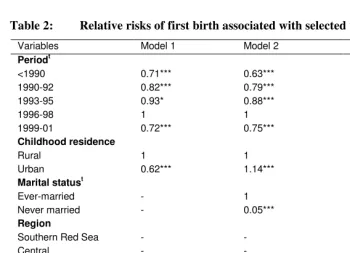
Tables 2 and 3 present the results from the multivariate analyses of first births of all women and of married women, respectively. Relative risks associated with calendar years indicate how much fertility has changed relative to the reference level, 1996-98. It is evident from these tables that there has been a gradual increase in first birth fertility until 1996-98, and a subsequent decline after this period. This clearly suggests that first birth fertility increased during the post-independence period when Eritrea enjoyed peace and economic improvements during 1992-98 and started to decline after 1998 during the border conflict. The later development may be due to the impact of mobilization of young married Eritreans to the military service during the border conflict. The effect of calendar period remains largely consistent and statistically significant even with the addition of marital status and other variables to the model.
fertility differentials by region of residence, an interaction model between calendar period and region was run (not presented here). But, no important regional differences in fertility trends in first births were found.
Table 2: Relative risks of first birth associated with selected variables
Variables Model 1 Model 2 Model 3
Periodt
<1990 0.71*** 0.63*** 0.61***
1990-92 0.82*** 0.79*** 0.80***
1993-95 0.93* 0.88*** 0.80***
1996-98 1 1 1
1999-01 0.72*** 0.75*** 0.76***
Childhood residence
Rural 1 1 1
Urban 0.62*** 1.14*** 1.13***
Marital statust
Ever-married - 1 1
Never married - 0.05*** 0.05***
Region
Southern Red Sea - - 1
Central - - 1.09*
Northern Red Sea - - 0.95
Anseba - - 1.04
Gash Barka - - 0.95
South - - 1.17***
Change in degrees of freedom (∆df) Change in model statistic (∆χ2 statistic)
1 7144.80
5 265.13
*Factor level significant at <10% **significant at <5%
***significant at <1% t Time varying covariates
study in rural Anhui, China (Yang, 1990) who found women who married at an older age had a higher fertility rate for the first five years of marriage, while younger married women had a lower initial fertility rate. A higher level of woman’s education is believed to be associated with lower level of fertility (e.g., UN, 1987; Freedman et al., 1988). The negative effect of education on fertility may work through several mechanisms (Knodel and Pitaktepsombati, 1973; Martin and Juarez, 1995): first, education may raise age at marriage by postponing marriage in order to complete higher education, second, education can lead to enhancement of women’s ability to make reproductive choices, such as greater use of contraception and postponement of childbearing, and to achieve desired low family size. However, unlike in other countries, neither higher education of women nor higher age at first marriage led to lower first birth fertility in Eritrea. This may suggest that educated women marry at higher ages (NSEO and ORC Macro Inc., 2003) and once they are married, they rapidly enter into motherhood.
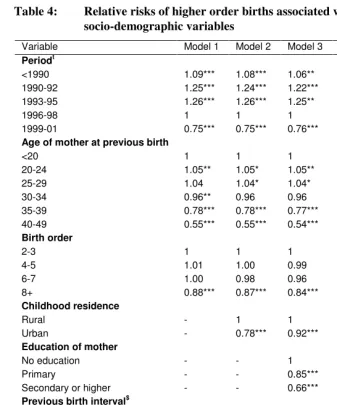
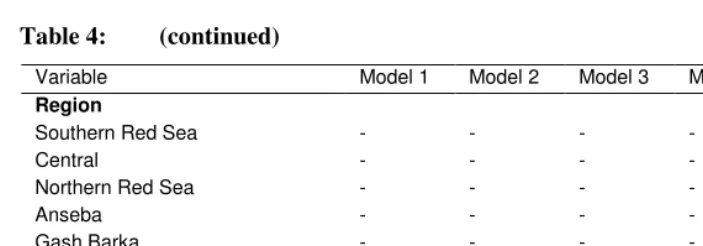
Table 4 displays the results from the multivariate analyses of second and higher order births. Unlike with first birth fertility, this table shows that all relative risks before the reference period are significantly above unity, and the decline has started sometime between 1996 and 1998, that is, before the conflict. This may suggest that women started to postpone or limit childbearing after they reach the desired number of children. Like with first births, the addition of other variables makes no significant difference on the period-fertility relationship. The results show that fertility is lower among women older than 35 years, but otherwise not much affected by age. The pattern by birth order also shows that, net of all the socio-demographic influences (Models 4 and 5), fertility is lower at the very high birth orders, but mostly not very strongly affected by birth order. The effects of rural-urban childhood residence and education of women is in the expected direction and statistically significant, where fertility is lower among women with some education and who lived in urban areas during childhood.
Table 3: Relative risks of first birth of married women associated with selected variables
Variable Model 1 Model 2 Model 3 Model 4
Periodt
<1990 0.57*** 0.61*** 0.62*** 0.62*** 1990-92 0.75*** 0.77*** 0.78*** 0.78*** 1993-95 0.85*** 0.86*** 0.87*** 0.87***
1996-98 1 1 1 1
1999-01 0.77*** 0.75*** 0.75*** 0.75***
Childhood residence
Rural 1 1 1 1
Urban 1.25*** 1.18*** 1.08 1.09
Age at 1st
marriage
<16 - 1 1 1
16-19 - 1.39*** 1.38*** 1.38***
20+ - 1.58*** 1.58*** 1.58***
Education of mother
No education - - 1 1
Primary - - 1.16*** 1.14***
Secondary or higher - - 1.20*** 1.19***
Region
Southern Red Sea - - - 1
Central - - - 1.00
Northern Red Sea - - - 1.01
Anseba - - - 1.07
Gash Barka - - - 0.93
South - - - 1.06
Change in degrees of freedom (∆df) Change in model statistic (∆χ2 statistic)
2 187.10
2 20.56
5 11.95
Table 4: Relative risks of higher order births associated with selected socio-demographic variables
Variable Model 1 Model 2 Model 3 Model 4 Model 5
Periodt
<1990 1.09*** 1.08*** 1.06** 1.03 1.03 1990-92 1.25*** 1.24*** 1.22*** 1.19*** 1.19*** 1993-95 1.26*** 1.26*** 1.25** 1.23*** 1.23**
1996-98 1 1 1 1 1
1999-01 0.75*** 0.75*** 0.76*** 0.77*** 0.77***
Age of mother at previous birth
<20 1 1 1 1 1
20-24 1.05** 1.05* 1.05** 1.10*** 1.10***
25-29 1.04 1.04* 1.04* 1.14*** 1.13***
30-34 0.96** 0.96 0.96 1.09*** 1.08**
35-39 0.78*** 0.78*** 0.77*** 0.91** 0.90** 40-49 0.55*** 0.55*** 0.54*** 0.65*** 0.64***
Birth order
2-3 1 1 1 1 1
4-5 1.01 1.00 0.99 0.94*** 0.94**
6-7 1.00 0.98 0.96 0.88*** 0.88***
8+ 0.88*** 0.87*** 0.84*** 0.76*** 0.77***
Childhood residence
Rural - 1 1 1 1
Urban - 0.78*** 0.92*** 0.92*** 0.92***
Education of mother
No education - - 1 1 1
Primary - - 0.85*** 0.85*** 0.85***
Secondary or higher - - 0.66*** 0.65*** 0.66***
Previous birth interval$
<18 - - - 1 1
18-23 - - - 0.94*** 0.94***
24-35 - - - 0.90*** 0.90***
36-47 - - - 0.79*** 0.79***
48+ - - - 0.72*** 0.72***
Survival of preceding birtht
Living 1 1
Table 4: (continued)
Variable Model 1 Model 2 Model 3 Model 4 Model 5
Region
Southern Red Sea - - - - 1
Central - - - - 0.93**
Northern Red Sea - - - - 0.94**
Anseba - - - - 1.02
Gash Barka - - - - 0.94**
South - - - - 0.99
Change in degrees of freedom (∆df) Change in model statistic(∆χ2 statistic)
1 96.12
2 131.58
5 214.85
5 21.41
*Factor level significant at <10% **significant at <5%
*** significant at <1% t Time varying covariate
$For second births the interval is from first marriage to first birth
Overall, it is evident from the multivariate models that fertility in Eritrea has declined in recent years and the onset of the decline seems to vary by birth order. While it is clear from Tables 2 and 3 that the decline in first birth fertility occurred after 1998, for second and higher order births, the decline did not follow 1998. It rather started prior to 1998, well before the conflict.
In the final model of Table 4, all possible interactions were also explored, and interactions of calendar period with birth order, age of mother at the birth of the previous child, and with region were found to be significant. Summaries of these interactions are presented in Tables 5, 6, and 7, respectively. Interactions that are not statistically significant are not shown. For instance, we run interactions of period with education and rural-urban residence to assess if the later factors have interacting effects on fertility in addition to their independent effects, but found no such effects. In our presentation of interaction results (Tables 5, 6, and 7), we have recalculated the relative risks of each combination of calendar period and the other variable of interest so that the risks for each category of birth order, age at previous birth, and region are given relative to that of 1996-98. This provides a more lucid overview of the period developments over the factors we consider.
relatively more affected in terms of population displacement, direct fighting, etc during the border conflict to have experienced lower fertility, no differential fertility response is observed in these regions. However, it is to be noted that region of residence is a potentially very problematic variable, since it is measured only at the time of the interview. The absence of information on migration histories during a period of much forced migration and displacement makes results of this variable to appear very tentative.
Table 5: Interaction effect of calendar period and birth order on fertility of 2nd and higher births: risks for period before 1996 & 1999-01 relative to the period 1996-98
Birth order
Period 2-3 4-5 6-7 8+
Before 1996 1996-98 1999-01 1.14 1 0.83 1.17 1 0.75 1.10 1 0.70 1.13 1 0.75 Change in degrees of freedom (∆df)
Change in model statistic (∆χ2 statistic)
p=0.000
6 14.50
Table 6: Interaction effect of calendar period and age of mother on fertility of 2nd and higher births: risks for the periods before 1996 & 1999-01 relative to the period 1996-98
Age of mother at birth of previous child
Period ≤19 20-24 25-29 30-34 35-39 40-49 Before 1996 1996-98 1999-01 1.17 1 0.92 1.12 1 0.78 1.09 1 0.72 1.16 1 0.78 1.31 1 0.69 1.80 1 0.59 Change in degrees of freedom (∆df)
Change in model statistic (∆χ2 statistic)
p=0.000
Table 7: Interaction effects of calendar period and region on fertility of 2nd and higher births: risks for period 1999-2002 relative to those of period before 1999
Region
Period Southern Red Sea
Central Northern Red Sea
Anseba Gash Barka South Before 1996 1996-98 1999-01 1.14 1 0.66 1.20 1 0.78 1.28 1 0.89 1.16 1 0.80 1.16 1 0.77 1.99 1 0.72
Change in degrees of freedom (∆df) Change in model statistic (∆χ2 statistic)
p=0.000
10 33.43
Note: In the interactions calendar period is collapsed into three categories
7. Discussion and conclusion
In this study, an attempt was made to examine the recent fertility decline in Eritrea, a setting that experienced a violent conflict and economic crisis in recent years. The purpose was to improve our understanding of the timing of the fertility decline and the underlying factors that contributed to it. It argues that looking solely at the changes in TFR is not adequate to give a clear picture and understanding of the nature and causes of the decline. This may lead to inappropriate policy options by failing to take into account the relative importance of the different factors that affect fertility.
initiating the first birth fertility decline. Second, our results from the interactions of calendar period with age of mother and with birth order clearly showed that although the decline occurs at all ages and at all birth orders, it is relatively stronger among older mothers (35 years or older) and higher order parities (4 or more). Such a pattern may suggest that many couples have purposely delayed or stopped childbearing after they achieved the desired number of children. This part of the fertility decline is likely to be a more long-term development. Third, if the conflict had been the sole factor responsible for the decline, a stronger decline could have been observed in the two regions which were most severely affected by the fighting. But, we did not find any significant regional differences in fertility trends; rather the decline occurred in all regions. Fourth, improvements in education and child survival and increased urbanization, which all pre-dated the conflict are likely to have had some impacts on fertility aspirations and consequently in the decline of fertility, although the mechanisms through which these factors have affected fertility are not clear from our study. Overall, the evidence of this study is that the decline in marital fertility is the main contributor to the overall fertility decline although a delay in age at first marriage and an increase in the proportion of never married women have played some role in the decline of births too. Part of the decline thus, appears to indicate the onset of a long-term fertility transition, which is likely to be related to improvements in access to healthcare services, education, and increased urbanization which pre-dated the conflict.
We are careful to point out that we do not find strong direct support for the role of socio-demographic factors in the fertility decline that we observe. This may partly be due to the cross-sectional character of much of our data, where we cannot keep proper track of changes over time in the composition of women over educational and employment histories, rural-urban residence, and other factors of importance.
reflects a long-term fertility transition which is further fuelled by a temporary impact of the border conflict and the economic crisis associated with it.
The findings of this study have methodological and theoretical implications. Methodologically, they highlight the importance of examining all parities and ages in a dynamic setup to the extent that data of that kind are available. Studies which do not explicitly focus on first and higher order births, on younger and older ages of women and survival status of preceding child and/or birth spacing are likely to miss important parts of the fertility dynamics and behaviours. Our findings have also implications for theories about fertility change in times of crises in that military conflict may affect certain social groups in the population and cause a short-term decline. The fact that the fertility response to the conflict seems to be important among first births implies that not all groups of the population may be uniformly affected by war crisis or exhibit the same fertility response. The results also imply that war crisis may fuel an ongoing decline, with an assumed subsequent recovery in peace time (Palloni et al., 1996). Note that the data used in this study do not allow any conclusion about the duration of the war-induced decline. These findings support the results from recent studies on fertility during crisis periods in Ethiopia (Lindstrom and Berhanu, 1999), Angola (Agadjania and Ndola, 2002), and Rwanda (Hill, 2004) which are also inconclusive in terms of consistent and sustainable changes in fertility.
(Balk, 1994; Caldwell and Caldwell, 1985; Morgan and Niraula, 1995). However, the amount of patriarchal control over women varies from place to place, could change over time and could be influenced by several other factors. In Eritrea, for instance, women fighters during the struggle for independence were active participants in the social, political and leadership of the liberation front. Such improvements in women’s participation might have affected the roles of women in Eritrea. It is likely that women have enjoyed some level of autonomy which avails them the opportunity to take independent decisions on certain issues of reproduction and fertility, but due to lack of timely information on the amount of progress gained in women’s individual autonomy we could not assess its effect on fertility.
Finally, given the present political and economic situation of the country, it seems difficult to predict the future course of fertility in Eritrea. However, on the basis of our findings of an emerging pattern of fertility limitation that was initiated before the outbreak of conflict it seems reasonable to assume that fertility in Eritrea will continue to decline gradually in the long-term perspective. The magnitude and nature of that decline is likely to depend on the socio-economic development and the political stability of the country. If the border conflict, which is still unresolved, continues or fighting resumes fertility may continue to be more depressed than what it otherwise would have been. This would be due to continued spousal separation and other fertility inhibiting influences of the conflict. Such an impact may or may not be followed by a temporary recovery of fertility by means of a short-term peace-time fertility boom. Our main prediction is nevertheless that the long-term development in Eritrea is set towards a reduced fertility.
8. Acknowledgements
References
Abbasi-Shavazi, M.J. (2001) “Recent changes and the future of fertility in Iran.” http://www.un.org/esa/population/publications/completingfertility/2RevisedAB BAS1paper.pdf
Agadjanian, V. and Ndola P. (2002) “War, peace, and fertility in Angola.”
Demography, 39(2): 215-231.
Andersson, G. (1999a). Trends in Childbearing and Nuptiality in Sweden: A Period
Analysis. Doctoral Dissertation, Stockholm University Demography Unit.
Andersson, G. (1999b). “Childbearing trends in Sweden, 1961-1997.” European Journal of Population, 15: 1-24.
Avogo, W. and Agadjanian, V. (2007). Reproduction in crisis: war, migration and fertility in Angola. A paper presented at the Population Association of America 2007 Annual Meeting Program. March 29-31, 2007, New York.
Balk, D. (1994) “Individual and community aspects of women’s status and fertility in rural Bangladesh.” Population Studies, 48(1): 21-45.
Basu, A. M. and Amin, S. (2000). “Conditioning factors for fertility decline in Bengal: History, language identity and openness to innovations.” Population and
Development Review, 26(4): 761-794
Blanc, A. K. 2004. “The role of conflict in the rapid fertility decline in Eritrea and prospects for the future.” Studies in Family Planning, 35(4): 236-245.
Blanc, A.K. and Rutenberg, N. (1990). Assessment of the qualitative of data at first sex, age at first marriage and age at first birth. Demographic and Health Surveys. In Assessment of DHS-I Data Quality. Institute for Resource Development. DHS Methodological Reports, no. 1. Columbia, Maryland.
Bongaarts, J. and Potter, R.G. (1983). Fertility, Biology and Behavior:An Analysis of
the Proximate Determinants. Academic Press. New York and London
Bongaarts, J. (1978). “A Framework for analyzing the proximate determinants of fertility.” Population and Development Review, 4(1): 105-132.
Boserup, E. (1985). “Economic and Demographic Interrelationships in sub-Sahara Africa.” Population and Development Review, 11(3): 383-397.
Bulatao, R. and Casterline, J. (eds.) (2001). Global Fertility Transition, Vol 27. Pp. 1-16. Population Council, New York.
Busza, J. and Lush, L. (1999). “Planning reproductive health in conflict: a conceptual framework.” Social Science and Medicine, 49(2): 155-171.
Caldwell, J.C. and Caldwell, P. (1985) “The cultural forces tending to sustain high fertility in tropical Africa,” Washington DC: World Bank, Population, Health and Nutrition Department, PNH Technical Note, 66pp.
CEPED (The French Center for Population and Development) (1998). “Crisis and Demographic Transition in Africa.” The CEPED NEWS, no. 2, pp. 1-5. Paris.
Chaudhury, R.H., Zaman, W. and Kari, Y. B. (2003). Impact of conflict on health including reproductive health in Nepal and Sri Lanka. Paper presented at the IUSSP Seminar on the Demography of Conflict and Violence, held in Oslo, Norway, 8-11 November 2003.
Cleland, J. (2001). “The effects of Improved survival on fertility: A reassessment.”
Population and Development Review, 27, Supplement: Global Fertility
Transition, Pp. 60-92.
Cleland, J. and Wilson, C. (1987). “Demand theories of the fertility decline: An iconoclastic view.” Population Studies, 41(1): 5-30.
Eloundou-Enyegue, P., Stokes, C.S., and Cornwell, G. T. (2000). “Are there crisis-led fertility declines? Evidence from central Cameroon.” Population Research and Policy Review, 19: 47-72.
Fargues, P. (2000). “Protracted national conflict and fertility change: Palestinians and Israelis in the twentieth century.” Population and Development Review, 26(3): 441-481.
Freedman, R., Xiao, X., Bohua, L., and Lavely, W.R. (1988). “Education and fertility in two Chinese provinces: 1967-70 to 1979-82.” Asia Pacific Population Journal,
3(1): 3-29.
Hill, K. (2004). “War, Humanitarian crisis, population displacement and fertility: A review of evidence”: In Roundtable on the demography of forced migration. New York: Mailman School of Public Health Columbia University.
Hinde, P. A. and Mturi, A. J. (2000). “Recent trends in Tanzanian Fertility.” Population Studies, 54: 177-191.
Hindin, M.J. (2000). “Women’s autonomy, women’s status and fertility-related behavior in Zimbabwe.” Population Research and Policy Review, 19(3): 255-283.
Hoem, J.M. (1991). “La standardisation indirecte améliorée et son application à la di-vortialité en Suède (1971-1989).” Population, 46: 1551-1568.
Hoem, J.M. (1993). “Classical demographic methods of analysis and modern event-history techniques.” IUSSP: 22nd International Population Conference,
Montreal, Canada, Volume 3: 281-291.
Holck, S.E. and Cates W. (1982). “Fertility and Population Dynamics in two Kampuchean Refugee Camps.” Studies in Family Planning, 13(4): 118-124.
Innocent, N. (2001). Socio-economic factors associated with pre-marital childbearing and adolescents’ age at first motherhood. Paper presented at the XXIV IUSSP General Population Conference, 18-24 August 2001. Salvador, Brazil.
Institute for Resource Development (IRD). 1990. An Assessment of DHS-I Data Quality. DHS Methodological Reports, No.1. Columbia, Maryland: IRD/Macro Systems, Inc.
Khlat, M., Deeb M., and Courbage, Y. 1997. “Fertility levels and differentials in Beirut during wartime: An indirect estimation based on maternity registers.”
Population Studies, 51(1): 85-92.
Knodel, J. and Pitaktepsombati, P. (1973). “Thailand: Fertility and Family Planning among rural and urban women.” Studies in Family Planning, 4(9): 229-255.
Lee, R.D. (1997). Population dynamics: Equilibrium, disequilibrium, and consequences of fluctuations. Handbook of Population and Family Economics. Vol. 1B, edited by Rosenzweig M.R. and Stark O. Amsterdam: Elsevier Science B.V.
Lindstrom, D. P. and Berhanu, B. (1999). “The impact of war, famine, and economic decline on marital fertility in Ethiopia.” Demography, 36(2): 247-261.
Lindstrom, D.P. and Kiros, G. (2007). “The impact of infant and child death on subsequent fertility in Ethiopia.” Population Research and Policy Review, 26(1): 31-49.
Luther, N.Y. and Pejaranonda, C. (1991). “The parity structure of fertility decline in Thailand, 1953-1979.” Genus, XLVII (1-2): 63-88.
Martin, T. and Juarez, F. (1995). “The impact of women’s education on fertility in Latin America: Search for explanation.” International Family Planning Perspective,
21(2): 52-57.
Martin, T. (1995). “Women’s education and fertility: Results from 26 Demographic and Health Surveys.” Studies in Family Planning, 26(4): 187-202.
Marwan, K., Pedersen, J.M., and Randall, S. (2003). The intifada, Palestinian fertility and education. Paper presented at the IUSSP seminar on the Demography of conflict and violence, held in Oslo, Norway, 8-11 November 2003.
Mason, K.O. (1993): “The impact of women’s position on demographic changes during the course of development”, in Federici N, Mason K.O. and Sogner S. (eds.),
Women’s Position and Demographic Change, Oxford, Clarendon Press, 19-42.
McGinn, T. (2000). “Reproductive health of war-affected populations: what do we know?” International Family Planning Perspectives, 26(4): 174-180.
Ministry of Education (2002). Eritrea:Essential Education Indicators 2001/02, pp. 1-39. Ministry of Education. Asmara, Eritrea.
Montgomery, M. R. and Casterline, J.B. 1998. Social networks and the diffusion of fertility control, Policy Research Division Working Paper no. 119. New York: Population Council.
Morgan, N. and Niraula, B. (1995) “Gender inequality and fertility in two Nepali villages.” Population and Development Review,21(3): 541-561.
Nair, S.N. (1996). “Determinants of birth intervals in Kerala: An application of Cox’s hazard model.” Genus, LII(3-4): 47-65.
NSEO (National Statistics and Evaluation Office) and ORC Macro (2003). Eritrea
Demographic and Health Survey 2002. Calverton, Maryland, USA.
NSEO (National Statistics and Evaluation Office) and ORC Macro (1997). Eritrea
Njogu, W. and Martin, T. C. (1991). Fertility decline in Kenya: The role of training and spacing of births, in IRD/Macro International, Inc. 1991, Proceedings of the
Demographic and Health Surveys World ConferenceVol. III. Washington, D.C.
1991, Columbia, Maryland.
Palloni, A., Hill, K., and Pinto Aguirre, G. (1996). “Economic Swings and Demographic Changes in the History of Latin America.” Population Studies,
50(1): 105-132.
Park, C. B., Ataharul, M., Chakraborty, N. and Kantner, A. (1998). “Partitioning the effect of infant and child death on subsequent fertility: An exploration in Bangladesh.” Population Studies, 52(3): 345-356.
Peng, X.. (1987). “Demographic consequences of the Great leap forward in China’s Provinces.” Population and Development Review, 13: 639-670.
Rodriguez, G., Hobcraft, T., McDonald, J., Menken J., and Trussell, J. (1984). A comparative analysis of determinants of birth intervals. WFS Comparative Studies, 30. Voorburg, Netherlands: International Statistical Institute.
Rutenberg, N. and Diamond, I. (1993). “Fertility in Botswana: The recent decline and future prospects.” Demography, 30(2): 143-157.
Santow, G. and Bracher, M.D. (1984). “Child death and time to the next birth in Central Java.” Population Studies, 38(2), 241-253.
Sathar, Z., Crook, N., Callum, C., and Kazi, S. (1988). “Women’s status and fertility change in Pakistan.” Population and Development Review, 14(3): 415-432.
UN (1987). “Fertility Behaviour in the context of development: Evidence from the World Fertility Survey.” Population Studies, 100 ST/ESA/SERA/100.
UN (2002). United Nations Development Assistance Framework (UNDAF) (2002-2006). Asmara, Eritrea
Watkins, S. and Menken, J. (1985). “Famines in historical perspective.” Population and
Development Review, 11(4): 647-675.
Yang, Q. (1990). “Age at first marriage and fertility in rural Anhui, china.” Journal of Biosocial Science, 22(2): 143-157.
Annex
Table 8: List of variables used in the analysis of fertility together with the percentage distribution of births in each category
Percentage in Category
Variable First births Higher order births
Calendar period
<1990 38.5 29.8
1990-92 14.3 15.6
1993-95 18.7 19.2
1996-98 15.6 19.0
1999-01 12.9 16.4
Age of mother at previous birth
<20 47.2 15.6
20-24 36.0 30.3
25-29 12.9 26.9
30-34 3.1 18.1
35-39 0.6 7.4
40-49 0.1 1.7
Birth order
2-3 - 47.0
4-5 - 29.6
6-7 - 15.5
8+ - 7.9
Previous birth interval
<18 - 22.7
18-23 - 18.0
24-35 - 31.1
36-47 - 13.2
48+ - 15.0
Survival of preceding child
Alive - 92.6
Dead - 7.4
Age at 1st
marriage
<16 35.3 39.8
16-19 36.4 34.3
Table 8: (continued)
Percentage in Category
Variable First births Higher order births
Childhood residence
Rural 79.0 90.6
Urban 21.0 9.4
Mother’s education
No education 70.0 80.1
Primary 20.9 15.7
Secondary and higher 9.1 4.2
Region
Southern Red Sea 17.1 16.2
Central 12.5 10.6
Northern Red Sea 17.0 17.4
Anseba 16.9 18.1
Gash Barka 16.8 17.0
Southern 19.7 20.8