in the population sciences published by the Max Planck Institute for Demographic Research Konrad-Zuse Str. 1, D-18057 Rostock · GERMANY www.demographic-research.org
DEMOGRAPHIC RESEARCH
VOLUME 17, ARTICLE 27, PAGES 803-820
PUBLISHED 20 DECEMBER 2007
http://www.demographic-research.org/Volumes/Vol17/27/ DOI: 10.4054/DemRes.2007.17.27
Research Article
Migration and union dissolution in a changing
socio-economic context: The case of Russia
Magdalena Muszynska
Hill Kulu
Special Collection 6: Interdependencies in the Life Course, edited by Hill Kulu and Nadja Milewski.
© 2007 Muszynska & Kulu
This open-access work is published under the terms of the Creative Commons Attribution NonCommercial License 2.0 Germany, which permits use, reproduction & distribution in any medium for non-commercial purposes, provided the original author(s) and source are given credit.
1 Introduction 804
2 Migration and union dissolution – theoretical considerations 804
3 Data and methods 807
3.1 Data 807
3.2 Models 810
4 Results 810
4.1 The effect of migration and the place of residence 810 4.2 The effects of other variables 814
5 Summary and discussion 815
6 Acknowledgements 816
Migration and union dissolution in a
changing socio-economic context:
The case of Russia
Magdalena Muszynska1 Hill Kulu2
Abstract
Previous studies show that family migration is usually to the benefit of the man’s professional career and that it has a negative impact on the woman’s economic well-being and employment. This study extends previous research by examining the effect of family migration on union dissolution. We use the event-history data of two retrospective surveys from Russia and apply hazard regression. The analysis shows that couples who move frequently over long distances have a significantly higher risk of union dissolution than couples who do not move or move only once. Our further analysis reveals that the risk of disruption for frequent movers is high when the migrant woman has a job. Frequent migrants had a high risk of union dissolution during the Soviet period but they faced no such risk during the post-Soviet socio-economic transition. We argue that frequent moving increases union instability through a variety of mechanisms, the effect of which may vary across socio-economic contexts.
1 Duke Population Research Institute & Population, Policy, and Aging Research Center, Terry Sanford
Institute of Public Policy, Duke University, 188 Rubenstein Hall, Durham, NC 27708, USA. E-mail: [email protected]
2 Max Planck Institute for Demographic Research, Konrad-Zuse-Straße 1, 18057 Rostock, Germany.
1. Introduction
Previous studies show that family migration is usually to the benefit of the career of the male earner in the household and that family migration has a negative impact on the professional career and earnings of the women. Migrant women are less likely to be employed and they tend to have smaller incomes and work shorter hours than non-migrant women of similar characteristics (Sandell 1977, Mincer 1978, Cooke and Bailey 1999, Boyle et al. 1999, 2001, 2003, 2006, Cooke 2001, Clark and Davies Withers 2002). If women’s economic well-being suffers from family migration, one would expect that family migration also exerts a negative influence on the quality of the relationship between the partners, and hence raises the propensity of union disruption. In their recent study, Boyle et al. (2006) show that family migration indeed raises union instability: Couples who move frequently have a significantly higher risk of union dissolution compared to non-moving ones or couples who move only once. The present study follows this research direction and examines the effect of migration on union dissolution among married and cohabiting couples in Russia.
Russia is an interesting case for two reasons. The level of divorce in Russia is among the highest in Europe (Council of Europe 2004), but it has been rarely examined and poorly understood. Most previous studies have been based on aggregated data (e.g., Andreev and Scherbov 1996, Avdeev and Monnier 2000, Becker and Hemley 1998, Mazur 1969); research based on individual level data has been conducted only recently (Scherbov and van Vianen 2001, 2004). Another reason is that Russia’s recent history allows us to distinguish between two periods of different socio-economic contexts: of the planned economy and of transition to the market economy. While most research focuses on the consequences of family migration in the context of the Western market economy, we study whether or not patterns similar to the ones found in these studies also exist in Russia, i.e., a former socialist country that has experienced significant socio-economic and institutional changes in the past two decades.
2. Migration and union dissolution – theoretical considerations
Family migration is expected to increase the propensity of union dissolution due to the following reasons (Boyle et al. 2006). First, previous studies show that women’s economic well-being and employment suffer from family migration, which is usually
stimulated by the man’s professional career (Boyle et al. 2003). Women’s employment
Withers 2002). This non-symmetrical gain and loss from family migration possibly exerts a negative influence on the quality of the relationship between the partners. A tied migrant might experience personal loss that is unexpectedly high when moving with a partner, and she may consider separating from him when an opportunity to do so opens up, i.e., when she can afford to maintain a separate household (Mincer 1978, Boyle et al. 2006).
Second, moving to a new place also leads to changing social networks. Social networks at the old place of residence might have constrained divorce, particularly the social networks shared by both partners, where kin relations play a major role (Boyle et al. 2006). This disruption entails the loss of a source of psychological and social support. As a result, migration may overload a couple, with one of the partners expecting from the other to fill in in terms of the psychological and social functions fulfilled previously by the members of the former networks (Sluzki 1998). The additional burden may increase union instability.
Third, changing the place of residence is stressful and this may precipitate divorce. This applies in particular to frequent movers (Boyle et al. 2006). A change of residence requires significant changes to a person’s routines, roles, and identities, all of which are a major source of stress, and particularly so if it happens again and again. Similarly, the moving process in itself is stressful, particularly for families with children, who additionally have to organise child care and other child-centred activities.
Finally, the marriage market changes as the place of residence changes. New potential partners become available; these are likely to be partners with whom the mover is in contact with in everyday life, thus placing additional strains on the current relationship (South and Spitze 1986, Boyle et al. 2006).
There are reasons to believe that the effect of migration depends on the settlements of origin and destination. Migration from rural to urban areas entails a move to an environment where more liberal views dominate and divorce is less stigmatised (Boyle
et al. 2006). Further, cities offer greater opportunities for a woman to find a job and maintain a separate household. Finally, as the marriage market in urban areas is larger, there is also a higher chance to find a better match there (South and Spitze 1986, Boyle
et al. 2006). Couples who move from a rural to an urban area should thus have a considerably higher risk of union dissolution than those staying in a rural area, because of the effect of both the migration and the destination context.
migration from urban to rural areas to decrease the risk of union dissolution – urban-to-rural migrants should exhibit the disruption levels similar to those of urban-to-rural stayers.
3. Data and methods
3.1 Data
Our study is based on data stemming from two surveys. The first, the Generations and Gender Survey (GGS), was conducted in Russia between June and August 2004 (for the
description of the GGS Programme, see Vikat et al. 2007). The questionnaire included
detailed partnership and fertility histories. The survey is based on a multistage probability sample of dwelling units (for a description of the sample, see Kosolapov 2004). As a result, 4223 Russian men and 7038 women between the ages of 18 and 79 were interviewed. Out of 7038 interviewed women, 5579 had ever been in union.
The second survey, the Education and Employment Survey (EES), was conducted in November 2005. Detailed information was collected on the employment, educational, and migration histories of the Russian population. The sample for the survey consists of GGS Survey respondents. After matching the GGS with the EES data files, there were 3074 women who had ever been in union.
The study subject was union, with the woman as the marker. Women were treated as being in union based on co-residence (and an intimate relationship) with a male partner for more than three months; co-residence with the same partner more than once was treated as two different unions.
As the union formation and dissolution patterns might differ across ethnic groups, we studied only the unions of women with a Russian, Belarusian, or Ukrainian ethnicity. We thus excluded 255 women who belonged to other ethnic groups. We also excluded women who provided incomplete data (e.g., a different year of birth in the two surveys or who misreported the date of union formation), thus leaving 2803 women in our final sample. Our data includes 2803 first unions (907 dissolutions), 597 second unions (203 dissolutions), and 78 third unions (30 dissolutions). The study period is 1967–2004. The year 1967 was the earliest year a union had been formed by our respondents.
based on co-residence. We also checked whether or not the risk of union dissolution was stable right after migration – there was no evidence of a high risk in the few months following migration, suggesting that our definition and data set-up is reasonable to distinguish moves that lead to separation from the moves that followed separations.
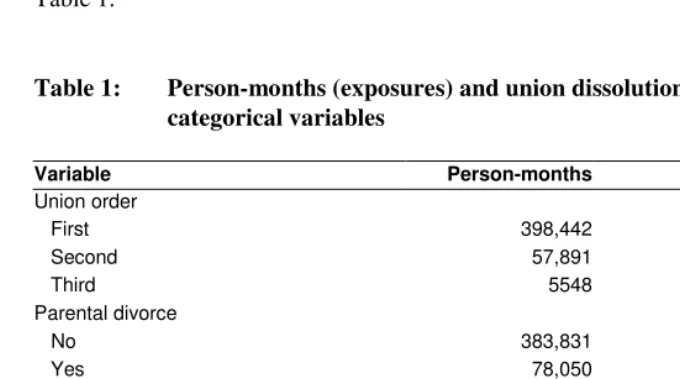
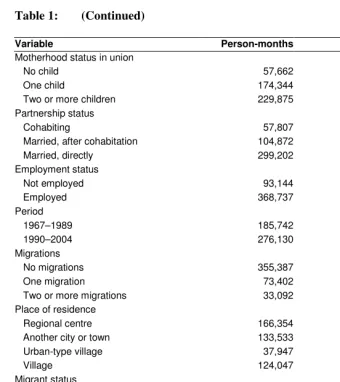
Additional demographic and socio-economic variables were included in the analysis to control for the compositional differences between migrant and non-migrant couples. We included the following time-varying variables: union duration, age, educational level (in education, primary, secondary, higher), motherhood status in union (no child, one child, two or more children), partnership status (cohabiting; married, after cohabitation; married, directly), employment status (not employed or employed), and calendar period (1967–1989 or 1990–2004). The time-constant variables included in the analysis were: union order (first, second, third), parental divorce (divorced or not divorced), motherhood status at union formation (childless or mother). The distribution of risk-months and number of dissolutions across categorical variables is presented in Table 1.
Table 1: Person-months (exposures) and union dissolutions (occurrences) by categorical variables
Variable Person-months Union dissolutions
Union order
First 398,442 907
Second 57,891 203
Third 5548 30
Parental divorce
No 383,831 874
Yes 78,050 266
Educational level
In education 159,766 427
Primary 40,910 98
Secondary 237,779 557
Higher 23,426 58
Motherhood status at union formation
Childless 61,689 198
Table 1: (Continued)
Variable Person-months Union dissolutions
Motherhood status in union
No child 57,662 393
One child 174,344 590
Two or more children 229,875 157
Partnership status
Cohabiting 57,807 320
Married, after cohabitation 104,872 286
Married, directly 299,202 534
Employment status
Not employed 93,144 260
Employed 368,737 880
Period
1967–1989 185,742 396
1990–2004 276,130 744
Migrations
No migrations 355,387 926
One migration 73,402 139
Two or more migrations 33,092 75
Place of residence
Regional centre 166,354 549
Another city or town 133,533 344
Urban-type village 37,947 63
Village 124,047 184
Migrant status
Non-migrants in urban areas 151,023 487
Non-migrants in rural areas 33,399 65
Urban–urban migrants 92,609 260
Urban–rural migrants 81,961 110
Rural–urban migrants 56,255 146
Rural–rural migrants 46,634 72
Total 461,881 1140
3.2 Models
We studied the dissolution of marital and non-marital unions. We considered the date at which the respondent reported the co-residence ended as the moment of separation. The observation was censored if the partner had died. We modelled time since union formation to separation, using hazard regression models (Hoem 1987, 1993, 2001, Blossfeld and Rohwer 2002). The basic model can be specified as follows:
∑
+ +∑
+∑
+
= k k ijk l l ijl m m ijm
ij(t) y(t) z (u t) x w (t)
lnµ α β , (1)
where µij(t) denotes the hazard of the jth union dissolution for individual i and y(t) represents a piecewise linear spline that captures the impact of the baseline (i.e., union) duration on the hazard3. Parameter zk(uijk + t) denotes the spline representation of the effect of a time-varying variable that is a continuous function of t with origin uijk (e.g., a woman’s age). Parameter xijl represents the values of a time-constant variable (e.g., parental divorce) and wijm(t) denotes a time-varying variable whose values can change only at discrete times (e.g., migration status or place of residence).
4. Results
4.1 The effect of migration and the place of residence
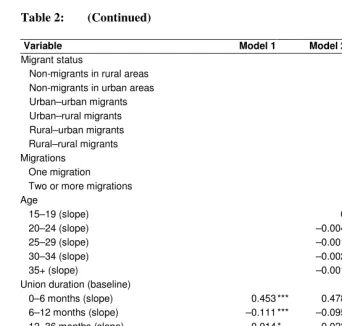
Model 1 (see Table 2) shows that first migration does not change the risk of union dissolution, whereas changing the settlement of residence twice or more within a union increases the hazard of union disruption by 31% compared to non-moving couples. We also see that couples living in urban areas are more likely to experience union dissolution than those who live in rural settlements. Model 2 controls for the socio-demographic characteristics of a woman. The effect of migration and the settlement of residence do not change much: Frequent movers and couples living in urban areas have a significantly higher risk of union dissolution. Similar results were obtained when only inter-settlement moves over 50 km were included in the model.
3 We used a piecewise linear spline specification (instead of the widely used piecewise constant approach) to
Table 2: Relative risks of union dissolution by categorical variables and slope estimates of log-hazard for age and union duration
Variable Model 1 Model 2 Model 3
Union order
First 1 1
Second or third 1.23 * 1.23 *
Parental divorce
No 1 1
Yes 1.28 *** 1.29 ***
Educational level
In education 1.05 1.07
Primary 1 1
Secondary 1.03 1.04
Higher 1.14 1.18
Motherhood status at union formation
Childless 1 1
Mother 0.77 ** 0.77 **
Motherhood status in union
No child 1 1
One child 0.86 * 0.86
Two or more children 0.42 *** 0.42 ***
Partnership status
Cohabiting 2.21 *** 2.22 ***
Married, after cohabitation 1.27 *** 1.28 ***
Married, directly 1 1
Employment status
Not employed 1 1
Employed 1.06 1.05
Period
1967–1989 1 1 1
1990–2004 1.55 *** 1.32 *** 1.33 ***
Migrations
No migrations 1 1
One migration 1.01 1.06
Two or more migrations 1.31 ** 1.37 ***
Place of residence
Regional centre 1.24 *** 1.15 **
Another city or town 1 1
Urban-type village 0.67 *** 0.68 ***
Table 2: (Continued)
Variable Model 1 Model 2 Model 3
Migrant status
Non-migrants in rural areas 1
Non-migrants in urban areas 1.71 ***
Urban–urban migrants 1.72 ***
Urban–rural migrants 0.96
Rural–urban migrants 1.88 ***
Rural–rural migrants 1.29
Migrations
One migration 1
Two or more migrations 1.26 *
Age
15–19 (slope) 0 0
20–24 (slope) –0.004 –0.005
25–29 (slope) –0.001 –0.001
30–34 (slope) –0.002 –0.002
35+ (slope) –0.001 –0.001
Union duration (baseline)
0–6 months (slope) 0.453 *** 0.478 *** 0.477 *** 6–12 months (slope) –0.111 *** –0.095 *** –0.095 *** 12–36 months (slope) 0.014 * 0.023 *** 0.023 ** 36–48 months (slope) –0.029 * –0.021 –0.021 48–60 months (slope) 0.006 0.013 0.013 60–72 months (slope) –0.038 ** –0.025 * –0.025 72+ months (slope) –0.002 *** 0.002 0.002
Constant –8.059 *** –8.376 *** –8.807 ***
Log-likelihood –7193.0 –7080.2 –7081.4
Model 3 includes the origin and destination of migration. Couples who move between urban areas or rural settlements for the first time have a similar risk of separation as non-moving couples in urban or rural areas, correspondingly. Those who move from rural to urban areas exhibit disruption levels similar to non-migrants living in cities, while couples who move from urban to rural areas display dissolution levels close to non-movers in rural areas. Thus, the disruption levels of first-time migrants are similar to the levels of non-migrants at destination. Moving twice or more increases the risk of union dissolution, whatever the origin and destination of migration (the effects are proportional).
To gain a deeper understanding of the causes of union dissolution of migrant couples, we examined whether or not the effect of family migration depends on a woman’s employment status after the move. When the employment status of a woman was included in the models, there was no difference between women who are employed and those who are not (see Table 2, Models 2 and 3). However, the effect of employment on union dissolution turns out to be significant for frequent migrants. For non-migrants and first-time migrants alike, the risk of union dissolution is similar when a woman works or does not do so, whereas the situation changes after the second migration (see Table 3). The risk of union dissolution is very high when a woman is employed, but relatively low when she is unemployed or inactive after the move.
Table 3: Relative risks of union dissolution by number of migrations and employment status
Employment status No migrations One migration Two or more migrations
Not employed 1 1.11 0.96
Employed 1.04 1.09 1.52***
Source: Calculations based on the Russian GGS and EES. Significance: '*'=10%, '**'=5%, '***'=1%.
Note: Controlled for union order, parental divorce, educational level, motherhood status at union formation, motherhood status in union, partnership status, period, place of residence.
migration on the risk of union dissolution thus depends on the socio-economic context of the movers.
Table 4: Relative risks of union disruption by number of migrations and period
Period No migrations One migration Two or more migrations
1967–1989 1 0.87 1.53**
1990–2004 1.33 ** 1.33 ** 1.46**
Source: Calculations based on the Russian GGS and EES. Significance: '*'=10%, '**'=5%, '***'=1%.
Note: Controlled for union order, parental divorce, educational level, motherhood status at union formation, motherhood status in union, partnership status, employment status, place of residence.
4.2 The effects of other variables
5. Summary and discussion
This study examined the effect of family migration on union dissolution in Russia. We used event-history data from two retrospective surveys and applied hazard regression. The analysis showed that couples who move frequently over long distances have a significantly higher risk of union dissolution than couples who do not move or who move only once. Our further analysis revealed that the risk of disruption for frequent movers is high when a woman has a paid job, and that frequent migrants had a high risk of union dissolution during the Soviet period, but not in the post-Soviet period. We also found that dissolution levels in urban areas are much higher than in rural areas, and that migrants exhibit disruption levels similar to non-migrants at destination.
We believe that while several factors account for the elevated risk of disruption among frequent migrants, economic and psychological factors play a decisive role. Family migration is usually to the benefit of the migrant man’s career and has a negative impact on the woman’s economic well-being (Cooke and Bailey 1999, Boyle
et al. 2001). Therefore, when moving over long distances, many partnered women consciously or unconsciously subject themselves to traditional gender roles and sacrifice their professional career for the sake of the family’s well-being. The costs that result from repeating this adjustment several times may turn out to be too high, however, and eventually women leave a union that has become unsatisfactory after a sequence of moves. The fact that frequent migrants have a particularly high risk of union dissolution when the woman has a job is consistent with the arguments suggesting that women leave an unsatisfactory relationship when they find work in a new place and are thus able to maintain a separate household. Anticipation of union dissolution, of course, may accelerate a woman’s return to the labour market.
actual risk of union dissolution or not may thus depend much on whether or not and how easily women find paid jobs in a particular socio-economic context.
The higher risk of union dissolution in urban areas is as expected. An environment that is more liberal in the cities, greater employment opportunities there, and higher chances to find a better match are the factors that account for urban-rural differences in the disruption levels. The fact that migrants exhibit dissolution levels similar to those of non-migrants at destination is not surprising, either. This suggests that migrants adapt to the socio-economic and cultural environment at destination, although selectivity may also play a role, particularly for urban-to-rural migrants. Moves to rural areas are usually made at a family stage at which union stability is high or mostly by couples who accord higher priority to the family than to professional career (Boyle et al. 2006, Kulu 2007).
The results of our study on Russia are thus consistent with the findings of the previous study by Boyle et al. (2006) on Austria, suggesting that there are more general factors that increase the risk of union dissolution for frequent migrants. However, we observed some variation over historical time (across contexts) and this suggests that further research may benefit from cross-national comparisons of the effect of migration on union dissolution. Another important issue to consider is the role of unobserved migrant selectivity: Disruption-prone people may be over-represented among frequent
movers. However, Boyle et al. (2006) modelled union dissolution and migration jointly,
showing that the disruption patterns remained similar even when unmeasured characteristics of migrants were controlled for. Another extension would be the inclusion of the partner’s characteristics, which would allow us to gain further insights into the nature and consequences of family migration. In addition, the union dissolution patterns of frequent migrants need further examination by origin and destination of migration. Our current study showed elevated risks of union disruption for frequent migrants whatever their origin and destination, but the sample was too small to explore the patterns in detail.
6. Acknowledgements
References
Andreev, E., and S. Scherbov. 1996. Demographic Atlas of Russia. Unpublished
manuscript.
Avdeev, A., and A. Monnier. 2000. Marriage in Russia: a complex phenomenon poorly understood, Population: An English Selection 12: 7–50.
Becker, C. M., and D. D. Hemley. 1998. Demographic change in the former Soviet
Union during the transition period, World Development 26: 1957–1975.
Becker, G. S. 1993. A Treatise on the Family. Cambridge: Harvard University Press.
Becker, G. S., E. M. Landes, and R. T. Michael. 1977. An economic analysis of marital instability, Journal of Political Economy 85: 1141–1187.
Blossfeld, H.-P., and G. Rohwer. 2002. Techniques of Event History Modeling: New Approaches to Causal Analysis. Second edition. Mahway: Lawrence Erlbaum Associates.
Boyle P. J., T. J. Cooke, K. Halfacree, and D. Smith. 1999. Gender inequality in employment status following family migration in GB and the US: the effect of relative occupational status, International Journal of Sociology and Social Policy 19: 115–150.
Boyle, P. J., T. J. Cooke, K. Halfacree, and D. Smith. 2001. A cross-national comparison of the impact of family migration on women’s employment status,
Demography 38: 201–213.
Boyle, P. J., T. J. Cooke, K. Halfacree, and D. Smith. 2003. The effect of long-distance family migration and motherhood on partnered women’s labour market activity
rates in GB and the US, Environment and Planning A 35: 2097–2114.
Boyle, P. J., H. Kulu, T. Cooke, V. Gayle, and C. H. Mulder. 2006. The effect of moving
on union dissolution. MPIDR Working Paper, WP–2006–002. Rostock: Max Planck Institute for Demographic Research. http://www.demogr.mpg.de/ papers/working/wp-2006-002.pdf.
Boyle, P. J., and H. Kulu. 2006. Does cohabitation prior to marriage raise the risk of
marital dissolution and does this effect vary geographically? MPIDR Working Paper, WP–2006–051. Rostock: Max Planck Institute for Demographic
Research. http://www.demogr.mpg.de/papers/working/wp-2006-051.pdf.
Clark, W. A. V., and S. Davies Withers. 2002. Disentangling the interaction of
migration, mobility, and labor-force participation, Environment and Planning A
34: 923–945.
Cooke, T. J. 2001. ‘Trailing wife’ or ‘trailing mother’? Family migration, life course
events, and the labor market participation of married women, Environment and
Planning A 33: 419–430.
Cooke, T. J. 2003. Family migration and the relative earnings of husbands and wives,
Annals of the Association of American Geographers 93: 338–349.
Cooke, T. J., and A. J. Bailey. 1999. The effects of family migration, migration history, and self-selection on married women’s labor market achievement, in P. J. Boyle
and K. Halfacree (Eds.), Migration and Gender in the Developed World.
London: Routledge, pp. 102–113.
Council of Europe. 2004. Recent Demographic Developments in Europe 2004.
Strasbourg: Council of Europe.
Hoem, B., and J. M. Hoem. 1992. The disruption of marital and non-marital unions in contemporary Sweden, in J. Trussell, R. Hankinson and J. Tilton (Eds.),
Demographic Applications of Event History Analysis. Oxford: Clarendon Press, pp. 61–93.
Hoem, J. M. 1987. Statistical analysis of a multiplicative model and its application to the standardization of vital rates: a review, International Statistical Review 55: 119–152.
Hoem, J. M. 1993. Classical demographic models of analysis and modern event-history
techniques, IUSSP: 22nd International Population Conference, Montreal,
Canada, Volume 3, pp. 281–291.
Hoem, J. M. 1997. Educational gradient in divorce risks in Sweden in recent decades,
Population Studies 51: 19–27.
Hoem, J. M. 2001. Demographic analysis, a probabilistic approach to, in N. J. Smelser
and P. B. Baltes (Eds.), International Encyclopaedia of the Social and
Behavioral Sciences. Vol. 14. Oxford: Elsevier, pp. 3428–3432.
Kosolapov, M. 2004. Preliminary Report: Sample of the Russian Federation. Moscow:
Demoscope.
Kulu, H. 2003. Residence and migration in post-war Soviet Estonia: the case of
Russian-born Estonians, TESG: Journal of Economic and Social Geography
Kulu, H. 2004. Determinants of residence and migration in the Soviet Union after
World War 2: the immigrant population in Estonia, Environment and Planning A
36(2): 305–325.
Kulu, H. 2007. Fertility and spatial mobility in the life-course: evidence from Austria,
Environment and Planning A (advanced online publication).
Lehrer, E. L. 2003. The economics of divorce, in S. A. Grossbard-Shechtman (Ed.),
Marriage and the Economy: Theory and Evidence from Advanced Industrial Societies. Cambridge: Cambridge University Press, pp. 55–74.
Mazur, D. P. 1969. Correlates of divorce in the U.S.S.R., Demography 6: 279–286.
Mincer, J. 1978. Family migration decisions, The Journal of Political Economy 86: 749–773.
Muszynska, M. 2006. Woman’s employment and union disruption in a changing
socio-economic context: the case of Russia. MPIDR Working Paper, WP–2006–027.
Rostock: Max Planck Institute for Demographic Research.
http://www.demogr.mpg.de/papers/working/wp-2006-027.pdf.
Sandell, S. E. 1977. Women and economics of family migration, The Review of
Economics and Statistics 59: 406–414.
Sayer, L. C., and S. M. Bianchi. 2000. Women’s economic independence and the probability of divorce, Journal of Family Issues 21: 906–943.
Scherbov, S., and H. van Vianen. 2001. Marriage and fertility in Russia of women born
between 1900 and 1960: a cohort analysis, European Journal of Population 17:
281–294.
Scherbov, S., and H. van Vianen. 2004. Marriage in Russia: a reconstruction,
Demographic Research 10(2): 27–60. www.demographic-research.org/ Volumes/Vol10/2/default.htm
Shihadeh, E. S. 1991. The prevalence of husband-centred migration: employment consequences for married mothers, Journal of Marriage and the Family 53: 432–444.
Sjöberg, Ö. 1999. Shortage, priority and urban growth: towards a theory of urbanisation
under central planning, Urban Studies 36: 2217–2235.
Sluzki, C. E. 1998. Migration and the disruption of the social network, in M.
McGoldrick (Ed.), Re-Visioning Family Therapy: Race, Culture and Gender in
South, S. J., and G. Spitze. 1986. Determinants of divorce over the marital life course,
American Sociological Review 51: 583–590.
Tammaru, T. 2000. Differential urbanisation and primate city growth in Soviet and post-Soviet Estonia, TESG: Journal of Economic and Social Geography 91: 20–30.
Vikat, A., Z. Speder, G. Beets, F. Billari, C. Buhler, A. Desesquelles, T. Fokkema, J. M. Hoem, A. MacDonald, G. Neyer, A. Pailhe, A. Pinnelli, and A. Solaz. 2005. Generations and Gender Survey (GGS): Towards a better understanding of relationships and processes in the life course, Demographic Research 17(14): 389–440. www.demographic-research.org/Volumes/Vol17/14/default.htm.