DEMOGRAPHIC RESEARCH
VOLUME 37, ARTICLE 29, PAGES 917
,
928
PUBLISHED 6 OCTOBER 2017
http://www.demographic-research.org/Volumes/Vol37/29/ DOI: 10.4054/DemRes.2017.37.29
Descriptive Finding
Who becomes a grandparent – and when?
Educational differences in the chances and
timing of grandparenthood
Jan Skopek
Thomas Leopold
© 2017 Jan Skopek & Thomas Leopold.
This open-access work is published under the terms of the Creative Commons Attribution NonCommercial License 2.0 Germany, which permits use, reproduction, and distribution in any medium for noncommercial purposes, provided the original author(s) and source are given credit.
1 Introduction 918
2 Data and methods 918
3 Results 920
3.1 Education and the chance of grandparenthood 920
3.2 Education and the timing of grandparenthood 923
4 Discussion 924
Demographic Research: Volume 37, Article 29 Descriptive Finding
Who becomes a grandparent – and when? Educational differences in
the chances and timing of grandparenthood
Jan Skopek1
Thomas Leopold2
Abstract
BACKGROUND
Despite recent advances, the demographic understanding of grandparenthood remains limited.
OBJECTIVE
Our study examines educational differences in the transition to grandparenthood. Comparing East and West Germany, we analyze educational differences in a) the chance of becoming a grandparent, and b) the timing of grandparenthood for both men and women.
METHODS
We used fertility data across three family generations (German Ageing Survey,
N = 2,434 men and women born 1933‒1948) and methods of survival time analysis to study educational gradients in the transition to grandparenthood.
RESULTS
We found a strong educational gradient in the chances of grandparenthood among West German women: Lower-educated women’s chances of becoming a grandmother were similar to higher-educated women’s chances of becoming a mother.
CONCLUSIONS
Our findings have implications for research on multi-generational social mobility and on the consequences of grandparenthood.
CONTRIBUTION
Our study is the first to analyze how the transition to grandparenthood is socially stratified.
1. Introduction
Grandparent research usually takes grandparenthood as an exogenous factor – a phenomenon that is taken as given rather than as a process to be explored. This is reflected in common strategies of sample selection. Analysts restrict their studies to three-generational structures, selecting grandparents, their children, or their grandchildren as the starting point of the analysis (e.g., Chan and Boliver 2013; Chiang and Park 2015; Hank and Buber 2009; Modin, Erikson, and Vågerö 2012; Musil et al. 2011). As a result, the demographic understanding of transitions to grandparenthood remains limited.
A notable gap in the knowledge concerns socioeconomic differences in grandparenthood. Educational gradients in fertility (Kravdal and Rindfuss 2008) suggest that the experience of grandparenthood is stratified both in occurrence and timing. Differences may be particularly large in transitions to grandparenthood because they emerge as the combined outcome of fertility in successive family generations. Extant evidence on education and fertility suggests not only that higher-educated people become grandparents later in life, but also that they are less likely to experience the transition at all.
The present study explores the demographic linkages between education and the transition to grandparenthood. Understanding these linkages is relevant to different strands of current grandparent research, given that the chance of becoming a grandparent and the timing of this transition are important factors in determining the meaning, performance, and consequences of the grandparent role.
The German context presents an interesting setting in which to study educational differences in the transition to grandparenthood because the legacy of the East-West divide still offers sharp contrasts in various important aspects, including the timing and level of fertility, kinship structure, career trajectories, and gender differences.
2. Data and methods
Our analysis is based on data from the third wave of the German Ageing Survey (DEAS), a large-scale survey representative of older adults aged 40 to 85 living in private households in Germany (Engstler and Motel-Klingebiel 2010). In the third wave of the DEAS, comprehensive retrospective information about fertility and grandparenthood was collected. We restricted our analysis to data from the cross-sectional sample of 6,205 first-time respondents recruited in 2008.
Demographic Research: Volume 37, Article 29
lived in East or West Germany before reunification (birth cohorts 1933 to 1948; N = 2,434). An important difference is that we focused not only on parents in our analysis (i.e., those ‘at risk’ of grandparenthood) but also on childless persons.
The DEAS provides data on highest educational attainment coded according to the ISCED scheme. Because more differentiated educational categories means fewer cases in each, we dichotomized educational level into higher (tertiary level, ISCED 5–6) versus lower (non-tertiary, ISCED 1–4). This distinction captures meaningful differences for the purpose of our study: Higher education is strongly associated with the timing of childbearing, as parenthood is typically postponed until finishing education. This applied in both socialist East Germany and in West Germany, although family formation and education were more compatible in the East than in the West (Kreyenfeld 2004).
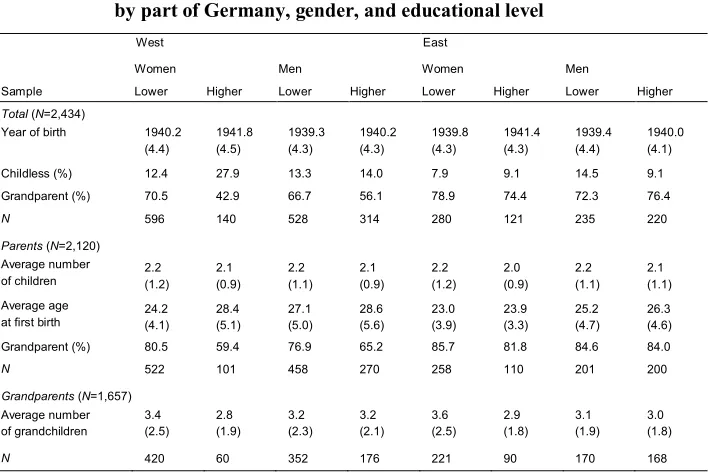
Table 1 provides a descriptive overview of our sample according to the different indicators of fertility. Data is shown separately by region of Germany (East or West), gender, and educational level (lower or higher). For the cohorts under study we observed higher levels of tertiary education for East Germans (about 10 percentage points higher for both men and women). Childlessness was more prevalent in West Germany, especially among higher-educated women: Almost 28% of higher-educated women were childless at the interview date, compared to about 13% of women with nontertiary education. However, conditioning on parenthood, we observed no East/West differences in the average number of children.
Table 1: Descriptive statistics on the total sample, parents, and grandparents by part of Germany, gender, and educational level
West East
Women Men Women Men
Sample Lower Higher Lower Higher Lower Higher Lower Higher
Total (N=2,434)
Year of birth 1940.2
(4.4) 1941.8 (4.5) 1939.3 (4.3) 1940.2 (4.3) 1939.8 (4.3) 1941.4 (4.3) 1939.4 (4.4) 1940.0 (4.1)
Childless (%) 12.4 27.9 13.3 14.0 7.9 9.1 14.5 9.1
Grandparent (%) 70.5 42.9 66.7 56.1 78.9 74.4 72.3 76.4
N 596 140 528 314 280 121 235 220
Parents (N=2,120) Average number
of children 2.2(1.2)
2.1 (0.9) 2.2 (1.1) 2.1 (0.9) 2.2 (1.2) 2.0 (0.9) 2.2 (1.1) 2.1 (1.1) Average age
at first birth 24.2(4.1)
28.4 (5.1) 27.1 (5.0) 28.6 (5.6) 23.0 (3.9) 23.9 (3.3) 25.2 (4.7) 26.3 (4.6)
Grandparent (%) 80.5 59.4 76.9 65.2 85.7 81.8 84.6 84.0
N 522 101 458 270 258 110 201 200
Grandparents (N=1,657) Average number of grandchildren 3.4 (2.5) 2.8 (1.9) 3.2 (2.3) 3.2 (2.1) 3.6 (2.5) 2.9 (1.8) 3.1 (1.9) 3.0 (1.8)
N 420 60 352 176 221 90 170 168
Notes: Men and women born between 1933 and 1948. Parents and grandparents are subsamples of the total sample. Standard deviation in parentheses. Lower = educational level less than ISCED 5 (non tertiary). Higher = educational level ISCED 5 or 6 (tertiary).
Source: DEAS (German Ageing Survey 2008).
3. Results
3.1 Education and the chance of grandparenthood
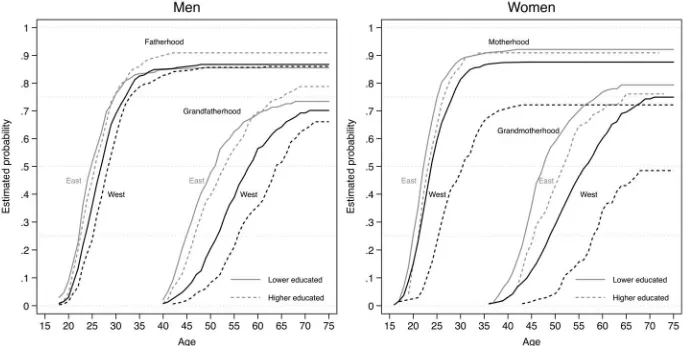
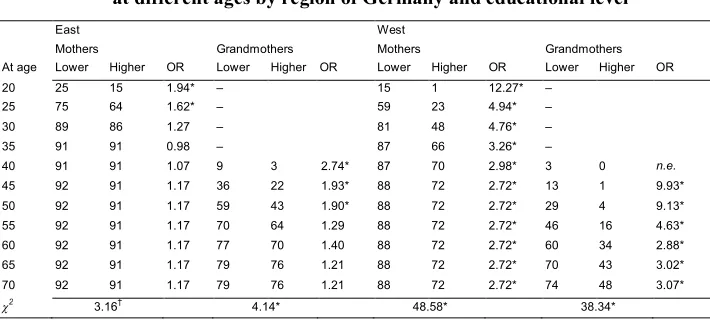
Kaplan‒Meier estimates for the fraction of parents and grandparents at different ages are presented in Figure 1. Table 2 (men) and Table 3 (women) show estimates at different ages including statistical tests and odds ratios.
Demographic Research: Volume 37, Article 29
in our study cohorts in West Germany never become grandmothers. More detailed analysis of grandmotherhood at different ages shows that educational gaps in West Germany were largest at younger ages, decreased thereafter, but remained large even towards the end of the process.
Figure 1: Probability of parenthood and grandparenthood by gender, region of Germany, and education. Cumulated probability functions obtained by Kaplan‒Meier estimation
Table 2: Men’s cumulative probability of being a father and grandfather at different ages by region of Germany and educational level
East West
Fathers Grandfathers Fathers Grandfathers
At age Lower Higher OR Lower Higher OR Lower Higher OR Lower Higher OR
20 9 5 2.06† – 3 2 1.93 –
25 51 45 1.30 – 36 24 1.82* –
30 76 76 0.99 – 69 61 1.43* –
35 83 86 0.82 – 83 79 1.29 –
40 85 90 0.61† 2 1 2.37 85 83 1.16 1 0 2.39
45 85 91 0.57† 26 16 1.75* 86 84 1.16 6 2 3.53*
50 86 91 0.59† 48 40 1.39† 87 86 1.09 20 8 2.85*
55 86 91 0.59† 63 56 1.29 87 86 1.09 39 21 2.38*
60 86 91 0.59† 69 70 0.97 87 86 1.09 56 36 2.34*
65 86 91 0.59† 72 75 0.86 87 86 1.06 64 51 1.69*
70 86 91 0.59† 73 79 0.74 87 86 1.06 69 63 1.30
β2 0.04 0.14 4.73* 17.26*
Notes: Estimated probabilities expressed in percentages. Values obtained by Kaplan‒Meier estimation. OR = odds ratio – factor by which odds of grandparenthood (grandparents/nongrandparents) of lower-educated differ from those of higher-educated; local statistical test of proportions based on standard errors obtained from Greenwood’s approximation.β2of a global statistical test of equality of survivor functions (log-rank test). Lower = educational level less than ISCED 5 (non tertiary); Higher = educational level ISCED 5 or 6 (tertiary).
† p <.10, * p < .05.
Table 3: Women’s cumulative probability of being a mother and grandmother at different ages by region of Germany and educational level
East West
Mothers Grandmothers Mothers Grandmothers
At age Lower Higher OR Lower Higher OR Lower Higher OR Lower Higher OR
20 25 15 1.94* – 15 1 12.27* –
25 75 64 1.62* – 59 23 4.94* –
30 89 86 1.27 – 81 48 4.76* –
35 91 91 0.98 – 87 66 3.26* –
40 91 91 1.07 9 3 2.74* 87 70 2.98* 3 0 n.e.
45 92 91 1.17 36 22 1.93* 88 72 2.72* 13 1 9.93*
50 92 91 1.17 59 43 1.90* 88 72 2.72* 29 4 9.13*
55 92 91 1.17 70 64 1.29 88 72 2.72* 46 16 4.63*
60 92 91 1.17 77 70 1.40 88 72 2.72* 60 34 2.88*
65 92 91 1.17 79 76 1.21 88 72 2.72* 70 43 3.02*
70 92 91 1.17 79 76 1.21 88 72 2.72* 74 48 3.07*
β2 3.16† 4.14* 48.58* 38.34*
Notes: Estimated probabilities expressed in percentages. Values obtained by Kaplan‒Meier estimation. OR = odds ratio – factor by which odds of grandparenthood (grandparents/nongrandparents) of lower-educated differ from those of higher-educated; local statistical test of proportions based on standard errors obtained from Greenwood’s approximation.n.e. = not estimable.β2of a global statistical test of equality of survivor functions (log-rank test). Lower = educational level less than ISCED 5 (non tertiary); Higher = educational level ISCED 5 or 6 (tertiary).
Demographic Research: Volume 37, Article 29
The findings for all remaining groups – East German women, East German men, and West German men – looked different. For West German men and East German women the curves of lower-educated and higher-educated individuals ultimately converged in each of these groups, indicating that differences in prevalence were only temporary, emerging from differential timing of fertility in successive generations.
An exception to these patterns is East German men. The chance of being a grandfather was initially higher in lower-educated men, but this difference reversed around the age of 60. As a result, the chance of being a grandfather at older ages was greater in higher-educated East German men, although the difference was not statistically significant. This reversal is a consequence of the inverted educational gradient in zero fertility observed for East German men, which makes the higher-educated less likely to remain childless (OR = 0.59, p<.10).
3.2 Education and the timing of grandparenthood
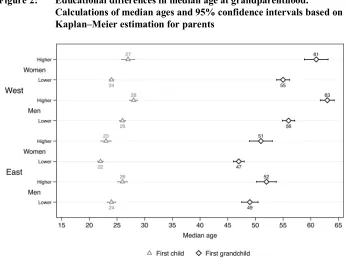
Figure 2: Educational differences in median age at grandparenthood.
Calculations of median ages and 95% confidence intervals based on Kaplan‒Meier estimation for parents
4. Discussion
This study is the first to examine educational differences in the demographic transition to grandparenthood, filling gaps in demographic knowledge about one of the major role transitions of older age. We used retrospective life-course data from the German Ageing Survey to reconstruct transitions to grandparenthood for men and women born between 1933 and 1948 in East and West Germany.
Demographic Research: Volume 37, Article 29
level of childlessness among highly educated West German women in the birth cohorts under study.
By contrast, East German women displayed not only a lower level of childlessness but also no difference in childlessness by educational level, leading to a much smaller educational gap in grandparenthood at later ages. These findings reflect the fact that the link between women’s educational participation, labor market attachment, and family formation was not as strong in the former socialist regime of the German Democratic Republic as in West Germany (Kreyenfeld 2004; Pascall and Manning 2000). We also found no educational differences in the chance of becoming a grandparent up to age 70 for East and West German men.
Educational differences were larger for the timing of grandparenthood than for the timing of parenthood, and larger in the West than in the East of Germany. In West Germany, differences between lower- and higher-educated people in the median age at grandparenthood amounted to six years among grandmothers and seven years among grandfathers, at least doubling the educational differences observed for the median age at parenthood. These findings illustrate how fertility delays are magnified in multigenerational processes of demographic reproduction. They also demonstrate how the legacy of historical differences between East and West Germany still shapes contemporary transitions to grandparenthood. In the former GDR, higher fertility levels over longer periods of time resulted not only in earlier parenthood and grandparenthood, but also in a weaker linkage between educational attainment and fertility.
We found no educational differences in the occurrence and timing of higher-parity transitions to further grandchildren (analyses not shown). The absence of notable differences beyond the initial transition to grandparenthood illustrates the selectivity associated with conditioning on grandparenthood. An important implication of this is that educational differences in the chances of grandparenthood are implicitly canceled out of the analysis if samples are reduced to three-generational structures – a common strategy in current grandparent research. For example, some analysts of ‘grandparent effects’ on social mobility have concluded that higher-educated grandparents improve their grandchildren’s chances of school success above and beyond the contribution of parents (Modin, Erikson, and Vågerö 2012). However, this focus on social reproduction disregards educational differences in demographic reproduction.
Our findings on the educational gradient in the experience of grandparenthood are also relevant to other areas of current grandparent research. For example, one provocative hypothesis to test empirically is whether grandparenthood is ‘a blessing for the rich and a curse for the poor.’ This hypothesis derives from the idea that among those in higher social positions, passages into the grandparent role are experienced later in life and in a possibly less demanding life-course context. These grandparents might reap the benefits of an enriching, affirming, and rewarding role in which they have a more active lifestyle yet are not overburdened, and their other activities are not interfered with. Among the disadvantaged, by contrast, grandparenthood at younger ages is more common. Earlier transitions, in turn, might induce stress and role overload, thus potentially entailing adverse effects on well-being, mental health, and physical health (Musil et al. 2011; Minkler and Fuller-Thomson 1999).
Demographic Research: Volume 37, Article 29
References
Burton, L.M. (1996). Age norms, the timing of family role transitions, and intergenerational caregiving among aging African American women. The Gerontologist 36(2): 199–208.doi:10.1093/geront/36.2.199.
Chan, T.W. and Boliver, V. (2013). The grandparents effect in social mobility: Evidence from British Birth Cohort Studies. American Sociological Review 78: 662–678.doi:10.1177/0003122413489130.
Chiang, Y.-L. and Park, H. (2015). Do grandparents matter? A multigenerational perspective on educational attainment in Taiwan. Social Science Research 51: 163–173.doi:10.1016/j.ssresearch.2014.09.013.
Condon, J., Luszcz, M., and Mckee, I. (2016). The transition to grandparenthood: A prospective study of mental health implications. Ageing and Mental Health. doi:10.1080/13607863.2016.1248897.
Engstler, H. and Motel-Klingebiel, A. (2010). Datengrundlagen und Methoden des Deutschen Alterssurveys (DEAS). In: Motel-Klingebiel, A., Wurm, S., and Tesch-Römer, C. (eds).Altern im Wandel. Befunde des Deutschen Alterssurveys (DEAS). Stuttgart: W. Kohlhammer: 34–60.
Goodman, C. and Silverstein, M. (2002). Grandmothers raising grandchildren: Family structure and well-being in culturally diverse families.The Gerontologist 42(5): 676–689.doi:10.1093/geront/42.5.676.
Hank, K. and Buber, I. (2009). Grandparents caring for their grandchildren: Findings from the 2004 Survey of Health, Ageing, and Retirement in Europe. Journal of Family Issues 30(1): 53–73.doi:10.1177/0192513X08322627.
Kravdal, Ø. and Rindfuss, R.R. (2008). Changing relationships between education and fertility: A study of women and men born 1940 to 1964.American Sociological Review 73(5): 854–873.doi:10.1177/000312240807300508.
Kreyenfeld, M. (2004). Fertility decisions in the FRG and GDR: An analysis with data from the German Fertility and Family Survey.Demographic Research SC 3(11): 275–318.doi:10.4054/DemRes.2004.S3.11.
Ku, L.-J.E., Stearns, S.C., Van Houtven, C.H., and Holmes, G.M. (2012). The health effects of caregiving by grandparents in Taiwan: An instrumental variable estimation. Review of Economics of the Household 10(4): 521–540.
Leopold, T. and Skopek, J. (2015a). The delay of grandparenthood: A cohort comparison in East and West Germany.Journal of Marriage and Family 77(2): 441–460.doi:10.1111/jomf.12169.
Leopold, T. and Skopek, J. (2015b). The demography of grandparenthood: An international profile.Social Forces 94(2): 801–832.doi:10.1093/sf/sov066. Luo, Y., LaPierre, T.A., Hughes, M.E., and Waite, L.J. (2012). Grandparents providing
care to grandchildren: A population-based study of continuity and change.
Journal of Family Issues 33(9): 1143–1167.doi:10.1177/0192513X12438685. Miller, B.C. and Benson, B. (2001). Family relationships and adolescent pregnancy
risk: A research synthesis. Developmental Review 21(1): 1–38.
doi:10.1006/drev.2000.0513.
Minkler, M. and Fuller-Thomson, E. (1999). The health of grandparents raising grandchildren. American Journal of Public Health 89(9): 1384–1389.
doi:10.2105/AJPH.89.9.1384.
Modin, B., Erikson, R., and Vågerö, D. (2012). Intergenerational continuity in school performance: Do grandparents matter? European Sociological Review 29(4): 858–870.doi:10.1093/esr/jcs064.
Musil, C.M., Gordon, N.L., Zauszniewski, J.A., Warner, C.B., Standing, T., and Wykle, M. (2011). Grandmothers and caregiving to grandchildren: Continuity, change, and outcomes over 24 months. The Gerontologist 51(1): 86–100.
doi:10.1093/geront/gnq061.