Multi-method Active Learning Approach: improving
the educational experience in Pharmaceutical Drug
Development
Herdeiro MT*1, Teixeira Rodrigues A1,2, Ferreira M1, da Cruz e Silva OAB1 and Fardilha M1,3 1 Center for Cell Biology, University of Aveiro (CBC/UA), Portugal
2Faculty of Pharmacy, University of Coimbra (FFUC), Portugal
3Signal Transduction Laboratory, Center for Cell Biology, Biology Department and Health Department, University of Aveiro
ABSTRACT
Background: Improve educational experience, teaching effectiveness and learning outcomes remains one of the major educational challenges nowadays. Purpose: To determine the effect of organizing and teaching the Pharmaceutical Drug Development curricular unit using a Multi-method Active Learning Approach, MALA, as a novel teaching/learning strategy. Methods: MALA involved several different activities about pharmaceutical legislation, medicines production and validation process, Common Technical Document, and others, and the evaluation of this active learning approach was made in two ways: students’ performance (grades), and students’ evaluation regarding the curricular unit and the teachers’ performance. Results: Results revealed two main important aspects of the implementation of MALA: (i) the implementation of MALA showed high rates of students’ satisfaction regarding the curricular unit and teachers’ performance; (ii) student’s performance (grades) were very high, revealing excellent teaching/ learning results. Conclusion: The present study fostered the concept that the MALA- learning approach should contribute to knowledge- enhancing in the pharmaceutical practice and could encourage integration of the students' learning skills in the future career, thus stimulating the flexibility in learning. Keywords: MALA, Active learning approach, PBL, pharmaceutical drug development.
DOI: 10.5530/ijper.48.3.4
Address for correspondence:
Prof. Maria Teresa Herdeiro
Health Sciences Depart-ment, Agra do Crasto – ed-ifício 30, 3810-193 Aveiro, Portugal
Phone: +351234370200 Fax: +351234370985 E-mail: teresaherdeiro@ ua.pt
INTRODUCTION
Improve educational experience, teaching effectiveness and learning outcomes (LO) remains one of the major educational chal-lenges nowadays. Surrounding pharmaceu-tical education, the Accreditation Council for Pharmacy Education refers that it is fundamental to implement active learning methods in under graduation process to improve learning outcomes.1
Pharmaceutical Drug Development (PDD) constitutes a challenging subject to be learned by the undergraduate students who face difficulties in the integration of the theoretical and practical concepts of the discipline. Traditional learning methods are characterized by the simple transmission of
information (theoretical lectures and teach-ing materials) and an exam at the end of the semester.
Active learning approaches, as prob-lem-based learning (PBL), have been developed and widely used in higher education,2 aiming to improve the
edu-cational experience and outcomes in opposition to the traditional methods. Firstly, these learning processes pretend to be active efforts and the student must learn in different ways.3 This learning
discover, research, process and apply information,5
and also play a pivotal role on planning, monitoring and evaluating the educational method.6,7 The
char-acteristics considered essential in the PBL method are the problems as an incentive for learning, tutors as facilitators and group working as motivation for interaction, where tutors and consultants should stimulate students towards self-directed learning and to explore the knowledge profoundly.4
Accordingly, in 2006, the Health Sciences Department of Aveiro University (UA) applied a multi-method active learning approach (MALA)8 in the PDD
cur-ricular unit (CU) instead of teaching in a traditional manner. Thus, the objectives of the study were to determine the effect of organizing and teaching the PDD unit using the MALA as a novel teaching/learn-ing strategy and to assess Biomedical Sciences degree students´ performance and evaluation towards this learning process.
MATERIALS AND METHODS
Educational setting, study population and study period
In 2006, the Health Sciences Department of UA adopted MALA8 in the Biomedical Sciences
under-graduate degree. The MALA was thus implemented in the PDD-CU of the second year Biomedical Sciences degree at the UA. The PDD unit was initiated in the year 2007/2008 comprising 15 students. The second year edition, in 2008/2009, accounted for a total of 12 students, the third edition, in 2009/2010, involved a group of 13 students, the fourth edition, in 2010/2011, included 16 students, and the fifth edition included 19 students (2012/2013). In 2011/2012, PDD wasn’t taught because of restructuring matters of the Biomedi-cal Sciences Degree.
It is important to refer that MALA was implemented in the first year of the Biomedical Sciences degree. There-fore, the second-year undergraduate students were familiar with this active learning method.
The traditional method
Traditionally, PDD is taught through lectures and the assessment is performed at the end of the semester, when students face with a great volume of new con-cepts that should be memorized and understood in a short period of time, increasing the difficulty of trans-pose theoretical concepts into practice. Moreover, the lack of motivation, participation and autonomy can contribute to the failure of the learning process.
MALA - Multi-method Active Learning Approach
The preceptor responsible for the PDD- CU is a scien-tific expert in pharmaceutical sciences, with expertise in Regulatory Affairs from Portuguese Pharmacists’ Pro-fessional Organization.
In order to implement MALA, competence- based LO were defined and structured by the consultant, which implied the transference of the learning conscientious-ness to the learners.9 Consultant defined the LO
accord-ing with the syllabus defined in the Biomedical Sciences degree.
Table 1 presents the competences, LO and specific
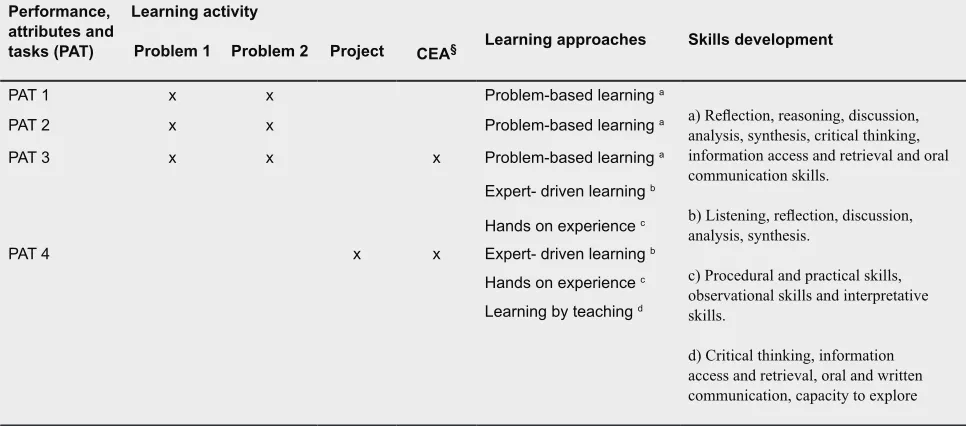
objectives related to each PAT (Performance, Attributes and Tasks) defined for this CU. Also, for each PAT, was defined the learning activity, the learning approaches used and the skills development pretended (Table 2).
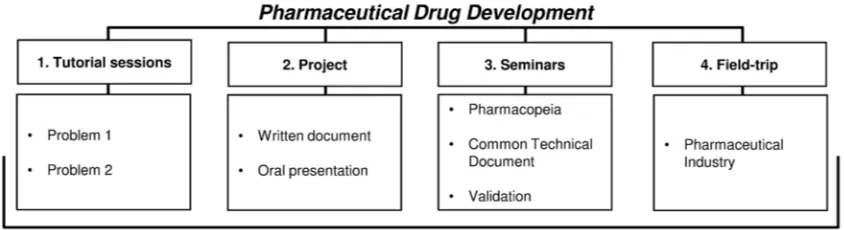
The MALA included four main activities (Figure 1):
Tutorial sessions
The course unit on PDD included tutorial sessions (TS) dealing with the general context of the CU. The intent was to stimulate the students to ascertain about the sub-ject, and also to promote independent study and active research:
● The first problem (Problem 1) presented to the
students addressed the competencies and activi-ties of the institutions that regulate the pharma-ceutical activity in terms of National regulation, National Authority of Medicines and Health Products I.P. (INFARMED), along with
Euro-pean regulation, EuroEuro-pean Medicines Agency (EMA), as well as the guidelines for Technical Requirements for Registration of Pharmaceu-ticals for Human Use, referred in the Interna-tional Conference of Harmonization (ICH);
● The second problem (Problem 2) addressed
the European legislation, Eudralex (Volume 2), of Pharmaceutical Legislation, Notice to appli-cants and regulatory guidelines medicinal prod-ucts for human use, presentation and content of the Common Technical Document (CTD), procedures for marketing authorization, varia-tions and renewal of CTD. Given the specific-ity of the proposed problem, adaptations were made accordingly to the students’ difficulties in the resolution of Problem 1.
Table 1: Competences, learning outcomes, and specific objectives related to Pharmaceutical Drug Development.
Competency Learning outcome (LO) Performance, Attributes and
Tasks (PAT)
Specific learning objectives
To identify the European and National institutions that regulate the drug marketing authorization
To identify the National and European
institutions that regulate the introduction of a drug in the market and to recognize their competences
PAT 1 To identify National Authority of Medicines and Health Products, IP (INFARNED*) as the agency responsible for monitor, assess and regulate all activities relating to human medicines and health products for the protection of Public Health
To identify the European Medicines Agency (EMA†), decentralized body of the European Union responsible for medicines regulation
To recognize the INFARMED IP competencies
To recognize the EMA competencies
To identify and recognize the National and European legislation of pharmaceutical drug development
PAT 2 To use informatics tools to research, and collect regulation and technical- scientific information in the pharmaceutical development
To identify and recognize the national legislation that regulates pharmaceutical development
To identify and recognize the European legislation that regulate pharmaceutical development
To evaluate, analyze, organize and construct the documentation relative to the Chemical-pharmaceutical and biological information for chemical active substances and biological medicinal products” – Module 3 of CTD
To recognize the Common Technical Document (CTD‡) in particular the format and content of module 3 of the CTD
PAT 3 To recognize the CTD
To recognize the format and content of module 3
To be able to research and analyze the information related with the parameters defined in module 3
To evaluate, organize and construct the information related with the parameters referred in module 3 of the CTD
PAT 4 To organize and construct module 3, with the information obtained through the active substance identification and assay according to the European Pharmacopeia
To know the concept of the manufacturing process validation
To know the concept of analytical procedure validation
To know the regulation for the stability protocol development
thus activating prior knowledge that facilitates the pro-cessing and clarification of new information.
Project
As a complementary approach in the PDD unit, it was proposed to the students that they should develop a project covering a specific subject within the framework of the CU. Therefore, students were invited to examine, in detail an active substance mentioned in the European Pharmacopeia. Tutor supported the project progress, by directing the research to specific paths, and to accom-plish specific objectives within the scheduled deadline. In addition, students were instigated to follow a line of research within the recommended literature. Founded on the literature review, it was defined the production of a written report, correspond to the module 3 of the CTD, to be presented to the rest of the class in Power-Point format. Both the written report and the oral
pre-sentation were communicated in the English language, and the latter had the duration of 10 minutes with 5 minutes of open discussion with the rest of the class. This process was monitored by the tutor and contrib-uted to an open line of communication.
The evaluation factor included, not only, the perfor-mance during the presentation, but also, the active partic-ipation in the discussion of other groups´ presentations. Since the class was divided into groups, it was ensured that all students had the opportunity to actively partici-pate in each project presentation, to learn more about a specific subject matter, and to develop their capacity of interaction and mutual aid within the group. Also, the students acquired relevant knowledge about panoply of
subjects, and developed skills closely related to critical opinion.
Seminars
Three seminars were included in the CU:
● Pharmacopeias: the first seminar was given by
a pharmacist with a doctoral degree in Pharma-ceutical Sciences. This seminar was dedicated to the Pharmacopeias, and students had the opportunity to consult and interpret the infor-mation mentioned in the Pharmacopeias. The students dealt with the European, Portuguese, British and United American Pharmacopeia, denoting the particularities of each one.
● CTD: the second seminar was given on the
theme CTD by a specialist in Pharmaceutical Regulatory Affairs. During the seminar, the spe-cialist focused on the five modules of the CTD, especially, module 3, demonstrating with practi-cal information.
● Validation of analytical procedures and
manu-facturing process: the third seminar approached the validation process and was given by a Chem-ical Engineer/Pharmacist working in a Pharma-ceutical company.
Field-trip
Complimentarily, the PDD unit comprised a field-trip to a pharmaceutical enterprise where the students had contact with the drug manufacturing process. More-over, the students were invited to integrate the process of quality control, collecting and analyzing the samples
Table 2: Learning approaches and skills development, associated with each learning activity Performance,
attributes and tasks (PAT)
Learning activity
Learning approaches Skills development Problem 1 Problem 2 Project CEA§
PAT 1 x x Problem-based learning a
a) Reflection, reasoning, discussion, analysis, synthesis, critical thinking, information access and retrieval and oral communication skills.
b) Listening, reflection, discussion, analysis, synthesis.
c) Procedural and practical skills, observational skills and interpretative skills.
d) Critical thinking, information access and retrieval, oral and written communication, capacity to explore
PAT 2 x x Problem-based learning a
PAT 3 x x x Problem-based learning a
Expert- driven learning b Hands on experience c
PAT 4 x x Expert- driven learning b
Hands on experience c Learning by teaching d
(in-process control), under the supervision of the head of department. These activities were of extraordinary importance, allowing the in loco visualization of the
manufacturing equipment, procedures and general work environment. The students also had the opportunity to recognize the process underlying to the stability, con-trol of the drug manufacturing rooms (including the temperature, humidity, and pressure), the water qual-ity control, plus the complete circuit of raw-materials entrance and the outlet of the finished-product. Over-all, the students were allowed to explore the main quality procedures, the good-quality laboratory practices, man-ufacturing and warehouse of the drugs, so they could understand the drug production in the context of a real work environment.
Evaluation and assessment
Students’ performance
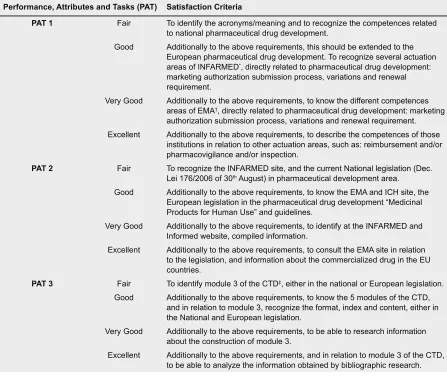
Different assessment tools were used for each PAT
(Table 3). The evaluation was defined at the
begin-ning of the year, and presented to the students on the first day of classes, as well as the tutorial chronogram, project work, field- trip and seminars, programmatic contents, and recommended literature. In relation to the assessment, 20% of the evaluation corresponded to TS, through a schedule grid previously established for this type of assessment that contemplated, among other factors, the following: assiduity, punctuality, indi-vidual work, sharing/analysis/synthesis and integration of information. The remaining 80% were distributed in the PAT component, more specifically PAT 1, 2, and 3, which were evaluated by final exam and had a weighting factor of 1, and PAT 4, that was assessed by the projects elaboration and presentation and had a weighting fac-tor of 2. These techniques are integrated in the active learning, where the students are profoundly involved, over simply listening to a lecture, thus developing skills involved in higher- order thinking, and students embrace activities (analysis/discussion/evaluation) to explore their own attitudes and values.
Table 3: Performance, Attributes and Tasks assessment
Performance, Attributes and Tasks (PAT) Satisfaction Criteria
PAT 1 Fair To identify the acronyms/meaning and to recognize the competences related to national pharmaceutical drug development.
Good Additionally to the above requirements, this should be extended to the European pharmaceutical drug development. To recognize several actuation areas of INFARMED*, directly related to pharmaceutical drug development: marketing authorization submission process, variations and renewal requirement.
Very Good Additionally to the above requirements, to know the different competences areas of EMA†, directly related to pharmaceutical drug development: marketing authorization submission process, variations and renewal requirement. Excellent Additionally to the above requirements, to describe the competences of those
institutions in relation to other actuation areas, such as: reimbursement and/or pharmacovigilance and/or inspection.
PAT 2 Fair To recognize the INFARMED site, and the current National legislation (Dec. Lei 176/2006 of 30th August) in pharmaceutical development area. Good Additionally to the above requirements, to know the EMA and ICH site, the
European legislation in the pharmaceutical drug development “Medicinal Products for Human Use” and guidelines.
Very Good Additionally to the above requirements, to identify at the INFARMED and Informed website, compiled information.
Excellent Additionally to the above requirements, to consult the EMA site in relation to the legislation, and information about the commercialized drug in the EU countries.
PAT 3 Fair To identify module 3 of the CTD‡, either in the national or European legislation. Good Additionally to the above requirements, to know the 5 modules of the CTD,
and in relation to module 3, recognize the format, index and content, either in the National and European legislation.
Very Good Additionally to the above requirements, to be able to research information about the construction of module 3.
About students’ global evaluation (grades of the year), it was made using a quantitative scale, from 0 to 20, which converge the evaluation of each PAT and the tutorial sessions. Five years were available for the analy-sis: 2007/2008, 2008/2009, 2009/2010, 2010/2011 and 2012/2013.
Students’ evaluation
UA recently implemented a quality assurance system that included students´ opinion about the CU and about teachers’ performance. Students were asked to respond to a questionnaire where each question was rated on a 9-point Likert scale, from 1 (disagree) to 9 (agree). Three years were available for the analysis: 2009/2010, 2010/2011 and 2012/2013. The quality assurance sys-tem was only implemented in the second semester of 2008/2009, and because of it, we don’t have results from 2007/2008 and 2008/2009 (PDD is a CU from the first semester).
The students’ opinion regarding the CU was evaluated in five different variables:
A. Global functionality of the CU;
B. Adequacy of the CU proposed activity to the defined objectives;
C. Students’ assiduity degree with the tutorial classes;
D. Global satisfaction degree concerning student performance;
E. Motivation to the CU.
The students’ opinion regarding the teachers’ perfor-mance was evaluated in four different variables:
i. Global evaluation of the teacher’ performance; ii. Fulfillment of the evaluation standing rule
according to the students;
iii. Relationship between the students and teacher; iv. Creation of learning favorable atmosphere.
RESULTS
Students’ performance
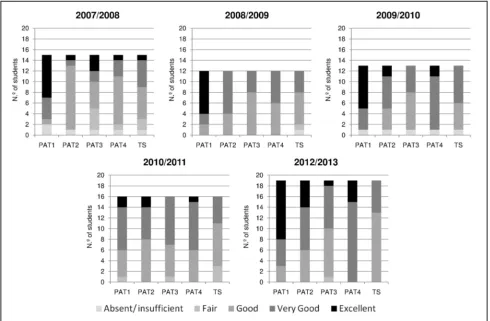
About students’ grades, in 2007/2008 the mean was 14, in 2008/2009 was 14.8, in 2009/2010 was 16.1, in 2010/2011 was 15.4 and in 2012/2013 was 15.8. In gen-eral, the grades have increased during the years and in 2009/2010 we have obtained the highest classification (16.1).
Figure 2 presents the distribution of students grades
on a qualitative scale obtained in the different compo-nents of PAT evaluated in the PDD- CU. Comparing students’ performance in each PAT, PAT 1 and PAT 4 revealed higher rates in all years analyzed.
Students’ evaluation
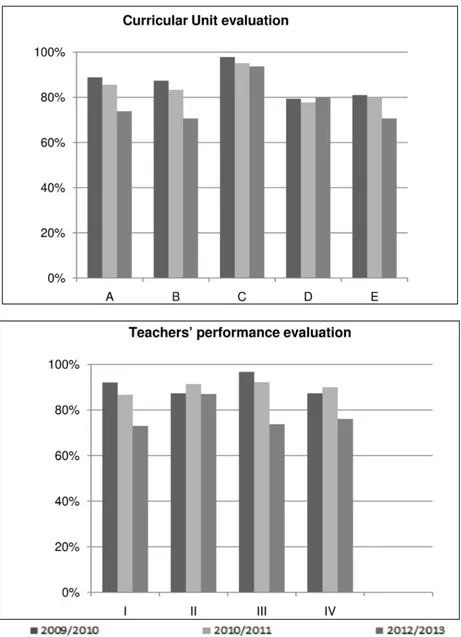
In relation to questionnaires, the results were transposed into a percentage (Figure 3).
As demonstrated for all years analyzed, students’ evalu-ation was higher than 70% for all variables analyzed. About the CU evaluation, students’ assiduity degree with the tutorial classes (C) and global satisfaction degree concerning student performance (D) present a rate superior of 75%. Teachers’ performance evaluation
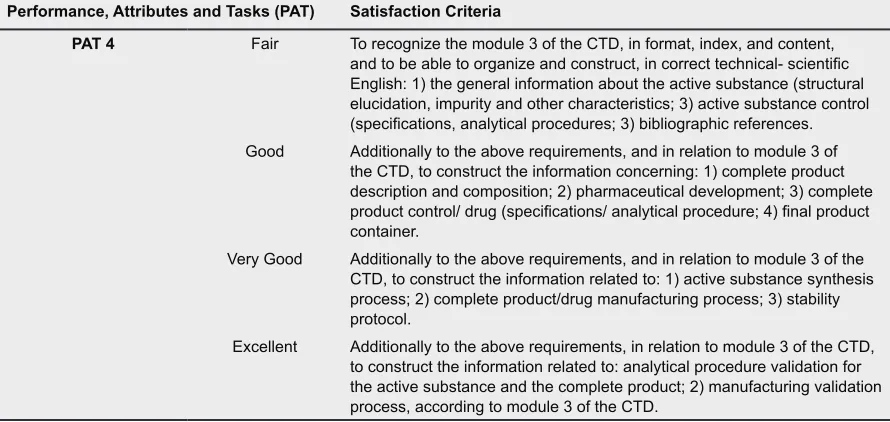
Table 3: Performance, Attributes and Tasks assessment ... (Continue...)
Performance, Attributes and Tasks (PAT) Satisfaction Criteria
PAT 4 Fair To recognize the module 3 of the CTD, in format, index, and content, and to be able to organize and construct, in correct technical- scientific English: 1) the general information about the active substance (structural elucidation, impurity and other characteristics; 3) active substance control (specifications, analytical procedures; 3) bibliographic references. Good Additionally to the above requirements, and in relation to module 3 of
the CTD, to construct the information concerning: 1) complete product description and composition; 2) pharmaceutical development; 3) complete product control/ drug (specifications/ analytical procedure; 4) final product container.
Very Good Additionally to the above requirements, and in relation to module 3 of the CTD, to construct the information related to: 1) active substance synthesis process; 2) complete product/drug manufacturing process; 3) stability protocol.
Excellent Additionally to the above requirements, in relation to module 3 of the CTD, to construct the information related to: analytical procedure validation for the active substance and the complete product; 2) manufacturing validation process, according to module 3 of the CTD.
revealed for all variables, in 2009/2010 and 2010/2011, satisfaction levels higher than 80%. Comparing all years analyzed, the level of students’ satisfaction decreases, in general, over time.
DISCUSSION
This study examines the effectiveness of using MALA as a novel learning approach for PDD, and two main con-clusions can be made: (i) the implementation of MALA revealed high rates of students’ satisfaction regarding the CU and teachers’ performance; (ii) student’s perfor-mance (grades) are very high revealing excellent teach-ing/learning results.
Our results revealed that the quantitative evaluation of the students’ performance increased over time, from 14 (2007/2008) to 15.8 (2012/2013). It’s also important to refer that higher rated PAT’s were the PAT 1 and PAT 4. PAT 1 is related to Portuguese legislation surround-ing medicines, which is very interestsurround-ing for the students, and PAT 4 is about the project elaboration, which con-cern the practical application of the knowledge acquired before.
The PDD unit was re-structured and taught accordingly with this innovative learning strategy, comprising a vari-ety of active- learning educational techniques organized following the PBL method associated with complemen-tary education activities (CEA), thus including problems on the subject matter, and a project consisting in the elaboration of the model on the CTD. Moreover, the CU was complemented with seminars presented by spe-cialists on drug development/regulatory affairs, and a field- trip to the pharmaceutical industry of drug manu-facturing.
The PBL learning approach encouraged students to integrate preliminary explanations and formulate learning questions as suggested in several studies.10-13
Complementarily, students enhanced the self- directed learning skills in the sense that it improved the exploita-tion of literature to access informaexploita-tion, thus addressing the proposed LO.4,13 Effectively, in 2005, Dolmans et al.4
revealed that learning, in the context of PBL, stimu-lates the transference of knowledge, and motivates self- directed and lifelong learning. Furthermore, the number of students that attended the PBL sessions was crucial to the success of the learning process.14
Figure 2: Distribution of students´ grades (qualitative scale) obtained in the different Performance, Attributes and Tasks (PAT)
Figure 3: Quality assurance system: Curricular Unit (CU): A. Global functionality of the CU; B. Adequacy of the CU proposed
activity to the defined objectives; C. Students assiduity degree to the tutorial classes; D. Global satisfaction degree concerning
student performance; E. Students motivation for the CU. Teachers’ performance: I. Global evaluation of the teacher performance;
II. Fulfillment of the evaluation standing rule agreed with de students; III. Relationship between students and teacher; IV. Creation
Given that the number of student we had exceeded the optimal quantity, as discussed above, we decided, by preceding experience, that it was advisable to have two smaller groups, thus comprising 6-8 students each group in the same classroom.14 The main reason for
this preference was that, in smaller groups, the infor-mation was easily exchanged between all students. None the less, our teaching experience leads us to consider that session group with less than 6 students decrease the discussion throughput, resulting in less participative and monotonous sessions. Still, given that this strategy was implemented in previous editions of the course,8 students were more comfortable in
adopt-ing that system.
Furthermore, the Biomedical Sciences course cur-ricular structure provided students the opportunity of transposing the information from previously taught curricular units. Hence, the active-learning process is cumulative and influenced by prior knowledge, provid-ing the support for the problem analysis, self- directed learning and future learning.15, 16
The seminars permitted the enthusiastic participation of the students, who were encouraged to interact with the experts by asking questions. Equally, the seminars gave to the students, the opportunity of contacting with professionals, exposing them to the labor-market. More-over, the pharmaceutical industry visit was very interest-ing and highly motivatinterest-ing for the reason that students effectively visualized and materialized the knowhow integrated during the theoretical component of the unit. In essence, students felt motivated to learn, particularly in the context of MALA. This multi- faceted teach-ing method makes it possible to effectively embrace competences in the technical, scientific and pedagogic areas, given that theoretical students´ knowledge were approached by specialists in pharmaceutical areas. Moreover, practical competences were acquired dur-ing the field- trip, promotdur-ing the development of stu-dents´ technical skills. These so- named “hands on experience” schemes promote the students autonomy and the feeling of responsibility for the transmission of knowledge within working groups. Additionally, increased research autonomy, synthesis, integration, student assessment and discussion of knowledge were markedly noted.
CONCLUSION
In conclusion, the present study fostered the concept that the MALA- learning approach should contribute
ing skills in the future career, thus stimulating the flex-ibility in learning.
ACKNOWLEDGEMENT
The authors wish to express their sincere thanks to the students, without whom this study would not be pos-sible, and to the experts who collaborate with this cur-ricular unit.
CONFLICTS OF INTEREST
No conflicts of interest to declare.
ABBREVIATION
CEA: Complementary Education Activities CTD: Common Technical Document CU: Curricular Unit
EMA: European Medicines Agency
ICH: International Conference of Harmonization INFARMED: National Authority of Medicines and Health Products, IP
LO: Learning Outcomes
MALA: Multi-method Active Learning Approach PAT: Performance, Attributes and Tasks
PBL: Problem-based Learning
PDD: Pharmaceutical Drug Development TS: Tutorial sessions
UA: University of Aveiro
REFERENCES
1. Accreditation Council for Pharmacy Education. Accreditation standards and guidelines for professional program in pharmacy leading to the doctor of pharmacy degree. Chicago, Illinois: ACPE; 2006. .
2. Gwee MC. Globalization of problem-based learning (PBL): cross-cultural implications. Kaohsiung J Med Sci. 2008 Mar; 24(3 Suppl): S14–22. 3. Meyers C, Jones TD. Case Studies, Promoting Active Learning-Strategies
for the College Classroom. Jossey-Bass Washington, San Francisco; 1993. pp. 103–19.
4. Dolmans DH, De Grave W, Wolfhagen IH, van der Vleuten CP. Problem-based learning: future challenges for educational practice and research. Med Educ. 2005 Jul; 39(7): 732–41.
5. Bowell C, Eison J. Active-Learning: Creating Excitement in the Classroom, AEHE-ERIC Higher Education Report No. 1 Jossey-Bass Washington, DC; 1991.
6. Bate E, Hommes J, Duvivier R, Taylor DC. Problem-based learning (PBL): getting the most out of your students - their roles and responsibilities: AMEE Guide No. 84. Med Teach. 2014 Jan; 36(1): 1–12.
7. Norman GR, Schmidt HG. The psychological basis of problem-based learning: a review of the evidence. Acad Med. 1992 Sep; 67(9): 557–65. 8. Fardilha M, Schrader M, da Cruz ESOA, da Cruz ESEF. Understanding fatty
10. Gijselaers W. Perspectives on problem-based learning. Educational Innovation in Economics and Business Administration; 1995. 39–52. 11. Albanese MA, Mitchell S. Problem-based learning: a review of literature on
its outcomes and implementation issues. Acad Med. 1993 Jan; 68(1): 52–81. 12. Boud D, Feletti G, Eds. Changing Problem-Based Learning, Introduction to
the Second Edition. Routledge; 1997. Millon Park.
13. Schmidt HG. Problem-based learning-Rationale and description Med Educ. Online.1983; 17: 11–6.
14. Haworth IS, Eriksen SP, Chmait SH, Matsuda LS, McMillan PA, King EA, et al. A problem based learning, case study approach to pharmaceutics: Faculty and student perspectives. American Journal of Pharmaceutical Education. 1998; 62(4): 398–405.
15. Whitley HP. A public health discussion series in an advanced pharmacy practice experience. American Journal of Pharmaceutical Education. 2010 Aug 10; 74(6): 101.