The University of San Francisco
USF Scholarship: a digital repository @ Gleeson Library |
Geschke Center
Master's Theses
Theses, Dissertations, Capstones and Projects
1994
Factors in the Selection of Board Members to
501(c)(3) Human Service Organizations
Robert G. Campbell
University of San Francisco
Follow this and additional works at:
https://repository.usfca.edu/thes
Part of the
Nonprofit Administration and Management Commons
This Thesis is brought to you for free and open access by the Theses, Dissertations, Capstones and Projects at USF Scholarship: a digital repository @ Gleeson Library | Geschke Center. It has been accepted for inclusion in Master's Theses by an authorized administrator of USF Scholarship: a digital repository @ Gleeson Library | Geschke Center. For more information, please [email protected].
Recommended Citation
Campbell, Robert G., "Factors in the Selection of Board Members to 501(c)(3) Human Service Organizations" (1994).Master's Theses. 1168.
The author of this thesis has agreed to make available
to the University community and the public a copy of this thesis project.
Unauthorized reproduction of any portion of this thesis is prohibited.
The quality of this reproduction is
contingent upon the quality of the original copy submitted.
University of San Francisco Gleeson Library/Geschke Center
2130 Fulton Street
FACTORS IN THE SELECTION OF BOARD MEMBERS
TO 501(c)(3) HUMAN SERVICE ORGANIZATIONS
A
THESIS SUBMITTED
by
Robert G. Campbell
In Partial Fulfillment of the Requirements
for the Degree of
Master of Non profit Administration
The University of San Francisco
FACTORS IN THE SELECTION OF BOARD MEMBERS
TO 501(c)(3) HUMAN SERVICE ORGANIZATIONS
This Thesis Written by
Robert G. Campbell
This thesis written under the guidelines of the Faculty Advisory Committee, and approved by all its members, has been accepted in partial fulfillment of the
requirements for the degree of:
Master of Nonprofit Administration
at the
University of San Francisco
o d Reader
c:\'
~~~ L:f;J~
;;;1;91
~IProgram Director Date
Table of Contents
Abstract. ... . . ... .IV
Vita Auctoris.... . . . . ... ··· ... ··· ... v
Acknowledgments ... . ..VI
List of Appendices ... . .VIl
List of Tables. . . . ... VIII
Chapter One: Introduction ..
Chapter Two Review of Literature ... . . ... 10
Chapter Three: Methodology .. . ... 23
Chapter Four Results.
29
Chapter Five Summary and Conclusion ... . .67
References . . . ... 80
Abstract
The purpose of this study is to identify the processes actually used by nonprofit
organizations in the selection ofboard members. In-depth interviews were conducted with
30 subjects representing 10 human service nonprofit organizations. The data were
analyzed in relation to various research questions. Case studies were written which
describe the process ofboard member selection used by each of the organizations.
Elements of these selection processes were formulated into a model of the actual
processes applied in board member selection. The actual model was then compared to the
prescribed model of selection formulated as a result of information encountered in a
review of the literature. Results of this study provide a rare glimpse into the actual board
member selection processes applied by nonprofit organizations. One, outstanding finding
was that nonprofit organizations are not necessarily following the model of board member
selection prescribed in the literature. This study indicates that the selection of new board
members provides the opportunity for nonprofit organizations to increase their
effectiveness. Although filling vacant seats on a board may be difficult, subjects reported
that it is more important to find the right board member than to fill a vacant seat By
selecting new board members who possess the expertise and characteristics sought the
board enhances its ability to advance the mission of the organization successfully into the
Name:
Date ofBirth:
High School:
Graduated:
Baccalaureate Degree:
College:
Graduated:
Vita Auctoris
Robert G. Campbell
February 13, 1950
Northwestern High School
Hyattsville, Maryland
1968
Bachelor of Arts Degree
University of California
Santa Cruz
Acknowledgments
This thesis is possible because of a number of people and the watchful assistance of divine providence. My friends, classmates, instructors, and Supportive Outreach Services
provided much of the help and inspiration required to complete this process. However, there are some people without whose help this would have been literally an impossible task
To them a special thank you with much appreciation:
Amy Pine, my wife and partner Shelly D'Amour
Lansing V Foster Ellen Bass
Jerry Solomon
I also want to thank my thesis advisor Kathleen Fletcher, my second reader Judy
Schwartz, my statistics instructor Brad Smith, and my research seminar classmates Susan Patz and Nancy Melmon.
List of Appendices
Appendix A Subject Consent Form
Appendix B Interview Protocol - Nominating Committee Chair
Appendix C Interview Protocol - Executive Director
Appendix D Interview Protocol- Newest Board Member
Table 1
Table 2
Table 3
Table 4
Table 5
Table 6
Table 7
List of Tables
Characteristics ofParticipating Board members
Characteristics of Participating Organizations
Number of Board Seats, Vacancies Before and After Selection, Prospects Considered, and Prospects Selected by each Organization
Length ofBoard Terms in Consecutive Number ofYears by Organization
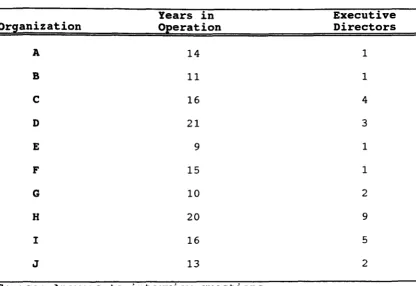
The Organization's Age and Number of Executive Directors by Organization
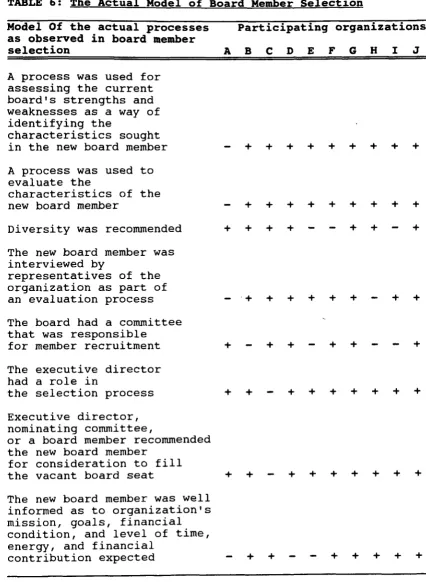
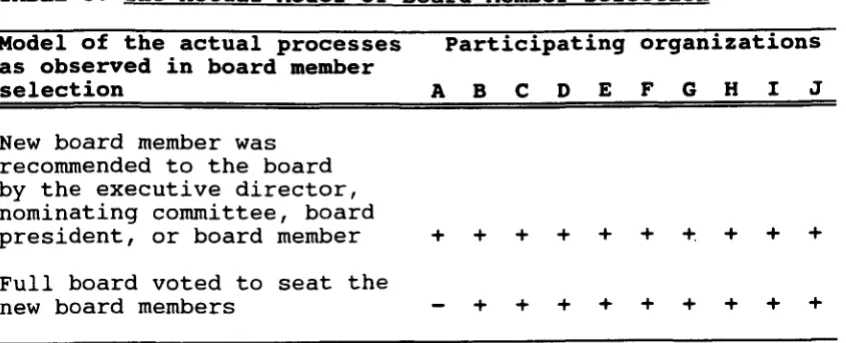
The Actual Model of Board Member Selection
Chapter 1: Introduction
Background
Nonprofit organizations represent an important economic
sector in the United States. In 1988, the Internal Revenue
Service's master file had one million active nonprofit
organizations. These organizations employed nearly eight
million people and had expenditures totaling more than $280
billion. The bulk of these activities and assets represent
approximately four hundred thousand 50l(c)(3) charitable
organizations providing human services in the areas of
health, mental health, and education throughout the United
States (Hodgkinson, 1990). The nonprofit sector has been
rapidly expanding with the number of 501(c)(3)'s increasing
by 5.5 percent between 1989 and 1990 (Wood, 1992). According
to the California attorney general's office, there were
fifty thousand 501(c)(3) charitable organizations registered
in California in 1988 with a combined income of $20 billion
and assets totaling $40 billion (Silk, 1992). There are
between 500 and 700 501(c)(3) organizations formed each
month in California (Nonprofit Times, April, 1989). A
conservative estimate would place the number of people
living in California serving as members on a nonprofit board
of directors at over 250,000. In Santa Cruz, a small rural
county in central California with a population of 225,000,
there are three hundred and ninety eight 501(c)(3) human
$250,000 in 1991.
Every nonprofit organization is required by law to have
a board of directors; most operate with a minimum of three
members. The policies regarding the specific number of
members, terms of office and selection process are usually
found in the organization's bylaws. Board members of
nonprofit organizations are usually unpaid, part-time
volunteers who are none the less responsible -- legally,
financially, and morally -- for these organizations (Wood,
1992). Board and board member responsibilities are
fundamentally the same for all nonprofit organizations. The
ways in which boards and board members actually fulfill
their responsibilities vary greatly (Ingram, 1988).
The performance of the board of directors of nonprofit
organizations is of concern to executive directors, funding
sources, the community within which the organization
functions, the clientele served by the organization, and
individual board members themselves. Thanks to a growing
emphasis on nonprofit management, an increasing number of
nonprofit organizations are well managed. However, many
board members believe themselves and their organizations to
be a good deal less well managed than the average business
(Drucker, 1990). In response to the concerns for improving
board performance, there have appeared a number of books and
articles offering self-help guidance for boards (O'Connell,
1985; Mathiasen, 1986; Conrad, 1986; Ingram, 1988; Herman,
the existing literature on the roles and responsibilities of
boards is prescriptive; in addition, i t often draws on
personal experience and anecdotal evidence (Bradshaw, 1992).
Each board member possesses the potential to impact the
performance of the board, the organization, and ultimately
the community and clientele i t serves. The prescriptive
literature discusses how to do everything from creating
board resolutions and accomplishing self-assessments, to
the cultivation, recruitment, selection, and orientation of
new board members. Tools are available for the creation of
bylaws, board member job descriptions, step-by-step
procedures for the establishment of nominating committees,
and lists of preferred board member characteristics.
The selection of board members to nonprofit human
service organizations is important. The literature on this
subject addresses concerns about board structure and
effectiveness, the role and needs of executive directors
relative to the board, and the requisite characteristics of
new members, suggesting an integral connection between
organizational success and board member selection. A
prescriptive model for board member selection has emerged
from this literature.
This study will identify this prescriptive model for
selecting board members and then describe the actual
processes applied by 10 nonprofit human service
organizations in Santa Cruz County, California, for the
Statement of the Problem
The quality of the governing board is an important
ingredient in the success of a nonprofit organization. The
board's quality, in turn, often directly reflects both the
strength of the nominating committee members and the plan
the committee develops to select and engage each new board
member from the time of recruitment until retirement
(Nelson, 1992). The prescriptive literature proposes a model
for board member selection yet research on the topic is
rare.
Results of interviews with 37 individuals who have
nonprofit expertise suggested a number of important research
questions related to the effectiveness of boards. One such
question was how do boards actually behave, as opposed to
how models and bylaws say they should (Brown, 1986). This
study answers that question in the area of board member
selection.
Locating volunteers who are willing to take on the
legal and financial responsibilities of a director in a
nonprofit organization is both time-consuming and difficult.
Much of the prescriptive literature on board development
suggests having board terms of no more than three years,
with mandatory "retirement" at the end of each term (Houle,
1989; Conrad, 1986). Many boards allow election of
individual board members to a second term while some
organizations allow an unlimited succession of terms.
vacancies is a regular part of organizational life for
almost all nonprofit organizations.
Though the literature suggests that nonprofit
organizations are successful, in part, due to the quality of
the governing board and prescribes a model to recruit board
members who will be effective, no studies on the actual
selection process used by nonprofit human service
organizations could be found. Before addressing the issue of
a successful board of directors i t is important to know how
the selection process actually happens.
This project, therefore, will describe the actual
processes of selecting new board members to 10 nonprofit
human service organizations that had expenses of $250,000 or
more, in Santa Cruz County, California.
Research Questions
1. Is i t difficult for nonprofit organizations to find
qualified board members?
2. How are the strengths and weaknesses of a prospective
board member ascertained?
3. Does a relationship exist between a nonprofit
organization's stage of development and the qualities
i t seeks in new members to its board of directors?
members as an opportunity to improve organizational
effectiveness?
s.
What is the process used to identify prospective boardmembers?
6. What is the role of the executive director in the
selection process?
1. What common elements can be identified in the actual
processes used to select new board members among the 10
nonprofit human service organizations studied in Santa
Cruz County?
8. How do the actual board member selection processes of
the 10 organizations in the sample compare with the
prescribed model for board member selection presented
in the literature?
Definitions
Nonprofit human service organizations: Organizations that
primarily provide direct benefits and services for
individuals and families, such as hospital care; outpatient
services; home health care; rehabilitation; elementary,
secondary, post-secondary, and continuing education; family
services; foster care; food subsidies; subsidized housing;
Board member: A person serving as a director on the board of
a nonprofit human service organization in a voluntary
capacity.
Prospective board member: A candidate identified by a
nonprofit organization, with the potential to meet the
requisite qualifications to be considered for election to a
seat on the organization's board of directors.
Governance structure: The operating procedures and protocols
by which the activities of the board of directors of a
nonprofit organization take place.
Nominating committee: A committee designated by the board of
directors of a nonprofit organization for the purpose of
identifying prospective board members. Such a committee is
often charged with the responsibility to establish the
criteria by which prospective board members will be
evaluated.
Self-perpetuating board: A board of directors of a nonprofit
organization that elects its own members.
Membership organization: A 50l(c)(3) nonprofit organization
in which the board of directors is elected by the membership
Stage of development: An organizational behavior concept
that identifies various life cycles of an organization,
typically founding, growth, maturity, and decline.
Generally, the stages imply various management decision
making processes in the development of strategic goals.
Significance of the Study
The nonprofit sector has become identified as the
"third sector" and an important part of the economy of the
United States, along with business and government (O'Neill,
1989). Nonprofit practitioners and researchers have made
observations over the past decade about board performance
and structure and have regarded these as integral to
organizational effectiveness and accountability.
This study provides a description of the actual
selection process of board members, based on interviews with
the nominating committee chair (or alternate), the newest
board member, and the executive director of 10 nonprofit
human service organizations. An in-depth understanding of
the board member selection processes of these 10
organizations will provide important insights for other
nonprofit boards as they prepare for the selection of new
board members. A comparison of actual selection processes
with that prescribed in the literature is also offered. The
information gathered for this study will help to prepare
nonprofit boards to maximize the effectiveness of their
Limitations
Generalization is limited because data are collected
from only ten 501(c)(3) human service organizations, with
expenses of $250,000 or more, in Santa Cruz County,
California. Because of the limited amount of time and
financing available, only 30 subjects were interviewed. Due
to the relatively small size of the sample this study is
potentially biased and, therefore, limited in its ability to
provide suggestions about the typical board member selection
process.
The research undertaken is qualitative rather than
quantitative. It suggests emergent elements in actual board
member selection processes used by the 10 nonprofit
organizations studied, and also provides a comparison to the
model prescribed in the literature, rather than presenting
precise descriptive statements about the board member
selection processes used by nonprofit organizations.
Although interviews with the 30 subjects were guided by an
interview protocol in an effort to gain empirical
information, the personal nature of the observations and
measurements made by the researcher present significant
limitations in replicating the research findings. Therefore
Chapter 2: Review of the Literature
The literature regarding board member selection is, for
the most part, prescriptive. It ranges from very specific
suggestions for the recruitment process (Nelson, 1992), to
vague generalizations noting board member selection as an
important strategy affecting organizational effectiveness
(Axelrod, 1990). Throughout the literature member selection
is linked to organizational effectiveness. Consequently the
literature reviewed for this study discusses the issue of
board member selection from two general perspectives: board
member qualifications and governance structure. These
perspectives were chosen because they capture the elements
recommended in the model for board member selection
prescribed in the literature.
The literature reviewed regarding board member
qualifications is divided into two parts: board member
characteristics, and board effectiveness and
self-evaluation. The literature regarding governance structure
reviews the role of board members, the executive director,
and the nominating committee.
Board Member Qualifications
Board member characteristics.
One question this research project answers relates to
the difficulty nonprofit organizations have in finding
boards were comprised of volunteers taking on the legal,
financial, and moral responsibilities of nonprofit human
service organizations.
Volunteerism is a tradition in American life.
Volunteers offer many skills, insights, and hours of
helpfulness. Volunteers get the job done without
compensation. For the most part, board members of nonprofit
organizations are volunteers. Though most nonprofit human
service organizations are formed to provide services to
individuals, governing boards do not volunteer to help
individuals obtain services. Board members of nonprofit
organizations volunteer to own the business--often in trust
for some larger ownership, i.e. founders, the community, and
the clientele. Board members are responsible and liable for
the legal and financial obligations of the organization.
Therefore, members of the board of directors of nonprofit
organizations are expressing an "ownership interest" rather
than a "helpfulness interest'' (Carver, 1990). Because of the
level of legal responsibility for the organization that
board members assume, selecting volunteer board members is
different than selecting volunteers to run a food bank.
In his book, Boards That Make A Difference, Carver
lists the following five qualifications for board
membership:
1. Commitment to the ownership and to the specific
2. Propensity to think in terms of systems and
context
3. Ability and eagerness to deal with values, vision,
and the long term
4. Ability to participate assertively in deliberation
5. Willingness to delegate, to allow others to make
decisions
Houle (1990) states that some of the basic traits board
members should possess include commitment to the
organizational mission, a respected position in the
community, and an ability to influence public opinion among
significant sectors of the community. A diversity in
background among board members is also important. The board
members should have some spread in age, and both genders
should be represented. The location of residence should be
considered because the cost in time and money of widespread
geographical representation is high. In addition, important
elements in the constituency and clientele of the
organization should be examined. Since organizations need
board members with specialized expertise, they may look for
someone knowledgeable in personnel policy, financial
management, investment, legal matters, or political
contacts. Chait (1989), however, points out that there are
no guarantees that the traits possessed by the individual at
the time of recruitment will carry into the activities
executives often forget sound management principles when
they become trustees of nonprofit organizations.
In a study of executive directors, Fletcher identified
10 criteria of a "good board" from the point of view of the
executive. These concur with similar findings by Houle that
good boards choose new members with regard to specific
skills or connections the new member can offer (Fletcher,
1992). Contrary to this view of board member traits is
another that suggests boards give greater priority to a
recruit's interest in the organization's work than to his or
her demographic characteristics, occupation, or connections
to a community's elite (Herman, 1985). Herman also suggests
that potential members who desire to learn or improve skills
related to board performance should be seriously considered.
The model generally prescribed in the literature
suggests that a profile of desired characteristics of
prospective board members be compiled (Houle, 1989). Such a
profile should be used to evaluate the new recruit's
qualifications prior to recommendation to the board.
There is evidence that board member characteristics
change as organizations pass through various growth cycles
(Wood, 1992). Therefore, traits desired in new board members
will change as organizations move through developmental
stages. Wood identifies three recurring stages that follow
the founding of boards: super-managing boards, corporate
boards, and ratifying boards. These cyclic changes in board
and behavior of boards as well as the characteristics of
board members. Founding board members tend to be strongly,
even morally, committed to solving the social problems that
are the agency's mission. "Super-managing" board members are
personally interested in promoting a business-like approach
to board affairs but are also committed to the mission. In
the "corporate" phase, board members tend to exhibit the
attitudes and values of middle-aged-professionals. That is
to say, goals, bureaucratic structure and process are
emphasized more than mission. "Ratifying" board members are
more interested in associating with other prestigious board
members in support of a good cause. Wood's cyclical model
offers board members, executive directors, and others a
potentially useful insight into board behavior.
If the cyclical model seems applicable in understanding
a particular board's behavior (i.e. its members' interests
and motivations at a particular point in the life of the
organization), the same approach should also be used to
identify some of the characteristics desired in new board
members; because as an organization changes, so do its board
members. Characteristics sought in prospective board members
for a start up organization may change as the organization
becomes more mature.
Board effectiveness and self-evaluation.
One way boards can evaluate the strengths and
strengths and weaknesses of the board as a whole. The model
of board member selection generally prescribed in the
literature recommends a systematic process for assessing
strengths and weaknesses of the current board composition.
The cyclical model described by Wood suggests such a process
would need to be applied often enough to reflect the current
stage of the organizational cycle.
The literature on board-of-directors effectiveness is
growing, and characteristics of effective boards are being
identified (Knauft, 1991). One suggestion for strengthening
boards is to base member recruitment on considerations of
function and diversity (Vittitow, 1992). According to
Bradshaw (1992), having board members who share a common
vision is important, as is having the executive director be
the primary source of that vision. This view supports the
work of Herman (1989), who concludes that the leadership
quality of a nonprofit executive director is the single most
important factor in organizational effectiveness. However,
prescriptions like those summarized by Herman suggest that
the board, in tandem with the executive, is of comparable
importance in determining the performance of the
organization i t governs. The universality of these
prescriptions in predicting actual board performance is
increasingly being tested empirically (Bradshaw, 1992).
Boards are responsible for evaluating organizational
activities. Evaluation is generally a planning function that
organization to go. Self-assessment by board members
identifies where the board is. Measurable standards are key
to a successful evaluations. (Michaels, 1989). Such
evaluation, applied to board member selection, can guide the
board in deciding what levels of expertise are needed or
desired. Accurate evaluation of the board, by the board, is
critical, especially when considering the range of
knowledge, experience, skills, and other characteristics
needed in new members. Through such evaluations nonprofit
boards can select new members strategically, with the goal
of making the organization as effective as possible
(Axelrod, 1990).
In their efforts to improve board performance, trustees
need to examine current organizational functioning; identify
specific areas requiring further development; and monitor
the impacts of any interventions (Holland, 1991). To
accomplish this, boards need to have clear standards of
performance and trustworthy assessment methods. Applying
such standards and assessment methods to the strategic
selection of new board members would have a positive impact
on the organization's effectiveness.
The literature suggests that board members should be
concerned with their effectiveness. Holland (1991) concludes
that boards have little ability and fewer tools with which
to perform self-evaluation that might reveal how effective
they are. The literature recommends that the board of
strengths and weaknesses of the board prior to determining
the qualifications they will seek in new board members.
Governance Structure
Roles of board members, executive directors, and
nominating committees.
Governance structure is one of the most significant
factors for effective selection of board members. The
literature recommends that a process for board member
selection be identified in organizational bylaws, nominating
committee procedures, and other written procedures enacted
by the whole board. The research conducted for this study
describes actual processes used by nonprofit organizations
in the selection of board members and compares these
processes with the prescriptive model in the literature.
~
The success of a nonprofit organization depends, in
large part, on the quality of the governing board (Nelson,
1992). Significant factors of board quality identified by
executive directors in a study by Fletcher (1992), included
having a board committee that screens prospective members
and having a formal orientation for new board members. As
mentioned by Ingram (1988), the selection of board members
is as important a function of governance as determination of
organizational mission, selection of the executive director,
review of executive performance, and effective management of
resources. Herman outlines eight prescriptive standards
widely accepted as necessary to bring quality to governance
board member selection: assessment of board member strengths
and weaknesses; creation of a board profile; and recruitment
of new board members whose attributes address weaknesses
identified by the board profile (Herman, 1989).
The executive director is the principal connection
between the board and the staff. The executive's role
relative to board membership should be to help the board
maintain an effective nominating committee and to provide a
thorough orientation for new board members (Axelrod, 1990).
Executive directors of nonprofit agencies with top-scoring
boards, as identified from a study of 200 executives in the
San Francisco Bay Area, indicated that they: (1) took an
active role in the board recruitment process only in
conjunction with a board membership committee; (2) are
active in the orientation process of new members; and (3)
believed board success was dependent, in part, on a careful
recruitment and selection process of new board members
(Fletcher, 1992). This research project will describe the
role of the executive director in the board member selection
process of those organizations studied.
The establishment of a nominating committee, (sometimes
called the membership committee), is the recommended
approach to board recruitment. The board should define the
nominating committee's responsibility in the bylaws, a board
resolution, or under the guidance of a precept or other
authoritative written direction. Committee responsibilities
cultivating their interest in the nonprofit, presenting them
to the board for approval, orienting new members to their
responsibilities, and involving them in the life and work of
t'he board (Nelson, 1992).
In a 1985 study on an incentive approach to board
participation, Widmer posed several questions regarding the
desirability of board participation to 98 individuals
representing 10 human service agencies in New York state.
Board members participating in Widmer's study were asked to
identify the first organizational representative who spoke
to them about potential board membership. Forty-three
percent responded that the first contact was from a friend
on the board, 17 percent by staff or the executive director,
and 6 percent by their employer or supervisor at their job
(Widmer, 1985).
The prescribed model recommends that each board member
take responsibility for cultivating new board members and
that the board as a whole approve the recommendation of the
nominating committee.
In the process of recruitment an interview with the
prospective board member is often suggested. The recruitment
team should candidly spell out duties and responsibilities
of board membership (Broce, 1986). Some prospective board
members are required to attend board meetings prior to
assuming membership. Others are chosen from a pool of
persons already familiar with board operations
It is generally accepted that the nominating committee
is one of the most important board committees (O'Connell,
1985). Trusting recruitment to a nominating committee of
the board can be useful, but integrity is maintained only if
the board as a body has decided what type of people i t
desires. The board should phrase its committee charge so
that finding the right people is given greater priority than
filling vacancies (Carver, 1990).
The Prescribed Model of Board Member Selection
The literature review concludes with a listing of
various elements of the board member selection processes
suggested by several authors including Herman (1985), Conrad
(1986), Mathiasen (1986), Ingram (1988), Houle (1989),
Axelrod (1990), and Nelson (1992). The list of these
elements are organized into a logical order and the
resultant process is identified by the researcher as the
prescribed model of board member selection.
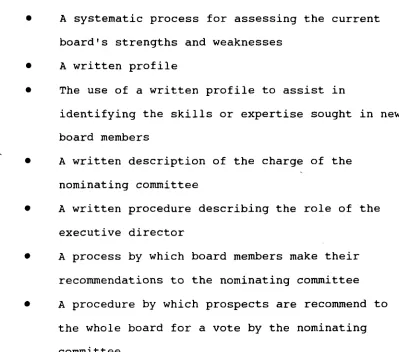
The prescriptive model is comprised of the following
elements:
Qualifications.
1. The board has and uses a systematic process for assessing the strengths and weaknesses of the current board members. Strengths and weaknesses are usually assessed regarding demographic
characteristics, expertise and skills, resulting in a board profile.
2. The profile is used to identify the personal characteristics and expertise and skills desired in new recruits to the board. Diversity is
3. The prospective board member gets a well-thought-out interview or meeting with two board members
(or with one member and the executive director), during which the candidate's motivation and
qualifications for joining the board are assessed relative to the board profile.
Governance structure.
4. The board has a committee charged with recruiting new board members. The committee is usually called the nominating committee or the membership
committee.
s.
The charge of the nominating committee is a matter of written record, either in the by-laws, board resolution, or other authoritative writtendirection. This record includes the role of the executive director in the recruitment, selection, and orientation processes.
6. Each board member takes responsibility for cultivating prospective members by making recommendations to the nominating committee.
7. Potential members are thoroughly informed about the mission and goals of the organization, its financial condition, and the time, effort, and level of financial contribution expected of them.
8. Potential board members are recommended by the nominating committee to the full board for approval.
Summary.
Board member selection is a very specific governance
activity of nonprofit boards. The literature on board
member selection tends to focus on more general concerns for
board governance such as board effectiveness and
organizational success. The literature on board member
selection can be organized into two general categories:
board member characteristics, and governance structure. The
result of the literature review provides a prescription for
literature i t is suggested that the success of a nonprofit
organization depends in part on the board, and that the
effectiveness of the board results from careful selection of
each board member (Nelson, 1992). No literature was found
that describes how board members are actually selected by
nonprofit human service organizations. The literature review
concludes with a synthesized model of board member
selection. This prescribed model is used for comparison with
research results illustrating how board members are actually
selected in ten 501(c)(3) human service organizations in
Chapter 3: Methodology
Introduction
The executive director, chair of the nominating
committee (or alternate), and the newest board member from
ten 501(c)(3) public charity human service organizations in
Santa Cruz County were interviewed to obtain a description
of the process used to select their newest board member. The
data from the interviews were used to answer the research
questions and to develop case studies for each
organization's process. Common elements that emerged from
the case studies are organized into a logical order and the
resultant process is identified as the actual model of
board member selection. The actual model is compared with
the model for board member selection prescribed in the
literature.
Subjects
Ten 501(c)(3) human service organizations in Santa Cruz
County, California with expenditures of $250,000 or more in
1991 were randomly selected for the study from a pool of
organizations that provide a range of services including:
family planning, legal assistance for seniors, shelter for
homeless individuals, and after-school day-care for
children. Interviews with the executive director, the
nominating committee chair (or alternate), and the newest
Four nominating committee chairs were interviewed for
this study. When no nominating committee chair was available
the executive director designated an alternate interviewee.
The alternates selected included three board presidents, two
board secretaries, and one board treasurer.
Research Design
Semi-structured interviews with the executive director,
nominating committee chair (or alternate), and the newest
board member from each of 10 randomly selected human
services organizations were used to obtain qualitative data.
A total of 30 one-hour interviews were completed. Each
interview was guided by an interview protocol. The questions
were open-ended. The interviews were recorded and notes were
taken.
The data resulting from the interviews provides
information to answer the research questions, identify
common elements, identify a model of the actual board member
selection process used by the 10 organizations, and provide
a brief case study for each organization relative to its
specific board member selection process.
This ethnography provides descriptive information on
how board members are actually selected .. These descriptions
were compared with the prescriptive model of board member
Instrumentation
The instrument for the study was the interview protocol
(Appendices B, C, and D). The protocol was developed to
elicit each subject's experience of hisjher organization's
most recent board member selection process. The interview
method was most appropriate for gathering descriptive
information. Open-ended questions elicited information which
may not have emerged from a completely structured interview
or a mailed survey questionnaire.
Personal background and agency demographic information
was obtained in the interview to provide a more detailed
profile of individuals and organizations participating in
the study.
Procedures
A random sample of 10 agencies was drawn from a
population of thirty two 501(c)(3) public charity,
charitable purpose human services organizations with
expenses of $250,000 or more in 1991 in Santa Cruz County.
The sampling frame was obtained from the California
Nonprofit Database at the University of San Francisco's
Institute for Nonprofit Organization Management. The model
for board member selection suggested by the literature
reflects processes that large educational and human service
organizations tend to follow. The sampling frame for this
study was selected because i t includes agencies large enough
by the literature. The type of agencies included within the
sampling frame are schools, food banks, skilled nursing
facilities, family planning centers, rehabilitation and job
training centers for the disabled, housing programs for the
mentally i l l , youth homes, drug treatment centers, and
senior services agencies.
The 32 organizations in the sampling frame were listed
in alphabetical order and numbered 1 through 32. All 32
organizations were selected using a random sample table.
Some of those contacted declined. Eighteen organizations
were contacted before the 10 required for the study agreed
to participate.
Interviews of 30 minutes to one hour were conducted
with the executive director, nominating committee chair (or
alternate), and the newest board member of each
organization. There were four nominating committee chairs.
Executive directors of organizations without nominating
committee chairs board officers as alternates. Thirty
interviews were completed with 10 executive directors, 10
nominating committee chairs or board officers, and 10 new
board members.
The interview protocol was used to guide the interview
and answer the research question, "How are board members
selected for 501(c)(3) human service organizations?" Each
interview was taped and notes were taken. Common elements
were identified among the actual processes used by the 10
The result is a description of how board members are
selected in these 10 nonprofit human service organizations.
Treatment of the Data
The research questions guided analysis of the tapes.
The data, in the form of the answers given during the
interviews, made possible the identification of common
elements among the organizations regarding their executive
directors, nominating committee members (or alternates), and
new board members perception of the most recent selection
process. The personal background and agency information
collected during the interviews provides additional detail
describing the 10 organizations collectively.
Each organization was assigned a letter "A" through
"J."
The taped interviews were the basis for 10 written casestudies covering the 10 organizations. The case studies
describe the actual board member selection process of each
organization. Elements of the board member selection process
common to each of the organizations in the study are
identified as the actual model. How board members are
actually selected is answered by the identification of the
actual model.
The actual process of board member selection described
by participants in the study is compared with the prescribed
model drawn from the literature. Differences between the
revealed in this study are considered. Conclusions are drawn
Chapter 4: Results
Introduction
This chapter reports the results of interviews with
executive directors, nominating committee chairs (or
alternates), and the newest board members in each of the 10
nonprofit human services organizations studied. The findings
of these interviews are divided into three sections.
Section A responds to research questions one through
six and contains an analysis of 20 interviews: 10 with the
executive directors and 10 with the nominating committee
chairs, (or alternates) of the 10 organizations
participating in this study.
Section B contains the case studies found in Appendix
E, lettered A through J. The case studies are the results of
30 interviews with the executive directors, nominating
chairs (or alternates), and new board members from each of
the 10 organizations studied. Table 6 presents general
patterns of the actual procedures that emerged from the
interviews about the selection processes used by the 10
organizations studied.
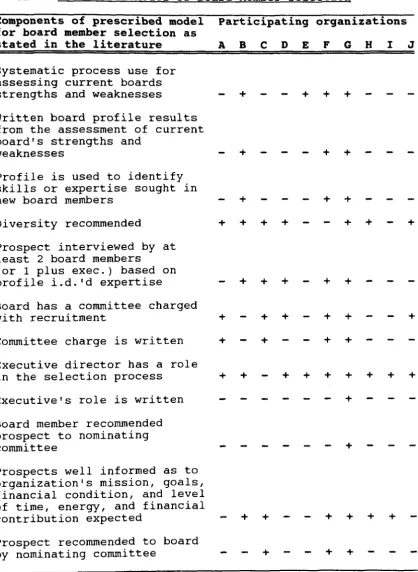
Section C reports on the prescriptive model of board
member selection identified as a result of the literature
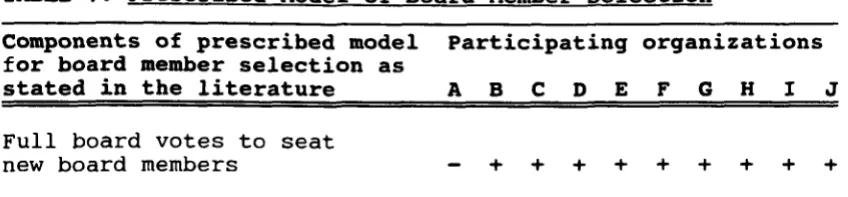
review. These are presented graphically in Table 7. The
findings regarding actual board member selection processes,
presented in Table 6, are compared with the prescriptive
The information contained in this chapter is intended
to identify procedures actually applied in the selection of
new board members to 501(c)(3) nonprofit human service
organizations.
Data Collection
Ten 501(c)(3) human service organizations with
expenditures of $250,000 or more located in Santa Cruz
County were randomly selected for this study from a sample
group of 32 similar organizations. After the random
selection, the organizations were relisted 1 through 32 in
the order they were drawn. The executive directors of 18
organizations were contacted before 10 agreed to
participate. Eight organizations declined to participate
citing time restraints.
Thirty interviews were conducted with three respondents
from each of the 10 organizations. Interviews were taped and
transcribed. Case studies were written and research
questions were answered based on the results of those
interviews. The data collected were used to identify actual
board member selection processes and to compare these to the
prescribed model that emerged from the literature review.
Participant Characteristics
The 10 organizations participating in this study were
selected randomly. Two of the 10 organizations studied were
by the membership of the organization rather than by the
board. One of these organizations followed a procedure by
which the board itself could appoint up to three individuals
to board seats. In such instances, the individual appointed
to a seat would have to be elected by the membership at the
next election in order to continue as a board member. Eight
organizations had self-perpetuating boards.
Ten executive directors were interviewed as were 10 new
board members. Six of the 10 new board members had served in
their organizations five months or less prior to being
interviewed for this study. The median length of board
service among the new board members interviewed was four
months in their respective organizations. The length of time
these members had served on these boards ranged from one
month to five years. The individual with five years of
service was counted as a new board member because he was
returning to an organization after a mandatory time-out
between consecutive board terms.
Four organizations had nominating committee chairs.
Executive directors of the six organizations without
nominating committee chairs chose board offers as alternates
to be interviewed for this study. Three of the six officers
chosen were board presidents. The four nominating committee
chairs, three board presidents, and the three other board
officers were interviewed, each representing one of the 10
executive directors from each of the 10 organizations
studied were also interviewed for a total of 30 interviews.
The researcher kept the names of the organizations
confidential to encourage candid responses by the subjects.
More information regarding the characteristics of the
individual subjects and participant organizations is listed
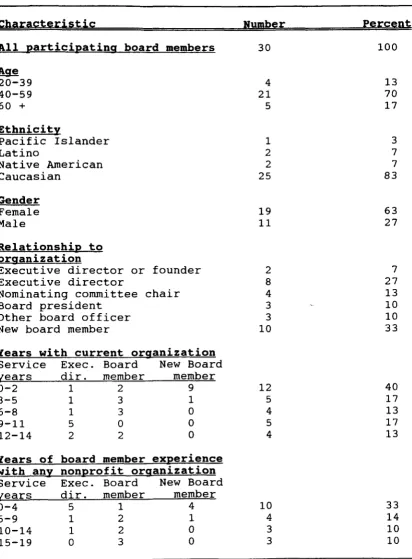
TABLE 1: Characteristics of Participating Board Members
Characteristic
All participating board members
Age
20-39 40-59 60 +
Ethnicity
Pacific Islander Latino
Native American Caucasian Gender Female Male Relationship organization to
Executive director Executive director
or
Nominating committee Board president
Other board officer New board member
founder
chair
Years with current organization
Service Exec. Board New Board years dir. member member
0-2 1 2 9
3-5 1 3 1
6-8 1 3 0
9-11 5 0 0
12-14 2 2 0
Years of board member experience with any nonprofit organization
Service Exec. Board New Board years dir. member member
0-4 5 1 4
5-9 1 2 1
10-14 1 2 0
15-19 0 3 0
Number 30 4 21 5 1 2 2 25 19 11 2 8 4 3 3 10 12 5 4 5 4 10 4 3 3
Source: Responses to interview questions
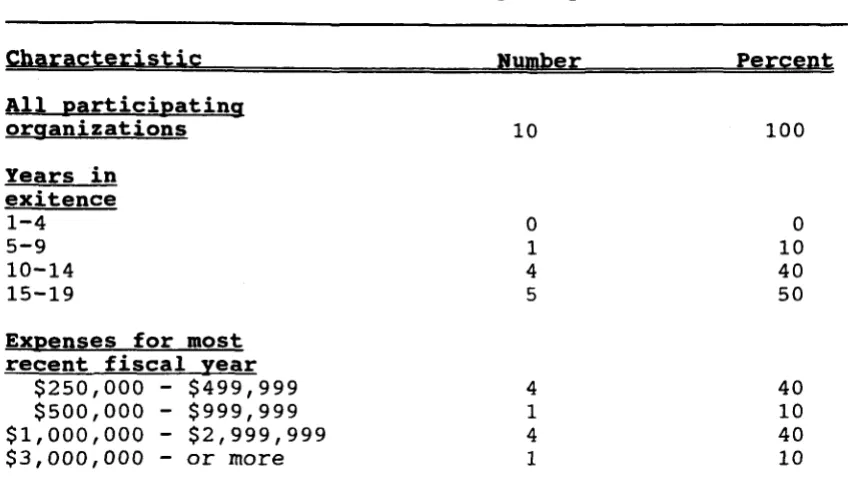
TABLE 2: Characteristics of Participating Organizations
Characteristic
All participating organizations
Years in exitence 1-4
5-9 10-14 15-19
Expenses for most recent fiscal year
$250,000 - $499,999 $500,000 - $999,999 $1,000,000 - $2,999,999 $3,000,000 - or more
Number
10
0
1
4 5
4 1 4
1
Source: Responses to interview questions
Percent
100
0 10 40 50
Findings
Research questions
Research questions one through six are listed and
analyzed in relation to the interviews with 10 executive
directors, four nominating committee chairs, three board
presidents, two board secretaries, and one board treasurer
who represented the 10 organizations studied. Therefore 20
interviews were conducted to answer research questions one
through six.
The responses of the new board members interviewed were
not applied to research questions one through six. New board
members were interviewed to gain their perspective as
outsiders on the selection processes used by the 10
organizations. The data collected through interviews with
the new board members provided information regarding the
actual selection processes used by each organization. These
are described in the case studies. However, the outsiders'
perspective of the new board members limited their ability
to relate adequately to issues addressed by the research
questions one through six, so their responses were not
applied.
1. Is i t difficult for nonprofit organizations to find
qualified board members?
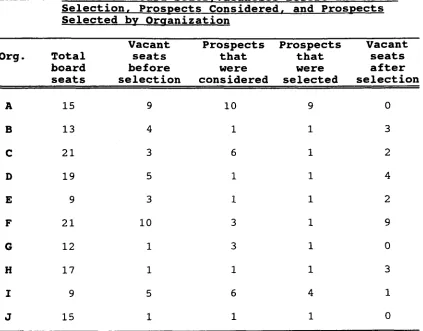
Table 3 identifies the number of board of director
seating of the most recent board member, the number of
prospects considered for the vacant seats, the number of
seats actually filled, and the number of seats remaining on
the board at the conclusion of the most recent selection
process for each of the 10 organizations. The bylaws of two
organizations allow for a variable number of board members;
one from 13 to 19 members, and the other from 11 to 21. The
higher number of allowable seats was the number used for
compiling these research findings.
The median number of directors' seats in the 10
organizations studied was 15, within a range of nine to 21.
During the most recent selection process a total of 42 seats
were vacant, and 33 prospects were considered for these
vacant seats. Twenty-one new board members were actually
~
seated as a result of the most recent selection processes.
After the most recent board member selection process had
been completed, the median number of board seats remaining
vacant was two. The number of remaining vacancies on each
board ranged from a zero to nine.
Upon completion of the most recent selection, 70
percent of the organizations continued with at least one
vacant seat. The length of time each board operated with at
least one vacant seat ranged from one month to 11 years,
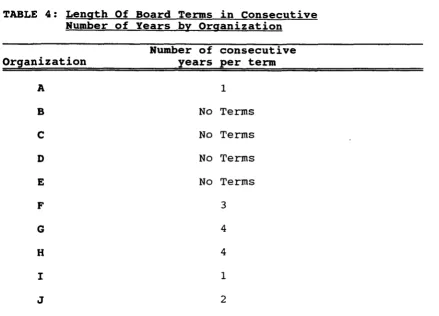
with a median of 15 months. Sixty percent of the
organizations have terms for board members ranging from one
to four years in length with the average board term among
(1986) suggest that board terms be no longer than three
years. The median board term for the 10 organizations in
this study was one year. Table 4 provides information
TABLE 3: Number of Board Seats,Vacancies Before and After Selection, Pros~ects Considered, and Pros~ects
Selected by Organization
Vacant Prospects Prospects Vacant
Org. Total seats that that seats
board before were were after
seats selection considered selected selection
A 15 9 10 9 0
B 13 4 1 1 3
c
21 3 6 1 2D 19 5 1 1 4
E 9 3 1 1 2
F 21 10 3 1 9
G 12 1 3 1 0
H 17 1 1 1 3
I 9 5 6 4 1
J 15 1 1 1 0
TABLE 4: Length Of Board Terms in Consecutive Number of Years by Organization
Number of consecutive Organization years per term
A 1
B No Terms
c
No TermsD No Terms
E No Terms
F 3
G 4
H 4
I 1
J 2
Seventy-five percent of the 20 individuals interviewed
believed i t is difficult to find qualified candidates to
fill vacancies on their boards. The three most mentioned
obstacles to filling board vacancies were:
(1) finding people who have the time to give and the
commitment to accomplishing the work of_the board;
(2) finding community members who possess the skills
and qualifications being sought; and
(3) the difficulty in identifying recruits who will
help balance the ethnic diversity represented on
the board.
Other common difficulties in filling board seats
include a lack of clarity among current board members
regarding the priority of characteristics sought in new
board members, and recruitment of individuals when
fundraising is an expectation of board service. One
executive director summed up the effort to find board
members by saying, "It is a constant process; we never let
i t go."
In conclusion, i t is difficult for most nonprofit
organizations to fill vacancies on their boards of
directors, and vacant seats are a matter of routine. Board
member selection is part of the ongoing work of boards of
directors. The organizations profiled in this study place a
higher priority on selecting skilled board members than on
filling vacant seats. Carver (1990) suggests that any
board member selection should clearly state this priority.
The consensus among those interviewed in this study is that
the essential characteristics desired in new board members
are: a commitment to give the time required to complete
board tasks; willingness to participate in fundraising; and
ethnic identity that enhances the ethnic diversity of the
board.
2. How are the strengths and weaknesses of a prospective
board member ascertained?
Nine of the 10 organizations studied had some process
for determining the characteristics they desired in new
board members. Four of the 10 have written procedures
detailing this process. Only 3 of the 10 compiled a written
matrix or board profile identifying the current board's
expertise and demographics as a method of specifying those
characteristics sought in prospective board members.
The processes reported in the interviews ranged from
such informal means as the executive director calling the
board's attention to an increasing number of vacancies on
the board, brainstorming with the board about what expertise
they felt was needed, and suggesting an individual for
recruitment, to formal procedures such as a presentation by
the nominating committee chair at a board meeting,
suggestion of prospects from a list of groomed individuals
whose qualifications closely matched a written matrix
members. These processes, however intuitive or formalized,
set the standard against which prospective board member's
strengths or weaknesses were measured.
In her 1992 study to identify characteristics of "good
boards" as defined by executive directors, Fletcher found
that "good boards" choose new members with regard to
specific skills they will bring to the organization. Houle
(1990) and Herman (1989) also prescribe a process for the
identification and evaluation of characteristics sought in
prospective board members.
Two of the 10 organizations in the present study are
membership organizations in which the board itself does not
select board members, except in special situations. Instead,
board members are selected by the membership of the
organization during elections at an annual meeting. The
election process is formalized in the bylaws of these
organizations. Respondents from both these organizations
stated that there is no "real evaluation" of prospective
board members, (or in this case nominees) prior to election.
However, in one of these organizations, the most recent
board member was appointed by the board. In this case the
individual had served four years as a board member but had
to leave the board because he had served the maximum number
of successive terms. After passing a mandatory period of
time off the board, he was seated a second time by
appointment, without an interview, by a vote of the whole
Eight of the 10 organizations (excluding the two
membership organizations) followed an interview procedure to
assist in evaluating prospective board members. Half of
these organizations conducted interviews through interview
committees composed of a combination of nominating committee
chairs, board officers, andjor executive directors. One
organization had a staff member other than the executive
director on the interview committee. Interviews were usually
conducted after a board candidate had completed an
application which stated demographic information, interest
in serving, and areas of expertise. Two of the 10
organizations conducted interviews at a regular board
meeting with the prospect present.
Prior to these interviews there were various internal
conversations, both formal and informal, that assisted the
evaluation of the prospect's strengths and weaknesses. In
nine of the 10 organizations either the executive director,
nominating chair, or an officer of the board had at least
one contact with the prospect. During these contacts
qualifications were discussed and the prospect's interest in
serving was clarified. In six of the 10 organizations i t was
the executive director or the nominating committee chair who
had the first contact with the prospect.
After the first conversation with the board as a whole
and prior to formal seating of the new board member, all 20
of those interviewed rated the recruit as desirable for
"very desirable." For the most recent member selection nine
of the 10 boards conducted a final vote which formally
seated the new board member. The one organization that did
not do this was the membership organization in which the
most recent board member was elected by the general
membership at the annual meeting. The vote by the whole
board of the nine organizations was the final step in the
evaluation of the new board member's strengths and
weaknesses and the last approval necessary to fill vacant
board seats.
Seventy percent of those interviewed believed that
prospective board members are well informed about the
mission, goals, and financial condition of the organization
prior to being seated. However, 60 percent believed that
there was a general lack of clarity on the part of the
organization regarding expectation of a financial
contribution from the prospect.
In conclusion, most organizations follow some process
for identifying standards by which prospective board
members' strengths and weaknesses will be measured, but few
formalize these standards into written policy and
procedures. Recruits are interviewed by board
representatives and, with the exception of membership
organizations, a vote by the full board is required to
formally seat new board members. All of the individuals who
were seated were desired by the organization in advance of