* Corresponding author. Tel: +381 18500687 Fax: +381 18 588244 E-mail: [email protected] (M. Madić)
© 2014 Growing Science Ltd. All rights reserved. doi: 10.5267/j.ijiec.2014.1.002
International Journal of Industrial Engineering Computations 5 (2014) 223–234
Contents lists available at GrowingScience
International Journal of Industrial Engineering Computations
homepage: www.GrowingScience.com/ijiec
Optimization of machining processes using pattern search algorithm
Miloš Madić* and Miroslav Radovanović
Faculty of Mechanical Engineering in Niš, University of Niš, A. Medvedeva 14, 18000 Niš, Serbia C H R O N I C L E A B S T R A C T
Article history: Received October 2 2013 Received in revised format November 7 2013
Accepted January 10 2014 Available online January 14 2014
Optimization of machining processes not only increases machining efficiency and economics, but also the end product quality. In recent years, among the traditional optimization methods, stochastic direct search optimization methods such as meta-heuristic algorithms are being increasingly applied for solving machining optimization problems. Their ability to deal with complex, multi-dimensional and ill-behaved optimization problems made them the preferred optimization tool by most researchers and practitioners. This paper introduces the use of pattern search (PS) algorithm, as a deterministic direct search optimization method, for solving machining optimization problems. To analyze the applicability and performance of the PS algorithm, six case studies of machining optimization problems, both single and multi-objective, were considered. The PS algorithm was employed to determine optimal combinations of machining parameters for different machining processes such as abrasive waterjet machining, turning, turn-milling, drilling, electrical discharge machining and wire electrical discharge machining. In each case study the optimization solutions obtained by the PS algorithm were compared with the optimization solutions that had been determined by past researchers using meta-heuristic algorithms. Analysis of obtained optimization results indicates that the PS algorithm is very applicable for solving machining optimization problems showing good competitive potential against stochastic direct search methods such as meta-heuristic algorithms. Specific features and merits of the PS algorithm were also discussed.
© 2014 Growing Science Ltd. All rights reserved Keywords:
Machining Optimization
Pattern search algorithm
1. Introduction
Wide spectrum of optimization methods and algorithms has been proposed for solving machining optimization problems (Dixit & Dixit, 2008; Mukherjee & Ray, 2006; Zhang et al., 2006). Some of these include analytical, classical optimization and artificial intelligence methods. In an early work, Gilbert (1950) presented an analytical approach for the selection of optimal cutting speed in a single pass turning process. Armarego and Brown (1969) reported the application of differential calculus for solving unconstrained machining optimization problem. Bhattacharya et al. (1970) applied Lagrange’s method for optimization of unit cost in turning process, subject to the constraints of surface roughness and cutting power. Many references presented the application of linear, non-linear, geometric and dynamic programming methods.
Linear programming was used in the early stage of optimization of machining process (Ermer & Patel, 1974). Later on, Tan and Creese (1995) used a sequential method based on linear programming for optimization of multi-pass turning operation. An approach based on the use of integer linear programming was presented by Gupta et al. (1995) for optimization of machining cost. Linear programming methods are fast and reliable (Al-Sumait et al., 2007), but both objective function and constraint equation(s) are linear functions. As machining optimization problems are mostly complex and non-linear in nature, linear programming methods do not provide an adequate answer, or may not be appropriate for many such problems. Multi-modal objective functions and consideration of multiple non-linear objective functions justify the use of non-linear programming methods (Mukherjee and Ray, 2006). Geometric programming was earlier used for solving different machining optimization problems. Ermer (1971), Petropoulos (1973) and Lambert and Walvekar (1978) applied geometric programming for solving constrained machining economics optimization problems. Sönmez et al. (1999) used geometric and dynamic programming for optimization of multi-pass slab milling and face milling for maximum production rate. The geometric programming method could not become popular for two reasons. First, the constraints and objective functions must be expressible in the form of a polynomial and second, as the number of constraints increase, the degree of difficulty in solving a geometric programming problem increases (Dixit & Dixit, 2008).
Dynamic programming has been applied for solving sequential and multi-stage optimization problems (Shin & Joo, 1992; Hayers & Davis, 1979; Sekhon, 1982)and goal programming was earlier used to solve multi-objective non-linear machining optimization problems (Sundaram, 1978; Philipson & Ravindran, 1978; El-Gizawy & El-Sayed, 2002). The aforementioned mathematical programming optimization methods are mostly gradient-based, and they possess many limitations in the application for solving machining optimization problems including: (i) inability to deal with integer/discrete input variables (Zhang et al., 2006), (ii) inclined to obtain a local optimal solution (Yildiz, 2009; Rao & Pawar, 2010; Debroy & Chakraborty, 2013) (iii) a judicious choice of an initial starting point in the input space is required (Zhang et al., 2006; Debroy & Chakraborty, 2013), (iv) slow convergence, (v) lack of robustness (Rao & Pawar, 2010) and (vi) inability to handle the overall machining process complexities due to large number of inter-dependent input variables and their stochastic relationships (Markos et al., 1998).
M. Madić and M. Radovanović / International Journal of Industrial Engineering Computations 5 (2014)
hybrid method by combining immune algorithm with a hill climbing local search algorithm for solving multi-pass turning operation. Also, hybridization of simulated annealing and Hooke-Jeeves algorithm (Chen & Tsai, 1996), genetic algorithm and simulated annealing (Wang et al., 2004), Taguchi’s method and genetic algorithm (Yildiz & Ozturk, 2006), etc., proved the effectiveness and efficiency of combined approach for solving machining optimization problems.
Although the popularity of the meta-heuristic algorithms is ever increasing, they are plagued by their own limitations including (Kovačević et al., 2013; Yildiz, 2009): (i) the optimality of the determined solution is impossible to prove, (ii) algorithm parameters settings have a strong influence on the final optimization solution, (iii) there is no universal rule for setting the algorithm parameters and (iv) even expert knowledge in meta-heuristics, systematical selection of the algorithm parameters, as well as understanding of the optimization problem being solved, do not guarantee the optimality of the obtained solution, (v) premature convergence to a local minimum and poor exploitation abilities. Apart from meta-heuristic algorithms, the potential for solving machining optimization problems also have other optimization methods that are conceptually simpler. In recent years, direct search methods have received renewed interest due to new mathematical analysis, their suitability for parallel and distributed computing, and their utility in addressing optimization problems that involve complex computer simulations (Lewis & Torczon, 2011). Direct search methods as one of the earliest numerical optimization methods, formally proposed in the late 1950s and early 1960s, have remained popular with users due to their (Macklem, 2006; Lewis et al., 2000; Lewis & Torczon, 2011): (i) ease of implementation and formulation requiring setting of only few parameters, (ii) flexibility, reliability and practical success in solving a wide range of non-continual, non-differentiable and multimodal optimization problems, (iii) features unique to direct search methods often avoid the pitfalls that can plague more sophisticated approaches, (iv) robustness in locating at least local optimal solutions. Historically direct search methods can be classified into pattern search (PS) methods, simplex methods, and methods with adaptive sets of search directions (Lewis et al., 2000). The development and results of Torczon's multidirectional search (Torczon, 1989), generalized pattern search (Torczon, 1997), generating set search (Kolda et al., 2003) and mesh adaptive direct search (Audet and Dennis, 2006) renewed interest in the application of direct search methods for solving nonlinear optimization problems. Direct search methods neither compute nor approximate derivatives, instead, they work directly with values of the objective function to drive the search for an optimal point (Lewis & Torczon, 2011). They generate search points according to a pattern, around the current point, and accept points, which improve the objective function. Many of the direct search methods are based on surprisingly sound heuristics that fairly recent analysis demonstrates guarantee global convergence behavior analogous to the results known for globalized quasi-Newton techniques (Lewis et al., 2000).
The main objective of this paper is to introduce the use of PS algorithm to the subject of machining optimization, which to the best of the authors’ knowledge, has not been previously applied in this field. This paper aims at investigating applicability and performance of conceptually simple PS algorithm for solving single and multi-objective machining optimization problems. The machining optimization application examples considered are taken from scientific resource bases, such as Springer, Elsevier, and Sage. The paper is organized as follows. After introduction, the brief description of the PS algorithm is given in the second section. In the third section, six case studies of machining optimization problems were considered. In each case study optimization solutions obtained by previous researchers using meta-heuristic algorithms and optimization solutions obtained using the PS algorithm were compared and discussed. Findings and observations are summarized in the last section.
2. Pattern search algorithm
The PS algorithm uses a set of vectors {vi}, called a pattern, to determine which points to search at each
iteration. The pattern is defined by the number of independent variables of the objective function, N, and the positive basis set. Two commonly used ones are the maximal basis, with 2N vectors (v1=[1 0
0], v2=[0 1 0], v3=[0 0 1], v4=[-1 0 0], v5=[0 -1 0], v6=[0 0 -1]), and the minimal basis, with N+1
vectors (v1=[1 0 0], v2=[0 1 0], v3=[0 0 1], v4=[-1 -1 -1]).
At each iteration, the PS algorithm searches a set of points, called a mesh, around the current point(the point computed at the previous step of the algorithm) for a point that improves the objective function value. The mesh is formed by (MathWorks, 2012):
1. Generating a set of vectors {di} by multiplying each pattern vector viby a scalar Δm, called the
mesh size.
2. Adding the current point to the {di}.
The pattern vector that produces a mesh point is called its direction. After generation of mesh the PS algorithm polls the points in the current mesh by computing their objective function values. If the PS algorithm finds a point in the mesh that improves the objective function value, the new point becomes the current point in the next iteration. In this case the mesh size Δm is multiplied by 2 (expansion
factor). Otherwise, the poll is called unsuccessful, the current point remains in the next iteration and the mesh size Δm is multiplied by 0.5 (contraction factor). The PS algorithm stops when any of the
following conditions occurs (MathWorks, 2012):
The mesh size is less than mesh tolerance.
Maximal number of iterations is reached.
Total number of objective function evaluations is reached.
Time limit is reached.
The distance between the point found in two consecutive iterations and the mesh size are both
less than a set tolerance.
The change in the objective function in two consecutive iterations and the mesh size are both less than function tolerance.
It should be noted that the implementation of the PS algorithm in the Matlab programming environment allows for customization of the PS algorithm by defining polling, searching, and other functions. For a detailed description of the PS algorithm, its variants and other direct search algorithms refer to Lewis et al., (2000), Torczon, (1989, 1997), Kolda et al. (2003) and Audet and Dennis, (2006).
3. Case studies
To investigate the applicability of the PS algorithm for solving machining optimization problems, six research papers dealing with machining optimization were considered. In order to facilitate validation and comparison of obtained optimization solutions this paper considered only mathematical models developed using polynomial equations. For the purpose of optimization, the related m.files for the considered mathematical models were developed in Matlab. In an initial attempt this study was not focused on the analysis of the effects of main control parameters of the PS algorithm on the quality of optimization solutions obtained and convergence speed. Therefore in all case studies considered the PS algorithm was implemented with the following values of main control parameters.
Poll Mesh
poll method: maximal basis 2N initial size: 1
complete poll: off expansion factor: 2
M. Madić and M. Radovanović / International Journal of Industrial Engineering Computations 5 (2014)
Prior to the application, the PS algorithm takes at least two input arguments, namely the definition of the mathematical model i.e. objective function and a start point – initial solution. For each case study the optimization was attempted starting from three different initial solutions that are: all machining parameter values set on low level (–1) – “PS solution 1”, all machining parameter values set on centre level (0) – “PS solution 2” and all machining parameter values set on high level (+1) – “PS solution 3”. All computations were run on Intel Core2Duo T5800 with 4 GB RAM.
3.1. Single objective machining optimization examples
3.1.1. Abrasive waterjet machining
Çaydaş and Hasçalik (2008) investigated the abrasive waterjet machining process through the application of artificial neural networks and regression analysis. Using the obtained experimental data the authors developed mathematical models to predict surface roughness (Ra) using machining
parameters of traverse speed (V), waterjet pressure (P), standoff distance (h), abrasive grit size (d) and abrasive flow rate (m). The final mathematical model for the prediction of Ra was obtained as:
(1)
The range of machining parameter values used in experimental process was selected to present the constraints of the optimization problem as given in Eq. (2).
mm/min
150 V
50
(2)
(MPa) 250 P
125
(mm) 4 h
1
(µm) 120 d
60
(g/s) 3.5 m
0.5
Considering the constraints given in Eq. (2), the PS algorithm was used to optimize Eq. (1). The obtained optimization solutions and optimization solutions obtained by past researches using meta-heuristic algorithms (Zain et al., 2011; Yusup et al., 2013) are given in Table 1.
Table 1
Comparison of optimization solutions for abrasive waterjet machining process
Approach V (mm/min) P (MPa) h
(mm) d (µm)
m
(g/s) Minimal Ra
Computational time (s)
Number of iterations
GA Zain et al. (2011) 50.024 125.018 1.636 94.73 0.525 1.5549
SA Zain et al. (2011) 50.003 125.029 1.486 107.737 0.5 1.5355
ABC Yusup et al. (2013) 50 125 1.55 102.521 0.5 1.5223
PS
PS solution 1 50 125 1.545 102.494 0.5 1.5223 1.16 66
PS solution 2 50 125 1.545 102.494 0.5 1.5223 1.53 88
PS solution 3 50 125 1.545 102.494 0.5 1.5223 1.78 104
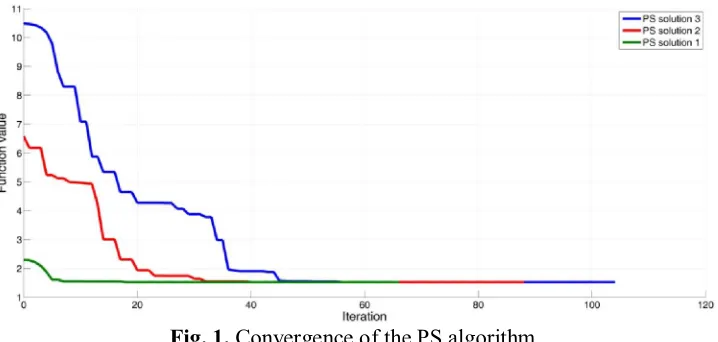
It can be observed from Table 1 that the PS algorithm gives better results than the genetic algorithm (GA) and simulated annealing (SA) obtained previously by (Zain et al., 2011). The optimization results are comparable with the results of ABC algorithm as previously reported by Yusup et al. (2013). The optimization results indicate that PS algorithm, starting from three different initial points, successfully avoided the local minimum entrapment problem. However, it should be noted that in this case study the initial point had great impact on the convergence speed of the PS algorithm (Fig. 1). As can be observed only 66 iterations were needed to find the optimal solution when starting the optimization from lower bound [50 125 1 60 0.5] as initial point, whereas 104 iterations were needed when starting
2 2 2
2 2
5.07976 0.08169 0.07912 0.34221 0.08661
0.34866 0.00031 0.00012 0.10575
0.00041 0.07590 0.00008 0.00009
0.03089 0.00513
a
R V P h d
m V P h
d m V m P m
h m d m
the optimization from upper bound [150 250 4 120 3.5] as initial point. Considering that the surface roughness mathematical model was complex having five independent variables as well interaction and quadratic terms, the computational time less than 2s indicate that the application of PS algorithm represents an efficient alternative for solving machining optimization problems.
Fig. 1. Convergence of the PS algorithm
3.1.2. Turning process
In an attempt to optimize turning parameters so as to minimize surface roughness, Bhushan et al. (2012) presented an integrated approach consisting of regression analysis and GA. On the basis of the experimental results, Bhushan et al. (2012) developed the following mathematical model for the prediction of surface roughness:
(3)
where A= cutting speed, B= feed rate, C= depth of cut and D= nose radius.
The range of machining parameter values used in experimental process was selected to present the constraints of the optimization problem as given in Eq. (4).
(m/min) 210 A
90
(4)
(mm/rev) 0.25
B
0.15
(mm) 0.6 C
0.2
(mm) 1.2 D
0.4
The optimization solution of the afore-mentioned optimization problem using the PS algorithm and optimization solution obtained Bhushan et al. (2012) are given in Table 2.
Table 2
Comparison of optimization solutions for turning process
Approach Cutting speed (m/min)
Feed rate (mm/rev)
Depth of cut (mm)
Nose radius
(mm) Minimal Ra Computational
time (s)
Number of iterations
GA Bhushan et al. (2012) 207.055 0.151 0.201 1.199 1.06509*
PS
PS solution 1 90 0.15 0.2 1.2 1.28744 1.14 40
PS solution 2 210 0.15 0.2 1.2 1.04984 1.41 82
PS solution 3 210 0.15 0.2 1.2 1.04984 1.18 56
*
Corrected value
Unlike the previous study, although the objective function was simpler containing fewer independent variables, local solution entrapment was observed. However, comparison of optimization results from
2
2
0.72412 0.00324 0.19694 4.19915 0.18753 0.0000174
3.42419 3.33125 0.56484
a
R A B C D A
C B C C D
M. Madić and M. Radovanović / International Journal of Industrial Engineering Computations 5 (2014)
Table 2 indicate that the PS algorithm yielded better results than the GA obtained previously by Bhushan et al. (2012).
3.1.3. Turn-milling machining process
Savas and Ozay (2008) investigated tangential turn-milling machining process. The study was aimed at determination of optimum machining parameter values at which surface roughness is minimal by using GA. According to the experiment data obtained the following mathematical model for surface roughness was obtained:
2 2
0.000008 0.0082 2.8734 0.00003 0.0135 1.9924
0.0171 0.4677 0.2525 0.4087 5.3
a
R N N n n
f a
(5)
where N= workpiece speed, n= tool speed, f= feed rate and a= depth of cut.
The constraints for the machining parameters used in optimization are given in Eq. (6).
(rev/min) 700
N
300
(6)
(rev/min) 00
3 n
150
(mm/min) 20
f
3
(mm) 1 D
0.1
The optimization solution of the afore-mentioned optimization problem using the PS algorithm and optimization solution obtained by Savas and Ozay (2008) are given in Table 3.
Table 3
Comparison of optimization solutions for turn-milling machining process
Approach Workpiece speed (rev/min)
Tool speed (rev/min)
Feed rate (mm/min)
Depth of cut
(mm) Minimal Ra
Computational time (s)
Number of iterations
GA Savas and Ozay (2008) 511.9 224.9 3.2 0.1 0.439437*
PS
PS solution 1 512.5 225 3 0.1 0.436558 1.24 62 PS solution 2 512.5 225 3 0.1 0.436558 1.28 66 PS solution 3 512.5 225 3 0.1 0.436558 1.51 78
*
Corrected value
Analysis of obtained optimization results given in Table 3 indicates again the efficiency of the PS algorithm in determining optimization solution which is better than the one obtained by the GA.
3.1.4. Drilling process
Kilickap et al. (2011) presented a GA based methodology for optimization of drilling parameters considering surface roughness as objective function in drilling of AISI 1045. Mathematical prediction model of the surface roughness was obtained as
, (7)
where x1 = cutting speed, x2 = feed rate, x3 = cutting environment.
The constraints for the machining parameters used in optimization are given in Eq. (8).
(m/min) 15 x
5 1
(8)
(mm/rev) 3
0 x
0.1 2 .
3 x
1 3
The optimization solution of the afore-mentioned optimization problem using the PS algorithm and optimization solution obtained Kilickap et al. (2011) are given in Table 4.
2
1 2 3 1
4.115 0.82767 8.225 0.135 0.0538
a
Table 4
Comparison of optimization solutions for drilling process
Approach Cutting speed (m/min)
Feed rate
(mm/rev) Cutting environment Minimal Ra
Computational time (s)
Number of iterations
GA Kilickap et al. (2011) 7.62 0.1 1 1.89
PS
PS solution 1 7.692 0.1 1 1.88924 1.04 48
PS solution 2 7.692 0.1 1 1.88924 1.13 68
PS solution 3 7.692 0.1 1 1.88924 1.21 70
Optimization solutions obtained by the PS algorithm are comparable with the optimization solutions obtained by using the GA. It can be also observed that convergence to the optimal point of the PS algorithm was not affected by the selection of initial point.
3.2. Multi-objective machining optimization examples
In multi-objective optimization of the machining processes, instead of treating two objective functions (responses) separately, both are to be simultaneously optimized.
3.2.1. Electrical discharge machining process
Maji and Pratihar (2011) modeled input-output relationships of an electrical discharge machining process based on the experimental data (collected according to a central composite design) using regression analysis. Three machining parameters, such as peak current (Ip), pulse-on-time (Ton) and
pulse-duty-factor (t), and two process responses, namely, material removal rate (MRR) and surface roughness (SR) were considered in the study. Both MRR and SR were expressed separately, as given in Eq. (9) and Eq. (10), respectively:
5 2
7 2 4 2 5
5
0.112931 0.0170470 0.000222059 0.0190297 7.23331 10
2.43026 10 3.03374 10 1.58294 10
0.00148333 3.96310 10
p on p
on p on
p on
MRR I T t I
T t I T
I t T t
(9) (10)
Maji and Pratihar (2011) formulated the multi-objective problem considering both MRR and SR as given bellow:
Maximize 1/
subject to: 6 18 (A),
50 750 (μs),
4 12. p
on
Y MRR SR
I I t (11)
The obtained optimization solution obtained using the PS algorithm and the solution obtained by Maji and Pratihar (2011) by using the binary coded GA are compared in Table 5.
Table 5
Comparison of optimization solutions for electrical discharge machining process
Approach Peak current, Ip (A)
Pulse-on-time, Ton (µs)
Pulse-duty-factor, t Y
MRR (g/min) SR (µm) Computational time (s) Num. of iterations GA Maji & Pratihar, 2011 17 138 11 0.745349 0.608957 7.331776
PS
PS solution 1 18 50 12 0.833964 0.676512 6.351134 0.85 32 PS solution 2 18 50 12 0.833964 0.676512 6.351134 0.9 42 PS solution 3 18 50 12 0.833964 0.676512 6.351134 0.98 50
2
6 2 2
4
1.76966 0.882071 0.00686577 0.447132 0.0373631
9.89173 10 +0.0221831 0.000517857
0.0109375 2.76786 10
p on p
on p on
p on
SR I T t I
T t I T
I t T t
M. Madić and M. Radovanović / International Journal of Industrial Engineering Computations 5 (2014)
The obtained optimization results indicate that the PS algorithm can be efficiently used for solving multi-objective machining optimization problems formulated based on classic weighted sum method. Fast computational time and avoidance of local optima entrapments confirm the validity on the use of the PS algorithm. From Table 5, it is obvious that the optimal solution obtained by the PS algorithm actually represents the boundary points of the machining parameter values in the covered experimental hyperspace.
3.2.2. Wire electrical discharge machining process
Rao and Pawar (2009) investigated the wire electrical discharge machining (WEDM) process. The authors developed mathematical models for correlating different machining parameters and cutting speed (Vm) and surface roughness (Ra). The developed mathematical models by for Vm and Ra are
given by Eqs. (12) and (13), respectively, whereas Eq. (14) gives the surface roughness constraint.
1 2 3 4 1 2
1 3 1 4 2 3 2 4
2 2 2 2
3 4 1 2 3 4
1.555 0.1095 0.187 0.0929 0.1279 0.0393
0.0793 0.01188 0.01688 0.0493
0.0606 0.03219 0.02031 0.0909 0.06094
m
V x x x x x x
x x x x x x x x
x x x x x x
(12)
1 2 3 4 1 2
1 3 1 4 2 3 2 4
2 2 2 2
3 4 1 2 3 4
3.6 0.2979 0.2979 0.1479 0.03542 0.021875
0.2031 0.04062 0.01562 0.1531
0.1031 0.3182 0.3807 0.4057 0.2682
a
R x x x x x x
x x x x x x x x
x x x x x x
(13)
0
per a
R R (14)
where x1 = pulse-on time, x2 = pulse-off time, x3 = peak current, x4 = servo feed setting and Rper is the
permissible value of surface roughness.
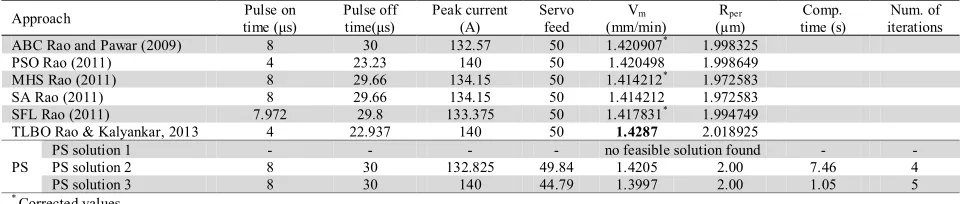
The upper and lower bound values for the machining parameters used by Rao and Pawar (2009) are as given as: pulse-on time (µs) = 4 – 8; pulse-off time (µs) = 10 – 30; peak current (A) = 90 – 140; servo feed setting = 30 – 50. In order to determine optimal machining parameter values such that permissible surface value of Rper = 2 μm is obtained and cutting speed is maximized at the same time, different
meta-heuristic algorithms were previously applied (Rao & Pawar, 2009; Rao, 2011; Rao & Kalyankar, 2013) (Table 6). For solving nonlinear constraint problems, as in this case study, the PS algoritm uses augmented Lagrangian approach, in which the bounds and linear constraints are handled separately from nonlinear constraints. A subproblem is formulated by combining the objective function and nonlinear constraint function using the Lagrangian and the penalty parameters. A sequence of such optimization problems are approximately minimized using the PS algorithm such that the linear constraints and bounds are satisfied (MathWorks, 2012). The optimization solutions obtained using the PS algorithm are given in Table 6.
Table 6
Comparison of optimization solutions for wire electrical discharge machining process
Approach Pulse on time (μs)
Pulse off time(μs)
Peak current (A)
Servo feed
Vm
(mm/min)
Rper
(µm)
Comp. time (s)
Num. of iterations ABC Rao and Pawar (2009) 8 30 132.57 50 1.420907* 1.998325
PSO Rao (2011) 4 23.23 140 50 1.420498 1.998649 MHS Rao (2011) 8 29.66 134.15 50 1.414212* 1.972583 SA Rao (2011) 8 29.66 134.15 50 1.414212 1.972583 SFL Rao (2011) 7.972 29.8 133.375 50 1.417831* 1.994749 TLBO Rao & Kalyankar, 2013 4 22.937 140 50 1.4287 2.018925
PS
PS solution 1 - - - - no feasible solution found - - PS solution 2 8 30 132.825 49.84 1.4205 2.00 7.46 4
PS solution 3 8 30 140 44.79 1.3997 2.00 1.05 5
*
Corrected values
when starting the optimization from lower bound [4 10 90 30] as the initial point. PS optimization led to the maximum Vm of 1.3997 mm/min (local maximum) when starting the optimization from upper
bound [8 30 140 50] as the initial point. However, the best obtained solution by the PS algorithm was obtained when starting the optimization from [6 20 115 40] as the initial point. It is interesting to note that this solution was found only in four iterations, requiring however, computational time of about 8 s. When comparing the optimization solution obtained by the PS algorithm with the solutions of other meta-heuristic algorithms it can be observed that the PS algorithm solution is comparable to the solution obtained by the particle swarm optimization (PSO) algorithm, and better than solutions obtained by SA, shuffled frog leaping (SFL) algorithm and modified harmony search (MHS) algorithm, all reported by Rao (2011). As can be seen from Table 6, the best optimization solution was obtained by the artificial bee colony (ABC) algorithm (Rao and Pawar, 2009).
4. Conclusions
This paper has introduced a new approach based on the PS algorithm for solving machining optimization problems. The PS algorithm has been used to solve both the single- and multi-objective optimization problems which had been solved by the past researchers using meta-heuristic algorithms. The conclusions of this research are summarized in the following points:
Convergence of the PS algorithm, i.e. the number of required iterations and computational time greatly depends on the selection of the initial solution. The effectiveness of the PS algorithm appears to rely on how close the initial point is to the optimal point.
Unlike meta-heuristic algorithms, the PS algorithm consistently produces the same solutions when the optimization is started from the same initial point.
In the case of solving single-objective optimization problems, the optimization solutions obtained by the PS algorithm are better or at least comparable with the optimization solutions obtained by using meta-heuristic algorithms such as GA, SA and ABC algorithm.
The PS algorithm can be efficiently used for solving multi-objective machining optimization problems formulated on the basis of the classic weighted sum method.
Although the PS algorithm has yielded comparable or better optimization solutions than the optimization solutions obtained by several meta-heuristic algorithms such as PSO, SA, SFL and MHS, when solving nonlinear constrained machining optimization problems, the PS algorithm has faced convergence problems. The comparative analysis of optimization results has indicated that the priority in this case should be given to the ABC algorithm, which has powerful mathematical tools to guide the exploration of optimization space.
M. Madić and M. Radovanović / International Journal of Industrial Engineering Computations 5 (2014) Acknowledgments
This work was carried out within the project TR 35034, financially supported by the Ministry of Science and Technological Development of the Republic of Serbia.
References
Al-Sumait, J.S., Al-Othman, A.K., & Sykulski, J.K. (2007). Application of pattern search method to power system valve-point economic load dispatch. Electrical Power and Energy Systems, 29, 720–730.
Armarego, E.J.A., & Brown, R.H. (1969). The machining of metals. Englewood Cliffs, NJ: Prentice Hall. Audet, C., & Dennis, J.E. (2006). Mesh adaptive direct search algorithms for constrained optimization. SIAM
Journal on Optimization, 17, 188–217.
Bhattacharya, A., Faria-Gonzalez, R., & Inyong, H. (1970). Regression analysis for predicting surface finish and its application in the determination of optimum machining conditions. Journal of Engineering for Industry, 92, 711–714.
Bhushan, R.K., Kumar, S., & Das, S. (2012). GA approach for optimization of surface roughness parameters in machining of Al Alloy SiC particle composite. Journal of Materials Engineering and Performance, 21, 1676–1686.
Çaydaş, U., & Hasçalik, A. (2008). A study on surface roughness in abrasive waterjet machining process using artificial neural networks and regression analysis method. Journal of Materials Processing Technology, 202, 574–582.
Chen, M.C., & Tsai, D.M. (1996). A simulated annealing approach for optimization of multi-pass turning operations. International Journal of Production Research, 34, 2803–2825.
Debroy, A., & Chakraborty, S. (2013). Non-conventional optimization techniques in optimizing non-traditional machining processes: a review. Management Science Letters, 3, 23–38.
Dixit, P.M., & Dixit, U.S. (2008). Modeling of metal forming and machining processes: by finite element and
soft computing methods. Springer.
El-Gizawy, A.S., & El-Sayed, J.J. (2002). A multiple objective based strategy for process design of machining operations. International Journal of Computer Integrated Manufacturing, 15, 353–360.
Ermer, D.S. (1971). Optimization of constrained machining economics problem by geometric programming,
Journal of Engineering for Industry, 93, 1067–1072.
Ermer, D.S., & Patel, D.C. (1974). Maximization of the production rate with constraints by linear programming and sensitivity analysis. Proceedings NAMRC, pp. 436–449.
Gilbert, W.W. (1950). Economics of machining. In: Machining Theory and Practice. American Society of Metals, pp. 465–485.
Goswami, D., & Chakraborty, S. (2014). Differential search algorithm-based parametric optimization of electrochemical micromachining processes. International Journal of Industrial Engineering Computations, 5, 1–14.
Gupta, R., Batra, J.L., & Lal, G.K. (1995). Determination of optimal subdivision of depth of cut in multi-pass turning with constraints. International Journal of Production Research, 33, 2555–2565.
Hayers, G.M., & Davis, R.P. (1979). A discrete variable approach to machine parameter optimization. AIIE Transactions, 11, 155–159.
Kilickap, E., Huseyinoglu, M., & Yardimeden, A. (2011). Optimization of drilling parameters on surface roughness in drilling of AISI 1045 using response surface methodology and genetic algorithm. International
Journal of Advanced Manufacturing Technology, 52, 79–88.
Kolda, T.G., Lewis, R.M, & Torczon, V (2003). Optimization by direct search: new perspectives on some classical and modern methods. SIAM Review, 45, 385–482.
Kovačević, M., Madić, M., & Radovanović, M. (2013). Software prototype for validation of machining optimization solutions obtained with meta-heuristic algorithms. Expert Systems with Applications, 40, 6985– 6996.
Lambert, P.K., & Walvekar, A.G. (1978). Optimization of multi-pass machining operations. International
Journal of Production Research, 16, 247–259.
Lewis, R.M, Torczon, V., & Trosset, M.W. (2000). Direct search methods: then and now. Journal of
Computational and Applied Mathematics, 124, 191–207.
Maji, K., & Pratihar, D. K. (2011). Modeling of electrical discharge machining process using conventional regression analysis and genetic algorithms. Journal of Materials Engineering and Performance, 20, 1121– 1127.
Macklem, M. (2006). Low-dimensional curvature methods in derivative-free optimization on shared computing networks. PhD Thesis, Dalhousie University.
Markos, S., Viharos, Zs.J., & Monostori, L. (1998). Quality-oriented, comprehensive modelling of machining processes. Sixth ISMQC IMEKO symposium on metrology for quality control in production, pp. 67–74. MathWorks Inc. Global Optimization Toolbox User’s Guide, 2012. Natick, MA: MathWorks, Inc.
Mukherjee, I., & Ray, P. K. (2006). A review of optimization techniques in metal cutting processes. Computers and Industrial Engineering, 50, 15–34.
Petropoulos, P.G. (1973), Optimal selection of machining rate variables by geometric programming.
International Journal of Production Research, 11, 305–314.
Philipson, R.H., & Ravindran, A. (1978). Application of goal programming to machinability data optimization.
Journal of Mechanical Design, 100, 286–291.
Rao, R.V., & Pawar, P.J. (2009). Modelling and optimization of process parameters of wire electrical discharge machining. Proceedings of the Institution of Mechanical Engineers, Journal of Engineering Manufacture 223, 1431–1440.
Rao, R.V., & Pawar, P.J. (2010). Parameter optimization of a multi-pass milling process using non-traditional optimization algorithms. Applied Soft Computing, 10, 445–456.
Rao, R.V. (2011). Advanced modeling and optimization of manufacturing processes: international research and
development. London: Springer-Verlag.
Rao, R.V., & Kalyankar, V.D. (2013). Parameter optimization of modern machining processes using teaching– learning-based optimization algorithm. Engineering Applications of Artificial Intelligence, 26, 524–531. Samanta, S., & Chakraborty, S. (2011). Parametric optimization of some non-traditional machining processes
using artificial bee colony algorithm. Engineering Applications of Artificial Intelligence, 24, 946–957. Savas, V., & Ozay, C. (2008). The optimization of the surface roughness in the process of tangential turn-milling
using genetic algorithm. International Journal of Advanced Manufacturing Technology, 37, 335–340.
Sekhon, G.S. (1982). Application of dynamic programming to multi-stage batch machining. Computer-Aided
Design, 14, 157–159.
Shin, Y.C., & Joo, Y.S. (1992). Optimization of machining condition with practical constraints. International
Journal of Production Research, 30, 2907–2919.
Sönmez, A.I., Baykasoglu, A., Dereli, T., & Filiz, I.H. (1999). Dynamic optimization of multipass milling operation via geometric programming. International Journal of Machine Tools and Manufacture, 39, 297– 320.
Sundaram, R.M. (1978). An application of goal programming technique in metal cutting. International Journal
of Production Research, 16, 375–382.
Tan, F.P., & Creese, R.C. (1995). A generalized multi-pass machining model for machining parameter selection in turning. International Journal of Production Research, 33, 1467–1487.
Torczon, V. (1989). Multi-directional search: a direct search algorithm for parallel machines. PhD thesis, Rice University.
Torczon, V. (1997). On the convergence of pattern search algorithms. SIAM Journal on Optimization, 7, 1–25. Wang, Z.G., Wong, Y.S., & Rahman, M. (2004). Optimisation of multi-pass milling using genetic algorithm and
genetic simulated annealing. International Journal Advanced Manufacturing Technology, 24, 727–732. Yildiz, A.R. (2009). An effective hybrid immune-hill climbing optimization approach for solving design and
manufacturing optimization problems in industry. Journal of Materials Processing Technology, 209, 2773– 2780.
Yildiz, A.R., & Ozturk, F. (2006). Hybrid enhanced genetic algorithm to select optimal machining parameters in turning operation. Proceedings of the Institution of Mechanical Engineers Part B Journal of Engineering
Manufacture, 220, 2041–2053.
Yusup, N., Sarkheyli, A., Zain, A.M., Hashim, S.Z.M., & Ithnin, N. (2013). Estimation of optimal machining control parameters using artificial bee colony. Journal of Intelligent Manufacturing, DOI 10.1007/s10845-013-0753-y.
Zain, A.M., Haron, H., & Sharif, S. (2011). Genetic algorithm and simulated annealing to estimate optimal process parameters of the abrasive waterjet machining. Engineering with Computers, 27, 251–259.