V
OLUMEN
O.
7
(2017),
I
SSUEN
O.
05
(M
AY)
ISSN
2231-5756
A Monthly Double-Blind Peer Reviewed (Refereed/Juried) Open Access International e-Journal - Included in the International Serial Directories
Indexed & Listed at:
Ulrich's Periodicals Directory ©, ProQuest, U.S.A., EBSCO Publishing, U.S.A., Cabell’s Directories of Publishing Opportunities, U.S.A., Google Scholar, Open J-Gage, India [link of the same is duly available at Inflibnet of University Grants Commission (U.G.C.)],
Index Copernicus Publishers Panel, Poland with IC Value of 5.09 & number of libraries all around the world.
V
OLUMEN
O.
7
(2017),
I
SSUEN
O.
05
(M
AY)
ISSN
2231-5756
INTERNATIONAL JOURNAL OF RESEARCH IN COMMERCE, IT & MANAGEMENT
CONTENTS
Sr.
No.
TITLE & NAME OF THE AUTHOR (S)
Page
No.
1
.
E-GOVERNANCE IN INDIAN UNIVERSITIES: A CONCEPTUAL FRAMEWORK
VIJAY BHASKAR KOUDIKI & K JANARDHANAM
1
2
.
EMPIRICAL ANALYSIS ON THE ADOPTION OF QUALITY MANAGEMENT PRACTICES IN
INFORMATION TECHNOLOGY SECTOR IN INDIA
DR. BEULAH VIJI CHRISTIANA. M & JOSEPH SASI RAJAN.M
5
3
.
IMPACT OF FOREIGN DIRECT INVESTMENT INFLOWS ON BRAZILIAN ECONOMY
ROBIN INDERPAL SINGH, DR. SANJEEV BANSAL & DR. JAGWANT SINGH
12
4
.
A STUDY OF ORGANIZATIONAL INVESTMENT IN EMPLOYEE TRAINING, WORK ENGAGEMENT AND
TURNOVER INTENTION: A CROSS-LEVEL MEDIATION ANALYSIS
YU-PING HSU
17
5
.
ENTREPRENEURSHIP: IN A DYNAMIC WAY
DR. R. SATHYADEVI & SALMA.C.T
24
6
.
PARTICIPATION OF WOMEN IN SOCIO-ECONOMIC DECISION MAKING: A COMPARISON BETWEEN
JOINT FAMILY AND NUCLEAR FAMILY
BHAGWATESHWARI KARKI & DR. B. P. SINGHAL
26
7
.
A STUDY OF INVESTORS’ PERCEPTION TOWARDS STOCK MARKET IN JALANDHAR
DR. ANIL SONI
29
8
.
ROLE OF ORGANISATIONS TO COMBAT STRESS AMONG EMPLOYEES IN IT SECTOR
DR. SUDHAKAR B INGLE & ANITA D’SOUZA
34
9
.
THE EFFECT OF SOCIO-ECONOMIC FACTORS ON PUBLIC HEALTH SERVICE DELIVERY IN KENYA (A
CASE OF MURANG’A COUNTY HOSPITALS)
CLIFFORD MACHOGU, DR. JAIRUS BOSTON AMAYI, DR. JOHN WEKESA WANJALA & LYDIAH KEYA
ABUKO
38
10
.
A STUDY ON POSSIBLE PARTICIPATION OF MINING INDUSTRY IN MAKE IN INDIA CONCEPT
DR. MAMTA BRAHMBHATT & AMIT KUMAR SHARMA
48
11
.
IMPACT OF FOREIGN DIRECT INVESTMENT INFLOWS ON INDIAN ECONOMY
ROBIN INDERPAL SINGH, DR. SANJEEV BANSAL & DR. JAGWANT SINGH
50
12
.
GLOBAL PREVALENCE OF IFRS WITH SPECIAL REFERENCE TO INDIA
VAISHALI NAROLIA & AMIT KUMAR PASWAN
55
13
.
A STUDY ON THE CURRENT STATE OF INDIAN HEALTHCARE INDUSTRY
PRIYANKA SAHNI
60
14
.
DEMONETIZATION AND REMONETISATION OF INDIAN ECONOMY: AFTERMATH
GURVEEN KAUR
63
15
.
EFFICIENCY OF BANKS UNDER DIFFERENT OWNERSHIP GROUPS
RACHITA GARG
66
16
.
REVIVING UP INDIAN VC INDUSTRY: LESSONS FROM USA
NEHARIKA SOBTI
71
17
.
WOMEN ENTREPRENEURSHIP: ENTERING A MALE DOMAIN
BHAWNA MITTAL
79
18
.
STUDENTS ATTITUDE TOWARDS MATHEMATICS AT SECONDARY LEVEL IN SIKKIM
RAJESH SINGH
84
19
.
TRANSFER PRICING REGULATIONS AND ADVANCE PRICING AGREEMENTS IN INDIA
PRIYANKA SAHNI
87
20
.
DIGITAL INDIA OPPORTUNITIES AND CHALLENGES
SAPNA
90
V
OLUMEN
O.
7
(2017),
I
SSUEN
O.
05
(M
AY)
ISSN
2231-5756
INTERNATIONAL JOURNAL OF RESEARCH IN COMMERCE, IT & MANAGEMENT
CHIEF PATRON
Prof. (Dr.) K. K. AGGARWAL
Chairman, Malaviya National Institute of Technology, Jaipur
(An institute of National Importance & fully funded by Ministry of Human Resource Development, Government of India)
Chancellor, K. R. Mangalam University, Gurgaon
Chancellor, Lingaya’s University, Faridabad
Founder Vice-Chancellor (1998-2008), Guru Gobind Singh Indraprastha University, Delhi
Ex. Pro Vice-Chancellor, Guru Jambheshwar University, Hisar
FOUNDER PATRON
Late Sh. RAM BHAJAN AGGARWAL
Former State Minister for Home & Tourism, Government of Haryana
Former Vice-President, Dadri Education Society, Charkhi Dadri
Former President, Chinar Syntex Ltd. (Textile Mills), Bhiwani
FORMER CO-ORDINATOR
Dr. S. GARG
Faculty, Shree Ram Institute of Business & Management, Urjani
ADVISOR
Prof. S. L. MAHANDRU
Principal (Retd.), Maharaja Agrasen College, Jagadhri
EDITOR
Dr. R. K. SHARMA
Professor & Dean, Bharti Vidyapeeth University Institute of Management & Research, New Delhi
CO-EDITOR
Dr. BHAVET
Faculty, Shree Ram Institute of Engineering & Technology, Urjani
EDITORIAL ADVISORY BOARD
Dr. S. P. TIWARI
Head, Department of Economics & Rural Development, Dr. Ram Manohar Lohia Avadh University, Faizabad
Dr. CHRISTIAN EHIOBUCHE
Professor of Global Business/Management, Larry L Luing School of Business, Berkeley College, Woodland
Park NJ 07424, USA
Dr. SIKANDER KUMAR
Chairman, Department of Economics, Himachal Pradesh University, Shimla, Himachal Pradesh
Dr. JOSÉ G. VARGAS-HERNÁNDEZ
Research Professor, University Center for Economic & Managerial Sciences, University of Guadalajara,
Gua-dalajara, Mexico
Dr. M. N. SHARMA
Chairman, M.B.A., Haryana College of Technology & Management, Kaithal
Dr. TEGUH WIDODO
Dean, Faculty of Applied Science, Telkom University, Bandung Technoplex, Jl. Telekomunikasi, Terusan
Buah Batu, Kabupaten Bandung, Indonesia
Dr. M. S. SENAM RAJU
V
OLUMEN
O.
7
(2017),
I
SSUEN
O.
05
(M
AY)
ISSN
2231-5756
INTERNATIONAL JOURNAL OF RESEARCH IN COMMERCE, IT & MANAGEMENT
Dr. CLIFFORD OBIYO OFURUM
Director, Department of Accounting, University of Port Harcourt, Rivers State, Nigeria
Dr. KAUP MOHAMED
Dean & Managing Director, London American City College/ICBEST, United Arab Emirates
SUNIL KUMAR KARWASRA
Principal, Aakash College of Education, ChanderKalan, Tohana, Fatehabad
Dr. MIKE AMUHAYA IRAVO
Principal, Jomo Kenyatta University of Agriculture and Technology, Westlands Campus, Nairobi-Kenya
Dr. S. TABASSUM SULTANA
Principal, Matrusri Institute of P.G. Studies, Hyderabad
Dr. NEPOMUCENO TIU
Chief Librarian & Professor, Lyceum of the Philippines University, Laguna, Philippines
Dr. SANJIV MITTAL
Professor, University School of Management Studies, Guru Gobind Singh I. P. University, Delhi
Dr. ANA ŠTAMBUK
Head of Department in Statistics, Faculty of Economics, University of Rijeka, Rijeka, Croatia
Dr. RAJENDER GUPTA
Convener, Board of Studies in Economics, University of Jammu, Jammu
Dr. SHIB SHANKAR ROY
Professor, Department of Marketing, University of Rajshahi, Rajshahi, Bangladesh
Dr. ANIL K. SAINI
Chairperson (CRC), Guru Gobind Singh I. P. University, Delhi
Dr. SRINIVAS MADISHETTI
Professor, School of Business, Mzumbe University, Tanzania
Dr. NAWAB ALI KHAN
Professor, Department of Commerce, Aligarh Muslim University, Aligarh, U.P.
MUDENDA COLLINS
Head of the Department of Operations & Supply Chain, The Copperbelt University, Zambia
Dr. EGWAKHE A. JOHNSON
Professor, Babcock University, Ilishan-Remo, Ogun State, Nigeria
Dr. A. SURYANARAYANA
Professor, Department of Business Management, Osmania University, Hyderabad
Dr. MURAT DARÇIN
Associate Dean, Gendarmerie and Coast Guard Academy, Ankara, Turkey
Dr. ABHAY BANSAL
Head, Department of I.T., Amity School of Engineering & Technology, Amity University, Noida
Dr. YOUNOS VAKIL ALROAIA
Head of International Center, DOS in Management, Semnan Branch, Islamic Azad University, Semnan, Iran
WILLIAM NKOMO
Asst. Head of the Department, Faculty of Computing, Botho University, Francistown, Botswana
Dr. JAYASHREE SHANTARAM PATIL (DAKE)
Head of the Department, Badruka PG Centre, Hyderabad
SHASHI KHURANA
Associate Professor, S. M. S. Khalsa Lubana Girls College, Barara, Ambala
Dr. SEOW TA WEEA
Associate Professor, Universiti Tun Hussein Onn Malaysia, Parit Raja, Malaysia
Dr. OKAN VELI ŞAFAKLI
Associate Professor, European University of Lefke, Lefke, Cyprus
Dr. MOHENDER KUMAR GUPTA
V
OLUMEN
O.
7
(2017),
I
SSUEN
O.
05
(M
AY)
ISSN
2231-5756
INTERNATIONAL JOURNAL OF RESEARCH IN COMMERCE, IT & MANAGEMENT
Dr. BORIS MILOVIC
Associate Professor, Faculty of Sport, Union Nikola Tesla University, Belgrade, Serbia
Dr. MOHAMMAD TALHA
Associate Professor, Department of Accounting & MIS, College of Industrial Management, King Fahd
Uni-versity of Petroleum & Minerals, Dhahran, Saudi Arabia
Dr. V. SELVAM
Associate Professor, SSL, VIT University, Vellore
Dr. IQBAL THONSE HAWALDAR
Associate Professor, College of Business Administration, Kingdom University, Bahrain
Dr. PARDEEP AHLAWAT
Associate Professor, Institute of Management Studies & Research, Maharshi Dayanand University, Rohtak
Dr. ALEXANDER MOSESOV
Associate Professor, Kazakh-British Technical University (KBTU), Almaty, Kazakhstan
Dr. ASHOK KUMAR CHAUHAN
Reader, Department of Economics, Kurukshetra University, Kurukshetra
YU-BING WANG
Faculty, department of Marketing, Feng Chia University, Taichung, Taiwan
SURJEET SINGH
Faculty, Department of Computer Science, G. M. N. (P.G.) College, Ambala Cantt.
Dr. MELAKE TEWOLDE TECLEGHIORGIS
Faculty, College of Business & Economics, Department of Economics, Asmara, Eritrea
Dr. RAJESH MODI
Faculty, Yanbu Industrial College, Kingdom of Saudi Arabia
Dr. SAMBHAVNA
Faculty, I.I.T.M., Delhi
Dr. THAMPOE MANAGALESWARAN
Faculty, Vavuniya Campus, University of Jaffna, Sri Lanka
Dr. SHIVAKUMAR DEENE
Faculty, Dept. of Commerce, School of Business Studies, Central University of Karnataka, Gulbarga
SURAJ GAUDEL
BBA Program Coordinator, LA GRANDEE International College, Simalchaur - 8, Pokhara, Nepal
FORMER TECHNICAL ADVISOR
AMITA
FINANCIAL ADVISORS
DICKIN GOYAL
Advocate & Tax Adviser, Panchkula
NEENA
Investment Consultant, Chambaghat, Solan, Himachal Pradesh
LEGAL ADVISORS
JITENDER S. CHAHAL
Advocate, Punjab & Haryana High Court, Chandigarh U.T.
CHANDER BHUSHAN SHARMA
Advocate & Consultant, District Courts, Yamunanagar at Jagadhri
SUPERINTENDENT
V
OLUMEN
O.
7
(2017),
I
SSUEN
O.
05
(M
AY)
ISSN
2231-5756
INTERNATIONAL JOURNAL OF RESEARCH IN COMMERCE, IT & MANAGEMENT
CALL FOR MANUSCRIPTS
We invite unpublished novel, original, empirical and high quality research work pertaining to the recent developments & practices in the areas of Com-puter Science & Applications; Commerce; Business; Finance; Marketing; Human Resource Management; General Management; Banking; Economics; Tourism Administration & Management; Education; Law; Library & Information Science; Defence & Strategic Studies; Electronic Science; Corporate Gov-ernance; Industrial Relations; and emerging paradigms in allied subjects like Accounting; Accounting Information Systems; Accounting Theory & Practice; Auditing; Behavioral Accounting; Behavioral Economics; Corporate Finance; Cost Accounting; Econometrics; Economic Development; Economic History; Financial Institutions & Markets; Financial Services; Fiscal Policy; Government & Non Profit Accounting; Industrial Organization; International Economics & Trade; International Finance; Macro Economics; Micro Economics; Rural Economics; Co-operation; Demography: Development Planning; Development Studies; Applied Economics; Development Economics; Business Economics; Monetary Policy; Public Policy Economics; Real Estate; Regional Economics; Political Science; Continuing Education; Labour Welfare; Philosophy; Psychology; Sociology; Tax Accounting; Advertising & Promotion Management; Management Information Systems (MIS); Business Law; Public Responsibility & Ethics; Communication; Direct Marketing; E-Commerce; Global Business; Health Care Administration; Labour Relations & Human Resource Management; Marketing Research; Marketing Theory & Applications; Non-Profit Or-ganizations; Office Administration/Management; Operations Research/Statistics; Organizational Behavior & Theory; Organizational Development; Pro-duction/Operations; International Relations; Human Rights & Duties; Public Administration; Population Studies; Purchasing/Materials Management; Re-tailing; Sales/Selling; Services; Small Business Entrepreneurship; Strategic Management Policy; Technology/Innovation; Tourism & Hospitality; Transpor-tation Distribution; Algorithms; Artificial Intelligence; Compilers & Translation; Computer Aided Design (CAD); Computer Aided Manufacturing; Computer Graphics; Computer Organization & Architecture; Database Structures & Systems; Discrete Structures; Internet; Management Information Systems; Mod-eling & Simulation; Neural Systems/Neural Networks; Numerical Analysis/Scientific Computing; Object Oriented Programming; Operating Systems; Pro-gramming Languages; Robotics; Symbolic & Formal Logic; Web Design and emerging paradigms in allied subjects.
Anybody can submit the soft copy of unpublished novel; original; empirical and high quality research work/manuscriptanytime in M.S. Word format
after preparing the same as per our GUIDELINES FOR SUBMISSION; at our email address i.e. [email protected] or online by clicking the link online submission as given on our website (FOR ONLINE SUBMISSION, CLICK HERE).
GUIDELINES FOR SUBMISSION OF MANUSCRIPT
1. COVERING LETTER FOR SUBMISSION:
DATED: _____________
THE EDITOR
IJRCM
Subject: SUBMISSION OF MANUSCRIPT IN THE AREA OF______________________________________________________________.
(e.g. Finance/Mkt./HRM/General Mgt./Engineering/Economics/Computer/IT/ Education/Psychology/Law/Math/other, please specify)
DEAR SIR/MADAM
Please find my submission of manuscript titled ‘___________________________________________’ for likely publication in one of your journals.
I hereby affirm that the contents of this manuscript are original. Furthermore, it has neither been published anywhere in any language fully or partly, nor it is under review for publication elsewhere.
I affirm that all the co-authors of this manuscript have seen the submitted version of the manuscript and have agreed to inclusion of their names as co-authors.
Also, if my/our manuscript is accepted, I agree to comply with the formalities as given on the website of the journal. The Journal has discretion to publish our contribution in any of its journals.
NAME OF CORRESPONDING AUTHOR :
Designation/Post* :
Institution/College/University with full address & Pin Code : Residential address with Pin Code : Mobile Number (s) with country ISD code : Is WhatsApp or Viber active on your above noted Mobile Number (Yes/No) : Landline Number (s) with country ISD code :
E-mail Address :
Alternate E-mail Address :
Nationality :
V
OLUMEN
O.
7
(2017),
I
SSUEN
O.
05
(M
AY)
ISSN
2231-5756
INTERNATIONAL JOURNAL OF RESEARCH IN COMMERCE, IT & MANAGEMENT
NOTES:a) The whole manuscript has to be in ONE MS WORD FILE only, which will start from the covering letter, inside the manuscript. pdf.
version is liable to be rejected without any consideration.
b) The sender is required to mention the following in the SUBJECT COLUMNof the mail:
New Manuscript for Review in the area of (e.g. Finance/Marketing/HRM/General Mgt./Engineering/Economics/Computer/IT/ Education/Psychology/Law/Math/other, please specify)
c) There is no need to give any text in the body of the mail, except the cases where the author wishes to give any specific message
w.r.t. to the manuscript.
d) The total size of the file containing the manuscript is expected to be below 1000 KB.
e) Only the Abstract will not be considered for review and the author is required to submit the complete manuscript in the first instance.
f) The journal gives acknowledgement w.r.t. the receipt of every email within twenty-four hours and in case of non-receipt of
acknowledgment from the journal, w.r.t. the submission of the manuscript, within two days of its submission, the corresponding author is required to demand for the same by sending a separate mail to the journal.
g) The author (s) name or details should not appear anywhere on the body of the manuscript, except on the covering letter and the cover page of the manuscript, in the manner as mentioned in the guidelines.
2. MANUSCRIPT TITLE: The title of the paper should be typed in bold letters, centeredand fully capitalised.
3. AUTHOR NAME (S) & AFFILIATIONS: Author (s) name, designation, affiliation (s), address, mobile/landline number (s), and email/al-ternate email address should be given underneath the title.
4. ACKNOWLEDGMENTS: Acknowledgements can be given to reviewers, guides, funding institutions, etc., if any.
5. ABSTRACT: Abstract should be in fully Italic printing, ranging between 150 to 300 words. The abstract must be informative and eluci-dating the background, aims, methods, results & conclusion in a SINGLE PARA. Abbreviations must be mentioned in full.
6. KEYWORDS: Abstract must be followed by a list of keywords, subject to the maximum of five. These should be arranged in alphabetic order separated by commas and full stop at the end. All words of the keywords, including the first one should be in small letters, except special words e.g. name of the Countries, abbreviations etc.
7. JEL CODE: Provide the appropriate Journal of Economic Literature Classification System code (s). JEL codes are available at www.aea-web.org/econlit/jelCodes.php. However, mentioning of JEL Code is not mandatory.
8. MANUSCRIPT: Manuscript must be in BRITISH ENGLISH prepared on a standard A4 size PORTRAIT SETTING PAPER. It should be free
from any errors i.e. grammatical, spelling or punctuation. It must be thoroughly edited at your end.
9. HEADINGS: All the headings must be bold-faced, aligned left and fully capitalised. Leave a blank line before each heading. 10. SUB-HEADINGS: All the sub-headings must be bold-faced, aligned left and fully capitalised.
11. MAIN TEXT:
THE MAIN TEXT SHOULD FOLLOW THE FOLLOWING SEQUENCE:
INTRODUCTION REVIEW OF LITERATURE
NEED/IMPORTANCE OF THE STUDY STATEMENT OF THE PROBLEM OBJECTIVES
HYPOTHESIS (ES)
RESEARCH METHODOLOGY RESULTS & DISCUSSION
FINDINGS
RECOMMENDATIONS/SUGGESTIONS
CONCLUSIONS LIMITATIONS
SCOPE FOR FURTHER RESEARCH
REFERENCES
APPENDIX/ANNEXURE
V
OLUMEN
O.
7
(2017),
I
SSUEN
O.
05
(M
AY)
ISSN
2231-5756
INTERNATIONAL JOURNAL OF RESEARCH IN COMMERCE, IT & MANAGEMENT
12. FIGURES & TABLES: These should be simple, crystal CLEAR, centered, separately numbered & self-explained, and the titles must be above the table/figure. Sources of data should be mentioned below the table/figure. It should be ensured that the tables/figures are
referred to from the main text.
13. EQUATIONS/FORMULAE: These should be consecutively numbered in parenthesis, left aligned with equation/formulae number placed at the right. The equation editor provided with standard versions of Microsoft Word may be utilised. If any other equation editor is utilised, author must confirm that these equations may be viewed and edited in versions of Microsoft Office that does not have the editor.
14. ACRONYMS: These should not be used in the abstract. The use of acronyms is elsewhere is acceptable. Acronyms should be defined on its first use in each section e.g. Reserve Bank of India (RBI). Acronyms should be redefined on first use in subsequent sections. 15. REFERENCES: The list of all references should be alphabetically arranged. The author (s) should mention only the actually utilised
references in the preparation of manuscript and they may follow Harvard Style of Referencing. Also check to ensure that everything
that you are including in the reference section is duly cited in the paper. The author (s) are supposed to follow the references as per the following:
•
All works cited in the text (including sources for tables and figures) should be listed alphabetically.•
Use (ed.) for one editor, and (ed.s) for multiple editors.•
When listing two or more works by one author, use --- (20xx), such as after Kohl (1997), use --- (2001), etc., in chronologically ascending order.•
Indicate (opening and closing) page numbers for articles in journals and for chapters in books.•
The title of books and journals should be in italic printing. Double quotation marks are used for titles of journal articles, book chapters, dissertations, reports, working papers, unpublished material, etc.•
For titles in a language other than English, provide an English translation in parenthesis.•
Headers, footers, endnotes and footnotes should not be used in the document. However, you can mention short notes to elucidatesome specific point, which may be placed in number orders before the references.
PLEASE USE THE FOLLOWING FOR STYLE AND PUNCTUATION IN REFERENCES:
BOOKS
•
Bowersox, Donald J., Closs, David J., (1996), "Logistical Management." Tata McGraw, Hill, New Delhi.•
Hunker, H.L. and A.J. Wright (1963), "Factors of Industrial Location in Ohio" Ohio State University, Nigeria.CONTRIBUTIONS TO BOOKS
•
Sharma T., Kwatra, G. (2008) Effectiveness of Social Advertising: A Study of Selected Campaigns, Corporate Social Responsibility, Edited by David Crowther & Nicholas Capaldi, Ashgate Research Companion to Corporate Social Responsibility, Chapter 15, pp 287-303.JOURNAL AND OTHER ARTICLES
•
Schemenner, R.W., Huber, J.C. and Cook, R.L. (1987), "Geographic Differences and the Location of New Manufacturing Facilities," Jour-nal of Urban Economics, Vol. 21, No. 1, pp. 83-104.CONFERENCE PAPERS
•
Garg, Sambhav (2011): "Business Ethics" Paper presented at the Annual International Conference for the All India Management Asso-ciation, New Delhi, India, 19–23UNPUBLISHED DISSERTATIONS
•
Kumar S. (2011): "Customer Value: A Comparative Study of Rural and Urban Customers," Thesis, Kurukshetra University, Kurukshetra.ONLINE RESOURCES
•
Always indicate the date that the source was accessed, as online resources are frequently updated or removed.WEBSITES
V
OLUMEN
O.
7
(2017),
I
SSUEN
O.
05
(M
AY)
ISSN
2231-5756
INTERNATIONAL JOURNAL OF RESEARCH IN COMMERCE, IT & MANAGEMENT
REVIVING UP INDIAN VC INDUSTRY: LESSONS FROM USA
NEHARIKA SOBTI
DOCTORAL CANDIDATE
DEPARTMENT OF FINANCIAL STUDIES
UNIVERSITY OF DELHI
DELHI
ABSTRACT
The paper aims to collate the existing literature on the evolution of venture capital industry in USA in order to aggrandize the level of understanding regarding its operations, performance and factors determining its success. Being a pioneering financial institution in USA, VC industry with its unprecedented growth is testimony to the fact that they help entrepreneurs to strengthen the company by providing not just capital but also expertise, networks and economies of scale in fundraising. A well-functioning VC industry is a prerequisite for the growth and development of high tech novel ideas and processes which ultimately leads to increase in GDP of the economy. The paper tries to examine microstructure of VC industry, cycle, factors affecting its success, deal terms, historical background, current scenario and predictions regarding the future of venture capital industry. Using industry data from 1995-2015, an attempt has been made to analyse the VC industry in USA to draw meaningful insights regarding deals, fundraising, investments, exit, composition of investment on the basis of type of investors and geographic area and aims to recommend plausible solutions for the growth of a robust entrepreneurial ecosystem in emerging economies like India.
KEYWORDS
USA, venture capital, fundraising, investment, exit, performance.
INTRODUCTION
he increased euphoria of the government of emerging economies to spur growth and job creation have made for a strong stance for the establishment of a robust venture capital industry either through direct participation in the form of government venture capital programs or through indirect efforts aimed at creating the right institutional environment. Entrepreneurial firms characterized by significant intangible assets, expecting years of negative return, having limited operating history and have uncertain prospects are unlikely to receive bank loans or debt financing. This calls for a strong and vibrant venture capital industry to boost the entrepreneurial spirit by building a fertile ground for innovation by providing adequate capital infusion, managerial and technical expertise. (Gompers & Lerner, 2001) defined venture capital as an independent, professionally managed, dedicated pools of capital that focus on equity or equity linked investments in privately held, high growth companies. VC are, thus, alternative investment vehicles which pools large sums of money from institutional investors like pension funds to invest in highly risky and unproven ventures. The argument in favor of the need to adopt the VC framework stands on the basic macroeco-nomic theory that to produce output which is brought through innovation of young entrepreneurs, there needs to be an optimum combination of labour and capital which is brought by VCs.
The role of VC is to fill the funding gap by providing seed and early stage financing to emerging companies in return for equity stake and seat on board and earn returns by way of IPO or acquisition. So, in its functioning, VC represent a variant of private equity. The main goal of VC industry is to create fast-growing and sustainable companies, introduce new technologies, and increase growth potential of the economies, while providing an attractive return to those who trust the industry with their capital. Since the VC industry of the emerging economies needs to learn a lot from the its pioneers, it behooves us to take a look at mature and highly successful VC industry of USA and draw meaningful insights from the same.
This paper tries to present a brief history of the evolution of VC industry in USA by analysing its historical background, current state of performance and predicting the future growth prospects of it. VC has been undoubtedly a successful institution solving the most difficult problem of financing new ventures and providing a strong impetus for development of entrepreneurship in the USA. Being a very importance source of entrepreneurial finance, majority of successful IPOs in USA are VC backed and this model is widely copied around the world
OBJECTIVES
The main aim of this paper is to explore various aspects of venture capital industry in US and draw insights for developing a robust VC industry in India by answering following research questions-
• To examine the scope of venture capital industry in USA
• To explore the evolution of venture capital industry and trace its performance.
• To examine the problems that VC industry solves for US economy as a whole.
• To understand the microstructure of VC industry in US
• Will it disrupt the existing sources of entrepreneurial finance?
• What are the determinants of a successful VC industry?
• What is the role of government in promoting VC industry?
• How successful has VC industry in US in terms of performance trends from the period 1995- 2015?
RESEARCH DESIGN
An exploratory research is carried out by undertaking conventional method of research by reviewing the literature, surveys from different consultancy firms, expert opinions, past interviews, industry reports from VC associations, and blogs. Secondary data pertaining to performance statistics were taken from databases maintained by VC associations and independent industry reports for the period of 1995-2015. By analysing the trends and past outcomes, insights were drawn with regard to its success and adaptation of this model across the globe.
REVIEW OF LITERATURE
Venture capital is a relatively small financial institution in US. In the five years from 2009 to 2013, the National Venture Capital Association (2014) reports that an average of fewer than 1,200 firms received venture capital for the first time annually in the U.S. Over the same five-year period, U.S. venture capital partnerships received an average of less than $18 billion in new capital commitments from investors each year. And these figures are for the U.S., by far the largest market for venture capital in the world.
So why then does venture capital receive a large amount of theoretical, empirical, policy and media interest? From a theoretical perspective, venture capital is particularly interesting because it encompasses the extremes of many corporate finance challenges: uncertainty, information asymmetry and asset intangibility. At the same time, from an empirical and policy perspective, venture capital has had a disproportionate impact. (Kortum & Lerner, 2000) find that venture capital is three to four times more powerful than corporate R&D as a spur to innovation. Kaplan and (S. N. Kaplan & Lerner, 2009) find that roughly 50% of the “entrepre-neurial” IPOs in recent years are venture-backed despite the fact that only 0.2% of all firms receive venture funding.
V
OLUMEN
O.
7
(2017),
I
SSUEN
O.
05
(M
AY)
ISSN
2231-5756
INTERNATIONAL JOURNAL OF RESEARCH IN COMMERCE, IT & MANAGEMENT
Uncertainty and informational asymmetries often characterize young firms, particularly in high-technology industries. If all the outcomes of the entrepreneurial firm cannot be foreseen, and effort of the entrepreneur cannot be ascertained with complete confidence, it may be difficult to write a contract governing the financing of the firm. That's why, these specialized financial intermediaries called Venture Capital alleviate these information gaps by scrutinizing the firm inten-sively and monitoring it by meting out financing in discrete stages over time; syndicating investments with other venture capital firms; taking seats on a firm's board of directors; and compensation arrangements including stock options.
(NVCA, 2015) reports that much of venture capital’s success has come from the entrepreneurial spirit pervasive in the American culture, financial recognition of success, access to good science, and fair and open capital markets. protection of intellectual property, and a skilled workforce.
(Black & Gilson, 1998) argue that the key source of the U.S. competitive advantage in venture capital is the existence of a robust market for initial public offerings enabling VCs to transfer control back to the entrepreneur when a public equity market for new issues exists. Thus, by removing the hindrance of moral hazard (agency problem) and information asymmetry through intensive screening procedure (Chan, 1983), financial contracts (S. Kaplan, 2003), stage funding (Admati, 1994) and seat on board to closely monitor the performance and advise the management (Rin & Hellmann, 2012), VC ensures ethical governance and investor protection.
(Gorman & Sahlman, 1989) argued that the nascent deployment of venture capital in other countries is gated by a country’s or region’s cultural fit, tolerance for failure, services infrastructure that supports developing companies, intellectual property protection, efficient capital markets, and the willingness of big business to purchase from small companies.
(Gompers, 1998) show that venture capital backing adds value even after the initial public offering: venture-backed companies substantially outperform non venture-backed firms in the public aftermarket. (Barry & Barry, 2010) found that returns from venture capital investments can only be observed many years after the original investments because private firms are valued at cost until they are sold or taken public many years later.
(Fellow, Marion, & Foundation, 2009), (Wright, Pruthi, & Lockett, 2005),.(Lerner & Tåg, 2013) found that the firm performance has a dramatic effect on fundraising. Both the value of equity held in firms taken public by the venture capital firm in the current year and in the previous year have a positive effect on the probability of raising a new fund and the size of the fund. The effect of the previous year’s IPO volume is nearly four times as large as the current year’s. This might be due to the long process of raising a new fund (which may take many months
(Klonowski, 2006), (Michelacci & Suarez, 2004), (Kortum & Lerner, 2000),(Hall, 2002), (Djankov, 2010) and (Lerner & Tåg, 2013) have found that the institutional environment, in particular, the legal environment, financial market development, the tax system, labor market regulations, and public spending on research and development indeed correlates with success of local venture capital activities. (Gompers & Lerner, 2010) found commitment by tax exempt and taxable investors are equally sensitive to changes in capital gain tax, consistent with the notion that decrease in capital gain tax rates increase the demand for VC as more people try to become entrepreneurs.
(S. N. Kaplan, Sensoy, & Strömberg, 2002) provides an extensive empirical research on the persistence of VC but found that fund size is the enemy of persistence. General partners(GP) who have funds with good returns tend to get bigger. Persistence research has an important implication that persistence is found irrespective of the size of the fund but it not a guarantee.
(Gompers & Lerner, 2010) found that reputation also appears to have a positive effect on the size of the fund raised as it captures beliefs about future returns not captured in recent performance variables. Older and larger venture organizations have higher probabilities of raising funds and raise larger funds.
OVERVIEW OF VENTURE CAPITAL INDUSTRY IN USA
EVOLUTION OF VC INDUSTRY IN USA
The origin of modern private equity started with the first true venture capital firm American Research and Development (ARD), established in 1946 by MIT Presi-dent Karl Compton, General Georges F. Doriot, who was a professor at Harvard Business School, and local business leaders. This small group made high-risk investments in emerging companies that were based on technology developed by soldiers returning from World War II. The success of the investments began when almost half of ARD's profits during its 26-year existence as an independent entity came from its $70,000 investment in Digital Equipment Company in 1957, which grew in value to $355 million. ARD was structured as a publicly traded closed-end fund. Initially, institutional investors showed little interest in VC funds due to unproven style of investing and hence ADR was mostly targeted to individuals (S. N. Kaplan & Lerner, 2009).
Then, limited partnership was introduced in VC industry with the was the passage of the Small Business Investment Act of 1958 which pushed for ventures with predefined lifeline which provided liquidity to investors as assets were returned back after the set period. The federal government played an important role in pushing VC industry by forming SBIC (Small business investment company) exploiting breakthroughs in electronic, medical, or data-processing technology, as a result of which, venture capital came to be almost synonymous with technology finance.
1970s marked the coming up of independent investment firms and setting up of National Venture Capital Association (NVCA) to serve as the industry trade group for the venture capital industry. The disbursement of VC funds was biased towards information technology industries, especially communications and net-working, software, and information services that led to the most successful high-technology companies during the 1980s and 1990s, including Apple Computer, Cisco Systems, Genentech, Microsoft, Netscape, and Sun Microsystems. Facing huge shock from Nasdaq and technology slump in 2000, VC still tried to maintain steady level of deals till 2007.
FUNCTIONS AND ROLES
Venture capital has enabled the United States to support its entrepreneurial talent and appetite by turning latent ideas and basic science into products and services to freestanding and mature organizations. Being an important financial intermediary, it performs three basic functions in order to mitigate agency conflicts which arise between entrepreneurial firms and outside investors. First, VCs spend a large amount of resources and time systematically screening deals, consider the attractiveness and risks of the opportunity by looking at market size, strategy, technology, customer adoption, and competition; the management team; and the deal terms and finally, selecting deals. Second, VCs engage in sophisticated contracting and structuring of their investments such that the VC does not get involved / exert control if the entrepreneur performs; but the VC takes control if the entrepreneur does not perform by carefully allocating cash flow rights, control rights and employment terms. Third, VC performs various value added services of monitoring, governance, recruitment, strategy formulation and networking.
KEY PLAYERS AND STAGES OF VC FINANCING
Typically, a venture capital firm will create a Limited Partnership with the investors as LPs and the firm itself as the General Partner (GP). Each “fund,” or portfolio, is a separate partnership and is established when the venture capital firm obtains necessary commitments from its investors. Since the investment is illiquid and have long gestation period ranging from 8-10 years, VC are expected to carry out due diligence process in order to increase the likelihood of reaching the exit stage to garner returns. VC play an important role in 4 stages of venture development - idea generation, start up, ramp up and exit. These unknown privately held ventures see the light of the day by meeting the VC is via a strong web of networks through referrals from the investors' trusted sources and other business contacts; investor conferences and symposia, and summits where companies pitch directly to investor groups in face-to-face meetings like speed venturing. Typi-cally, there are 5 stages of VC financing corresponding to different levels of venture growth curve.
1. Seed stage - This is setup stage wherein venture comes up with an idea or product prototype and has to convince the VC regarding the economic and technical
feasibility of the product. The downside risk is tremendously high.
2. Start-up stage - This stage involves proof of testing and market research in order to launch the product for the first time in the market.
3. Second stage - This involves funding for commercial manufacturing and working capital requirement.
4. Third stage - This involves expansion to meet the rapidly growing demand and develop follow up products.
V
OLUMEN
O.
7
(2017),
I
SSUEN
O.
05
(M
AY)
ISSN
2231-5756
INTERNATIONAL JOURNAL OF RESEARCH IN COMMERCE, IT & MANAGEMENT
KEY DETERMINANTS OF SUCCESS OF VC INDUSTRY IN US
An important factor for the increase in venture capital in US is probably a huge increase in the number of high quality startups leading to more demand for venture financing. Policies that increase the relative attractiveness of becoming an entrepreneur and promote technology innovation probably would have more of an effect on venture capital investments than an across the board cut in the capital gains tax rate.
But VC industry can't grow on its own initially, it needs strong positive externalities in the form of active government policy, structures, experiences, peers, inter-mediaries, investors and continuous research and innovation. The legal environment in a country affects the extent to which efficient contracts between venture capitalists and entrepreneurs can be written and enforced and has implications for how entrepreneurs are compensated, screened and monitored. The presence of well-developed stock markets will then boost the liquidity of an active venture capital market because holding periods are shortened, and more young and innovative firms are able to benefit from the skills and capital venture capitalists provide. An extensive literature has shown a negative relation between taxation and entry into entrepreneurship through diminishing the gains from starting a new business, as expected profits when the firm matures are lower.
Apart from them, there are a number of other institutional support that are essential but can't be quantified like the attitudes toward entrepreneurship shaped by culture and religion, educational institutions, mass media and peers. The better the environment, the more viable is a career as an entrepreneur, the more people enter entrepreneurship, which helps create a critical mass of entrepreneurs needed for a local venture capital market to develop.
DESCRIPTIVE ANALYSIS
PERFORMANCE AND TRENDS
2015 was a record-setting year for venture capital, with over $128 billion of total investment made worldwide, topping 2014’s total by 44 percent. What sets 2015 apart, however, lies in the size and scope of the venture capital (VC) investments that were made. Investors saw this potential and made significant investments by allowing 71 VC-backed companies achieved Unicorn status ($1 billion valuation) during the year, compared to 53 in 20141. An uncertain global economy, a
projected slowdown in China, and expected interest rate increases following the recent increase in the US seem to be driving some investors to hold back their investment dollars. These trends, along with a number of Q4’15 IPOs falling short of recent private valuations appear to be making investors more cautious. This paper tries to analyse the available secondary data on the venture capital activity in the US from the period 1995-2015 focusing on three statistics: fundraising, investing and exiting. These statistics may be indicative of the strength of venture capital development in these countries. The fundraising activity indicates the attractiveness of the market to potential investors, both domestic and foreign. The investment activity reflects the amount of high quality projects found by venture capitalists. Lastly, exit or realization activity denotes the venture capitalists’ ability to convert their illiquid investments into cash, be it at a profit or a loss.
DEAL FLOWS
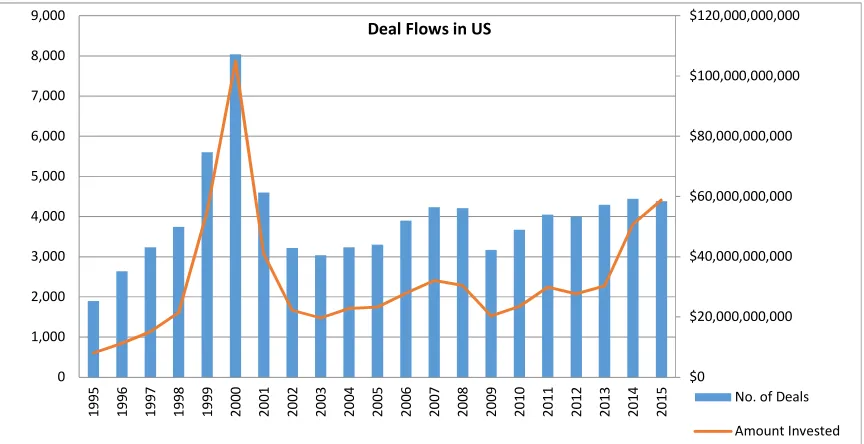
The performance of VC industry in USA has seen highs and lows. The main determinant of the robust VC industry is the no. of deals undertaken by VC. Chart 1
deals with the number of VC deals from 1995 which grew enormously until the dot com bubble in the year 2000 and then due of stock market crash, the number fell drastically and then stabilized over the course until 2015.
CHART 1: NUMBER OF VC DEALS EXECUTED IN PERIOD 1995- 2015
Data Source- PricewaterhouseCoopers/National Venture Capital Association MoneyTree™ Report, Data: Thomson Reuters
For every 100 business plans that come to a venture capital firm for funding, usually only 10 or so get a serious look, and only one ends up being funded. The venture capital firm looks at the management team, the concept, the marketplace, fit to the fund’s objectives, the value-added potential for the firm, and the capital needed to build a successful business.
Table 1 shows a comparative analysis of the no. of deals and the amount invested by VC in last two decades. The no. of deals rose by 4 times from 1995 to 2015
and the amount invested rose by 7 times for the same period. The quarterly data shows uneven variation within a year. This points to the strong deal flows observed in the that period.
TABLE 1: AMOUNTS INVESTED BY VC IN 20 YEARS
Quarter 1995 2005 2015
No. of Deals Amount Invested No. of Deals Amount Invested No. of Deals Amount Invested
1 503 $1,690,040,500 763 $5,222,331,500 1,063 $13,555,679,100
2 466 $2,546,374,500 862 $6,149,008,500 1,206 $17,310,376,700
3 434 $1,709,754,500 813 $6,068,106,000 1,149 $16,605,830,600
4 494 $2,070,353,900 864 $5,805,921,700 962 $11,339,301,900
Grand Total 1,897 $8,016,523,400 3,302 $23,245,367,700 4,380 $58,811,188,300
Source: PricewaterhouseCoopers/National Venture Capital Association MoneyTree™ Report, Data: Thomson Reuters
1 Venture Pulse, Q4'15, Global Analysis of Venture Funding, KPMG International and CB Insights (data provided by CB Insights) January 19th, 2016
$0 $20,000,000,000 $40,000,000,000 $60,000,000,000 $80,000,000,000 $100,000,000,000 $120,000,000,000 0 1,000 2,000 3,000 4,000 5,000 6,000 7,000 8,000 9,000 1 9 9 5 1 9 9 6 1 9 9 7 1 9 9 8 1 9 9 9 2 0 0 0 2 0 0 1 2 0 0 2 2 0 0 3 2 0 0 4 2 0 0 5 2 0 0 6 2 0 0 7 2 0 0 8 2 0 0 9 2 0 1 0 2 0 1 1 2 0 1 2 2 0 1 3 2 0 1 4 2 0 1 5
Deal Flows in US
V
OLUMEN
O.
7
(2017),
I
SSUEN
O.
05
(M
AY)
ISSN
2231-5756
INTERNATIONAL JOURNAL OF RESEARCH IN COMMERCE, IT & MANAGEMENT
FUNDRAISING
Commitments are defined as the pledges that venture capitalists receive for investment over the lifetime of the fund. They are not the amount of money that is actually invested in a given year. Typically, venture funds draw on and invest the committed capital over a two to three year time period. Commitments to the venture capital industry have been highly variable over the past 30 years. The historical patterns of commitments to U.S. VC funds and investments in companies by those funds represent a remarkably constant 0.15% of the total value of the stock market.
TABLE 2: CURRENT AND HISTORICAL SNAPSHOT OF VC COMMITMENT
Indicator 2015 2005 Number of Active VC Firms - 505 Number of Funds 1,331 1,785 Average Fund Size ($M) 144.9 147.8 Total Capital Managed ($M) 192,900 263,800 Total Cumulative Funds 4,957 3,282 New Capital Raised ($M) 29,826 19,154
Source: QUANDL, 2015
Commitments to VC funds, while more variable, are consistently in the 0.10% to 0.20% range. The level of commitments to and the investment pace of VC funds has been consistent with the historic averages since 2002. At the same time, returns relative to the overall stock market appear to have been roughly average. This does not suggest to us that there is too much money in U.S. VC, nor does it indicate to us that the VC model is broken. It seems to be the natural evolution of a relatively competitive market.
VENTURE INVESTING
Staged capital infusion may be the most potent control mechanism a venture capitalist can employ. Staged capital infusion keeps the owner/ manager on a "tight leash" and reduces potential losses from bad decisions. The venture capitalist can increase the duration of funding and reduce the frequency of reevaluation as the company becomes better established and conflicts with the entrepreneur appear more likely.
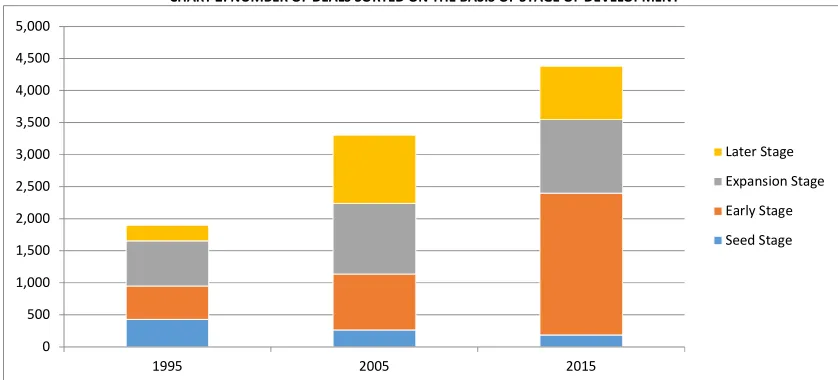
CHART 2: NUMBER OF DEALS SORTED ON THE BASIS OF STAGE OF DEVELOPMENT
Data Source- PricewaterhouseCoopers/National Venture Capital Association MoneyTree™ Report, Data: Thomson Reuters
Chart 2 shows that there has been a decrease in seed stage financing by VC from 1995 to 2015 due to emergence of angel investors, incubators and crowd funding
platforms. There has been a huge increase in early stage funding by VC showing that VC has started focusing more on novel ideas and business plan helping them in their testing of proof of concept and marketing initial product. The expansion stage showed a very stable growth. But, later stage financing showed a slight fall from the previous decade due to IPO drought faced by US after subprime crisis and hence, more focus on acquisition as an exit strategy.
The nature of sector wise focus and completed investment transactions reflect the types of available projects, demand for specific products and services, sophis-tication of financial investors, and the development of the financial institutions seen in the market. The initial investments focused on basic sectors such as man-ufacturing, construction, food processing, and services and investments. In later years, the focus was on communications, manman-ufacturing, and services. Chart 3
shows that the majority of the investment by VC in 2015 went towards software industry signifying the mushrooming of internet based startups and services. Biotechnology was another favorite industry for VC in the year 2015. IT services, FMCG, financial service, medicine, media and energy showed stable contribution by VC.
0 500 1,000 1,500 2,000 2,500 3,000 3,500 4,000 4,500 5,000
1995 2005 2015
V
OLUMEN
O.
7
(2017),
I
SSUEN
O.
05
(M
AY)
ISSN
2231-5756
INTERNATIONAL JOURNAL OF RESEARCH IN COMMERCE, IT & MANAGEMENT
CHART 3: VC INVESTMENT IN DIFFERENT INDUSTRIES IN 2015
Data Source - PricewaterhouseCoopers/National Venture Capital Association MoneyTree™ Report, Data: Thomson Reuters
GEOGRAPHIC CONCENTRATION
Chart 4 shows that the VC commitment in 2015 has been quite uneven geographically with majority of deals concentrated in California while minor trends seen
in other parts of the country.
This points towards the phenomenon of unequal rise of entrepreneurship in different states across USA.
CHART 4: VC COMMITMENTS IN USA IN 2015
Data Source - Preqin Investor Intelligence, 2015
Geographic location of the largest venture firms is increasingly concentrated. California-domiciled firms managed 35% of the capital, compared with 49% a year earlier. This is due to large California firms raising the larger funds, and the relocation of some east coast firms to the west. Contrary to some popular misconcep-tions, only 31 firms managed more than $1 billion. By comparison, 360 firms managed $25 million or less The longer-term drivers of venture capital financing.
Chart 5 shows that majority of the investment in VC funds are done by Pension funds in US followed by foundations and endowment plans.This proves the risk
taking ability inherent in American culture of free enterprises as they are ready to invest their pension money in highly risky investment alternative like VC funds. 13%
1% 1%
8% 1% 5%
1% 5% 7% 8%
5% 0% 0%
2% 1% 40%
1%
Investment in different industries 2015
BiotechnologyBusiness Products and Services Computers and Peripherals Consumer Products and Services Electronics/Instrumentation Financial Services Healthcare Services Industrial/Energy IT Services
Media and Entertainment Medical Devices and Equipment Networking and Equipment Other
Retailing/Distribution Semiconductors Software
Telecommunications
35%
13% 7%
28% 17%
Geographic Concentration of VC investment in 2015 in USA
V
OLUMEN
O.
7
(2017),
I
SSUEN
O.
05
(M
AY)
ISSN
2231-5756
INTERNATIONAL JOURNAL OF RESEARCH IN COMMERCE, IT & MANAGEMENT
CHART 5: TYPE OF INVESTORS INVESTING IN VC FUNDS IN 2015
Data Source - Preqin Investor Intelligence, 2015
EXIT STRATEGY
Once successful portfolio companies mature, venture funds generally exit their positions in those companies by taking them public through an initial public offering (IPO) or by selling them to presumably larger organizations (acquisition, trade sale, or increasingly a financial buyer). This then lets the venture fund distribute the proceeds to investors, raise a new fund for future investment, and invest in the next generation of companies. In order to measure the performance of VC, it is not possible to calculate risk and return of VC funds rather we use a measure of the market value of equity held by venture capitalists in firms that went public in a particular year.
VC exit strategy was not dominated by IPO initially in the year 1985 by started taking a jump in the year 1994 onwards and reached its peak at 300 IPO in just before the dotcom bubble burst in; ate 1990's and then due to crash in stock market, the IPO drought was observed for several years until US financial crisis and then started showing some revival in late 2013. The offer amount of IPO moved in relation to the no. of deals except in 2011 onwards where the IPO offer reached $23 billion but the no. of deals was comparatively less.
Chart 6 shows that in the decade from 1990-2000, majority of the startups were still held privately and VC funds were invested in them. Large portion of them got acquired and on 14% went for IPO and 18% failed. This data reveals that VC industry was not a success as it was not able to garner returns and its funds were blocked for a very long gestation period.
CHART 6: EXIT STRATEGY OF VC FROM 1990-2000
Source - NVCA Yearbook 2015
Chart 7 shows that 79 venture-backed initial public offerings (IPOs) raised $9.4 billion in 2015, marking a 40 percent decline in dollars raised compared to 20142.
Chart 8 shows that 578 venture-backed M&A deals were reported in the 2015, 26 of which had an aggregate deal value of $3.6 billion, decreasing 48 percent
compared to the third quarter of this year. For full year 2015, 372 M&A transactions were reported, with 84 deals combining for a disclosed value of $16.3 billion, the slowest full year period for venture-backed M&A since 20093.
2 Exit Poll Report, 2015 by Thomson Reuters and the National Venture Capital Association (NVCA). 3 Exit Poll Report, 2015 by Thomson Reuters and the National Venture Capital Association (NVCA).
15%
14%
13% 12%
8% 7% 6% 5%
20%
Breakdown of Investors with an Appetite for USA VC Funds by Type
Foundation Endowment Plan
Private Sector Pension Fund Public Pension Fund Fund of Funds Manager Family Office Insurance Company Wealth Manager Other
33%
14% 35%
18%
Exit Outcomes of 11,686 companies from 1991-2000
V
OLUMEN
O.
7
(2017),
I
SSUEN
O.
05
(M
AY)
ISSN
2231-5756
INTERNATIONAL JOURNAL OF RESEARCH IN COMMERCE, IT & MANAGEMENT
CHART 7: NUMBER OF VENTURE-BACKED IPO COMPANIES IN THE UNITED STATES FROM 1996-2015
Data Source - Dow Jones Venture
CHART 8 - NUMBER OF MERGERS AND ACQUISITIONS OF VENTURE-BACKED COMPANIES IN THE UNITED STATES 1996-2015
Data Source - Dow Jones Venture
OBSERVATIONS
• In 2014, the venture capital market produced its strongest performance in terms of both financing and liquidity activity since the end of the dot-com boom. Deal flow approached its highest level since 2000, total venture capital financing proceeds soared to the second highest level in history, the median pre money valuation hit a record level, the number of VC-backed US issuer IPOs was the largest since 2000, and the median acquisition price for VC-backed companies was the highest since 2000. Year 2015 proved to be a lousy year for VC industry as both the VC backed IPO and VC investment saw a dip.
• VC industry is witnessing traction in 2015 due to the mushrooming of incubators angel investors and crowd funding platforms meeting the seed and early finance requirement and due to this VC investment are dominating the later stage financing in US and emerging markets.
• The effectiveness of public efforts to transfer the venture capital model to other regions is highly debatable. Even if venture capital organizations spur technological innovation in the United States, it is not evident that the model can be seamlessly transferred abroad. Different employment practices, regu-latory policies, or public market avenues might limit the formation these funds.
• Overseas venture initiatives may be able to benefit from the experience of venture organizations in the United States. In particular, the Israeli Yozma program seems to have successfully captured “spillovers” of knowledge from U.S. and British venture organizations.
• Venture capitalists focus on scale or potential for scale, rather than profitability. VC-financed firms are significantly larger when they fail in terms of employ-ees and sales, but they are not very different in terms of profitability at the time of failure.
• Whether VC-financed firms fail more often is a function of the time period under consideration. The probability of a VC-financed firm failing is much lower than a non-VC-financed firm, but the probability of a VC-financed firm failing is higher than for non-VC-financed firm’s conditional on their having survived for more than five years. Thus, venture capitalists allow firms time to grow and appear to be “patient” but only to a certain point.
0 1 2 3 4 5 6 7 8 9 10
0 50 100 150 200 250 300
IPO Deals Time to IPO
0 1 2 3 4 5 6 7
0 100 200 300 400 500 600 700
V
OLUMEN
O.
7
(2017),
I
SSUEN
O.
05
(M
AY)
ISSN
2231-5756
INTERNATIONAL JOURNAL OF RESEARCH IN COMMERCE, IT & MANAGEMENT
POLICY IMPLICATION FOR INDIAN VC INDUSTRY
This research has a variety of implications for policy makers who wish to stimulate venture capital activity in the emerging economies like India
• For Entrepreneurs - Robust entrepreneurial ventures is a precondition for a thriving VC industry so budding entrepreneurs in India should keep
innovat-ing and develop new products/services and ensure a constant flow of opportunities that have enormous upside potential.
• For Financial institutions - Creating a synergistic web of stable financial institutions which provides minimally supportive environment will spur the growth of the venture capital industry and initiating a co-evolutionary dynamic with other institutions.
• For Regulators - Like in USA, Government of India should play a significant role in promoting VC indirectly by following sound monetary and fiscal policies
ensuring relatively low inflation which led to stability in the financial environment and currency. Ensuring favorable tax policy and decreases in capital gains taxes may have some positive effect on the availability of venture capital. The stock market, which has been the exit strategy of choice for venture capitalists, should be strictly regulated and characterized by increasing openness. This will create a general macroeconomic environment of financial stability and open-ness for investors, thereby reducing the external risks of investing in high-risk firms.
• For Academicians - Non availability of reliable data on the performance of VC industry in India with respect to deals, fundraising and exit will be a hurdle but primary surveys can be conducted in order to deepen the understanding of VC industry in India and bring more transparency
CHALLENGES
Venture capital is increasingly becoming an important financial intermediary which is able to transform capital into new firms in an apparently highly productive manner. This intermediary is attracting increasing interest by policymakers and investors, but the availability of data as well as the consistency of the academic findings using these data are still lacking. The economic stabilization, strong growth, and favorable business outlook in the countries of the US have provided a strong foundation for an active and developing venture capital industry. Reflecting the relative lack of disclosure and the substantial information asymmetries surrounding venture capital, it is difficult to paint in definitive terms the level of investment activity and fund performance. Existing databases differ in methodol-ogies, and analyses frequently produce discrepancies and varying conclusions. These problems are particularly prevalent when it comes to transaction-level data. That being said, the venture data space has seen substantial entry, particularly in regard to performance measurement. As a result, the quality of information available has increased in recent years and can be expected to continue to do so going forward.
CONCLUSION
In the United States and in India the development of venture capital has been a co-evolutionary process. This is particularly true in India, where it remains a small industry precariously dependent upon other institutions, particularly the government, and external factors such as international lending agencies, overseas inves-tors, and successful Indian entrepreneurs in Silicon Valley. The growth of Indian venture capital must be examined within the context of the larger political and economic system in India. As was true in other countries, the Indian venture capital industry is the result of an iterative learning process, and it is still in its infancy. If it is to be successful it will be necessary not only for it to grow, but also for its institutional context to evolve. The possibility and ease of cross-national transfer-ence of institutions has been a subject of debate among scholars, policymakers, and industrialists during the entire twentieth century and there is no denying of the role of VC industry in investing risk capital successfully, there is no reason to believe that the success of a startup solely related to it being backed by a VC and hence, However, venture capital and entrepreneurship are separate phenomena, even among growth companies, and conflating the two, let alone implying that the former causes the latter, is untrue and unhelpful.
SCOPE FOR FURTHER RESEARCH
The VC industry has reached an inflection point wherein the returns have stagnated and declined as compared with the go go years of late 1990's. This points to the new debated regarding right sizing the VC industry, whether it should be big enough in terms of underling financial commitment or more equipped to catalyse the high growth firms? Should it be smaller to take more risks, drive higher returns, and thus keep investors satisfied?
Second, another area for future research is cross-border venture capital investments and local venture capital markets. A relevant question relates to how im-portant cross-border investments are for the development of a local venture capital market. On one hand, foreign venture capital firms could subdue the local venture capital market by “picking the cherries.” On the other, they could help in generating a critical mass of venture capital activities.
Third, the major question arises that whether this US model should be replicated to the rest of the worlds as it is or the model has to undergo changes in order to adapt to different financial markets around the world.
Fourth, does reputation follow general partners who start their own fund or must they establish new reputations? In markets without experienced venture capi-talists, how can the lack of reputation be overcome? Clearly, more work is necessary.
Thus, an active venture capital market can boost economic growth which is driven by innovation, spearheaded by young entrepreneurial firms by solving the problem of moral hazard and asymmetric information, thereby connecting idea-rich entrepreneurs with cash-rich investors.
REFERENCES
1. Barry, C. B., & Barry, B. (2010). Directions Capital Finance New. Venture Capital, 23(3), 3–15.
2. Black, B. S., & Gilson, R. J. (1998). Venture capital and the structure of capital markets: banks versus stock markets. Journal of Financial Economics, 47(3), 243–277.
3. Fellow, S., Marion, E., & Foundation, K. (2009). RIGHT-SIZING THE U. S. VENTURE CAPITAL INDUSTRY,Venture Capital Journal, 27(1), 240-263. 4. Gompers, P. a. (1998). Venture capital growing pains: Should the market diet? Journal of Banking & Finance, 22(6-8), 1089–1104. 5. Gompers, P., & Lerner, J. (2001). The Venture Capital Revolution. Journal of Economic Perspectives, 15(2), 145–168.
6. Gompers, P., & Lerner, J. (2010). What Drives Venture Capital Fundraising?, 1–55.
7. Gorman, M., & Sahlman, W. a. (1989). What do venture capitalists do? Journal of Business Venturing, 4, 231–248. 8. Hall, B. H. (2002). The Financing of Research and Development. Oxford Review of Economic Policy, 18(1), 35–51.
9. Kaplan, S. (2003). Financial Contracting Theory Meets the Real World: Evidence from Venture Capital Contracts. Review of Economic Studies, 70(2), 281–315. 10. Kaplan, S. N., & Lerner, J. (2009). It Ain’ t Broke: The Past, Present, and Future of Venture Capital by, (December).
11. Kaplan, S. N., Sensoy, B. a, & Strömberg, P. (2002). How well do venture capital databases reflect actual investments? University of Chicago Working Papers, (September).
12. Klonowski, & Darek. (2006). Venture capital as a method of financing enterprise development in Central and Eastern Europe. International Journal of Emerg-ing Markets, 1(2), 165–175.
13. Kortum, S., & Lerner, J. (2000). Assessing thr contribution of venture capital to innovation. The RAND Journal of Economics, 31(4), 674–692. 14. Lerner, J., & Tåg, J. (2013). Institutions and venture capital. Industrial and Corporate Change, 22(1), 153–182.
15. Rin, M. Da, & Hellmann, T. F. (2012). A survey of VC research. 16. Statistics, I., & The, F. (2015). National Venture.
V
OLUMEN
O.
7
(2017),
I
SSUEN
O.
05
(M
AY)
ISSN
2231-5756
INTERNATIONAL JOURNAL OF RESEARCH IN COMMERCE, IT & MANAGEMENT
REQUEST FOR FEEDBACK
Dear Readers
At the very outset, International Journal of Research in Commerce, IT & Management (IJRCM) acknowledges
& appreciates your efforts in showing interest in our present issue under your kind perusal.
I would like to request you to supply your critical comments and suggestions about the material published
in this issue, as well as on the journal as a whole, on our e-mail
for further
improve-ments in the interest of research.
If you have any queries, please feel free to contact us on our e-mail
.
I am sure that your feedback and deliberations would make future issues better – a result of our joint effort.
Looking forward to an appropriate consideration.
With sincere regards
Thanking you profoundly
Academically yours
Sd/-
Co-ordinator
DISCLAIMER
V
OLUMEN
O.
7
(2017),
I
SSUEN
O.
05
(M
AY)
ISSN
2231-5756