The Implementation and Impact
of the Reformation in Shropshire,
1545-1575
Elizabeth Murray
A thesis submitted in fulfilment of the requirements for the
degree of
Master of Arts
United Faculty of Theology
The Melbourne College of Divinity
Abstract
Acknowledgements
I am grateful to Dr Craig D’Alton for his constant support and guidance as my supervisor. Thanks to Dr Dolly Mackinnon for introducing me to historical soundscapes with enthusiasm. Thanks also to the members of the Medieval Early Modern History Cohort for acting as a sounding board for ideas and for their assistance in transcribing the manuscripts in palaeography workshops.
I wish to acknowledge the valuable assistance of various Shropshire and Staffordshire clergy, the staff of the Lichfield Heritage Centre and Lichfield Cathedral for permission to photograph churches and church plate. Thanks also to the Victoria & Albert Museum for access to their textiles collection. The staff at the Shropshire Archives, Shrewsbury were very helpful, as were the staff of the State Library of Victoria who retrieved all the volumes of the Transactions of the Shropshire Archaeological Society.
Contents
Abbreviations and Notes ii
List of Tables and Figures iii
Introduction 1
Chapter One: The Town of Shrewsbury 7
Chapter Two: North Shropshire Outside the Town 49
Chapter Three: Bishops and Parish Clergy 98
Conclusion 125
ii Abbreviations
CCEd Clergy of the Church of England database CWA Churchwardens’ Accounts
DNB Dictionary of National Biography LHC Lichfield Heritage Centre
OED Oxford English Dictionary SA Shropshire Archives
TSAS Transactions of the Shropshire Archaeological Society VCH Victoria County History
Note on Place Names
iii List of Tables
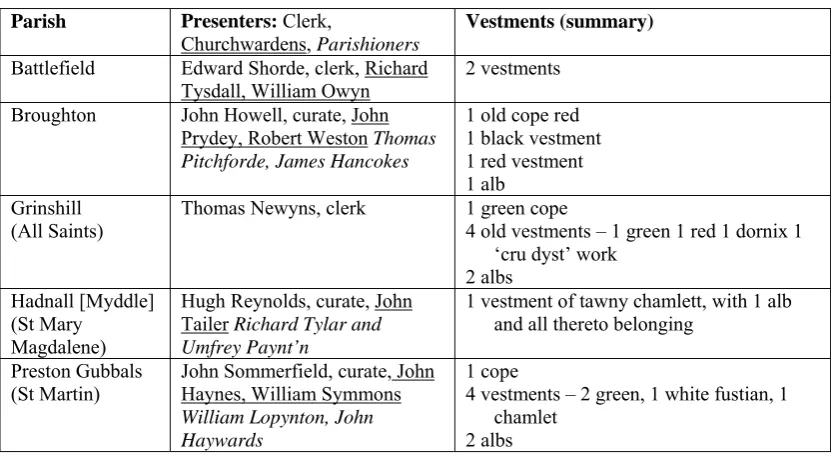
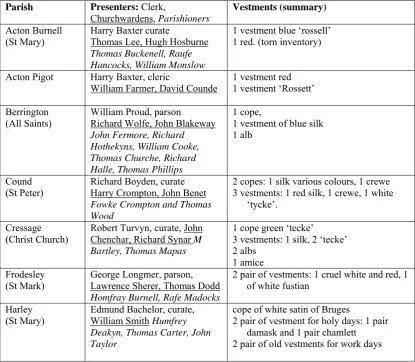
2.1 North Shropshire parishes funding obits, lights or lamp from rent money.
50
2.2 Parishes funding priests from stocks of cattle or money. 50 2.3 Summary of vestments held by parishes in the Town of
Shrewsbury in 1552.
59
2.4 Summary of vestments held by parishes in Shrewsbury Liberty in 1552.
63
2.5 Summary of vestments held by parishes in Condover Hundred in 1552.
65
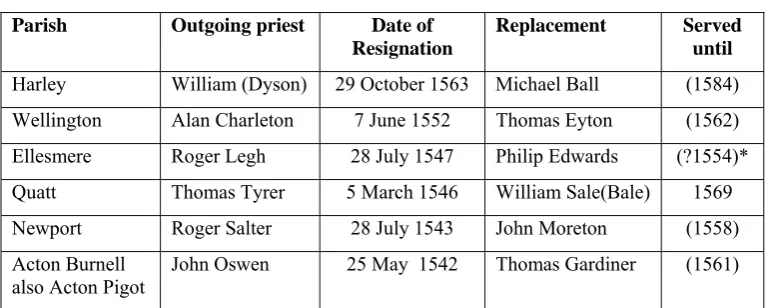
3.1 Parish Clergy Resignations in North Shropshire. 118
List of Illustrations
1.1 Lady Chapel, Old St Chad, Shrewsbury with the towers of St Alkmund, St Mary and St Julian. [Photo E. Murray, 15 March 2007.]
11
1.2 Examples of medieval censer and three pyxes found in England. On display at Victoria and Albert Museum, London. [Photo E. Murray, 30 March 2007.]
25
1.3 Cloth of Gold chasuble and detail. On display at Victoria and Albert Museum, London. [Photo E. Murray, 30 March 2007.]
27
2.1 Plan of Lilleshall Church. Source: VCH Shropshire XI www.british-history.ac.uk [6 December 2006.]
56
2.2 Battlefield Church, Shropshire. [Photo E. Murray, 19 March 2007.]
61
2.3 View of Moreton Corbet Castle from Moreton Corbet churchyard, Shropshire. [Photo E. Murray, 19 March 2007.]
64
2.4 Sample of Green, Red and Blue textiles found in England before the Reformation. On Display at the Victoria and Albert Museum, London. [Photos E. Murray, 30 March 2007.]
iv 2.5 Sample of Say, Dornix and Saracenet used in domestic and
church contexts. On display at the Victoria and Albert Museum, London. [Photos E. Murray, 30 March 2007.]
68
2.6 Exterior and interior of Preston Gubbals church, Shropshire. [Photos E. Murray, 19 March 2007.]
76
2.7 Chalice and paten from St Michael and All Angels, Hamstall Ridware, Staffordshire, circa 1360. Photographed with the kind permission of the Rev’d Ty Leyland and the cooperation of staff at the LHC, Lichfield. [Photo E. Murray, 28 March 2007.]
79
2.8 Elizabethan chalices from parishes in Coventry and Lichfield diocese
A: St Mary, Blymhill, Staffordshire. Photographed with kind permission of the Rev’d Gary Thompson and the cooperation of LHC staff. [Photo E. Murray, 28 March 2007.]
B: St Michael’s, Child’s Ercall, Shropshire. Photographed with kind permission of the Rev’d Jeremy Stagg and the cooperation of staff at the LHC. [Photo E. Murray, 28 March 2007.]
C: Ruyton-xi-towns, Shropshire. On loan to Lichfield Cathedral. Photographed with kind permission of David Wallington at Lichfield Cathedral. [Photo E. Murray, 26 March 2007.]
D: Little Ness, Shropshire. On display at Victoria and Albert Museum, London. [Photo E. Murray, 30 March 2007.]
Introduction
It gets overlooked that much of what is said about the progress of the Reformation in England is applicable almost only to the most highly developed areas of the south and east.1
Forty years on from Glanmor Williams’ observation, this is still the case. With many local Reformation studies being conducted in the last fifty years, broad statements about the English Reformation are more locally grounded than once they were, but still apply to the south and east because these areas have been studied in the most detail. Extensive surveys of the available documents have resulted in detailed analyses and clearer pictures of how the reformation impacted many localities at the various levels of diocese, county, city and parish. These local studies complement general surveys of the Reformation throughout England, such as Reformation in Britain and Ireland by Felicity Heal, The Stripping of the
Altars by Eamon Duffy, and English Reformations by Christopher Haigh.2 The local studies illustrate how national trends, such as popular support for traditional Catholicism and the rate of Reformation throughout England, relate to local religious expression. The areas already studied in greatest detail include: London (Susan Brigden), Devon and Cornwall (Robert Whiting), Lincoln diocese (Margaret Bowker), Gloucestershire (Caroline Litzenberger), Suffolk (Diarmaid MacCulloch), East Anglia (Eamon Duffy), and the wider south east (John F. Davis) .3 Christopher Haigh’s work on York and Lancashire helps to carry the story north, but the Reformation in the west remains an under studied area.4
1 Glanmor Williams,
Welsh Reformation Essays (Cardiff: University of Wales Press, 1967). p. 20.
2 Felicity Heal,
Reformation in Britain and Ireland (Oxford: Oxford University Press, 2003);
Eamon Duffy, The Stripping of the Altars (London and New Haven: Yale University Press, 1992);
Christopher Haigh, English Reformations: Religion, Politics, and Society under the Tudors
(Oxford: Clarendon Press, 1993). 3 For local studies see Susan Brigden,
London and the Reformation (Oxford: Clarendon Press,
Whilst none of these historians claim that their area of concern is representative of the whole of England, the picture they have drawn has become dominant. Doreen Rosman’s The Evolution of English Churches, is a synthesis of many Reformation histories which demonstrates this south-eastern focus.5 There is a notable gap in the history of the Reformation in the west and midlands. This is in part an issue of sources. In comparison to some other counties there is, for example, a relatively small amount of extant documentary evidence for Shropshire which might account for its obscurity in the historiography. There are still useful sources available however, and when studied in detail these can reveal much about how the Reformation was experienced by the parishioners and clergy of a comparatively poor western county.
This thesis addresses this historiographical gap. Its focus is on the Archdeaconry of Salop in the north of Shropshire from 1545-1575. The thesis begins by outlining the situation at the end of the reign of Henry VIII, and then charts the impact and reception of the protestant reforms under Edward VI, the Roman Catholic reign of Mary and the early decades of Elizabeth I’s reign. This was a period of change in religious policy determined by the monarch and those appointed to positions of authority. 1575 was not the end of the English
University Press, 1981); Caroline Litzenberger, The English Reformation and the Laity: Gloucestershire 1540-1580 (Cambridge: Cambridge University Press, 1997); Diarmaid
MacCulloch, Suffolk and the Tudors: Politics and Religion in an English County 1500-1600
(Oxford: Clarendon Press, 1986); Eamon Duffy, The Voices of Morebath (London and New
Haven: Yale University Press, 2001); John F. Davis, Heresy and Reformation in the South-East of England, 1520-1559 (London: Royal Historical Society, 1983); Patrick Collinson and John Craig,
eds., The Reformation in English Towns, 1500-1640 (New York: St. Martin's Press, 1998).
4 Christopher Haigh,
Reformation and Resistance in Tudor Lancashire (London and New York:
Cambridge University Press, 1975). 5 Doreen M. Rosman,
The Evolution of English Churches 1500-2000 (Cambridge: Cambridge
Reformation: the focus of this thesis is the times of transition from one religious policy to another. By 1575 local records, or at least those of Shropshire, had settled into routine recording and the actions initially taken with some sense of urgency continued in more measured ways.
The geographic area of focus is the area of overlap between the county of Shropshire and the diocese of Coventry and Lichfield.6 The English Reformation
was a religious and political movement and the various elements of the Tudor regime, church and secular government, were used together to transmit the reforms throughout England. The effectiveness of these systems has been tested by the number of parishes disinclined to take up the reforms in a timely manner. The ways in which the structure of church and state authority were used to enforce the religious changes are amply demonstrated in this area. The shift in who had control of religious policies from the clergy to secular authorities is here explored and articulated in a way not previously charted for that region.
This thesis explains, through material culture and historical soundscapes, how the Reformation was implemented and enforced in a poor western county by investigating the various ways that Tudor governments attempted to change the religious beliefs of parishioners. Material culture encompasses all elements of church fabric and buildings. In this thesis, ‘soundscape’ refers to the auditory world, the sounds of history.7 Alain Corbin’s article on bells is particularly
6 See Appendix for alphabetical list of parishes included. Area as defined in Cecil
Humphrey-Smith, ed., The Phillimore Atlas and Index of Parish Registers (West Sussex: Phillimore & Co.
Ltd., 1998). p. 29.
7 For details of methodology see Alain Corbin, "The Auditory Markers of the Village," in
The Auditory Culture Reader, ed. Michael Bull and Les Black (Oxford and New York: Berg, 2003).
pp. 117-125, and Bruce R. Smith, "Tuning into London c. 1600," in The Auditory Culture Reader,
relevant to a study of death and funerals during the Reformation: this thesis draws on the idea that there is a full range of sounds to examine in the past, not just those involved with speech.8 Material culture and the soundscape of the past are accessed through documentary evidence such as town chronologies and church inventories. Throughout this thesis, there will be descriptions of the materials and sounds that surrounded those who lived and died during the Reformation. This fuller description is a means of further analysing the impact of the Reformation on all aspects of parish life.
The first two chapters chart the changes to the exteriors and the interiors of church buildings during this period of Reformation. There were changes to patterns of bell ringing, one of the loudest aspects of the religious soundscape. These changes were part of the attempt by reformers to transform attitudes towards and beliefs connected with death. Ringing for the souls of the dead was connected to the doctrine of purgatory, so changes in ideology had auditory consequences: the use of bells was changed in an attempt to enforce ideology. The overall physical appearances of the church exteriors did not change dramatically, but instead of representing the reach and power of popes in Rome, the buildings became part of the institutional church under the control of the English monarch. Throughout, they remain a focus of community life. By contrast, the Reformation greatly affected the appearance of the interior of the churches. Images were removed from the walls, and vestments, plate and altars were removed from the sanctuary. The sanctuary was the focal point of the Mass and any changes to the way Holy Communion was celebrated affected parishioners during the Reformation. Altars
8 Corbin, "The Auditory Markers of the Village." p. 117; Smith, "Tuning into London c. 1600." p.
became tables, and pulpits were installed, as words, scripture and vernacular prayers, were exalted over the Mass.
Chapter one focuses on how the Reformation was experienced by the parishioners in the town of Shrewsbury. The wealth of the town is reflected in the church property and goods. The model of a lavish and sumptuous Roman Catholic faith, so familiar in English Reformation historiography of the south-east, is found in Shrewsbury and the removal of those items by the reformers is clearly illustrated. The shift of power from the church to the state, from clergy to laity, is highlighted in the context of the town through the use of bailiffs and past and present sheriffs. This provincial town was not removed from any part of the various changes that were implemented under various monarchs, distance from London proving little impediment to those responsible for ensuring conformity to the new doctrine. The religious experience in Shrewsbury, at most levels, offers few surprises.
Chapter three places these two stories of Reformation in the national context. It examines the leading men of the Shropshire church: bishops and parish clergy; how they were affected by the Reformation, how they participated in national events and the local context. The diocese of Coventry and Lichfield was large and the politics of the Reformation became a part of the bishops’ experience. Popular rebellion or religious zeal of either protestant or catholic faith does not mark the history of the Reformation in Shropshire. What, in the Shropshire context, led to the absence of large scale action? The concern of central government during this period was a shortage of qualified clergy who also supported the official religious policy, whatever it happened to be at the time. Parishes in North Shropshire did not have a high turnover of priests during these uncertain times. Most clergymen remained in their cure until they died, but there are cases of resignations and deprivations. These demonstrate that all members of the communities of North Shropshire, whether lay or cleric, were affected by the policy of central government or the diocese.
Chapter One: The Town of Shrewsbury
This yeare in Adam Myttoon and Roger Popes tyme the pycture of or Lady owt of St. Mary’s in Shrosbery and the picture of Mary Mawdelen and the pycture of St. Chaddes owt of Sainct Chadds churche in the same town were weare all three burnyd in the market place there commonly callyd the corne marcket. (1546-7)9
1546-47 is the first year that a reference to iconoclasm is made in the Shrewsbury Chronicle. Adam Mitton and Roger Popes were bailiffs of the town that year and laymen of the town. The Chronicler would use the names of those who held the position of bailiff at the start of each year’s account. Not only did this distinguish one year from another, but it showed the recurring holders of authority in the town over the years. The same men exercised secular authority during periods of different religious policy. The town of Shrewsbury had five parishes: Holy Cross, previously the Abbey church, with a chapel at St Giles, St Julian, St Alkmund, St Chad and St Mary. Adam Mitton occasionally appears in the St Mary churchwardens’ accounts in his capacity as bailiff.
The chronicler tells us that three pictures were taken from the churches of St Chad and St Mary to the corn market and burnt. ‘Picture’ formerly also referred to a sculpted likeness.10 What does this description tell us about the objects themselves and the people of Shrewsbury? We know that this action took place after ‘Images were commaundyd to be put downe and owt of the churches,’ by implication in response to such a command.11 These images must have been made of combustible material, most likely wood. We know where the images came from: one picture came from the parish of St Mary and two from the parish of St Chad.
9 W. A. Leighton, "Early Chronicles of Shrewsbury, 1372-1606,"
TSAS III (1880). p. 258.
10 OED.
We also know that at least one parish in Shrewsbury had an image depicting a figure other than the saint to which the church was dedicated. This may demonstrate the past role of guilds within the church.
Guilds were dedicated to God, Christ or a saint and their primary function was usually intercessory.12 Images owned by guilds were used for devotion and this was one of the reasons they were dissolved during Edward’s reign. Was this a sign that a guild dedicated to Mary Magdalene which had been in the parish of St Chad no longer existed? We know which guilds existed in the town of Shrewsbury at the end of the reign of Henry VIII. A certificate describing each chantry, hospital and guild in the counties of Shropshire and Staffordshire was compiled in 1546 by Bishop of Coventry and Lichfield, Richard Sampson, Sir Philip Draycot, knight, Edward Littleton, esquire, Anthony Bourchier, gentleman and William Sheldon, gentleman.13 Four of the Shrewsbury parish churches hosted guilds. The Drapers Guild at St Mary used the altar of the Trinity.14 Holy Cross parish was the base for the Guild of St Winifred.15 The Shearmen’s Guild used the altar of Our Lady in St Julian parish church.16 The parish with the most
guilds was that of St Chad: the Mercers’ Guild at the altar of St Michael, the Tailors’ Guild at the altar of St John the Baptist, the Shoemakers’ Guild at the altar of St Katharine, and the Weavers’ Guild used the parish church, although no altar was specified.17 Unless the Weavers Guild was dedicated to Mary
12 Robert Whiting,
Local Responses to the English Reformation (London: Macmillian Press Ltd,
1998). p. 46.
13 A. Hamilton Thompson ed., "Certificates of the Shropshire Chantries under the Acts of 37
Henry VIII. Cap. IV and 1 Edward VI. Cap. XIV," TSAS X 3rd series (1910). p. 304.
Magdalene, it appears that the image of the saint taken to the burning was not overtly connected to the guilds in the parish of St Chad.
We may attempt to reconstruct the scene of the public image burning. The market would have been a public place where tradesmen and customers conducted business. We are not told what day the event took place or at what time of day; this would affect the impact of the spectacle. During trading time would be the most public demonstration if the iconoclasts made a point of drawing attention to themselves. The market site does not exist today as it did in 1546, when it was surrounded by buildings and open air. It would be possible for some folk to be separated from the event by obstruction of sightlines and the ambient noise of a busy market. All present would know something was burning from the smell created. If it was a day other than market day, the spectacle would be obvious to all within the space. Another option would have been evening or night time, attention grabbing in a different way, with the noise and smell of a bonfire at night attracting interest at what might otherwise be a time of rest.18 Presumably, it was a bonfire to be able to burn the images properly, but the size of the blaze cannot be determined from the chronicler’s account. Bonfires ‘were dangerous and exciting’ and formed a traditional part of celebrations both secular and religious.19 Roger Martyn of Long Melford, Suffolk, recalled village bonfires to mark the eves of St James, Sts Peter and Paul and St Thomas, as well as on Midsummer Eve.20 Parishes throughout England were accustomed to organising large fires in public places and ‘wood was a valuable commodity, sometimes in short supply, but
18 ‘Bonfires . . created light in darkness, warmth in cold, and a vibrant visual focus or a crowd.’
David Cressy, Bonfires and Bells: National Memory and the Protestant Calendar in Elizabethan and Stuart England (London: Weidenfeld and Nicholson, 1989). p. 80.
19 Ibid. p. 80. 20 Haigh,
people were willing to burn it for festive or political purposes.’21 The burning of images in the corn market of Shrewsbury was a political statement, but what was the meaning of the message?
There are many questions raised by this event, a number of which cannot be answered. The knowledge is lost to history, a lost voice in the story of the Reformation in Shrewsbury. While many of the answers may be lost to us, the questions still need to be asked and considered to appreciate the impact of this event on the people of Shrewsbury.
How did the images get from the churches to the corn market? Were they processed from the churches to the place of their burning? Were they simply brought to the market at the appointed time? It is no more than an eight minute walk to the market from each parish with a two-three minute walk between St Chad and St Mary. They may not even have come directly from the churches. The pictures may have already been removed and stored elsewhere, as happened in London when books were collected then burnt. Coming from two churches suggests a planned action rather than spontaneous iconoclasm. The corn market was a central location in the town. The choice of venue means that this action was not intended to be covert in any way. A public place was chosen for a public message. This is not the same as the two Lollards in Leicester who burned an image of St Catherine when they ran out of fuel to cook their supper.22 The public burning of images was not incompatible with protestant reformers’ ideas nor was it new in the 1540s. ‘When the iconoclastic fires were lit in 1538 Hugh Latimer,
21 Cressy,
Bonfires and Bells. p. 80.
22 Margaret Aston,
England's Iconoclasts: Laws against Images. Vol. 1. (Oxford: Clarendon Press,
later bishop, was closely involved,’ even ensuring that the image of the Virgin removed from his own church, ‘perished in the flames along with other notorious ‘idols’’.23 An earlier example of iconoclasm by fire was recorded in Rickmansworth in the 1520s when people set fire to images while they were still in the church!24
Illustration 1.1: Lady Chapel, Old St Chad, Shrewsbury. In the background, from left to right, the towers of St Alkmund, St Mary, and St Julian.
Who brought the Shrewsbury images to be burnt? The description does not say who did the burning. The ‘who’ affects the nature of the event. If it was by the clergy in those parishes, then they show themselves to be protestant reformers and supportive of the actions of the late-Henrician and Edwardine reformers. If it was the churchwardens or other parishioners, this becomes an act of popular iconoclasm performed by the laity, possibly in defiance of their clergy, but given
that the curate of St Chad was later a married priest, we have at least a hint that he might have supported some of the ideas of the reformers. This does not mean that anyone who accepted one ideal of the reformation automatically accepted all reformation actions.
Another possibility behind the public burning of likenesses of saints in Shrewsbury is that the images were forcibly removed and taken to the market by local or even outside secular authorities. It is not definitively stated whether the burning was instigated by those in lawful authority or the people of Shrewsbury.
Finally, given that there were five parishes in the town, what can be understood from the fact that the chronicler only mentions two parish churches? Were these congregations acting in defiance of the majority of the town? The focus on the two parishes could be explained if the chronicler lived in one of these parishes and the event was of particular concern to him. It may have been the only public burning he knew about. Perhaps the other churches did not have images, or if they did, perhaps they just disposed of them quietly or sold them, as was done in the parish of Ludlow in south Shropshire in 1548.25 The royal and episcopal commands about images only demanded that they be taken out of the churches. There was no mention of the means of disposal. The fact that any images were publicly destroyed in Shrewsbury demonstrates that an iconoclastic zeal of some sort was present in the town even if it did not exist in all the parishes. Regardless of how it was organised, the burning of images in the market was a noisy and open display of iconoclasm by some people in Shrewsbury.
25 Thomas Wright,
Churchwardens' Accounts of the Town of Ludlow, 1540-1600 (Westminster:
The Churchwardens’ Accounts for St Mary parish 1550 give an indication of how the Reformation was affecting the churches in Shrewsbury, ‘payd for takyng downe ye autore & pavyng of the graueas’.26 It is not specified which altar in the church was removed, but probably this refers to the high altar. The Reformers wanted to change the nature of Holy Communion. Removing the altars and installing tables was the physical manifestation of the change in the doctrine of the Eucharist.
The next dramatic event in Shrewsbury connected with religious reform was the commission to make an Inventory of Church Goods. In May 1552, men of note in each county were called to be commissioners to survey the goods, jewels, ornaments and bells in every church and then return those items deemed necessary and confiscate the rest.27 The commissioners chosen for the survey of church goods in the county of Shropshire were Andrew Corbet of Moreton, George Blount of Kinlet, Richard Mainwaring of Ightfield, Richard Newport of High Ercall and Eyton-on-Severn, and Richard Cornwall of Burford. The first three were knights and the last two esquires. All these men served as Sheriff at various times during the Tudor period.28
This mass inventory of church goods is a striking example of authority and power shifting from the clergy to the laity in church matters. In the same way that bishops were replaced by noblemen as presidents of Councils,29 the
26 Shrewsbury – St Mary CWA. SA P257/B/3/1. 12r.
27 "Inventories of the Church Goods of Shropshire Temp. Edward VI,"
TSAS XII (1900). p. 345.
28 Ibid. p. 342-3. 29
commissioners were under royal authority and did not answer to any ecclesial powers. These inventories were taken by the cleric of the parish (whether called curate, vicar, or pastor), the churchwardens and other honest men of the parish. The inventory would be presented by anywhere between three to six laymen and one cleric. In Shrewsbury the parishes of St Mary, St Chad and St Alkmund made their presentments before the bailiffs of the town, the secular authority.30
It is unlikely that the commissioners visited every parish in Shropshire. Instead they called for inventories to be taken which would then be presented to them. The inventories presented to the commissioners in 1552 would give the name of the cleric in the parish, the churchwardens and usually other “honest men” of the parish. In Shrewsbury, the parishes of St Mary, St Alkmund and St Julian made their presentments on 24 August 1552 before Sir Adam Mitton, knight, and the bailiffs of the town. Adam Mitton was one of the men who was serving as bailiff when the images were burned in the corn market a few years earlier and although he was not one of the serving bailiffs at the time of the inventory, still held a certain standing in the community. The parishes of St Chad and Holy Cross made their presentments on 26 August 1552. The inventory for St Chad parish tells us that the presentment was made by Edward Stephens the curate with at least four churchwardens being Thomas Hosier, Richard Clerk, Roger Allen and Morgan (last name unknown) and four esquires of the parish namely Humphrey Onslow, Thomas Sturrey, Nicholas Purcell and Edward Hosier. The signatures also include Thomas Ireland, Richard German, John Mokewoth, and Richard Evarett. These
30 "Inventories of the Church Goods in the Town of Shrewsbury at the Time of the Reformation,
men made their presentments to Sir Adam Mitton, Roger Luter, and Richard Whitacres.31
These honest men of the parish would have been well known in their community, trusted with the task of presenting the church goods. This is the only mention any of them receive in extant historical record. Their inclusion in the inventory process does not illustrate their doctrinal or religious beliefs, but it does demonstrate being prepared to participate in official actions. Those to whom the presentments were made are slightly better remembered. The Chronicle records Roger Luter and Richard Whitacres as bailiffs for the year 1551-2 and Sir Adam Mitton and Roger Lewis as bailiffs for ‘1552-3 (I Mary)’.32 None of the commissioners are named in the inventories themselves, but they are mentioned as ‘the kynges comysyonners assyngnened for the tyme’ and it is noted that the inventories were made in response to their charge.33
From these inventories we learn the state of church bells, plate and vestments in August that year. The indentures listing which goods could remain in the churches were issued between May and June 1553. What does the information gathered during the 1552-1553 commission tell us about the soundscape and material culture of Reformation Shrewsbury?
Churches were prominent buildings in the towns and villages. In sixteenth-century wills, people were said to be of the parish and diocese, not the town and county. The church was ever present in the community and even when the building was
31 Ibid. p. 403.
out of sight, the presence of the church in the soundscape continued. Church bells were among the loudest noise makers in early modern England. Bruce R. Smith notes that, ‘as a soundscape, early modern London was far too diffuse to be contained by parish boundaries.’34 Shrewsbury was not as large as London, but the town context is a valid framework for a discussion of the soundscape of that place.
The proximity of the five parish churches would lead to an overlap of their auditory reach. Residents of the town would have been able to distinguish between the bells of each parish. There was a vocabulary for bell ringing. Those who lived in the soundscape would learn what the different patterns of ringing signified: worship, marriage, birth, death; each event had a distinct sound pattern. These patterns had different meanings for different people, ‘like other forms of communication it was susceptible to prompts and crossed meanings.’35 What people understood the ringing of bells to signify was of concern to the Edwardine reformers.
How many bells made up the soundscape of Shrewsbury? In 1552, the parish of Holy Cross recorded, ‘iiij ringinge belles, with a bell whiche the clocke goethe upon’.36 The parish of St Chad also recorded a bell for the clock along with, ‘iij. gret bells.’37 St Mary parish recorded, ‘a rynge of belles of v. with that that the cloke strykes on,’ and St Alkmund and St Julian recorded four and three bells
34 Bruce R. Smith,
The Acoustic World of Early Modern England (Chicago and London: The
University of Chicago Press, 1999). p. 54. 35 Cressy,
Bonfires and Bells. p. 68.
respectively with no mention of clocks.38 The bells for the clocks would be the most likely to ring at the same time. St Mary, St Alkmund and St Julian are all at a higher elevation than St Chad’s. Holy Cross is down in the river valley which carries the sound.
We know that the parishes had these bells because the clergy and churchwardens were asked to record the number of bells along with the other details of church plate and fabric. Why were the commissioners interested in the church bells? The aim was to collate all church plate, jewels and goods that were in the parishes and confiscate those considered by the reformers as unnecessary. The Edwardine reformers were against bell ringing, most particularly because of the superstitions that surrounded it. In one of his sermons, Hugh Latimer said that the belief that ringing bells would fend off storms and the devil, ‘was the teaching of the devil’.39 Given such criticism of ringing bells, their inclusion in the inventory of church goods was probably with the intention of confiscating them. The logistics of such action was known to the commissioners. In the original summons to the church of Bedingfield, Suffolk, officers were instructed to bring before the commissioners at Ipswich, ‘All and everye suche p’cell of plate jewells metall or other ornamente (whatsoever they be)’ with the statement at the end that ‘The grete Belles and Saunce Belles in the Steples only excepte.’40 The practicalities of removal and transport of all bells from the steeples of England made the exception a logical one.
38 Ibid. pp. 402, 400, 401. 39 George Elwes Corrie, ed.,
Sermons by Hugh Latimer (Cambridge: The University Press, 1844).
p. 498. 40 J. J. Raven,
As the commissioners were never presented with the actual bells, the visual aspect of their role in worship was not scrutinised. Bells could be inscribed, setting in metal prayers and ideas contrary to the Reformed notions of what was acceptable worship, particularly if they were forged when England still held to Roman Catholic worship and doctrine. Some inscriptions personified the bells, giving them agency to affect the spiritual and temporal worlds. Examples of such inscriptions Europe-wide include:
DAE MONES ANGO - I torment demons FLEO MORTUA - I cry for the dying ROGOS PLORO - I weep at the burial LAUDO DEUM VERUM - I praise the true God PLEBEM VOCO - I call the people EXCITO LENTOS - I arouse the lazy CONGREGO CLERUM - I collect the clergy41
As the bells were out of sight of the parishioners anyway, what would it matter if the bells were inscribed or not? The corporate memory of what was inscribed on the bells would affect the belief in what the bells were doing when they were rung.
The town of Shrewsbury had the potential of 21 bells ringing at once including three different clocks. As the loudest noisemakers in the parish, ‘None could escape their clamour . . . ringing above the routine noises of urban or village life’.42 The regular ringing of bells was an example of the church affecting secular life. Bells were not a means of private devotion; their use could not be secret or hidden. Bell ringing was the most public display by a church extending beyond its physical presence. It was experienced by all within range who could hear. No one
41 Percival Price,
Bells and Man (Oxford, New York, Toronto, Melbourne: Oxford University
Press, 1983). p. 128. 42 Cressy,
could escape the sound of bells in the town, but changing what people thought when they heard the ringing was not a simple matter. One way for the reformers to save the people from their superstitious thoughts was to stop the ringing of bells. The most permanent way to silence was removal, so why were the bells permitted to remain? In this instance, practicality appears to have outweighed religious zeal.
The indentures of 1553 reveal that Holy Cross parish was granted custody of four bells and a clock bell. St Mary’s kept its five bells. St Alkmund was permitted three bells which would appear to be a reduction, but three bells would still make much noise. St Julian was permitted to keep three bells in its Indenture with the direction:
whiche . . . belles the sayed commyssyoners on the Kynges majestes behalf starytly chargeth and commandyth them saveley and surely to kepe unsold ne otherwise imbessylyd, untyll suche tyme as the Kynges majesties plesure be unto them further signifyed and declared.43
There were uses for the bells which reformers could not replace. Bells were rung to summon people to worship.44 No superstitions attached to that action. Bells rung at weddings and funerals could be more problematic, particularly funerals due to the traditional connection between the ringing of bells and protection of souls. In general, before the Reformation, bells would be rung when a person was dying, at the time of death and at burial. They could be rung for hours at a time, day or night.45 According to Percival Price, ‘The fathers of the Protestant
43 "Shrewsbury Church Goods." p. 405. 44 Cressy,
Bonfires and Bells. p. 69.
45 David Cressy,
Reformation found that they could not do without church bells, but in their zeal to purify Christianity they took the ‘magic’ out of them.’46
In two parishes the bells are listed as being in ‘one accord’. This suggests that the bells were a set, intended to be rung together, either at the same time or in a pattern of different tones. Why were they listed in such a way? This is how the parishes thought of their bells, as an integrated set. The bells were probably made by the same maker in order to be properly tuned, if they were different tones. Each neighbourhood would know their own bells: the locality does not change when the patterns are altered. The bells were permitted to stay, they had to be cared for and they were not to be employed as weapons of the devil.47 Bells continued to be a problem for protestant reformers as they attempted to educate the people and remove belief that bells would affect the souls of the dying or dead.
Ringing at the elevation was also a target for the Reformers. Sacring bells were used just before the Elevation of the Host at Mass and a great bell might also have been rung at that time.48 The elevation was prohibited in 1549.49 It is impossible
to know if individual parishes adhered to the ban. The physical presence of the bells meant that the practice could continue, but if the 1549 Book of Common Prayer was followed, there would be no elevation and the sacring bell would be silent.
46 Price,
Bells and Man. p. 129.
47 Corrie, ed.,
Sermons by Hugh Latimer. p. 497.
48 Duffy,
The Stripping of the Altars. pp. 97, 126.
What of the other goods listed in the inventories? How did they affect the experience of those who worshipped in the churches? In 1537-8 the abbeys were suppressed and their goods taken. The Benedictine Shrewsbury Abbey became Holy Cross parish, also referred to as Foriet Orient (East Fored or Gate). As goods were taken when the abbey was suppressed, the goods recorded in 1552 either represent what was left behind at that time or a combination of what was left and any items acquired in the interim. The Inventory of 1552 listed the following vestments and paraphernalia:
A chalice with a patent parcel gilt, 12 oz.,
A cross of wood, covered with silver latten plate and gilt, A pyx of maslin,
A censer of aslin, [maslin] A pair of cruets of pewter, A cope of white damask,
A vestment of green satin Abridges, and an alb of the same A vestment of blue silk with gold, and an alb,
A vestment of white fustian with an alb,
A vestment of red silk with a blue cross bordered with gold, A vestment of white fustian with a black cross of velvet, Three corpus cases of silk,
Two altar clothes, One pax of glass,
Four ringing bells, with a bell which the clock goes on, Two sacring bells,
A little chapel used for burials called St Giles chapel, with three small bells in it.50
That was a lot for this parish to have confiscated. The 1552 Book of Common Prayer prohibited the use of copes and vestments that had been permitted in 1549
for the celebration of communion.51 The allowance of vestments in 1549 was a concession on the part of the reformers, but with no compulsion to discard these items, the parishes in Shrewsbury still had copes and vestments in 1552.52 The items described as ‘vestment’ in the documents would include stole and chasuble. The detailed description of the vestments was to distinguish them from each other, but if they were all to be taken away, what did it matter? Why not just say a vestment of green, a vestment of blue etc.? The parish valued these items and the type of material indicated cost. Vestments are a valuable commodity and expensive to replace. The detailed list may betray an expectation that the goods would be returned, or that appropriate compensation was expected.
From the fifteenth to sixteenth centuries, the English textile industry was very strong, including exports to Europe.53 Shrewsbury was one of the centres for the cloth trade.54 This meant that the town had access to the materials to make the vestments locally as well as access to complete imported vestments. Woollen textiles accounted for most of those produced and used however, ‘massive expenditures to purchase precious textiles were incurred for royal or ecclesiastical investitures, and for the matrimonial and funerary requirements of medieval society’s elite.’55 Special purposes and occasions called for the use of valued fabrics. Holy Cross parish had a vestment of green satin Abridges, a product of the town of Bruges, “satin of Bridges”, ‘originally had a silk warp and a linen weft, and was therefore relatively inexpensive’ when compared to other satins
51 Duffy,
The Stripping of the Altars. p. 492.
52 Diarmaid MacCulloch,
Thomas Cranmer (London and New Haven: Yale University Press,
1996). p. 410-11. 53 Eric Kerridge,
Textile Manufacturers in Early Modern England (Manchester: Manchester
University Press, 1985). pp. 12-13. 54 Ibid. p. 214.
55 Désirée G. Koslin and Janet E. Snyder, eds.,
from Europe.56 Fustian was a napped fabric, a mixture of linen and cotton or wool.57 Fustian was originally produced in Naples and later in the Netherlands.58
An attempt was made to produce fustian in England, but ‘Norwich fustians enjoyed only limited commercial success,’ so the fabric used to make the vestments was most likely imported from Europe.59
Various factors added value to textiles. The closer to the finished product and the more people who had worked on an item by the time it was purchased, the higher the cost and purchase price.60 This is particularly true for coloured vestments. Quality colour was complicated and costly:
. . . natural dyes were limited by seasonal availability, strength, and consistency, and did not, for instance, include a direct, bright green-this color had to be achieved by top-dyeing yellow over blue. The original textile substrate also had to be available in as pure a state of whiteness as possible.61
We are not told the shade of green of the vestment at Holy Cross parish, but as the fabric was of a high quality, the dyeing probably was as well.62 The materials used in the making of vestments demonstrates how expensive to buy and valuable to own these items were. A parish with many vestments in a range of colours had made a major investment.
What can we discover about worship in Holy Cross parish church from this list of vestments? Although the colours of the vestments are given, there is no indication here of which colours were worn during a particular season. A Lichfield Sequence
56 Kerridge,
Textile Manufacturers in Early Modern England. p. 47.
57 OED. 58 Kerridge,
Textile Manufacturers in Early Modern England. p. 49.
59 Ibid. p. 50.
60 Koslin and Snyder, eds.,
Encountering Medieval Textiles. p. 234.
61 Ibid. pp. 235-6.
from the thirteenth century makes no mention of green or blue vestments. After indicating when white, red and varied coloured vestments are to be worn, it states that ‘All these things must be modified according to the means of the church,’ as an acknowledgement that a full set of coloured vestment may not be affordable for all parishes.63 Therefore, while Holy Cross parish may have followed the sequence, there was space for local variation. The parish had vestments of green, blue, white and red, a wealthy parish for the county. To have all these taken away would remove much of the colour from the sanctuary, particularly as the altar cloths were taken too, although Holy Cross parish did not list decorated frontals as other parishes did.
The inventory recorded other items that decorated the church. A wooden cross was covered with latten plate and gilt. While latten today refers to an alloy the colour of brass and made from thin sheets, historically it referred to any metal made in thin sheets, especially tin plate.64 As the plate was initially described as silver, the colour of the metal probably resembled silver. The plate and the gilt was the reason the cross appeared on the inventory for there is no mention in the Shropshire inventories of items made only of wood. The size of the cross is unknown as is its location in the church. It could have been a processional cross, an altar cross or a wall decoration, to list just three possibilities.
The remaining items in the inventory give an indication of actions performed in the church at some time in its history. The censer made of a type of brass suggests that incense was used. The chalice indicates that wine was blessed and the pair of
cruets was most likely used for pouring water and wine. The pyx and corpus cases show that bread was blessed and reserved. The two sacring bells would have been used as a signal within the church to indicate the approaching consecration of the host. The fact that the parish possessed all this equipment does not mean the vicar Sir William Hordley did not follow the 1549 service, only that the church kept these goods.
Censer. England, about 1350. Copper alloy, hammered, cast and gilded. V&A M.123-1978.
Three Pyxes: A: Spain, 1500. B: England, about 1350-1400. Copper & bronze, gilded. M.360-1921. C: England 1400-1500, Copper. M. 91-1984
A
B C
Illustration 1.2: Examples of Medieval censer and pyxes of the types that may have been found in Shrewsbury parishes. Victoria and Albert Museum, London.
Of the items in Holy Cross church listed and discussed above, all that was permitted to remain in the parish in 1553 was the 12 oz. chalice and paten, five bells and the three bells in St Giles chapel.65 This sudden and large deprivation is very much in line with the view of the impact of reform outlined by Eamon Duffy.
Duffy describes the richness of Catholic worship in England before the Reformation and then describes the removal of images, altars and roods and the mass confiscation of church goods with the more tangible examples coming from
the county of Essex.66 There is an important point made that many parishes sold their goods to pay for the work required by the demands of the Reformation.67 In
the records examined, he found many examples of sales of church plate in the late 1540s, ‘as parishes shed particularly valuable second or third chalices, crosses, pyxes, paxes, and monstrances’.68 Such goods could have been sold within the parish, removing them from the building but not separating them from the community. Duffy also explores the possibility that parishes concealed goods from the commissioners, ‘provided they submitted a reasonably complete-looking inventory and the wardens could keep their nerve before the commissioners.’69 Whether sold, hidden or confiscated, the impression that the churches during the time of Catholic worship were richly decorated and then stripped during the Henrician and Edwardine reforms is a powerful one and seems to fit with the experiences of the parishioners of Shrewsbury. However, as will be demonstrated later, once we move out of the town of Shrewsbury the parishes of Shropshire look very different.
The parish of St Julian in the town of Shrewsbury recorded the following goods in their 1552 Inventory:
One cope of cloth of gold,
One chalice silver gilt weighing 10 oz., Three bells of one accord,
One velvet cope of silk, Two copes of tawny silk,
Cope of red silk with lines of gold,
66 Duffy,
The Stripping of the Altars.
67 Ibid. p. 484. 68 Ibid. p. 484.
69 Ibid. p. 491. The relevance of this to the Shropshire context will be explained in the discussion
Green cope of silk, Cope of blue and red silk, Vestment of velvet silk,
Vestment of red silk with lines of gold, Vestment of red velvet,
Vestment of ray silk,
Vestment of silk blue and red, Vestment of green silk, One pair of organs, Three altar cloths, Four altar cloths painted, One towel,
A cross copper and gilt, A pyx copper and gilt, Three corpus cases.70
Illustration 1.3: Back of chasuble, cloth of gold with cut pile velvet and detail showing sheen of material. Velvet, Italian, 1500. Orphrey, German, 1480-1500. M.8074-1863, Victoria and Albert Museum, London.
The cloth of gold cope was definitely on the commissioners’ list of items to be removed. On 29 May 1553, they declared:
that there wer not or be any Copes vestment’ alterclothes of any cloth of gold cloth of Tissue or cloth of Silver wtin any Churche or chappell within the p’cinct’ of owre auctoryte 71
Apart from the cope of cloth of gold, most of the vestments at St Julian were silk. Silk cannot be cultivated in England’s climate so ‘full-size silk fabrics were imported at considerable expense. . . Some raw fibre was also brought in from the Mediterranean.’72 The vestments themselves may have been made in England or imported complete. The silk vestments would have cost more than those made from locally produced woollens, but it appears that the parish of St Julian preferred and could afford the vestments made of silk. Who brought such items into the country? Did individual clergy, churchwardens or another private person have to import these fabrics? Perhaps the religious orders organised for the material to come to England and then arranged for the manufacture of complete articles.
The four painted altar cloths were probably frontals in the colours to match the sets of vestments. We are not told what design was painted on them or what colour they were. Was this lack of detail because the clerk and parishioners knew they would not be permitted to keep the frontals? As St Julian was the only parish in the town to list painted altar cloths, the detail is not required to distinguish them from the goods of other parishes. These frontals would have added colour to the sanctuary of St Julian when they were in use. Along with the coloured vestments it would have been a visually striking scene and all the more noticeable once they were removed as parishioners remembered what was missing.
71 "Shropshire Church Goods." p. 341. 72 Penelope Walton, "Textiles," in
English Medieval Industries, ed. John Blair and Nigel Ramsey
The chalice, pyx and corpus cases show that wine and bread was blessed and that the bread would be kept as the blessed host. The inventory does not describe what the corpus cases were made of. There was a range of materials used so why is the detail not given? It may be an indication of the relative value placed on these items by the people of St Julian. The corpus cases were smaller items than vestments, although apparently made of similar materials, silk for example. The finished fabric and work that went into making church vestments made them costly and a precious commodity. The colours and types of textile affected their value and were important when making a list of the church goods.
On 23 May 1553, the parish of St Julian was permitted to keep one chalice with paten weighing 12 oz. and three bells.73 Why was there a difference in the weight of the chalice from that recorded in the inventory? Either the clerk, wardens and parishioners got the weight of the chalice wrong, or they were permitted to keep a chalice that was not the one originally from the parish. Given that chalices were sometimes bought by estates in memory of family, what would be the affect on the parish of the removal of such an item? The details of where plate and vestments came from and who had paid for them were not given in the inventory. Such information would be of little or no interest to the commissioners, but was probably part of the corporate memory of the parish. Being granted a different chalice and having all vestments taken away not only reduced the material wealth of the parish, but removed mnemonics of the generations that had gone before.
With masses and prayers for the dead prohibited, the dead were becoming less and less a part of the devotional lives of the living.74
What property did the neighbouring parish of St Alkmund present to the commissioners?
One chalice with paten parcel gilt, 4 bells of one accord and one saunce bell, A cross of brass,
A pyx of copper, A censer of brass,
Two candlesticks of brass, Three corpus cases, One pair of organs, One cope of cloth of gold,
A cope and a vestment of purple velvet and gold together, One cope of blue velvet,
One cope of tawny velvet,
Two copes white coloured silk and gold,
Four copes broken to make a carpet to the lord’s table, One vestment with two tunicles of blue velvet,
One vestment with two tunicles of tawney velvet, One vestment with two tunicles of white silk, One vestment with two tunicles raised with velvet, viij. vestments of sundry colours,
2 alter clothes and 2 towels.75
There are two aspects of this inventory that are of particular interest: first, the erasures and second, the carpet to the Lord’s Table. The erasures cannot be a sign that the parish was trying to hide goods from the commissioners. If it was for the
74 Duffy,
The Stripping of the Altars. p. 482.
purpose of deception, the wardens would not have put them on the list in the first place and even with parchment being costly, if it was some sort of plot, it would have been planned. The erasures could be indicators of the process through which these documents were drafted. Perhaps one or more members of the parish made the list as they thought correct and when shown to the rest of the men who would be putting their names to the document, corrections were made. The similarities in the presentations of the many inventories in the town and the rest of the region, suggests that the written documents were formed from interviews. Oral accounts from the different parishes were given and then written by the same man or a member of the same group who agreed to a format.
The clergy, churchwardens and other honest men were present to provide witness to the veracity of the account and be interrogated by the commissioners. The four vestments of sundry colours may have been questioned, ‘Are you sure there are four?’ This apparent uncertainty suggests a list made from memory rather than by counting every piece of vestment in the church. The tawny cope was written down, then erased, perhaps because it could not be found when it came time to present the goods or someone had forgotten that it was no longer in the church. It may have been one of the ‘iiij coopes broken to make a carpett to the lordes table’.
the altar? Later in the inventory there were two altar cloths, not table cloths; an illustration of the problem of vocabulary during the early decades of the English Reformation. The use of different terms to describe the same items could be a sign of religious affiliation, or a sign of confusion. Altars became tables by physically removing the altar and installing a table instead. The cloth that had been on the altar may have been used on the table, but it was still called an altar cloth because that is what it had been and what it remained in the minds of those writing the inventory as a means of identifying the object. The cloth may not have been used since the altar was removed and that was why the name did not change. However, the presence of a table demonstrates conformity with the reformers’ demands in this parish.
The longest and most detailed inventory of Shrewsbury churches came from St Chad parish. In addition to giving the colour and material of the vestments and other church goods, the inventory also says when some of these vestments and items were used. A suite of silk vestments was ‘for sondays’. One of the green copes was ‘callyd the Sonday cope’ and one of the white vestments was specifically for Lent. There were two violet copes called chantry copes and a suite of vestments called the nones vestments and three towels of silk for Corpus Christi day.76
The colour of the silk vestments for Sundays is not given, but perhaps they matched the green Sunday cope as was the case other parishes which tended to have vestments that matched the copes. The use of white vestments at Lent is not in keeping with the Lichfield sequence which says, ‘in Advent and Lent and
offices of the dead they must use black silk copes’.77 St Chad parish had black vestments, but they, like St Mary parish, specify white vestments for Lent.78 The
Chantry copes were presumably used in the chantry and may have been bought with the bequests of those souls prayed for there. How does this image of the parish with all the necessary vestments and linens for Roman Catholic Mass and an extravagant celebration of Corpus Christi sit with the image of the parish that had two “pictures” burned in the corn market? The parishioners do not appear to be hiding any goods from the commissioners and may have been glad to hand over these popish items. There is no extant indenture for the parish, so it is speculation to say that St Chad parish was left with its six bells and the lighter (13¾oz.) of their two chalices, but this would be consistent with what happened in the other Shrewsbury parishes which saw all textiles and paraphernalia removed from the church.
Did the commissioners take all these goods away in August 1552 and then return the chalices in May 1553? From a public worship perspective, it does not make sense to deprive a parish of its chalice and hence prevent the performance of Holy Communion over Christmas and Easter. The reformers were not opposed to Holy Communion. The language of the Inventories used by the clerk, wardens and honest men of the parish who ‘presented and delivered’ the items has the implication that the commissioners saw the goods at some point. It does not mean they deprived the parish of the items in the interim. As was discussed earlier, steeple bells did not have to be physically brought to the commissioners, so
perhaps the smaller goods were also left in the churches until the commissioners decided which goods were to remain.
The documents connected with inventories taken in other counties state explicitly that church goods were taken away. ‘The Inventory of Church Goods and Ornaments taken in Staffordshire’ has the parish of Bloxwich saying at the end of their inventory that a certain Richard Forsett, surveyor, ‘had the reste of the ornaments belongynge to the sayd chappell,’ and a number of parishes make similar statements.79 Richard Forsett was identified in these records as an earlier surveyor who took inventory of goods in the county of Staffordshire and further information about his actions will be discussed in the next chapter. The inventories for Shrewsbury say that the goods were presented to the commissioners on 24 and 26 August 1552, they do not state that those goods were taken away. As mentioned above, the indenture made 23 May 1553 between the commissioners and St Julian parish says that the commissioners, John Griffiths the curate, churchwardens and other parishioners witnessed that the goods remained in the church and that the curate, wardens and parishioners were to keep the goods unsold and unembezzled.80 It is not explicit whether these goods were returned to the church, but they were permitted to remain and any items not listed in the indenture were not to be present in the church after May 1553.
The churchwardens’ accounts for the parish of St Mary show evidence that the parishioners may have some sense that action like the confiscation of church
79 F. J. Wrottesley, "The Inventory of Church Goods and Ornaments Taken in Staffordshire in 6 E.
VI (1552)," Collections for a history of Staffordshire VI New Series (1903). pp. 165-190.
goods may take place. In 1551, the year after the altar was removed, the following note appeared:
In the hands of John boltrey the best coppe of clothe of gold In the hands of Ed byston clark achallic of sylr’ & gylt 81
These were valuable church items of vestment and plate. Why were they handed over to parishioners? These items were not sold they were handed into the care of these men. The motivation for the removal of these items from the church may have been to protect them from royal confiscation or because the parish did not wish to use these items anymore. However, if it was the latter, then the items would probably have been sold to help pay for activities such as removing the altar or the cost of having the inventory of church goods made or the purchase of Erasmus’ paraphrases.82
These entries suggest that the parish wanted to conceal these items. In the 1552 Inventory the parish listed the following items before all the vestments in the parish:
one cope of clothe of gold,
a chalice parcel gilt with paten weighing xij ounces, another chalice parcel gilt with a paten, in the hands of sir Edward Ryscou,
a cross of copper and gilt,
a box covered with red velvet, with a little cup in it. 2 brass candle sticks. 83
The parish of St Mary handed over a cope of cloth of gold to the commissioners. Was it the same cope handed to John Boltrey? Was the other chalice the one handed to Edward Byston (aka ?Ryscou) two years earlier? The twelve ounce
81 Shrewsbury – St Mary CWA. SA P257/B/3/1. 12v.
82 ‘payd for a padfrase peraferas of erasmus – xij s . . . payd for the makynge of a ymytory of the
chalice was returned to the parish in 1553, but as the other chalice was already in private hands (even if it was the priest) before the inventory and confiscation, it may already have been absent from regular worship in the parish church. Given the expense, would the parish have owned more than one cope of cloth of gold? It is not specified if the cope was being held by an individual member of the parish or being held with the other vestments. It appears that the parish did not give a cope and chalice to individuals to conceal them from authorities; they presented all goods to the commissioners, fully cooperating with the royal commissioners.
The widespread action of the commissioners came toward the end of Edward VI’s reign, but at the time it was happening, it was only a beginning. Edward VI died in June 1553, a few months after the confiscation of church goods. The Edwardine reformers did not get the time to finish educating the people of Shrewsbury, or the rest of England, about the reformed religion. With Edward VI’s death and Mary’s accession to the throne, official religious policy returned in large measure to how it was at the end of Henry VIII’s reign. On 1 October 1553, Mary I was crowned queen. She renounced the title ‘Supreme Head of the English Church’ on 5 December that same year.84 In 1554, the churchwardens of St Mary Shrewsbury spent 2s., ‘for wyne at the taverne when Quene Marie was proclaymed.’85 How did the new monarch and the change of religious policy affect the people of Shrewsbury?
84 Rosemary O'Day,
The Longman Companion to the Tudor Age (London and New York:
Longman, 1995). p. 19.
‘This xxvijth daye of August the serveys began in Latten at Poules churche in London after the use of Sarum’.86 The chronicler of Shrewsbury was aware of the
changes in London. In April 1554, an order came from the Pope that married clergy be deprived and Bishop Sampson of Coventry and Lichfield was actively involved in carrying out this policy.87 It was noted in the year 1546-7 that priests were ‘grauntyd to marry in England,’ and in 1551-2 their children were made legitimate.88 In the first year of Mary’s reign:
and the daye aforesayd (4 September) on Edward Stephen beinge curate of St. Chadds church in Shrosberye beinge marieed and all other maryed prests of the dyoses were forbydden to selebrate any more uppon they’re perrells by the ordynarye.89
The next year, the chronicler reported that all statutes concerning religion and the administration of sacraments made during Edward’s reign were reversed, ‘and masse and Latten serveys and all the olde relygyon was wholly restored agayne’.90 It is difficult to know what happened with the soundscape and material culture during the years of Mary’s reign.
As the bells had remained in the churches, if the parish wanted to ring them for masses they could do so immediately. The use of clock bells in the town would have continued regardless of the changes to the liturgical used of bells. The collective memory would recall bells being rung to announce the elevation of the host. Most of the clergy in the town were the same men, trained in the performance of Catholic liturgies. All the bells were the same bells. The
86 Leighton, "Early Chronicles of Shrewsbury." p. 263. 87 O'Day,
The Longman Companion to the Tudor Age. p. 19; DNB.
88 Leighton, "Early Chronicles of Shrewsbury." pp. 258, 262. 89 Ibid. p. 263.
Edwardine reforms did not leave any physical impediment to the use of bells in Catholic-style worship.
The return to the use of vestments was more problematic than the resumption of bell ringing in Catholic Masses. Linens were to have been given to the poor and this may have included various items of vestments.91 If they were given away, they may have been put to other uses and not be able to be returned. If the vestments were confiscated outright they would need to be replaced and if the items were sold, then there was the possibility they could be bought back. However, as discussed above, fabric and vestments were expensive. The Shrewsbury parishes may have been wealthy enough to commit their resources to the refurbishment of their churches. If the textiles were bought from the commissioners by local people, they may have simply returned the vestments to the parish. There were no countywide inventories made during the reign of Mary. We have to wait until the accession of Elizabeth before we can gain insight into what may have happened between the death of Edward and the death of Mary.
‘The xxij daye of November hyr grace [Queen Elizabeth] was p’claymyd in this towne of Salop.’ (1558-9) 92 In May 1558-9, ‘Parlyme’t reioornyd and the serveys apoyntyd in Englishe agayne throughowt all Engla’d the olde byshopps depryvyd and other placyd, howses or relygyon suppressyd sutche as were & Imags burnyd’.93 Thus the religious policy of the new monarch was recorded in Shrewsbury.
91 "Shropshire Church Goods." p. 340-1.
How does the soundscape and material culture of the Elizabethan reforms compare with that of the Edwardine? The next reference to the bells in the Shrewsbury Chronicle is in 1558-9. Some time after May, the chronicler recorded that John Hallywell, a bailiff of Shrewsbury and a resident of the parish of St Julian, ‘ordaynyd . . . that the bell in the sayde churche shulld ringe ev’y morninge at iiij of the clocke,’ and again at six in the morning, noon, and six at night.94 These times could correspond to hours of devotion, or it demonstrates that the bailiff was able to get the church to perform a secular function of time keeping. As St Julian parish did not list a clock bell in their 1552 inventory, this would appear to be a new function for the bells of the parish.
In the parish of St Alkmund, the use of bells to keep time had a long tradition. A note from 1458-9 records payment to the keeper of the clock.95 In 1536, the Corporation ordered, ‘payment of 40d. half-yearly to the clerk of St. Alkmund for ringing the watch bell at 4 a.m., to give notice to the night-watchmen that their duties were at an end,’ and in 1554 the bailiffs paid 11s. 8d. ‘for tolling the morning bell.’96 Did the task of ringing the morning bell for the nightwatchmen
shift from the parish of St Alkmund to St Julian in 1558? The use of church bells to keep time is a continuity in the town of Shrewsbury, although not for individual parishes.
With the reign of Elizabeth I religious policy changed again. As Edward VI before her, Elizabeth sought to limit bell ringing for the dead to reduce the opportunities
94 Ibid. p. 265.
95 H. B. Walters, "The Church Bells of Shropshire VIII,"
TSAS X 3rd series (1910). p. 31.