A b s t r a c t. The paper presents the results of a study of the use of electro-separation methods for improvement of the utility value of 5 winter rapeseed cultivars. The process of electro-separation of rapeseed was conducted on a prototype apparatus built at the Labo-ratory of Application of Electro-technologies in Agriculture, Lviv National Agriculture University. The process facilitated separa-tion of damaged, low quality seeds from the sowing material. The initial mean level of mechanically damaged seeds in the winter rapeseed cultivars studied varied within the range of 15.8-20.1%. Verification of the amount of seeds with mechanical damage was performed on X-ray images of seeds acquired by means of a digital X-ray apparatus. In the course of analysis of the X-ray images, it was noted that the mean level of mechanical damage to the seeds after the electro-separation was in the range of 2.1-3.8%. The ap-plication of the method of separation of rapeseeds in the corona discharge field yielded a significant reduction of the level of seeds with mechanical damage. The application of the method in practice may effectively contribute to improvement of the utility value of sowing material or seed material for production of edible oil.
K e y w o r d s: winter rapeseeds, electro-separation, utility value
INTRODUCTION
Ukraine has high potential for production of winter rapeseed, which can be used as raw material for production of edible and industrial oils (biofuels) as well as for fodder purposes (oil cake and extraction cake). During the period from 2008 to 2012, the area of rapeseed cultivation in Ukraine increased from 386.8 to 1 033 thousand ha, and rape-seed production during that period increased from 605.7 thousand to 1.9 mln t (Markov, 2012). The regions of West Ukraine, have especially favourable soil-climate conditions for production of this valuable material. It is worth
emphasis-ing that among the primary oil-bearemphasis-ing crops in the world winter rapeseed ranks third after soybean and cotton. In the EU countries, the mean productivity of rapeseed is 3.0-4.0 t ha-1. In Ukraine, the yields of winter rapeseed are at the level of 1.5-2.0 t ha-1. One of the causes of such low productivity is sowing of seeds with non-uniform quality traits, with defects mainly in the form of mechanical damage. A negative impact is exerted by seeds with damage in the form of disturbed na-tural continuity of the seed cover and deformation of cotyle-dons and the germ part. The above reasons indicate a need for popularization of the method of electro-separation of sowing material with respect to homogeneity of biological traits that guarantee high yielding; in the case of seeds for production of edible oil, it is essential to reduce the level of qualitative losses related to oxidation of oil in material destined for consumption.
Electric properties of agricultural products of biological origin have been of interest for many years. From the macro-scopic point of view, agricultural products can be regarded as non-homogeneous semiconductors or dielectrics (Hlava-èova, 2003, 2005). The electric properties of these materials are influenced by the internal structure and, from the macro-scopic point of view of loose and porous material, primarily their relative humidity and temperature (Hlavaèova, 2011).
The literature associated with studies of the electric pro-perties of seeds of crop plants provides remarkable reports egby Berlage et al. (1990) on electrostatic separation of carrot and celery seeds for improvement of their sowing value. The paper by Adamkiewiczet al. (1996) on the effect of electrostatic field on resistance of wheat seeds and the paper by Pietrzyket al. (1996) presenting a comparison of Int. Agrophys., 2013, 27, 419-424
doi: 10.2478/intag-2013-0012
Use of the electro-separation method for improvement
of the utility value of winter rapeseeds
S.J. Kovalyshyn
1*, O.P. Shvets
1, S. Grundas
2, and J. Tys
21
National Agriculture University, Volodymira Vielikokho 1, 80381 Lviv-Dublyany, Ukraine
2
Institute of Agrophysics, Polish Academy of Sciences, Doœwiadczalna 4, 20-290 Lublin, Poland
Received February 20, 2013; accepted May 21, 2013
© 2013 Institute of Agrophysics, Polish Academy of Sciences *Corresponding author e-mail: [email protected]
A
A
research results on energy consumption during cereal seed drying in a convective and drum drier in electrostatic field are equally noteworthy. The authors of the latter study con-cluded that energy losses could be reduced through appli-cation of the electrostatic phenomenon. The study was con-ducted on barley, rye, and oat grain. Sumorek and Pietrzyk (1999) also studied the effect of electric field on the rate of convective drying of moist wheat grain. The fundamentals concerning the conditions of winter rapeseed cultivation for production of biofuels are given in a paper by Kovalyshyn (2010). The paper provides a description of the potential capacity of the regions of West Ukraine for production of biofuels, with calculations of permissible norms of winter rapeseed sowing density and the expected yield of material for production of biofuels. For the province of Lviv, an assessment was made of the possibility of substituting petroleum-based products with biofuel (Kovalyshyn, 2007). There are a large number of electrical devices for separation of seeds based on the use of electric or electro-magnetic fields. Most generally, they can be classified in four groups: chamber separators, drum separators, sieve separators, and belt separators (Basov, 1968). The most effective for sepa-ration of rapeseeds is an electrobelt separator, in which the working element is a moving sloped electro-conducting belt. Such a separator facilitates separation of seeds based on their electrical and mechanical properties (Kovalyshyn and Shvets, 2010, 2011; Shvets, 2010).
The objective of this paper is to describe the electro-separation method and its use for enhancing the productive po-tential of rapeseed following the post-harvest processing of sowing material and improving their industrial utility value.
MATERIALS AND METHODS
The experimental material comprised seed samples of winter rapeseed cultivars Dangal, Egzotik, Chorwat, Olio and Atlant, originating from the harvest of 2012 at the seed-producing company ‘Siaivo’ in the region of Stryjsk, District Lviv. Prior to the experiments, the material was stored in refrigeration chambers at a temperature of 16.0°C. The moisture of the seeds of the rapeseed cultivars studied was 8.0%, on average. The seed moisture content was
de-termined with the oven-dry method in conformance with the relevant standard.
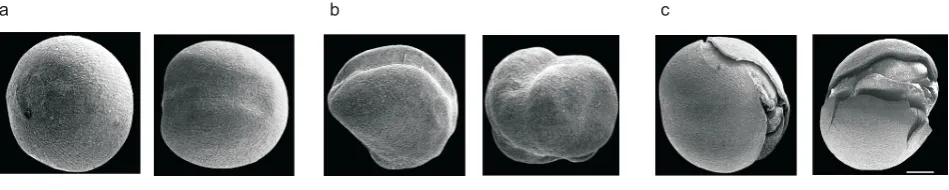
Prior to the beginning of the process of separation of damaged seeds on the electro-separator, a sample of seeds of cv. Dangal was taken in parallel for detailed surface analysis with the use of an electron microscope, type Jeol-T220A (Fig. 1). The analysis of the surface of the seeds was con-ducted at the Faculty of Soil Physics, Ivano Franko National University of Lviv.
In addition, random samples of seeds of each rapeseed cultivar were taken for analysis of mechanical damage with the use of the digital X-ray apparatus Faxitron MX-20 con-ducted at the Laboratory of Quality Estimation of Cereal and Oil Raw Materials of the Institute of Agrophysics, PAS, Lublin. For each cultivar, 100 seeds were taken at random and placed on self-adhesive measurement cartridges. Recording of the X-ray images of the seeds on the measure-ment cartridges was made in 10 replicates. An analogous procedure was followed in the case of rapeseeds after the process of electro-separation.
Figure 2a presents a window from the operating system of the apparatus, showing rapeseeds distributed on a measure-ment cartridge. Figure 2b shows a fragmeasure-ment of a section with digital images of seeds of cultivar Dangal, prior to electro-separation, in x10 magnification, where seeds with damage to the seed cover and deformed seeds are clearly visible.
The experiment on the process of electro-separation of winter rapeseeds was conducted on a special prototype device equipped with a corona discharge emitter, charging the individual particles of the mixture (seeds) with a suitable electric potential (Paranyuket al., 1998).
The process of separation proceeds as follows. Seeds drop down from the feeder chute onto the separation belt situated beneath the corona-generating electrode, supplied with high voltage from the power supply unit. The seeds are charged from the corona discharge. Damaged seeds accept a greater charge, as a result of which they are attracted by electric field to the belt and lifted upwards with the belt movement, after which they fall into the upper container. Seeds without damage roll down the belt and are deposited in the container for separated seeds. In addition, in the course of the process, stimulation of the seeds takes place under the effect of the corona charge.
Fig. 1.Electron microscope images of rapeseeds: a – seeds without mechanical damage, b – not fully developed seeds (slender seeds), c – seeds with damage to the seed cover and cotyledons.
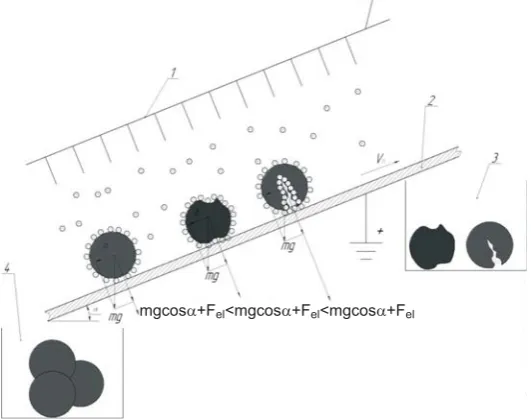
Figure 3 presents the principle of the mechanism by which the sloped belt of the separator acts on seeds with diverse values of the force potential Fel. In the process of separation, the seeds pass through a corona electrode and enter the ionized space between the separator electrodes, where their charging takes place caused by ions flowing from the needles of the corona electrode.
In the course of the separation, rapeseeds receive non-uniform charges under the effect of ionized air. Seeds without any mechanical damage, as in Fig. 1a, with spherical shapes, receive the lowest charge. Deformed seeds (Fig. 1b), as well as cracked or crushed seeds (Fig. 1c), receive larger charges, corresponding to the increase in their surface area, as the ions in the space between the separator electrodes con-centrate at points of damage to the seed coat, indentations, and protrusions on the surface of the seeds.
In the ionised space between the electrodes, charging of seeds takes place under the effect of electrostatic induction, accompanied by appearance of negative charges on the seeds, originating from the corona electrode. As the receiver electrodeiethe conducting belt of the separator, has a positi-ve potential, the charged seeds are attracted to it by the force of electrostatic field. As a result, apart from the normal component of the force of gravity mgcosa, an additional electric force Felacts on the surface of the conducting belt (Kovalyshynet al., 2008).
Therefore, the combined effect of the normal compo-nent of gravity mgcosaand the additional electric force Fel on seeds without damage is notably smaller than in the case of deformed seeds or damaged seeds (Fig. 1). In that way, damaged seeds remain on the surface of the fabric and are transported to the container situated at the top of the belt (Fig. 3). Optimization of the parameters of the separa-tion process, at which the rate of removal of defective seeds is the maximum, was conducted using multiple tests in which the numbers of regulated parameters varied succes-sively within the following ranges: angle of slope of the separator belta= 5…15°; velocity of separator belt travel Vt = 0.03…0.09 m s-1; and the value of electric charge Fig. 2.Window from the operating system of the digital X-ray
ap-paratus Faxitron MX-20: a – with rapeseeds placed on the measu-rement cartridge, b – fragment of a section with digital images of seeds with damage to the seed cover in x10 magnification.
b a
Fig. 3.Schematic diagram of the mechanism of operation of the electrical separator: 1 – corona discharge emitter, 2 – separator belt, 3 – con-tainer for not fully developed and damaged seeds, 4 – concon-tainer for non-demaged seeds.
E = 0.71…2.14 kV cm-1 (Kovalyshyn and Shvets, 2011; Kovalyshyn et al., 2008; Paranyuk et al., 2007; Shvets, 2010, 2012). As a result of the multiple experiments, the fol-lowing optimum process parameters were determined:a= 9 °; Vt = 0.07 m s-1; E = 2.0 kV cm-1. In order to determine the effectiveness of the method under study, an experiment was conducted on separation of poor quality seeds of 5 cultivars of winter rapeseed: Dangal, Egzotic, Chorwat, Olio, and Atlant. The experiment was conducted at the determined optimum parameters of the separation process.
The results of the experiments were subjected to ana-lysis of regression at a confidence level of 0.05%, and the results of the analysis were presented in the form of mean values and coefficients of variation.
RESULTS AND DISCUSSION
Figure 1 presents the shapes of rapeseeds without me-chanical damage, not fully developed rapeseeds, and mecha-nically damaged rapeseeds.
Mechanical damage makes seeds produce plants that are susceptible both to frost and to infestation with fungal diseases. With the modern system of cultivation (Budzyñski, 2012), sowing ofca. 4 kg of seeds per hectare guarantees the optimal density of 50-60 plants m-2. Any deficiency in plant density significantly contributes to weed infestation of the cultivation and a decreased yield.
Studies conducted using X-ray detection also con-firmed the possibility of application of the method not only for the study of damage to cereal seeds (Grundas et al., 1999), but also for estimation of the quality of seeds of other crop plants (Dobrzañskiet al., 2003).
The use of damaged sowing material leads to a re-duction of sowing density, non-uniformity of plant density and proper plant growth and development, and in conse-quence – to lower yields.
In the work by Kovalyshyn and Shvets (2010), the main attention was focused on obtaining homogeneous winter rape-seed sowing material. It was found that in many cases un-suitable sowing material is used. Notable amounts of seeds are damaged and do not have suitable germination capacity. The problem lies in the fact that those seeds are highly simi-lar in terms of geometric and mechanical features to seeds with high reproduction potential, which makes them hard to separate by sieve screening. The appearance of such seeds in sowing material is the result of unfavourable cultivation conditions and loss of quality due to mechanical deforma-tion in the course of harvest and processing. The effect of mecha-nical deformation occurring during storage of crops on seed quality is presented in a study by Tys and Szwed (2000).
This issue indicates an urgent need for improvement of the processes of separation of seeds, and for adaptation of quality assessment parameters to the requirements concern-ing sowconcern-ing material with high reproductive potential. One of the methods for solving the problem is the application of the phenomenon of corona discharge in seed separators.
Therefore, it is necessary to separate seeds that do not have a suitable utility value from the sowing material. The sieve separators used so far do not meet the requirements con-cerning obtaining uniform seeds in terms of reproductive potential. These requirements can only be met using separa-tors operating on the basis of the phenomenon of electric fields. Electro-separation consists in the interaction of par-ticles (seeds) charged with an electric potential with the sur-face of a belt conveyor to which a suitable electric charge is applied. Experiments conducted at the Faculty of Power Engineering and Mechanisation of Agriculture show that a larger electric charge is accepted by damaged seeds that are dropped from the feed chute onto the surface of a separa-tor sloped at a suitable angle. The belt of the separasepara-tor moves in a direction opposite to the direction of movement of undamaged seeds. This method of seed separation gives a distinct effect in the form of separating damaged seeds and carrying them on the sloping conveyor to a special container for defective material.
Seed separation was conducted for each of the winter rapeseed cultivars studied earlier. The seed material sepa-rated in that way was subjected to repeated X-ray analysis in which, at the same number of seeds per sample, the numbers of seeds with clearly observable damage were determined. The results of the analysis are presented in Table 1. It can be concluded that the percentage of damaged seeds was considerable in all the cultivars under study. The highest level of damage to the seeds was characteristic ofcv. Olio (20.1%), while the lowest level of damaged seeds was noted forcv. Chorwat (15.8%).
The coefficients of variation for the mean levels of damaged seeds prior to electro-separation changed in the range from 5.04 (cv. Atlant) to 8.16 (cv. Egzotik); after electro-separation, the values of this estimator changed in the range 4.16 (cv. Atlant) to 6.42 (cv. Chorwat).
The results obtained demonstrate that the application of the method of seed separation in electric field decreased the percentage of non-uniform (defective) seeds to the level of 2.1-3.8%. The best effect was obtained for cv. Chorwat (2.1%) andcv. Atlant (2.2%). The above results prove the applicability of the method of electro-separation of seeds in the process of preparation of sowing material.
Based on a comprehensive approach to solving the problem of supplying farms with suitable sowing material, it is proposed that the following technical problems should be addressed – selection of the parameters of the separation technology and determination of the criteria of selection of seeds with a high biological reproduction potential. Resolv-ing these issues will contribute to effective utilisation of the sowing area and an increase in the level of production of high-quality material (Kovalyshyn, 2005).
CONCLUSIONS
1. The use of electro-separation method of winter rape-seeds with mechanical damage decreases of the percentage of defective seeds from 15.8-20.1 to 2.1-3.8%.
2. The application of additional systems, operating on the basis of the corona discharge phenomenon, above the stream of seeds separated on typical seed separators will yield sowing material with uniformity at the level of 97%, which fully complies with the relevant European standards.
REFERENCES
Adamkiewicz J., Pietrzyk W., Z³onkiewicz Z., and Œcibisz M., 1996.Resistance of wheat seeds influence by tensile forces and electrostatic field. Int. Agrophysics, 10, 263-267. Basov A.M., 1968.Electric grain cleaning machine. The theory,
design and calculation (in Russian). Eng., 203, 18-64. Berlage A.G., Bilsland D.M., Churchill D.B., and Cooper T.M.,
1990.Electrostatic separation to improve germination of carrot and celery seed. Trans. ASAE, 33(2), 597-600. Budzyñski W., 2012.Agronomy of winter rape-seeds (in Polish).
Institute of Plant Breading and Acclimatization, http://www. ihar.edu.pl/agrotechnika_rzepaku_ozimego.php.
Dobrzañski B. jr, Banak E., Grundas S., Sosnowski S., and Pecen J., 2003.Rentgenography in the identification of internal cracks of french bean (in Polish). Acta Agrophysica, 95, 31-38. Grundas S., Velikanov L., and Archipov M., 1999.Importance
of wheat grain orientation for the detection of internal mechanical damage by the X-ray method. Int. Agrophysics, 13, 355-361.
Hlavaèova Z., 2003.Low-frequency electric properties utilization in agriculture and food treatment. Res. Agric. Eng., 4, 125-136.
Hlavaèova Z., 2005.Utilization of electric properties of granular and powdery materials. Int. Agrophysics, 19, 209-213. Hlavaèova Z., 2011.Electrical properties of agricultural products.
In: Encyclopedia of Agrophysics (Eds J. Gliñski, J. Horabik and J. Lipiec). Springer Press, Dordrecht-Heidelberg-London-New York.
Kovalyshyn S.J., 2005. Comprehensive approach to the solution of problems of the production of biofuels (in Ukrainian). News on Agric. Sci., Special Edition, 130-133.
Kovalyshyn S.J., 2007.Management of the process of substitu-tion of hydrocarbon fuels in the Lviv region (in Ukrainian). New Scientist of Vasylenko National Technical University, Charkiv, 2, 231-236.
Kovalyshyn S.J., 2010.Raw material base of Western Ukraine re-gion for biodiesel production. Agric. Forest Eng., 56, 45-49. Kovalyshyn S.J., Nishchenko I.O., and Shvets O.P., 2008.
Investigation of winter rape seed of separation moving in an electric field downhill. Proc. 9th Int. Scientific and Practical Conf. Memory of Academician P. Vasilenko. October 17-18, Lviv, Ukraine.
Kovalyshyn S.J. and Shvets O.P., 2010.Design requirements concerning the surface of fabric of electrostatic separator of winter rape-seeds (in Ukrainian). Scientific News NUBiP, 144(2), 125-131.
Kovalyshyn S.J. and Shvets O.P., 2011.Utilisation of electric field of corona discharge for the preparation of winter rape-seed reproductive material. Motrol, Motorization and Power Industry in Agriculture, 13, 276-283.
Cultivar
Successive replicate Mean
value
Coeff. of variation
1 2 3 4 5 6 7 8 9 10
Prior to electro-separation
Markov I., 2012.Intensive technology of rape cultivation (in Ukrainian). Agro-business Today: http://www.agro-business. com.ua/component/content/article/34-2011-05-26-08-53-3 6/439-2011-05-26-09-12-31.html
Paranyuk V.O., Kovalyshyn S.J., Melnychuk V.I., and Shvets O.P., 2007. Physical bases of technology crop seeds separation. Proc. UkrNDIPVT Memorial to L. Pogorelogo. Technical and technological aspects of the development and testing of new techniques and technologies for agriculture in Ukraine, 10(24), 77-86.
Paranyuk V., Kovalyshyn S., Vorobkiewich V., and Rivis Y., 1998.Device for seed treatment (in Ukrainian). Patent of Ukraine No. 25302, MKI ADISI/0.
Pietrzyk W., Horyñski M., and Œcibisz M., 1996.The electric field influence on drying curves of grain seeds in a fluidal layer. Int. Agrophysics, 10, 57-67.
Shvets O.P., 2010.Research and impact angle of equilibrium seeds of winter rape on the trajectory of its motion on the working electric friction separator. All-national scientific and technical collection Kirovograd National Technical University: Design, Manufacture and Operation of Agric. Machinery, 40(2), 235-241.
Shvets O.P., 2012.The study further purification winter rape seeds (in Ukrainian). Mechanization Agric. Production, 124(1), 282-288.
Sumorek A. and Pietrzyk W., 1999.Influence of electric field on the speed of convective removal of water from wheat grain. Int. Agrophysics, 13, 509-513.