A b s t r a c t. Some physical and germination properties of bitter gourd seed were determined in a moisture content range of 9.3-32.1% d.b. For this moisture, the average length, width, and thickness of seed increased by 3.68, 4.07, and 4.56%, respectively. The geometric properties increased with increasing moisture content. The bulk density and rupture force decreased while thousand seed mass, true density, porosity, terminal velocity and static coefficient of friction increased with increasing moisture content. At all moisture contents, the maximum friction was offe-red by rubber, followed by plywood, aluminum, and galvanized iron surface. The seed germination duration, seedling emergence percentage, and germination index values gave the best results at the 19.9% moisture content, whereas fresh seedling mass was not affected by different moisture contents.
K e y w o r d s: bitter gourd seed, moisture content, physical properties, germination properties
INTRODUCTION
Bitter gourd is a tropical and subtropical vine of the familyCucurbitaceae, widely grown for edible fruit, which is among the most bitter of all fruits. Other common names include Papara, Momordica charantia, Balsam apple, Momordica, or Bitter melon. It is Turkish name is known as ‘Kudret Narý’.
The original home of the species is not known, other than that it is native to the tropics. It is widely grown in India, Nepal and other parts of the Indian subcontinent, Southeast Asia, China, Africa, the Caribbean, and Mediterranean countries such as Turkey and Italy. In Turkey, it is usually grown in Bursa and Yalova provinces.
Bitter gourd (Momordica charantia, L.), a cucurbi-taceousfruit-vegetable is popular as a medicinal vegetable (Anonymous, 2011).
Bitter gourd is an annual plant of the Cucurbitaceae family with slender vine characteristics. The leaves are palmate and have a pedicel. The fruit splits at maturity. The fruits are 8-15 cm in length and 4-10 cm in width, the fruit surface is rough and sharpens at the tip. The fruit, which is green initially, turns to yellow and golden yellow as it matu-res and contains 20-30 dark red bean-like seeds. It is used as a natural drug after mixing with olive oil (Anonymous, 2012a, 2012b).
Bitter gourd is grown by seed or seedlings obtained from seeds. Seeds are sown in April or May into containers or directly to the field when the soil temperature rises 8-10°C. Planting seedlings is advisable since the germination rate of seeds is not 100% (Baryeh, 2002).
Bitter gourd is little known in Turkey and grown in minute quantities, despite its many useful characteristics. Agricultural subventions are essential so that cultivation thereof becomes widespread over the country. Therefore, construction of machinery and equipment and modelling research related to sowing, care, harvest, and handling processes for the crop is also of importance. The physical properties of bitter gourd seed, like those of other grains and seeds, are essential for the design of equipment for handling, harvesting, processing, and storing the kernels. Various types of cleaning, grading, and separation equipment are designed on the basis of the physical properties of the seeds or kernels. Threshing is usually carried out on a hard floor with homemade threshing machines. To optimize threshing performance, pneumatic conveying, and storage of bitter gourd, its physical properties must be known as a function of the moisture content (Srivastavaet al., 1990).
Researchers have investigated the physical properties of several agricultural products for a similar purpose (Aghkhaniet al., 2012; Baryeh, 2002). These investigators Int. Agrophys., 2013, 27, 455-461
doi: 10.2478/intag-2013-0016
Effect of the moisture content on the physical properties of bitter gourd seed
H. Ünal
1, H.C. Alpsoy
2, and A. Ayhan
11Department of Biosystems Engineering,2Protected Cultivation Programme, Yeniºehir Vocational School, University of Uludað, Bursa, Turkey
Received January 18, 2013; accepted April 16, 2013
© 2013 Institute of Agrophysics, Polish Academy of Sciences
*Corresponding author e-mail: [email protected]
A
A
Agggrrroooppphhyhyysssiiicccsss
determined the size of various grains and seeds by measur-ing their principal axial dimensions. Garavandet al.(2012), Balakrishnanet al.(2011), and Aviaraet al.(1999) investi-gated the variation of these dimensions with moisture the content for hemp seed, cardamom, and guna seed, respecti-vely. Balakrishnanet al. (2011) employed the geometric mean and equivalent sphere effective diameters of the three principal axes of mass in calculating the volume of the seed. The results reported showed that these diameters approxi-mately predicted the experimentally determined values. In a similar work on guna seeds, Aviaraet al. (1999) reported that it was the geometric diameter that gave the closest va-lues to the experimentally determined volume of guna seeds. Two basic studies were applied to bitter gourd seeds with different moisture contents. These consisted of deter-mining physical properties and germination rates of the seeds. Our primary objective was to investigate some moisture-dependent physical and mechanical properties of the bitter gourd seed, namely; linear dimensions, sphericity, volume, surface area, thousand seed mass, bulk and true densities, porosity, terminal velocity, coefficient of static friction and rupture strength. Our secondary objective was to determine the germination ratios and indexes of bitter gourd seeds at different moisture contents.
MATERIAL AND METHODS
Dry mature bitter gourd seeds (Momordica charantiaL.) were used for all the experiments in this study. The seeds were grown in the 2010-2011 growing season at the ex-perimental farm of the Protected Cultivation Programme in Yeniºehir Vocational School of Uludað University. The seeds were cleaned in an air screen cleaner where all foreign matter such as dust, dirt, stones, and chaff as well as immature and broken seeds was removed. Then, they were stored in plastic buckets with a cover and kept in cold storage at 5°C. The seeds were removed and kept at room temperature of 20-25°C for 3 h before making any measure-ment (ASAE, 1997).
The moisture content of the seed samples was deter-mined in three replicates using the air oven method ac-cording to the ASAE Standard S352.2 (ASAE, 1997) for bitter gourd. About 15 g grain was dried in a convection oven at 103°C for 72 h. A cabinet drier (Nuve, EN500S, ac-curacy ±1°C, Turkey) with a front panel made of heat re-sistant glass was used for the drying experiments. The average moisture content was found to be 9.3% d.b.
Seed samples were conditioned to obtain different moisture contents in the range of 9.3-32.1% d.b. The samples of the desired moisture level were prepared by adding the amount of distilled water (Mohsenin, 1986).
To determine the average size of the bitter gourd seed, 100 grains were randomly picked and their three axial dimensions, namely lengthL, widthW, and thicknessTwere measured using a digital calliper with a sensitivity of
0.01 mm. The geometric mean diameter (Dg), sphericity (f), surface area (As) and volume of seeds (V) were computed at the different moisture contents according to Garavandet al. (2012) and Mohsenin (1986).
Thousand seed mass (M1000) was determined using an electronic balance (MP-300 Chyo) weighing to an accuracy of 0.001 g.
Bulk density (rb) is the ratio of grain mass to the volume
of the sample container. True density (rt) was determined using the Toluene displacement method (Balakrishnanet al.,2011). Porosity (e) was computed from the values of the true and bulk density of seeds using the relationship given by Izliet al.(2009).
The terminal velocity which kept the grain in suspen-sion was recorded by a digital anemometer (Thies clima, Germany) having a least count of 0.1 m s-1(Unalet al.,2008).
The static coefficient of friction was obtained through the use of an inclinometer and 4 friction plates (rubber, gal-vanized iron, aluminum, and plywood) (Nimkaret al.,2005).
The rupture strength of bitter gourd seed was tested to know the magnitude of force that was required to break the seed in the axial dimension (thickness). Rupture forces were measured using a dynamometer (Sundoo, 500 SH, accuracy 0.1 N, China) with 500 N capacity. The loading velocity of the dynamometer was constant at 35 mm min-1during mea-surements. For each test, a single seed was placed on its thick-ness axes on a flat plate and then compressed with a 12 mm dia-meter probe. The process was replicated 30 times and the ave-rage of the 30 readings was taken as the representative value. The seeds were divided into three groups for each mois-ture content in order to determine the germination characte-ristics of bitter gourd seeds with different moisture contents. 10 seeds chosen at random for each group were sown into multicellular containers. Peat was used as germination medium. The containers were regularly irrigated and the emergence of seeds was observed daily and recorded along the germination period. At the end of the trials, the germi-nation period, germigermi-nation rate, germigermi-nation index, and fresh seedling mass were determined for the seeds with dif-ferent moisture contents. The relation of the seed moisture content and seed coat firmness with the germination period and germination rates were investigated.
The results were processed by the MINITAB (Version 14, University of Texas, Austin, USA) and MS-Excel soft-ware programs. One way analysis of variance and LSD test MSTAT_C (Version 2.1., Michigan State University, USA) software program were used to analyse the results. Differen-ces were considered significant at p<0.01 and p<0.05, un-less otherwise specified.
RESULTS AND DISCUSSION
Table 1. A very high correlation was observed between the three principal dimensions and the moisture content indicat-ing that upon moisture absorption, the bitter gourd seed ex-pands in length, width, and thickness within the moisture range of 9.3-32.1% d.b. The mean dimensions of 100 seeds mea-sured at a moisture content of 9.3% d.b. are: length 13.85 mm, width 7.61 mm, and thickness 4.17 mm. Differences between the values are statistically significant at p<0.05.
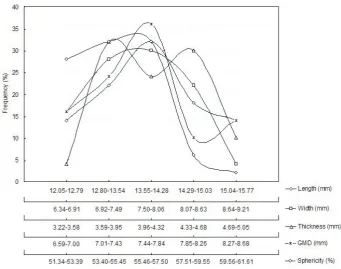
The frequency distribution curves of length, width, thick-ness, geometric mean diameter, and sphericity of the bitter gourd seed showed a trend towards a normal distribution (Fig. 1). The results showed that the length, width, and thick-ness of the seed ranged between 12.05-15.77, 6.34-9.21, and 3.22-5.05 mm, respectively, while the geometric mean dia-meter and sphericity ranged between 7.47-8.68 mm and 51.34-61.61%, respectively. About 72% of bitter gourd seeds are between 12.79 and 15.03 mm in length, 80% of them were
between 6.91 and 8.63 mm in width, and 86% of them were between 3.58 and 4.68 mm in thickness. Also, 76% of seeds were between 7.47 and 8.26 mm in geometric mean diameter and 92% of them were between 51.34 and 59.55% in sphericity.
The values of sphericity were calculated individually using the data on the geometric mean diameter and the major axis of the seed and the results obtained are presented in Table 1. It can be seen that the grain has mean values of sphericity ranging from 54.86 to 55.09%. Aydin and Ozcan (2007) has reported the value for sphericity of myrtle fruits to be 58.30%, which is close to the results of this investi-gation. Saciliket al. (2003) and Dursun and Dursun (2005) considered the grain as spherical when the sphericity value was higher than 0.80 and 0.73, respectively. In this study, bitter gourd seed should not be treated as an equivalent sphere for calculation of the surface area.
Moisture content (% d.b.)
Length Width Thickness Geometric mean diameter
Sphericity (%) (mm)
9.3 13.85 b (0.96) 7.61 b (0.66) 4.17 b (0.39) 7.59 b (0.50) 54.86 ns (2.11)
19.9 13.97 b (0.98) 7.68 ab (0.58) 4.23 ab (0.40) 7.68 b (0.51) 55.02 ns (2.27)
25.0 14.20 ab (0.84) 7.75 ab (0.64) 4.27 ab (0.41) 7.77 ab (0.51) 54.75 ns (2.86)
32.1 14.36 a (0.90) 7.92 a (0.75) 4.36 a (0.39) 7.91 a (0.57) 55.09 ns (2.68)
All data represent the mean 100 determinations. Values in the same columns followed by different letters (a-b) are significantly different (p<0.05). Standard deviation is given in parenthesis, ns – not significant.
T a b l e 1.Axial dimensions, geometric mean diameter, and sphericity of bitter gourd seed at different moisture contents
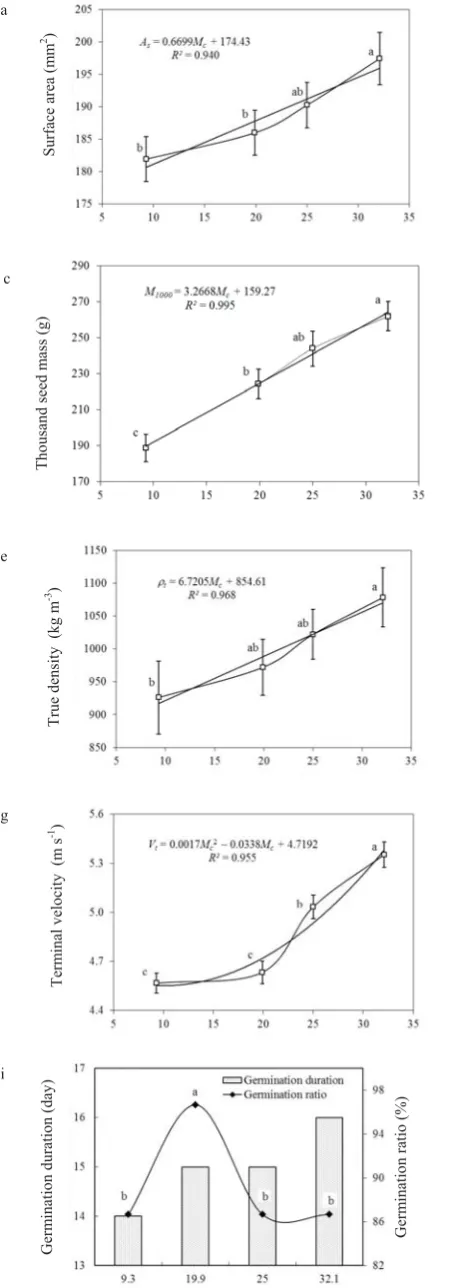
The surface area of seed increases linearly from 181.91 to 197.42 mm2(statistically significant at p<0.05) when the moisture content increased from 9.3 to 32.1% d.b. (Fig. 2a). A similar trend has been reported for millet (Baryeh, 2002), hemp seed (Saciliket al., 2003), and caper seed (Dursun and Dursun, 2005).
The values obtained for seed volume of bitter gourd are shown in Fig. 2b. The values obtained for seed volume increa- ses linearly from 232.21 to 262.83 mm3with the increase in the moisture content and the change was significant (p<0.05). Similar results of an increase in seed volume, due to an increase in the grain moisture content, were reported for millet (Baryeh, 2002) and hemp seed (Saciliket al., 2003).
The thousand seed mass of bitter gourd seed,M1000(g) increased from 188.7 to 262.0 g (p<0.01) as the moisture content increased from 9.3 to 32.1% d.b. (Fig. 2c). Similar trends have been reported by Aviaraet al. (1999) for guna seed, Saciliket al. (2003) for hemp seed, and Balakrishnan et al. (2011) for cardamom.
The seed bulk density at different moisture levels varied from 514.1 to 435.9 kg m-3(p<0.01) (Fig. 2d) and indicated a decrease in bulk density with an increase in the moisture content from 9.3 to 32.1% d.b. This was due to the fact that the increase in mass owing to moisture gain in the grain sample was lower than the accompanying volumetric expan-sion of the bulk. The negative linear relationship of bulk density with the moisture content was also observed by Saciliket al. (2003), Dursun and Dursun (2005), and Aydin and Ozcan (2007) for hemp seed, caper seed and myrtle fruits, respectively. The true density of seeds was found to vary from 969.7 to 1134.2 kg m-3, when the moisture level increased from about 9.3 to 32.1% d.b. (Fig. 2e). The varia-tion in true density with the moisture content was significant (p<0.05). The increase in true density varying with the increase in the moisture content might be attributed to the relatively low true volume as compared to the corresponding mass of the seed attained due to adsorption of water. Although the results were similar to those reported by Aydin and Ozcan (2007) for myrtle fruit and Pradhanet al. (2008) for karanja kernel, a different trend was reported by Suthar and Das (1996) for karinga seed.
The variation of porosity depending upon the moisture content is shown in Fig. 2f. Porosity was found to increase linearly from 42.5 to 59.3% (p<0.05) at the specified moisture levels. Aydin and Ozcan (2007) for myrtle fruit and Pradhanet al. (2008) for karanja kernel stated that as the moisture content increased, the porosity value also in-creased, but Dursun and Dursun (2005) and Aghkhaniet al. (2012) reported a decreasing trend for caper and Christmas Lima bean, respectively.
The variation in terminal velocity values of bitter gourd seed with the increase in the moisture content is shown in Fig. 2g. It was observed that terminal velocity increased linearly from 4.57 to 5.35 m s-1 with the increase in the moisture content and this change was significant (p<0.01). The results indicated that the percent increase in terminal velocity of mung bean was 17% for the corresponding in-crease in the moisture content of 9.3 to 32.1% d.b. At the moisture content of 9.3% d.b. the terminal velocity of bitter gourd seed was found to be smaller than that of moth gram (Nimkaret al., 2005), mung bean (Unalet al., 2008), and Christmas Lima bean (Aghkhaniet al., 2012), while it was greater than that of psyllium seed (Ahmadiet al., 2012).
Experimental data of the static coefficient of friction for bitter gourd seed on frictional surfaces of rubber, plywood, aluminum, and galvanized iron sheet at various moisture levels are presented against the moisture content, as shown in Table 2. It can be seen that the static coefficient of friction increased logarithmically with the increase in the moisture content for all the contact surfaces. The cause of the increa-sed friction coefficient at the higher moisture content may be the water present in the seed, offering a cohesive force on the surface of contact. Increases of 74.2, 64.2, 73.8, and 70.0% were recorded in the case of rubber, plywood, aluminum, and galvanized iron, respectively, as the moisture content increased from 9.3 to 32.1% d.b. The static coefficient of friction is important for designing storage bins, hoppers, pneumatic conveying systems, screw conveyors, forage har-vesters, threshers,etc. (Pradhanet al., 2008). At all the mois-ture contents, the maximum friction was offered by rubber, followed by plywood, aluminum, and galvanized iron sur-face. The lowest static coefficient of friction may be relaed to the smoother and more polished surface of the galvanized iron sheet than the other materials used. Rubber also offered the maximum friction for caper seed, mung bean, and Christmas Lima bean and the coefficient of friction increa-sed with the moisture content (Aghkhaniet al., 2012; Dursun and Dursun, 2005; Unal et al., 2008). The relationship between the coefficient of static friction and the moisture content for the surfaces considered was found to be logarith-mic as presented in Table 3.
Fig. 2.Effect of moisture content on: a – surface area, b – volume seed, c – thousand seed mass, d – bulk density, e – true density, f – porosity, g – terminal velocity, h – rupture force, i – germina-tion duragermina-tion and ratio of bitter gourd seed.
f e
h
Surf
ace
area
(m
m
2 )
Volum
e
seed
(m
m
2 )
T
housand
seed
m
ass
(g
)
Bulk
density
(kg
m
-3 ) d c
b a
T
rue
density
(k
g
m
-3)
Po
ro
sity
(%)
Term
inal
velocity
(m
s
-1)
Ruptur
e
for
ce
(N
)
g
Germ
ination
duration
(day)
i
Germ
ination
ratio
(%)
working on hemp seed, and the values of 1-30 N found by Aydin and Ozcan (2007) while working on myrtle fruit. The differences between the rupture force values of seeds at dif-ferent moisture contents have been found to be statistically significant (p<0.01).
Germination results related to seed samples used for germination trials, as well as the physical properties of bitter gourd seeds are given in Table 4. As can be seen in the table, there was no significant effect of the change in the moisture content on the germination period and seedling mass. On the other hand, the effect of the 19.9% moisture content on the germination rate and germination index was found to be more significant than the other moisture contents (p<0.05).
The germination period and germination index values of seeds used in this trial were similar to those reported by Bewley (1997), Wanget al. (2003), and Thirusenduraselvi and Jerlin (2007). The germination duration and germina-tion ratio values of bitter gourd seeds are shown compara-tively in Fig. 2i.
CONCLUSIONS
1. The average length, width, thickness, geometric mean diameter, surface area and unit volume of seed in-creased linearly with the increasing moisture content from 9.3 to 32.1% d.b.
2. Similarly, thousand seed mass, true density, porosity and terminal velocity increased linearly whereas bulk den-sity decreased linearly with the increasing moisture content.
3. The highest static coefficient of friction was found on rubber, followed by plywood, aluminium sheet, and galvani-zed iron sheet.
4. The rupture force was highly dependent on the mois-ture content. The highest rupmois-ture strength obtained was 209.2 N at the moisture content of 9.3% d.b.
5. The seed germination duration, seedling emergence percentage, and germination index values gave the best re-sults at the 19.9% moisture content.
Moisture content (% d.b.)
Coefficient of static friction
Significance level
Rubber Plywood Aluminium Galvanized iron
9.3 0.695 A,c (0.023) 0.668 AB,c (0.024) 0.613 BC,c (0.011) 0.603 C,c (0.015) **
19.9 1.026 A,b (0.040) 0.924 B,b (0.030) 0.880 B,b (0.033) 0.851 B,b (0.020) **
25.0 1.113 A,ab (0.047) 1.033 A,a (0.027) 0.939 B,b (0.033) 0.916 B,b (0.027) **
32.1 1.219 A,a (0.067) 1.099 AB,a (0.043) 1.056 B,a (0.040) 1.015 B,a (0.042) **
Significance level ** * * *
All data represent the mean 10 determinations. Standard deviation is given in parenthesis. Means followed by the same letter between rows (a, b, c) and between columns (A, B, C) within each surface are significant. *, ** Significance levels at p<0.05, p<0.01, respectively. T a b l e 2.Coefficient of static friction of bitter gourd seed
Surface Regression equations R2
Rubber mru=0 423. ln(Mc)-0 2472. 0.999
Plywood mplw=0 354. ln(Mc)-01229. 0.996
Aluminium mal=0 349. ln(Mc)-01675. 0.996
Galvanized iron mgi=0 328. ln(Mc)-01307. 0.998 T a b l e 3.Regression equations related to coefficients of static friction of bitter gourd seed
Moisture content (% d.b.)
Mean germination duration (days)
Germination ratio (%)
Germination index
Fresh seedling mass (g)
9.3 14 ns 86.7 b 0.762 b (0.071) 3.1 ns (0.3)
19.9 15 ns 96.7 a 0.806 a (0.035) 3.0 ns (0.2)
25.0 15 ns 86.7 b 0.717 c (0.078) 3.3 ns (0.2)
32.1 16 ns 86.7 b 0.719 c (0.031) 3.0 ns (0.2)
All data represent the mean 30 determinations. Standard deviation is given in parenthesis, a-c letters indicate the statistical difference in same columns (p<0.05), ns – not significant.
REFERENCES
Aghkhani M.H., Miraei Ashtiani S.H., Baradaran Motie J. and
Abbaspour-Fard M.H., 2012. Physical properties of
Christmas Lima bean at different moisture content. Int. Agrophys., 26, 341-346.
Ahmadi R., Kalbasi-Ashtari A., and Gharibzahedi S.M.T., 2012.Physical properties of psyllium seed. Int. Agrophys., 26, 91-93.
Anonymous, 2011. Available: <http://en.wikipedia.org/wiki/ Bitter_melon>
Anonymous, 2012a. Available: <http://www.sifalibitkiler.us/ archives/584> (in Turkish)
Anonymous,2012b.Available: <http://www.50mucizebitki.com/ kudretnari.html> (in Turkish)
ASAE,1997.S352.2 Moisture measurement – unground grain and seeds. Am. Soc. Agric. Eng., St. Joseph, MI, USA Aviara N.A., Gwandzang M.I., and Haque M.A., 1999.Physical
properties of guna seeds. J. Agric. Eng. Res., 73, 105-111. Aydin C. and Ozcan M., 2007.Determination of nutritional and
physical properties of myrtle (Myrtus communisL.) fruits growing wild in Turkey. J. Food Eng., 79, 453-458. Balakrishnan M., Manikantan M.R., Viswanathan R., and
Sreenarayanan V.V., 2011.Moisture dependent physical properties of cardamom. Int. Agrophys., 25, 399-402. Baryeh E.A., 2002.Physical properties of millet. J. Food Eng., 51,
39-46.
Bewley J.D. 1997.Seed germination and dormancy. Plant Cell, 9, 1055-1066.
Dursun E. and Dursun I., 2005. Some physical properties of caper seed. Bios. Eng., 92(2), 237-245.
Izli N., Unal H., and Sincik M. 2009.Physical and mechanical properties of rapeseed at different moisture content. Int. Agrophys., 23(2), 137-145.
Mohsenin N.N., 1986.Physical properties of plant and animals materials. Gordon Breach Sci. Press, New York, NY, USA.
Nimkar P.M., Mandwe D.S., and Dudhe R.M. 2005.Physical
properties of moth gram. Bios. Eng., 91, 183-189. Paksoy M. and Aydin C., 2006.Determination of some physical
and mechanical properties of pea (Pisum sativumL.) seeds. Pakistan J. Biol. Sci., 9(1), 26-29.
Pradhan R.C., Naik S.N., Bhatnagar N., and Swain S.K., 2008. Moisture-dependent physical properties of Karanja ( Ponga-mia pinnata) kernel. Ind. Crops Prod., 28(2), 155-161.
Sacilik K., Ozturk R., and Keskin R., 2003. Some physical
properties of hemp seed. Bios. Eng., 86, 213-215.
Srivastava A.K., Mahoney W.T., and West N.L., 1990.The
effect of crop properties on combine performance. ASAE Paper No. 63-72.
Suthar S.H. and Das S.K., 1996.Some physical properties of karingda seeds. J. Agr. Eng. Res., 65, 15-22.
Taheri-Garavand A., Nassiri A., and Gharibzahedi S.M.T., 2012.Physical and mechanical properties of hemp seed. Int. Agrophys., 26, 211-215.
Thirusenduraselvi D. and Jerlin R., 2007.Effect of pre-germina-tion treatments on the emergence percentage of bitter gourd
cv. CO 1 seeds. Tropical Agric. Res. Extension, 10, 88-90. Unal H., Isik E., Izli N., and Tekin Y., 2008.Geometric and
mechanical properties of mung bean (Vigna radiata L.) grain: Effect of moisture. Int. J. Food Prop., 11(3), 585-599. Wang H.Y., Chen C.L., and Sung J.M., 2003.Both warm water