A Monthly Double-Blind Peer Reviewed (Refereed/Juried) Open Access International e-Journal - Included in the International Serial Directories
Indexed & Listed at:
VOLUME NO.2(2012),ISSUE NO.9(SEPTEMBER) ISSN 2231-5756
INTERNATIONAL JOURNAL OF RESEARCH IN COMMERCE, IT & MANAGEMENT
CONTENTS
CONTENTS
CONTENTS
CONTENTS
Sr.No.
TITLE & NAME OF THE AUTHOR (S)
Page No.
1. HIGH PERFORMANCE ORGANIZATION AND ORGANIZATIONAL EFFECTIVENESS IN BAPPEDA (DEVELOPMENT AND PLANNING BOARD), ACEH- INDONESIA
FIFI YUSMITA & DR. VIMALASANJEEVKUMAR
1
2. SOCIAL ENTREPRENEURS IN BANGLADESH
DEWAN MAHBOOB HOSSAIN & MOINUL HOSSAIN
7 3. IMPACT OF WORKING CAPITAL MANAGEMENT ON FIRM’S PERFORMANCE: EVIDENCES FROM LISTED COMPANIES OF INDIA
DR. AVANISH KUMAR SHUKLA
13 4. ENGLISH TEACHERS’ EMOTIONAL INTELLIGENCE AND ITS IMPACT ON THEIR ORGANIZATIONAL CITIZENSHIP BEHAVIOUR IN SRI LANKAN
SCHOOLS
U.W.M.R. SAMPATH KAPPAGODA
18
5. A QUALITATIVE INQUIRY OF LEADERSHIP PRACTICES AND ITS BEHAVIORAL AND PSYCHOLOGICAL OUTCOMES
MADIHAREHMANFAROOQUI
23 6. LINKING ORGANIZATIONAL CULTURE, STRUCTURE, AND ORGANIZATIONAL EFFECTIVENESS
FAKHRADDIN MAROOFI, AFSHINGHASEMI & SAMIRA DHGHANI
29 7. SWOT ANALYSIS: AN INSTRUMENT FOR STRATEGIC PLANNING – A CASE STUDY
GOMATESH M. RAVANAVAR & DR. POORNIMA M. CHARANTIMATH
35 8. THE ROLE OF HRM PRACTICES IN ORGANIZED RETAILING A STUDY OF SELECT RETAILERS IN BANGALORE CITY
LAKSHMI NARAYANA.K, DR. P. PARAMASHIVAIAH & DR. SREENIVAS. D. L
41 9. WATER CRISIS AT COAL CAPITAL OF INDIA: A PRAGMATIC STUDY OF ROOT CAUSES, IMPACT AND SOLUTION OF WATER CRISIS IN REGIONS
OF WORKING COAL MINES OF BHARAT COKING COAL LIMITED DHANBAD
ABHINAV KUMAR SHRIVASTAVA & DR. N. C. PAHARIYA
46
10. PORTFOLIO MANAGEMENT OF INDIAN MUTUAL FUNDS: A STUDY ON DIVERSIFIED EQUITY FUNDS PERFORMANCE
E. UMA REDDY & C. MADHUSUDANA REDDY
50 11. A STUDY OF DIFFERENCES IN PERCEPTION OF EMPLOYEES ABOUT THE HRD CLIMATE PREVAILS IN THE ENGINEERING INSTITUTE ON THE
BASIS OF AGE GROUP
MUKESH KUMAR PARASHAR & DR. MURLIDHAR PANGA
54
12. INSTITUTIONAL FINANCING OF AGRICULTURE IN INDIA WITH SPECIAL REFERENCE TO COMMERCIAL BANKS: PROBLEMS FACED BY FARMERS – AN EMPIRICAL STUDY
DR. KEWAL KUMAR & ATUL GAMBHIR
58
13. MULTIPLE FACETS OF ORGAN TRANSPLANTATION IN A TERTIARY CARE HOSPITAL MANAGEMENT, INDIA
DR. PRAKASH.K.N, DR. CYNTHIA MENEZES, DR. ANNAPURNA RAMESH & S. HARISH BABU
61 14. FDI, TRADE, AND ECONOMIC GROWTH IN SINGAPORE--EVIDENCE FROM TIME-SERIES CAUSALITY ANALYSES
DR. G. JAYACHANDRAN
66 15. AN EVALUATION OF MICRO CREDIT IMPACT ON RURAL POOR WOMEN – A CASE STUDY IN BELLARY DISTRICT, KARNATAKA
K. S. PRAKASHA RAO
77 16. APPRECIATION AND APPREHENSIONS OF INDIAN CORPORATE SECTOR ABOUT CORPORATE SOCIAL RESPONSIBILITY
DR. B. M. HARSHAVARDHAN, DR. A. PRASAD & A V LAL
84 17. SOCIAL MEDIA MARKETING: THE NEXT FRONTIER (AN EXPLORATORY STUDY ON SOCIAL MEDIA MARKETING PROSPECTIVE WITH
REFERENCE TO PUNE CITY)
GUNJN SINGH
92
18. ROLE OF INFORMATION TECHNOLOGY IN AGRICULTURE AND AGRO-BASED INDUSTRIES
DR. B. RAMACHNADRA REDDY, E. LAVANYA & P. HUSSAIN BASHA
97 19. ADVENTURE TOURISM POTENTIAL: A STUDY OF KASHMIR
FARHAT BANO BEG & DR. ASHOK AIMA
99 20. INVENTORY MODEL IN A FUZZY ENVIRONMENT WITH ITS ASSOCIATED COSTS IN EXPONENTIAL MEMBERSHIP FUNCTIONS
K. PUNNIAKRISHNAN & K. KADAMBAVANAM
102 21. EMPLOYEES PERSPECTIVE VIEW TOWARDS PERFORMANCE APPRAISAL AND TRAINING PROGRAMMES PRACTICED IN SUGAR INDUSTRIES
IN ERODE DISTRICT
M. SELVI SRIDEVI & DR. L. MANIVANNAN
107
22. INTEREST IN MANAGEMENT EDUCATION: THE CURRENT TREND AND ITS IMPLICATIONS
VIJENDRA KUMAR S. K. & ANCY MATHEW
116 23. IMPACT OF CORPORATE GOVERNANCE PRACTICES ON THE FIRM PERFORMANCE: AN EMPIRICAL EVIDENCE OF THE SMALL AND MEDIUM
ENTERPRISES IN INDIA
PARTHA SARATHI PATTNAYAK & DR. PRIYA RANJAN DASH
119
24. A REVIEW OF HUMAN ERROR IN MAINTENANCE AND SAFETY
ROSHAN KURUVILA
124 25. SEARCH-EXPERIENCE FRAMEWORK: A CASE OF MOVIE INDUSTRY
T. SAI VIJAY & TANUSHREE GOSWAMI
127 26. GENDER EQUALITY AND INCLUSIVE GROWTH: IN CASE OF PUNJAB
DR. SANGEETA NAGAICH & PREETI SHARMA
132 27. ESTIMATION OF POPULATION MEAN USING RANKED SET SAMPLING
DR. SUNIL KUMAR, DR. SANDEEP BHOUGAL & RAHUL KUMAR SHARMA & DR. KULDIP RAJ
139 28. A GOAL PROGRAMMING FORMULATION IN NUTRIENT MANAGEMENT OF FERTILIZERS USED FOR RUBBER PLANTATION IN TRIPURA
NABENDU SEN & MANISH NANDI
142 29. A STUDY ON THE FACTORS INFLUENCING INDIVIDUAL INVESTOR BEHAVIOR IN IT SECTOR
SINDU KOPPA & SHALINI .P
145 30. RELIGION, LAW & THE ROLE OF STATE
NITUJA KUMARI & MOHD YASIN WANI
150
CHIEF PATRON
CHIEF PATRON
CHIEF PATRON
CHIEF PATRON
PROF. K. K. AGGARWAL
Chancellor, Lingaya’s University, Delhi
Founder Vice-Chancellor, Guru Gobind Singh Indraprastha University, Delhi
Ex. Pro Vice-Chancellor, Guru Jambheshwar University, Hisar
FOUNDER
FOUNDER
FOUNDER
FOUNDER PATRON
PATRON
PATRON
PATRON
LATE SH. RAM BHAJAN AGGARWAL
Former State Minister for Home & Tourism, Government of Haryana
Former Vice-President, Dadri Education Society, Charkhi Dadri
Former President, Chinar Syntex Ltd. (Textile Mills), Bhiwani
CO
CO
CO
CO----ORDINATOR
ORDINATOR
ORDINATOR
ORDINATOR
AMITA
Faculty, Government M. S., Mohali
ADVISORS
ADVISORS
ADVISORS
ADVISORS
DR. PRIYA RANJAN TRIVEDI
Chancellor, The Global Open University, Nagaland
PROF. M. S. SENAM RAJU
Director A. C. D., School of Management Studies, I.G.N.O.U., New Delhi
PROF. M. N. SHARMA
Chairman, M.B.A., Haryana College of Technology & Management, Kaithal
PROF. S. L. MAHANDRU
Principal (Retd.), Maharaja Agrasen College, Jagadhri
EDITOR
EDITOR
EDITOR
EDITOR
PROF. R. K. SHARMA
Professor, Bharti Vidyapeeth University Institute of Management & Research, New Delhi
CO
CO
CO
CO----EDITOR
EDITOR
EDITOR
EDITOR
DR. BHAVET
Faculty, M. M. Institute of Management, Maharishi Markandeshwar University, Mullana, Ambala, Haryana
EDITORIAL ADVISORY BOARD
EDITORIAL ADVISORY BOARD
EDITORIAL ADVISORY BOARD
EDITORIAL ADVISORY BOARD
DR. RAJESH MODI
Faculty, Yanbu Industrial College, Kingdom of Saudi Arabia
PROF. SANJIV MITTAL
University School of Management Studies, Guru Gobind Singh I. P. University, Delhi
PROF. ANIL K. SAINI
Chairperson (CRC), Guru Gobind Singh I. P. University, Delhi
DR. SAMBHAVNA
Faculty, I.I.T.M., Delhi
DR. MOHENDER KUMAR GUPTA
VOLUME NO.2(2012),ISSUE NO.9(SEPTEMBER) ISSN 2231-5756
INTERNATIONAL JOURNAL OF RESEARCH IN COMMERCE, IT & MANAGEMENT
DR. SHIVAKUMAR DEENE
Asst. Professor, Dept. of Commerce, School of Business Studies, Central University of Karnataka, Gulbarga
MOHITA
Faculty, Yamuna Institute of Engineering & Technology, Village Gadholi, P. O. Gadhola, Yamunanagar
ASSOCIATE EDITORS
ASSOCIATE EDITORS
ASSOCIATE EDITORS
ASSOCIATE EDITORS
PROF. NAWAB ALI KHAN
Department of Commerce, Aligarh Muslim University, Aligarh, U.P.
PROF. ABHAY BANSAL
Head, Department of Information Technology, Amity School of Engineering & Technology, Amity University, Noida
PROF. A. SURYANARAYANA
Department of Business Management, Osmania University, Hyderabad
DR. SAMBHAV GARG
Faculty, M. M. Institute of Management, Maharishi Markandeshwar University, Mullana, Ambala, Haryana
PROF. V. SELVAM
SSL, VIT University, Vellore
DR. PARDEEP AHLAWAT
Associate Professor, Institute of Management Studies & Research, Maharshi Dayanand University, Rohtak
DR. S. TABASSUM SULTANA
Associate Professor, Department of Business Management, Matrusri Institute of P.G. Studies, Hyderabad
SURJEET SINGH
Asst. Professor, Department of Computer Science, G. M. N. (P.G.) College, Ambala Cantt.
TECHNICAL ADVISOR
TECHNICAL ADVISOR
TECHNICAL ADVISOR
TECHNICAL ADVISOR
AMITA
Faculty, Government H. S., Mohali
MOHITA
Faculty, Yamuna Institute of Engineering & Technology, Village Gadholi, P. O. Gadhola, Yamunanagar
FINANCIAL ADVISORS
FINANCIAL ADVISORS
FINANCIAL ADVISORS
FINANCIAL ADVISORS
DICKIN GOYAL
Advocate & Tax Adviser, Panchkula
NEENA
Investment Consultant, Chambaghat, Solan, Himachal Pradesh
LEGAL ADVISORS
LEGAL ADVISORS
LEGAL ADVISORS
LEGAL ADVISORS
JITENDER S. CHAHAL
Advocate, Punjab & Haryana High Court, Chandigarh U.T.
CHANDER BHUSHAN SHARMA
Advocate & Consultant, District Courts, Yamunanagar at Jagadhri
SUPERINTENDENT
SUPERINTENDENT
SUPERINTENDENT
SUPERINTENDENT
SURENDER KUMAR POONIA
CALL FOR MANUSCRIPTS
CALL FOR MANUSCRIPTS
CALL FOR MANUSCRIPTS
CALL FOR MANUSCRIPTS
Weinvite unpublished novel, original, empirical and high quality research work pertaining to recent developments & practices in the area of Computer, Business, Finance, Marketing, Human Resource Management, General Management, Banking, Insurance, Corporate Governance and emerging paradigms in allied subjects like Accounting Education; Accounting Information Systems; Accounting Theory & Practice; Auditing; Behavioral Accounting; Behavioral Economics; Corporate Finance; Cost Accounting; Econometrics; Economic Development; Economic History; Financial Institutions & Markets; Financial Services; Fiscal Policy; Government & Non Profit Accounting; Industrial Organization; International Economics & Trade; International Finance; Macro Economics; Micro Economics; Monetary Policy; Portfolio & Security Analysis; Public Policy Economics; Real Estate; Regional Economics; Tax Accounting; Advertising & Promotion Management; Business Education; Management Information Systems (MIS); Business Law, Public Responsibility & Ethics; Communication; Direct Marketing; E-Commerce; Global Business; Health Care Administration; Labor Relations & Human Resource Management; Marketing Research; Marketing Theory & Applications; Non-Profit Organizations; Office Administration/Management; Operations Research/Statistics; Organizational Behavior & Theory; Organizational Development; Production/Operations; Public Administration; Purchasing/Materials Management; Retailing; Sales/Selling; Services; Small Business Entrepreneurship; Strategic Management Policy; Technology/Innovation; Tourism, Hospitality & Leisure; Transportation/Physical Distribution; Algorithms; Artificial Intelligence; Compilers & Translation; Computer Aided Design (CAD); Computer Aided Manufacturing; Computer Graphics; Computer Organization & Architecture; Database Structures & Systems; Digital Logic; Discrete Structures; Internet; Management Information Systems; Modeling & Simulation; Multimedia; Neural Systems/Neural Networks; Numerical Analysis/Scientific Computing; Object Oriented Programming; Operating Systems; Programming Languages; Robotics; Symbolic & Formal Logic and Web Design. The above mentioned tracks are only indicative, and not exhaustive.
Anybody can submit the soft copy of his/her manuscript anytime in M.S. Word format after preparing the same as per our submission guidelines duly available on our website under the heading guidelines for submission, at the email address: [email protected].
GUIDELINES FOR SUBM
GUIDELINES FOR SUBM
GUIDELINES FOR SUBM
GUIDELINES FOR SUBMISSION OF MANUSCRIPT
ISSION OF MANUSCRIPT
ISSION OF MANUSCRIPT
ISSION OF MANUSCRIPT
1. COVERING LETTER FOR SUBMISSION:
DATED: _____________ THE EDITOR
IJRCM
Subject: SUBMISSION OF MANUSCRIPT IN THE AREA OF .
(e.g. Finance/Marketing/HRM/General Management/Economics/Psychology/Law/Computer/IT/Engineering/Mathematics/other, please specify)
DEAR SIR/MADAM
Please find my submission of manuscript entitled ‘___________________________________________’ for possible publication in your journals.
I hereby affirm that the contents of this manuscript are original. Furthermore, it has neither been published elsewhere in any language fully or partly, nor is it under review for publication elsewhere.
I affirm that all the author (s) have seen and agreed to the submitted version of the manuscript and their inclusion of name (s) as co-author (s).
Also, if my/our manuscript is accepted, I/We agree to comply with the formalities as given on the website of the journal & you are free to publish our contribution in any of your journals.
NAME OF CORRESPONDING AUTHOR: Designation:
Affiliation with full address, contact numbers & Pin Code: Residential address with Pin Code:
Mobile Number (s): Landline Number (s): E-mail Address: Alternate E-mail Address:
NOTES:
a) The whole manuscript is required to be in ONE MS WORD FILE only (pdf. version is liable to be rejected without any consideration), which will start from
the covering letter, inside the manuscript.
b) The sender is required to mention the following in the SUBJECT COLUMN of the mail:
New Manuscript for Review in the area of (Finance/Marketing/HRM/General Management/Economics/Psychology/Law/Computer/IT/ Engineering/Mathematics/other, please specify)
c) There is no need to give any text in the body of mail, except the cases where the author wishes to give any specific message w.r.t. to the manuscript. d) The total size of the file containing the manuscript is required to be below 500 KB.
e) Abstract alone will not be considered for review, and the author is required to submit the complete manuscript in the first instance.
f) The journal gives acknowledgement w.r.t. the receipt of every email and in case of non-receipt of acknowledgment from the journal, w.r.t. the submission
of manuscript, within two days of submission, the corresponding author is required to demand for the same by sending separate mail to the journal.
2. MANUSCRIPT TITLE: The title of the paper should be in a 12 point Calibri Font. It should be bold typed, centered and fully capitalised.
3. AUTHOR NAME (S) & AFFILIATIONS: The author (s) full name, designation, affiliation (s), address, mobile/landline numbers, and email/alternate email address should be in italic & 11-point Calibri Font. It must be centered underneath the title.
VOLUME NO.2(2012),ISSUE NO.9(SEPTEMBER) ISSN 2231-5756
INTERNATIONAL JOURNAL OF RESEARCH IN COMMERCE, IT & MANAGEMENT
5. KEYWORDS: Abstract must be followed by a list of keywords, subject to the maximum of five. These should be arranged in alphabetic order separated bycommas and full stops at the end.
6. MANUSCRIPT: Manuscript must be in BRITISH ENGLISH prepared on a standard A4 size PORTRAIT SETTING PAPER. It must be prepared on a single space and single column with 1” margin set for top, bottom, left and right. It should be typed in 8 point Calibri Font with page numbers at the bottom and centre of every page. It should be free from grammatical, spelling and punctuation errors and must be thoroughly edited.
7. HEADINGS: All the headings should be in a 10 point Calibri Font. These must be bold-faced, aligned left and fully capitalised. Leave a blank line before each heading.
8. SUB-HEADINGS: All the sub-headings should be in a 8 point Calibri Font. These must be bold-faced, aligned left and fully capitalised.
9. MAIN TEXT: The main text should follow the following sequence:
INTRODUCTION
REVIEW OF LITERATURE
NEED/IMPORTANCE OF THE STUDY
STATEMENT OF THE PROBLEM
OBJECTIVES
HYPOTHESES
RESEARCH METHODOLOGY
RESULTS & DISCUSSION
FINDINGS
RECOMMENDATIONS/SUGGESTIONS
CONCLUSIONS
SCOPE FOR FURTHER RESEARCH
ACKNOWLEDGMENTS
REFERENCES
APPENDIX/ANNEXURE
It should be in a 8 point Calibri Font, single spaced and justified. The manuscript should preferably not exceed 5000 WORDS.
10. FIGURES & TABLES: These should be simple, crystal clear, centered, separately numbered & self explained, and titles must be above the table/figure. Sources of data should be mentioned below the table/figure. It should be ensured that the tables/figures are referred to from the main text.
11. EQUATIONS: These should be consecutively numbered in parentheses, horizontally centered with equation number placed at the right.
12. REFERENCES: The list of all references should be alphabetically arranged. The author (s) should mention only the actually utilised references in the preparation of manuscript and they are supposed to follow Harvard Style of Referencing. The author (s) are supposed to follow the references as per the following:
•
All works cited in the text (including sources for tables and figures) should be listed alphabetically.•
Use (ed.) for one editor, and (ed.s) for multiple editors.•
When listing two or more works by one author, use --- (20xx), such as after Kohl (1997), use --- (2001), etc, in chronologically ascending order.•
Indicate (opening and closing) page numbers for articles in journals and for chapters in books.•
The title of books and journals should be in italics. Double quotation marks are used for titles of journal articles, book chapters, dissertations, reports, workingpapers, unpublished material, etc.
•
For titles in a language other than English, provide an English translation in parentheses.•
The location of endnotes within the text should be indicated by superscript numbers.PLEASE USE THE FOLLOWING FOR STYLE AND PUNCTUATION IN REFERENCES: BOOKS
•
Bowersox, Donald J., Closs, David J., (1996), "Logistical Management." Tata McGraw, Hill, New Delhi.•
Hunker, H.L. and A.J. Wright (1963), "Factors of Industrial Location in Ohio" Ohio State University, Nigeria.CONTRIBUTIONS TO BOOKS
•
Sharma T., Kwatra, G. (2008) Effectiveness of Social Advertising: A Study of Selected Campaigns, Corporate Social Responsibility, Edited by David Crowther &Nicholas Capaldi, Ashgate Research Companion to Corporate Social Responsibility, Chapter 15, pp 287-303.
JOURNAL AND OTHER ARTICLES
•
Schemenner, R.W., Huber, J.C. and Cook, R.L. (1987), "Geographic Differences and the Location of New Manufacturing Facilities," Journal of Urban Economics,Vol. 21, No. 1, pp. 83-104.
CONFERENCE PAPERS
•
Garg, Sambhav (2011): "Business Ethics" Paper presented at the Annual International Conference for the All India Management Association, New Delhi, India,19–22 June.
UNPUBLISHED DISSERTATIONS AND THESES
•
Kumar S. (2011): "Customer Value: A Comparative Study of Rural and Urban Customers," Thesis, Kurukshetra University, Kurukshetra.ONLINE RESOURCES
•
Always indicate the date that the source was accessed, as online resources are frequently updated or removed.WEBSITES
INSTITUTIONAL FINANCING OF AGRICULTURE IN INDIA WITH SPECIAL REFERENCE TO COMMERCIAL
BANKS: PROBLEMS FACED BY FARMERS – AN EMPIRICAL STUDY
DR. KEWAL KUMAR
PRINCIPAL
INSTITUTE OF MANAGEMENT & TECHNOLOGY
KASHIPUR
ATUL GAMBHIR
ASST. PROFESSOR
INSTITUTE OF MANAGEMENT & TECHNOLOGY
KASHIPUR
ABSTRACT
Indian economy is still dominated by agriculture. It is a core sector of economy. Development of agriculture is a necessary prequisite for the over all development of Indian economy. But the growth of this sector is lagging behind in comparison to other sector’s growth. A break through in this sector is thus essential for placing the economy on a sound footing. Credit is leverage for development and adequate finance is a panacea for this. Presently under priority sector, Govt. and RBI are guiding to commercial banks channelizing more and more funds to farmers at easy terms. Indian banking is shaping the rural economy. Impact of agricultural credit on the economy of farmers is positive. Banks are now catalyst of development. Institutional financing of agriculture or multi agency approach (MAA) is a complex approach. It includes Govt. agencies, co-operatives, regional rural banks and commercial banks. NABARD (National bank for agriculture and rural development) is the apex institution providing refinance to rural credit. The role of commercial banks is increasing year to year after nationalization and share of moneylenders is decreasing. It shows a success of govt. efforts towards rural credit yet the system faces some problems like financial inclusion especially for landless and marginal farmers, high rate of interest and cumbersome process of getting loan. Author suggests more deployment of funds through micro financing (bank linkage self help group scheme) and use of I.T. solutions in cost effective manner. Government schemes like NAREGA(National rural employment grauntee act) and PMGSY(Pradhan mantri gramin sadak yojna) should go through banks .This paper highlights the present comparative position of institutional financing and reveals some primary problems faced by farmers in getting agricultural credit through an empirical study and explores the new avenues for commercial banks financing agriculture.
KEYWORDS
Cumbersome process, Financial inclusion, Micro financing, Multi agency approach, Priority sector.
INTRODUCTION
ndian economy still has the dominance of agriculture and agriculture is the key sector of economy. This sector contributes 17% of GDP and provides livelihood to 67% of the working population of country. Nearly 10% of the total exports of country are shared by agriculture. Development of agriculture is a necessary prerequisite for the overall development of Indian economy but the growth of this sector is lagging behind in comparison to growth of other sectors. Agriculture growth rate is 3% while industry 7.1%, services 10%.
TABLE 1: YEAR ON YEAR GROWTH RATE IN PERCENT
Annual rates 2005-06 2006-07 2007-08 2008-09 2009-10 2010-11 2011-12 Agriculture 5.1 4.2 5.8 -0.1 0.4 6.6 3.0 Industry 9.7 12.2 9.7 4.4 8.0 7.9 7.1 Services 11.0 10.1 10.3 10.1 10.1 9.4 10.0 Non-agriculture 10.5 10.8 10.1 8.2 9.4 8.9 9.0
A break through in this sector is thus essential for placing the economy on sound footing. Before nationalization of banks, the main source of rural credit was moneylenders. Exploitation, substandard practices and high rate of interest were the stigma on this sector. In 1969, govt. nationalized commercial banks. The preamble of this act stated “The banking system touches the lives of millions and has to be inspired by large social purpose and has to serve national priorities and objectives such as rapid growth of agriculture, small industry and export rising of employment level and development of backward areas”. Disguised unemployment and low productivity are the main negative features of agriculture sector. Credit plays a vital role for the development of agriculture .As this sector generates low income or surplus due to increasing cost of inputs and implements, resulting Indian agriculture a way of sustenance not a surplus yielding work. Use of technology and high yielding varieties of seeds is still cry for mars for marginal and small farmers. Credit needs is beneficiary for all types of farmers. However it is inevitable for small and marginal farmers which constitute 78% of the total farmers. Small farmers having holding less than 2 hectares and marginal farmers having holding less than 1 hectare. Economy of Indian farmers is dualistic where existence of two different segments. One segment of the economy is developed, makes use of modern technique of production and is usually market oriented and have a few problems regarding bank finance. The other segment is subsistence type of economy that makes use of primitive methods of production and has various problems in financing agriculture credit.
Agricultural credit needs can be classified in three categories: 1. Short term
2. Medium term 3. Long term
Short term needs varies between 3 months to 15 months it is seasonal and for purchasing of seeds, fertilizers, pesticides and payment of wages and operational expenses. This type of need is mostly required by all farmers.
Medium term needs varies between 15 months to 5 years for the purchase of cattle, small agricultural implements, repairs and constructional wells etc. Long term needs are required for the permanent improvement on lands , digging tube wells, purchase of larger agricultural implements and machinery like tractor, harvesters etc and repayment of old debts . The period of such credit extends beyond 5 years. Commercial banks provide two types of loan i.e. crop loan and investment loan. Crop loan is a short term loan, stands due for repayment immediately after the harvesting of the crop whereas investment loan is a long term loan required for the purposes of capital formation on land.
SOURCES OF AGRICULTURAL CREDIT
VOLUME NO.2(2012),ISSUE NO.9(SEPTEMBER) ISSN 2231-5756
INTERNATIONAL JOURNAL OF RESEARCH IN COMMERCE, IT & MANAGEMENT
1) Non Institutional Agencies 2) Institutional Agencies
Non institutional agencies include the local village money lender and their agents and landlords. Institutional agencies include government, cooperative societies, commercial banks including regional rural banks and NABARD at apex level for refinance.
TABLE 2 – SOURCES OF AGRICULTURAL CREDIT (In %)
Source 1952-52 1961-62 1970-71 1981-82 1991-92 2002-03 2010-11
Government 3.3 2.6 3.6 4 6.1 3 4
Cooperative societies 3.1 15.5 22.7 28.6 21.6 26 24.9
Commercial banks .9 .6 4.0 28 33.7 27 43.1
Moneylenders 90.9 67.4 68.4 38.8 32.7 41 21.9
Others 1.8 13.9 1.3 .6 5.9 3 6.1
Total 100.0 100.0 100.0 100.0 100.0 100.0 100.0
Source: Report of the all India rural credit review committee 1969, RBI bulletin and NSSO, May 2011, Economic Survey 2010-11
POLICY DEVELOPMENTS IN RESPECT OF AGRICULTURAL CREDIT
Government and RBI views in respect of agricultural credit policy, can be divided into two phases 1) Period before 1970
Before 1970 the government was committed to the exclusive development of cooperatives as major source of institutional credit in rural areas. This period is called cooperative period.
2) Period since 1970
Two major developments occurred; the first was the green revolution in the wake of adoption of the new agricultural technology.
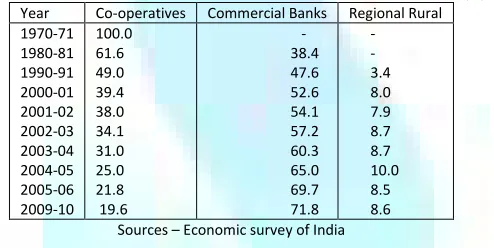
The second was the nationalization of 14 major commercial banks in July 1969(six more commercial banks was nationalize in April 1980) .Multi agency Approach (MAA) was started regarding agricultural and rural credit. Commercial banks begin to participate with full heart in agriculture finance. Two new institutions known as regional rural banks and the farmers service societies were also establish during this period. The following table shows the share of commercial banks and cooperatives in India.
TABLE 3 - RELATIVE SHARE OF COMMERCIAL BANKS AND COOPERATIVES (%) Year Co-operatives Commercial Banks Regional Rural 1970-71 1980-81 1990-91 2000-01 2001-02 2002-03 2003-04 2004-05 2005-06 2009-10 100.0 61.6 49.0 39.4 38.0 34.1 31.0 25.0 21.8 19.6 - 38.4 47.6 52.6 54.1 57.2 60.3 65.0 69.7 71.8 - - 3.4 8.0 7.9 8.7 8.7 10.0 8.5 8.6 Sources – Economic survey of India
REVIEW OF THE LITERATURE
There are some studies related to the development of rural economy and bank finance but very few have studied the problems faced by farmers. Present study is a micro level study about problems of farmers in getting loan from banks. Katter (92) concluded in their article that after nationalization of banks, there was increase in saving, investment, productivity of capital and GDP; however the desired goals were not fully met. Yadav (2005) highlighted the rule of Regional rural bank in rural development. Das (2007) has made a sincere attempt to establish the relationship between commercial bank and rural development. Sharma Lokesh, Parul D and associates (2011) concluded in his paper that how bank are shaping the rural economy and playing catalytic rule in the development of economy. NABARD has indirect positive effects on rural credit and rural development, stated in his paper by Shrivastav P.K (2009). Still there is a need of some more study about multi agency approach (MAA) in agriculture credit in India. Are these agencies over lapping? What is their individual area of work and their problems? Present study is an attempt in this regard.
OBJECTIVES OF THE STUDY
The main objectives of the study are:
• To provide an analysis of various steps taken by commercial banks regarding agricultural credit after nationalization and there impact on economic development of rural area.
• To know the problems faced by farmers in getting agricultural credit from banks especially for small and marginal farmers.
• To highlight the future of multi agency approach in agriculture finance in India.
• To suggest some new ideas about financial inclusion for landless and marginal farmers.
• To suggest some new avenues to penetrate the role of banks in rural development.
• To provide a comparative picture of various agencies providing agricultural credit in India.
RESEARCH METHODOLOGY
The nature of present study is analytical and empirical. For analytical work secondary data from various reports and surveys are used and for empirical portion, primary data is used collected through questionnaire. Purposive discussions with bank official were held time to time. A questionnaire with asking various problems faced by farmers in getting agriculture credit from bank was given but filled by investigators. Our sample unit is 120 borrower farmers from sample area (Kashipur block of Udham singh nagar distt.). Further this sample unit of borrowers is stratified in marginal and small farmers, medium farmers and big farmers in proportion of 3:2:1 so that marginal and small farmers can get a justified presentation in this study.
MICROFINANCING – NEW AVENUE FOR COMMERCIAL BANKS
Under this programme, banks provide loans to SHGs for their activities. These SHGs also deposit their saving in the banks which helps in capital formation. SHGs – bank linkage programme currently covers 523 districts in all the state & 504 banks including 48 commercial banks, 192 RRBs, 264 co-operative banks, & 2800 NGOs are associated with this programme. More than 90% of the SHGs linked with bank are exclusive women groups. The experience so far indicated that microfinance approach is viable approach; the repayment rates under the programme have been higher than about 95% of the loans.
TABLE 4: SHG - BANKING LINKAGE PROGRAM PROGRESS No. of SHGs(000) Loans distributed Agency 2007-08 2008-09 2007-08 2008-09
Commercial banks 735 1005 5404 8061
RRBs 328 406 2652 3193
Cooperative bank 165 199 794 999
Total 1228 1610 8849 12254 Source: NABARD Annual report 2008-09.
ANALYSIS & INTEERPRETETION OF FINDINGS
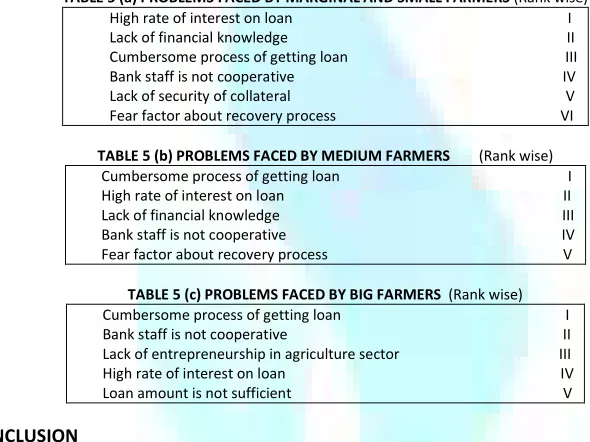
Data received through questionnaire are analyzed in three categories A. Problems of marginal and small farmers B. problems of medium farmers C. problems of big farmers. Almost all marginal and small farmers responded about problems and there high rank problems are – high rate of interest on loan, lack of financial knowledge about bank products and plans and cumbersome process of getting loans and lack of security and collateral. Medium farmers responded there problems rank wise as cumbersome process of getting loan, lack of financial knowledge and high rate of interest. Bank staff is not cooperative it is also reported by this group. Responded top problems of big farmers are as – cumbersome process of getting loan, bank staff is not cooperative, lack of financial knowledge and high interest rate. Some common problems faced by all the three groups of farmers are cumbersome process of getting loan, high rate of interest and bank staff is not cooperative.
TABLE 5 (a) PROBLEMS FACED BY MARGINAL AND SMALL FARMERS (Rank wise) High rate of interest on loan I Lack of financial knowledge II Cumbersome process of getting loan III Bank staff is not cooperative IV Lack of security of collateral V Fear factor about recovery process VI
TABLE 5 (b) PROBLEMS FACED BY MEDIUM FARMERS (Rank wise) Cumbersome process of getting loan I High rate of interest on loan II Lack of financial knowledge III Bank staff is not cooperative IV Fear factor about recovery process V
TABLE 5 (c) PROBLEMS FACED BY BIG FARMERS (Rank wise) Cumbersome process of getting loan I Bank staff is not cooperative II Lack of entrepreneurship in agriculture sector III High rate of interest on loan IV Loan amount is not sufficient V
SUGGESTIONS AND CONCLUSION
There are many studies are in trends at macro level on agricultural finance by commercial banks but study at micro level about problems faced by farmers is out of vogue and need of the time for realistic approach. The present study is an attempt in this regard and will serve a base for future policy makers. All types of farmers have responded high interest rate and cumbersome process of getting loan. policy maker’s should simplify the procedure of agriculture credit, interest rate for marginal and small farmers should be reduced and about problem of lack of cooperation by bank staff,--training college of bank staff should provide compulsory rural oriented training. Education about financial knowledge (financial inclusion) to marginal and small farmers be spread through NGOs and educational institutions. Role of government should strictly be adhesive to infrastructure development like road, transport, irrigation and electricity Micro financing (bank linkage) is a right step for financial inclusion. Recovery process of loan must be elastic and based on reality. Fear factor about recovery process of bank amongst rural poor should be reduced through education. For landless marginal and small farmers priority should be given for this deprived sector and image of bank be presented in rural society as friend, philosopher and guide.
REFERENCES
1. Bhole L M, “Financial Institutions and Markets”, 2010 pp. 295 Tata McGraw hill publications.
2. Kusum W. ketkar (1993) “Public Sector Banking, Efficiency & Economic Growth InIndia” world development journal, vol 21, p.p 1685-1697. 3. Misra & puri,“Indian Economy”, Himalaya Publishing House Mumbai 2010, pp. 375-377.
4. Mohan Rakesh, “Agricultural credit in India”, Economic & political weekly, March, 2006.
5. Reserve Bank of India (2004): “Report of the Advisory Committee on Flow of Creditto Agriculture and Related Activities From the Banking System”. URL (www.rbi.org.in).
6. Reserve bank of India, trend and progress of banking in India.
7. Sharma , R. D. , “Farm financing by commercial banks—a regional study” , Bharat book depot, Bhagalpur
8. Sharma Lokesh, Agarwal Parul “Indian banking: Shaping The Rural Economy” Indian jounal of social development, vol 11 dec 2011.
VOLUME NO.2(2012),ISSUE NO.9(SEPTEMBER) ISSN 2231-5756
INTERNATIONAL JOURNAL OF RESEARCH IN COMMERCE, IT & MANAGEMENT
REQUEST FOR FEEDBACK
Dear Readers
At the very outset, International Journal of Research in Commerce, IT and Management (IJRCM)
acknowledges & appreciates your efforts in showing interest in our present issue under your kind perusal.
I would like to request you to supply your critical comments and suggestions about the material published
in this issue as well as on the journal as a whole, on our E-mail i.e.
for further
improvements in the interest of research.
If you have any queries please feel free to contact us on our E-mail
.
I am sure that your feedback and deliberations would make future issues better – a result of our joint
effort.
Looking forward an appropriate consideration.
With sincere regards
Thanking you profoundly
Academically yours
Sd/-