International Journal of Engineering
J o u r n a l H o m e p a g e : w w w . i j e . i rA Nonlinear Model for a Capacitated Location-allocation Problem with Bernoulli
Demand using Sub-sources
M. Alizadeh, I. Mahdavi *, S. Shiripour, H. Asadi
Department of Industrial Engineering Mazandaran University of Science & Technology, Babol, Iran
P A P E R I N F O
Paper history:
Received 09 March 2013
Received in revised form 18 March 2013 Accepted 18 April 2013
Keywords:
Capacitated Location-allocation Problem Bernoulli Demands
Nonlinear Programming Model Outsourcing
A B S T R A C T
Providing permanent services for customers is one of our today’s difficulties. In this paper, a capacitated multi-facility location-allocation model with stochastic demands based on a well-known Bernoulli distribution function proposed to solve the problem. In this discrete environment, besides the capacitated facilities, the capacitated sub-sources of each facility could be utilized to satisfy the demands of customers. The proposed model is capable of allowing each facility to be interacted with its sub-source as well as other facility and their sub-sources. The objective function is to find the optimal locations of facilities among a finite number of potential locations and optimal allocation of the demand points (customers) to the operated facilities. Thus, the total sum of establishment costs of the facilities, costs of allocation the costumers to the operated facilities and the expected values of servicing and outsourcing costs are minimized. To display the applicability of the model, a numerical example is provided and computational results are reported.
doi:10.5829/idosi.ije.2013.26.09c.08
1. INTRODUCTION 1
Facility location problem has been continuously studied in operations research. This is an optimization problem in which the goal is to minimize the cost of operated facilities to serve the demand points. Initially, Weber [1] introduced the location theory in which a single warehouse location problem for minimizing the total distance between a warehouse and a finite number of costumers was considered. Later, many authors focused on the different applications of the location theory. A discrete location theory was addressed by Mirchandani and Francis [2] in which the goal was to minimize the total penalty costs of points that their demands were not satisfied. Francis et al. [3] studied some general models like single/multi facility location problems, quadratic assignment location problems and covering problems. Farahani et al. [4] studied a dynamic single facility location problem beside relocation problem. The goal of this study is not to find locations and/or relocations for the entire horizon, but to find out an optimal or near-optimal solution for the problem over an infinite horizon. Nickel and Puerto [5] studied the
*Corresponding Author Email:[email protected] (I. Mahdavi)
based location models mainly about median location problem.
The location-allocation (LA) problems are to locate a set of facilities and assign the existing customers to the facilities for satisfying the demands. For the first time, Cooper [6] introduced the location-allocation problem which was applied in several applications such as: emergency service systems, public services, telecommunication networks and etc. Later, a capacitated location-allocation problem was studied by Murtagh and Niwattisyawong [7]. This problem was one of the most prominent subjects in the location-allocation problems field in which the capacity constraints on facilities were considered. More extensive studies on the location-allocation problems could be found in Badri [8] and Hokey et al. [9].
location-allocation problem with stochastic demands. By gathering a network simplex algorithm, stochastic simulations and genetic algorithm, the authors proposed a hybrid intelligent algorithm to solve the problem. A queueing location model for locating the emergency vehicles was presented by Marianov and Revelle [11] where the goal was to maximize the availabilities of vehicles. More details about the queueing location problem under uncertainty could be seen in Larson [12], Fernández et al. [13] and Silva and Serra [14]. Kuvelis and Yu [15] investigated the robustness approach of decision making in location analysis. Beraldi and Bruni [16] extended the model was presented by Kuvelis and Yu [15] in which the authors represented a stochastic programming model for emergency medical services. In order to solve the problem, an exact solution method and three heuristic methods was introduced. To survey the relationship between a manufacturer and a retailer in a two-echelon supply chain, a game theory approach was introduced by Hua and Li [17] in which a single period product is produced and sold. Pan et al. [18] represented a problem of looking for the best pricing and ordering of a single product with uncertain demand where the goal was to maximize the expected profit. For defining the uncertainty of each customer’s demand, there are two alternatives, probabilistic constraints and multi stage stochastic programs. Chapman and White [19] exerted appropriate level of effort on a model with probabilistic constraints in a classical location set covering problem in order to take into account the randomness of service availability. The proposed model has never been used due to its mathematical complexities. Daskin [20] simplified the model of Chapman and White [19] supposing independence and general busy probabilities among servers and proposed a maximum expected covering location problem (MEXCLP). The objective of MEXCLP model was to maximize the expected value of population coverage so that a fixed number of facilities have to be placed on a network. Furthermore, the author introduced an exchange-based heuristic algorithm that approximates the solution of the problem for all values of the probability of a vehicle being busy. Logendran and Terrell [21] introduced a stochastic uncapacitated transportation plant location-allocation model with the goal of maximizing expected profits. In addition, they proposed several heuristics to solve the model. Laporte et al. [22] considered an uncapacitated facility location problem with uncertainty in demands, selling prices, transportation and production costs. To solve the problem, a stochastic integer linear programming model and a branch and cut solution approach was proposed by the authors. Davoud Pour and Nosraty [23] proposed a meta-heuristic method, namely ant-colony algorithm to solve a multi-facility location problem with rectangular and Euclidean distances. This meta-heuristic algorithm obtains the best solutions for problem instances of up to
approaches. The priori solution showed the location of the facilities and the allocation of the demand points to the facilities. The posteriori solution indicated an approximation of the expected value of the recourse functions. Berman and Simichi [32] proposed a single-vehicle location-routing problem with Bernoulli demand. They investigated a travelling salesman problem (TSP) and proposed a lower bound on the value of the optimum a priori tour. Jaillet [33] considered a probabilistic traveling salesman problem (PTSP) in which a closed formulation is defined to evaluate the expected value of the length of any given tour. A travelling salesman problem with probabilistic demand was studied by Laporte et al. [34]. The authors presented a linear probabilistic programming model solved by a branch-and-cut approach. Since PTSP problems seemed to be hard due to the combination of the TSP problem and uncertainty in demand, an exact algorithm was proposed by authors. Later, a probabilistic traveling salesman problem was proposed by Bianchi and Campbell [35]. The authors considered a heuristic approach for solving a heterogeneous version of probabilistic travelling salesman problem where all customers have the same probability of being realized.
In this study, a capacitated multi-facility location problem with Bernoulli demand using sub-sources (CMFLPBDS) is considered. The proposed model is to find optimal locations of facilities among a set of candidate locations and optimal allocations of the existing customers with probabilistic demands for the operating facilities. The aim of this stochastic model is to minimize the total sum of establishment costs, costs of allocating the existing demand points to the operated facilities and expected value of outsourcing function. It is assumed that there are a finite number of potential locations for establishment of facilities and each facility could only be opened when a pre-specified minimum number of demand points are allocated to it. The remainder of this paper is organized as follows. Section 2 contains the structure and the definitions of problem. A nonlinear mathematical programming model for capacitated multi-facility location-allocation problem with Bernoulli demands using sub-sources is introduced in section 3. In order to display the efficiency and application of the proposed model, a sample problem is provided in section 4. Finally, section 5 presents conclusions and future researches.
2. MODEL DEFINITION
Let iÎ{1,2, , }¼I be index of potential locations for establishment of the facilities and jÎ{1, 2, , }¼ J be index of demand points. The request for service of each demand point is denoted by a binary random variable so that it gets to be 1, if there is a request for service for
jth demand point otherwise it gets to be zero. Hence, in
our paper, it is possible that some demand points request service and others do not. Since, the requests for service of demand points follow a probabilistic distribution function, the random variabledj is defined as follows:
1, ,
, 0, 1 ,
p j
j J
j p j
d = " Î
-ìï í ïî
According to the Bernoulli distribution, is considered to be distributed, where parameter shows probability of request for service of the jth demand point. Therefore, the probability functions of could be inscribed as following equality:
(
)
1(1 ) , ,
,
j j
j j
pj pj j J
p
f d = d - -d " Î
It means that each demand point has request for service
with probability and has no request with
probability 1− . The applied notations in this study are presented as follows:
ai Cost of establishment of facility i,
di Minimum number of demand points to be allocated to
facility i if it is operated,
mi Maximum number of demand points to be served from
facility i if it is operated,
ni Maximum number of demand points that can be served
by sub-source of facility i if it is operated,
ij
v Allocation cost of demand point j to facility i,
ij
w Service cost of demand point j by facility i,
i
l Cost of satisfying of outsourced demand of facility i by
its corresponding sub-source,
'
ii
r Cost of satisfying of outsourced demand of facility i by
facility i'ÎI i\ .
In probability theory and statistics, the Bernoulli distribution, is a discrete probability distribution, which takes value of 1 with success probability and value 0 with failure probability 1− . In our work, the request for service of each demand point is unitary that each demand point has request for service with probability and not any demand with probability 1− . This behavior is according to the Bernoulli distribution.
constraints in both facilities and sub-sources show the maximum number of demand customers that can be served from these facilities or sub-sources and do not have any effect on the number of demand points that can be assigned to each facility. So, in this paper, exceeding the number of demand points assigned to a facility from its capacity is possible. Hence, to satisfy the additional demand customers, we resort to other facilities or their sub-sources which means outsourcing
process. Furthermore, the additional demand customers
of each facility are called outsourced demands. Let and ϕ are the set of customers are allocated to ith facility and the number of demand customers allocated to ith facility (i.e. ϕ =∑ ), respectively. With respect to the provided notations, it can be stated that if ϕ ≤ , then the whole demand customers allocated to ith facility, receive services from the corresponding facility. Else, if among the demand points allocated to facility i, the number of demand customers exceeds the upper bound . In order to satisfy the additional requests for service, we will resort to the outsourcing strategy. Here, outsourcing can be implemented in different methods. It is considered that each facility
,
i i IÎ , has a sub-source with upper bound . The innovation of our model is that we consider a capacitated sub-source for each facility. Furthermore, each facility can resort to other facilities or their sub-sources to serve the outsourced demands. In other words, if <ϕ ≤ + , then to satisfy the outsourced demands, first the facility i uses the capacities of its corresponding sub-source. If ϕ > +
, then the facility i must first resort to other facilities which are ϕ < , \ . If ϕ ≥ , \ , occurred for all facilities, it can resort to their sub-sources. It is obvious that due to this occurred outsourcing, some additional costs will be included in the problem. It is notable that for each sub-source, its first priority is to service the corresponding facility. That is, each sub-source should be used to service the corresponding facility and then other facilities, if it is necessary. In the followings, there are some decision variables for the model:
{
1, if a facility is operated at ith candidate location0, otherw ise,
i i I
,
y " Î =
{
1, if co stom er is allocated to facility, ,
0, otherwise,
j i ,
i I j J ij
z = " Î Î
The number of outsourced demands of facility which
satisfied by facility ', , ' , ' ,
'
" Î ¹
i
i
i i I i i
ii s
The number of outsourced demands of facility which satisfied by sub source of facility ', , ' , ' , '
i
i
i i I i i
ii
t
- " Î ¹
2.1. Explanation of Outsourcing Function
Primarily, we state the decision variables
i
z and
i
f as follows:
,
j J
i I
z
j ij
z
Î " Î
=
å
(1),
j J
i I
z
i j ij
f d
Î
" Î
=
å
(2)where, is the number of demand points allocated to facility i i I, Î . With respect to (2), there is a dependency between probability distribution ϕ and the decision variable on the set of Ji=
{
j J zÎ : ij=1 ,}
i IÎ .Considering Bernoulli distribution function for demand of each demand point, we will have:
x i i x j ij i
j J
c z c
f d
Î
= =
å
= =
P P
\ :
(1 ), ,
i i i
i i i i
j j
j C j J C
C J C c
p p i I
Î Î
= Ì
- "
Õ
Õ
å
ò(3)
where, , ∈ , is a possible value. Since Equation (3) is a non-homogeneous case, the problem will be complicated. So for simplifying the problem, we will transform this equation to a homogeneous case. It is considered that all the demand points request services with the same probability = ∀ .
Therefore, according to Equations (2) and (3), the variable and where = . That is, the distribution of variable ϕ depends on the number of demand points assigned to facility and we haveℙ ⟦ϕ = ⟧∼ ( ; , ). So, the Equation (3) will be transformed to Equation (4):
(
1 p)
,0,1, , , .
i
i i
i
i i
x
ci i ci
c p
c
c i I
q
q f
q
-= =
-= ¼ "
æ ö ç ÷ è ø P
ò
(4)
In outsourcing strategy, the sub-source of ith facility satisfies the outsourced demands of the given facility with cost per outsourced demand. Moreover, the other facilities and their sub-sources satisfy the outsourced demands of ith facility with costs and +ℓ ,
(
)
service cost
1, ,
j j ij ij j ij ij
i I j J i I j J
p z p z
f
d
d w w
Î Î Î Î
=
= =
å
åå
å
E
(5)
Applying the homogeneous case, this expected value will be simplified as Equation (6):
service cost
ij ij,i I j J
p z
d w
Î Î
=
åå
E (6)
According to outsourcing strategy, the expected value of outsourcing cost by enumerating the possible values of ϕ is computed as follows:
outsourcing cost
d =
E
0
outsourcing cost |
i
i
x i i i i
i I c
c d c
q
f f
Î =
= ´ =
åå
P E(
)
[
]
1
1 i i i i i i i c i c i i
i I i
m n
i
c m
p p c m
c q q -Î + = +
= æ öç ÷ -
-è ø
å å
l(
)
' '
' \ ' \
1
i 1 [
i
i i i
i i i i
i I i i I i
i i i
c c
i i
i I
m n m n
c m n c
p p q n
q Î Î -Î + + + = + + æ ö
+ ç ÷
-è ø
å å
å
å
l(
')
' ' '
' \
]
i ii
ii ii ii
i I i
s r t
r Î
+
+
å
+ l(7)
3. PROPOSED MATHEMATICAL MODEL
The proposed problem is to find the optimum locations of facilities among a set of potential locations and the optimum allocations of the existing customers with probabilistic demands to the operated facilities. Note that both facilities and sub-sources are capacitated. The objective function is to minimize a total cost function involving the sum of costs directly proportional to the operated facilities, directly costs proportional to the allocation of demand points and costs directly proportional to the servicing and the outsourcing strategies. Some necessary variables to make the nonlinear mathematical model are presented as follow:
1, 0, , 0, , i i i m c i I
oth erw ise
y =ìí - ³ " Î
î (8) ' ' ' ' 1, 0, \ , 0, , i i i c m
i I i
otherwise
g =ìí - ³ " Î
î
(9)
' ' ' ' '
'
1, ( ) 0,
\ .
0, ,
i i i i
i
n c m
i I i otherwise
g
J =ìí - - ³ " Î î
(10)
Generally, the objective function of the problem can be presented as:
Min
å
i i+åå
ij ij+ service cost outsourcing cost+ i I i I j Ja y w z E
ò ò ò (11)
where,
service cost outsourcing cost service cost outsourcing cost
d
d d
+ =
+
E
E E (12)
Finally, using Equations (6)-(12) the proposed mathematical model is formulated as follow:
Min i i ij ij ij ij
i I i I j J i I j J
a y v z pw z
Î Î
+ +
å
åå
åå
ò ò ò
(
)
1 1 p i i i i i i i m n c c ii i i
i I c m i
p c m
c
q
q +
-Î = +
æ ö é
ê
ê ç ÷ é ù
ë è ø - ë - û
+
å å
l(
)
' '
' \ ' \ 1
1 p [
i i i i
i I i i I i
i i i
i i i
m n m n
c c
i
i i
i I c m n i
p n c q q Î Î + + +
-Î = + +
æ ö ç ÷ è ø
å å
+
å
å
- l(
)
' ' ' '
' \
]
i
ii ii ii ii
i I i
s t r r Î ù ú û
+
å
+ l +(13)
s.t.
(
)
,ij i i i
i I j J i I
z m n y
Î £ +
åå
å
ò ò (14) , 1, ij i I j Jz = " Î
å
ò
(15)
,
,
ij i i j J
i I
z ³y d " Î
å
ò (16) ' ' ' \ ' \ , ,i i i
ii ii
i I i i I i
c m n i I
s + t ³ - - " Î
å
å
ò ò
(17)
(
' ')
'' i i i
,
' \,
iii I
m c
s
£ - y " Îi
I i
å
ò (18)(
)
(
' ' ' ')
' ' ' \ , ,i i i i i
ii i I
n c m i I i
t £ - - g J " Î
å
ò(19)
, ,
,
ij i i I j J
z
£y
" Î Î (20)' ' ' ' ' '
' \ ,
2miyi -2ciyi ³mi -ci," Îi I i (21)
' ' ' ' ' '
' \ ,
2cigi -2migi ³ci -mi ," Îi I i (22)
' ' ' ' ' ' ' ' ' ' ' ' ' '
2 2 2
\
, ,
- + ³
" Î
- +
i i i i i i i i i i i i i
n c m
i I i
n c m
J g J g J g g (23)
{ }
' ' ' , , ' \ ,
, , , , 0,1 ," Î Î Î
i ij i i i i I j J i I i
y z y g J ò (24)
' ' '
'
, , , , , \ ,
i i ii ii
c c s t are integer " Îi I i ÎI i (25)
points to the operated facilities. The third states the costs of serving the demand points. The fourth shows the costs of outsourcing strategy of the operating facilities. Constraints (14) represent the capacity restrictions of facilities. Constraints (15) ensure that each demand point will be assigned to only one facility. Constraints (16) consider the minimum number of demand points to be allocated to any operated facility. The least number of outsourced demands of each facility is stated by constraints (17). Constraints (18) show the maximum number of capacities that can be prepared by each facility in order to satisfy the outsourced demands of other facilities. Constraints (19) indicate the maximum number of capacities that each sub-source can prepares for other facilities. Constraints (20) guarantee that the demand points can only be allocated to the operated facilities. We have swapped equalities (8) with the Equations (21), confirming that when a facility is able to give its capacities to other facilities, then gets to be 1, otherwise it gets to be zero. Equations (9) and (10) have been swapped by constraints (22) and (23) and also, guarantee that when a sub-source is able to provide its capacities to other facilities, then is to be 1, otherwise it gets to be zero. Constraints (24) and constraints (25) indicate the binary and integer variables, respectively.
4. NUMERICAL EXAMPLE
To show the efficiency of the proposed stochastic model, a numerical example is provided. This example
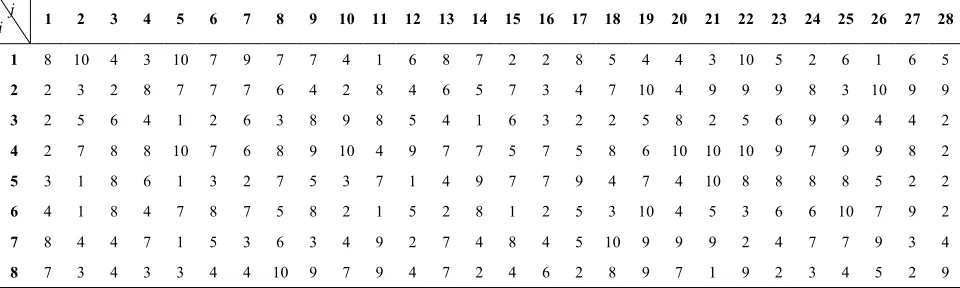
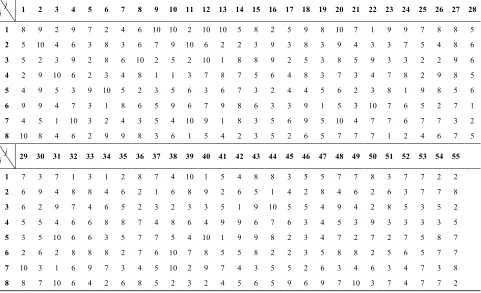
consists of 8 potential locations for establishment of facilities and 55 demand points. The model finds the optimum locations for establishment of facilities and the optimum allocations of demand customers to the facilities and their sub-sources. Values of the parameters , , ,ℓ and are randomly created in the ranges [18, 26], [1, 10], [1, 10], [5, 10] and [14, 20], respectively. Values of the parameters , and are fixed respectively to be 1, 4 and 7 for each facility ∈ . Furthermore, the binary parameter is randomly created based on the Bernoulli distribution. The proposed model has been coded in the LINGO 9.0 software package. The costs of establishing the facilities and satisfying of outsourced demand of each facility by its corresponding sub-source, respectively and ℓ are given in Table 1. Also, the request for services of the demand points, and the allocation costs of demand points, are reported in Tables 2 and 3, respectively. Table 4 shows the value of service costs of demand points, . The cost of satisfying of outsourced demand of facility i by facility , is provided in Table 5.
TABLE 1. Values of the parameters andℓ.
I
1 2 3 4 5 6 7 8
19 26 18 18 19 24 23 23
ℓ
5 7 9 6 8 7 9 10
TABLE 2. Values of the parameter .
j 1 2 3 4 5 6 7 8 9 10 11 12 13 14 15 16 17 18 19 20 21 22 23 24 25 26 27 28
0 1 1 1 1 1 1 1 0 1 1 1 1 1 1 1 1 1 1 1 1 1 1 1 1 1 1 1
j 29 30 31 32 33 34 35 36 37 38 39 40 41 42 43 44 45 46 47 48 49 50 51 52 53 54 55
0 1 1 1 1 1 1 1 1 1 0 1 1 1 1 1 1 1 1 1 1 1 1 0 1 1 1
TABLE 3. Values of the parameter . j
i 1 2 3 4 5 6 7 8 9 10 11 12 13 14 15 16 17 18 19 20 21 22 23 24 25 26 27 28
1 8 10 4 3 10 7 9 7 7 4 1 6 8 7 2 2 8 5 4 4 3 10 5 2 6 1 6 5
2
2 3 2 8 7 7 7 6 4 2 8 4 6 5 7 3 4 7 10 4 9 9 9 8 3 10 9 9
3 2 5 6 4 1 2 6 3 8 9 8 5 4 1 6 3 2 2 5 8 2 5 6 9 9 4 4 2
4 2 7 8 8 10 7 6 8 9 10 4 9 7 7 5 7 5 8 6 10 10 10 9 7 9 9 8 2
5
3 1 8 6 1 3 2 7 5 3 7 1 4 9 7 7 9 4 7 4 10 8 8 8 8 5 2 2
6 4 1 8 4 7 8 7 5 8 2 1 5 2 8 1 2 5 3 10 4 5 3 6 6 10 7 9 2
7 8 4 4 7 1 5 3 6 3 4 9 2 7 4 8 4 5 10 9 9 9 2 4 7 7 9 3 4
TABLE 3. Values of the parameter (continued) j
i 29 30 31 32 33 34 35 36 37 38 39 40 41 42 43 44 45 46 47 48 49 50 51 52 53 54 55
1 8 2 5 6 2 5 8 2 7 8 6 1 4 10 2 8 4 4 6 5 9 4 10 9 10 3 1
2 8 5 9 9 1 8 5 6 10 9 10 4 3 4 4 6 4 9 7 8 3 2 9 3 7 1 4
3 7 3 9 5 4 3 2 8 8 5 9 7 3 1 2 4 8 8 2 4 2 7 2 10 8 2 5
4 2 6 7 5 5 4 10 9 10 3 1 9 7 6 3 6 2 5 3 8 9 9 2 7 4 8 4
5 8 1 6 8 10 5 2 6 3 4 10 2 8 4 5 2 2 9 2 9 5 5 5 3 10 4 5
6 5 1 6 8 7 2 7 4 4 8 2 3 5 6 4 5 4 9 7 3 7 1 10 4 6 8 5
7 3 1 7 4 1 4 2 2 6 1 9 2 5 2 5 9 7 10 5 5 8 9 5 10 9 9 9
8 2 8 2 4 2 10 8 2 5 5 8 8 10 8 7 9 4 9 8 9 5 2 7 8 6 1 4
TABLE 4. Values of the parameter . j
i 1 2 3 4 5 6 7 8 9 10 11 12 13 14 15 16 17 18 19 20 21 22 23 24 25 26 27 28
1 8 9 2 9 7 2 4 6 10 10 2 10 10 5 8 2 5 9 8 10 7 1 9 9 7 8 8 5
2 5 10 4 6 3 8 3 6 7 9 10 6 2 2 3 9 3 8 3 9 4 3 3 7 5 4 8 6
3 5 2 3 9 2 8 6 10 2 5 2 10 1 8 8 9 2 5 3 8 5 9 3 3 2 2 9 6
4 2 9 10 6 2 3 4 8 1 1 3 7 8 7 5 6 4 8 3 7 3 4 7 8 2 9 8 5
5 4 9 5 3 9 10 5 2 3 5 6 3 6 7 3 2 4 4 5 6 2 3 8 1 9 8 5 6
6 9 9 4 7 3 1 8 6 5 9 6 7 9 8 6 3 3 9 1 5 3 10 7 6 5 2 7 1
7 4 5 1 10 3 2 4 3 5 4 10 9 1 8 3 5 6 9 5 10 4 7 7 6 7 7 3 2
8 10 8 4 6 2 9 9 8 3 6 1 5 4 2 3 5 2 6 5 7 7 7 1 2 4 6 7 5
j
i 29 30 31 32 33 34 35 36 37 38 39 40 41 42 43 44 45 46 47 48 49 50 51 52 53 54 55
1 7 3 7 1 3 1 2 8 7 4 10 1 5 4 8 8 3 5 5 7 7 8 3 7 7 2 2
2 6 9 4 8 8 4 6 2 1 6 8 9 2 6 5 1 4 2 8 4 6 2 6 3 7 7 8
3 6 2 9 7 4 6 5 2 3 2 3 3 5 1 9 10 5 5 4 9 4 2 8 5 3 5 2
4 5 5 4 6 6 8 8 7 4 8 6 4 9 9 6 7 6 3 4 5 3 9 3 3 3 3 5
5 3 5 10 6 6 3 5 7 7 5 4 10 1 9 9 8 2 3 4 7 2 7 2 7 5 8 7
6 2 6 2 8 8 8 2 7 6 10 7 8 5 5 8 2 2 3 5 8 8 2 5 6 5 7 7
7 10 3 1 6 9 7 3 4 5 10 2 9 7 4 3 5 5 2 6 3 4 6 3 4 7 3 8
8 8 7 10 6 4 2 6 8 5 2 3 2 4 5 6 5 9 6 9 7 10 3 7 4 7 7 2
TABLE 6. The results obtained for the example problem.
Facility index 1 2 3 4 5 6 7 8
Number of customers allocated to facilities 12 0 16 4 14 0 0 9
Number of demand customers 12 0 16 2 12 0 0 8
Number of outsourced demands 1 0 5 0 1 0 0 0
Explanation of outsourcing process s1,4 =1 0 t3,4 =2
TABLE 5. Values of the parameter . i'
i 1 2 3 4 5 6 7 8
1
0 15 18 14 20 17 16 19
2
14 0 15 18 19 20 16 17
3 18 17 0 20 14 19 15 15
4 20 20 14 0 16 15 19 18
5 17 16 18 19 0 19 20 15
6 15 15 18 17 16 0 15 14
7 16 18 20 16 15 18 0 20
8
19 14 17 15 18 14 17 0
Moreover, the probability of service request of each demand point is fixed = 0.8. In Table 6, the finding resulting from the example by LINGO software is reported.
In the second row of the table, the non-zero values show the number of customers allocated to each facility. The zero values represent the relevant facilities are not opened and therefore any demand point are not allocated to them. It can be seen that facilities 1, 3, 4, 5 and 8 are opened and the number of allocated demand points are 12, 6, 4, 14 and 9, respectively. Among the allocated demand points of the facilities, a number of demand points have request of demand and other not. The number of demand customers is shown in the third row of the table which is 12, 16, 2, 12 and 8,
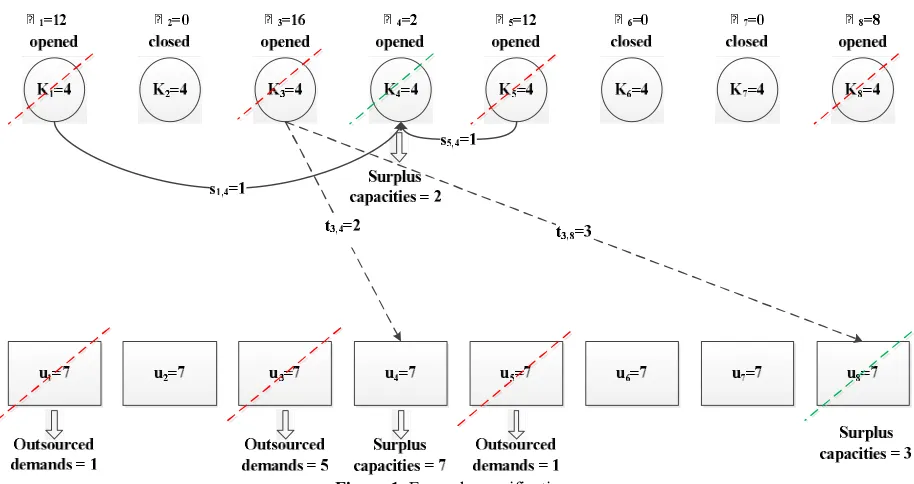
respectively. Finally, the last row of the table indicates how each facility resorts to other facilities or sub-sources to satisfy its outsourced demands. The obtained results for the example show that facility 1 resorts to facility 4 (i.e., , =1), facility 3 resorts to sub-sources of facilities 4 and 8 (i.e., , =2 and , =3) and facility 5 resorts to facility 4 (i.e., , =1) to satisfy theirs outsourced demands. Among the allocated demand points of the facilities, a number of demand points have request of demand and other not. The number of demand customers is shown in the third row of the table which is 12, 16, 2, 12 and 8, respectively, Finally, the last row of the table indicates how each facility resorts to other facilities or sub-sources to satisfy its outsourced demands. The obtained results for the example show that facility 1 resorts to facility 4 (i.e., , =1), facility 3 resorts to sub-sources of facilities 4 and 8 (i.e., , =2 and , =3) and facility 5 resorts to facility 4 (i.e.,
, =1) to satisfy theirs outsourced demands.
In Figure 1, behavior of the proposed model for the example problem is displayed graphically. In this figure, the opened facilities and the number of demand customers are specified. In addition, the opened facilities and their sub-sources which have surplus capacities are marked with green lines and the other opened facilities and their sub-sources with red lines. The surplus capacities and the outsourced demands of the opened facilities and the obtained values of variablesϕ , and are shown in the figure.
5. CONCLUSION
We proposed a stochastic nonlinear mathematical programming model for the capacitated multi-facility location-allocation problem with Bernoulli demand using the capacitated sub-sources. The objective of the problem is to determine a set of the optimum locations for facilities among a finite number of potential locations and optimum allocations of the existing demand points to the operated facilities, such that the summation of the costs of the operating facilities, allocation of customers and the expected values of servicing and outsourcing costs is minimized. A numerical example was provided to evaluate the efficiency of the proposed model. We solved the example using the LINGO 9.0 software package that led to the global optimum solutions. The experimental results showed that the proposed model was effective in finding the optimum solutions for the presented problem.
6. REFERENCES
1. Weber, A., Uber den standort der industrien. Tubingen: JCB mohr. English translation: The theory of the location of industries., Chicago: Chicago University Press, (1929). 2. Mirchandani, P. B. and Francis, R. L., "Discrete location
theory", (1990).
3. Louveaux, F. V. and Peeters, D., "A dual-based procedure for stochastic facility location", Operations Research, Vol. 40, No. 3, (1992), 564-573.
4. Farahani, R. Z., Drezner, Z. and Asgari, N., "Single facility location and relocation problem with time dependent weights and discrete planning horizon", Annals of Operations Research, Vol. 167, No. 1, (2009), 353-368.
5. Nickel, S. and Puerto, J., "Location theory [electronic resource]: A unified approach", Springer, (2005).
6. Cooper, L., "Location-allocation problems", Operations
Research, Vol. 11, No. 3, (1963), 331-343.
7. Murtagh, B. and Niwattisyawong, S., "An efficient method for the multi-depot location-allocation problem", Journal of the
Operational Research Society, (1982), 629-634.
8. Badri, M. A., "Combining the analytic hierarchy process and goal programming for global facility location-allocation problem", International Journal of Production Economics, Vol. 62, No. 3, (1999), 237-248.
9. Min, H., Melachrinoudis, E. and Wu, X., "Dynamic expansion and location of an airport: A multiple objective approach",
Transportation Research Part A: Policy and Practice, Vol. 31,
No. 5, (1997), 403-417.
10. Zhou, J. and Liu, B., "New stochastic models for capacitated location-allocation problem", Computers & Industrial
Engineering, Vol. 45, No. 1, (2003), 111-125.
11. Marianov, V. and ReVelle, C., "The queueing maximal availability location problem: A model for the siting of emergency vehicles", European Journal of Operational
Research, Vol. 93, No. 1, (1996), 110-120.
12. Larson, R. C., "A hypercube queuing model for facility location and redistricting in urban emergency services", Computers &
Operations Research, Vol. 1, No. 1, (1974), 67-95.
13. Fernandez, E., Hinojosa, Y. and Puerto, J., "Filtering policies in loss queuing network location problems", Annals of Operations
Research, Vol. 136, No. 1, (2005), 259-283.
14. Silva, F. and Serra, D., "Locating emergency services with different priorities: The priority queuing covering location problem", Journal of the Operational Research Society, Vol. 59, No. 9, (2007), 1229-1238.
15. Kouvelis, P. and Yu, G., "Robust discrete optimization and its applications", Springer, Vol. 14, (1997).
16. Beraldi, P. and Bruni, M. E., "A probabilistic model applied to emergency service vehicle location", European Journal of
Operational Research, Vol. 196, No. 1, (2009), 323-331.
17. Hua, Z. and Li, S., "Impacts of demand uncertainty on retailer's dominance and manufacturer-retailer supply chain cooperation",
Omega, Vol. 36, No. 5, (2008), 697-714.
18. Pan, K., Lai, K., Liang, L. and Leung, S. C., "Two-period pricing and ordering policy for the dominant retailer in a two-echelon supply chain with demand uncertainty", Omega, Vol. 37, No. 4, (2009), 919-929.
19. Chapman, S. and White, J., "Probabilistic formulations of emergency service facilities location problems", in ORSA/TIMS Conference, San Juan, Puerto Rico. (1974).
20. Daskin, M. S., "Application of an expected covering model to emergency medical service system design", Decision Sciences, Vol. 13, No. 3, (1982), 416-439.
21. Logendran, R. and Terrell, M. P., "Uncapacitated plant location-allocation problems with price sensitive stochastic demands",
Computers & Operations Research, Vol. 15, No. 2, (1988), 189-198.
22. Laporte, G., Louveaux, F. V. and van Hamme, L., "Exact solution to a location problem with stochastic demands",
Transportation Science, Vol. 28, No. 2, (1994), 95-103.
23. Pour, H. D. and Nosraty, M., "Solving the facility and layout and location problem by ant-colony optimization-meta heuristic",
International Journal of Production Research, Vol. 44, No. 23, (2006), 5187-5196.
24. Silva, F. J. F. and de la Figuera, D., "A capacitated facility location problem with constrained backlogging probabilities",
International Journal of Production Research, Vol. 45, No. 21, (2007), 5117-5134.
25. Riis, M. and Andersen, K. A., "Capacitated network design with uncertain demand", INFORMS Journal on Computing, Vol. 14, No. 3, (2002), 247-260.
26. Manzini, R. and Gebennini, E., "Optimization models for the dynamic facility location and allocation problem", International
Journal of Production Research, Vol. 46, No. 8, (2008),
2061-2086.
27. Conde, E., "Minmax regret location–allocation problem on a network under uncertainty", European Journal of Operational
Research, Vol. 179, No. 3, (2007), 1025-1039.
28. Kaya, O., "Outsourcing vs. In-house production: A comparison of supply chain contracts with effort dependent demand",
Omega, Vol. 39, No. 2, (2011), 168-178.
29. Albareda-Sambola, M., Van Der Vlerk, M. H. and Fernandez, E., "Exact solutions to a class of stochastic generalized assignment problems", University of Groningen, (2002). 30. Albareda-Sambola, M., Fernández, E. and Laporte, G.,
"Heuristic and lower bound for a stochastic location-routing problem", European Journal of Operational Research, Vol. 179, No. 3, (2007), 940-955.
31. Albareda-Sambola, M., Fernández, E. and Saldanha-da-Gama, F., "The facility location problem with bernoulli demands",
32. Berman, O. and Simchi-Levi, D., "Finding the optimal a priori tour and location of a traveling salesman with nonhomogeneous customers", Transportation Science, Vol. 22, No. 2, (1988), 148-154.
33. Jaillet, P., "A priori solution of a traveling salesman problem in which a random subset of the customers are visited", Operations
Research, Vol. 36, No. 6, (1988), 929-936.
34. Laporte, G., Louveaux, F. V. and Mercure, H., "A priori optimization of the probabilistic traveling salesman problem",
Operations Research, Vol. 42, No. 3, (1994), 543-549.
35. Bianchi, L. and Campbell, A. M., "Extension of the 2-p-opt and 1-shift algorithms to the heterogeneous probabilistic traveling salesman problem", European Journal of Operational
Research, Vol. 176, No. 1, (2007), 131-144.
A Nonlinear Model for a Capacitated Location-allocation Problem with Bernoulli
Demand using Sub-sources
M. Alizadeh, I. Mahdavi, S. Shiripour, H. Asadi
Department of Industrial Engineering Mazandaran University of Science & Technology, Babol, Iran
P A P E R I N F O
Paper history:
Received 09 March 2013
Received in revised form 18 March 2013 Accepted 18 April 2013
Keywords:
Capacitated Location-allocation Problem Bernoulli Demands
Nonlinear Programming Model Outsourcing
هﺪﯿﮑﭼ
ﺪﺷﺎﺑﯽﻣنﺎﯾﺮﺘﺸﻣﻪﺑﯽﻤﺋاديﺎﻬﺴﯾوﺮﺳﻪﺋاراﺎﻣيزوﺮﻣاتﻼﮑﺸﻣزاﯽﮑﯾ .
ﯽﺑﺎﯾنﺎﮑﻣلﺪﻣﮏﯾﻪﻟﺎﻘﻣﻦﯾارد
-ﺺﯿﺼﺨﺗ
دﺎﻬﻨﺸﯿﭘﻪﻟﺎﺴﻣﻦﯾاﻞﺣياﺮﺑﯽﻟﻮﻧﺮﺑهﺪﺷﻪﺘﺧﺎﻨﺷﻊﯾزﻮﺗﻊﺑﺎﺗسﺎﺳاﺮﺑﯽﻟﺎﻤﺘﺣايﺎﻫﺎﺿﺎﻘﺗﺎﺑهﺪﺷﯽﻫدﺖﯿﻓﺮﻇﻪﻠﯿﻬﺴﺗﺪﻨﭼ ﺖﺳاهﺪﺷ . ﻪﺑ ﺎﺑﯽﻋﺮﻓﻊﺑﺎﻨﻣ،هﺪﺷﯽﻫدﺖﯿﻓﺮﻇتﻼﯿﻬﺴﺗرﺎﻨﮐرد،ﻪﺘﺴﺴﮔﻂﯿﺤﻣﻦﯾاردنﺎﯾﺮﺘﺸﻣيﺎﻫﺎﺿﺎﻘﺗﻦﯿﻣﺎﺗرﻮﻈﻨﻣ
ﺪﻨﺷﺎﺑﯽﻣهدﺎﻔﺘﺳاﻞﺑﺎﻗﻞﯿﻬﺴﺗﺮﻫياﺮﺑدوﺪﺤﻣﺖﯿﻓﺮﻇ .
ﻪﺑشاﯽﻋﺮﻓﻊﺒﻨﻣﺎﺑﺎﺗﺪﻫدﯽﻣهزﺎﺟاﻞﯿﻬﺴﺗﺮﻫﻪﺑيدﺎﻬﻨﺸﯿﭘلﺪﻣ
ﻣﺎﻌﺗ ردنﺎﺸﯿﻋﺮﻓﻊﺑﺎﻨﻣوتﻼﯿﻬﺴﺗﺮﮕﯾد ﺎﺑشا ﻪﻄﺑارﯽﺑﻮﺧ ﺪﺷﺎﺑﻞ
. ﻪﻨﯿﻬﺑيﺎﻫنﺎﮑﻣندﺮﮐاﺪﯿﭘ لﺎﺒﻧدﻪﺑفﺪﻫ ﻊﺑﺎﺗ
ﺎﺿﺎﻘﺗطﺎﻘﻧﻪﻨﯿﻬﺑﺺﯿﺼﺨﺗوهﻮﻘﻟﺎﺑيﺎﻫنﺎﮑﻣزايدوﺪﻌﻣداﺪﻌﺗنﺎﯿﻣردتﻼﯿﻬﺴﺗ )
نﺎﯾﺮﺘﺸﻣ ( ،ﺪﺷﺎﺑﯽﻣزﺎﺑتﻼﯿﻬﺴﺗﻪﺑ
ﺰﻫيرﺎﻈﺘﻧاﺮﯾدﺎﻘﻣوزﺎﺑتﻼﯿﻬﺴﺗﻪﺑنﺎﯾﺮﺘﺸﻣﺺﯿﺼﺨﺗيﺎﻫﻪﻨﯾﺰﻫ،تﻼﯿﻬﺴﺗﺲﯿﺳﺎﺗيﺎﻫﻪﻨﯾﺰﻫﻞﮐﻊﻤﺟﻪﮑﯾرﻮﻄﺑ ﻪﻨﯾ
ﺪﻧﻮﺷﻢﻤﯿﻨﯿﻣيرﺎﭙﺴﻧوﺮﺑوﯽﻫدﺲﯾوﺮﺳيﺎﻫ .
ﯽﺗﺎﺒﺳﺎﺤﻣﺞﯾﺎﺘﻧوهﺪﺷﻪﺋارايدﺪﻋلﺎﺜﻣﮏﯾ،لﺪﻣﺖﯿﻠﺑﺎﻗﺶﯾﺎﻤﻧرﻮﻈﻨﻣﻪﺑ
ﺪﻧاهﺪﺷشراﺰﮔ .