A Monthly Double-Blind Peer Reviewed (Refereed/Juried) Open Access International e-Journal - Included in the International Serial Directories Indexed & Listed at:
VOLUME NO.3(2013),ISSUE NO.10(OCTOBER) ISSN 2231-5756
INTERNATIONAL JOURNAL OF RESEARCH IN COMMERCE, IT & MANAGEMENT
CONTENTS
CONTENTS
CONTENTS
CONTENTS
Sr.No.
TITLE & NAME OF THE AUTHOR (S)
Page No.
1. MACHINE USAGE BASED ON PRODUCT MIX IN MANUFACTURING CLASSIFICATIONS
DR. SURESH TULSHIRAM SALUNKE & SHWETA SURESH TULSHIRAM SALUNKE
1
2. A STUDY ON THE CHALLENGES FACED BY TIRUPUR GARMENT EXPORTERS
DR. S. SARAVANAN & S. MOHANRAJ
5
3. HEALTHCARE AND MEDICAL TOURISM: RETROSPECT AND PROSPECT
R. VEERAPPAN, J. SASIGANTH, FR. ANGELO JOSEPH & A. JOE ROBINSON
8
4. TRADE BETWEEN INDIA AND ASEAN COUNTRIES FOR AGRICULTURAL AND MINERAL PRODUCTS: EXPLORING COMPATIBILITY THROUGH REVEALED COMPARATIVE ADVANTAGE
DR. B. P. SARATH CHANDRAN
11
5. RELEVANCE OF ISLAMIC BANKING TO INDIAN ECONOMY
S. NAYAMATH BASHA & DR. BADIUDDIN AHMED
17
6. AXIOMATIZATION OF THE PREFERENCE CORE IN MULTICRITERIA COOPERATIVE GAMES
A. SUGUMARAN & P. VISHNU PRAKASH
21
7. CORPORATE GOVERNANCE & INFORMATION SECURITY: AN ANALYTICAL STUDY
DR. BADIUDDIN AHMED, SYED HAMID MOHIUDDIN QUADRI & IRFANUDDIN
25
8. RUPEE FALLING: DOLLAR IS ON HORSE RIDE
M. RAMU, M. S. K. VARMA & S.SUDHEER
28
9. AN ANALYSIS OF INDIAN AUTOMOBILE INDUSTRY: SLOWDOWN AS AN OPPORTUNITY FOR NEW DEVELOPMENT
DR. ANKUR KUMAR RASTOGI & NITIN GOPAL GUPTA
36
10. A PROPOSED THEORY OF NEURAL NETWORKS IN KNOWLEDGE MANAGEMENT FOR AN EXPERT SYSTEM
V. SUMALATHA
41
11. THE INFORMATION MANAGEMENT PRACTICES OF BHIRDAR UNIVERSITY
DR. MATEBE TAFERE
45
12. VEBLENIAN SOCIO-PSYCHOLOGICAL MODEL: AN ETHNOGRAPHIC STUDY
DR. K. ABRAHAM & DR. M. RAJASEKHAR
51
13. INNOVATIVE TEACHING AND LEARNING TO ENHANCE CRITICAL THINKING AND REFLECTIVE PRACTICE, FOR QUALITY AND RELEVANCE OF HEALTH EDUCATION
DR. BIRHANU MOGES ALEMU
56
14. A STATISTICAL ANALYSIS OF PHYSICALLY DISABLED POPULATION: DEVELOPMENT IN REHABILITATION SCHEMES
DR. CHINNA ASHAPPA
68
15. USE OF E-JOURNALS IN THE DISCIPLINES OF LIFE SCIENCE IN K.U.K: AN ANALYTICAL STUDY
ANIL KUMAR
72
16. ISLAMIC MICROFINANCE-FINANCING THE POOREST OF THE POOR
DILAWAR AHMAD BHAT
79
17. USE OF CLOUD COMPUTING IN MANUFACTURING COMPANIES
SHEETAL MAHENDHER & SUBASHREE
83
18. CLIMATE CHANGE AND VECTOR BORNE DISEASES: THE ROLE OF GIS & REMOTE SENSING
DIVYA GEORGE & DR. R. RAJKUMAR
88
19. FEASIBILITY STUDY FOR IMPLEMENTATION OF AN ACTIVITY- BASED COSTING SYSTEM (ABCS) IN ALLOY STEEL INDUSTRIES (ASI)
MAJID NILI AHMADABADI & ALI SOLEIMANI
96
20. AN IMPACT OF SERVICE QUALITY ON LOYAL CUSTOMER AND ITS SATISFACTION: A STUDY OF PRIVATE BANKS IN KANPUR CITY (INDIA)
RAVINDRA KUMAR KUSHWAHA, GURPREET SINGH, NEERAJ JOSHI & NEHA PUSHPAK
101
21. A STUDY ON EMPLOYEE PERFORMANCE APPRAISAL IN CEMENT INDUSTRY IN TAMILNADU
DR. M. RAGURAMAN, R. VEERAPPAN, S. ALBERT, M. SUGANYA & S. HEMAVATHY
107
22. DETERMINANTS OF MOBILE BANKING TECHNOLOGY ADOPTION OF COMMERCIAL BANKS IN ETHIOPIA
ZEMENU AYNADIS, TESFAYE ABATE & ABEBE TILAHUN
110
23. EVALUATION OF LIC’S EFFICIENCY IN GENERATING CAPITAL FUNDS UNDER ULIP’S SCHEMES
MANJUSHREE S
117
24. EVALUATION OF COST MANAGEMENT TOOLS: A STUDY ON MULTINATIONAL PHARMACEUTICAL COMPANIES OF BANGLADESH
TAHMINA AHMED
120
25. AN EVALUATION OF NEW ZEALAND’S EXPORT COMPETITIVENESS USING SHIFT-SHARE ANALYSIS
DR. SATYA GONUGUNTLA
126
26. INCREASING INTERNATIONAL COLLABORATIONS IN SCIENCE AND TECHNOLOGY AROUND THE WORLD, AND ITS PATTERNS IN INDIA WITH SPECIAL REFERENCE TO INDO-GERMAN COLLABORATION
MUNEEB HUSSAIN GATTOO & MUJEEB HUSSAIN GATTOO
131
27. A STUDY ON THE ETHICAL INVESTMENT DECISION MAKING IN INDIAN RELIGIOUS ORGANISATIONS
BINCY BABURAJ KALUVILLA
135
28. GREEN MARKETING MIX: A STRATEGY FOR SUSTAINABLE DEVELOPMENT
L. NANDA GOPAL
138
29. CONSIDERING RELATIONSHIP BETWEEN CASH WITH CAPITAL COST AND FINANCIAL FLEXIBILITY
AHMAD GHASEMI & DR. ROYA DARABI
140
30. UNDERSTANDING THE GREEKS AND THEIR USE TO MEASURE RISK
SANJANA JUNEJA
146
CHIEF PATRON
CHIEF PATRON
CHIEF PATRON
CHIEF PATRON
PROF. K. K. AGGARWAL
Chairman, Malaviya National Institute of Technology, Jaipur
(An institute of National Importance & fully funded by Ministry of Human Resource Development, Government of India)
Chancellor, K. R. Mangalam University, Gurgaon
Chancellor, Lingaya’s University, Faridabad
Founder Vice-Chancellor (1998-2008), Guru Gobind Singh Indraprastha University, Delhi
Ex. Pro Vice-Chancellor, Guru Jambheshwar University, Hisar
FOUNDER
FOUNDER
FOUNDER
FOUNDER PATRON
PATRON
PATRON
PATRON
LATE SH. RAM BHAJAN AGGARWAL
Former State Minister for Home & Tourism, Government of Haryana
Former Vice-President, Dadri Education Society, Charkhi Dadri
Former President, Chinar Syntex Ltd. (Textile Mills), Bhiwani
CO
CO
CO
CO----ORDINATOR
ORDINATOR
ORDINATOR
ORDINATOR
AMITA
Faculty, Government M. S., Mohali
ADVISORS
ADVISORS
ADVISORS
ADVISORS
DR. PRIYA RANJAN TRIVEDI
Chancellor, The Global Open University, Nagaland
PROF. M. S. SENAM RAJU
Director A. C. D., School of Management Studies, I.G.N.O.U., New Delhi
PROF. M. N. SHARMA
Chairman, M.B.A., Haryana College of Technology & Management, Kaithal
PROF. S. L. MAHANDRU
Principal (Retd.), Maharaja Agrasen College, Jagadhri
EDITOR
EDITOR
EDITOR
EDITOR
PROF. R. K. SHARMA
Professor, Bharti Vidyapeeth University Institute of Management & Research, New Delhi
CO
CO
CO
CO----EDITOR
EDITOR
EDITOR
EDITOR
DR. BHAVET
Faculty, Shree Ram Institute of Business & Management, Urjani
EDITORIAL ADVISORY BOARD
EDITORIAL ADVISORY BOARD
EDITORIAL ADVISORY BOARD
EDITORIAL ADVISORY BOARD
DR. RAJESH MODI
Faculty, Yanbu Industrial College, Kingdom of Saudi Arabia
PROF. SANJIV MITTAL
University School of Management Studies, Guru Gobind Singh I. P. University, Delhi
PROF. ANIL K. SAINI
VOLUME NO.3(2013),ISSUE NO.10(OCTOBER) ISSN 2231-5756
INTERNATIONAL JOURNAL OF RESEARCH IN COMMERCE, IT & MANAGEMENT
DR. SAMBHAVNA
Faculty, I.I.T.M., Delhi
DR. MOHENDER KUMAR GUPTA
Associate Professor, P. J. L. N. Government College, Faridabad
DR. SHIVAKUMAR DEENE
Asst. Professor, Dept. of Commerce, School of Business Studies, Central University of Karnataka, Gulbarga
ASSOCIATE EDITORS
ASSOCIATE EDITORS
ASSOCIATE EDITORS
ASSOCIATE EDITORS
PROF. NAWAB ALI KHAN
Department of Commerce, Aligarh Muslim University, Aligarh, U.P.
PROF. ABHAY BANSAL
Head, Department of Information Technology, Amity School of Engineering & Technology, Amity
University, Noida
PROF. A. SURYANARAYANA
Department of Business Management, Osmania University, Hyderabad
DR. SAMBHAV GARG
Faculty, Shree Ram Institute of Business & Management, Urjani
PROF. V. SELVAM
SSL, VIT University, Vellore
DR. PARDEEP AHLAWAT
Associate Professor, Institute of Management Studies & Research, Maharshi Dayanand University, Rohtak
DR. S. TABASSUM SULTANA
Associate Professor, Department of Business Management, Matrusri Institute of P.G. Studies, Hyderabad
SURJEET SINGH
Asst. Professor, Department of Computer Science, G. M. N. (P.G.) College, Ambala Cantt.
TECHNICAL ADVISOR
TECHNICAL ADVISOR
TECHNICAL ADVISOR
TECHNICAL ADVISOR
AMITA
Faculty, Government M. S., Mohali
FINANCIAL ADVISORS
FINANCIAL ADVISORS
FINANCIAL ADVISORS
FINANCIAL ADVISORS
DICKIN GOYAL
Advocate & Tax Adviser, Panchkula
NEENA
Investment Consultant, Chambaghat, Solan, Himachal Pradesh
LEGAL ADVISORS
LEGAL ADVISORS
LEGAL ADVISORS
LEGAL ADVISORS
JITENDER S. CHAHAL
Advocate, Punjab & Haryana High Court, Chandigarh U.T.
CHANDER BHUSHAN SHARMA
Advocate & Consultant, District Courts, Yamunanagar at Jagadhri
SUPERINTENDENT
SUPERINTENDENT
SUPERINTENDENT
SUPERINTENDENT
CALL FOR MANUSCRIPTS
CALL FOR MANUSCRIPTS
CALL FOR MANUSCRIPTS
CALL FOR MANUSCRIPTS
We invite unpublished novel, original, empirical and high quality research work pertaining to recent developments & practices in the areas of Computer Science & Applications; Commerce; Business; Finance; Marketing; Human Resource Management; General Management; Banking; Economics; Tourism Administration & Management; Education; Law; Library & Information Science; Defence & Strategic Studies; Electronic Science; Corporate Governance; Industrial Relations; and emerging paradigms in allied subjects like Accounting; Accounting Information Systems; Accounting Theory & Practice; Auditing; Behavioral Accounting; Behavioral Economics; Corporate Finance; Cost Accounting; Econometrics; Economic Development; Economic History; Financial Institutions & Markets; Financial Services; Fiscal Policy; Government & Non Profit Accounting; Industrial Organization; International Economics & Trade; International Finance; Macro Economics; Micro Economics; Rural Economics; Co-operation; Demography: Development Planning; Development Studies; Applied Economics; Development Economics; Business Economics; Monetary Policy; Public Policy Economics; Real Estate; Regional Economics; Political Science; Continuing Education; Labour Welfare; Philosophy; Psychology; Sociology; Tax Accounting; Advertising & Promotion Management; Management Information Systems (MIS); Business Law; Public Responsibility & Ethics; Communication; Direct Marketing; E-Commerce; Global Business; Health Care Administration; Labour Relations & Human Resource Management; Marketing Research; Marketing Theory & Applications; Non-Profit Organizations; Office Administration/Management; Operations Research/Statistics; Organizational Behavior & Theory; Organizational Development; Production/Operations; International Relations; Human Rights & Duties; Public Administration; Population Studies; Purchasing/Materials Management; Retailing; Sales/Selling; Services; Small Business Entrepreneurship; Strategic Management Policy; Technology/Innovation; Tourism & Hospitality; Transportation Distribution; Algorithms; Artificial Intelligence; Compilers & Translation; Computer Aided Design (CAD); Computer Aided Manufacturing; Computer Graphics; Computer Organization & Architecture; Database Structures & Systems; Discrete Structures; Internet; Management Information Systems; Modeling & Simulation; Neural Systems/Neural Networks; Numerical Analysis/Scientific Computing; Object Oriented Programming; Operating Systems; Programming Languages; Robotics; Symbolic & Formal Logic; Web Design and emerging paradigms in allied subjects.
Anybody can submit the soft copy of unpublished novel; original; empirical and high quality research work/manuscriptanytime in M.S. Word format after preparing the same as per our GUIDELINES FOR SUBMISSION; at our email address i.e. [email protected] or online by clicking the link online submission as given on our website (FOR ONLINE SUBMISSION, CLICK HERE).
GUIDELINES FOR SUBMISSION OF MANUSCRIPT
GUIDELINES FOR SUBMISSION OF MANUSCRIPT
GUIDELINES FOR SUBMISSION OF MANUSCRIPT
GUIDELINES FOR SUBMISSION OF MANUSCRIPT
1. COVERING LETTER FOR SUBMISSION:
DATED: _____________
THE EDITOR IJRCM
Subject: SUBMISSION OF MANUSCRIPT IN THE AREA OF.
(e.g. Finance/Marketing/HRM/General Management/Economics/Psychology/Law/Computer/IT/Engineering/Mathematics/other, please specify)
DEAR SIR/MADAM
Please find my submission of manuscript entitled ‘___________________________________________’ for possible publication in your journals.
I hereby affirm that the contents of this manuscript are original. Furthermore, it has neither been published elsewhere in any language fully or partly, nor is it under review for publication elsewhere.
I affirm that all the author (s) have seen and agreed to the submitted version of the manuscript and their inclusion of name (s) as co-author (s).
Also, if my/our manuscript is accepted, I/We agree to comply with the formalities as given on the website of the journal & you are free to publish our contribution in any of your journals.
NAME OF CORRESPONDING AUTHOR: Designation:
Affiliation with full address, contact numbers & Pin Code: Residential address with Pin Code:
Mobile Number (s): Landline Number (s): E-mail Address: Alternate E-mail Address:
NOTES:
a) The whole manuscript is required to be in ONE MS WORD FILE only (pdf. version is liable to be rejected without any consideration), which will start from the covering letter, inside the manuscript.
b) The sender is required to mentionthe following in the SUBJECT COLUMN of the mail:
New Manuscript for Review in the area of (Finance/Marketing/HRM/General Management/Economics/Psychology/Law/Computer/IT/ Engineering/Mathematics/other, please specify)
c) There is no need to give any text in the body of mail, except the cases where the author wishes to give any specific message w.r.t. to the manuscript. d) The total size of the file containing the manuscript is required to be below 500 KB.
e) Abstract alone will not be considered for review, and the author is required to submit the complete manuscript in the first instance.
f) The journal gives acknowledgement w.r.t. the receipt of every email and in case of non-receipt of acknowledgment from the journal, w.r.t. the submission of manuscript, within two days of submission, the corresponding author is required to demand for the same by sending separate mail to the journal.
2. MANUSCRIPT TITLE: The title of the paper should be in a 12 point Calibri Font. It should be bold typed, centered and fully capitalised.
3. AUTHOR NAME (S) & AFFILIATIONS: The author (s) full name, designation, affiliation (s), address, mobile/landline numbers, and email/alternate email address should be in italic & 11-point Calibri Font. It must be centered underneath the title.
VOLUME NO.3(2013),ISSUE NO.10(OCTOBER) ISSN 2231-5756
INTERNATIONAL JOURNAL OF RESEARCH IN COMMERCE, IT & MANAGEMENT
5. KEYWORDS: Abstract must be followed by a list of keywords, subject to the maximum of five. These should be arranged in alphabetic order separated bycommas and full stops at the end.
6. MANUSCRIPT: Manuscript must be in BRITISH ENGLISH prepared on a standard A4 size PORTRAIT SETTING PAPER. It must be prepared on a single space and single column with 1” margin set for top, bottom, left and right. It should be typed in 8 point Calibri Font with page numbers at the bottom and centre of every page. It should be free from grammatical, spelling and punctuation errors and must be thoroughly edited.
7. HEADINGS: All the headings should be in a 10 point Calibri Font. These must be bold-faced, aligned left and fully capitalised. Leave a blank line before each heading.
8. SUB-HEADINGS: All the sub-headings should be in a 8 point Calibri Font. These must be bold-faced, aligned left and fully capitalised.
9. MAIN TEXT: The main text should follow the following sequence:
INTRODUCTION
REVIEW OF LITERATURE
NEED/IMPORTANCE OF THE STUDY
STATEMENT OF THE PROBLEM
OBJECTIVES
HYPOTHESES
RESEARCH METHODOLOGY
RESULTS & DISCUSSION
FINDINGS
RECOMMENDATIONS/SUGGESTIONS
CONCLUSIONS
SCOPE FOR FURTHER RESEARCH
ACKNOWLEDGMENTS
REFERENCES
APPENDIX/ANNEXURE
It should be in a 8 point Calibri Font, single spaced and justified. The manuscript should preferably not exceed 5000 WORDS.
10. FIGURES &TABLES: These should be simple, crystal clear, centered, separately numbered & self explained, and titles must be above the table/figure. Sources of data should be mentioned below the table/figure. It should be ensured that the tables/figures are referred to from the main text.
11. EQUATIONS:These should be consecutively numbered in parentheses, horizontally centered with equation number placed at the right.
12. REFERENCES: The list of all references should be alphabetically arranged. The author (s) should mention only the actually utilised references in the preparation of manuscript and they are supposed to follow Harvard Style of Referencing. The author (s) are supposed to follow the references as per the following:
•
All works cited in the text (including sources for tables and figures) should be listed alphabetically.•
Use (ed.) for one editor, and (ed.s) for multiple editors.•
When listing two or more works by one author, use --- (20xx), such as after Kohl (1997), use --- (2001), etc, in chronologically ascending order.•
Indicate (opening and closing) page numbers for articles in journals and for chapters in books.•
The title of books and journals should be in italics. Double quotation marks are used for titles of journal articles, book chapters, dissertations, reports, working papers, unpublished material, etc.•
For titles in a language other than English, provide an English translation in parentheses.•
The location of endnotes within the text should be indicated by superscript numbers.PLEASE USE THE FOLLOWING FOR STYLE AND PUNCTUATION IN REFERENCES: BOOKS
•
Bowersox, Donald J., Closs, David J., (1996), "Logistical Management." Tata McGraw, Hill, New Delhi.•
Hunker, H.L. and A.J. Wright (1963), "Factors of Industrial Location in Ohio" Ohio State University, Nigeria. CONTRIBUTIONS TO BOOKS•
Sharma T., Kwatra, G. (2008) Effectiveness of Social Advertising: A Study of Selected Campaigns, Corporate Social Responsibility, Edited by David Crowther & Nicholas Capaldi, Ashgate Research Companion to Corporate Social Responsibility, Chapter 15, pp 287-303.JOURNAL AND OTHER ARTICLES
•
Schemenner, R.W., Huber, J.C. and Cook, R.L. (1987), "Geographic Differences and the Location of New Manufacturing Facilities," Journal of Urban Economics, Vol. 21, No. 1, pp. 83-104.CONFERENCE PAPERS
•
Garg, Sambhav (2011): "Business Ethics" Paper presented at the Annual International Conference for the All India Management Association, New Delhi, India, 19–22 June.UNPUBLISHED DISSERTATIONS AND THESES
•
Kumar S. (2011): "Customer Value: A Comparative Study of Rural and Urban Customers," Thesis, Kurukshetra University, Kurukshetra. ONLINE RESOURCES•
Always indicate the date that the source was accessed, as online resources are frequently updated or removed. WEBSITESFEASIBILITY STUDY FOR IMPLEMENTATION OF AN ACTIVITY- BASED COSTING SYSTEM (ABCS) IN ALLOY
STEEL INDUSTRIES (ASI)
MAJID NILI AHMADABADI
ASST. PROFESSOR
DEPARTMENT OF MANAGEMENT
ISLAMIC AZAD UNIVERSITY
NAJAFABAD BRANCH
ISFAHAN, IRAN
ALI SOLEIMANI
STUDENT
INDUSTRIAL MANAGEMENT
DEPARTMENT OF MANAGEMENT
ISLAMIC AZAD UNIVERSITY
NAJAFABAD BRANCH
ISFAHAN, IRAN
ABSTRACT
Precise appraisal of products and submission of suitable reports for decision-making is the goal of a costing system. Therefore, one of the concerns of steel industry is providing finished price to remove the weaknesses of absorptive costing system and providing proper information to access an integral quality. In fact, this system is one of the powerful and suitable tools for companies to access their goals and to preserve their competitive power. This paper studies the effective factors for a feasibility study for implementation of an activity-based costing system (ABCS) in alloy steel industries of Iran. The factors that deviate finished price in absorptive costing are: high production overload, production complexities, production diverse, volume diverse, production physical size diverse, complexity of raw materials, high inventory of finished semi-finished products at the end of period, and recognition of cost storages and cost-creation factors. Survey method was used to gather data including library, interview, and questionnaire. T Test was used to confirm or reject the assumptions. It was found that implementation of an activity-based costing system is feasible in ASI.
KEYWORDS
Activity-based costing, management accounting, product-level activities.
INTRODUCTION
teel industry is a mother industry in country. Researchers believe that development is not possible without steel industry. Events such as world competition development, IT development, access to information systems during last two decades, and efforts of economic agents to meet world ranks and to enter into international markets necessitate views such as customer satisfaction and activity-based management.
Also, by increment of technology and other overload costs shares on production and services, traditional costing methods are obsoleted, while data for finished prices of products, services and customers are the most important one in financial information. Inefficiency of information by traditional costing systems has directed economic units toward activity-based costing system (ABCS). ABCS is one of the modern costing systems for products and services with capabilities such as calculation of finished price, improvement of production process, removal of abandoned activities, recognition of cost motives, operational planning, and determination of commercial strategies for an economic unit. This system concerns with cost and production creation reasons instead of concerning with effects, and if an activity is not justifiable, it will be removed, adjusted, or improved. Despite innovation of new methods in production styles and tools, costing systems are ever criticized. By a short review of the literature of management accounting and ABC, we try to identify the effective factors on implementation of ABC in ASI.
PROBLEM EXPRESSION
Companies have no other way to accompany with rapid changes of technology, so they try to use modern methods to improve their business quality and to control finished prices of their products. In this situation, companies are going to change their information systems and removal of traditional systems. Competition implies control of costs. Here, we study absorptive costing method. Regarding to diversity of products and processes, and regarding to sever competition in steel market, this method cannot respond information needs of managers. Now, we ask “Is it possible to use ABCS regarding diversity of activities, cost structures, production processes, and products?”
GOAL OF RESEARCH
One of the main goals of finished price accounting system (FPAS) is providing proper information for finished prices of products. If a trade unit has its production costs, it can concentrate on the most profitable activities and avoid non-profitable ones.
Available costing systems have weaknesses, because they report finished prices improperly when there are diverse products. ABC determines costs precisely. The strategic goal of this system is providing suitable information for costs and profits for better decision-making about prices, production combinations, and improvement of operations. The main goal of this research is “Feasibility study for implementation of an activity-based costing system (ABCS) in Alloy Steel Industries (ASI)”.
TABLE 1: ASSUMPTIONS
Main assumption Implementation of ABCS in ASI is feasible.
Sub-main assumption 1 Overload production share is high in ASI. Sub-main assumption 2 There is production complexity in ASI. Sub-main assumption 3 There is production diversity in ASI. Sub-main assumption 4 There is production volume diversity in ASI. Sub-main assumption 5 There is products’ physical size diversity in ASI. Sub-main assumption 6 There is raw material complexity in ASI.
VOLUME NO.3(2013),ISSUE NO.10(OCTOBER) ISSN 2231-5756
INTERNATIONAL JOURNAL OF RESEARCH IN COMMERCE, IT & MANAGEMENT
THEORETICAL FUNDAMENTALS AND ACCOUNTING INFORMATION SYSTEM (AIS)
In practice, all organizations have AIS. These systems are similar in three cases: structures, processes, and goals. These items are more complex in production companies. Generally, accounting is recognition, measurement, recording, classification, and redaction of financial effects of transactions, operations, activities, and other conditions of financial events affecting on an economic unit and converting this data to comprehensive reports for beneficiaries and decision-makers. Accounting is the art of interpretation, measurement, and transferring the results of economic activities and operations. Accounting is the language of trade. Expressions like asset, debt, net profit, cash fund circulation, and share profit are common in accounting.
The goals of AIS can be used to:
1. Determine major strategies and long term planning 2. Make decisions about resource assignment 3. Plan and control financial reporting 4. Measure performances of staff
CALCULATION OF FINISHED PRICE PROCESS IN TRADITIONAL SYSTEMS AND ITS FAULTS
Improvement of production technology and changes of management thought for inventory, on-time production, and other factors have severely modified product costs structures and have increased overload costs and decreased direct and raw material costs.
In traditional systems, often direct labor cost is used to assign overload cost. While today, direct labor cost mostly include less than 15% and overload costs include more than 50% of product costs.
Therefore, assignment of overload costs up on direct labor hours conclude incorrect calculation of finished price. In traditional system, finished price is calculated as follows:
1. Assignment of direct materials and direct remuneration to products and services 2. Assignment of overload costs to products and services by a certain absorption rate 3. Calculation of finished price
Disadvantages of this system are:
1. Direct labor cost has no value any more.
2. Usage of a certain assignment rate cannot show all relations between costs.
3. Despite high share of overload cost in product cost, its assignment method is not important. 4. This system does not respond in complex and unusual production processes.
5. This system does not provide proper and real information for finished price and profitability.
To overcome these faults, many companies have gravitated toward ABCS. This system does not replace order costing of step-by-step method, but it can be used in parallel of them. ABCS includes modern philosophy of managers (customer satisfaction) and competition in product costing quantitatively. Namely, rather than costs of direct material and direct remuneration, this system includes technology costs, product quality costs, and flexible production costs, too.
ACTIVITY BASED COSTING SYSTEM OVERVIEW AND BACKGROUND
In late of 1960s and early of 1970s, some writers pointed to the relation between activity and cost. However, in 1980, following reflection of weaknesses and deficiencies of common accounting systems to report cost information, universities noticed to this relation much more. This notice was based on three main structures:
1. Structure 1: Modern changes to introduce modern production technologies and mechanisms in different countries such as Japan,…
2. Structure 2: Mental philosophies of many company managers have largely changed in 1980s, and rather than profitability, international competition, customer satisfaction, quality control, and cost decrement also were added to their goals.
3. Structure 3: Many accounting writers proceeded to describe new production space, different roles of technology, and new views of managers. These writers claimed that not only traditional systems of industrial accounting could not respond needs of managers, but also their output might deviate managers.(Oava, 2002)[1].Then, those writers introduced a new system called “Activity-based Costing System”.
ABC/M is a two-stage process, (1) associating cost to resource (activity), and (2) selecting an appropriate activity measurement (activity cost driver), [2]. Kee[3] named the two steps as; (1) breaking overhead costs into different cost pools and (2) assigning overhead costs hrough different activity cost drivers to products or orders. As a result, a more accurate overhead costs assignment is achieved. ABC/M supporters highlight two principal objectives, [4] and [5]: (1) to provide detailed information about the costs and consumption of activities in a specific process and (2) to provide accurate information for managers to improve decisions. This has also been corroborated by Gosselin[6] regarding a pilot and full ABC/M implementation studies. However, the use of ABC/M has been limited to a cost accounting approach, rather than as a managerial technique (Gosselin[6]; Kaplan and Anderson [7]; Gosseling[8]). ABC/M advantages, and constructive effects, on a firm's performance have been determined through numerous studies and dissertations. Kennedy and Afleck-Graves [9], Ittner et al. [10], and Cagwin and Bouwman[11] attested ABC/M as a preferable accounting approach compared to the TCA systems. Some studies such as; Novićević and Antić[12] and Cagwin and Barker [13] showed evidence of a positive impact of ABC/M on lean manufacturing components like Just-In-Time (JIT) and Total Quality Management (TQM). The preeminence of ABC/M in providing detailed cost information represents a potential powerful approach for developing PTP Supply Chain Decision Support Systems. Malik and Sullivan [14] developed an ABC/M-based Mixed-Integer Programming (MIP) decision support model for product mix problems. Kee[3] integrated some aspects of the Theory of Constraints (TOC) in ABC/M-based MIP modeling for the product mix problem and named it “Expanded ABC/M model.” The model identifies the firm's optimal product mix by evaluating simultaneously the resources and product cost, the production resources availability, and the business marketing opportunities. In Supply Chain Order Management, [15] and [16] presented a PTP– MIP model for accepting or rejecting orders by implementing ABC/M homogeneous cost pools' structure originally introduced by Cooper and Kaplan [2]. The purpose of the model was to gain insight into how significant Order Management decisions are in maximizing profitability when the firm has insufficient production resources to satisfy all the demand. Khataie et al. [17] added the possibility of pursuing two main different goals simultaneously, reducing the residual capacity and increasing the profitability to the previous models. A powerful PTP Order Management tool assists management to monitor, analyze, and foresee the consequences and outcomes of each decision, and monitors their business competitiveness factors dynamically.
WHICH COMPANIES SHOULD USE ABCS?
Using ABCS is not suitable for some companies and is ineffective for some others. ABC is suitable for companies with the following features: 1. Companies with different products and services.
2. Companies with high overload costs, so that these costs cannot be assigned their products equally. 3. Companies that use automatic machinery in production.
4. Companies with complex and unusual production processes.
CLASSIFICATION OF COSTS IN ABCS
The first three levels deal with those costs that can be assigned to products directly. However, the first level includes common costs for products and they can be divided between products optionally (e.g. lighting and cleaning costs).
ABCS is a modern phenomenon that has developed traditional costing thought in management accounting and has attracted notices of many economic units. Some of advantages of this system are:
1. Improvement of costing system and better assignment of costs 2. Determination of finished price and pricing more precisely and logically 3. Control of operations and better planning
4. Better evaluation of financial operations of managers 5. Removal of none value-added activities
Despite these advantages, today only scientific communities contribute ABCS and factories and industries have not contributed to it so much. Its reason is unfamiliarity of managers, industries, and related personnel and fear of costs of implementation of this system.
ABC IN ASI
ASI has a special place as one of the economic development branches between industries. This industry plays an important role in manufacturing of industrial parts. Products of this industry in country compete with similar external products.
The nature of this industry increases complexity of decisions by its structure and shape and its capital-consuming nature. Usage of suitable methods follows cost-saving and prevents incorrect decisions and methods.
Progressive trend of orders in internal and external markets have made it inevitable to move toward optimization of activities with high qualities and low prices. Therefore, necessity of using modern techniques is understood regarding the above mentioned conditions in industries of Iran and the concepts of ABCS. As mentioned before, this system was not paid attention too much, especially in its data gathering aspect and offering on-time information submission.
Traditional costing method deviates product costs because of its cost division methods. Traditional costing method emphasized on production volume and assigns all overload costs by a certain rate to products. But, ABC method assigns costs more properly.
Traditional costing method overstates costs of large products and understates costs of small products. It also overstates overload costs for high-produced products and understates overload costs for low-produced products. Such deviations often intensify each other so that cost of a product may be over or understated.
If resources for a unit of a product are not directly proportional to its other resources, traditions costing systems that depend product unit, report product costs improperly. Here are samples of cases that cause improper reporting:
• Diversity of production volume • Diversity of production complexity • Diversity of physical size of products • Diversity of raw materials
The effects of different diversities can be recognized by ABCS. Each diversity needs an activity motor. Since traditional costing system uses a certain basis for division of overload costs, this deviates finished price of products. ABC can be implemented in companies with much overload cost and much product diversity (diversity in volume, physical size, complexity, and raw materials). Product diversity causes ABCS to determine overload costs properly. In turn, this causes proper finished price. Ongoing products and end of period finished products cause different profit reports between ABCS and traditional costing system. Ongoing products and end of period finished products cause conveyance of costs to next period. But, if there is not end of period inventory, reported profits for both systems will not be different very much.
RESEARCH METHOD
Since selection of research method depends on the goal and nature of research subject, survey method was selected.
MEASUREMENT TOOLS AND DATA GATHERING METHODS
One of the most important sections of a research is data gathering and editing. The selection of data gathering method depends on research nature, data type, and limitations.
Some studies use all recognized methods (interview, observation, questionnaire, etc.). In this research, the researcher has used the following methods: a) Library
b) Interview c) Questionnaire
DATA ABRIDGEMENT a) Library method
For assumption 1, this method says that share of overload is high. Table 2 shows comparison of overload costs to total finished price costs, including direct material costs and direct remuneration costs for three years.
TABLE 2: OVERLOAD COSTS IN PRODUCTION Item 2012 2011 2010
Production overload 48% 53% 48%
Direct materials 42% 34% 40%
Direct remuneration 10% 12% 12%
Total 100% 100% 100%
b) Interview
VOLUME NO.3(2013),ISSUE NO.10(OCTOBER) ISSN 2231-5756
INTERNATIONAL JOURNAL OF RESEARCH IN COMMERCE, IT & MANAGEMENT
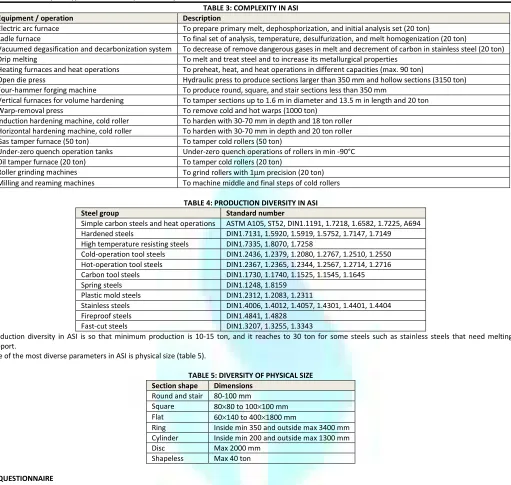
TABLE 3: COMPLEXITY IN ASI Equipment / operation Description
Electric arc furnace To prepare primary melt, dephosphorization, and initial analysis set (20 ton)
Ladle furnace To final set of analysis, temperature, desulfurization, and melt homogenization (20 ton)
Vacuumed degasification and decarbonization system To decrease of remove dangerous gases in melt and decrement of carbon in stainless steel (20 ton)
Drip melting To melt and treat steel and to increase its metallurgical properties
Heating furnaces and heat operations To preheat, heat, and heat operations in different capacities (max. 90 ton)
Open die press Hydraulic press to produce sections larger than 350 mm and hollow sections (3150 ton)
Four-hammer forging machine To produce round, square, and stair sections less than 350 mm
Vertical furnaces for volume hardening To tamper sections up to 1.6 m in diameter and 13.5 m in length and 20 ton
Warp-removal press To remove cold and hot warps (1000 ton)
Induction hardening machine, cold roller To harden with 30-70 mm in depth and 18 ton roller Horizontal hardening machine, cold roller To harden with 30-70 mm in depth and 20 ton roller
Gas tamper furnace (50 ton) To tamper cold rollers (50 ton)
Under-zero quench operation tanks Under-zero quench operations of rollers in min -90°C
Oil tamper furnace (20 ton) To tamper cold rollers (20 ton)
Roller grinding machines To grind rollers with 1µm precision (20 ton)
Milling and reaming machines To machine middle and final steps of cold rollers
TABLE 4: PRODUCTION DIVERSITY IN ASI Steel group Standard number
Simple carbon steels and heat operations ASTM A105, ST52, DIN1.1191, 1.7218, 1.6582, 1.7225, A694
Hardened steels DIN1.7131, 1.5920, 1.5919, 1.5752, 1.7147, 1.7149
High temperature resisting steels DIN1.7335, 1.8070, 1.7258
Cold-operation tool steels DIN1.2436, 1.2379, 1.2080, 1.2767, 1.2510, 1.2550
Hot-operation tool steels DIN1.2367, 1.2365, 1.2344, 1.2567, 1.2714, 1.2716
Carbon tool steels DIN1.1730, 1.1740, 1.1525, 1.1545, 1.1645
Spring steels DIN1.1248, 1.8159
Plastic mold steels DIN1.2312, 1.2083, 1.2311
Stainless steels DIN1.4006, 1.4012, 1.4057, 1.4301, 1.4401, 1.4404
Fireproof steels DIN1.4841, 1.4828
Fast-cut steels DIN1.3207, 1.3255, 1.3343
Production diversity in ASI is so that minimum production is 10-15 ton, and it reaches to 30 ton for some steels such as stainless steels that need melting support.
One of the most diverse parameters in ASI is physical size (table 5).
TABLE 5: DIVERSITY OF PHYSICAL SIZE Section shape Dimensions
Round and stair 80-100 mm
Square 80×80 to 100×100 mm
Flat 60×140 to 400×1800 mm
Ring Inside min 350 and outside max 3400 mm
Cylinder Inside min 200 and outside max 1300 mm
Disc Max 2000 mm
Shapeless Max 40 ton
C) QUESTIONNAIRE
The questionnaire contained 24 questions by Likert 5-option scale (very low, low, medium, high, very high). To complete the questionnaire, the researcher has went to the offices of managers and experts. These persons were familiar with financial affairs and ASI. Then Excel and SPSS were used to analyze data.
VALIDITY AND RELIABILITY OF MEASUREMENT TOOLS
The views of experts were used to increase validity of research tools (library, interview, questionnaire). Reliability of test was measured by Cronbach’s Alpha, which was equal to 0.79625 that shows suitable reliability. The best reliability is >0.70 .
STATISTICAL METHOD
Statistical methods were used in two methods:
a) Descriptive statistics: This method merely describes society and its goal is calculation of society parameters. If values and indices are calculated by counting all elements of a society, it is called “descriptive statistics”. Descriptive statistics indices are: table, average, dispersion, SD, etc.
b) Statistical inference: Here we suggest a special kind of statistical inference called “statistical hypothesis tests”. In this research, statistical hypothesis test is:
µ>3 : H0 is confirmed µ≤3 : H1 is rejected
T Test was used to examine data and statistical sample. In this research, Lickert Test (very high (5), high (4), medium (3), low (2), very low (1)) was used to estimate µ . So, the assumption is confirmed by confidence interval of 95% (α=5%; significance level<5%). If upper and lower limits are positive in 95% confidence interval and the statistic is not negative, then the assumption is evaluated higher than average.
If H1 is confirmed, it indicates that ABCS is applicable in ASI. If H0 is confirmed, it indicates that ABCS is not applicable in ASI.
ANALYSIS OF ASSUMPTIONS
µ>3 : H0 = There is an effective factor on ABCS in ASI. µ≤3 : H1 = There is no effective factor on ABCS in ASI.
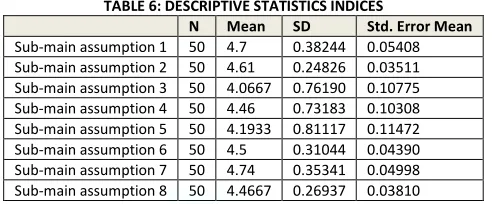
TABLE 6: DESCRIPTIVE STATISTICS INDICES
N Mean SD Std. Error Mean
Sub-main assumption 1 50 4.7 0.38244 0.05408
Sub-main assumption 2 50 4.61 0.24826 0.03511
Sub-main assumption 3 50 4.0667 0.76190 0.10775
Sub-main assumption 4 50 4.46 0.73183 0.10308
Sub-main assumption 5 50 4.1933 0.81117 0.11472
Sub-main assumption 6 50 4.5 0.31044 0.04390
Sub-main assumption 7 50 4.74 0.35341 0.04998
Sub-main assumption 8 50 4.4667 0.26937 0.03810
Table 7 shows output of SPSS software for single-sample T Test.
TABLE 7: SINGLE-SAMPLE T TEST Test value = 3
Sub-main assumptions T df Sig. Mean difference 95% confidence interval Lower Upper
Sub-main assumption 1 31.432 49 0 1.7 1.5913 1.8287
Sub-main assumption 2 45.857 49 0 1.61 1.5394 1.6806
Sub-main assumption 3 9.899 49 0 1.06667 0.8501 1.3832
Sub-main assumption 4 14.302 49 0 1.46 1.3549 1.6651
Sub-main assumption 5 10.403 49 0 1.19333 0.9638 1.4339
Sub-main assumption 6 34.167 49 0 1.5 1.4118 1.5882
Sub-main assumption 7 34.814 49 0 1.74 1.6396 1.8404
Sub-main assumption 8 38.5 49 0 1.46667 1.3901 1.5432
As you see in table 7, upper and lower limits in confidence interval of 95% are positive and T statistic is positive, too. This shows that the views of respondents for the effective factors on implementation of ABCS are higher than the average. Thus H0 is confirmed and H1 is rejected. So, there are effective factors on implementation of ABCS in ASI.
CONCLUSION
Regarding to the results, we conclude that there are effective factors on implementation of ABCS in ASI. Therefore, implementation of ABCS in ASI is feasible. Excess changes in economics o alloy steel have changed its conditions significantly. International competence and rapid new technologies have encountered this industry with major modifications. Thus, management accounting is changing beside changes of production systems. Usage of modern costing management in this industry increases its competitive power and provides conditions to produce more qualitative and cheaper products. ABCS can provide better information for decisions and helps diagnosis of none value-added costs. ABCS helps managers to understand capital cost and investment better. It also helps managers not to decide by after-tax profit, but follow long term programs and improve capital resources by considering economic efficiency. However, this system will not improve activities of a company automatically, but it provides information affecting efforts of managers to improve their companies.
REFERENCES
1. Oana,velcu'' practical ASPECTS in the Implementation of an ABC Model'',M.Sc. Thesis in Accounting, Swedish School of Economics and Business Administration, 2002.
2. R. Cooper, R.S. Kaplan, The Design of Cost Management Systems: Text, Cases and Readings, First ed. Prentice-Hall, Englewood Cliffs, 1991.
3. R. Kee, Integrating activity-based costing with theory of constraints to enhance production-related decision-making, Accounting Horizons 9 (1995) 48–61. 4. J.S. Holmen, ABC vs. TOC: it's a matter of time, Management Accounting 76 (1995) 37–40.
5. C. Sheu, M.H. Chen, S. Kovar, Integrating ABC and TOC for better manufacturing decision making, Integrated Manufacturing System 14 (2003) 433–441. 6. M. Gosselin, The effect of strategy and organizational structure on the adoption and implementation of activity-based costing, Accounting, Organizations
and Society 22 (1997) 105–122.
7. R.S. Kaplan, S.R. Anderson, Time-driven activity-based costing, Harvard Business Review 82 (2004) 131–138.
8. M. Gosselin, A review of activity-based costing: technique, implementation, andconsequences, Handbook of Management Accounting Research 2 (2007)641–671.
9. T. Kennedy, J. Affleck-Graves, The impact of activity-based costing techniques on firm performance, Journal of Management Accounting Research 13 (2001) 19–45.
10. C.D. Ittner, W.N. Lanen, D.F. Larcker, The association between activity-basedcosting and manufacturing performance, Journal of Accounting Research 40(2002) 711–726.
11. D. Cagwin, M.J. Bouwman, The association between activity-based costing and improvement in financial performance, Management Accounting Research 13 (2002) 1–39.
12. B. Novićević, L. Antić, Total quality management and activity-based costing,Economics and Organization 1 (1999) 1–8.
13. D. Cagwin, K.J. Barker, Activity-based costing, total quality management and business process reengineering: their separate and concurrent association with improvement in financial performance, Academy of Accounting and Financial Studies Journal 10 (2006) 49–77.
14. S.A. Malik, W.G. Sullivan, Impact of ABC information on product mix and costing decisions, IEEE Transactions on Engineering Management 42 (1995) 171– 176.
15. E.T. Kirche, S.N. Kadipasaoglu, B.M. Khumawala, Maximizing supply chain profits with effective order management: integration of activity-based costing and theory of constraints with mixed-integer modeling, International Journal of Production Research 43 (2005) 1297–1311.
16. E. Kirche, R. Srivastava, An ABC-based cost model with inventory and order level costs: a comparison with TOC, International Journal of Production Research 43 (2005) 1685–1710.
VOLUME NO.3(2013),ISSUE NO.10(OCTOBER) ISSN 2231-5756
INTERNATIONAL JOURNAL OF RESEARCH IN COMMERCE, IT & MANAGEMENT
REQUEST FOR FEEDBACK
Dear Readers
At the very outset, International Journal of Research in Commerce, IT and Management (IJRCM)
acknowledges & appreciates your efforts in showing interest in our present issue under your kind perusal.
I would like to request you to supply your critical comments and suggestions about the material published
in this issue as well as on the journal as a whole, on our E-mail i.e.
for further
improvements in the interest of research.
If you have any queries please feel free to contact us on our E-mail
.
I am sure that your feedback and deliberations would make future issues better – a result of our joint
effort.
Looking forward an appropriate consideration.
With sincere regards
Thanking you profoundly
Academically yours
Sd/-