A b s t r a c t. After rice seed was irradiated, the embryonal structure (structure of embryo bud and radicle) was affected by g-ray. The result revealed that the outline and venations of embryo and radicle were unclear with the increasing dose. These changes of embryonal structure caused by increasing irradiation dose were due to the increasing breakage degree of embryo (including embryo bud and radicle) cells. The influence of ã-ray irradiation on the structure of radicle was more significant than that of embryo. The results were confirmed by a germination experiment, which show-ed that the lengths of buds of irradiatshow-ed rice were diminishshow-ed, the roots of irradiated rice were found to disappeare, and the germina-tion of irradiated rice was 0%. After long-term storage, the germi-nation rate of irradiated rice seed increased and that of some irra-diated samples were found to reach to comparatively high values after different storage time.
K e y w o r d s: gamma irradiation, rice, embryo, germination, micrology observation
INTRODUCTION
Irradiation is a suitable method for crop preservation because it can effectively destroy moulds and insects without any pollution. The crop seeds are easily infected with insect and pests during storage. To combat these problem cereals, pulses and other stored products were preserved with chemical fumigation. Their use has created problems relating to health and environment. The use of
irradiation has been proven to be very useful for the effective control of pests and reduce mass loss during post-harvest storage (Pietruszewski and Kania, 2010; Zepeda-Bautista, et al., 2010).
However, it was reported that the irradiation of wheat seeds reduces shoot and root lengths upon germination. Selvan and Thomas (1999) have evaluated the rooting characteristics and rate of root elongation in irradiated onions and shallots. It was testified by Yu and Wang (2005, 2006) that cells of rice and wheat could be destroyed by gamma irradiation, and it may affect the germination of rice and wheat seed. The effect of gamma irradiation on wheat is to inhibit the germination (Barroset al., 2002; Wang and You, 2000) and especially inhibits the development of root. It is clear that gamma irradiation is a kind of processing methods which affect the germination of grain.
In the former reports on the effects of gamma irradiation on germination of grain mentioned above, the germination experiments were concluded in three months after irra-diation at farthest, and their research were mainly focus on low irradiation dose (0-1.0 kGy). Many researches in these reports demonstrated that the irradiated organism could self-repair in long term ( Boubriaket al., 1997; Martini and Almouzni, 1997; Mustonenet al., 1999). Little research has been reported on the long-term germination characteristics of irradiated rice (Oryza sativaL.) seed and the effect of gamma irradiation on embryo structure of rice seed.
The long-term germination characteristics of irradiated rice seed were investigated and microstructure observation was performed to explain the effect of gamma irradiation on the germination of rice seed.
Effect of gamma irradiation pretreatment on embryo structure and long-term
germinating characteristics of rice seed**
J. Wang* and Y. Yu
Department of Biosysterms Engineering, Zhejiang University, 268 Kaixuan Road, Hangzhou 310029, PR China
Received October 24, 2010; accepted January 12, 2011
© 2011 Institute of Agrophysics, Polish Academy of Sciences *Corresponding author’s e-mail: [email protected]
**This work was financial supported of Chinese National Foundation of Nature and Science by the Project 3047000, the Research Fund for the Doctoral Program of Higher Education through Project 20020335052, and supported by Science Foundation of Chinese University.
A
A
Agggrrroooppphhyhyysssiiicccsss
MATERIALS AND METHODS
Rice seed (Zhenong 1, late-cropping season japonica rice) harvested in October, 2003, from the Experimental Farm of Agronomy, Zhejiang University, was used. The moisture content of rice seed was 30% d.b., which was determined by drying five samples at 105°C till the mass of samples became constant (GB/5497-85, National Standard of China).
Five samples (500 g each sample) were irradiated before dried. After irradiation, experiment of micrology observation was carried out. Then the samples were dried and packed in polyethylene bags and stored in refrigerator at 5°C.
Rice seed samples were exposed to60Co source at an ambient condition at the Institute of Nuclear-Agriculture Sciences, Zhejiang University. The samples were exposed to controlled doses of 0, 2, 5, 8, and 10 kGy, respectively, with a dose rate of 1 kGy h-1.
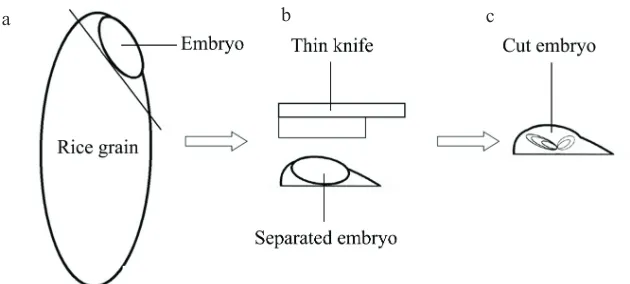
After irradiation, microstructures of samples were ob-served for determining the effect of irradiation on the embryonal structure. Micrology observation was done in the Institute of Plant-Protection Sciences, Zhejiang University, with the electronic microscope (XL30-ESEM, Philip, Holand) and the ion coater (IB-5 ION COATER, Philip, Holand). The rice embryo (including embryo bud and radicle) samples used in this experiment were separated from rice grain with knife (Fig. 1a). Then, under optical microscope, the embryos were cut into two parts with thin knife along the middle of embryo (Fig. 1b), that parts with whole shape of embryo bud and radicle were used in micrology observation (Fig. 1c).
Irradiated samples were symmetrically placed on a sif-ter drying with an air velocity of 0.5±0.1 m s-1and a low drying temperature of 40°C (Inprasit and Noomhorm, 2001). The samples were dried until it reached a final moisture content of 14.5±0.1% d.b., which represented the safe moisture value for rice storage.
For each sample, which had been dipped in water for one hour, in a 15 cm diameter Petri dish, one hundred seeds were symmetrically placed on two filter papers. Seeds were
incubated under 12 h light and 12 h darkness for 14 days in growth chambers at 30°C (GB/T 3543.4-1995, National Standard of China). Seed germination was checked daily and the length of root and sprout were measured at the 14th day. Seeds were considered germinated when the root was 5 mm long (Baiet al., 2003). All germination experiment had there replications. The data in the figures are average values, and the standard errors are less than 12.46% of average values. After irradiated at 0, 2, 5, 8, and 10 kGy, the first set of germination tests were commenced immediately, and the other sets of tests were done at intervals of two months. The experiments were conducted within two years.
RESULTS AND DISCUSSION
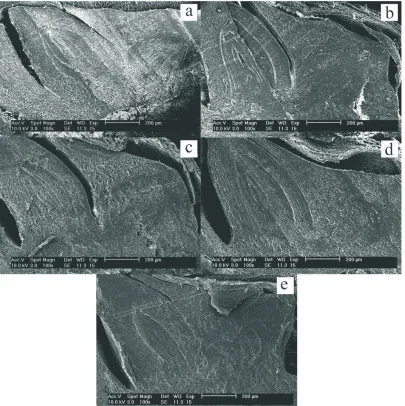
The effect of irradiation dose on embryo structure was shown in Fig. 2. The embryo structure of non-irradiated rice grain was intact. The outline and venations of embryo bud and radicle were clear and easy to distinguish (Fig. 2a). With the increasing irradiation dose, the venations of embryo bud were decreased and blurry gradually (Fig. 2b-e). Similar changes were more evidently represented in radicle. After irradiation with 2 kGy dose, the outline and venations of radicle were unclear, and those were hard to distinguish when the dose was higher than 5 kGy (Fig. 2b-e). It could also be seen from Fig. 2 that the influence ofg-ray irradiation on the structure of radicle was more significant than that of embryo bud.
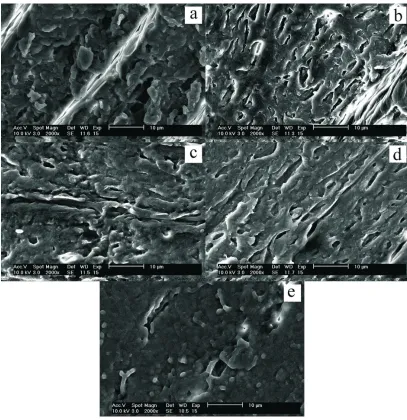
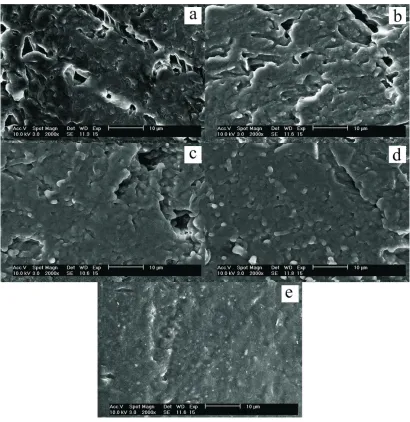
The changes of venations of embryo bud and radicle caused by different irradiation dose were more distinctly in Figs 3 and 4. The venations ofembryo bud and radicle were actually composed of the gaps of adjacent two layers of cells. The cells of embryo bud and radicle were destroyed by g-ray irradiation, and the cytoplasm wasfound to flow out of cell and filled in those gaps. With the increasing irradiation dose, the breakage degree of cells was increased and more cytoplasm flowedout of cells and filled in those gaps. It was likely to be the reason for the changes of embryo structure caused by increasingg-ray irradiation.
384 J. WANG and Y. YU
Fig. 1. Sketch of process of making sample for micrology observation.
The results of germination experiment which com-menced immediately after irradiation are shown in Table 1 (data measured at 14th day). It was evident that the germination rate of rice seed was significantly affected by gamma irradiation, and the germination rates were de-creased to 0 % when dose was higher than 2 kGy. The effects of different dose on germination characteristics were repre-sented in bud occur rate (the percentage of rice grain owning bud). With the increasing dose, the bud rates decreased from 87 to 52%, and the mean length of bud decreased from 0.6 to 0.4 cm. The bud rate and mean length of bud of irradiated samples evidently decreased than that of non-irradiated rice sample (98%, 6.9 cm). The root occur rate and mean length of root, however, decreased to 0% and 0 cm, respectively, when dose was higher than 2 kGy. The conclusion draw from data of Table 1 was thatthe influence ofg-ray irradia-tion on root was more significant than that on bud, and this conclusion is collaborated by the micrology observation
mentioned above. Because the seed were considered germi-nated when the root was 5 mm long, the effects of g-ray irradiation on germination rate were mainly due to the effects on root.
386 J. WANG and Y. YU
Fig. 3.Effect of irradiation dose on the structure of embryo bud: a – 0, b – 2, c – 5, d – 8, e – 10 kGy. The greyish strias in (a) is the venations of embryo bud, and from (b) to (e), the venations is unclear with the increasing dose.
Parameter Irradiation dose (kGy)
0 2 5 8 10
Germination rate (%) 97 0 0 0 0
Bud occur rate 1 (%) 98 87 77 65 52
Mean length of bud (cm) 6.9 0.6 0.5 0.5 0.4
Root occur rate 2 (%) 97 0 0 0 0
Mean length of root (cm) 5.6 0 0 0 0
germination rates may emerge from two adjacent experi-ments periods. Fourthly, after long-term storage, germina-tion rates of some irradiated samples were higher than that of non-irradiated rice sample. For example, after 22 months storage, the germination rates of irradiated at 2 and 5 kGy (86 and 84%, respectively) were higher than that of non-irradiated sample (73%). Those changes of germination rates of irradiated samples might be due to the self-repair of irradiated organism (Boubriak et al., 1997; Martini and Almouzni, 1997; Mustonenet al., 1999).
The effect of storage time on germination characte-ristics of non-irradiated rice sample and 2 kGy irradiated rice sample were shown in Fig. 5. The points in these figures
express the number of germinated seeds in each day during germination period. For the non-irradiated rice sample, it was evident that, with the increasing storage time from 0 to 24 months, the peak value of germinated seeds decreased and the time needed to reach the peak value increased (Fig. 5a). For the 2 kGy irradiated rice sample, and for an the increa-sing storage time from 14 to 18 months, the peak value of germinated seeds increased and the time needed to reach the peak value decreased (Fig. 5b). With an increased storage time from 18 to 22 months, the peak value of germinated seeds decreased. Figure 6 also shows that the germination characteristics may be similar to that of non-irradiated rice sample if storage time was prolonged.
CONCLUSIONS
1. The embryo structure of rice was affected byg-ray irradiation. The result shows that the outline and venations of embryo bud and radicle were unclear. These changes of embryo structure caused by increasing irradiation dose were due to the increasing breakage degree of embryo cells.
2. The germination experiment commenced immedia-tely after irradiation, the lengths of buds of all irradiated rice minished consumingly, the roots of all irradiated rice were disappeared, and the germination rate of irradiated rice was all considered 0%.
3. After long-term storage, the germination rates of irradiated samples increased, and that of some irradiated samples could reach to the comparatively high values in two years after different store periods.
REFERENCES
Bai Y., Tischler C.R., Booth D.T., and Taylor E.M., 2003. Variations in germination and gain quality within a rust resistant common wheat germplasm as affected by parental CO2conditions. Environ. Exp. Botany, 50, 159-168.
Barros A.C., Freund M.T.L., Villavicencio C.H., Delincee H., and Arthur V., 2002.Identification of irradiated wheat by germination test, DNA comet assay and electron spin re-sonance. Radiation Physics Chem., 63, 423-426.
Boubriak I., Kargiolaki H., Lyne L., and Osborne D.J., 1997. The requirement for DNA repair in desiccation tolerance of germinating embryos. Seed Sci. Res., 7, 97-105.
GB/5497-85,1985.Inspection of grain and oilseeds. Methods for determination of moisture content. National Standard of China.
GB/T 3543.4-1995, 1995. Rules for agricultural seed testing. Germination test. National Standard of China.
Inprasit C. and Noomhorm A., 2001.Effect of drying air tempe-rature and grain tempetempe-rature of different types of dryer and operation on rice quality. Drying Technol., 19, 389-404. Martini E. and Almouzni G., 1997.UVC irradiation, DNA repair
and chromatin assembly. Mutation Res., 379, 45-52. Mustonen R., Bouvier G., Wolber G., Stöhr M., Peschke P., and
Bartsch H., 1999. A comparison of gamma and neutron irradiation on raji cells: effects on DNA damage, repair, cell cycle distribution and lethality. Mutation Res., 429, 169-179.
Pietruszewski S. and Kania K., 2010.Effect of magnetic field on germination and yield of wheat. Int. Agrophys., 24, 297-302. Wang Z. and You R., 2000. Changes in wheat germination following g-ray irradiation: an in vivo electronic para-magnetic resonance spin-probe. Environ. Exp. Botany, 43, 219-225.
Yu Y. and Wang J., 2005.Effect ofãirradiation pre-treatment on drying characteristics and qualities of rice. Radiation Physics Chem., 74, 378-383.
Yu Y. and Wang J., 2006.Effect of gamma-ray irradiation on drying characteristics of wheat. Biosys. Eng., 95, 219-225. Zepeda B.R., Hernández A.C., Domínguez P.A., Cruz O.A.,
Godina N.J.J., and Martínez O.E., 2010.Electromagnetic field and seed vigour of corn hybrids. Int. Agrophys.,24, 329-332.
388 J. WANG and Y. YU
Months after irradiation
Irradiation dose (kGy)
0 2 5 8 10
2 95 0 0 0 0
4 94 0 0 0 0
6 94 0 0 0 0
8 91 0 0 0 0
10 89 0 0 0 0
12 85 2 0 0 0
14 83 27 0 0 0
16 82 65 6 0 0
18 79 90 31 0 0
20 74 87 68 9 0
22 73 86 84 27 3
24 70 82 85 59 22
T a b l e 2.Germination rate of long-term germination experi-ment (%)
Fig. 5.Effect of storage time on germination characteristics of: a – non-irradiated rice, b – 2kGy non-irradiated rice.
a