A Monthly Double-Blind Peer Reviewed (Refereed/Juried) Open Access International e-Journal - Included in the International Serial Directories
Indexed & Listed at:
VOLUME NO.4(2014),ISSUE NO.08(AUGUST) ISSN 2231-5756
INTERNATIONAL JOURNAL OF RESEARCH IN COMMERCE, IT & MANAGEMENT
CONTENTS
Sr.
No.
TITLE & NAME OF THE AUTHOR (S)
Page
No.
1
.
IMPACT OF MOBILE MARKETING IN THE CURRENT INDIAN SCENARIO
DR. VINAYAK KHARE, DR. HARISH B. BAPAT & DR. VISHAL SONI
1
2
.
FARMER’S SUGGESTIONS TO IMPROVE THE TANK SYSTEMS PERFORMANCE WITH
SPECIAL REFERENCE TO MADURAI DISTRICT
DR. M. A. RAJKUMAR & DR. P. KARTHIKEYAN
4
3
.
A COMPARATIVE STUDY OF PROBLEMS FACED BY CONSUMERS WHILE USING
SERVICES OF INDIA POST AND PRIVATE COURIER SERVICE IN WESTERN MUMBAI
MEHUL CHHATBAR & DR. CHITRA NATARAJAN
9
4
.
POLICY OF NATIONALISM GUIDANCE THROUGH IN TRADITIONAL MARKET
MANAGEMENT IN CENTRAL JAVA
DR. SRI SUWITRI
14
5
.
GREEN PURCHASING BEHAVIOUR OF YOUNG CONSUMERS IN THOOTHUKUDI
DR. K. MARIAMMAL & M.SHUNMUGAVALLI
17
6
.
A RESEARCH ON THE EFFICACY OF EMPLOYEE TRAINING IN MANUFACTURING
COMPANY, PUNE
DR. MANISHA PUROHIT
21
7
.
MANAGEMENT LESSONS FROM DABBAWALA
B. SARUMATHI, B. SARANYA & A. ANITHA SUPRIYA JOSEPH
24
8
.
A STUDY ON THE FACTORS AFFECTING RFID ADOPTING INTENTION OF ONLINE
SHOPPING LOGISTICS PROCESS: CASE OF TAIWAN ONLINE RETAIL BUSINESS
YU-BING, WANG
29
9
.
TRAINING AND DEVELOPING EMPLOYEES: METHODS AND EFFECTS
PAYAL CHATLY
36
10
.
EURO ZONE CRISIS: ITS GENESIS AND IMPLICATIONS ON INDIAN ECONOMY
DR. MADHUR M.MAHAJAN
39
11
.
EFFECT OF DIVIDEND ON SHARE’S VOLUME, SHARE’S TURNOVER AND SHARE’S
TRADING WITH SPECIAL REFERENCE TO BANKING AND AUTO INDUSTRY: AN INDIAN
PERSPECTIVE
DR. DEBASISH BISWAS & SAJIJUL ISLAM
46
12
.
WOMEN ENTREPRENEURSHIP: PROBLEMS & PROSPECTS
PAYAL CHATLY
51
13
.
REVERSE INNOVATION AS A PERSUASIVE MARKETING TOOL
SONIA LOHIA & SACHIN LOHIA
54
14
.
CONTRIBUTION OF MICRO AND SMALL SCALE INDUSTRIES IN RURAL DEVELOPMENT:
A CASE STUDY OF AJMER DIVISION (AJMER, BHILWARA, TONK AND NAGAUR
DISTRICTS)
SHWETA SHARMA, DEEPALI SHARMA & S. L. CHOUDHARY
57
15
.
INTEGRATING INFORMATION AND COMMUNICATION TECHNOLOGY INTO THE
GHANA EDUCATION HEAD OFFICES: AN EMPIRICAL EVIDENCE FROM GHANA
ELISHA D’ARCHIMEDES ARMAH
69
CHIEF PATRON
PROF. K. K. AGGARWAL
Chairman, Malaviya National Institute of Technology, Jaipur
(An institute of National Importance & fully funded by Ministry of Human Resource Development, Government of India)
Chancellor, K. R. Mangalam University, Gurgaon
Chancellor, Lingaya’s University, Faridabad
Founder Vice-Chancellor (1998-2008), Guru Gobind Singh Indraprastha University, Delhi
Ex. Pro Vice-Chancellor, Guru Jambheshwar University, Hisar
FOUNDER PATRON
LATE SH. RAM BHAJAN AGGARWAL
Former State Minister for Home & Tourism, Government of Haryana
Former Vice-President, Dadri Education Society, Charkhi Dadri
Former President, Chinar Syntex Ltd. (Textile Mills), Bhiwani
CO-ORDINATOR
AMITA
Faculty, Government M. S., Mohali
ADVISORS
DR. PRIYA RANJAN TRIVEDI
Chancellor, The Global Open University, Nagaland
PROF. M. S. SENAM RAJU
Director A. C. D., School of Management Studies, I.G.N.O.U., New Delhi
PROF. M. N. SHARMA
Chairman, M.B.A., Haryana College of Technology & Management, Kaithal
PROF. S. L. MAHANDRU
Principal (Retd.), Maharaja Agrasen College, Jagadhri
EDITOR
PROF. R. K. SHARMA
Professor, Bharti Vidyapeeth University Institute of Management & Research, New Delhi
CO-EDITOR
DR. BHAVET
Faculty, Shree Ram Institute of Business & Management, Urjani
EDITORIAL ADVISORY BOARD
DR. RAJESH MODI
Faculty, Yanbu Industrial College, Kingdom of Saudi Arabia
PROF. SANJIV MITTAL
University School of Management Studies, Guru Gobind Singh I. P. University, Delhi
PROF. ANIL K. SAINI
VOLUME NO.4(2014),ISSUE NO.08(AUGUST) ISSN 2231-5756
INTERNATIONAL JOURNAL OF RESEARCH IN COMMERCE, IT & MANAGEMENT
DR. SAMBHAVNA
Faculty, I.I.T.M., Delhi
DR. MOHENDER KUMAR GUPTA
Associate Professor, P. J. L. N. Government College, Faridabad
DR. SHIVAKUMAR DEENE
Asst. Professor, Dept. of Commerce, School of Business Studies, Central University of Karnataka, Gulbarga
ASSOCIATE EDITORS
PROF. NAWAB ALI KHAN
Department of Commerce, Aligarh Muslim University, Aligarh, U.P.
PROF. ABHAY BANSAL
Head, Department of Information Technology, Amity School of Engineering & Technology, Amity
University, Noida
PROF. A. SURYANARAYANA
Department of Business Management, Osmania University, Hyderabad
DR. SAMBHAV GARG
Faculty, Shree Ram Institute of Business & Management, Urjani
PROF. V. SELVAM
SSL, VIT University, Vellore
DR. PARDEEP AHLAWAT
Associate Professor, Institute of Management Studies & Research, Maharshi Dayanand University, Rohtak
DR. S. TABASSUM SULTANA
Associate Professor, Department of Business Management, Matrusri Institute of P.G. Studies, Hyderabad
SURJEET SINGH
Asst. Professor, Department of Computer Science, G. M. N. (P.G.) College, Ambala Cantt.
TECHNICAL ADVISOR
AMITA
Faculty, Government M. S., Mohali
FINANCIAL ADVISORS
DICKIN GOYAL
Advocate & Tax Adviser, Panchkula
NEENA
Investment Consultant, Chambaghat, Solan, Himachal Pradesh
LEGAL ADVISORS
JITENDER S. CHAHAL
Advocate, Punjab & Haryana High Court, Chandigarh U.T.
CHANDER BHUSHAN SHARMA
Advocate & Consultant, District Courts, Yamunanagar at Jagadhri
SUPERINTENDENT
CALL FOR MANUSCRIPTS
We invite unpublished novel, original, empirical and high quality research work pertaining to recent developments & practices in the areas of Computer Science & Applications; Commerce; Business; Finance; Marketing; Human Resource Management; General Management; Banking; Economics; Tourism Administration & Management; Education; Law; Library & Information Science; Defence & Strategic Studies; Electronic Science; Corporate Governance; Industrial Relations; and emerging paradigms in allied subjects like Accounting; Accounting Information Systems; Accounting Theory & Practice; Auditing; Behavioral Accounting; Behavioral Economics; Corporate Finance; Cost Accounting; Econometrics; Economic Development; Economic History; Financial Institutions & Markets; Financial Services; Fiscal Policy; Government & Non Profit Accounting; Industrial Organization; International Economics & Trade; International Finance; Macro Economics; Micro Economics; Rural Economics; Co-operation; Demography: Development Planning; Development Studies; Applied Economics; Development Economics; Business Economics; Monetary Policy; Public Policy Economics; Real Estate; Regional Economics; Political Science; Continuing Education; Labour Welfare; Philosophy; Psychology; Sociology; Tax Accounting; Advertising & Promotion Management; Management Information Systems (MIS); Business Law; Public Responsibility & Ethics; Communication; Direct Marketing; E-Commerce; Global Business; Health Care Administration; Labour Relations & Human Resource Management; Marketing Research; Marketing Theory & Applications; Non-Profit Organizations; Office Administration/Management; Operations Research/Statistics; Organizational Behavior & Theory; Organizational Development; Production/Operations; International Relations; Human Rights & Duties; Public Administration; Population Studies; Purchasing/Materials Management; Retailing; Sales/Selling; Services; Small Business Entrepreneurship; Strategic Management Policy; Technology/Innovation; Tourism & Hospitality; Transportation Distribution; Algorithms; Artificial Intelligence; Compilers & Translation; Computer Aided Design (CAD); Computer Aided Manufacturing; Computer Graphics; Computer Organization & Architecture; Database Structures & Systems; Discrete Structures; Internet; Management Information Systems; Modeling & Simulation; Neural Systems/Neural Networks; Numerical Analysis/Scientific Computing; Object Oriented Programming; Operating Systems; Programming Languages; Robotics; Symbolic & Formal Logic; Web Design and emerging paradigms in allied subjects.
Anybody can submit the soft copy of unpublished novel; original; empirical and high quality research work/manuscriptanytime in M.S. Word format
after preparing the same as per our GUIDELINES FOR SUBMISSION; at our email address i.e. [email protected] or online by clicking the link online submission as given on our website (FOR ONLINE SUBMISSION, CLICK HERE).
GUIDELINES FOR SUBMISSION OF MANUSCRIPT
1. COVERING LETTER FOR SUBMISSION:
DATED: _____________
THE EDITOR IJRCM
Subject: SUBMISSION OF MANUSCRIPT IN THE AREA OF.
(e.g. Finance/Marketing/HRM/General Management/Economics/Psychology/Law/Computer/IT/Engineering/Mathematics/other, please specify)
DEAR SIR/MADAM
Please find my submission of manuscript entitled ‘___________________________________________’ for possible publication in your journals.
I hereby affirm that the contents of this manuscript are original. Furthermore, it has neither been published elsewhere in any language fully or partly, nor is it under review for publication elsewhere.
I affirm that all the author (s) have seen and agreed to the submitted version of the manuscript and their inclusion of name (s) as co-author (s).
Also, if my/our manuscript is accepted, I/We agree to comply with the formalities as given on the website of the journal & you are free to publish our contribution in any of your journals.
NAME OF CORRESPONDING AUTHOR:
Designation:
Affiliation with full address, contact numbers & Pin Code: Residential address with Pin Code:
Mobile Number (s): Landline Number (s): E-mail Address: Alternate E-mail Address:
NOTES:
a) The whole manuscript is required to be in ONE MS WORD FILE only (pdf. version is liable to be rejected without any consideration), which will start from the covering letter, inside the manuscript.
b) The sender is required to mentionthe following in the SUBJECT COLUMN of the mail:
New Manuscript for Review in the area of (Finance/Marketing/HRM/General Management/Economics/Psychology/Law/Computer/IT/
Engineering/Mathematics/other, please specify)
c) There is no need to give any text in the body of mail, except the cases where the author wishes to give any specific message w.r.t. to the manuscript. d) The total size of the file containing the manuscript is required to be below 500 KB.
e) Abstract alone will not be considered for review, and the author is required to submit the complete manuscript in the first instance.
f) The journal gives acknowledgement w.r.t. the receipt of every email and in case of non-receipt of acknowledgment from the journal, w.r.t. the submission of manuscript, within two days of submission, the corresponding author is required to demand for the same by sending separate mail to the journal.
2. MANUSCRIPT TITLE: The title of the paper should be in a 12 point Calibri Font. It should be bold typed, centered and fully capitalised.
3. AUTHOR NAME (S) & AFFILIATIONS: The author (s) full name, designation, affiliation (s), address, mobile/landline numbers, and email/alternate email address should be in italic & 11-point Calibri Font. It must be centered underneath the title.
4. ABSTRACT: Abstract should be in fully italicized text, not exceeding 250 words. The abstract must be informative and explain the background, aims, methods,
VOLUME NO.4(2014),ISSUE NO.08(AUGUST) ISSN 2231-5756
INTERNATIONAL JOURNAL OF RESEARCH IN COMMERCE, IT & MANAGEMENT
5. KEYWORDS: Abstract must be followed by a list of keywords, subject to the maximum of five. These should be arranged in alphabetic order separated bycommas and full stops at the end.
6. MANUSCRIPT: Manuscript must be in BRITISH ENGLISH prepared on a standard A4 size PORTRAIT SETTING PAPER. It must be prepared on a single space and
single column with 1” margin set for top, bottom, left and right. It should be typed in 8 point Calibri Font with page numbers at the bottom and centre of every page. It should be free from grammatical, spelling and punctuation errors and must be thoroughly edited.
7. HEADINGS: All the headings should be in a 10 point Calibri Font. These must be bold-faced, aligned left and fully capitalised. Leave a blank line before each
heading.
8. SUB-HEADINGS: All the sub-headings should be in a 8 point Calibri Font. These must be bold-faced, aligned left and fully capitalised.
9. MAIN TEXT: The main text should follow the following sequence:
INTRODUCTION
REVIEW OF LITERATURE
NEED/IMPORTANCE OF THE STUDY
STATEMENT OF THE PROBLEM
OBJECTIVES
HYPOTHESES
RESEARCH METHODOLOGY
RESULTS & DISCUSSION
FINDINGS
RECOMMENDATIONS/SUGGESTIONS
CONCLUSIONS
SCOPE FOR FURTHER RESEARCH
ACKNOWLEDGMENTS
REFERENCES
APPENDIX/ANNEXURE
It should be in a 8 point Calibri Font, single spaced and justified. The manuscript should preferably not exceed 5000 WORDS.
10. FIGURES &TABLES: These should be simple, crystal clear, centered, separately numbered & self explained, and titles must be above the table/figure. Sources of data should be mentioned below the table/figure. It should be ensured that the tables/figures are referred to from the main text.
11. EQUATIONS:These should be consecutively numbered in parentheses, horizontally centered with equation number placed at the right.
12. REFERENCES: The list of all references should be alphabetically arranged. The author (s) should mention only the actually utilised references in the preparation
of manuscript and they are supposed to follow Harvard Style of Referencing. The author (s) are supposed to follow the references as per the following:
•
All works cited in the text (including sources for tables and figures) should be listed alphabetically.•
Use (ed.) for one editor, and (ed.s) for multiple editors.•
When listing two or more works by one author, use --- (20xx), such as after Kohl (1997), use --- (2001), etc, in chronologically ascending order.•
Indicate (opening and closing) page numbers for articles in journals and for chapters in books.•
The title of books and journals should be in italics. Double quotation marks are used for titles of journal articles, book chapters, dissertations, reports, working papers, unpublished material, etc.•
For titles in a language other than English, provide an English translation in parentheses.•
The location of endnotes within the text should be indicated by superscript numbers.PLEASE USE THE FOLLOWING FOR STYLE AND PUNCTUATION IN REFERENCES: BOOKS
•
Bowersox, Donald J., Closs, David J., (1996), "Logistical Management." Tata McGraw, Hill, New Delhi.•
Hunker, H.L. and A.J. Wright (1963), "Factors of Industrial Location in Ohio" Ohio State University, Nigeria.CONTRIBUTIONS TO BOOKS
•
Sharma T., Kwatra, G. (2008) Effectiveness of Social Advertising: A Study of Selected Campaigns, Corporate Social Responsibility, Edited by David Crowther & Nicholas Capaldi, Ashgate Research Companion to Corporate Social Responsibility, Chapter 15, pp 287-303.JOURNAL AND OTHER ARTICLES
•
Schemenner, R.W., Huber, J.C. and Cook, R.L. (1987), "Geographic Differences and the Location of New Manufacturing Facilities," Journal of Urban Economics, Vol. 21, No. 1, pp. 83-104.CONFERENCE PAPERS
•
Garg, Sambhav (2011): "Business Ethics" Paper presented at the Annual International Conference for the All India Management Association, New Delhi, India, 19–22 June.UNPUBLISHED DISSERTATIONS AND THESES
•
Kumar S. (2011): "Customer Value: A Comparative Study of Rural and Urban Customers," Thesis, Kurukshetra University, Kurukshetra.ONLINE RESOURCES
•
Always indicate the date that the source was accessed, as online resources are frequently updated or removed.WEBSITES
TRAINING AND DEVELOPING EMPLOYEES: METHODS AND EFFECTS
PAYAL CHATLY
ASST. PROFESSOR
DEPARTMENT OF COMMERCE
SHREE ATAM VALLABH JAIN COLLEGE
HUSSAINPURA
ABSTRACT
Training is a tool that can assist organizations in building a more committed and productive workforce. By helping to establish employee investment, reciprocity, identification, and by limiting alternative employment options, an effective training program can lead to greater commitment and less employee turnover. The result is an organization that is more productive. Employee competencies change through effective training programs. It therefore not only improves the overall performance of the employees to effectively perform their current jobs but also enhances the knowledge, skills an attitude of the workers necessary for the future job, thus contributing to superior organizational performance. It is an undeniable fact that in recent times many organizations have come to the realization of the importance of the role of training and development programs as it increases the organization’s staff efficiency, skills and productivity.
KEYWORDS
Training, Development, Employee Performance.
INTRODUCTION
here is no doubt that organizations worldwide are striving for success and out-competing those in the same industry. In order to do so, organizations have to obtain and utilize her human resources effectively. Organizations need to be aware of face more realistically towards keeping their human resources up-to-date. In so doing, managers need to pay special attention to all the core functions of human resource management as this plays an important role in different organizational, social and economically related areas among others that are influential to the attainment of the organizational goals and thus organizations successful continuation in the market.
Organizations are facing increased competition due to globalization, changes in technology, political and economic environments and therefore prompting these organizations to train their employees as one of the ways to prepare them to adjust to the increases above and thus enhance their performance. It is important to not ignore the prevailing evidence on growth of knowledge in the business corporate world in the last decade. This growth has not only been brought about by improvements in technology nor a combination of factors of production but increased efforts towards development of organizational human resources. It is, therefore, in every organizations responsibility to enhance the job performance of the employees and certainly implementation of training and development is one of the major steps that most companies need to achieve this. As is evident that employees are a crucial resource, it is important to optimize the contribution of employees to the company aims and goals as a means of sustaining effective performance. This therefore calls for managers to ensure an adequate supply of staff that is technically and socially competent and capable of career development into specialist departments or management positions.
DEFINITIONS
Training is a type of activity which is planned, systematic and it results in enhanced level of skill, knowledge and competency that are necessary to perform work effectively.
Development is a broad ongoing multi-faceted set of activities (training activities among them) aimed at bringing someone or an organization up to another threshold of performance, often to perform some job or a new role in the future.
Employee performance is defined as the outcome or contribution of employees to make them attain goals while performance may be used to define what an organization has accomplished with respect to the process, results, relevance and success. Researchers define performance as the achievement of specific tasks measured against predetermined or identified standards of accuracy, completeness, cost and speed. Employee performance can be manifested in improvement in production, easiness in using the new technology, highly motivated workers.
HR TRAINING NEEDS
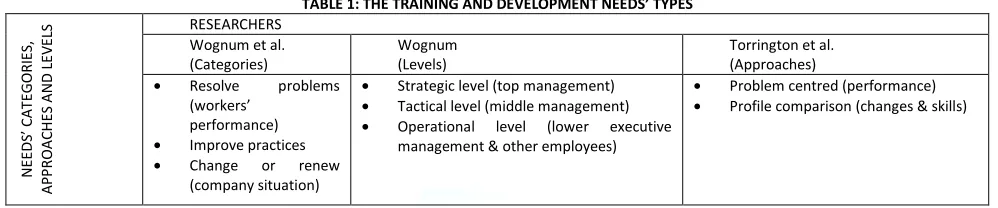
Training and development needs may occur at three organizational levels namely; (1) strategic level where needs are determined by top management while considering organizations goals, mission, strategy and problems, which need to be resolved or fixed (2) tactical level where needs are determined with middle management while considering developments needs to the coordination and cooperation between organization units and (3) operational level where needs are determined with lower executive management and other employees while considering problems related to operations such as performance problems of individual workers and departments in subject. In order to enable an organization formulate human resource training and development goals that will enable both formal and informal human resource training and development methods and programmes create a workforce that enables effectiveness and competitiveness, it is worth giving consideration to, providing proper coordination as well as proper incorporation of the needs within the three levels
The first issue is to identify the needs relevant to the organizations objectives. There are three categories of identifying training and development needs. These include: resolving problems, this focuses on workers’ performance, improving certain working practices, this focuses on improvement regardless of the performance problems and changing or renewing the organization situation, which may arise because of innovations or changes in strategy. It is worth putting in mind that during the identification of training needs, there is need to create, develop, maintain and improve any systems relevant in contributing to the availability of people with required skills. Moreover, training programmes should be designed to carter for the different needs. Further still, the training programme, content and the trainees' chosen depend on the objectives of the training programme.
A number of approaches have been highlighted in previous literature for identifying needs. These are the problem-centred (performance gap) and profile comparison (changes and skills) approaches. Similarly, a number of approaches for analyzing training needs depending or either new or current employees have been pointed out by earlier studies. The two most traditional approaches being the problem centered approach and the profile comparison approach. The problem centred approach focuses on any performance difficulties and the corporation analyses if the problems are due to insufficient skills, which then need to be developed if the problem is to be solved. Profile comparison approach on the other hand focuses on matching the competencies with the job filled, whether new position or existing position. Some changes in strategy and technology may also bring the need for new or additional skills.
VOLUME NO.4(2014),ISSUE NO.08(AUGUST) ISSN 2231-5756
INTERNATIONAL JOURNAL OF RESEARCH IN COMMERCE, IT & MANAGEMENT
TABLE 1: THE TRAINING AND DEVELOPMENT NEEDS’ TYPESN E E D S ’ C A T E G O R IE S , A P P R O A C H E S A N D L E V E LS RESEARCHERS
Wognum et al. (Categories)
Wognum (Levels)
Torrington et al. (Approaches)
• Resolve problems (workers’
performance)
• Improve practices
• Change or renew (company situation)
• Strategic level (top management)
• Tactical level (middle management)
• Operational level (lower executive management & other employees)
• Problem centred (performance)
• Profile comparison (changes & skills)
TRAINING AND DEVELOPMENT METHODS
Human resource development activities are meant to either improve performance on the present job of the individual, train new skills for new job or new position in the future and general growth for both individuals and organization so as to be able to meet organization’s current and future objectives. There are broadly two different methods that organizations may choose from for training and developing skills of its employees. These are on-the-job training given to organizational employees while conducting their regular work at the same working venues and off-the-job training involves taking employees away from their usual work environments and therefore all concentration is left out to the training. Examples of the on-the-job training include but are not limited to job rotations and transfers, coaching and/or mentoring. On the other hand, off-the-job training examples include conferences, role playing, and many more as explained below in detail. Researchers argue that on-the-job training may consist of teaching or coaching by more experienced people or trainers at the desk or at the bench. Different organizations are motivated to take on different training methods for a number of reasons for example; (1) depending on the organization’s strategy, goals and resources available, (2) depending on the needs identified at the time, and (2) the target group to be trained which may include among others individual workers, groups, teams, department or the entire organization.
• JOB ROTATION AND TRANSFERS: Job rotation and transfers as a way of developing employee skills within organization involves movements of employees from one official responsibility to another for example taking on higher rank position within the organization, and one branch of the organization to another. For transfers for example, it could involve movement of employees from one country to another. These rotations and transfers facilitate employees acquire knowledge of the different operations within the organization together with the differences existing in different countries where the organization operates. The knowledge acquired by the selected employees for this method is beneficial to the organization as it may increase the competitive advantage of the organization.
• COACHING AND/OR MENTORING: This involves having the more experienced employees coach the less experienced employees. It is argued that mentoring offers a wide range of advantages for development of the responsibility and relationship building. The practice is often applied to newly recruited graduates in the organization by being attached to mentor who might be their immediate managers or another senior manager. This however does not imply that older employees are excluded from this training and development method but it is mainly emphasized for the newly employed persons within the organization.
• ORIENTATION: This is yet another training and development method. This involves getting new employees familiarized and trained on the new job within an organization. During this process, they are exposed to different undertakings for example the nature of their new work, how to take on their identified tasks and responsibilities and what is generally expected of the employees by the organization. They are further given a general overview of the organizational working environment including for example working systems, technology, and office layout, briefed about the existing organizational culture, health and safety issues, working conditions, processes and procedures.
• CONFERENCES: A as a training and development method involves presentations by more than one person to a wide audience. It is more cost effective as a group of employees are trained on a particular topic all at the same time in large audiences. This method is however disadvantageous because it is not easy to ensure that all individual trainees understand the topic at hand as a whole; not all trainees follow at the same pace during the training sessions; focus may go to particular trainees who may seem to understand faster than others and thus leading tot under training other individuals.
• ROLE PLAYING: Involves training and development techniques that attempt to capture and bring forth decision making situations to the employee being trained. In other words, the method allows employees to act out work scenarios. It involves the presentation of problems and solutions for example in an organization setting for discussion. Trainees are provided with some information related to the description of the roles, concerns, objectives, responsibilities, emotions, and many more. Following is provision of a general description of the situation and the problem they face. The trainees are there after required to act out their roles. This method is more effective when carried out under stress-free or alternatively minimal-stress environments so as to facilitate easier learning. It is a very effective training method for a wide range of employees for example those in sales or customer service area, management and support employees.
• FORMAL TRAINING COURSES AND DEVELOPMENT PROGRAMMES: These are a number of methods which may be used to develop the skills required within an organization. These course and programmes are usually a set of defined and known programmes where the contents, durations and all the details about the training are clear to both the organization and the personnel to be trained. Unlike informal trainings and programmes, formal training and programmes can be planned earlier and also plan for their evaluation. Employees may undertake these courses and programmes while completely off work for a certain duration of time or alternatively be present for work on a part-time basis. These programmes can be held within the organization (in-house) or off the job. Off the job is argued to be more effective since employees are away from work place and their concentration is fully at training. Depending on the knowledge needed, organization’s structure and policies, the trainers too may be coming within the corporation or outside the organization.
EFFECT OF TRAINING ON PERFORMANCE
In the real world, organizational growth and development is affected by a number of factors. During the development of organizations, employee training plays a vital role in improving performance as well as increasing productivity. This in turn leads to placing organizations in the better positions to face competition and stay at the top. This therefore implies an existence of a significant difference between the organizations that train their employees and organizations that do not. The employee performance is a function of organizational performance since employee performance influences general organizational performance. In relation to the above, research note that employee competencies change through effective training programs. It therefore not only improves the overall performance of the employees to effectively perform their current jobs but also enhances the knowledge, skills an attitude of the workers necessary for the future job, thus contributing to superior organizational performance. Training has been proved to generate performance improvement related benefits for the employee as well as for the organization by positively influencing employee performance through the development of employee knowledge, skills, ability, competencies and behavior.
BENEFITS OF TRAINING
• High morale – employees who receive training have increased confidence and motivations;
• Lower cost of production – training eliminates risks because trained personnel are able to make better and economic use of material and equipment thereby reducing and avoiding waste;
• Lower turnover – training brings a sense of security at the workplace which in turn reduces labor turnover and absenteeism is avoided;
• Change management – training helps to manage change by increasing the understanding and involvement of employees in the change process and also provides the skills and abilities needed to adjust to new situations;
• Provide recognition, enhanced responsibility and the possibility of increased pay and promotion;
• Help to improve the availability and quality of staff.
CONCLUSION
Training is a tool that can assist organizations in building a more committed and productive workforce. By helping to establish employee investment, reciprocity, identification, and by limiting alternative employment options, an effective training program can lead to greater commitment and less employee turnover. The result is an organization that is more productive and professional. Although training can play a major role in this process, organizations need to look at additional work force strategies and practices that can enhance commitment. Employee is a valuable resource (asset) of the organization. The success or failure of the organization depends on employee performance. It is an undeniable fact that in recent times many organizations have come to the realization of the importance of the role of training and development programs as it increases the organization’s staff efficiency, skills and productivity.
REFERENCES
1. Ahuja, K. 2006. Personnel management. 3rd Ed. New Delhi. India. Kalyani publishers
2. Debrah, Y. A. & Ofori, G 2006. Human Resource Development of Professionals in an Emerging Economy: the Case of the Tanzanian Construction Industry. International Journal of Human Resource Management 17,3, 440 – 463.
3. Ghauri, P. N. & Prasad, S. B. 1995. A network approach to probing Asia’s interfirm linkages. Advances in International Comparative Management 10, 63–77. 4. Harvey, M. 2002. Human Resource Management in Africa: Alice’s Adventures in Wonderland. International Journal of Human Resource Management. 13,7,
1119 – 1145.
5. Jackson, T. 2002. Reframing human resource management in Africa: a cross-cultural perspective. International Journal of Human Resource Management 13,7, 998–1018.
6. McCourt, W. & Derek, E. 2003. Global Human Resource Management: Managing People in Developing and Transitional Countries. Cheltenham, UK: Edward Elgar.
7. Torrington, D., Hall, L. & Taylor, S. 2005. Human Resource Management. 6th Ed. London: Prentice Hall
8. Wognum, A. A. M. 2001. Vertical Integration of HRD Policy within Companies. Human Resource Development International 4,3, 407–421.
VOLUME NO.4(2014),ISSUE NO.08(AUGUST) ISSN 2231-5756
INTERNATIONAL JOURNAL OF RESEARCH IN COMMERCE, IT & MANAGEMENT
REQUEST FOR FEEDBACK
Dear Readers
At the very outset, International Journal of Research in Commerce, IT & Management (IJRCM)
acknowledges & appreciates your efforts in showing interest in our present issue under your kind perusal.
I would like to request you tosupply your critical comments and suggestions about the material published
in this issue as well as on the journal as a whole, on our E-mail
for further
improvements in the interest of research.
If youhave any queries please feel free to contact us on our E-mail
.
I am sure that your feedback and deliberations would make future issues better – a result of our joint
effort.
Looking forward an appropriate consideration.
With sincere regards
Thanking you profoundly
Academically yours
Sd/-
Co-ordinator
DISCLAIMER