A Monthly Double-Blind Peer Reviewed (Refereed/Juried) Open Access International e-Journal - Included in the International Serial Directories
Indexed & Listed at:
Ulrich's Periodicals Directory ©, ProQuest, U.S.A., EBSCO Publishing, U.S.A., Cabell’s Directories of Publishing Opportunities, U.S.A., Open J-Gage, India [link of the same is duly available at Inflibnet of University Grants Commission (U.G.C.)],
VOLUME NO.4(2014),ISSUE NO.07(JULY) ISSN 2231-5756
INTERNATIONAL JOURNAL OF RESEARCH IN COMMERCE, IT & MANAGEMENT
CONTENTS
Sr.
No.
TITLE & NAME OF THE AUTHOR (S)
Page
No.
1
.
EMPLOYER BRANDING: A NEW STRATEGIC ASPECT OF HUMAN RESOURCE
DR. RUCHI JAIN & SURINDER KAUR
1
2
.
EMPLOYEE ENGAGEMENT AND COMMITMENT: A STUDY CONDUCTED IN DELHI AND
NCR WITH SPECIAL REFERENCE TO TELECOM INDUSTRY
DR. ANIL CHANDHOK & DR. BHAVET
5
3
.
CORPORATE GOVERNANCE ATTRIBUTES AND THE LEVEL OF CORPORATE
VOLUNTARY DISCLOSURES IN ANNUAL REPORTS: THE CASE OF ETHIOPIA
HABTAMU BERHANU ABERA & MOHD. AKBAR ALI KHAN
11
4
.
WORK-LIFE BALANCE IN DUAL WORKING COUPLES IN MEDICAL SECTOR
DR. SNIGDHARANI MISHRA & RACHNA NIGAM
17
5
.
M-COMMERCE AS A PROMISING DESCENDENT OF E-COMMERCE: A LITERATURE
REVIEW
RAVINDER PANT & ANTRIKSHA NEGI
24
6
.
DEVELOPING A MODEL TO ENSURE SWIFT JUSTICE IN DEVELOPING COUNTRIES: A
STUDY ON SUIT JAMS IN BANGLADESH
SARUAR AHMED & ABDUL LATIF
27
7
.
AN ANALYSIS OF GROWTH PATTERN OF CHINA
DR. ASHOK KUMAR CHAUHAN & MANOJ KUMAR
32
8
.
BUYING PATTERNS OF CONSUMER DURABLES GOODS WITH REFERENCE TO
SELECTED ORGANIZED AND UNORGANIZED RETAIL OUTLETS IN CHENNAI CITY
P. ARIVAZHAGAN & DR. MATHIVANAN
36
9
.
DISCRIMINATION OF MEMBERS ON THE DIFFERENT REASONS TO JOIN SELF HELP
GROUPS: A STUDY IN SALEM DISTRICT, TAMILNADU
DR. P. UMA MAHESWARI
41
10
.
RESPONSIVE WEB DESIGN: A FORWARD-THINKING APPROACH TO WEBSITE
CREATION
SWATI BHAT
46
11
.
A STUDY ON CUSTOMER ATTITUDE TOWARDS SELECTED DURABLE GOODS WITH
SPECIAL REFERENCE TO COIMBATORE CITY
J. UDHAYAKUMAR & PRIYADHARSHINI
49
12
.
PERFORMANCE OF COIR INDUSTRY IN INDIA
SK. RAMEEZ RAJA & DR. K. EKAMBARAM
54
13
.
THE RIGHTS OF TEA WORKERS OF BANGLADESH IN THE LIGHT OF EXISTING LABOR
LAWS AND STANDARDS: A STUDY ON SELECTED TEA ESTATES OF SYLHET DISTRICT
SARUAR AHMED & SAMIUR RASHID CHOWDHURY
59
14
.
EXAMINING CONSUMERS’ ATTITUDE TOWARDS MOBILE ADVERTISEMENT IN
ETHIOPIA: CASE STUDY ON MOBILE USERS OF MEKELLE UNIVERSITY
ADEM MOHAMMED, YIBELTAL NIGUSSIE & ETSEGENET KIDANE
64
15
.
PARTICIPATION OF COMMERCIAL BANKS IN DEVELOPING MICRO, SMALL AND
MEDIUM ENTERPRISES (MSMEs) IN INDIA: AN OVERVIEW
RASHMI PANDEY
71
INTERNATIONAL JOURNAL OF RESEARCH IN COMMERCE, IT & MANAGEMENT
CHIEF PATRON
PROF. K. K. AGGARWAL
Chairman, Malaviya National Institute of Technology, Jaipur
(An institute of National Importance & fully funded by Ministry of Human Resource Development, Government of India)
Chancellor, K. R. Mangalam University, Gurgaon
Chancellor, Lingaya’s University, Faridabad
Founder Vice-Chancellor (1998-2008), Guru Gobind Singh Indraprastha University, Delhi
Ex. Pro Vice-Chancellor, Guru Jambheshwar University, Hisar
FOUNDER PATRON
LATE SH. RAM BHAJAN AGGARWAL
Former State Minister for Home & Tourism, Government of Haryana
Former Vice-President, Dadri Education Society, Charkhi Dadri
Former President, Chinar Syntex Ltd. (Textile Mills), Bhiwani
CO-ORDINATOR
AMITA
Faculty, Government M. S., Mohali
ADVISORS
DR. PRIYA RANJAN TRIVEDI
Chancellor, The Global Open University, Nagaland
PROF. M. S. SENAM RAJU
Director A. C. D., School of Management Studies, I.G.N.O.U., New Delhi
PROF. M. N. SHARMA
Chairman, M.B.A., Haryana College of Technology & Management, Kaithal
PROF. S. L. MAHANDRU
Principal (Retd.), Maharaja Agrasen College, Jagadhri
EDITOR
PROF. R. K. SHARMA
Professor, Bharti Vidyapeeth University Institute of Management & Research, New Delhi
CO-EDITOR
DR. BHAVET
Faculty, Shree Ram Institute of Business & Management, Urjani
EDITORIAL ADVISORY BOARD
DR. RAJESH MODI
Faculty, Yanbu Industrial College, Kingdom of Saudi Arabia
PROF. SANJIV MITTAL
University School of Management Studies, Guru Gobind Singh I. P. University, Delhi
PROF. ANIL K. SAINI
VOLUME NO.4(2014),ISSUE NO.07(JULY) ISSN 2231-5756
INTERNATIONAL JOURNAL OF RESEARCH IN COMMERCE, IT & MANAGEMENT
DR. SAMBHAVNA
Faculty, I.I.T.M., Delhi
DR. MOHENDER KUMAR GUPTA
Associate Professor, P. J. L. N. Government College, Faridabad
DR. SHIVAKUMAR DEENE
Asst. Professor, Dept. of Commerce, School of Business Studies, Central University of Karnataka, Gulbarga
ASSOCIATE EDITORS
PROF. NAWAB ALI KHAN
Department of Commerce, Aligarh Muslim University, Aligarh, U.P.
PROF. ABHAY BANSAL
Head, Department of Information Technology, Amity School of Engineering & Technology, Amity
University, Noida
PROF. A. SURYANARAYANA
Department of Business Management, Osmania University, Hyderabad
DR. SAMBHAV GARG
Faculty, Shree Ram Institute of Business & Management, Urjani
PROF. V. SELVAM
SSL, VIT University, Vellore
DR. PARDEEP AHLAWAT
Associate Professor, Institute of Management Studies & Research, Maharshi Dayanand University, Rohtak
DR. S. TABASSUM SULTANA
Associate Professor, Department of Business Management, Matrusri Institute of P.G. Studies, Hyderabad
SURJEET SINGH
Asst. Professor, Department of Computer Science, G. M. N. (P.G.) College, Ambala Cantt.
TECHNICAL ADVISOR
AMITA
Faculty, Government M. S., Mohali
FINANCIAL ADVISORS
DICKIN GOYAL
Advocate & Tax Adviser, Panchkula
NEENA
Investment Consultant, Chambaghat, Solan, Himachal Pradesh
LEGAL ADVISORS
JITENDER S. CHAHAL
Advocate, Punjab & Haryana High Court, Chandigarh U.T.
CHANDER BHUSHAN SHARMA
Advocate & Consultant, District Courts, Yamunanagar at Jagadhri
SUPERINTENDENT
INTERNATIONAL JOURNAL OF RESEARCH IN COMMERCE, IT & MANAGEMENT
CALL FOR MANUSCRIPTS
We invite unpublished novel, original, empirical and high quality research work pertaining to recent developments & practices in the areas of Computer Science & Applications; Commerce; Business; Finance; Marketing; Human Resource Management; General Management; Banking; Economics; Tourism Administration & Management; Education; Law; Library & Information Science; Defence & Strategic Studies; Electronic Science; Corporate Governance; Industrial Relations; and emerging paradigms in allied subjects like Accounting; Accounting Information Systems; Accounting Theory & Practice; Auditing; Behavioral Accounting; Behavioral Economics; Corporate Finance; Cost Accounting; Econometrics; Economic Development; Economic History; Financial Institutions & Markets; Financial Services; Fiscal Policy; Government & Non Profit Accounting; Industrial Organization; International Economics & Trade; International Finance; Macro Economics; Micro Economics; Rural Economics; Co-operation; Demography: Development Planning; Development Studies; Applied Economics; Development Economics; Business Economics; Monetary Policy; Public Policy Economics; Real Estate; Regional Economics; Political Science; Continuing Education; Labour Welfare; Philosophy; Psychology; Sociology; Tax Accounting; Advertising & Promotion Management; Management Information Systems (MIS); Business Law; Public Responsibility & Ethics; Communication; Direct Marketing; E-Commerce; Global Business; Health Care Administration; Labour Relations & Human Resource Management; Marketing Research; Marketing Theory & Applications; Non-Profit Organizations; Office Administration/Management; Operations Research/Statistics; Organizational Behavior & Theory; Organizational Development; Production/Operations; International Relations; Human Rights & Duties; Public Administration; Population Studies; Purchasing/Materials Management; Retailing; Sales/Selling; Services; Small Business Entrepreneurship; Strategic Management Policy; Technology/Innovation; Tourism & Hospitality; Transportation Distribution; Algorithms; Artificial Intelligence; Compilers & Translation; Computer Aided Design (CAD); Computer Aided Manufacturing; Computer Graphics; Computer Organization & Architecture; Database Structures & Systems; Discrete Structures; Internet; Management Information Systems; Modeling & Simulation; Neural Systems/Neural Networks; Numerical Analysis/Scientific Computing; Object Oriented Programming; Operating Systems; Programming Languages; Robotics; Symbolic & Formal Logic; Web Design and emerging paradigms in allied subjects.
Anybody can submit the soft copy of unpublished novel; original; empirical and high quality research work/manuscriptanytime in M.S. Word format
after preparing the same as per our GUIDELINES FOR SUBMISSION; at our email address i.e. [email protected] or online by clicking the link online submission as given on our website (FOR ONLINE SUBMISSION, CLICK HERE).
GUIDELINES FOR SUBMISSION OF MANUSCRIPT
1. COVERING LETTER FOR SUBMISSION:
DATED: _____________ THE EDITOR
IJRCM
Subject: SUBMISSION OF MANUSCRIPT IN THE AREA OF.
(e.g. Finance/Marketing/HRM/General Management/Economics/Psychology/Law/Computer/IT/Engineering/Mathematics/other, please specify)
DEAR SIR/MADAM
Please find my submission of manuscript entitled ‘___________________________________________’ for possible publication in your journals.
I hereby affirm that the contents of this manuscript are original. Furthermore, it has neither been published elsewhere in any language fully or partly, nor is it under review for publication elsewhere.
I affirm that all the author (s) have seen and agreed to the submitted version of the manuscript and their inclusion of name (s) as co-author (s).
Also, if my/our manuscript is accepted, I/We agree to comply with the formalities as given on the website of the journal & you are free to publish our contribution in any of your journals.
NAME OF CORRESPONDING AUTHOR:
Designation:
Affiliation with full address, contact numbers & Pin Code: Residential address with Pin Code:
Mobile Number (s): Landline Number (s): E-mail Address: Alternate E-mail Address:
NOTES:
a) The whole manuscript is required to be in ONE MS WORD FILE only (pdf. version is liable to be rejected without any consideration), which will start from
the covering letter, inside the manuscript.
b) The sender is required to mentionthe following in the SUBJECT COLUMN of the mail:
New Manuscript for Review in the area of (Finance/Marketing/HRM/General Management/Economics/Psychology/Law/Computer/IT/
Engineering/Mathematics/other, please specify)
c) There is no need to give any text in the body of mail, except the cases where the author wishes to give any specific message w.r.t. to the manuscript. d) The total size of the file containing the manuscript is required to be below 500 KB.
e) Abstract alone will not be considered for review, and the author is required to submit the complete manuscript in the first instance.
f) The journal gives acknowledgement w.r.t. the receipt of every email and in case of non-receipt of acknowledgment from the journal, w.r.t. the submission
of manuscript, within two days of submission, the corresponding author is required to demand for the same by sending separate mail to the journal.
2. MANUSCRIPT TITLE: The title of the paper should be in a 12 point Calibri Font. It should be bold typed, centered and fully capitalised.
3. AUTHOR NAME (S) & AFFILIATIONS: The author (s) full name, designation, affiliation (s), address, mobile/landline numbers, and email/alternate email address should be in italic & 11-point Calibri Font. It must be centered underneath the title.
4. ABSTRACT: Abstract should be in fully italicized text, not exceeding 250 words. The abstract must be informative and explain the background, aims, methods,
VOLUME NO.4(2014),ISSUE NO.07(JULY) ISSN 2231-5756
INTERNATIONAL JOURNAL OF RESEARCH IN COMMERCE, IT & MANAGEMENT
5. KEYWORDS: Abstract must be followed by a list of keywords, subject to the maximum of five. These should be arranged in alphabetic order separated bycommas and full stops at the end.
6. MANUSCRIPT: Manuscript must be in BRITISH ENGLISH prepared on a standard A4 size PORTRAIT SETTING PAPER. It must be prepared on a single space and
single column with 1” margin set for top, bottom, left and right. It should be typed in 8 point Calibri Font with page numbers at the bottom and centre of every page. It should be free from grammatical, spelling and punctuation errors and must be thoroughly edited.
7. HEADINGS: All the headings should be in a 10 point Calibri Font. These must be bold-faced, aligned left and fully capitalised. Leave a blank line before each
heading.
8. SUB-HEADINGS: All the sub-headings should be in a 8 point Calibri Font. These must be bold-faced, aligned left and fully capitalised.
9. MAIN TEXT: The main text should follow the following sequence:
INTRODUCTION
REVIEW OF LITERATURE
NEED/IMPORTANCE OF THE STUDY
STATEMENT OF THE PROBLEM
OBJECTIVES
HYPOTHESES
RESEARCH METHODOLOGY
RESULTS & DISCUSSION
FINDINGS
RECOMMENDATIONS/SUGGESTIONS
CONCLUSIONS
SCOPE FOR FURTHER RESEARCH
ACKNOWLEDGMENTS
REFERENCES
APPENDIX/ANNEXURE
It should be in a 8 point Calibri Font, single spaced and justified. The manuscript should preferably not exceed 5000 WORDS.
10. FIGURES &TABLES: These should be simple, crystal clear, centered, separately numbered & self explained, and titles must be above the table/figure. Sources of data should be mentioned below the table/figure. It should be ensured that the tables/figures are referred to from the main text.
11. EQUATIONS:These should be consecutively numbered in parentheses, horizontally centered with equation number placed at the right.
12. REFERENCES: The list of all references should be alphabetically arranged. The author (s) should mention only the actually utilised references in the preparation
of manuscript and they are supposed to follow Harvard Style of Referencing. The author (s) are supposed to follow the references as per the following:
•
All works cited in the text (including sources for tables and figures) should be listed alphabetically.•
Use (ed.) for one editor, and (ed.s) for multiple editors.•
When listing two or more works by one author, use --- (20xx), such as after Kohl (1997), use --- (2001), etc, in chronologically ascending order.•
Indicate (opening and closing) page numbers for articles in journals and for chapters in books.•
The title of books and journals should be in italics. Double quotation marks are used for titles of journal articles, book chapters, dissertations, reports, workingpapers, unpublished material, etc.
•
For titles in a language other than English, provide an English translation in parentheses.•
The location of endnotes within the text should be indicated by superscript numbers.PLEASE USE THE FOLLOWING FOR STYLE AND PUNCTUATION IN REFERENCES: BOOKS
•
Bowersox, Donald J., Closs, David J., (1996), "Logistical Management." Tata McGraw, Hill, New Delhi.•
Hunker, H.L. and A.J. Wright (1963), "Factors of Industrial Location in Ohio" Ohio State University, Nigeria. CONTRIBUTIONS TO BOOKS•
Sharma T., Kwatra, G. (2008) Effectiveness of Social Advertising: A Study of Selected Campaigns, Corporate Social Responsibility, Edited by David Crowther &Nicholas Capaldi, Ashgate Research Companion to Corporate Social Responsibility, Chapter 15, pp 287-303. JOURNAL AND OTHER ARTICLES
•
Schemenner, R.W., Huber, J.C. and Cook, R.L. (1987), "Geographic Differences and the Location of New Manufacturing Facilities," Journal of Urban Economics,Vol. 21, No. 1, pp. 83-104. CONFERENCE PAPERS
•
Garg, Sambhav (2011): "Business Ethics" Paper presented at the Annual International Conference for the All India Management Association, New Delhi, India,19–22 June.
UNPUBLISHED DISSERTATIONS AND THESES
•
Kumar S. (2011): "Customer Value: A Comparative Study of Rural and Urban Customers," Thesis, Kurukshetra University, Kurukshetra.ONLINE RESOURCES
•
Always indicate the date that the source was accessed, as online resources are frequently updated or removed. WEBSITESINTERNATIONAL JOURNAL OF RESEARCH IN COMMERCE, IT & MANAGEMENT
DEVELOPING A MODEL TO ENSURE SWIFT JUSTICE IN DEVELOPING COUNTRIES: A STUDY ON SUIT JAMS
IN BANGLADESH
SARUAR AHMED
SR. LECTURER
DEPARTMENT OF LAW
SYLHET INTERNATIONAL UNIVERSITY
BANGLADESH
ABDUL LATIF
ASSOCIATE PROFESSOR
DEPARTMENT OF BUSINESS ADMINISTRATION
SYLHET INTERNATIONAL UNIVERSITY
BANGLADESH
ABSTRACT
It is evident from different statistics that, an ever increasing suit jam is prevailing in the courts of Bangladesh. The researchers attempted to develop a model to reduce the suit jam by analyzing the present scenario and the causes of the problem. The research is primary and secondary data based along with a semi-structured questionnaire to collect data from 100 lawyers, 100 victims, 100 academicians and 100 judges and magistrates by stratified sampling. It is proved from huge number of pending suits that thousands of people are suffering from long lasting verdict process due to provision of long duration to be equipped to provide the justice to the sufferers. The information collection, analyzing and transferring process of different parties with others, intentional and institutional procedures are worsening the situation. The researchers developed a model of providing the verdicts at four different stages; department level, lawyers level, specialized judge/magistrate level and higher court level on the basis of standardized laws to provide verdict at lower levels and forwarded the cases of exceptional nature on the basis of Management of Exceptions to the higher level with reports to provide necessary information to provide rapid verdict.
KEYWORDS
Suit Jam, Stratified Sampling, Specialized Judge/Magistrate, Management by Exception, Standardized Law.
INTRODUCTION
enerally an individual can suffer from two types of wrongs, namely, criminal wrong and civil wrong. In ordinary language, the term crime denotes an unlawful act punishable by the state (Wikipedia). The term crime does not, in modern criminal law, have any simple and universally accepted definition, though statutory definitions have been provided for certain purposes. The most popular view is that crime is a category created by law (i.e. something is a crime if applicable law says that it is). One proposed definition is that a crime, also called an offence or a criminal offence, is an act harmful not only to some individual, but also to the community or the state (a public wrong). Such acts are forbidden and punishable by law. Section 40 of the Penal Code 1860 states that “the word "offence" denotes a thing made punishable by this Code.”(Penal Code 1860) On the other hand, a “suit in law" is a civil action brought in a court of law in which a plaintiff, a party who claims to have incurred loss as a result of a defendant's actions, demands a legal or equitable remedy (Wikipedia). The defendant is required to respond to the plaintiff's complaint. If the plaintiff is successful, judgment is in the plaintiff's favor, and a variety of court orders may be issued to enforce a right, award damages, or impose a temporary or permanent injunction to prevent an act or compel an act. A declaratory judgment may be issued to prevent future legal disputes (Wikipedia).
In general there are three basic classifications of criminal offenses - felonies, misdemeanors and infractions (about.com). They are distinguished from each other by the seriousness of the offense and the amount of punishment for which someone convicted of the crime can receive.
Felonies are the most serious classification of crimes, punishable by incarceration of more than a year in prison and in some cases life in prison and even execution. Murder, rape and kidnapping are felony crimes, but armed robbery and grand theft also can be felonies. Not only can the person who committed the crime be charged with a felony, but so can anyone who aided or abetted the felon before or during the crime and anyone who became accessories of the crime after it was committed, such as those who help the felon avoid capture.
Misdemeanors are crimes that do not rise to the severity of a felony. The distinction between misdemeanors and felonies lies within the seriousness of the crime. Aggravated assault (beating someone with a cricket bat, for example) is a felony, while simple battery (slapping someone in the face) is a misdemeanor. Infractions are crimes for which jail time is usually not a possible sentence. Sometimes known as petty crimes, infractions are usually punishable by fines, which can be paid without even going to court.
There exists another type of crime known as the Capital crimes. These crimes are punishable by death. They are, of course, felonies. Such as, Section 303 of the Penal Code 1860 provides Death Penalty as only punishment for committing murder by a person imprisoned for life.
On the contrary civil suits include- Contract disputes, Obligations disputes, Property disputes or damages, Torts (a physical or psychological wrong or damage against another person whether intentional or not), which result in harm, including negligence, libel, and accidents, Succession disputes, Administrative law matters, Business disputes, Commercial law disputes, Temporary restraining orders, Dispute arising out of marriage (i.e. Polygamy, Divorce, Dower, Maintenance, Guardianship etc.) (Wikipedia).
In Bangladesh, in both cases (Criminal and Civil) the person who suffers injury for the acts of others needs to go to the court for seeking relief. Such as, in Criminal Case the remedy for the victim is five types of punishments awarded to the person found guilty, namely:
1. Death Sentence, 2. Imprisonment for life,
3. Imprisonment, which can be of Simple or Rigorous, 4. Forfeiture and
5. Fine. (Penal Code, 1860)
In Civil Suits the remedies are Injunction, Specific Performance, Appointment of Receiver, Declaration of rights etc.
The policy of the Court is that judgment should be delivered as expeditiously as possible. However, the constantly changing and often unpredictable demands on judicial time, the differences in the priorities for the delivery of judgments in different cases and the difference in the time required for the writing of judgment in different cases, the judges do not regard it as appropriate or useful to settle a time-table governing the delivery of reserved judgments. All judges aim to deliver decisions as promptly as possible. It is an internationally accepted norm that decisions will be delivered within three (3) months of the last day of hearing or receipt of the last submission. This period does not include court vacations. On occasion a judge may advise the parties at the hearing that the judgment will take longer than three months to deliver due to the complexity of the case or other pressing matters of court business.
VOLUME NO.4(2014),ISSUE NO.07(JULY) ISSN 2231-5756
INTERNATIONAL JOURNAL OF RESEARCH IN COMMERCE, IT & MANAGEMENT
Criminal proceedings are started by filing an FIR to the nearest police station stating the harm or loss caused by the victim for the acts of the accused (This is known as GR case or General Register case) and when the victim fails to lodge the complain with the police station then the Magistrate will register the case (Which is generally known as Complaint register). The police can arrest the accused without the permission of Magistrate or without warrant in case of cognizable offence. In case of Non-cognizable offences a police officer can arrest only with a warrant. According to the Article 33 of Constitution and 167 section of Code of Criminal Procedure police must produce the accused before the nearest Magistrate within 24 hours of arrest. With the permission of magistrate the police can keep the accused for more than 24 hours for further interrogations (Constitution of Bangladesh & CrPC). This is usually known as remand.
Section 15 of the Code of Civil Procedure of 1908 says that every suit shall be instituted in the Court of the lowest grade competent to try it (CPC 1908). The suit starts by moving a written petition called “Plaint” to the court. The Civil Courts Act 1887 laid down the Jurisdiction of the Civil Courts. According to this Act the suit valued below tk. 2 lacs is to be placed in the Court of Assistant Judge, of tk. 2 lac to 4 lac to the Court of Senior Assistant Judge and where the suit value is more than tk. 4 lacs it is to be instituted to the Court of Joint District Judge. The defendant must pay the court fee as per the rates fixed by the laws of the land time to time (Civil Court Act 1887).
Stages of Criminal proceeding: All criminal proceedings are regulated under the Code of criminal procedure 1898 and other Criminal Rules and Order (CRO). The CrPC contains details about the administration of criminal justice into three stages: namely investigation, inquiry and trial.
PRE-PROCEEDING STAGE: This is the initial stage of investigation and the preparation of a criminal case. Only the police plays role from the beginning to the end of this stage.
First Information Report----Investigation----Charge-sheet or a Final report----Naraji. PROCEEDING STAGE: Taking Cognizance
THE TRIAL STAGES:
Pre-trial hearing----Framing of charge----Plea and conviction----Evidence----Examination of accused/342 [of CrPC] Steps. ----Final arguments----Judgment of Acquittal or Conviction.(CrPC, 1898)
Stages of civil suits:
Submission of plaint/ Institution of suits---- Service of Summon---- Service Return/ Acknowledgement---- Written Statement---- Discovery and Inspection---- Framing of issue---- Settling date for peremptory hearing---- Peremptory hearing---- Argument---- Judgment---- Decree---- Execution of Decree (CPC, 1908). From the secondary data it is found that each civil court is dealing with almost 1274.66 suits. It is observed that Suits of 1961 is under judgment, both the parties of many suits have died but the case is still pending, a Signboard shows that Injunction Granted on 1978 is still in force, a Suit of 1965 regarding the determination of the rights of parties on Khas land is still not settled, even after 37 years of a murder no judgment is made yet, a suit on Election dispute instituted 40 years back is not settled yet, and thousands of Political cases remained unsettled.(Shaptahik 2000).
The civil suits take more times than the criminal case. 186 suits which were instituted on Pakistan period (1961-1970) is still under trial. Among the old cases, the number of 50 years old running cases is 175; number of 25-30 years old 1288 and the number of 20-50 years old cases are 2000 (Shaptahik 2000). At present in all courts in Bangladesh the number of pending suits is more than 30 lacs. The main reason is slow processing of the cases, rate of filing cases are much higher than that of settlements as reported by many experts.
In this situation, it quite impossible to ensure justice to the people of the country. So it is essential to examine the suit management system of Bangladesh and develop a perfect model to solve the problem of suit jam and initiate efficient and effective suit management system to ensure justice.
OBJECTIVES: THE SPECIFIC OBJECTIVES OF THE STUDY ARE
1. To study the present scenario of disposing suits in Bangladesh 2. To study the causes of suit jam in present structure.
3. To develop a model to ensure swift justice to the victims of suitjam in Bangladesh
METHODOLOGY
This research is a problem solving analytical research. The researchers used the sampling design of stratified probability types and collected data from 200 lawyers of Sylhet, Dhaka and Chittagong of lower court and high courts and of 100 academicians of different universities and also 100 magistrates and judges regarding the causes and types of suits and the suitability of the proposed model. The data were properly tabulated and processed by Microsoft excel 2007. The secondary data were collected from different authentic sources.
FINDINGS
PRESENT SCENARIO OF VARIOUS CIVIL COURTS IN BANGLADESH
The breathtaking figure of pending civil cases in the districts of Bangladesh is mounting gradually. Up to December'2012, the total number of civil litigation pending in the divisional districts is given below.
TABLE 1: THE NUMBER OF PENDING CIVIL SUITS AT DIFFERENT COURTS:
City Pending Civil suit Courts Pending suit per court Dhaka 62,250 38 1638.158
Chittagong 75,010 39 1923.333 Khulna 21,118 21 1005.619 Rajshahi 15,339 17 902.2941 Sylhet 6,664 22 302.9091 Barishal 25,760 18 1431.111 Rangpur 9,228 14 659.1429 Total 215,369 169 1274.373
Source: Statement up to December'2012 of Dhaka, Chittagong, Khulna, Rajshahi, Sylhet, Barishal & Rangpur courts
As no authentic data are available regarding the proportion of civil suits of different types, so the authors collected the opinion of 100 lawyers of Sylhet, Dhaka, & Chittagong regarding this. According to their opinion of land disputes contributed the most (65%) on civil suit and it is followed by family matter (25%) and the rest 10% are regarding business and other matters.
INTERNATIONAL JOURNAL OF RESEARCH IN COMMERCE, IT & MANAGEMENT
TABLE 2: TYPES OF CRIMINAL SUITS FILEDTypes of Criminal Case 2001 2002 2003 2004 2005 2006 2007 CAGR Proportion in 2007 Dacoity 758 963 949 885 796 795 1047 0.05 0.01
Robbery 1265 1397 1170 1207 898 843 1298 0.00 0.01 Burglary 3654 3959 3883 3356 3270 2991 4439 0.03 0.03 Theft 7432 8245 8234 8605 8101 8332 12015 0.07 0.08 Murder 3678 3503 3471 3902 3592 4166 3863 0.01 0.02 Rioting 2161 1276 890 754 570 570 263 -0.26 0.00 Women Molestation 12958 18455 20242 12815 11426 11068 14250 0.01 0.09 Children Oppression 380 512 475 503 555 662 967 0.14 0.01 Kidnapping 834 1040 896 898 765 722 774 -0.01 0.00 Police Attack/ Torturing 344 281 271 280 240 337 278 -0.03 0.00 Rescue Operation 12909 17394 16785 16534 20960 22073 22802 0.08 0.15 Law of rapid Justice 2396 1693 2179 2053 1814 1638 1980 -0.03 0.01 Others 65422 68898 66194 67531 70046 76381 93224 0.05 0.59 Total 114191 127616 125639 119323 123033 130578 157200 0.05 1.00
Source: Statistical Pocket Book 2008
From the above table, it is depicted that the growth of criminal suits is 5% from 2001 to 2007. The highest growth is found in child Oppression suits (14%) is followed by rescue operation (8%) and theft (7%). The highest decrease in growth is recorded in rioting (26%). The highest proportion of criminal suits is found in other types (59%) that are followed by rescue operation (15%) and women molestation (9%).
The logistic supports are very limited to solve the huge number of suits. It is found that the rate of resolving is much higher than the rate of lodging cases. The number of pending cases and the number of judges available is known in the following table:
TABLE 3: COMPARATIVE STUDY ON THE NUMBER OF PENDING SUITS AND AVAILABLE JUDGES
Number of pending suits in different courts Number of judges on different courts Higher courts 422040
Lower Court 880307 Criminal 486000 Metropolitan Magistrate Court 210806 Family court 58106
Judges in High court 100 Lower Court 1598 Average suits on judge of High court 1400 Average suits on Judge at Lower court 3100
It is verified from the above table that the average suits on judge of high court is 1400 and on lower court it is 3100. And as the rate of lodging cases is higher than the rate of resolving so it is increasing rapidly. So the only way to reduce the suit jam is found as increasing the processing speed by appointing more judges and taking other measures or reduce the rate of lodging cases.
The policy of the Court is that judgment should be delivered as expeditiously as possible. However, the constantly changing and often unpredictable demands on judicial time, the differences in the priorities for the delivery of judgments in different cases and the difference in the time required for the writing of judgment in different cases, the judges do not regard it as appropriate or useful to settle a time-table governing the delivery of reserved judgments. All judges aim to deliver decisions as promptly as possible. It is an internationally accepted norm that decisions will be delivered within three (3) months of the last day of hearing or receipt of the last submission. This period does not include court vacations. On occasion a judge may advise the parties at the hearing that the judgment will take longer than three months to deliver due to the complexity of the case or other pressing matters of court business.
But in Bangladesh there is no time frame for civil and criminal suit in practice. Though certain acts require a suit to be finished within a specific period of time but in practice there exist no sign of that.
For instance, Section 10 of the Speedy Trial Tribunals Act requires disposing of cases within 90 days of the filing of the proceedings. In case of failure it can take another 15 days which may be extended up to 30 days. If the matter is not settled within the stipulated time then the same will be sent back to the regular court (Speedy Trial Tribunals Act 2002).
Section 20 of the Prevention of Women and Children Repression Act 2000 requires a trial to be finished within 180 days. If it is not done within the stipulated time the court may enlarge the accused on bail. But in practice most cases are not finished within the specific time (Women and Children Repression Act 2000). For negligence of doctors and police 2103 cases has been stopped. Doctors and police do not go to the court regularly when they are required to make their disposition before the court.
At present around 24000 Cases are settled every year, the number is much lesser than that of cases instituted each year. Survey shows that more than 40 years needed to settle the current disputes, without taking any new dispute for settlement.
CAUSES OF DELAY
Delay due to the Litigants: From the table below, it is found that the respondents verified that delay on the behalf of litigants are for the following reasons; lack of legal knowledge, failure to produce witness; intentional time killing, malicious prosecutions, delay in submission in written statement and lack of client to client interaction. The leading cause of delay is identified by the respondents is intentional time killing (25%) that is followed by delay in submission written statement (24%) and malicious prosecution (18%).
TABLE 4: DELAY IN VERDICT DUE TO LITIGANTS PROBLEMS
Category % Lack of legal knowledge 05 Failure to produce/ Delay in producing witness 15 Intentional time killing 25 Malicious prosecution 18 Delay in submitting written statements 24 No client to client interaction 13
VOLUME NO.4(2014),ISSUE NO.07(JULY) ISSN 2231-5756
INTERNATIONAL JOURNAL OF RESEARCH IN COMMERCE, IT & MANAGEMENT
TABLE 4: DELAY IN VERDICT DUE TO LAWYERS PROBLEMSCategory %
Inducing the litigants to sue where it was not necessary 23 Willfully causing delay to secure monetary interest 20 Lack of legal knowledge 05 Unwillingness to resolve the dispute through ADR 35 Absence of lawyer-client accountability 05 Vagueness in the terms and wordings of the plaint and written statement 05 Lack of skilled lawyers 07
In Criminal Cases: In criminal cases the main reasons for delay as identified by the respondents are; delay in investigation report (20%) abstention of required persons to verify (20%); corruption of the police (18%) and other causes, as reflected by the following table.
TABLE 5: REASONS FOR DELAYED VERDICT IN CRIMINAL CASES
Category %
Not ensuring the environment of dispensing justice 10 Corruption by the court personnel 10 Delay in submitting investigation report by the police 20 Abstention of the police, medical officer or other persons required by the court 20 Corruption of the police 18 Delay in issuing medical certificates 12 Insufficient court personnel’s 10
Delay caused by the judges: The insufficient number of judges (50%) is found as major causes of delay among the causes from judges as shown in the following table:
TABLE 6: DELAY CAUSED BY THE LIMITATION OF JUDGES
Category % Reluctance of the judges 15 Insufficient internal discipline and accountability 15 Need of specialization 05 Frequent adjournments 15 Insufficient number of judges 50 Model to reduce the Suit Jam:
By analyzing the causes of delay in settling the disputes by the present system, it is apparent that, the delay is due to three main reasons; the lengthy procedural practice, the long transferring time of information from advocates to judges; and time taken by the verdict givers in analyzing the problems and the intentional delay by supporting authority (police, lawyers and others).
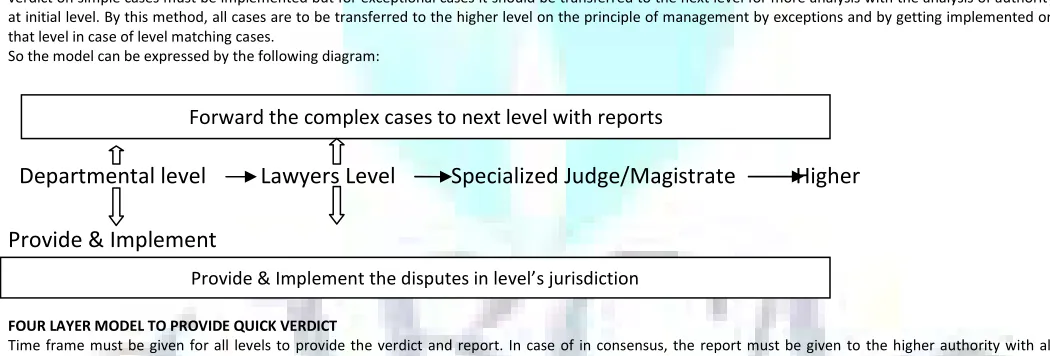
So the proposed model should address all the loopholes by standardized rules and laws to solve the simple cases at primary level and advancing the cases of exceptions to the next levels by Management by Exception rule (Lewis et. el 2007)
To reduce the information transferring duration, the parties with maximum information are empowered to give the verdict at initial level for all cases. The verdict on simple cases must be implemented but for exceptional cases it should be transferred to the next level for more analysis with the analysis of authority at initial level. By this method, all cases are to be transferred to the higher level on the principle of management by exceptions and by getting implemented on that level in case of level matching cases.
So the model can be expressed by the following diagram:
Departmental level Lawyers Level
Specialized Judge/Magistrate Higher
Provide & Implement
FOUR LAYER MODEL TO PROVIDE QUICK VERDICT
Time frame must be given for all levels to provide the verdict and report. In case of in consensus, the report must be given to the higher authority with all documents.
Measures to reduce criminal cases: Earlier we discussed that criminal offence can be of three kinds, namely, felonies, misdemeanors and infractions. The first two are serious types of crimes and the later is less serious. Our survey shows that most of the cases instituted belong to the third category. It means if there exists any effective mechanism to deal with infraction the suit jam will be decreased in a great extent. At the departmental level, from the report of the police station, verdicts and or report may be given by the higher police officials who must have necessary legal knowledge. But for more tinny problems, the relevant police officer must delegate the power to punish the criminals with fine and confinement in jail for hours to days.
Police shall be given some judicial powers in case where the accused is caught red-handed and they will also be empowered to try certain petty cases. Though it may also cause the police to involve in corruption in a larger scale, yet it can be controlled. If any person feels aggrieved by the decision of the police, he may have a chance to appeal against such decision and if it is found that the police had punished him maliciously than the court may compel the department (police) to pay compensation.
It is found from the field survey that there is a problem with investigation by the police officer. Delay in submitting investigation report is one of the biggest reasons of the suit jam. It is also found that the police officer who is investigating a matter has to do certain other things simultaneously. He has to maintain discipline among the countrymen, sometimes also has to ensure security of the Ministers, Prime- Minister, Diplomats etc. So the same person surely will not be able to discharge his duty efficiently. Many police officers prepare investigation report even without visiting the spot where the crime is committed. Usually he calls upon the parties and the witnesses in the police station and records their disposition and prepares the investigation report. This is also causing great injustice.
If the government forms a separate investigating authority and train them in a sophisticated manner, this problem can be solved. If the investigation report is submitted in due course it will help the judges to deliver justice within a short period of time.
Provide & Implement the disputes in level’s jurisdiction
INTERNATIONAL JOURNAL OF RESEARCH IN COMMERCE, IT & MANAGEMENT
There exists the concept of village court to deal with certain cases, but their functioning is not out of question. There should be a regulatory committee to supervise the function of the village court.
Section 345 of the CrPC speaks about certain offences which are compoundable. But the number is very limited. The law can be amended to maximize the number of compoundable cases.
For the complex cases, the police department may submit the report in shortest possible time. On the basis of the report specialized investigation cell must investigate and prepare the final report. If the accused person is indentified properly, the case will be in the jurisdiction of the department. Then the department may give their verdict. Otherwise transfer the case/s to the next level with their report. The lawyers of both parties (citizen vs citizen, or citizen vs. Govt or department) will draft the cases and sit together with a senior Lawyer (appointed by court) in a specific day to give their report on the case.
With the help of department’s report and the lawyers report the specialized magistrate will give and make arrangement to implement the verdict in a shorter period.
The dissatisfied party is allowed to go to the higher court for appeal against the verdict with the compulsion of bearing the compensation of other party in case of rejection of appeal.
Measures to reduce civil suits: The same model may be applied for the civil suits with the following stages of verdicts; Departmental Level, Lawyers level, Specialized judges level and higher court level.
To shorten the verdict delivery process and ensure the proper verdicts the above model may be formulated where every case must be solved at department level first. Survey shows that, In Bangladesh most of the civil suits arise out of common three grounds, namely Land 65%, Family 25% and Business 10%. To reduce the delay of land dispute the authorities which deal with land may be given certain judicial powers. Such as, the government can empower the authorities like Registration office, Tofshil Office and Vumi office to try certain land disputes. This process can be termed as solution in the departmental level If any party is not satisfied by the verdict he may be allowed to appeal to the court.
Similarly in dealing with family disputes the local chairman and other authorities shall be given more power to resolve such matters. If this happens then the suit jam will reduce automatically.
There exists various Business Organizations like the Chambers of Commerce etc. They can be given power to mitigate business disputes.
The second stage will be known as the lawyer’s stage. As the lawyers have to study the case before filing it, so usually they know everything about the fact. So the second stage of verdict can be found at lawyer’s level. The two parties will present documented the case and give a report on consensus with the help of third senior lawyers. Lawyers of both parties along with a third senior lawyer will try to reach in a conclusion.
The third stage is known as specialized judges & Magistrates Level. If any party becomes dissatisfied he can appeal to specialized court, where judges are appointed on the basis of specialization. There may be institutions who will train the judges on different disputes like disputes on land, marriage, women and child, jobs, business, human rights, politics etc. in a program of 2 or three years. At this level the dispute will be settled more expeditiously.
To reduce the number of cases, there may be a provision of taking compensation from the lawyer who advances the case to court despite the verdict at lawyers’ level. He will return all the fees he got from the client.
To establish the rule of law, a sufferer may be allowed to appeal to the higher court for final verdict, if he wishes but he must deposit all the projected cost of the defense party in case of failure.
Conclusion: The present scenario of pending suits in Bangladesh clearly indicates that the rate of lodging suit is much higher than that of settlement. The causes of suit jam are from three broad categories; lengthy process of information collection, analysis and transmission, intention delay and procedural delay. To reduce the suit jam, a model is developed on the basis of standardized laws for settling the disputes, cases at initial levels and on the basis of principle exceptional management by exception, the cases beyond the jurisdiction is to be transferred to next level with necessary documentation and report of analysis. Thus in the four stages of dispute settlement and suit resolution model can be adopted to reduce the session jam in the country.
REFERENCES
1. Bangladesh Gazette The Code of Criminal Procedure, 1898, (ACT NO. V OF 1898). 2. Bangladesh Gazette, The Code of Civil Procedure, 1908 (ACT NO. XLV OF 1860) 3. Bangladesh Gazette, THE PENAL CODE, 1860 (ACT NO. XLV OF 1860). 4. http://crime.about.com/od/Crime_101/a/Types of-Criminal-Offenses.htm 5. http://en.wikipedia.org/wiki/Civil_wrong
6. http://en.wikipedia.org/wiki/Crime 7. http://en.wikipedia.org/wiki/Lawsuit
8. Lewis P.S, Goodman S. H., Fandt P.M., Michitsch J.F. (2007), Management-Challenge for Tomorrow’s Leaders, 5th Edition. Thompson South-Western, USA. 9. Ministry of Information (2004, 2010), Statistical Pocket Book, Dhaka.
VOLUME NO.4(2014),ISSUE NO.07(JULY) ISSN 2231-5756
INTERNATIONAL JOURNAL OF RESEARCH IN COMMERCE, IT & MANAGEMENT
REQUEST FOR FEEDBACK
Dear Readers
At the very outset, International Journal of Research in Commerce, IT & Management (IJRCM)
acknowledges & appreciates your efforts in showing interest in our present issue under your kind perusal.
I would like to request you tosupply your critical comments and suggestions about the material published
in this issue as well as on the journal as a whole, on our E-mail
for further
improvements in the interest of research.
If youhave any queries please feel free to contact us on our E-mail
.
I am sure that your feedback and deliberations would make future issues better – a result of our joint
effort.
Looking forward an appropriate consideration.
With sincere regards
Thanking you profoundly
Academically yours
Sd/-
Co-ordinator
DISCLAIMER