University of Bolton
UBIR: University of Bolton Institutional Repository
Educational Cybernetics: Journal Articles
Institute for Educational Cybernetics
2005
The role of teachers in editing and authoring units
of learning using IMS Learning Design.
David Griffiths
University of Bolton, [email protected]
Josep Blat
Universitat Pompeu Fabra
This Article is brought to you for free and open access by the Institute for Educational Cybernetics at UBIR: University of Bolton Institutional Repository. It has been accepted for inclusion in Educational Cybernetics: Journal Articles by an authorized administrator of UBIR: University of Bolton Institutional Repository. For more information, please [email protected].
Digital Commons Citation
Griffiths, David and Blat, Josep. "The role of teachers in editing and authoring units of learning using IMS Learning Design.." (2005).
Advanced Technology for Learning, Vol. 2, No. 4, 2005
THE ROLE OF TEACHERS IN EDITING
AND AUTHORING UNITS OF LEARNING
USING IMS LEARNING DESIGN
D. Griffiths
∗and J. Blat
∗Abstract
The UNFOLD project, funded by the European Commission, runs a Community of Practice for Teachers and Learning Providers that has examined the way in which teachers can work with the IMS Learning Design Specification. The results of this work are presented. Relevant aspects of the specification are discussed, in particular the design process as it is set out in the Best Practice Guide. Two main challenges are identified and the approaches taken to address them described: a) how to enable teachers to participate in the initial design stages, and b) ways of representing Learning Design to teachers. The role of design primitives, patterns, taxonomies, and templates is outlined, and interface issues for tool design are explored. A short description is provided of some key projects in the area, including ACETS, DialogPlus, 8LEM, MOT+ and LAMS.
Key Words
Learning Design, Unit of Learning, authoring, pedagogy, template, patterns
1. Introduction
The IMS Learning Design specification brings many peda-gogic benefits when compared with earlier open specifica-tions for eLearning. It is not, however, easy for teachers to understand and work with. In this paper we summarize the way in which this issue has been approached in the UNFOLD project (www.unfold-project.net), a Coordina-tion AcCoordina-tion funded by the Technology Enhanced Learning Programme within the European Union Framework Plan
6. UNFOLD runs a Community of Practice (CoP) for
Teachers and Learning Providers, and in this paper we draw extensively on UNFOLD papers, online discussions and meetings held by the CoP, which are referenced in the bibliography. The authors would like to acknowledge and thank all the participants in CoP activities for the insights
∗Universitat Pompeu Fabra, Spain; e-mail: {david.griffiths,
josep.blat}@upf.edu
(paper no. 208-0867)
which are summarized here, and the European Commission whose funding supported our work.
We describe some relevant aspects of IMS Learning Design, and the methodology set out in the Best Practice Guide. We then move on to discuss two challenges to be addressed in using the specification with teachers:
– Providing a structure for the preparatory stage of the design process.
– Enabling teachers to understand and edit the Unit of Learning (UOL).
We explore some of the key aspects of these issues as they have been approached in UNFOLD, and provide short descriptions of the key current initiatives in this area. Finally some brief conclusions are provided.
2. Some Relevant Aspects of IMS Learning Design
2.1 Brief Introduction to IMS Learning Design
In this paper we follow emerging convention by capitalizing Learning Design when referring to the specification (often contracted to LD), and using lower case when referring to learning design in general. Similarly the capitalized UOL refers to the concept as used in the LD specification.
LD was developed from the Educational Modelling Language (EML) created by the Open University of the Netherlands (OUNL). EML was a response to a specific need, that of modelling the whole range of pedagogies then in use at the OUNL (and potential future pedagogies), and providing a basis for implementing e-Learning systems to support them. Indeed, as Olivier [1] (who worked on the LD specification) has commented, LD may be seen as a hypothesis, affirming that any pedagogic activity may be represented by defining howpeople in roles carry out
Three aspects of this high degree of expressiveness are relevant here. Firstly, the learning designer is confronted by a wide range of possibilities, and has no guidance as to the kinds of pedagogic structures that she or he can create. Secondly, the modelling language is extensive. It is probable that on most occasions it has many more elements than are required by any particular learning design. This means that authoring using LD is not a simple task, at least with the current generation of available tools. Thirdly, the underlying concepts of the LD modelling language which make it possible to express a wide range of pedagogies are not complex. They are, however, not the same concepts that a teacher uses to think about in planning educational activities.
2.2 Recommended Procedures in Developing a Unit of Learning
The IMS Learning Design Best Practice Guide [2] is one of the three documents that make up the LD specification (the others are the IMS Learning Design Information Binding and the IMS Learning Design Information Model). The Best Practice Guide describes the stages of developing a UOL as follows:
– In the analysis phase, a concrete educational problem (use case) is analyzed, usually by talking to the various stakeholders. What matters here is that the analysis results in a didactical scenario that is captured in a narrative, often on the basis of a checklist.
– The narrative then is cast in the form of a UML activity diagram in order to add more rigor to the analysis. This is the first design step. The UML activity diagram then forms the basis for an XML document instance that conforms to the LD spec. This is the second design step.
– This document instance subsequently forms the basis for the development of the actual content (resources) in the development phase.
– The content package with both the resources and the learning design will then be evaluated.
This process raises two challenges, which we will now discuss.
2.3 Two Challenges To Be Addressed
2.3.1 Providing a Structure for the Preparatory Stage
In UNFOLD activities, a number of teachers and learning providers have voiced their opinion that a methodology is required for the first stage of analysis and the creation of the didactical scenario. As Casey has succinctly put it, we are “looking for a way of discovering what the teacher is trying to do” [3]. This is not a simple task as different pedagogic approaches use different concepts and terminologies, as do individual teachers. No structure or methodology is recommended in the Best Practice Guide for this stage, other than mentioning that a checklist may be used, without any details of what might be on the checklist. It should be noted that this first stage is not considered a design step by the authors of the Best
Practice Guide, as point two, casting the narrative as a UML diagram, is described as “the first design step”.
2.3.2 Enabling Teachers To Understand and Edit the UOL
The origins of LD (and its predecessor EML) lie in the context of distance education, where a team of technical experts supporting teachers has a substantial budget to develop UOLs, which are then run with many cohorts of learners. In this context, the procedure in the Best Prac-tice Guide is reasonable, so long as the initial analysis stage is sufficiently rigorous. Once the teachers and pedagogi-cal experts have provided their narrative description they may not need to be involved in the development process. Nevertheless it is clear that in some circumstances teachers will be involved in working directly on UOLs.
In the first place teachers may need to make adjust-ments to the UOL such as changing the learning resources or choosing between alternative activities. While a tech-nical expert could introduce these changes, it would be cheaper and more agile to provide tools that enable teach-ers to make the changes themselves. In effect this means providing teachers with suitable tool enabling them to view and edit constrained UOL templates.
Secondly, many teachers and learning providers from contexts where UOLs are not developed entirely by techni-cal experts are also interested in LD. This is partly because LD has the valuable capability to represent multiple users and flexible pedagogies, and there is a desire to apply this in mixed-mode face-to-face and distance environments, of-ten referred to as blended learning, as well as small-scale distance education courses. We also observe that technol-ogy used in teaching is part of the learning environment, and many teachers see ongoing control of that environment as an essential part of their professional role.
UML is a powerful and relatively easy to understand graphical language, but it is intended for use by software developers and requires a degree of familiarity with its vo-cabulary and grammar to properly interpret the diagram. In this respect, Richards states that “Although UML is designed to be highly intuitive, the potential complexity of activity diagrams can obscure the meaning to a large potential audience: educational professionals that may not have training in software development and UML” [4]. One approach suggested by Burgos [3] would be to create a cut down version of UML, containing only the parts needed to represent UOLs. This might assist with legibility, but according to Richards [4] the problem is not simply that teachers are unfamiliar with the representation, but also that the representation of the organization hides the se-quence of events. From this perspective it is clear that new tools and representations are needed if teachers are to intervene in editing and creating UOLs.
3. Challenge 1: Providing a Structure for the Preparatory Stage
In this section we discuss the structures that could provide support for teachers’ participation in the first stage of analysis and the creation of the didactical scenario. These include design patterns and primitives, and taxonomies. Methodologies for this stage would, in practice, constitute an initial formal design step. The output would either provide “pre-digested” material that would ease the task of creating a UML diagram, or could perhaps replace the UML diagram. To assist in this preparatory design stage, it therefore seems valuable to identify and develop:
a) General purpose methodologies for generating narra-tives.
b) Didactic scenarios that represent the practice of partic-ular groups of teachers and learning designers. These may be instances of frequent scenarios within that community, or they may constitute a taxonomy that provides a complete view of the pedagogic process.
These two issues may well go hand in hand (though not inevitably so). This is because the items in a taxonomy of didactic scenarios are also candidates for implementation as templates which may be used both for teachers to adapt, or as the basis for discussions between teachers and learning designers. Even individual exemplary UOLs also provide the opportunity for teachers to say to learning designers something on the lines of, “I want a UOL like that one, but I want the learners to work on a collaborative document in the second part.”
3.1 Patterns
There is at present substantial interest in the application of design patterns to e-Learning, and these are discussed with particular reference to LD in McAndrew, Goodyear and Dalziel [5]. They remind us of Alexander’s original work with architectural patterns, and his statement that “A pattern language gives each person who uses it, the power to create an infinite variety of new and unique buildings, just as his ordinary language gives him the power to create an infinite variety of sentences” [6]. This stresses that the point of patterns is not to support immediate reuse, but rather to support creativity. Each pattern addresses a problem and provides a solution. The patterns are a way to build the scenario that may then be represented as LD or as something else. At the UNFOLD CoP meeting of September 2004 McAndrew maintained that in the context of LD the descriptions used in patterns should not relieve teachers of pedagogic responsibility, but rather support their engagement. He proposed that this was in line with Olivier’s statement that, “I think that the ability to share and modify LDs will enable us to build up better practice for eLearning – and that is the main aim of LD” [7]. We note that this view of patterns is not universal, for example Richards [8] lays less stress on the resolution of problems, and distinguishes between “PATTERNS (which we recognize in our environment) from DESIGNS (which are intentional change plans).”
Another perspective is that taken by Hern´andez-Leo who has proposed Collaborative Learning Flow Patterns as the “transition step” between LD and collaborative learning scenarios [9]. These patterns are in effect best practices in collaborative learning structuring, which the teacher can particularize to achieve a UOL. The emphasis in this use of patterns seems to be less on patterns as a tool for creativity, as stressed by McAndrew, and more on provision of a set of effective and proven structures that can be adapted as needed (though this may be the present author’s interpretation). Representation of such components in a way that is easy for teachers to understand remains a problem. Hern´andez-Leo has reported that teachers find it difficult to understand what is represented in Collaborative Learning Flow Patterns formalized with LD, and consequently they are not as effectively reusable as would otherwise be the case [3]. This provides additional evidence that the second of the challenges identified in this paper (enabling teachers to understand representations of LD) is of key importance.
The e-LEN project, funded under the Socrates pro-gramme, is relevant in this respect. It aims to create a Network of E-Learning Centres and leading organizations in the learning technologies, and one of its main objectives is to, “Identify and gather best practices, make a collection of design patterns, research roadmaps on e-learning and to enhance the dissemination of such results” [10]. To this end the project has established a repository of patterns, and although this has so far been little used, this is a valuable initiative showing one way of putting patterns to the service of e-Learning teachers and designers.
3.2 Primitives
The concept of primitives was introduced into the UN-FOLD discussion by Casey [3]. This draws on the use of the term in computer science, referring to “datatypes provided by a programming language as basic building blocks” [11]. Similarly, in 3D design a primitive is a basic structure that can be combined with others and refined. As applied to pedagogy, a primitive may be construed as an interactive event in a classroom, such as “discuss this text” or “research this topic on the web”. These are rougher, more tentative conceptions of pedagogy that reflect the real situation of lecturers and teachers, helping them to begin to articulate their pedagogy—which is an important first step.
used as the basis for discussion and collaborative work with teachers, as they help teachers identify and clarify the components of their own practice.
3.3 ACETS: A Methodology for Eliciting a Formal Statement of Learning Design
The ACETS project [12] offers a methodology for identify-ing teachers’ patterns of use. It is investigatidentify-ing the reuse of digital learning materials in situated teaching contexts in healthcare education, and is doing this by commission-ing exemplars of learncommission-ing objects embedded in the teach-ing and learnteach-ing practices of academics and teachers. An ACETS exemplar has three components:
1. A formal statement of learning design. This supports a degree of transferability and analysis of object use across different teaching and learning scenarios. 2. Reflective diary of experiences and evaluations of the
materials and their educational efficacy. 3. Any materials created (optional).
ACETS has recruited around 20 academics and teach-ers from a wide range of disciplines to create exemplars.
For our present purposes we are particularly interested in the first of these components. Following a base line survey, the project researchers carry out semi-structured interviews in an attempt to create a user-friendly way of formally expressing a teaching scenario that can be ana-lyzed and reused. The questions asked map closely onto the structure of the LD specification. In this way the focus remains on the interviewees practice, but the results are formulated with a structure that lends itself easily to expression as a Learning Design, at least for the scenario stage of the Best Practice recommended in the specifica-tion. This instrument is intended as a means of document-ing existdocument-ing practice, but it could be repurposed to gather design ideas from teachers about UOLs that they would like to have available to support their teaching practice. A semi-structured interview of this kind provides a simple way to facilitate communication between learning design-ers and teachdesign-ers. One of the strengths of the methodology is that LD structure can be made explicit in the semi-structured questionnaire, and so it is no longer necessary for a learning designer to have direct contact with the teacher. An education professional or researcher can carry out the interview using a discourse familiar to the teacher, and still be confident that the information gathered will be relevant to the learning designer. Examples of ACETS exemplars are available at [12].
3.4 Taxonomies
Primitives and patterns identify valuable structures that can be used in the creation of UOLs, but they do not provide an overview of pedagogy. Because of this, as Verpoorten has pointed out [3], there can be a danger in simply listing “primitive activities” or patterns, that one will never stop making the list and move on to defining a pedagogy that is something more than a listing. A taxonomy, on the other hand, aims at providing the teacher with a classification covering a complete range of options
(at a greater or lesser level of detail). The teacher can then use this as a guide when creating a UOL. This does not mean that in all circumstances a taxonomy is superior to an open ended collection of patterns or primitives. For example, the effort of the teacher to identify their own primitives and to place them in a structure may be a powerful staff development activity. A taxonomy is also more prescriptive, in that it embodies a particular view of the nature of learning and teaching, whereas a collection of primitives does not require the user to adopt any particular view.
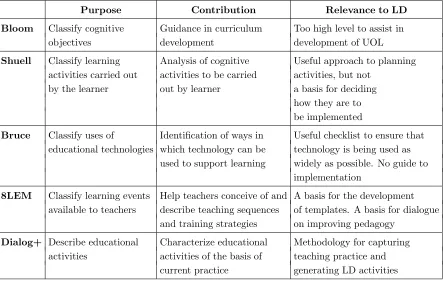
There are many educational taxonomies which are can-didates for use in this context. Many of these, however, are valuable in setting the context for UOL development, but do not provide specific guidance. For example Bruce and Levin [13] have produced a way of classifying uses of educational technologies based on a four-part division sug-gested by John Dewey in 1943: inquiry, communication, construction, and expression. This constitutes a valuable checklist, but does not help in the design of specific ac-tivities. A similar observation may be made of Shuell’s Learning Functions [14], and Bloom’s well known Taxon-omy of Educational Objectives [15], summarized in Huitt [16], which is relevant to curriculum design rather than planning learning activities.
In UNFOLD, two taxonomies have been seen as being more promising as supports for authoring in Learning Design. They are the 8 Learning Event Model (8LEM), and the Learning Activity Toolkit being developed by the DialogPlus project. Both these approaches set out to provide tools for LD that help teachers in creating educational activities, but they are very different in the level of detail which they provide, as we now discuss. The various contributions of the taxonomies discussed above are set out in Table 1.
3.5 DialogPlus
The DialogPlus [17] taxonomy sets out to capture what teachers are designing at present, and takes that as their starting point [3]. Tools are being developed for designers that help guide them through the complexity of the full taxonomy. The taxonomy is represented as a collapsible tree, which enables the user to concentrate on one section at a time. As the designer navigates through the taxonomy they define appropriate activities (and create the metadata in the process of making the choices). Thus the taxonomy is composed of a large number of elements, much greater than any of the other taxonomies discussed. The completed set of authoring choices is anugget in the terminology of the DialogPlus. Depending on its scope and focus, the nugget may be a primitive or pattern as discussed above. The taxonomy is complex because it aims at completeness and detail, but its advantage for our present purposes is that its categories are closer to the discourse of teachers than are those of LD.
Table 1
Relevance of Some Educational Taxonomies to Working with LD
Purpose Contribution Relevance to LD
Bloom Classify cognitive Guidance in curriculum Too high level to assist in
objectives development development of UOL
Shuell Classify learning Analysis of cognitive Useful approach to planning activities carried out activities to be carried activities, but not
by the learner out by learner a basis for deciding
how they are to be implemented
Bruce Classify uses of Identification of ways in Useful checklist to ensure that educational technologies which technology can be technology is being used as
used to support learning widely as possible. No guide to implementation
8LEM Classify learning events Help teachers conceive of and A basis for the development available to teachers describe teaching sequences of templates. A basis for dialogue
and training strategies on improving pedagogy
Dialog+ Describe educational Characterize educational Methodology for capturing
activities activities of the basis of teaching practice and
current practice generating LD activities
teachers can provide input which will identify case studies which are close to what teachers want to provide (using a graphical tool to achieve what is done in ACETS by using a semi-structured text). Fill has commented [3] that the DialogPlus team have found a willingness among teachers to use concept maps, and have consequently embedded this in their toolkit, which is available for download by anyone who is interested.
At the heart of the toolkit is the notion of a learning activity, consisting of three elements [18]:
1. The context within which the activity occurs, this includes the subject, level of difficulty, the intended learning outcomes and the environment within which the activity takes place.
2. The learning and teaching approaches adopted, includ-ing the theories and models.
3. The tasks undertaken, which specifies the type of task, the techniques used, associated tools and resources, the interaction and roles of those involved, and the assessments associated with the learning activity. Given the proximity of the basic notion of a learning activity nugget to that of a UOL in LD, it seems that interoperability between the two systems is both desirable and achievable. Work is currently underway to export this as LD (although this may be an activity structure rather than a full UOL), and initial results are encouraging.
3.6 The Eight Learning Events Model
The 8 Learning Events Model [19] (8LEM) has been de-veloped by LabSET of the University of Li`ege, Belgium, and like LD it focuses on processes in learning rather than
on content. It proposes that there are 8 basic ways of Learning/Teaching that the teacher or learning designer can choose from at any point in the educational process.
1) Imitation/Modelling. 2) Reception/Transmission. 3) Exercising/Guidance. 4) Exploration/Documenting. 5) Experimentation/Reactivity.
6) Creation/Confortation (strengthening). 7) Self-reflection/Co-reflection.
8) Debate/Animation.
The learning events may all be carried out by a sin-gle learner or by a group. It should be noted that the model does not specify any order of events, or imply a loop. Rather, it provides a taxonomy of possible learn-ing processes which the teacher and designer can use as a guide when creating didactic scenarios. The model con-nects in a systematic way both the learner’s demand and the teacher’s supply, and their interrelations. Learner and teacher actions are complementary and interdependent.
For our purposes here a key merit of the model is that it provides an easily understandable way of talking about different didactic scenarios at the level where conversations about improvement in pedagogy usually take place.
into the UOL. Work is being done towards implementing this approach in the ASK-LDT editor, being produced by ASK [20, 21] in the context of the iClass project [22]. This uses the 8LEM model to provide LD templates for teachers that can guide them in their decisions on the iClass platform. The editor produces UOLs using level B of the LD specification.
3.7 Constraining the Design Options
The strength of LD is that it aspires to avoid constraining pedagogy, but in some respects this makes things harder for teachers, because it forces them to make conscious de-cisions about pedagogy without providing any framework or structure to support them. One way to address this dif-ficulty is to reintroduce constraints into the authoring pro-cess. These need not be sub-optimal versions of the specifi-cation, but rather authoring environments which only offer teachers the choices which are relevant to them, hiding all those parts of the specification which they are not likely to need or use. These constrained environments can be specific to particular pedagogic approaches, institutions or subject areas. This makes possible to give teachers a head start in working with Learning Design, so they do not have to build from first principles. A highly constrained environment is in effect a template that a teacher can then adapt for reuse.
Using this approach the teacher does not have to go through the whole design process, but can select and adapt pre-existing UOLs, as she or he may select and adapt les-son plans. Rather than facing the problems of generating a formal description of a learning design, the teacher now has to deal with describing, finding and adapting UOLs. This is not a trivial problem. In order to avoid constrain-ing pedagogy, the LD specification avoids usconstrain-ing terminol-ogy that is associated with any particular pedagogic ap-proach. Teachers and institutions, however, have their own ways of taxonomising and discussing pedagogic scenarios, which may be widely understood (and misunderstood!), or specific to a particular teaching context. One approach opened up by LD is to focus on the practice rather than the description. This would involve making sets of exemplary UOLs which implement pedagogic structures, and which others might want to adapt and use. These can be stored in a database, together with comments and recommenda-tions from teachers working in a particular community of practice.
McAndrew has proposed that a natural way to use templates is through a wizard, starting at the form level, and then taking an existing template and adjusting it [23]. Richards added that there are advantages to this process from a training or staff development perspective, encouraging authors to look at good practice and extract learning designs [23]. As regards the practicalities of creating LD templates, at an UNFOLD CoP meeting, McAndrew and his colleague, Little, of the Open University explained that they are creating LD templates that are incomplete UOLs [23]. Olivier responded that these fitted well with the functionality of the Reload LD Editor [24]. This will enable LD “components” (i.e. smaller parts of
a UOL, such as activities with associated resources) to be saved as reusable units. This will make it possible to provide a higher level drag-and-drop interface where these activities can be assembled and modified for any given use. A similar approach could be taken in using DialogPlus nuggets with Reload. The technical infrastructure that makes it possible to define, manage, and use templates for UOLs is now becoming available. It is now necessary to provide the context where teachers can explain what they need to learning designers, and provide the means whereby they can identify, understand and edit the templates and UOLs they want to use. This leads us to the second of the two challenges that we have identified.
4. Challenge 2: Enabling Teachers to Understand and Edit a UOL
The two challenges that we identify are distinct aspects of a single process: the first concerns a methodology and the second is an issue of representation and interface. It is, therefore, not surprising that the possible solutions are also strongly related. Thus in this section we discuss two LD tools: MOT+ and LAMS, but we should also remember that the DialogPlus Toolkit has the potential to evolve into a general purpose authoring environment for Learning Design.
As discussed above, there is a consensus in the UN-FOLD Teachers and Learning Providers CoP that UML diagrams are not a satisfactory way for teachers to par-ticipate in the design process. An alternative approach is to provide teachers with tools that have an interface that is distant from the specification. These may be either specific or general purpose. Griffiths et al. [25] provides a discussion of the various types of tools, and provides a diagram which situates them on a quadrant of two axes:
close to/distant from the specification andgeneral pur-pose/specialized. It seems clear that teachers will need high level tools to understand the specification, and likely that tools which are specialized for a particular pedagogic context will be easier to use.
The first generation of tools is now emerging. These in-clude a number of valuable tools which are relatively close to the specification, such as Reload and CopperAuthor (both available on SourceForge), which are principally in-tended for learning design specialists. Others however, provide features that are intended for use by teachers, or suggest what teacher-friendly LD tools might be like. For example ASK-LDT is intended for professional learning designers, but it provides support for predetermined tem-plate structures that could provide a basis for a tool for teachers. We now discuss two significant initiatives in this area, MOT+ and LAMS.
4.1 MOT+
is modelled using the MOT+ editor [26]. This is an object-oriented model editor that enables users to navigate in a hypertext graphic mode, identifying and completing com-ponent templates making up the learning system’s specifi-cations. The editor has support for various domains, and one of these is LD. Most basic objects from LD, including
play and act have been added to the toolbar [4], and this makes it easy to make diagrams of LD. Richards [4] assesses the strengths of the MOT+ approach as follows:
The advantage of this type of diagram is that it is potentially very powerful, and can represent a wide variety of concepts, processes, and domain knowledge. The disadvantage is that any reader of this type of diagram would need to also read a primer on meta-knowledge representation and the conventions of this diagram system to be able to properly understand the meaning. For example the shapes of the diagram components convey information about the nature of each element, while the links of the MOTPlus graph has a semantic marker identifying the type of rela-tion. For example, I = instantiation, C = composition, P = precedence, R = regulation, I/P = an input or product.
Thus MOT+ is primarily intended as a tool for expert learning designers, rather than for practicing teachers. It may, nevertheless be useful to have alternative ways of rep-resenting UOLs that may be more understandable to some teachers, but this is not its principal importance to us here. Rather it is significant that a mature methodology, which was developed independently of Learning Design, can be used to generate UOLs. This is an early and encouraging test of the expressiveness of Learning Design, and indicates that it is a realistic ambition to develop representations of UOLs that are distant from the specification, and more accessible for teachers and pedagogic experts.
4.2 LAMS
LAMS (Learning Activity Management System) is a com-plete web-based learning design system that was designed to be usable by teachers. It has a drag-and-drop authoring environment for creating activity sequences, which is illus-trated on the LAMS web [27]. The author can drag and drop activities such as synchronous discussion (chat), web polls, students posting material, and structured debates into a flow chart. Learning resources can be added, and a series of online lessons can be planned and run. The components which can be used are fixed, but these cover many of the basic activities carried out in the classroom. This use of familiar elements makes the application easy for teachers to comprehend, as this is the way that con-ventional lessons are planned. These components do not correspond to any existing LD element, but they could be constructed from, for example, an environment and a service combined in a single entity which to a higher level user appears to be a single object, such as those provided by LAMS. Indeed one of the important contributions of LAMS has been to make it clear that this is a key function-ality of high level LD authoring systems. Some of these objects might correspond to primitives as described above.
So far the LAMS system has not generated LD compliant code, but progress is being made in this direction with the introduction of import and export features for LD level A scheduled for release under the GPL in July 2005.
LAMS espouses a particular approach to learning, one that stresses collaboration and the construction of ideas. James Dalziel, the principal architect of the system, has stated that the intention behind the development of LAMS was to provide a system that went beyond content based, single learner, self paced learning objects, and provided support for “sequences of learning activities which involve groups of learners interacting within a structured set of collaborative environments” [28]. The interface has been designed to support this, and the application is conse-quently particularly suited to constructivist pedagogies. Indeed it has been welcomed by many teachers as offering an alternative to the “delivery of knowledge” model that is so common in e-Learning. LAMS may therefore be seen as the first in a potentially extensive range of specialized LD editors that provide easy to use high level tools for a particular pedagogic approach. In the case of LAMS, the tool has very wide applicability while other possible editors could be much more specialized, perhaps being designed for a particular community of teachers. Such tools do not necessarily aspire to generating all possible pedagogic structures, but rather to providing effective solutions for the needs of practitioners.
4.3 Moodle as an LD Authoring Environment
The Moodle Learning Management System is very widely used. Moodle, like LAMS, also focuses on activities, although the interface used to author courses is quite different. There has been interest in enabling the system to generate and run LD UOLs, and the first steps were taken in this direction in a prototype by Michael Klebl that implements a subset of LD level A in Moodle [29]. There is also a forum on Moodle and LD on the Moodle.org site where the issue of making Moodle compliant has been discussed. There would clearly be many advantages of enabling teachers to work with an existing Learning Management System that they feel comfortable with, and at the same time produce interoperable code. A similar initiative has been started in the Zope based Eduplone system, while another Zope based system, FLE3, has implemented export and import from OUNL EML, the precursor to LD.
4.4 Authoring Using a Word Processor
MS Word interface without overburdening the user. This is because the simplicity of the MS Word environment (which make it so attractive to novice authors) also make it difficult to provide interface features which can help the author make sense of a UOL. The document centred nature of Word suggests that this approach may be suited to a document centred approach enabling teachers to add simple pedagogic structures to educational resources, and also to view and edit LD templates.
4.5 Pending Research Questions
The use of LD by teachers raises a number of research issues, including the key questions:
– What representations of UOLs do teachers find easiest to understand? What are the variables that determine their understanding?
– How should the various representations be character-ized and classified?
– Buzza [30] argues for the development of a controlled vocabulary to describe and label learning designs. What should this be and how should it be used? The answers to these questions will come from prac-tice, and so they were unanswerable in the absence of tools that could be used by teachers to view and classify UOLs. With the recent appearance of tools such as those we have described the questions become tractable. The applica-tions have however, largely been developed to enable tar-get groups of users to work with the specification. They have not been designed to help answer the questions we identify, for example by including a range of different rep-resentations and interfaces that could compare the results of different approaches. Consequently the results of stud-ies with the current toolset will inevitably be incomplete, and contingent on earlier decisions made by application developers. Nevertheless, current trends in development are encouraging. This is not only because many tools are under development, offering more opportunities for com-parison, but also because recent Open Source tools such as RELOAD LD Editor and the CopperCore Learning Design Engine are designed to make it easy for experimental new interfaces to be created.
5. Conclusion
There is no doubt that LD is an effective specification, as it is closely based on the EML specification developed by the Open University of the Netherlands and extensively tested in courses at that institution. It is clear that it can provide satisfactory solutions in its core application: large-scale distance education. The activities of UNFOLD have also shown that there is extensive interest among teachers and learning providers for using the specification in other areas, for mixed face-to-face and online learning, for paper based distance education, and even for documenting lesson plans in a purely face-to-face context. This interest has given rise to a large number of projects and studies and ideas that have been discussed in UNFOLD, some of which are described in this paper. The recent appearance of the first LD compliant editors and players means that these
ideas can now be tested, and also to examine the practical aspects of learning with UOLs. The richness and variety of the ideas that we have outlined suggest that the range of potential applications of LD for use with teachers is very great. We therefore confidently expect that there will be many interesting developments in the near future that will be reported in UNFOLD publications and events.
Acknowledgements
The authors wish to thank all the participants in the UNFOLD Teachers and Learning Providers Community of Practice, and in particular:
Bill Olivier, CETIS UK; Chris Kew, UNFOLD project; Colin Tattersall, OUNL; Daniel Burgos, UNFOLD Project; David Sudbury, LeadOn Training Solutions Inc; Davinia Hernandez Leo, Universidad de Valladolid; Dominique Ver-poorten, LabSet, University of Li`ege; Gilbert Paquette, Olga Marino CIRTA (LICEF), T´el´e-universit´e, Montreal; Griff Richards, BCIT Technology Centre, Burnaby BC CANADA; James Dalziel, Macquarie University, Australia; John Casey, UHI Millennium Institute; Karen Fill, Dialog-Plus, Southampton University; KL Kwong, GTK Press; Manuel Marco, Daniel Mor´on, COMALO Project; Patrick McAndrew, Open University UK; Rob Koper, OUNL; Roc´ıo Garc´ıa-Robles, Universidad de Sevilla; Rosabel Roig, Vicent Martinez, Edutic project; Suzanne Hardy, the ACETS Project, Newcastle; and of course our UNFOLD co-workers at UPF: N´ıdia Berbegal, Victor Pascual, Sergio Sayago, and Toni Navarrete.
We also gratefully acknowledge the funding of UN-FOLD by the European Commission within the Technology Enhanced Learning Programme of FP6.
References
[1] B. Olivier,Personal communication, Oxford, UK, 2004. [2] I.G.L. Inc, IMS Learning Design Best Practice and
Imple-mentation Guide, 2003, accessed 29th March, 2005, available at http://www.imsglobal.org/learningdesign/ldv1p0/imsld_ bestv1p0.html#1501849
[3] UNFOLD, Discussion of Griffiths: First steps in creating a unit of learning, online event, 17th November, 2004, ac-cessed 29th March, 2005, available at https://www.unfold-project.net:8082/UNFOLD/about_folder/events/online/ daionline/
[4] G. Richards & C. Knight, UNFOLD Discussion Paper: Learning design and representations of instructional intent. 2005, accessed 2nd April 2005, available at http://www. unfold-project.net/about_folder/events/online/griff/paper/ UNFOLD_26jan05.pdf
[5] P. McAndrew, P. Goodyear, & J. Dalziel, Patterns, designs and activities: unifying descriptions of learning structures,
International Journal of Learning Technology(in press 2006). [6] C. Alexander,The timeless way of building(New York: Oxford
University Press, 1979).
[7] B. Olivier, Discussion of learning design, the state of play, 2004, UNFOLD, accessed 31st March, 2005, available at https://www.unfold-project.net:8082/UNFOLD/about_ folder/events/online/billjuly04/
[8] UNFOLD, Online discussion of Richards, “Learning Design and Representations of Instructional Intent. 2005, accessed 4th April, 2005, available at https://www.unfold-project. net:8082/UNFOLD/about_folder/events/online/griff/ [9] D. Hern´andez-Leoet al.,IMS learning design-support for the
[10] e-LEN project website, accessed 31st March 2005, available at http://www2.tisip.no/E-LEN/
[11] Wikipedia, accessed 8th January 2005, available at http://www.wikipedia.org/
[12] ACETS,Project Website, Wikimedia Foundation Inc., accessed 26th April, 2005, available at http://www.acets.ac.uk/ [13] B.C. Bruce & J.A. Levin, Educational technology: Media for
inquiry, communication, construction, and expression,Journal of Educational Computing Research,17(1), 1997, 79–102. [14] T. Shuell, Designing instructional computing systems for
meaningful learning, in P. Winne & M. Jones (Eds.), Adaptive learning environments: Foundations and frontiers(New York: Springer Verlag, 1992), 19–54.
[15] B.S. Bloom,Taxonomy of educational objectives, handbook 1: Cognitive domain(New York: Longmans Green, 1956). [16] W. Huitt,Bloom et al.’s, Taxonomy of the cognitive domain.
Educational Psychology Interactive, 2004, Valdosta, GA: Valdosta State University, New York, accessed 31st March, 2005, available at http://chiron.valdosta.edu/whuitt/col/ cogsys/bloom.html
[17] DialogPlus, project website, accessed 31st March, 2005, available at http://www.dialogplus.org
[18] G. Conole & M. Oliver, Embedding theory into learning technology practice with toolkits,Journal of Interactive Media in Education, Special issue on learning technology theory, 8, 2002, available at http://www-jime.open.ac.uk/2002/8 [19] D. Leclerc & M. Poumay,The 8 learning events model, Release
2005.1. 2005, LabSET, University of Li`ege, accessed 5th April, 2005, available at http://www.labset.net/media/prod/ 8LEM.pdf.
[20] P. Karampiperis & D. Sampson, A flexible authoring tool supporting adaptive learning activities,inIADIS Int. Conf. on Cognition and Exploratory Learning in Digital Age (CELDA 2004), Lisbon, 2004, 51–58.
[21] P. Karampiperis & D. Sampson, Designing learning services for open learning systems utilizing IMS learning design, 4th IASTED Int. Conf. on web-based Education (WBE 2005), Special Session on Designing Learning Activities: From content-based to context-based Learning Services, Grindelwald, Switzerland, 2005, 165–170.
[22] iClass, Project website, accessed 1st April, 2005, available at http://www.iclass.info./
[23] D. Griffiths (Ed.), UNFOLD, Transcript of the Barcelona CoP meeting, Universitat Pompeu Fabra, 2004, accessed 1st April, 2005, available at https://www.unfold-project. net:8082/UNFOLD/about_folder/events/cops/f2fbarcelona/ transcript/
[24] Reload,Project website, accessed 1st April, 2005, available at http://www.reload.ac.uk/.
[25] D. Griffiths et al., Learning design tools, in R. Koper & C. Tattersall (Eds.),Learning design: modelling and implement-ing network-based education & trainimplement-ing (Berlin Heidelberg: Springer Verlag, 2005), 109–135.
[26] G. Paquetteet al., An instructional engineering method and tool for the design of units of learning, in R. Koper & C. Tattersall (Eds.),Learning design: A Handbook on Modelling and Delivering Networked Education and Training (Berlin Heidelberg: Springer 2005), 161–183.
[27] LAMS International, accessed 2nd April, 2005, available at http://www.lamsinternational.com./
[28] J. Dalziel, Discussion paper for learning activities and meta-data, 2003, accessed 2nd April, 2005, available at http://www.lamsinternational.com/documents/Learning Activities.Metadata.Dalziel.pdf.
[29] M. Klebl, Presentation: MS learning design: first-hand ex-perience in creating courses, 2004, accessed 2nd April, 2005, available at http://hdl.handle.net/1820/235.
[30] D.C. Buzza et al., Learning design repositories: Adapting learning design specifications for shared instructional knowl-edge, Canadian Journal of Learning and Technology,30(3), 2005, 79–96.
Biographies
David Griffiths holds his B.A. in English and History of Art from Leeds University, and his M.A. in History of Painting from the Uni-versity of Wales, and is currently a Ph.D. candidate at the Universi-tat Pompeu Fabra, Barcelona. He is fully qualified as a secondary school teacher in the UK and has worked in education at all levels from primary to industrial train-ing. In the early 1990s he started working in the field of educational technology, initially de-veloping educational multimedia resources. Since then he has conducted research into the educational applications of robotics with young children, and in recent years has focused on the pedagogic implications of eLearning interoperability specifications. He is currently Coordinator of the UNFOLD project, a European funded initiative to coordinate and promote the adoption of IMS Learning Design.