To cite: Sinha A, Patel AS, Siegert RJ, et al. The King’s Brief Interstitial Lung Disease (KBILD) questionnaire: an updated minimal clinically important difference. BMJ Open Resp Res 2019;6:e000363. doi:10.1136/ bmjresp-2018-000363
Received 2 October 2018 Revised 27 December 2018 Accepted 28 December 2018
For numbered affiliations see end of article.
Correspondence to Surinder S Birring; surinder. birring@ nhs. net
The King’s Brief Interstitial Lung
Disease (KBILD) questionnaire: an
updated minimal clinically
important difference
Aish Sinha, 1,2 Amit Suresh Patel,2 Richard J Siegert,3 Sabrina Bajwah,4 Toby M Maher, 5,6 Elizabeth A Renzoni,5 Athol U Wells,5 Irene J Higginson,4 Surinder S Birring1,2
© Author(s) (or their employer(s)) 2019. Re-use permitted under CC BY-NC. No commercial re-use. See rights and permissions. Published by BMJ.
Key messages
► The King’s Brief Interstitial Lung Disease (KBILD), an interstitial lung disease–specific health status questionnaire, has been recently updated to include a logit transformation step in its scoring, but its minimal clinically important difference (MCID) is not known.
► The MCID for the KBILD total score is 5 units. ► The logit-transformed KBILD questionnaire is a
responsive scale and potentially more linear; the revised MCID will aid the clinical interpretation of health status scores.
AbstrAct
Introduction The King’s Brief Interstitial Lung Disease (KBILD) is a 15-item validated health-related quality of life (HRQOL) questionnaire. The method of scoring the KBILD has recently changed to incorporate a logit-scale transformation from one that used raw item responses, as this is potentially a more linear scale. The aim of this study was to re-evaluate the KBILD minimal clinically important difference (MCID) using the new logit -transformed scoring.
Methods 57 patients with interstitial lung disease (17 idiopathic pulmonary fibrosis, IPF) were asked to complete the KBILD questionnaire on two occasions in outpatient clinics. At the second visit, patients also completed a 15-item global rating of change of health status questionnaire (GRCQ). The MCID was calculated as the mean of four different methods: the change in KBILD for patients indicating a small change in GRCQ, patients with a 7%–12% change in FVC, 1 SE of measurement of baseline KBILD and effect size (ES) of 0.3.
results The mean (SD) KBILD total score for all patients was 55.3 (15.6). 16 patients underwent a therapeutic intervention. 36 patients reported a change in their condition on the GRCQ; 22 deteriorated, 14 improved and 21 were unchanged. There was a significant change in KBILD total score in patients reporting a change in GRCQ; mean (SD) 57.0 (13.6) versus 50.0 (9.7); mean difference 7.0; 95% CI of difference 3.0 to 11.0; p<0.01. The change in KBILD total score correlated with the GRCQ scale; r=−0.49, p<0.01. The mean KBILD total score MCID was 5. The MCID of KBILD domains were 6 for Psychological, 7 for Breathlessness and Activities, and 11 for Chest Symptoms.
conclusion The KBILD is a responsive tool for longitudinal assessment of HRQOL in patients with ILD. The MCID of the KBILD total score is a 5-unit change.
IntroductIon
The King’s Brief Interstitial Lung Disease (KBILD) questionnaire is a brief, valid, self-completed health status measure for interstitial lung disease (ILD).1 We have
previously reported the minimal clinically important difference (MCID) to be eight units.2 MCID is defined as ‘the smallest
difference in score in the domain of interest which patients perceive as beneficial and which would mandate, in the absence of troublesome side effects and excessive cost, a change in the patient’s (healthcare) manage-ment’, and it helps the clinician interpret health status data.3 The scoring system of
the KBILD questionnaire has recently been modified by implementing logit transforma-tion of raw item response scores. There has been no change to the number of items or construct of the questionnaire. Logit scores have the advantage of being more sensitive at the extreme spectrums of health-related quality of life (HRQOL) questionnaires as they are potentially more linear.4 The KBILD
logit scores correlate highly with raw scores (r=0.94–0.99, p<0.05).5 We have recently
reported KBILD logit scores to have good reliability and internal consistency, compa-rable with original KBILD raw scores.5
Logit scores, compared with raw scores, are numerically smaller at the extreme ends of HRQOL questionnaires. Therefore, we hypothesised that the MCID for KBILD logit scores will be less than 8. The aim of this paper was, therefore, to determine the new
by copyright.
on September 18, 2020 by guest. Protected
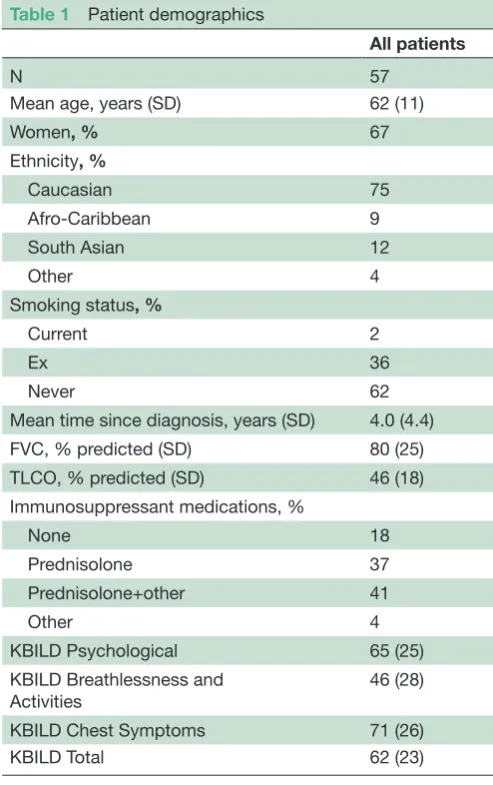
Table 1 Patient demographics
All patients
N 57
Mean age, years (SD) 62 (11)
Women, % 67
Ethnicity, %
Caucasian 75
Afro-Caribbean 9
South Asian 12
Other 4
Smoking status, %
Current 2
Ex 36
Never 62
Mean time since diagnosis, years (SD) 4.0 (4.4)
FVC, % predicted (SD) 80 (25)
TLCO, % predicted (SD) 46 (18)
Immunosuppressant medications, %
None 18
Prednisolone 37
Prednisolone+other 41
Other 4
KBILD Psychological 65 (25)
KBILD Breathlessness and Activities
46 (28)
KBILD Chest Symptoms 71 (26)
KBILD Total 62 (23)
All data are mean (SD) unless otherwise stated. South Asian patients originating from India, Pakistan or Bangladesh.
KBILD, King's Brief Interstitial Lung Disease Questionnaire; TLCO, transfer factor of the lung for carbon monoxide as % predicted. MCID for KBILD logit scores. This is important because
there are numerous clinical trials using the KBILD logit score version.6–8
Methods subjects
The subjects were recruited in a previous study investi-gating the KBILD MCID using raw scores. Briefly, consec-utive patients with ILD were recruited prospectively from secondary care (King’s College Hospital) and tertiary care (Royal Brompton Hospital) specialist clinics. Clin-ical characteristics, comorbidities and medications were recorded using a structured questionnaire.
Questionnaires
King’s Brief Interstitial Lung Disease Questionnaire
The KBILD is a self-completed health status questionnaire that comprises 15 items and a seven-point Likert response scale.1 It has three domains: psychological, breathlessness and activities and chest symptoms. The KBILD domain and total score ranges are 0–100; 100 represents best health status.
Global Rating of Change questionnaire (GRCQ)
The GRCQ is a 15-point scale used to determine the MCID.9 Patients score the change in their respiratory
health status between clinic visits. The response scale ranges from 7 (a great deal worse) to −7 (a great deal better). All subjects were asked to complete four GRCQs, one for each KBILD domain and overall health status. The score for each GRCQ was classified as unchanged (scores 1, 0, 1), a small change (3, 2, 2, 3), a moderate change (5, 4, 4, 5) or large change (7, 6, 6, 7).
Minimal clinically important difference of KBILD
The recommended approach to estimating the MCID is to use numerous ‘anchor-based’ methods with a mixture of objective and subjective clinical indicators, and to use distribution-based estimates as supportive estimates.10
The MCID should be representative of all these meas-ures. For the FVC anchor, subjects were categorised as per Swigris et al,11 ‘unchanged’ if the change in FVC (%)
between visits was 0%–7%, ‘minimal change’ if 7%–12% and ‘more than minimal change’ if greater than 12%. The MCID using the GRCQ anchor was defined as the change in KBILD health status corresponding to a small change in GRCQ score. Two distribution-based methods were used to estimate the MCID: SE of measurement (SEM) and 0.3 effect size.10 12 The calculation of these
has been mentioned in our previous paper.2
Protocol
All patients completed the KBILD questionnaire at the first and second clinic visits (the latter being more than 4 weeks after the former). FVC was assessed according
to American Thoracic Society standards at both visits.13
Patients also completed the GRCQ at the second visit.
Analysis
SPSS software V.18 and RUMM 2030 (RUMM Laboratory) were used for statistical analysis. Mean and SD were used to describe parametric data. The KBILD raw scores from a previous study,2 were converted to logit scores using Rasch analysis (RUMM software). The logit scores were transformed into a more easily understood scale (0–100) using an algorithm y=m+(s×logit score), where s=(wanted range)/(current range) and m=(wanted minimum)– (current minimum×s). This transformation was done in Microsoft Excel. The GRCQ score was expressed as an absolute number, that is, when the change was negative, the sign was reversed as was the sign of the corresponding change in KBILD score between visits.3 9 Correlations were assessed with Pearson’s (r) or Spearman’s (rho) coefficient for parametric or non-parametric data. Paired
by copyright.
on September 18, 2020 by guest. Protected
Table 2 Minimal clinically important difference of KBILD (logit scores version) MCID anchor
Mean MCID (range)
GRCQ FVC 7%–12% 1 SEM ES 0.3
KBILD Psychological 5.3 (17.8) 7.4 (5.6) 5.8 5.8 6 (5–7)
KBILD Breathlessness and Activities 8.3 (18.3) 6.9 (12.0) 6.9 6.1 7 (6–8)
KBILD Chest 11.2 (19.4) 13.7 (21.5) 12.3 7.1 11 (7–14)
KBILD Total 6.7 (13.2) 6.1 (7.0) 3.8 4.7 5 (4–7)
All data are mean (SD) (apart from mean MCID (range)). Positive and negative changes in each GRCQ and FVC category are grouped together.
ES, effect size; GRCQ, Global Rating of Change Questionnaire; KBILD, King’s Brief Interstitial Lung Disease Questionnaire; MCID, minimal clinically important difference; SEM, standard error of baseline measurement.
t-tests were used for group comparisons. P value <0.05 was considered significant.
results
subject characteristics
Fifty-seven patients with ILD were recruited (17 patients with idiopathic pulmonary fibrosis, 18 with connective tissue disease ILD, 9 with idiopathic non-specific inter-stitial pneumonia, 8 with hypersensitivity pneumonitis, 4 with idiopathic organising pneumonia, 1 with lymphoid interstitial pneumonia). Demographics and baseline characteristics are shown in table 1. The mean duration between visits was 9 months. Sixteen patients underwent a therapeutic trial for their ILD.
health-related quality of life
The mean (SD) KBILD total score for all patients was 55.3 (15.6). Twenty-two (38%) patients reported a deteriora-tion in their respiratory health status, 14 (25%) patients reported an improvement and 21 (37%) patients were unchanged between visits (as rated by patients on the GRCQ scale). The KBILD questionnaire was a responsive instrument in those patients indicating a change in their health status. There was a significant change in KBILD total score between the two visits in patients reporting a change in GRCQ; mean (SD) 57.0 (13.6) versus 50.0 (9.7); mean difference 7.0; 95% CI 3.0 to 11.0; p<0.01. The anchors used in this study were significantly related to changes in health status. The change in KBILD score correlated with the change in GRCQ (r=−0.49) and FVC %predicted (r=0.41, both p<0.01).
Minimal clinically important difference
The mean (range) KBILD total score MCID was 5 (4–7) (table 2). The MCID of KBILD domains were 6 for Psychological, 7 for Breathlessness and Activities, and 11 for Chest Symptoms.
dIscussIon
The KBILD scoring has recently changed with the intro-duction of a logit transformation step. The findings of our study support the KBILD logit version as a responsive
questionnaire. The MCID for the KBILD total score (logit version) was determined by both anchor and distri-bution-based methods and was a change of 5 units.
A range of statistical techniques such as factor analysis, calculation of Cronbach’s alpha, point biserial correla-tions and computing a raw score total are commonly used to develop questionnaire-based instruments for health and educational research.14 There are significant
limitations to using raw item responses that affect the precision of an instrument. The response scale is often not linear and it does not factor in the difficulty of the item or the ability of the person. The concept of linearity is one of the most fundamental ideas for Rasch Analysis, a form of Item Response Theory used by researchers to develop instruments. Rasch techniques offer a way to avoid these pitfalls and make use of raw test scores and rating-scale data to compute linear person measures. The term ‘person measure’ is the name of the Rasch scale number that expresses the performance of a respon-dent. Specifically, Rasch analyis allows researchers to use a respondent’s raw test score and express the respon-dent’s performance on a linear scale that accounts for the unequal difficulties across all test items. Rasch tech-niques involve corrections for a number of psychometric issues (eg, rating scales are ordinal, not all items assess the same part of the variable) so that accurate person measures can be computed. A ‘logit’ scale is used to express item difficulty on a linear scale that extends from negative infinity to positive infinity. For many analyses, item difficulties will range from −3 logits to +3 logits. Logit transformation of variables leads to the formation of a logit-normal distribution, which can be analysed with parametric tests. Furthermore, logit-transformed scores perform better at the extreme ends of a scale. Hence, logit transformation is being increasingly used in quali-ty-of-life questionnaires.15 16 We have previously reported
that while logit scales lead to a numerical reduction in the change of health status scores, there is a very high correla-tion between KBILD logit and raw scoring methods.4 We
have also reported that the KBILD logit score version had construct validity, reliability and repeatability comparable with the raw score version.5 As we expected, the MCID of
the KBILD logit version was smaller than that reported for the raw score version (5 vs 8 units). From the patient’s
by copyright.
on September 18, 2020 by guest. Protected
perspective, the magnitude of the perceived change in health status remains the same; the lower MCID score for the logit version simply reflects the introduction of a logit transformation of patients’ raw response scores.
MCIDs can be determined using a variety of methods. It is common practice to use multiple methods to improve the accuracy of the estimate. MCIDs can be determined by statistical/distribution methods (for example, SEM and effect sizes). The limitation of these methods is that they do not reflect the patients’ perspec-tive of change in their health status. This limitation can be overcome by adding anchor-based methodology. The anchors are patients’ assessments and they can be objec-tive or subjecobjec-tive. The advantage of subjecobjec-tive patient reported anchors is that they represent the patients’ perspective, whereas the advantage of objective methods is that they are not susceptible to recall bias or unre-lated variables such as the patients’ mood. We used a range of methods to determine the MCID in our study; however, this can be expanded even further to include more measures in future. The MCID has been investi-gated for other health status measures in ILD. Swigris et al11 investigated the MCID of the SGRQ and SF-36
using distribution (effect size and 1 SEM) and anchor (FVC, DLCO and dyspnoea) methods. Nolan et al17
inves-tigated MCID of incremental shuttle walk in idiopathic pulmonary fibrosis using distribution (0.5×SD and SEM) and anchor (GRCQ) methods.
There are some limitations to our study. The sample size for our study was small and this may have affected the validity of the MCID. It is possible that the GRCQ anchor may have been affected by recall bias due to the long follow-up period for some patients, that is, the GRCQ may reflect the follow-up KBILD score rather than its change. In order to minimise the effects of this recall bias, we included estimates of MCID using an objective measure, FVC, and also distribution methods, SEM and ES, which are not susceptible to bias. The MCID may vary according to the type of therapeutic intervention studied and the ILD condition. The MCID may also differ between those patients whose condition improved, compared with those who deteriorated. A recent, larger study that investigated the effects of pulmonary rehabilitation in ILD reported KBILD logit total score MCID of 4 units.18 Our estimate
for the KBILD MCID is therefore likely to be conserva-tive. A larger study is required to determine the KBILD MCID, preferably with a standardised intervention, such as that within a clinical trial.
In conclusion, the KBILD is a quick and valid tool to identify health status issues important to patients. The MCID of the logit version of KBILD total score is 5 units. Our findings should facilitate the clinical interpretation of health status measures in ILD.
Author affiliations
1Centre for Human and Applied Physiological Sciences, School of Basic and
Medical Biosciences, Faculty of Life Sciences and Medicine, King’s College London, London, UK
2Department of Respiratory Medicine, King’s College Hospital, London, UK
3Health and Rehabilitation Research Institute, AUT University, Auckland, New
Zealand
4Cicely Saunders Institute of Palliative Care, Policy and Rehabilitation, King’s
College London, London, UK
5Interstitial Lung Disease Unit, Royal Brompton Hospital, London, UK
6National Heart and Lung Institute, Imperial College London, London, UK
Acknowledgements We would like to thank the staff in the clinics and lung function units at King's College Hospital and Royal Brompton Hospital for their assistance in characterisation of patients.
contributors Conception and design: ASP, SB. Analysis and interpretation: AS, ASP, SB. Drafting of the manuscript for important intellectual content: AS, SB. Revision of manuscript: AS, ASP, RJS, SB, TMM, EAR, AUW, IJH, SSB.
Funding The authors have not declared a specific grant for this research from any funding agency in the public, commercial or not-for-profit sectors.
competing interests TMM has, via his institution, received industry-academic funding from GlaxoSmithKline R&D and UCB and has received consultancy or speaker's fees from Apellis, Astra Zeneca, Bayer, Biogen Idec, Boehringer Ingelheim, Galapagos, GlaxoSmithKline R&D, Indalo, Pliant, ProMetic, Roche, Samumed and UCB.
Patient consent for publication Obtained.
ethics approval This study was approved by London-Surrey Borders research ethics committee (ref: 09/H0806/74).
Provenance and peer review Not commissioned; externally peer reviewed.
data sharing statement No additional data are available.
open access This is an open access article distributed in accordance with the Creative Commons Attribution Non Commercial (CC BY-NC 4.0) license, which permits others to distribute, remix, adapt, build upon this work non-commercially, and license their derivative works on different terms, provided the original work is properly cited, appropriate credit is given, any changes made indicated, and the use is non-commercial. See: http:// creativecommons. org/ licenses/ by- nc/ 4. 0/.
RefeRenCes
1. Patel AS, Siegert RJ, Brignall K, et al. The development and validation of the King’s Brief Interstitial Lung Disease (K-BILD) health status questionnaire. Thorax 2012;67:804–10.
2. Patel AS, Siegert RJ, Keir GJ, et al. The minimal important difference of the King’s Brief Interstitial Lung Disease
Questionnaire (K-BILD) and forced vital capacity in interstitial lung disease. Respir Med 2013;107:1438–43.
3. Jaeschke R, Singer J, Guyatt GH. Measurement of health status. ascertaining the minimal clinically important difference. Control
Clin Trials 1989;10:407–15.
4. Patel AS, Siegert RJ, Bajwah S, et al. Rasch analysis and impact factor methods both yield valid and comparable measures of health status in interstitial lung disease. J Clin Epidemiol
2015;68:1019–27.
5. Sinha A, Bajwah S, Gosker H, et al. A comparison of two scoring methods for the King’s brief interstitial lung disease questionnaire.
Eur Respir J 2016;46.
6. Visca D, Tsipouri V, Mori L, et al. Ambulatory oxygen in fibrotic lung disease (AmbOx): study protocol for a randomised controlled trial.
Trials 2017;18:201.
7. ClinicalTrials. gov [Internet]. Hoffmann-La Roche: National Library of Medicine (US). Identifier NCT03261037. An international study to characterize the disease behavior of idiopathic pulmonary fibrosis (IPF) and interstitial lung disease (ILD) during the peri-diagnostic period, 2017.
8. ClinicalTrials. gov [Internet]. Boehringer Ingelheim: National Library of Medicine (US). In: Identifier NCT02999178. A double blind, randomized, placebo-controlled trial evaluating the efficacy and safety of nintedanib over 52 weeks in patients with progressive fibrosing interstitial lung disease PF-ILD, 2017.
9. Guyatt GH EF, Willan A, Griffith LE. Determining a minimal important change in a disease-specific quality of life questionnaire. J Clin Epidemiol 1994;47:81e7.
10. Revicki DA, Cella D, Hays RD, et al. Responsiveness and minimal important differences for patient reported outcomes. Health Qual
Life Outcomes 2006;4:70.
by copyright.
on September 18, 2020 by guest. Protected
11. Swigris JJ, Brown KK, Behr J, et al. The SF-36 and SGRQ: validity and first look at minimum important differences in IPF. Respir Med
2010;104:296–304.
12. Cohen JAssociates LE, Hillsdale NJ, eds. Statistical power analysis for the behavioral sciences. 2nd edn, 1988.
13. Standardizationof spirometry, 1994 update. American Thoracic Society. Am J Respir Crit Care Med 1995;152:1107e36. 14. Boone WJ. Rasch analysis for instrument development: why,
when, and how? LSE 2016;15:rm4.
15. du Toit R, Palagyi A, Ramke J, et al. Development and validation of a vision-specific quality-of-life questionnaire for Timor-Leste.
Invest Ophthalmol Vis Sci 2008;49:4284–9.
16. Ndosi M, Alcacer-Pitarch B, Allanore Y, et al. Common measure of quality of life for people with systemic sclerosis across seven European countries: a cross-sectional study. Ann Rheum Dis
2018;77:1032–8.
17. Nolan CM, Delogu V, Maddocks M, et al. Validity, responsiveness and minimum clinically important difference of the incremental shuttlewalk in idiopathic pulmonary fibrosis: a prospective study.
Thorax 2017.
18. Barker RE, Nolan C, Delogu V. The King’s brief interstitial lung disease questionnaire: response to pulmonary rehabilitation and minimal important difference. Am J Respir Crit Care Med
2017;195:A2849.
by copyright.
on September 18, 2020 by guest. Protected