Iran J Health Sci 2019; 7(2): 19 The Effect of Educational Intervention on the Physical Activity of the Elderly
Fatemeh Masroor¹ Ehteramsadat Ilali² Nouroeddin Mousavinasab³ Zohreh Taraghi4*
1. Master of Science in Geriatric Nursing, Student Research Committee, Mazandaran University of Medical Sciences, Sari, Iran
2. PhD in Gerontology, Assistant Professor, Department of Geriatric Nursing. Mazandaran University of Medical Sciences, Sari, Iran
3. PhD in Biostatistics, Associate Professor, Mazandaran University of Medical Sciences, Sari, Iran
4. PhD in Gerontology, Assistant Professor, Health Sciences Research Center, Institute of Addiction, Department of Geriatric Nursing, Mazandaran University of Medical Sciences, Sari, Iran
5. of Health, Zahedan University of Medical Sciences, Zahedan, Iran
*Correspondence to: Zohreh Taraghi [email protected]
(Received: 4 Dec. 2018; Revised: 19 Feb. 2019; Accepted: 8 Jun. 2019)
Copyright © 2019, Published by Mazandaran University of Medical Sciences on behalf of Iranian Journal of Health Sciences and Health Sciences Research Center. This is an open-access article distributed under the terms of the Creative Commons Attribution-Non Commercial 4.0 International License https://creativecommons.org/licenses/by-nc/4.0/which permits copy and redistribute the material just in noncommercial usages, provided the original work is properly cited.
Abstract
Background and Purpose: Changing the physical activity pattern is an important factor in reducing mortality and increasing longevity. The aim of the current study was to determine the effect of educational intervention on physical activity of elderly people.
Materials and Methods: In this quasi-experimental study, 80 elderly people from two rural health centers in Ghaemshahr city were selected and assigned to intervention (n=40) and control (n=40) groups. The elderly in the intervention group received 4 training sessions of 30 to 45 minutes in a month, while the control group did not receive such training. Before and one month after the intervention, Rapid Assessment of Physical Activity (RAPA) questionnaire was completed by both groups. The collected data were analyzed using chi square, paired sample t-test, independent sample t-test and ANCOVA.
Results: The mean total score of RAPA, before intervention, in the control group was significantly higher than the intervention group (P = 0.017). However, after the intervention, the mean total score in the intervention group was significantly higher than the control group (P <0.001). One month after the intervention, the mean of the RAPA score in the intervention group significantly changed from 2.1 to 4.95 (P <0.001), however, the mean change in the RAPA score in the control group (from 2.4 to 2.5) was not significant (P = 0.352).
Conclusion: Given the effect of educational intervention on the physical activity of the elderly, the design of such educational interventions is recommended.
Key words: Education; Physical Activity; Elderly
Citation:Masroor F, Ilali F, Mousavinasab N, Taraghi Z*. The Effect of Educational Intervention on the Physical Activity of the Elderly. Iran J Health Sci. 2019; 7 (2): 19-28. DOI: 10.18502/jhs.v7i2.1061
Original Article
Iran J Health Sci 2019; 7(2): 20
1. Introduction
Suitable physical activity is one of the most important health promoting behaviors (1), and inadequate activity accounts for 20% of deaths from cardiovascular disease, cancer and diabetes (2). Low activity can also lead to symptoms, such as osteoporosis, obesity, and depression (3). Inactive lifestyle in the elderly can also be attributed to muscle atrophy due to their lack of use, and it seems that it is responsible for more than 50% of physiological decline with aging, but it can be improved with appropriate exercise. The WHO recommends at least 30 minutes of moderate aerobic exercise 5 days a week (4). Even if the elderly is not able to physically move to the recommended level, they should exercise as much physical activity as possible (5). Changes in life style, such as physical activity and exercise at any age, can be important factors in reducing mortality and increasing longevity (6). The governments and international organizations and civil societies are able to overcome aging problems if they take planned measures and adopt dynamic programs for active aging (7).
Despite the benefits to physical activity, the findings of a national survey among Iranian adults showed that over 80% of the Iranian population is physically inactive (8), and the lowest physical activity is over the age group of 60 years (9); so that only 5-13.7% of the elderly have enough physical activity to reach general health (7). Given the wide range of mobility limitations for some elderly people (physical, psychosocial such as financial problems, lack of social support, depression symptoms, cognitive decline, and lack of adequate knowledge), encouragement of any type of activity, including physical activity seems vital (9). Another important factor that should not be overlooked is the elderly's place of residence. According to research, although the physical activity level of urban and rural elderly people is similar, the pattern of physical activity and its predictors vary (10). There are several reasons for the difference, which usually include limited financial resources and social isolation, which is more common in rural compared to urban areas.
Persons in rural areas have less access to facilities for physical activity, and are less educated and poorer than people in urban areas (11,12). Therefore, it is necessary to consider the environment of their life during the design of educational interventions. In this study, taking into account the field of work of the researcher, and the homogenization of the level of physical activity, the research population included rural elderly.
Although some studies have shown the effect of educational intervention on improving the physical activity of elderly people (1, 2, 6, 13, 14), in others, such an effect has not been observed (15-17). The likelihood that a person will behave in a particular way is influenced by some cultural or attitudinal factors (18). In our country, few educational interventions have been performed on the physical activity of elderly people, but they were either single-sex (1, 2, 14), or different from the current study in terms of the tool used to evaluate physical activity and teaching methods. The current study adopted Rapid Assessment of Physical Activity (RAPA) Scale designed by the University of Washington's Health Promotion Research Center (2006) for the elderly (19) with good sensitivity (81%) as well as positive and negative predictive value (77% and 75%, respectively) (20). The method of teaching in previous studies was lecture and group discussion. The film and slide shows were used in the current study. The study population was rural elderly. Given the inadequate physical activity of the elderly, the role of cultural factors, and the different means of evaluation and the method of education, the current study was designed to determine the effect of educational intervention on the physical activity of the elderly, which is hoped to be fruitful.
2. Materials and Methods
The sample size or the current study was calculated using the following statistical formula and according to Palmer study (2013) (15), with 95% confidence and 80% power, and the standard deviation of the physical activity score of the two groups (intervention and control) equaled 1.5, the least difference in
Iran J Health Sci 2019; 7(2): 21
mean of the two groups (Intervention and control)
was 1.3 in 36 subjects, given 10% of the fall, thus the study was conducted in two groups of 40 (intervention and control) elderlies with inclusion criteria.
2 2 1
2 2 2 1 2
1 2 1
) (
Z
Z
n
The centers were randomly selected from 19 health centers in the villages of Qaemshahr. One was then considered as intervention group and the other as control group. Within each center, the researcher outlined the goals and method of the study, and selected 40 people from the elderlies with systematic-randomly method.
The inclusion criteria were: age 60 and above, permanent residence in the village, minimum reading and writing skills for the elderly or one of the family members, score 4, and above based on the Abbreviated Mental Test (AMT) (21), the score below 9 based on Geriatric Depression Scale (GDS), and no limitation for physical activity, such as joint inflammation, bleeding or retinal detachment, eye surgery or laser treatment, hernia, recent surgery, coagulation disorders, dizziness or shortness of breath, pain or chest tightness, abnormal pulse rate or throbbing (22) based on the approval by the Center physician. Exclusion criteria included dissatisfaction for attending a meeting and absent in more than one training session (1), physical activity score 7, occurrence of any crisis during the study (acute illness or death of loved ones). The elders were included in the study after obtaining informed written consent and assuring them of the confidentiality of the information.
The data were collected by a questionnaire
including a demographic-medical
questionnaire (including age, gender, educational level, marital status, income status), underlying conditions including respiratory, renal, digestive, nervous, or thyroid problems, number of medications used, risk factors for cardiovascular diseases (overweight, high blood pressure, diabetes, hyperlipidemia, anemia), cognitive status, and
depressive symptoms based on AMT and GDS scores.
The researcher, referring to the authoritative sources of aging (22, 20), and under the supervision of the Gerontologist, selected the motions for warming up, strength, and balance. The educational package was confirmed by the 3 members of the academic sport medicine specialists in terms of validity. Then, the researcher conducted physical activity training in 4 sessions of 30 to 45 minutes in a month. First, she had a meeting with the target members, explained the research objectives, and decided on the time and place of the meetings to be held. In the first training session, safety tips, as well as, how to add gradual physical activity, physiological changes in aging, the classification of movements (endurance, flexibility, strength, and balance) were introduced to the participants by films and slideshows. In the second session, the importance of physical activity and exercise benefits, the subject of stretching movements of the neck, shoulder, arm, chest, back, waist, hip, trunk, thigh, back, and wrist (24 movements) were explained using video and slideshows.
In the third session, while reviewing the previous sessions, a demonstration and explanation of the strength exercises of the wrist, shoulder, arm, chest, back, waist, hip, trunk, buttocks, thighs, legs, and ankles (16 movements) were presented. In the fourth session, while reviewing the previous sessions, balance exercises (14 movements) were instructed. In the second to fourth sessions, the elderly were asked to perform each movement after a single observation. Educational sessions were attended by a researcher, physician, health center workers, and a faculty member of physical medicine. They, then, put videos and pictures into the computer at the village's healthcare center, and encouraged the participants to continue practicing as much as possible. However, they were asked to stop, when they felt extreme fatigue and abnormal symptoms, such as dizziness, shortness of breath, feeling pain or pressure in the chest.
Iran J Health Sci 2019; 7(2): 22
One month after the end of the intervention (1), the researcher again distributed RAPA questionnaire among both groups, and compared the results with that of obtained prior to the trainings. In the current study, Rapid Assessment of Physical Activity (RAPA) Scale was used. This questionnaire was divided into two parts. The first part was about endurance activities with a seven dichotomous items (yes-no).
The questionnaire classified persons into 5 groups or levels: first level persons included without activity (score 1), second and third level persons were with low and non-regular activity, or low and regular activity (score 2), fourth level persons were with regular and moderate activity (score 3), and fifth level persons, included appropriate activity (score 4).
The second part was about stretching and strength activities, with a two dichotomous items (yes-no) that divided the participants into 4 groups: The individuals who performed strength exercises at least once a week were given score 1. Score 2 was given to people who did stretching at least once a week. Score 3 was given to those who did both strength and stretching activities at least once a week. Those who did not perform stretching and strength activities, even once a week, were also given 0 score. Thus, the maximum total score of the questionnaire was 7, and the minimum score was 1, and the higher score indicates more physical activity (23). This questionnaire has before been validated by Khajavi et al. (2015) in Iran. The Cronbach's alpha coefficient for the whole tool was found to be 0.87 (24).
Data analysis was done using SPSS Software version 18.0. To determine the effect of educational intervention on the physical activity of the elderly in each group, before and after the intervention, paired sample t-test was used. Independent sample t-test was also used to compare the changes in physical activity in both groups (intervention and control). Then, Chi square was used to compare the demographic variables in both groups.
This study was supported by the Mazandaran University of Medical Sciences, Sari, Iran, with ethical code IR.MAZUMS. REC. 96. 10262.
3. Results
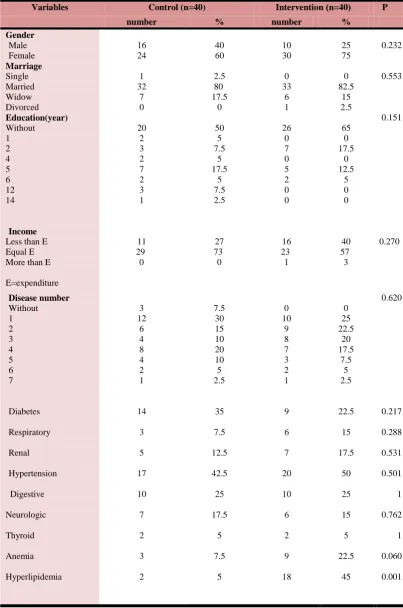
The mean age of the participants in the intervention and control groups were 65.25±4.16 and 67.43 ± 6.96, respectively (P=0.95). As is shown in Table 1, the two groups were homogeneous in terms of gender (P=232), marital status (P= 0.553), education (P=0.151), income (P=0.270) and number of illnesses (P=0.620). The most common underlying disease in both groups was hypertension. Chi-square test showed that hyperlipidemia (P<0.001) were significantly more in the intervention group than the control group (Table 1).
Iran J Health Sci 2019; 7(2): 23
Table 1. Comparison of the qualitative variables in the intervention and control groups
P ( n=40 ) Intervention Control (n=40) Variables % number % number 0.232 25 75 10 30 40 60 16 24 Gender Male Female 0.553 0 82.5 15 2.5 0 33 6 1 2.5 80 17.5 0 1 32 7 0 Marriage Single Married Widow Divorced 0.151 65 0 17.5 0 12.5 5 0 0 26 0 7 0 5 2 0 0 50 5 7.5 5 17.5 5 7.5 2.5 20 2 3 2 7 2 3 1 Education(year) Without 1 2 4 5 6 12 14 0.270 40 57 3 16 23 1 27 73 0 11 29 0 Income
Less than E Equal E More than E
E=expenditure 0.620 0 25 22.5 20 17.5 7.5 5 2.5 0 10 9 8 7 3 2 1 7.5 30 15 10 20 10 5 2.5 3 12 6 4 8 4 2 1 Disease number Without 1 2 3 4 5 6 7 0.217 0.288 0.531 0.501 1 0.762 1 0.060 0.001 22.5 15 17.5 50 25 15 5 22.5 45 9 6 7 20 10 6 2 9 18 35 7.5 12.5 42.5 25 17.5 5 7.5 5 14 3 5 17 10 7 2 3 2 Diabetes Respiratory Renal Hypertension Digestive Neurologic Thyroid Anemia Hyperlipidemia
Iran J Health Sci 2019; 7(2): 24
The mean of depression scores in the intervention group was 2.72±1.8, and it was 1.88 ± 1.65 in the control group (both below 4) that were not clinically significant. Mean scores of the Body Mass Index (BMI) in the intervention group were 30.13 ± 5.4 and 28.28 ± 3.63 in the control group, and there was no significant difference between the two groups (P=0.077).
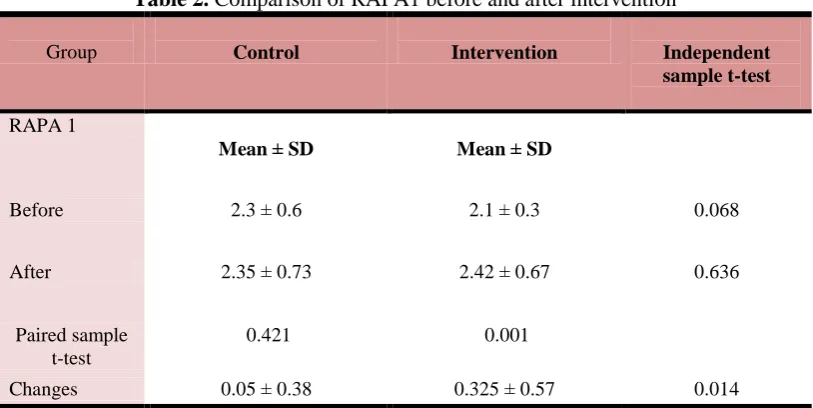
The Paired sample t-test showed that the mean score of RAPA1 was significant in the intervention group, compared to before the intervention. However, in the control group, the mean score of RAPA1 was not significant compared to the pre-study (Table 2).
Table 2. Comparison of RAPA1 before and after intervention
Independent sample t-test Intervention
Control Group
SD ± Mean SD
± Mean RAPA 1
0.068 0.3
± 2.1 0.6
± 2.3 Before
0.636 0.67
± 2.42 0.73
± 2.35 After
0.001 0.421
Paired sample t-test
0.014 0.57
± 0.325 0.38
± 0.05 Changes
The results of Paired sample t-test showed that the mean score of RAPA 2 was significantly higher in intervention group, compared to before the intervention (P
<0.001). But in the control group, the mean score of the RAPA2 was not significant compared to the pre-study (P = 0.421) (Table 3).
Table 3. Comparison of RAPA 2 before and after intervention
Independent t-test Intervention
Control Group
SD ± Mean SD
± Mean RAPA 2
0. 160 0
± 0 0.44
± 0.1 Before
<0.001 0.5
± 2.5 0.53
± 0.15 After
<0.001 0.421
Paired t-test
<0.001 0.51
± 2.5 0.55
± 0.05 Changes
Iran J Health Sci 2019; 7(2): 25
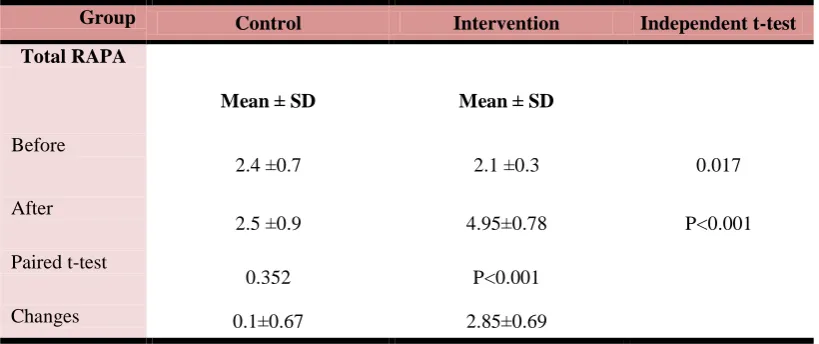
The results of Independent sample t-test showed that the mean total score of RAPA, before intervention, was significantly higher in the control group than in the intervention group (P = 0.017). However, after the intervention, the mean total score in the intervention group was significantly higher than the control group (P <0.001). The findings showed that the mean total
score of the RAPA was significant (P <0.001) after the educational intervention compared to before the intervention. But in the control group, the mean total score of RAPA after the intervention was not significant compared to the pre-study (P=0.352) (Table 4).
Table 4. Comparison of total RAPA before and after the intervention
Independent t-test Intervention
Control Group
SD ± Mean SD
± Mean Total RAPA
0.017 0.3
± 2.1 0.7
± 2.4 Before
P<0.001 0.78
± 4.95 0.9
± 2.5 After
P<0.001 0.352
Paired t-test
0.69 ± 2.85 0.67
± 0.1 Changes
ANCOVA test showed that the
intervention significantly improved the
physical activity level of the intervention group (Table 5).
Table 5. Tests of between subjects effects
Source Sum of Squares df Mean Square F Sig
Pretest 1428.02 1 1428.02 1833.51 .000
Group 46.22 1 46.22 59.35 .000
Error 60.75 78 0.779
Iran J Health Sci 2019; 7(2): 26
In fact, the results of above table showed that after omitting the effect of pretest as a confounding factor, there was a significant difference between the two groups (intervention and control) after the intervention.
4. Discussion
The results of Independent sample t-test showed that there was no significant difference between the two groups (intervention and control) after the intervention. This finding was consistent with that of Eshaghi et al., (2010), which evaluated the effect of religious-based instruction on physical activity of the elderly (6). The researchers believed that health education was used with different patterns and methods. Religious beliefs are among the individual values that can strengthen the motivation of individuals to carry out certain behaviors. But in their study, both types of educational interventions (with and without religious teachings) had a positive effect on physical activity, and there was no significant difference. In the current study, although the control group did not receive any training, the pre-test effect should not be overlooked.
Palmer et al. (2013) assessed changes in physical activity in community-dwelling older adults associated with the Matter of Balance Volunteer Lay Leader Model program (15). They used only the aerobic portion of RAPA (RAPA1). Their scoring style was different from our study. Their possible scores ranged from 1 to 7, based on the highest numbered item circled. The results showed that education did not improve the physical activity level of the elders significantly. The authors cited the cause of lack of effect as a possible lower
sample size. Ten people (20.8%) had a RAPA1 score of 7, before the intervention (ceiling effect). As a result, the effect of the intervention could not be shown
On the other hand, the results of Paired sample t-test showed that the mean score of RAPA1 was significant in the intervention group, compared to before the intervention. This finding was consistent with the studies of Karimi et al. and Amirzadeh Iranagh et al. (1, 14).
The findings of the current study also showed that there was a significant difference between the two groups (intervention and control) after the intervention. These findings were found consistent with that of Shams et al., (2011) and Sadeghi et al., (2007). In the current study, educational intervention was conducted for 4 sessions of 30 to 45 minutes per month and the elderly were asked to tailor their abilities accordingly. In the above studies, the duration of exercise was 30-60 minutes, 3 times per week (25, 26), for 5 weeks (25) or 6 weeks (26). Healthcare providers, especially nurses, can help improve balance, and subsequently reduce the fall of the elderly by implementing such programs.
A systematic review and meta-analysis (including 345 articles for initial review out of which 23 studies met the inclusion criteria) quantified dose-response relationships of balance training modalities (i.e., training period, training frequency,
training volume) to maximize
improvements in balance performance in healthy adults aged 65 years and older. The analyses revealed that an effective balance training protocol was characterized by the following independently considered training modalities to improve the balance
Iran J Health Sci 2019; 7(2): 27
performance in healthy older adults: a training period of 11-12 weeks, a frequency of three sessions per week, and a duration of 31-45 min of a single training session (27).
The results of ANCOVA test also showed that the intervention improved the physical activity level of the intervention group significantly. This finding was in line with some other previous studies. A program in Australia employing group education and goal setting sessions, did not increase pedometer-measured step counts among culturally and linguistically diverse older adults (17). A Cochrane review found no evidence for the effectiveness community level intervention (16). After the selection process had been completed, 25 studies were included in the review. Of the included studies, 19 were set in high income countries, and the remaining six were in low income countries .The reason of inconsistent results of our study may be related to the short time follow up. The follow up of our study was one month after the end of intervention (two months from the start of the intervention); however, in the Cochrane review, only studies with a minimum six-month follow up from the start of the intervention to measurement of outcomes were included.
Changes in lifestyle patterns, such as physical activity, and exercise at any age can be important factors in reducing mortality and increasing longevity. Given the results and the effect of educational intervention on the physical activity of the elderly, the design of such educational interventions in centers with elderly groups’ participation, including parks, was then recommended.
Limitation
In both clinical research and clinical practice, subjective measurement of physical activity is the choice due to the
simplicity, low cost, speed and ease of administration. A significant limitation in this study was the use of a self -report measure for physical activity (subject to recall and response biases) rather than more objective instrumented methods, such as accelerometers and step counters. Short time follow up was another limitation of our study.
Acknowledgments
We sincerely appreciate the Deputy of Research in the Mazandaran University of Medical Sciences, dear elders and Managing Directors of Rural Health Centers, physicians, and healthcare workers, so called Behvarzan, who have helped us in this research.
Conflict of interest: None
References
1. Karimi Z, Majlesi F, Tol A, et al. The effect of educational intervention on the promotion of physical activity of the elderly men in Qom city. Iranian Journal of Agieng, 2015; 10 (3):183-191. [In Persian]
2. Ghahremani L, Niknami SH, Mosavi MT, et al. Trans-theoretical model based interventions to improve physical activity in elderly men. Journal of Armaghan Danesh, 2008; 13(1):77-88. [In Persian]
3. Aghamolaei T, Tavvafyian SS, Hassani L. Self efficacy, perceived benefits and perceived barriers to regular physical activity. Hormozgan University of Medical Sciences .Epidemiology, 2007; 4(3-4):9-15. [In Persian] 4. Edlin G, Golanty E. Health and wellness. Canada: Jonesand Bartlett publisher. 2007 5. World Health Organization. Global recommendations on physical activity for health.[cited 2010 Mar 11] Available at : http://www.who.int/dietphysicalactivity/factsh eet-/recommendations/en
6. Ishaghi R, Mahmoudian SA, Asgarian R, et al. Effect of faith based education on physical activity on the elderly. Iranian Journal of Education in Medical Sciences, 2010;10(5):1281-1288. [In Persian]
7. Ishaghi R, Shahsanai A, Ardakani M. Assessment of the physical activity of elderly
Iran J Health Sci 2019; 7(2): 28
population of Isfahan, Iran. Isfahan Medical School, 2011; 29(147):939-46. [In Persian] 8. Mazloomi S, Mohammadi M, Morovati MA. Exercise and its relation to self-efficacy based on stages of change model in employees of Yazd. Journal of Kerman University Medical Sciences, 2010; 17 (4):346-354. [In Persian] 9.Chudyk AM, Mckay HA, Winters M, et al. Neighborhood walk ability, physical activity and walking for transportation: a cross sectional study of older adults living on low income. BMC Geriatric. 2017; 17(82):1-14 DOI:10.1186/s12877-017-0469-5
10. Arnadottir SA, Gunnarsdottir ED, Lundin-Olsson L. Are rural older Icelanders less physically active than those living in urban areas? A population-based study. Scandinavian Journal of Public Health, 2009; 37(4):409-417. PMID: 1923743
11. Shores KA, West ST, Theriault DS, Davison EA. Extra-individual correlates of physical activity attainment in rural older adults. The Journal of Rural Health. 2009;25 (2): 211-218. PMID: 19785589
12. Dondur S. Physical activity of elderly urban and rural women. Facta Universitatis. Series: physical education and sport. 2016; 14(2): 279-288.
13. Khavoshi N, Tol A, Shojaeizade D, et al. Effect of educational intervention on the life style of elderly people referred to clinical centers of Eslamshahr, Iranian Journal of Nursing Education, 2015; 3(4):19-28. [In Persian]
14. Amiirzadeh Iranagh J., Motallebi SA. The effect of health belief model education intervention on physical activity of elderly women. Journal of Urmia Nursing Midwifery Faculty. 2016; 13(12):1050-1058. [In Persian] 15. Palmer WE. Changes in physical activity in community older adults associated with the matter of balance volunteer lay leader model program. Dissertation of Allied Health Sciences. University of North Carolina. Chapel Hill. 2013
16. Baker PR, Francis DP, Soares J, Weightman AL, Foster C. Community wide interventions for increasing physical activity. Cochrane Database Systematic Review. 2011;13(4):CD008366. PMID: 21491409 17. Borschmann K, Moore K, Russell M, Ledgerwood K, Renehan E, Lin X, et al. Overcoming barriers to physical activity among culturaly and linguistically diverse older adults: A randomised controlled trials. Australas
Journal of Aging. 2010; 29(2):77-80. PMID: 20553538
18. Gahremani L, Nazari M, Mosavi M. Improvement of QOL in elderly men in Kahrizak Nursing Home based on educational intervention. Danesh VA Tandorosti. Shahrood University of Medical Sciences, 2008; 4 (2):18-23.
19. Rapid Assessment of Physical Activity (RAPA). University of Washington Health Promotion Research Center. 2006.
20. Topoloski TD, LoGerfo J, Patric DL, et al. The rapid assessment of physical activity (RAPA) among older adults. Prevention Chronic Disease, 2006; 3(4):1-8. PMID: 16978493
21. Akbari Kamrani AA., Foroughan M., Yazdani J., et al. Prediction model for self care behaviors among Iranian elders with chronic heart failure. Middle East Journal of Rehabilitation and Health. 2018; 5(3): e69601. DOI:10.5812/mejrh.69601
22. Exercise and physical activity: Your every day guide: National Institute on Aging. Publication 2016. No: 17-AG-4258. Available at:www.nia.nih.org/Go4life
23. Mayer CJ, Steinman L, Williams B, Topolski TD, LoGerfo J. Developing a telephone assessment of physical activity questionnaire for older adults. Preventing
Chronic Disease.2008; 5(1): A24. PMID: 18082013
24. Khajavi D, Khan Mohammadi R. Prediction of geriatric depression symptoms based on physical activity and demographic characteristics: The role of age and gender. Roshd VA Yadgiri Harkati -Varzeshi, 2015; 7(1): 87-103. [In Persian] DOI: 10.22059/jmlm.2015.54507
25. Shams F, Hasani Mehraban A, Taghizadeh GH. The effect of multisensory training of balance on postural control of older adults. Iranian Journal of Ageing. 2011; 6 (21):7-12. [In Persian]
26. Sadeghi H, Alirezaie F. The effect of water based exercise on static and dynamic balance of elderly women. Iranian Journal of Ageing. 2007; 2(6):402-409. [In Persian] 27. Lesinski M, Hortobagyi T, Muehlbauer T,
Gollhofer A. Effects of balance training on balance perfomance in healthy older adults: A systematic review and Meta-analysis.Sports Medicine. 2015; 45:1721-1738. DOI:10.1007/s40279-015-0375-y