TELL, Vol. 8, No. 1, Spring & Summer 2014, pp.61-92
The presentation of different types of
tasks in ELT textbooks
Minoo Alemi1
Post-doctoral Associate, Sharif University of Technology, Iran Assistant Professor, Islamic Azad University, Tehran West Branch
Zahra Hesami
M.A. Student, Sharif University of Technology, Iran
Received on August 16, 2013 Accepted on December 9, 2013
Abstract
It is mostly observed that textbooks are a key component in most language programs especially in the process of teaching and learning a second/foreign language. As a result, a number of studies have been carried out to evaluate English language teaching (ELT) materials. Trying to contribute to this growing body of literature, the present study was conducted to evaluate the eight most popular global textbooks which are taught in Iranian ELT institutes in terms of their task types according to Nunan’s (1999) classification of the tasks. To this end, all the tasks of each textbook were categorized in their major and minor associated groups. The results revealed that linguistic tasks were the most frequent type of tasks in almost all of the textbooks. Moreover, there was a significant difference among the frequency of task types in these course books. Finally Total
62 TELL, Vol. 8, No.1
The presentation of different types of tasks in ELT textbooks
English, English Result and Interchange proved to be the most balanced textbooks respectively in comparison to others with regard to each task types. It was concluded that unlike the common belief, being recently published does not guarantee the appropriateness of textbooks for language teaching program. The results of this study could be helpful for teachers to realize the types of the tasks and exercises in the available ELT textbooks and consequently help their students develop their English proficiency by adapting and mixing different types of tasks from different textbooks.
Keywords: textbook evaluation, task, task types, Nunan’s (1999) classification of tasks
1. Introduction
Previously, the primary purpose of language learning was to develop linguistic competence and master the structure of the language. However, in recent decades of communication, English appears to be playing a more crucial role, and the aim of language teaching has shifted from the mastery of structure to the ability to use language for communicative purposes. Therefore, the communication aspect of teaching and learning English has received more attention, especially in the domain of second language (L2) textbook and course book evaluation. At the heart of communicative language teaching (CLT), task based language teaching (TBLT) has emerged in 1987 with its focus on communicative tasks that involve learners in learning second language structures while their primary focus is on meaning (Ellis, 2003). Therefore, many English language teaching (ELT) textbooks tried to adapt their tasks and exercises to what TBLT researchers claimed.
TELL, Vol. 8, No. 1
Alemi and Hesami
63
precise information is needed on the types of tasks introduced by such materials.
2. Literature Review
Many studies have been done on ELT global textbooks evaluation, and the textbooks were evaluated in different ways and based on different criteria. Moreover, the available studies can be categorized based on their focus of evaluation.
Many of the studies done in the realm of textbook evaluation have focused on pragmatic aspects of the textbooks, especially on speech acts and language functions. Tavakoli (1995) did a research
on Top Notch series to investigate whether different forms of speech
acts were correctly used and how frequently each function was used in the dialogues of the book. Using Searle’s (1976) model of speech act, he believed that representative, directive, and expressive functions were mentioned in the textbooks, while commissives and declarations were not introduced at all. The same results were obtained by Soozandehfar and Sahragard (2011). The results of
their study on Top Notch conversations based on two pragmatic
models of Halliday’s (1978) language functions and Searle’s (1976) speech acts showed that the conversations in these textbooks are not pragmatically efficient and functional. Other studies indicated that the frequency of requests in this series was not problematic, but the refusals and complaints were barely included in most of them (Delen & Tavil, 2010).
In line with part of the findings from Delen and Tavil (2010) who demonstrated that there was a bias to some
particular speech act strategies in Summit, Top Notch and North star
Reading and Writing Series, there was also a significant
difference in the proportion of complaint and compliment
strategies in English Result series (Alemi & Irandoost, 2012).
However, despite the fact that there was almost no complaint strategy found through the three course book series, it was
documented that English Result textbooks were highly quantified
64 TELL, Vol. 8, No.1
The presentation of different types of tasks in ELT textbooks
In order to evaluate New Interchange textbooks pragmatically,
Soleymani and Dabbaghi (2012) evaluated the content of the books to see whether they provide sufficient and comprehensible pragmatic input for Iranian learners of English to fulfill their basic communicative needs. They also evaluated the ability of Iranian learners of English in dealing with different speech situations using an oral discourse completion test. The results of their study revealed a large disparity in pragmatic knowledge of students. Also it was concluded that the books provided enough pragmatic input for language learners to deal with their basic communicative needs of requesting/accepting, requesting/refusing expressing attitudes, and affirming. They achieved such a goal through providing variety of scenarios of different speech situations through audio conversations and video episodes.
In another attempt, Alemi, Bemani, and Roodi (2013) investigated four speech acts (refusal, request, apology, and
complaint) in American File, American Headway, and English
Result. Their results showed that the three textbooks cannot be
considered as appropriate or useful materials in order to teach or
learn speech acts in an EFL context. However, the New Headway
textbook enjoyed a higher and increasing mode of frequency of speech acts throughout its levels in comparison to other textbooks.
Regardless of pragmatic issues, a large body of studies paid attention to the overall values of the textbooks by analyzing the content of the textbooks using different models and frameworks (Birjandi & Alizadeh, 2013; Razmjoo & Kazempourfard, 2012; Riasati & Zare, 2010; Sahragard, Rahimi & Zaremoaeyeddi, 2008).
Using Littlejohn’s (1998) framework, Sahragard, Rahimi, and Zaremoaeyeddi (2008) conducted an in-depth evaluation of
Interchange Series with a focus on the real application of
communicative and task-based approaches applied in the materials of the text book. The result of their study suggested that the communicative skills were emphasized in the textbooks. In contrast, the textbook had the limitations in providing opportunities for the learners and the teachers in order to decide on the content of the
tasks. Interchange series; on the other, hand focused mainly on pair
TELL, Vol. 8, No. 1
Alemi and Hesami
65
language and more importantly they more often required them to express themselves than to be a listener. In its actual use; however, although lack of supplementary teaching materials, too many testing exercises, and inadequate number of Teacher’s Manual were mentioned as the demerits of the course books, the teachers agreed with the effectiveness and suitability of the series (Riasati & Zare, 2010).
As another drawback of Interchange series, Razmjoo and Kazempourfard (2012) showed this series cannot make learners critical thinkers. After codifying the content of the books based on the Bloom’s Taxonomy (2001), they found that lower order thinking skills were the most prevalent learning levels in these books. Their results are in line with what Birjandi and Alizadeh
(2013) found in their evaluation of Top Notch, Interchange, and
English File series. Using the same taxonomy, they concluded that
the books mainly tapped knowledge, comprehension, application, and building community of thinkers’ skills and failed to acceptably include other skills reported to be of utmost importance for students’ academic success.
With regard to the criticisms to Interchange series, it seems that
in Iranian language institutes, it is replaced by Top Notch series
which according to Eslami Rasekh, Esmaeli, Ghavaminia, and
Rajabi (2010) is labeled better than Interchange with regard to
external and internal evaluation. Therefore, many researchers tried
to evaluate the overall content of Top Notch series according to
various standards and frameworks.
Using ACTFL standards and collecting data from fifty Iranian
teachers, Alemi and Mesbah (2012) indicated that Top Notch series
encourage students’ communication by offering lots of
opportunities for interaction, and demonstrate cultural-based aspects without cultural bias.
As another advantage of the overall content of Top Notch
66 TELL, Vol. 8, No.1
The presentation of different types of tasks in ELT textbooks
Transformation, Near-synonyms and Synonyms (Hamiloğlu & Karlıova, 2009).
In another attempt to evaluate the values of the Top Notch
textbook in process and its actual effects on the users, Nahrkhalaji (2012) designed a two –phase evaluation framework which contained whilst-use and post-use evaluation. In the first phase, she examined the textbook in terms of its attractiveness, suitability, practicality, effectiveness, clarity, and teachability. In the second phase, the teachers who participated in this study evaluated the workbook as extremely useful, effective and worthwhile; however, in their opinion the material’s ease of use is problematic that may cause a heavy load for inexperienced teachers. The researcher also
stated that Top Notch includes a variety of the activities and
exercises that helps people with different kinds of intelligences and develops communicative abilities and critical thinking.
Besides evaluating textbooks in terms of their overall content, some of the researchers narrowed their focus and put the target of their evaluation on gender and cultural bias in the content of the textbooks/course books. As a part of their study, Tajeddin and Enayat (2010) tried to reveal the positioning of gender in the images
of Top Notch book. After analyzing the content of the course book,
and its images, it was found that men were represented to be more active, competent, socially important, breadwinners, and powerful. In contrast, women appeared as less active and more reactive, objects to be scrutinized, objects of desire, bread takers, and socially less powerful.
Tas (2010) tried to reveal the teachers’ and the students’ views
on teaching and learning “culture” through New English File series.
Considering the views of the learners and teachers, it was explicitly stated that this series reflect not only international cultures but also target cultures.
In another study, Alemi and Jafari (2012) analyzed gender and culture bias in 10 local and global EFL textbooks (one of them was
Interchange series). They found that females are less visible in
these textbooks than males and that the Interchange series as a
TELL, Vol. 8, No. 1
Alemi and Hesami
67
found that New Interchange Intro does not represent any sexist bias.
Naji Meidani and Pishghadam (2012) also found that in Interchange
and Top Notch, learners are supposed to think about their own lives,
experiences, culture or customs in each lesson based on the topic presented. In another attempt, Alemi and Mollaei (2012) evaluated
Total English series from teachers’ point of view, and with a focus
on cultural pattern which is presented in the books. Using a combination of Mukundan (2011), Miekley (2005), and Litz’s (2000) checklists, their results showed a moderate to high teachers’ satisfaction with the general concepts of the book, although there were some problems found with the issues related to cultural and social factors. As mentioned by the researchers, these textbooks concentrate on British English accent and the Great Britain context with little attention paid on other cultures and societies. However, from the view point of students, the textbooks are of satisfactory balance in terms of cultural content. (Alemi & Bagheri, 2013)
More recently, Alemi and Bemani (2013) evaluated 7
well-known international textbooks namely New American Headway,
Top Notch, Total English, New Interchange, Touchstone, English
Result and American File, from the viewpoint of teachers. Their
results showed that nearly all the textbooks were considered popular and communicatively suitable for learners. Furthermore, most teachers tend to consider the cultural clashes and values in textbooks but few of them believe that textbooks are biased in favor of target language culture.
Although a large body of studies was done on textbooks evaluation, a gap can be noticed in the literature in the evaluation of ELT textbooks in terms of their task types. To the best of the researchers’ knowledge, few studies were done on the evaluation of ELT textbooks based on the task types they used. Therefore, in order to fill this gap in literature, the purpose of the current study was to evaluate the eight most popular global course books, which have been taught in Iranian ELT institutes, in terms of their task types according to Nunan’s (1999) classification of the tasks.
68 TELL, Vol. 8, No.1
The presentation of different types of tasks in ELT textbooks
To fill the gap in the literature, the purpose of this study was to
evaluate the eight most popular global textbooks (American English
File, English Result, Face to Face, Four Corners, Interchange, Top
Notch, Total English, and World English), which are taught in
Iranian ELT institutes, in terms of their task types according to Nunan’s (1999) classification of the tasks.
The study tried to find the answer to the following questions:
1. What kinds of task types are utilized in the textbooks (American
English File, English Result, Top Notch, Interchange, Total
English, Four Corners, Face to Face, and World English)?
2. Which of these task types are more frequent in these textbooks?
3. Is there any significant difference among the frequency of task
types in these textbooks?
4. Which textbooks are more balanced in comparison to others with
regard to each task types?
4. Method
4.1 The CorpusThe present study evaluated the eight most popular global ELT textbooks which are currently taught in Iranian ELT institutes. These textbooks were as follows:
1. American English File (Oxenden & Latham-Koenig, 1997)
2. English Result (Hancock & McDonald, 2009)
3. Face to Face (Redston & Cunningham, 2006)
4. Four Corners (Richards & Bohlke, 2012)
5. Interchange (Richards, 2005)
6. Top Notch (Saslow & Ascher, 2006)
7. Total English (Clare & Wilson, 2005)
8. World English (Johannsen & Chase, 2011)
The textbook series covered a time span of about 15 years, based on their time of publication. For the sake of homogenization, the selected textbooks were all from the intermediate level of the
eight book series. They included: American English File (Students’
Book 3), English Result (Intermediate Students’ book), Face to
Face (Intermediate Students’ book), Four Corners (Students’ Book
TELL, Vol. 8, No. 1
Alemi and Hesami
69
Total English (Intermediate Students’ book), and World English 2.
Top Notch 3 is divided into two parts, i.e. A and B, and they are in
separate books. The aforementioned textbooks have been taught extensively in different countries around the world. In Iran, they are among the most used textbooks in English language institutes.
4.2 The Framework
In this study, Nunan’s (1999) framework for the classification of tasks was used. In his framework, he classified tasks into different groups according to the strategies underpinning them. As a whole he divided tasks into five major groups each one consisting sub-groups that made a list of twenty different task types. Not only did he provide a definition for each type of task, but also gave examples for each one that make it more comprehensible and practical. These types of tasks and their sub-groups are as follow:
1. Cognitive tasks: classifying, predicting, inducing, note taking, concept mapping, inferencing, discriminating, and diagramming
2. Interpersonal tasks: co-operating, and role playing
3. Linguistic tasks: conversational patterns, practicing, using
context, summarizing, selective reading/listening, and skimming
4. Affective tasks: personalizing, self-evaluating, and reflecting
5. Creative tasks: brainstorming
4.3 Data Collection Procedure
70 TELL, Vol. 8, No.1
The presentation of different types of tasks in ELT textbooks
significant difference were introduced. Finally, the most balanced textbooks with regard to the frequency of each minor task types were introduced.
4.4 Data Analysis
In this study, both quantitative and qualitative analyses of the data were provided. With regard to quantitative analyses, both descriptive and inferential statistics were carried out. The researchers used frequency and percentages as the inferential statistics in order to find the answer to the first and second research questions.
The researchers also used the mean in order to provide answer to the last research question. In order to answer the last research question, first the mean of percentages of each minor task type was calculated in all textbooks, and then the differences between each minor task type percentage and their mean were calculated. Finally the difference numbers for each textbook were added. Therefore, the textbooks with the least numbers were introduced as more balanced in terms of each minor task types.
In the qualitative part, the researchers analyzed each single task in all mentioned books and then based on Nunan’s (1999) model, categorized them in different categories. Then different examples of each task type in each course book were introduced and the advantages of using each type were analyzed. Moreover, with regard to the third research question, the Chi Square was run in order to compare the textbooks with regard to the frequency of their major task types, using SPSS (statistical package for social science) version 16.0.
5.
Results
With regard to the research questions the following results were attained.
TELL, Vol. 8, No. 1
Alemi and Hesami
71
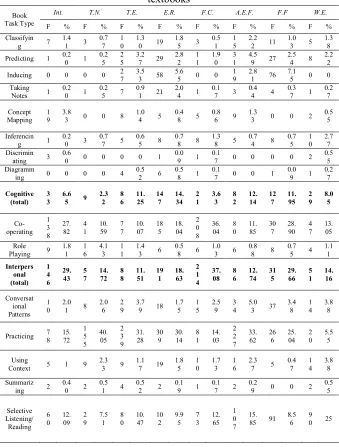
In order to answer to this research question, each course book was analyzed in terms of its task types based on Nunan’s (1999) framework. The results are presented in Table 1.
Table 1: The frequency and percentage of each task type in the target textbooks
Book Task Type
Int. T.N. T.E. E.R. F.C. A.E.F. F.F W.E.
F % F % F % F % F % F % F % F %
Classifyin
g 7
1.4
1 3
0.7 7
1 0
1.3 0 19
1.8
5 3
0.5 1
1 5
2.2 2 11
1.0
3 5
1.3 8
Predicting 1 0.2
0 1
0.2 5
2 5
3.2 7 29
2.8 2 1 1 1.9 0 3 1 4.5 9 27
2.5
4 8
2.2 2
Inducing 0 0 0 0 2
7 3.5
3 58 5.6
5 0 0
1 9
2.8 1 76
7.1
5 0 0
Taking
Notes 1
0.2
0 1
0.2
5 7
0.9 1 21
2.0
4 1
0.1
7 3
0.4
4 4
0.3
7 1
0.2 7 Concept Mapping 1 9 3.8
3 0 0 8
1.0
4 5
0.4
8 5
0.8
6 9
1.3
3 0 0 2
0.5 5
Inferencin
g 1
0.2
0 3
0.7
7 5
0.6
5 8
0.7
8 8
1.3
8 5
0.7
4 8
0.7 5 1 0 2.7 7 Discrimin
ating 3
0.6
0 0 0 0 0 1
0.0
9 1
0.1
7 0 0 0 0 2
0.5 5 Diagramm
ing 0 0 0 0 4
0.5
2 6
0.5
8 1
0.1
7 0 0 1
0.0
9 1
0.2 7 Cognitive (total) 3 3 6.6 5 9
2.3 2 8 6 11. 25 14 7 14. 34 2 1 3.6 3 8 2 12. 14 12 7 11. 95 2 9 8.0 5 Co-operating 1 3 8 27. 82 4 1 10. 59 7 7 10. 07 18 5 18. 04 2 0 8 36. 04 8 0 11. 85 30 7 28. 90 4 7 13. 05 Role Playing 9
1.8 1 1 6 4.1 3 1 1 1.4
3 6
0.5
8 6
1.0
3 6
0.8
8 8
0.7
5 4
1.1 1 Interpers onal (total) 1 4 6 29. 43 5 7 14. 72 8 8 11. 51 19 1 18. 63 2 1 4 37. 08 8 6 12. 74 31 5 29. 66 5 1 14. 16 Conversat ional Patterns 1 0 2.0
1 8
2.0 6
2 9
3.7 9 18
1.7 5 1 5 2.5 9 3 4 5.0 3 37
3.4 8 1 4 3.8 8
Practicing 7 8 15. 72 1 5 5 40. 05 2 3 9 31. 28 30 9 30. 14 8 1 14. 03 2 2 7 33. 62 26 6 25. 04 2 0 5.5 5 Using
Context 5 1 9
2.3
3 9
1.1 7 19
1.8 5 1 0 1.7 3 1 6 2.3
7 5
0.4 7 1 4 3.8 8 Summariz
ing 2
0.4
0 2
0.5
1 4
0.5
2 2
0.1
9 1
0.1
7 2
0.2
9 0 0 2
0.5 5 Selective Listening/ Reading 6 0 12. 09 2 9 7.5 1 8 0 10. 47 10 2 9.9 5 7 3 12. 65 1 0 7 15. 85 91
8.5 6
72 TELL, Vol. 8, No.1
The presentation of different types of tasks in ELT textbooks
Skimming 2 0 4.0 3 1 6 4.1 4 3 0 3.9 2 45
4.3 9 2 9 5.0 2 1 5 2.2 2 20
1.8
8 7
1.9 4 Linguistic (total) 1 7 4 35. 08 2 2 0 56. 84 3 9 1 51. 17 49 5 48. 29 2 0 9 36. 22 4 0 1 59. 40 41 9 39. 45 1 4 7 40. 83 Personaliz ing 8 2 16. 53 4 5 11. 65 1 0 0 13. 08 56
5.4 6 7 5 12. 99 4 9 7.2 5 38
3.5 7 6 1 16. 94 Self-Evaluatio n 1 3 2.6 2 1 1 2.8 4 3 6 4.7 1 85
8.2
9 3
0.5 1
3 8
5.6 2 85
8.0
0 5
1.3 8
Reflecting 2 0.4
0 0 0 3
0.3
9 1
0.0
9 0 0 0 0 0 0 0 0
Affective (total) 9 7 19. 55 5 8 14. 98 1 3 9 18. 19 14 2 13. 85 7 8 13. 51 8 7 12. 88 12 3 11. 58 6 6 18. 33 Brainstor ming 4 6 9.2 7 4 6 11. 91 6 0 7.8 5 50
4.8 7 4 6 7.9 7 2 5 3.7 0 78
7.3 4 6 7 18. 61 Creative (total) 4 6 9.2 7 4 3 11. 11 6 0 7.8 5 50
4.8 7 4 6 7.9 7 2 5 3.7 0 78
7.3 4 6 7 18. 61 Total 4 9 6 10 0 3 8 6 10 0 7 6 4 10 0 10 25 10 0 5 7 7 10 0 6 7 5 10 0 10 62 10 0 3 6 0 10 0
Note. Int. = Interchange; T.N. = Top Notch; T.E. = Total English; E.R. = English Result; F.C. = Four Corners; A.E.F. = American English File; F.F. = Face to Face; W.E. = World English; F = Frequency; and % = Percentage.
As Table 1 illustrates, most of the task types were covered by
these textbooks. With regard to macro task types, Interchange’s
tasks include 6.65% cognitive, 29.43% interpersonal, 35.08%
linguistics, 19.55% affective, and 9.27% creative tasks. For Top
Notch these percentages are 2.32%, 14.72%, 56.84%, 14.98%, and
11.11% respectively. In terms of Total English, 11.25% of the tasks
are cognitive, 11.51% interpersonal, 51.17% linguistic, 18.19%
affective and 7.85% creative. English Result also covers these
macro task types for 14.34%, 18.63%, 48.29%, 13.85%, and 4.87%,
respectively. With regard to Four Corners, 3.63% of tasks are
cognitive, 37.08% interpersonal, 36.22% linguistic, 13.51%
affective, and 7.97% creative. American English File has also all
these macro task types for 12.14%, 12.74%, 59.40%, 12.88%, and
3.70% respectively. Finally Face to Face and World English have
TELL, Vol. 8, No. 1
Alemi and Hesami
73
(11.95%, 8.05%); (29.66%, 14.16%); (39.45%, 40.83%); (11.58%, 18.33%); and (7.34%, 18.61%) respectively.
5.2 Which of Task Types Are More Frequent in Textbooks?
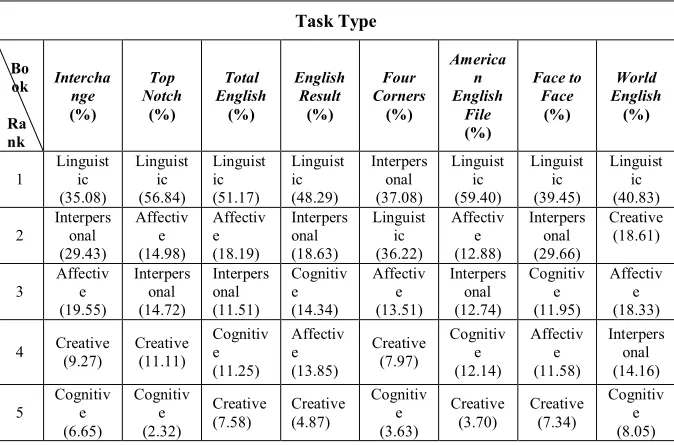
Table 2 shows the most frequent macro task types in each textbook.
Table 2: The ranking of macro task types in each textbook
Task Type Bo ok Ra nk Intercha nge (%) Top Notch (%) Total English (%) English Result (%) Four Corners (%) America n English File (%) Face to Face (%) World English (%) 1 Linguist ic (35.08) Linguist ic (56.84) Linguist ic (51.17) Linguist ic (48.29) Interpers onal (37.08) Linguist ic (59.40) Linguist ic (39.45) Linguist ic (40.83) 2 Interpers onal (29.43) Affectiv e (14.98) Affectiv e (18.19) Interpers onal (18.63) Linguist ic (36.22) Affectiv e (12.88) Interpers onal (29.66) Creative (18.61) 3 Affectiv e (19.55) Interpers onal (14.72) Interpers onal (11.51) Cognitiv e (14.34) Affectiv e (13.51) Interpers onal (12.74) Cognitiv e (11.95) Affectiv e (18.33)
4 Creative (9.27) Creative (11.11)
Cognitiv e (11.25) Affectiv e (13.85) Creative (7.97) Cognitiv e (12.14) Affectiv e (11.58) Interpers onal (14.16) 5 Cognitiv e (6.65) Cognitiv e (2.32) Creative (7.58) Creative (4.87) Cognitiv e (3.63) Creative (3.70) Creative (7.34) Cognitiv e (8.05)
Table 2 shows the most frequent macro task types in each
textbook. Generally, in all of the textbooks except Four Corners,
linguistic tasks were more frequent than other types of tasks. Table 2 shows that 35.08%, 56.84%, 51.17%, 48.29%, 59.40%, 39.455,
and 40.83% of all tasks were linguistic ones in Interchange, Top
Notch, Total English, English result, American English File, Face
to Face, and World English respectively.
Interpersonal and affective tasks were in the second and third position for most of the textbooks. After linguistic tasks most of the
tasks of Interchange, English Result, and Face to Face are
74 TELL, Vol. 8, No.1
The presentation of different types of tasks in ELT textbooks
However, in terms of Four Corners, interpersonal tasks were the
most frequent type of tasks and were in the first rank position.
Affective tasks were in the second position for Top Notch (14.98%),
Total English (18.19%), and American English File (12.88%) and in
third for Interchange (19.55%), Four Corners (13.51%), and world
English (18.33%).
The last ranking positions were occupied by cognitive and
creative tasks for most of the textbooks. Interchange, Top Notch,
and Four Corners had creative and cognitive tasks in their fourth and fifth rank respectively for 9.27%, 6.65%; 11.11%, 2.32%; and
7.97%, 3.63%, while in terms of Total English and American
English File the reverse were observed. The percentages of
cognitive tasks were 11.35, and 12.14 and the creative tasks were
7.58 and 3.70 for Total English and American English File
respectively.
5.3 Is There Any Significant Difference in the Frequency of Task Types in Textbooks?
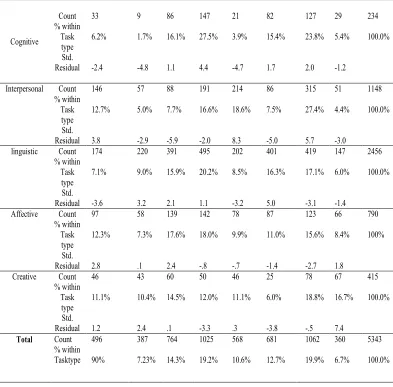
Chi-square was run to compare the frequencies of task types as appeared in eight English course books. Table 3 presents three sets of statistics for each cell, frequency, percentage and standardized residual (Std. Residual). While the former two indices are descriptive, the Std. Residual is a standardized index based on which inferences can be made. Any Std. Residuals beyond the ranges of +/- 1.96 indicate significant differences. If the index is negative it means that the task is used significantly less than what was expected and if the Std. Residual is positive it indicates that the task has appeared significantly more than what was expected.
Table 3: Frequencies, percentages and Std. Residuals of tasks by textbooks
Task Type
Textbooks
Interchange Top Notch
Total English
English Result
Four Corners
American English
File
Face to Face
TELL, Vol. 8, No. 1
Alemi and Hesami
75
Additionally, the chi-square value of 468 (P = .000 < .05) indicates that the differences observed in Table 4 are statistically significant. Thus, the null-hypothesis as there is no significant difference among the frequency of task types in these course books is rejected.
Table 4: Chi-Square results for the difference of the frequency of task types in the target textbooks
Cognitive Count % within Task type Std. Residual 33 6.2% -2.4 9 1.7% -4.8 86 16.1% 1.1 147 27.5% 4.4 21 3.9% -4.7 82 15.4% 1.7 127 23.8% 2.0 29 5.4% -1.2 234 100.0%
Interpersonal Count % within Task type Std. Residual 146 12.7% 3.8 57 5.0% -2.9 88 7.7% -5.9 191 16.6% -2.0 214 18.6% 8.3 86 7.5% -5.0 315 27.4% 5.7 51 4.4% -3.0 1148 100.0% linguistic Count % within Task type Std. Residual 174 7.1% -3.6 220 9.0% 3.2 391 15.9% 2.1 495 20.2% 1.1 202 8.5% -3.2 401 16.3% 5.0 419 17.1% -3.1 147 6.0% -1.4 2456 100.0%
Affective Count % within Task type Std. Residual 97 12.3% 2.8 58 7.3% .1 139 17.6% 2.4 142 18.0% -.8 78 9.9% -.7 87 11.0% -1.4 123 15.6% -2.7 66 8.4% 1.8 790 100%
Creative Count % within Task type Std. Residual 46 11.1% 1.2 43 10.4% 2.4 60 14.5% .1 50 12.0% -3.3 46 11.1% .3 25 6.0% -3.8 78 18.8% -.5 67 16.7% 7.4 415 100.0%
76 TELL, Vol. 8, No.1
The presentation of different types of tasks in ELT textbooks
5.4 Which of The Textbooks Are More Balanced in Comparison with the Others with Regard to Each Task Type?
Each of these course books included a variety of task types with different ratios based on what their authors believed to be more important. In order to see which of these course books were more balanced in comparison to others with regard to each task type, first the mean of the percentages of each task type in all of the course books was calculated. The findings were illustrated in Table 5 below.
Table 5: The mean of percentages of each task type in the textbooks
Percentages
Book Task Type
Interchan
ge Notch Top English Total English Result Four Corner s
America n English
File Face to
Face World English Mean
Classifying 1.41 0.77 1.30 1.85 0.51 2.22 1.03 1.38 1.30
Predicting 0.20 0.25 3.27 2.82 1.90 4.59 2.54 2.22 2.22
Inducing 0 0 3.53 5.65 0 2.81 7.15 0 2.39
Taking Notes 0.20 0.25 0.91 2.04 0.17 0.44 0.37 0.27 0.58
Concept
Mapping 3.83 0 1.04 0.48 0.86 1.33 0 0.55 1.01
Inferencing 0.20 0.77 0.65 0.78 1.38 0.74 0.75 2.77 1
Discriminating 0.60 0 0 0.09 0.17 0 0 0.55 0.17
Diagramming 0 0 0.52 0.58 0.17 0 0.09 0.27 0.20
Co-operating 27.82 10.5
9
10.0 7
18.0 4
36.0 4
11.8 5
28.9 0
13.0 5
19.5 4
Role Playing 1.81 4.13 1.43 0.58 1.03 0.88 0.75 1.11 1.46
Conversational
Patterns 2.01 2.06 3.79 1.75 2.59 5.03 3.48 3.88 3.07
Practicing 15.72 40.0
5 31.2
8
30.1 4
14.0 3
33.6 2
25.0
4 5.55
24.4 2
Using Context 1.008 2.33 1.17 1.85 1.73 2.37 0.47 3.88 1.85
Summarizing 0.40 0.51 0.52 0.19 0.17 0.29 0 0.55 0.32
Selective
Listening/Readi 12.09 7.51
10.4
7 9.95
12.6 5
15.8
5 8.56 25
12.7 6
Value df
Asymp. Sig. (2-sided)
Pearson Chi-Square 468a 28 .000
TELL, Vol. 8, No. 1
Alemi and Hesami
77
ng
Skimming 4.03 4.14 3.92 4.39 5.02 2.22 1.88 1.94 3.44
Personalizing 16.53 11.6
5 13.0
8 5.46
12.9
9 7.25 3.57
16.9 4
10.9 3
Self-Evaluation 2.62 2.84 4.71 8.29 0.51 5.62 8.00 1.38 4.24
Reflecting 0.40 0 0.39 0.09 0 0 0 0 0.11
Brainstorming 9.27 11.9
1 7.85 4.87 7.97 3.70 7.34
18.6
1 8.94
After that, the difference between the mean and percentage of each task type in each course book was calculated. After finding these differences, the total score for each course book, that is the
total of differences for each course book, was calculated. In this
study the mean of the percentages of each task type in all of the course books, was assumed as the criterion for the balance of task types, therefore in each task type, the course books that had the minimum difference with the mean are assumed to be more balanced. Table 6 shows the rank of each course book based on their balance in each of the task types.
Table 6: The ranking of the target textbooks based on their balance in the frequency of each task type
Rank Textbook
1 Total English
2 English Result
3 Interchange
4 Face to Face
5 American English File
6 Four Corners
7 Top Notch
8 World English
6.
Discussion
In order to answer the research questions, the discussions of the quantitative and qualitative analysis of the data collected from the corpus are presented in the following sections.
78 TELL, Vol. 8, No.1
The presentation of different types of tasks in ELT textbooks
As it was shown by Table 1, some of the micro task types were totally ignored by some of these course books. For instance, reflecting tasks as one type of affective tasks were totally ignored
by most of the course books (Top Notch, Four Corners, American
English File, Face to Face, and World English) and very rare in the
others (Interchange 0.4%, Total English 0.3%, and English Result
0.09%). However, as O’Malley and Chamot (1990) state, students who do not reflect about their learning process “are essentially learners without direction or opportunity to plan their learning, monitor their progress, or review their accomplishments and future learning directions” (p.8). Additionally, encouraging learners to reflect about their learning processes and strategies is one of the activities performed in communicative approach to language teaching. As Fenner and Newby (2006) stated:
Just as the communicative approach extended the narrow focus of formal aspects of language system to incorporate communication, so in the post-communicative phase the focus of communication has been extended to incorporate a variety of new competences such as sociocultural competence, intercultural awareness, and learning to learn. (p.8)
Therefore, learning to learn or reflecting on ways of learning is one of the activities that should be focused on post-communicative
phase. However, although most of these textbooks (i.e. Top Notch,
Four Corners, American English File, Face to Face, and World
English) claimed to follow a communicative approach, no instances
of reflecting tasks were found in them.
After reflecting tasks, inducing tasks are mostly ignored in the
target course books. Interchange, Top Notch, Four Corners, and
World English were the course books that did not devote any task to
TELL, Vol. 8, No. 1
Alemi and Hesami
79
induce the grammatical points from the examples. World English,
for example, presents the grammar directly in the form of tables. Discriminating and concept mapping tasks are the other task types that were ignored by some of these course books. As an important strategy while reading or listening, learners should be able to distinguish between the main idea and supporting information. Discriminating tasks can also be used as a means of assessing learners’ phonological competence. It is suggested that in
cross-language speech perception research, L2 learners’
phonological competence is normally assessed through
identification and discrimination tasks (Beddor & Gottfried 1995). Language learning tasks should encourage learners to improve
such a strategy; however, Top Notch, Total English, American
English File, and Face to Face do not seem to fulfill this
requirement since no discriminating task was found in these textbooks.
Distinguishing the main ideas from supporting details, learners are able to show the main ideas in a text in the form of a map.
However, Top Notch and Face to Face lack concept mapping tasks.
As Ausubel’s (1963) learning theory places its central emphasis on the influence of students’ prior knowledge on subsequent meaningful learning, concept mapping tasks can be useful techniques to facilitate meaningful learning.
Additionally, there is no opportunity for learners to use the
information from a text to label a diagram in Interchange, Top
Notch, and American English File and in terms of other course
books (Total English, English Result, Four Corners, Face to Face,
and World English) very few tasks were of diagramming type. In
80 TELL, Vol. 8, No.1
The presentation of different types of tasks in ELT textbooks
are hearing. Diagrams are also especially interesting for pair work and group work (Sokmen, 1997).
Summarizing is also an important academic skill especially for students since they are required to summarize complex concepts and information in real-life situations. Moreover, it is usually used by second language researchers to monitor students’ progress toward the acquisition of second-language reading comprehension
skills. Nevertheless, Face to Face did not include any summarizing
activities in its tasks and other course books (Interchange, Top
Notch, American English File, Total English, English Result, Four
Corners, and World English) included very few of them.
6.2 Which of These Task Types Are More Frequent in These Textbooks?
As Table 2 illustrates, linguistic tasks were more frequent types of tasks found in the target course books. According to Nunan (1999), this type of task includes some micro tasks such as conversational patterns, practicing, using context, summarizing, selective reading/listening, and skimming. Working on different components of a language and specifically the grammatical ones, play a crucial role in learning that language. As Purpura (2004) stated, in language teaching, the view that grammar plays a central role in the language curriculum is often firmly held. Schmidt (1990) in his “Noticing Hypothesis” believed that once a student becomes aware of a particular grammar point or language feature in input―whether through formal instruction, some type of focus-on-form activity, or repeated exposure to communicative use of the structure―he or she often continues to notice the structure on subsequent input, particularly if the structure is used frequently.
Although the knowledge of grammar is essential for clarity of communication, an ELT textbook which consisted mostly of linguistic tasks to the detriment of other types of tasks would not achieve this goal. In communicative approach, not only linguistic competence but also other competencies (i.e. discourse competence,
strategic competence, sociocultural competence, etc.) are
TELL, Vol. 8, No. 1
Alemi and Hesami
81
learners’ consciousness. Hence, grammar is considered as a means towards communication.
These findings were also in contrast with what the authors of
these course books claimed. American English File claimed to
emphasize communicative competence; Interchange claimed to
emphasize the role of meaningful communication in language
learning; Total English claimed to follow the Common European
Framework; Face to Face claimed to use communicative approach;
and World English claimed to utilize competency approach.
Cognitive and creative tasks were the least frequent type of
tasks in most course books. Except English Result and Face to Face
that had cognitive tasks as their third more frequent task types,
Interchange, Top Notch, Four Corners, and World English devote
the least number of their tasks to cognitive ones.
According to Kester and Kirschner (2012) “Cognitive tasks are those undertakings that require a person to mentally process new information (i.e., acquire and organize knowledge/learn) and allow them to recall, retrieve that information from memory and to use that information at a later time in the same or similar situation.”
(p.619)
Nunan (1999) considered eight types of tasks as cognitive:
classifying, predicting, inducing, note taking, concept mapping, inferencing, discriminating, and diagramming. It is claimed that performing these types of tasks, taxes the learner’s limited working memory (Sweller 1988). In other words, it induces significant cognitive load. However, little attention paid to cognitive tasks in most of these textbooks may be attributed to the fact that they mostly claimed to follow communicative approach to learning, and this approach emphasizes learning a language mostly through communication and in real-life situations.
In terms of creative tasks, except World English that devoted
most of its tasks to creative ones and ranked it as its second most
frequent task types, other textbooks (Interchange, Top Notch, Total
English, English Result, Four Corners, American English File, and
Face to Face) paid little attention to this type of tasks and ranked it
82 TELL, Vol. 8, No.1
The presentation of different types of tasks in ELT textbooks
many ideas as possible. Usually a wide range of ideas is often produced through this type of tasks. Brainstorming is an ideal warm-up activity because it takes little time, and can be explained easily and be used with any chosen topic.
Second language learners, especially in intermediate and advance level, need to be exposed to tasks and situations in which they can produce something (written or spoken) with the target language otherwise they cannot move from usage to use phase in the process of language learning. Researchers have reasoned that for intrinsic motivation to occur, students need to be given challenging creative tasks (Elliot & Dweck, 1988). Rao (2007) also found that students who had been trained in brainstorming techniques and used them regularly over a twelve-month period produced measurably higher results in writing tasks. In addition to this, his attitudinal survey showed that students felt positive about the effectiveness of the brainstorming techniques.
Little attention paid to such tasks in most of the target textbooks would be considered as a great drawback for these textbooks that can be removed by teachers using modified tasks and encouraging learners to think about as many ideas as they can on each topic.
6.3 Is There Any Significant Difference in the Frequency of Task Types in Textbooks?
As the results show, Interchange had significantly higher number of
TELL, Vol. 8, No. 1
Alemi and Hesami
83
also in line with what the Interchange author (Richards) has
claimed: “In the Interchange activities you can talk even more
freely about yourself. These fun activities let you share your own ideas and opinions. In the writing section you write about yourself and your classmates. (p. iii)”
In terms of affective tasks, that consist of personalizing, self-evaluating, and reflecting tasks, the book includes personalized speaking activities and frequent learner-centered progress checks.
Each lesson of Interchange started with a section named “Snapshot”
that introduced the unit’s topic by encouraging learners to share their own opinions, feelings, and ideas about a subject. Additionally after every two lessons, there appeared progress check sections in which learners could decide what material they need to review in self-assessment exercises by ranking their progress on a scale from “very well” to “a little”. With regard to reflecting tasks just two instances were observed that is quite insufficient for a course book.
The results for Interchange were also in line with what
Sahragard, Rahimi, and Zaremoaeyeddi (2008) suggested in their study that the textbook focused mainly on pair works and meaning. They also found that it encouraged students to use the language and more importantly they more often required them to express themselves than to be a listener. Naji Meidani and Pishghadam
(2012) also found that in Interchange, learners are supposed to
think about their own lives, experiences, culture or customs in each lesson based on the topic presented.
With regard to Top Notch, linguistic and creative tasks were
significantly more than the other course books with the Std. Residuals of 3.2 and 2.4 respectively. Linguistic tasks were categorized by Nunan (1999) to include conversational patterns, practicing, using context, summarizing, selective reading/listening,
and skimming tasks. In Top Notch, activities which involve mainly
the grammar exercises were mostly presented in two grammar boxes in each unit. Although this type of activities is not without pedagogical value, they do not seem to provide a meaningful context for the students, since they only let the learners do some grammatical transformations on single unrelated sentences. Besides
84 TELL, Vol. 8, No.1
The presentation of different types of tasks in ELT textbooks
section named “Grammar Booster” at the end of the book which mostly included practicing tasks. After analyzing the tasks of this
course book, it was observed that most of Top Notch’s tasks
exposed learners with controlled exercises to improve their linguistic knowledge and skills.
These results were in line with what Birjandi and Alizadeh
(2013) found in their evaluation of Top Notch that the book mainly
tapped knowledge and failed to acceptably include other skills reported to be of utmost importance for students’ academic success.
Moreover, with regard to creative tasks, each lesson of Top Notch
started with a page named “Unit Warm Up” in which learners were encouraged to create as many new ideas as they can about a specific subject in the pictures. At the end of some of its lessons, learners were also encouraged to continue the conversations in their own way. The results were in line with what Nahrkhalaji (2012) stated
that Top Notch includes a variety of the activities and exercises that
help people with different kinds of intelligences and develop communicative abilities and critical thinking.
The number of linguistic and affective tasks was significantly
higher in Total English than in the other course books with the Std.
Residuals of 2.1 and 2.4 respectively. Not only appeared several vocabulary, grammar and pronunciation sections in each unit of
Total English, but at the end of each unit two separate pages were
dedicated to vocabulary and grammar practice. Additionally learners share their own opinions, feelings, and ideas about a subject in the form of personalizing tasks in most of the tasks of each unit especially at the beginning of each lesson where the new topics were introduced. In most of the tasks learners were also required to check their answers with a partner or the audio in the form of self-evaluating tasks. However, in terms of reflecting tasks just three examples were observed in the whole course book that is quite insufficient.
English Result had significantly higher number of cognitive
TELL, Vol. 8, No. 1
Alemi and Hesami
85
activities of the learner that lead to successful learning. Therefore, the most prominent characteristics of the cognitive approach could be described as the focus on the processes underlying complex learning.
With regard to Four Corners, the number of interpersonal tasks
was significantly higher than other course books with the Std.
Residual of 8.3. Like Interchange, most of the activities in each
lesson of this course book were directly titled “pair work”, or “group work” and encouraged learners to share their ideas and opinions on a specific topic. Furthermore, at the end of the book there was a section called “Keep Talking” that mostly included pair work and group work activities for learners in order to have more practice on each lesson. However, very few tasks gave learners the opportunity to play different roles (1.03%).
With regard to American English File, linguistic tasks were
significantly more than the other course books with the Std. Residual of 5. Each unit of this book was consisted of three lessons, and each lesson included separate grammar, vocabulary and pronunciation sections. Besides, at the end of each unit a whole page named “What do you remember?” was devoted to grammar, vocabulary and pronunciation tasks. At the end of the book, there also appeared two sections named “Grammar Bank” and “Vocabulary Bank” in about 19 pages which totally included grammatical and vocabulary exercises.
These findings were in contrast with what the authors of the book claimed that it emphasized communicative competence, since more emphasis was put on grammatical competence that is just one part of communicative competence. The results were also in line with what Alemi, Bemani, and Roodi (2013) found in their study
that American English File was not pragmatically competent and
suitable for learners who need to gain communicative competence. Birjandi and Alizadeh (2013) also found that the book mainly tapped knowledge and comprehension and failed to acceptably include other skills reported to be of utmost importance for students’ academic success.
Face to Face had significantly higher number of cognitive and
86 TELL, Vol. 8, No.1
The presentation of different types of tasks in ELT textbooks
of 2 and 5.7 respectively. Although this course book ignored concept mapping, and discriminating types of cognitive tasks totally and included just one diagramming task, the number of its cognitive tasks were significantly higher than other course books as a whole. With regard to interpersonal tasks, most of the tasks encouraged learners to co-operate in terms of pair and group work rather than playing different roles.
Finally, the number of creative tasks was significantly higher in
World English than in other course books with the Std. Residual of
7.4. Several creative tasks were included in each unit of this book making the number of 67 creative tasks as a whole that included
18.61% of the total tasks of World English.
6.4 Which of These Textbooks Are More Balanced in
Comparison with the Others with Regard to Each Task Type?
Based on the findings of this study, Total English proved to have
the most balanced type of tasks in compare to other course books with regard to each task types. To the best of the researcher's knowledge, no previous study has investigated the type of tasks and their balance in the ELT course books. However, Alemi and
Mollaei (2012) in their study on Total English showed that teachers
had a moderate to high satisfaction with the general concepts of the book. Moreover, in another study to evaluate seven well-known international textbooks from teachers’ perspective, Alemi and
Bemani (2013) indicated that Total English is the most interesting
textbook for students and their communicative needs. Therefore, it
can be concluded that Total English meets not only the demands of
learners and teachers, but also includes a more balanced type of tasks in comparison to other course books with regard to each task types.
7.
Conclusion and Implications
TELL, Vol. 8, No. 1
Alemi and Hesami
87
totally ignored. Reflecting tasks as one type of affective tasks were totally ignored by most of the course books and very rare in the others. The most frequent task type for most of the course books was linguistic ones while the least frequent tasks were of cognitive and creative types. Therefore, it can be concluded that although most of the course books claimed to follow communicative approach to language teaching and learning it seems that most of them have focused on just one or two competencies (mostly linguistic competence) at the expense of the others.
The results also revealed that there was a significant difference among the frequency of task types in these course books. It seems that each of these course books has put emphasis significantly on one or two types of tasks based on what its author(s) believed to be more important in the process of language learning. However, in some cases the authors did not sufficiently include task types related on the theory that they claimed to follow. In these cases, the authors have significantly underestimated specific task types that were important aspects of their claimed approach. As a result it becomes difficult for language learners, teachers, and institutions to trust authors’ claims, appeared in the blurbs of the course books, and consequently to select the best one meeting their purpose.
As another conclusion of this study, unlike the common belief, being newly published does not guarantee the appropriateness of course books for language teaching program. Similarly, this study
proved that two newly published course books, Four Corners
(2012) and World English (2011), were not balanced in comparison
to others with regard to the frequency of each task type and ,therefore, not suitable for learners who now feel the need to gain communicative competence more than ever.
88 TELL, Vol. 8, No.1
The presentation of different types of tasks in ELT textbooks
Second, it is probable that if English teachers realize the types of the tasks and exercises in the available ELT textbooks, they can help their students develop their English proficiency by adapting and mixing different types of tasks from different textbooks. In this way they can also modify the limitations of each textbook in terms of the task type they used. This can stimulate Iranian EFL learners to experience more success in developing English proficiency.
Finally, the results of this study may help language teachers improve their teaching and curriculum design with hope to promote students’ language proficiency by creating classroom atmosphere
which encourages students to use target language for
communication.
As with teachers, materials developers can benefit from the results of this study. It is hoped that the following suggestions help materials developers enrich their books with all necessary types of tasks and information. First, materials developers should develop textbooks which cover all language tasks and sub-tasks as Nunan (1999) specified in his framework. Textbooks should be compiled in a way that these tasks appear within meaningful contexts. They should also provide students with real-life situations in which they can learn how to communicate even outside classrooms. Second, materials developers can take advantage of the findings of the present study and revise the investigated textbooks in order to include a reasonable variety of task types that is not only in line with what their authors claimed but also promotes learners’ communicative competence.
References
Alemi, M., & Bagheri, H. (2013). Evaluation of Total English textbooks from a cultural perspective. English as an International Language, 8(1), forthcoming.
Alemi, M., & Bemani, M. (2013). An evaluation of seven international EFL textbooks: A teachers’ belief study. Unpublished paper, Sharif University of Technology, Tehran.
TELL, Vol. 8, No. 1
Alemi and Hesami
89
Alemi, M., & Irandoost, R. (2012). A textbook evaluation of speech acts: The case of English Result Series. International Journal of Applied Linguistics & English Literature, 1(6), 199-209.
Alemi, M., & Jafari, H. (2012). Gender and culture analysis in EFL textbooks as measured by personal proper names. Advances in Asian Social Science, 1(2), 237-243.
Alemi, M., & Mesbah, Z. (2013). Textbook evaluation based on the ACTFL standards: The case of Top Notch series. Iranian EFL Journal, 9(1), 162-171.
Alemi, M., & Mollaei, S. (2012). The Total English series evaluation: A focus on cultural issues. Paper presented at first international conference on art, language, and technology, Mashhad, Iran.
Ausubel, D. P. (1963). Cognitive structure and the facilitation of meaningful verbal learning. Journal of Teacher Education, 14, 217-222.
Beddor, P. S., & Gottfried, T. L. (1995). Methodological issues in cross-language speech perception research with adults. In W. Strange (Ed),
Speech perception and linguistic experience: Theoretical and methodological issues (pp. 207-232). Timonium, MD: York Press. Birjandi, P., & Alizadeh, I. (2013). Manifestation of critical thinking skills
in the English textbooks employed by language institutes in Iran.
International Journal of Research studies in Language Learning, 2
(1), 27-38.
Clare, A., & Wilson, J. (2005). Total English. New York: Pearson Longman.
Delen, B., & Tavil, Z. M. (2010). Evaluation of four textbooks in terms of three speech acts: Requests, refusals, and complaints. Social and Behavioral Sciences, 9, 692-697.
Elliott, E. S., & Dweck, C. S. (1988). Goals: An approach to motivation and achievement. Journal of Personality and Social Psychology,
54(1), 5-12.
Ellis, R. (2003). Task-based language learning and teaching. Oxford: Oxford University Press.
Eslami Rasekh, A., Esmaeli, S., Ghavamnia, M., & Rajabi, S. (2010). Don’t judge a book by its cover: Textbook evaluation in the EFL setting. The Journal of international social research, 3(14), 448-461. Fenner, A. B., & Newby, D. (2006). Coherence of principles, cohesion of
90 TELL, Vol. 8, No.1
The presentation of different types of tasks in ELT textbooks
Hamiloğlu, K., & Karlıova, H. (2009). A content analysis on the vocabulary presentation in EFL textbooks. Ozean Journal of social science, 2(1), 43-54.
Hancock, M., & McDonald, A. (2012). English result. Oxford: Oxford University Press.
Johannsen, K. L., & Chase, R. T. (2011). World English. Egypt: Heinle, Cengage Learning.
Kester, L., Kirschner, P. A. (2012). Cognitive Tasks and Learning. In N. Seel (Ed.), Encyclopedia of the sciences of learning (pp. 619-622). New York: Springer.
Lindstromberg, S. (1985). Schemata for ordering the teaching and learning of vocabulary. ELT Journal, 39(4), 235-243.
Litz, D. (2000). Textbook evaluation and ELT management: A South Korean case study. Retrieved on November 18th 2006 from http://www.Asian-efl-journal.com/Ltzthesis.pdf
Miekley, J. (2005). ESL textbook evaluation checklist. Retrieved on June 9th 2011 from
http://www.readingmatrix.com/reading_projects/miekley/project.pdf Mora, J. C. (2005). Lexical knowledge effects on the discrimination of
non-native phonemic contrasts in words and non-words by Catalan/Spanish bilingual learners of English. Proceedings of the ISCA Workshop on Plasticity in Speech Perception. UCL, London, UK.
Mukundan, J., Nimehchisalem, V., & Hajimohammadi, R. (2011). Developing an English language textbook evaluation checklist: A focus group study. International Journal of Humanities and Social Science, 1, 100-106.
Nahrkhalaji, S. S. (2012). An evaluation of a global ELT textbook in Iran: A two-phase approach. International Journal of Humanities and Social Science, 2(3), 184-191.
Naji Meidani, E., & Pishghadam, R. (2012). Analysis of English language textbooks in the light of English as an International Language (EIL): A comparative study. International Journal of Research Studies in Language Learning, 1(1), 1-14.
Nunan, D. (1999). Second language teaching and learning. Cambridge: Cambridge University Press.
O’Malley, J. M., & Chamot, A. Uhl. (1990). Learning strategies in second
language acquisition. New York: Cambridge University Press.
TELL, Vol. 8, No. 1
Alemi and Hesami
91
Purpura, J. E. (2004). Assessing grammar. Cambridge: Cambridge University Press.
Rao, Z. (2007). Training in brainstorming and developing writing skill.
ELT Journal, 61(2), 100-106.
Razmjoo, S. A., & Kazempourfard, E. (2012). On the representation of Bloom’s Revised Taxonomy in Interchange textbooks. The Journal of Teaching Language Skills, 4(1), 171-204.
Redston, C., & Cunningham, G. (2006). Face to face. Cambridge: Cambridge University Press.
Riasati, M. J., & Zare, P. (2010). Textbook evaluation: EFL teachers’ perspectives on New Interchange. Studies in Literature and Language, 1(8), 54-60.
Richards, J. C. (2005). Interchange. Cambridge: Cambridge University Press.
Richards, J. C., & Bohlke, D. (2012). Four corners. Cambridg: Cambridge University Press.
Sahragard, R., Rahimi, A., & Zaremoayeddi, I. (2008). An in-depth evaluation of Interchange Series (3rd ed.). Porta Linguarum, 12, 37-54.
Saslow, J., & Ascher, A. (2006). Top Notch. New York: Pearson Longman.
Schmidt, R. (1990). The role of consciousness in second language learning. Applied Linguistics, 11, 129-158.
Searle, J. A. (1976). A classification of illocutionary acts. Language in Society, 5, 1-23.
Sokmen, A. J. (1997). Current trends in teaching second language vocabulary. In N. Schmitt & M. McCarthy (Eds.), Vocabulary: Description, acquisition and pedagogy (pp. 129-132). Cambridge: Cambridge University Press.
Soleimani, H., & Dabbaghi, A. (2012). Textbook evaluation: A reflection on the New Interchange Series. International Journal of Research Studies in Language Learning, 1(2), 19-32.
Soozandehfar, M., & Sahragard, R. (2011). A textbook evaluation of speech acts and language functions in Top-Notch Series. Theory and Practice in Language Studies, 1(12), 1831-1838.
Sweller, J. (1988). Cognitive load during problem solving: Effects on learning. Cognitive Science, 12, 257-285.
92 TELL, Vol. 8, No.1
The presentation of different types of tasks in ELT textbooks
Tas, S. (2010). A critical evaluation of New English File series in terms of culture teaching. ODÜ Sosyal Bilimler Enstitüsü Sosyal Bilimler Aratırmaları Dergis, 1(2), 168-177.