Analyzing Verbs in the Discussion Section of
Master's Theses Written by Iranian Foreign
Language Learners
Farzaneh Khodabandeh1Department of English Language and Literature, Payameh Noor University, Iran
Ahmad Kasir
Department of English Language and Literature, Payameh Noor University, Iran
Abstract
This study reports on the way nonnative Iranian writers make use of verbs in the discussion section/chapter of their master theses in the field of English Language Teaching. Although verbs have been studied extensively in academic writing, there has been little attention given to the verbs in the discussion of theses written by English Foreign Language (EFL) students. To fill this gap, sixty M.A. theses were purposively selected and analyzed. These theses were first categorized based on the research approach they had employed. There were three broad categories of quantitative, qualitative, and mixed method theses. The verbs in these theses were analyzed with reference to their reporting and nonreporting status. Then, other linguistic features; namely, tense, aspect, and voice were examined. Descriptive statistics was exploited to reveal differences among the theses representing each research approach. The findings indicated that there are no differences between the theses written within the three research approaches regarding the verbs used, except for the use of progressive aspect for the reporting verbs in the qualitative theses and the use of passive voice for the nonreporting verbs in the mixed methods theses. Suggestions for further studies on the issue and a number of implications are given at the end of this study.
Keywords: Aspect, Reporting and Nonreporting Verbs, Research Approach, Thesis, Tense, Voice
Received on December 1, 2018 Accepted on August 16, 2019 1. Introduction
Numerous researchers confirm that grammar plays a pivotal role in language learning and it is a simplistic view to just rely on vocabulary acquisition at
the expense of marginalizing grammar. In fact, without sufficient knowledge of grammar, students' language development will be extremely influenced or even impeded (Lai, 2004; Myles, 2002; Sabzalipour, 2012). Most English language instructors underscore the importance of teaching and learning English grammar; hence, they suggest that teachers necessarily allocate a portion of class time to teaching grammar either explicitly or implicitly (Lai, 2004). However, in spite of the bold emphasis on English grammar and its significance in class instruction, a majority of EFL (English as a Foreign Language) learners still regard grammar a thorny area and difficult to learn. It goes without saying that in the process of grammar learning, learners make errors at different levels and domains ranging from phonetic segments to larger stretches of language like discourses (Biber, 2006; Chen, 2004; Myles, 2002; Reimerink, 2007).
Talebzadeh, Ghafar Samar, Kiany, & Akbari, 2013). It seeks answers and explanations, makes comparisons and arrives at generalizations which can be used to extend a theory. As well as explaining what can be done, it addresses the underlying question of why (Smith, 2003).
In this study, verbs are analyzed in theses written by nonnative EFL students to see what patterns and tendencies emerge. Comprising a number of chapters, theses and dissertations can correspond to sections and subsections usually found in research articles. Among these chapters, the discussion is of considerable significance, because in this chapter the findings are interpreted in light of previous research and the authors' argumentations are put forward as a major contribution to the related field of study. For this reason, the content and structure of the discussion have been explored in several studies (Atai & Falah, 2005; Basturkmen, 2012; Bitchener & Basturkmen, 2006; Ershadi & Farnia, 2017; Hopkins & Dudley-Evans, 1988; Jalilifar, Hayati & Namdar, 2012; Holmes, 1997;Nguyen & Pramoolsook, 2015; Nodoushan & Khakbaz, 2011; Peacock, 2002). Having reviewed these studies, however, the authors of the current study found little attention has been paid to how verbs are used in the discussions of M.A. theses. More specifically, the study tends to find out if there are any links between the type of verbs used in the discussions and the different research approaches, that is, qualitative, quantitative, and mixed methods, employed by the EFL writers.
2. Review of the Literature 2.1 Background of the Study
the reverse is valid. The expression graduate thesis is sometimes used to allude to both master's theses and doctoral dissertations. A thesis ordinarily investigates a research project or is concerned with an expanded investigation of a particular subject. The structure of the thesis or dissertation clarifies the purpose, the past research writing which encroaches on the theme of the study, the strategies utilized and the discoveries of the project.
In this study, thesis refers to a document submitted at the end of Master's level to receive a Master of Art (M.A.) degree or a Master of Science (M.Sc.) degree. Most world colleges utilize a variety of chapter formats, often the following are the typical chapters: a) an introduction, which presents the topic of the research, the methodology, and in addition its extension and centrality; b) a literature review, reviewing correlate literature and demonstrating how this has educated the research issue; c) a methodology chapter, clarifying how the research has been planned and why the research methods/population/data collection and analysis being utilized have been picked; d) a findings chapter, sketching out the discoveries of the research itself; e) an analysis and discussion chapter, breaking down the discoveries and talking about them with regards to the review of the literature (this part is regularly isolated into two—analysis and discussion); and f) a conclusion.
In this study, verbs are analyzed based on a major dichotomy of reporting and nonreporting, which will be explained later. The logic behind this choice has already been eloquently explained by Hawes and Thomas (1997). They point out that the choice of reporting and nonreporting verbs demonstrates discourse functions which interact with the rhetorical function of verbs in the reported activity. In addition, in this study, verbs are also analyzed on the basis of the tense, aspect, and voice. The reason why these three dimensions are chosen is that a cumulative description of all three aspects in a single section of theses has not received any attention in the literature.
are the tokens of the verbs considered for the purpose of the study. The three dimensions, of the verbs (tense, aspect, & voice) play a significant role in constructing the meaning of a sentence, and additionally, they impose difficulties on learners of English as a foreign language (Bardovi-Harlig, 2000; Crystal, 2004; Williams, 2008, 2010; Wong, 1999, 2003).
Given that in this study verbs are considered in the discussions of theses; it is necessary to provide a description of this subgenre. It is usually the fifth chapter of the thesis and it is the part of the thesis that should address the questions raised in the introduction. Hopkins and Dudley-Evans (1988) identified nine communicative moves in the discussions of research articles of applied linguistics. Each Move functions in a particular way to convey pertinent coherent information in order for the readers to buy the authors' ideas and knowledge claims. The entire discussions of the theses are taken as the context of the present study; therefore, verb analysis are carried out across all the communicative moves. Comparing verbs across communicative moves of the discussions can be an interesting area for further generic studies of this subgenre.
2.2 Review of the Related Studies
theses written by EFL learners, our focus in this study is on how verbs are used in the discussion of theses written by EFL graduates of English Language Teaching.
The objective of discussion is to decipher and portray the noteworthiness of students' discoveries in light of what was at that point thought about the issue being researched (Moyetta, 2016), and to clarify any new understanding or bits of knowledge about the issue after students have contemplated the discoveries (Amnuai, 2017). The discussion normally interfaces with the introduction by method of research questions or hypotheses and the literature the writers review; however, it does not just rehash or improve the introduction; the discussion ought to dependably clarify how the writers' investigation has moved the reader's comprehension of the research problem forward from where they cleared out them toward the end of the introduction. Generally speaking, the importance of the discussion has clearly been stated by a number of researchers (Annesley, 2010, p.1472) as follows:
1. Most successfully exhibit their capacity as a researcher to contemplate an issue, to create inventive answers for issues in light of a sensible synthesis of the discoveries, and to figure a more profound, more significant comprehension of the research issue under investigation,
2. Present the basic significance of their research, note conceivable ramifications in different areas of study, and investigate conceivable enhancements that can be made with a specific end goal to additionally build up the worries of your research,
3. Highlight the credibility of their research and how it might have the capacity to add to or potentially help fill existing gaps in the field. If appropriate, the discussion is also where students state how the findings from their study revealed new gaps in the literature that had not been previously exposed or adequately described, and
4. Engage the reader in thinking critically about issues based upon an evidence-based interpretation of findings; it is not governed strictly by objective reporting of information.
research concerns the reporting verbs in research articles. In this regard, Leech (1983) defines reporting as attribution of information to an external source using a reporting verb. It is worthwhile to note that there are other ways to report in which a reporting verb is not used. One type of study on reporting and reporting verbs is citation analysis, where the number of references to other researchers are taken as indications of the way researchers contribute to their field. Another line of inquiry is associated with genre analysts who take interest in the generic and rhetorical structure of academic articles. Swales (1981), for instance, analyzed the research article Introductions, looking at the communicative moves. One of these moves is Reports of Previous Research. He distinguished three types of reports to prior writers based on the orientation an author takes. Swales’ subsequent work on citations (1990) makes a more general distinction between integral and nonintegral citations. Integral citations show the name of the researcher whose words are either borrowed or paraphrased while nonintegral citations indicate the name of the researcher in parentheses or by superscript numbers.
Some studies on reference to previous research have focused on the verb tenses used in the reporting sentences, for example, to unpack the relationship between tense forms and sentence function (Oster 1981; Lackstrom, Selinker, & Trimble 1972; Malcolm 1987; Shaw 1992), other studies have concentrated on verb voices and their ties with sentence function (Tarone, Dwyers, Gilette, & Icke 1981). Still other studies of citations have shed light on the choice of reporting verbs to communicate evaluation (Thompson & Ye, 1991).
the verb occurs, and the kind of activities involved in each section of the articles were basically discourse verbs, real-world verbs, and cognition verbs. They maintain that "cognition verbs correlate with reports of consensus views of the scientific community, tentativity (discourse) verbs with the conclusions of cited studies, and certainty verbs with reports of specific results and findings" (p. 147).
Reimerink (2007) examined the use of verbs in different sections of medical research articles. She selected a corpus of 30 texts and tagged them. Verbs were then classified according to their meaning in lexical domains. Her findings demonstrated that the lexical domains are distributed differently in each section of the article, reinforcing the rhetorical functions of each section. In another study by Tafaroji-Yeganeh and Boghayeri (2015) verbs were scrutinized in research articles since they were found to constitute a predicament for non-native writers. Tafaroji-Yeganeh and Boghayeri (2015) investigated the frequency of the reporting verbs and their function in the introduction and literature review s of research articles written by native and non-native writers. The results indicated that there are some differences in the use of reporting verbs between the two corpora with regard to tense, voice and function.
past-tense verbs. The usage of past past-tenses comes along with narratives and the present tenses with formal academic prose Hunston (2002), thus the topic plays a key role in the occurrence of each tense. The results also showed even more advanced L2 speakers try to avoid the passive voice and the perfect aspect. Hinkel suggested that teachers pinpoint the use of the passive voice and encourage them to shy away from the avoidance strategy.
These studies were chiefly concerned with the reporting verbs and their functions in the different sections of research articles; however, as pointed out earlier, no study to the best of the authors’ knowledge has cast light on the verb use and its specificities in the discussion of theses written be EFL student writers. This study aims to contribute to the understanding of the kind of verbs used in the discussion of theses by comparing and contrasting verbs in three different types of theses based on the approach to thesis writing (i.e., quantitative, qualitative, and mixed methods). Investigating a couple of studies have shown that most of the theses lack the quality of an appropriate discussion (Paltridge & Starfield, 2007; Swales, 1990, 2004). It is surely true that in writing a well-developed and understandable discussion, the role of verb type cannot be ignored, because all statements and actions are expressed by verbs.
proficient thesis, and the deviations students go through away from the acknowledged exploitations. EFL students and teachers will also benefit from considering the implications of the findings for student needs in research writing. Based on the review of the previous works and the gap identified, this study attempts to answer the following questions:
1. What types of verbs are used in the discussions of quantitative, qualitative and mixed method M.A. theses written by Iranian EFL students?
2. What are the differences in the types of verbs used in the discussions of the quantitative, qualitative, and mixed method M.A. theses written by Iranian EFL students?
3. Method 3.1 The Corpus
The corpus used for this study consists of 60 theses written by Iranian M.A EFL students in ELT. To select the corpus for this study, a comprehensive list of all the theses published in the field of EFL in Ahvaz Science and Technology University from 2010-2016 was prepared. This time period was chosen on the grounds that the university website from which the files were retrieved offers theses within this period. Sixty ELT theses out of this list were chosen purposively based on the research approach employed in each thesis. From each thesis, the discussion section was printed to investigate how verbs are utilized in them. To make the corpus data comparable, all of the chosen theses were matched in approximate lengths. Needless to mention, a permission to enter the website and print pages of the theses was granted by the dean of the university after he was informed of the purpose of this study.
relationships between them are detected. Dörnyei (2007) defines a qualitative research design as a method hinging on ethnographic interpretations and observations which hardly lends itself to quantification. Mixed methods research can be defined as "research in which the investigator collects and analyzes data, integrates the findings, and draws inferences using both qualitative and quantitative approaches in a single study or program of inquiry" (Creswell, 2003, p. 4). That is to say, high quality mixed-method research requires mixing throughout an entire study: from forming research questions, to sampling, to data collection, to analysis, and, finally, to interpretation (Hashemi & Babaii, 2013). The search for these types of theses was conducted until the criteria of twenty theses for each approach was met. This ended up in having twenty quantitative theses, twenty qualitative theses, and twenty mixed methods ones.
3.2 Procedure
This was a measure to increase the reliability and validity of analysis. Finally, the findings were tabulated and analyzed. In cases where disagreement arose, a second round of discussion was carried out to reanalyze the data until a threshold level of agreement was reached.
4. Results
Regarding the first research question, frequencies and percentages are presented in this section. The word counts of the corpus gave the followings; quantitative theses contained 39013 words, qualitative 43122 words, and mixed methods 41237 words. These numbers indicate that variations in the length of the theses discussions in the three categories did not have a confounding impact on the findings since they are roughly close to one another. The average length of discussions was 1951 words in the quantitative theses, 2156 words in the qualitative theses, and 2062 in the mixed methods ones. This is again an indication of create no meaningful threat to the analyses. Table 1 shows the number of clauses and verb tokens and types in the discussions of the three broad categories of theses, i.e., the quantitative, qualitative, and mixed methods respectively along with their percentages.
Table 1
Clauses and Verbs in the Discussions of Theses across Research Approaches Quantitative Qualitative Mixed methods Independent
Clauses
2366 (79.9%) 1972 (68.5%) 2070 (85.7%)
Dependent Clauses 594 (20.1%) 904 (31.5%) 345 (14.3%)
Verb token 2960 2876 2415
Verb type 2189 1203 1283
and fewer dependent clauses (14.3%), as compared to other two types of theses. Examples 1 and 2 illustrate the independent and dependent clauses as used in the discussion sections of the theses.
Example 1:
The researcher suggests that conventional expressions should be taught to learners
(Salahshoor, 2014) Indep. Cl.Dep. Cl. Example 2:
Stern (as cited in Dashab, 2016) states that for the purpose of developing an
instructional policy, both explicit and implicit
Indep. Cl. Dep. Cl. (for the previous clause), Indep. CL. (for the next clause) Dep. Cl.
strategies need to be combined.
In example 1, the author has used a dependent clause which is attached to a main independent clause to occupy the objective position. In example 2, there is one independent clause to which two dependent clauses are attached. Normally, the dependent clauses are more than one as in example 2; however, in a few cases, one can find a clause that functions as a dependently and, at the same time, independently. This is clearly shown in example 2 to demonstrate the process of clause identification in the study.
Verbs were also analyzed in relation to their reporting and nonreporting stance. This is illustrated in Table 2. It can be easily seen that qualitative theses constituted a different nature of reporting. In this type of theses, almost twice as many reporting verbs were used as the ones employed in the quantitative theses and three times as many as the ones found in the mixed methods theses. Obviously, the number of nonreporting verbs in the qualitative theses was less than other two categories of theses.
Table 2
Reporting and Nonreporting Verbs in the Discussions of Theses across Research Approaches
Quantitative Qualitative Mixed methods
Reporting verbs 226 (7.6%) 429 (14.9%) 135 (5.6%)
Non-reporting verbs
The following examples show instances of reporting and nonreporting verbs as used in the thesis types. In example 3, the verb is a reporting one, as it directly renders the speaker or the writer's words. There are also indirect quotes reported by verbs that can be categorized as reporting. Thus, it is not the direct or indirect quotes that assign a verb a token of reporting or nonreporting, but the verb itself is the sole indicator that a person has said something. Some examples of reporting verbs are say, tell, state, point out, suggest, recommend, assert, observe, claim, etc. Take example 4, where the verb examine is used to show what the researcher did. This is not a reporting verb simply because it does not directly or indirectly report what somebody said, but refers to what they did.
Example 3:
Ellis (as cited in Anvari, 2013) points out, "We are now at a stage at which there are important connections between SLA theory and neuroscience of learning and memory" (p.229).
Example 4:
Safarian (as cited in Faraji Birjandi, 2012) examined the nature of the association between intelligence, inductive reasoning and language learning in general.
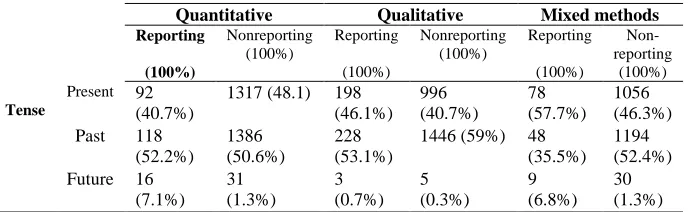
Alternatively, if we look at the table horizontally, it can be noted that the nonreporting present tense in quantitative theses were more frequent than the nonreporting present tense in other two research theses while the reporting past tense verbs in qualitative and quantitative theses respectively outnumbered their counterpart verbs in the mixed methods theses. As it can also be clearly seen, the non-reporting future tense verbs in the quantitative theses were the most in comparison to the other two categories.
Table 3
Tense in the discussions of Theses across Research Approaches
The following examples are but a few cases illustrating how verb tenses interact with the reporting and nonreporting status across the three thesis types. Example 5, taken from a quantitative thesis, demonstrates a verb in the present tense in a nonreporting fashion. It seems the writer intended to show that the fact is true over all times and across all circumstances. Example 6 illustrates a verb in the past tense in a nonreporting status, which showcase an analysis which holds true for the past. Example 7 displays a future possibility by employing a future tense verb in a nonreporting status.
Example 5:
(Present)The degree of conscious awareness of one's learning plays an important role in the clarity of learning (Nourozi Larki, 2013).
Example 6:
(Past)This analysis showed the range of effectiveness of tasks in extracting a scope of pragmatic meaning from native and nonnative speakers (Maleki, 2010).
Quantitative Qualitative Mixed methods
Reporting (100%) Nonreporting (100%) Reporting (100%) Nonreporting (100%) Reporting (100%) Non-reporting (100%) Tense
Present 92
(40.7%)
1317 (48.1) 198 (46.1%) 996 (40.7%) 78 (57.7%) 1056 (46.3%) Past 118
(52.2%)
1386 (50.6%)
228 (53.1%)
1446 (59%) 48 (35.5%)
1194 (52.4%) Future 16
Example 7:
(Future)Intentional learning will influence learner's proficiency because it is more likely to lead to explicit than implicit knowledge (Shamiri, 2014).
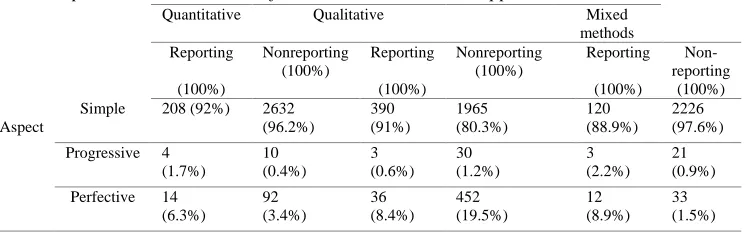
Another dimension of verbs that is of concern in this study is the aspect of the verb. It deals with the writers or speakers' view of an action or a state. It has been suggested that many nonnative speakers have doubts about usage of perfective verbs, and a graver situation has been reported to prevail in academic writing where writers draw on avoidance strategies. In this study, the frequency of the occurrences of verb aspects were surveyed. Table 4 provides information on the use of different verb aspects across theses written based on the three research approaches targeted at in this study. Another interesting line of inquiry would be to detect and cross-tabulate the interplay between tense and aspect which is not the concern of the current study.
Table 4
Aspect in the Discussions of Theses across Research Approaches
It is obvious that the simple aspect is dominant in the three types of theses. Moreover, except for the mixed methods theses, the percentages of reporting and nonreporting verbs in the simple aspect are proportionally close to one another. Progressive aspect does not form a significant share among other aspects. This can be testified by looking at the low percentages it represents. Perfective aspect also featured much less than the simple aspect; however, in the qualitative theses, there were many cases of non-reporting
Quantitative Qualitative Mixed
methods Reporting (100%) Nonreporting (100%) Reporting (100%) Nonreporting (100%) Reporting (100%) Non-reporting (100%) Aspect
Simple 208 (92%) 2632
(96.2%) 390 (91%) 1965 (80.3%) 120 (88.9%) 2226 (97.6%)
Progressive 4
(1.7%) 10 (0.4%) 3 (0.6%) 30 (1.2%) 3 (2.2%) 21 (0.9%)
Perfective 14
verbs in perfect aspect. The following examples show how the aspect of the verb interact with the reporting and nonreporting status.
Example 8:
(Simple) People learn about the thinks that they pay attention to and do not learn much about the things do not attend to (Azimi Tabar, 2012).
Example 9:
(Progressive) The zone of proximal development was transforming to the zone of actual development (Rafiee Samani, 2012).
Example 10:
(Perfective) Ellis (as cited in Toulabi, 2014) asserts that intentional learning has been proved to be more effective than incidental learning for both vocabulary and grammar.
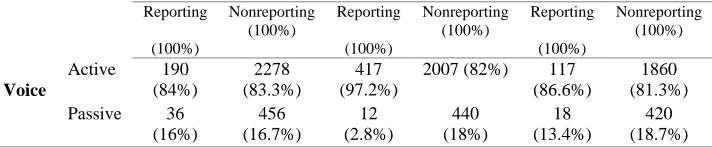
The last dimension examined in this study was the voice of the verbs. Many researchers find mastering this dimension as an obstacle to language learners (Hinkel, 2004; Williams, 2008). In this study, the instances of occurrence of the active and passive voice were considered in the Discussions of three types of theses with regard to the research approach they have employed. This analysis tended to reveal if there exist any associations between the voice of verbs and research approach guiding the thesis. Table 5 shows the frequency and percentages of active and passive verbs across research approaches.
Table 5
Voice in the Discussions of Theses across Research Approaches
As shown in Table 5, the use of active voice is much more frequent than the use of passive voice in all the three types of theses. Looking at frequencies, there seems to be an equal distribution of active and passive verbs in the nonreporting verbs across the three types of theses; however, in terms of the reporting verbs, the qualitative theses contained a proportionally
Reporting (100%) Nonreporting (100%) Reporting (100%) Nonreporting (100%) Reporting (100%) Nonreporting (100%) Voice
Active 190 (84%)
2278 (83.3%)
417 (97.2%)
2007 (82%) 117 (86.6%)
1860 (81.3%) Passive 36
larger number of active verbs than the other two types of theses. The following examples show the instances where the voice of the verbs intersects with the reporting and nonreporting status of the verbs across the three these types. Example 11 represents an action whose the doer of the action is known; hence, an active voice is chosen to highlight the agent of the action, while example 12 is stated in passive voice to highlight the action itself and downgrade the doer of the action. In these two examples, the verbs are nonreporting.
Example 11:
(Active)Chan and Liou (as cited in Ebrahimi, 2016) conducted a survey focused on collocation learning through Web-based concordance.
Example 12:
(Passive)Correlation analysis was done in order to examine the relationship between grammatical knowledge and pragmatic knowledge (Abroshan, 2014).
5. Discussion
of nonreporting verbs in the discussions of RAs. However, there was a difference in the percentage of reporting verbs of the qualitative theses (14.9%). This percentage is higher than the reporting verbs in other types of theses. This can be explained by the nature of qualitative work where narratives and interpretive language overrides other genres of writing. Another reason can be the marginal appeal the writers of this thesis type make to refer to previous literature in the discussion.
concerns about tense use by EFL learners (Guiora, 1983; Hawes & Thomas, 1997; Riddle, 1985). This is because students who are supposed to write a thesis in English have mastered tenses and often receive feedback from their supervisors to correct their mistakes.
Another dimension regarding the verbs in the discussions was the aspect. It was revealed that the simple aspect was the most typical among the three verb aspects in English, followed by perfective and progressive aspects respectively. An interesting finding was that there was an equal distribution of aspects between reporting and nonreporting verbs within discussions of each thesis type. This means that there was a sheer dominance of simple aspect and a blatantly insignificant number of verbs in perfective and progressive aspects. This is justified by reference to the completed actions the writers intend to describe rather than ongoing actions or incomplete events. The perfective aspect, though very much rare in comparison to the simple aspect, was most often used to describe actions that had a causal link to the present actions. This has already been verified by other researchers (Hawes & Thomas, 1997; Hinkel, 2004; Tafaroji-Yeganeh and Boghayeri, 2015; Thompson & Ye, 1991).
categories predominantly made use of active voice can be attributed to the descriptive and argumentative nature of the discussions. Writers topicalize the findings and use evaluative expressions to make the utterances more convincing. The evaluative apparatus is used either to detach writers from the propositions they have put forth or boost the relevance of the findings in the eye of the readers (Hyland, 2000). The findings of this study are in consistence with the findings of previous research (Hinkel, 2004; Tarone et al., 1981), in which an assertion is made about a general tendency among writers for exploiting active voice in the discussion of RAs and theses. The passive voice however is often used in the method section where writers describe the procedures and other related aspects (Holmes, 1997; Swales, 1990)
6. Conclusion
This study intended to investigate the nature of verbs in the discussion of theses written based on three main research approaches, that is, quantitative, qualitative, and mixed methods. Descriptive statistics was utilized to reveal any differences among the three types of theses with regard to clause types, the reporting status of verbs, verb tense, aspect, and voice. No difference was found except for the use of progressive aspect for the reporting verbs in the qualitative theses and the use of passive voice for the nonreporting verbs in the mixed methods theses. The findings of this study lend support to Myles (2002) and Lai’s (2004), who view attention to grammar and teaching it essential even at higher levels of proficiency due to the functional meanings attached to certain forms.
very few errors in verbs were detected and this is probably because of the process of reviews that a thesis undergoes before it is accepted.
This study is not without its limitations. First and foremost, although significant the differences in the study found, they do not allow for generalizations. Another limitation is that this study was exploratory in nature and it did not present qualitative accounts of the data. This can be taken up by other similar studies in which both quantitative and qualitative measures would conjoin to reveal better pictures of the genres under study. Another line of enquiry can be a comparative study of native and nonnative corpora in relation to the variables considered in this study. Furthermore, investigating whether these written by EFL learners aspire to emulate native-like norms is arguably an important question to be addressed. A further area of research can investigate the interplay between the variables of this study. This means, for instance, the interaction of voice with aspect and tense at the same time. This was not pursued in this study due to space limitation. In addition, further research which includes a focus on analyzing verbs on PhD dissertations would lead to a more complete picture of tense use.
References
Abroshan, M. (2014). The impact of conscious raising video-driven prompts on the pragmatic development of situational routines among Iranian male/female EFL learners. Unpublished master's thesis. Islamic Azad University of Ahvaz, Iran.
Amnuai, W. (2017). The textual organization of the discussion sections of accounting research articles. Kasetsart Journal of Social Sciences.
Retrieved from:
https://www.sciencedirect.com/science/article/pii/S2452315117302199 Annesley, M. (2010). The discussion section: Your closing argument.
Clinical Chemistry, 56, 1671-1674.
Anvari, S. (2013). Using lexical inferencing strategies while reading: the case of successful versus less successful EFL inferences. Unpublished master's thesis.Islamic Azad University of Ahwaz, Iran.
Atai, M. R., & Falah, S. (2005). A contrastive genre analysis of result and discussion sections of applied linguistic research articles written by native and non-native English speakers with respect to evaluated entities
and ascribed values. Retrieved from
http://paaljapan.org/resources/proceedings/PAAL10/pdfs/atai.pdf
Azimi Tabar, H. (2012). The effects of emotional intelligence on male and female high school students’ performance in production and recognition of test item formats of reading comprehension. Unpublished master's thesis.Islamic Azad University of Ahvaz, Iran.
Bardovi-Harlig, K. (2000). Tense and aspect in second language acquisition: Form meaning and use. Oxford: Blackwell
Basturkmen, H. (2012). A genre-based investigation of discussion sections of research articles in dentistry and disciplinary variation. Journal of English for Academic Purposes, 11(2), 134-144.
Basturkmen, H., Loewen, S., & Ellis, R. (2004). Teachers' stated beliefs about incidental focus on form and their classroom practices. Applied Linguistics, 25, 243–272.
Bitchener, J. & Basturkmen, H. (2006). Perceptions of the difficulties of postgraduate l2 thesis students writing the discussion section. Journal of English for Academic Purposes, 5, 4-18.
Chen, C. C. (1979). An error analysis of English composition written by Chinese Student in Unpublished doctoral dissertation, university of Texas. Austin.
Cowan, R. (2008). The teacher's grammar of English: A course book and reference guide. New York: Cambridge University Press.
Creswell, W. (2003). Research design: Qualitative, quantitative, and mixed methods approaches (2nd Ed.). Thousand Oaks, CA: Sage.
Crystal, D. (2004). Making Sense of Grammar. London: Pearson Longman. Dashab, E. (2016). Exploring the effects of exposure to L2 on Iranian
intermediate EFL learners’ acquisition of L2 structures. Unpublished master's thesis.Islamic Azad University of Ahwaz, Iran.
Dornyei, Z. (2007). Research methods in applied linguistics. New York: Oxford University.
Ebrahimi, M. (2016). The effect of corpus-based instruction via the Antcone software on EFL learners’ knowledge of collocations. Unpublished master's thesis.Islamic Azad University of Ahvaz, Iran.
Hopkins, A., & Dudley-Evans, A. (1988). A genre-based investigations of the Discussions s in articles and dissertation. English for Specific Purposes, 7(2), 113-122.
Ellis, R. (2002). The place of grammar instruction in the second/foreign language curriculum. In E. Hinkel & S. Fotos (Eds.), New perspectives on grammar teaching insecond language classrooms (pp. 17–34). Mahwah, NJ: Lawrence Erlbaum.
Ershadi, S., & Farnia, M. (2017). Comparative generic analysis of discussions of English and Persian computer research articles. Komunikacija i kultura online, 6(6), 15-31.
Faraji Birjandi, F. (2012). The relationship between Iranian EFL learners’ interpersonal and intrapersonal intelligence and their speaking accuracy and fluency. Unpublished master's thesis. Islamic Azad University of Ahwaz, Iran.
Green, P., & Hecht, K. (1992). Implicit and explicit grammar: An empirical study. Applied Linguistics, 13, 168–184.
Guiora, A. (1983). The dialectic of language acquisition. Language Learning. Hashemi, M. & Babaii, E. (2013). Mixed methods research: Toward new research designs in applied linguistics. Modern Language Journal, 97(4), 828–852.
Hawes, T., & Thomas, S. (1997). Tense choices in citations. Research in the Teaching of English, 31(3), 393-414.
Hewitt, M. (2007). How to search and critically evaluate research literature. The NIHR RDS for the East Midlands /Yorkshire & the Humber.
Hinkel, E. (1992). L2 tense and time reference. TESOL Quarterly, 26(3), 557-572.
Holmes, R. (1997). Genre analysis, and the social sciences: An investigation of the structure of research article Discussion s in three disciplines. English for Specific Purposes, 16(4), 321-337.
Hough, G. A. (1984). News writing. Boston: Houghton Mifflin.
Huang, S. L. (2001). Error analysis and teaching composition. Unpublished master's Dissertation, Taiwan: National Tsing Hua University.
Hyland, K. (2000). Disciplinary discourses: Social interactions in academic writing. London: Longman
Jalilifar, A. R., Hayati, A. M., & Namdari, N. (2012). A comparative study of research article discussion sections of local and international applied linguistic journals. The Journal of Asia TEFL, 9 (1), 1-29.
Kelin, W. (1994). Time in Language. London: Routledge.
Lackstrom, J., Selinker, L., & Trimble, L. (1972). Grammar and technical English. English Teaching Forum, 10(5),3-14.
Lai, S. J, (2004). High school English teachers' beliefs on grammar instruction in Taiwan. Unpublished master’s thesis, National Taiwan Normal University, Taipei, Taiwan.
Lee, C. T., & Haseltine, P. (2001). Basic English grammar. Taipei: Lingin. Leech, G. (1983). Principles of pragmatics. London: Longman.
Makokn, L. (1987). What rules govern tense usage in scientific articles. English for Specific Purposes, 13, 31-44.
Maleki, Sh. (2010). A comparative study on effects of teaching key word method vs semantic mapping on Iranian ESP students’ vocabulary recall. Unpublished master's thesis. Islamic Azad University of Ahwaz, Iran. Myles, J. (2002). Second Language Writing and Research: The Writing
Process and Error Analysis in Student Texts. TESL-EJ, 6(2), 1-20. Manan, N. A., & Noor, N. M. (2014). Analysis of reporting verbs in Master's
theses. Procedia-Social and Behavioral Sciences, 134, 140-145.
Moyetta, D. (2016). The discussion section of English and Spanish research articles in psychology: A contrastive study. E.S.P. Today, 4 (1), 87-106. Nguyen, L. T. T., & Pramoolsook, I. (2015). Move analysis of
results-discussion chapters in TESOL master’s theses written by Vietnamese students. 3L: Language,Linguistics, Literature,21(2).
Nodoushan, M., & Khakbaz, N. (2011). Theses ‘Discussion’sections: A structural move analysis. International Journal of English Studies, 5(3), 111-132.
Oster, S. (1981). The use of tenses in reporting past literature. In SeIinker, Tarone, & HanzeIi (Eds.), English for academic and technical purposes: Studies in honor of Louis Trimble. Newburg House.
Paltridge, B. (2002). Thesis and dissertation writing: An examination of published advice and actual practice. English for Specific Purposes, 21(2), 125–143.
Paltridge, B., & Starfield, S. (2007). Thesis and dissertation writing in a second language. New York: Routledge.
Peacock, M. (2002). Communicative moves in the discussion section of research articles. System, 30(4), 479-497.
Pecorari, D., & Petrić, B. (2014). Plagiarism in second-language writing. Language Teaching, 47(3), 269 – 302.
Rafiee Samani, R. (2012). The role of self-directed learning strategy in developing speaking of Iranian EFL learners and different proficiency levels. Unpublished master's thesis. Islamic Azad University of Ahwaz, Iran.
Reimerink, A. (2007). The use of verbs in research articles: A corpus analysis. Terminology, 13(2), 177–200.
Riddle, E. (1985). The meaning and discourse function of the past tense in
English. TESOL
Quarterly, 20(2), 267-286.
Rudestam, E., Newton, R. (2007). Surviving your dissertation: A comprehensive guide to content and process (3rd Ed.). Michigan: Sage
Publications.
Sabzalipour, B. (2012). Error analysis on students' Persian – English translation. Asian journal of social sciences & humanities, 1(4), 71-76. Salahshour, P. (2014). The effects of WhatsApp messenger on the Iranian
EFL learners’ learning Idiomatic expressions at the intermediate level. Unpublished master's thesis. Islamic Azad University of Ahwaz, Iran. Samraj, B. (2002). Introductions in research articles: variations across
disciplines. English for Specific Purposes, 21(1), 1-17.
Shamiri, H. (2014). The effect of implicit versus explicit corrective feedback on Iranian intermediate EFL learners’ speaking self-efficacy beliefs. Unpublished master's thesis. Islamic Azad University of Ahwaz, Iran. Shaw, P. (1992). Reasons for the correlation of voice, tense and sentence
function in reporting verbs. Applied Linguistics, 13, 302-319.
Silva, T. (1993). Toward an understanding of the distinct nature of L2 writing: The ESL research and its implications. TESOL Quarterly, 27, 657-677.
Smith, C. S. (2003). Modes of discourse. Cambridge: Cambridge University Press Cambridge.
Swales, J. (1981). Aspects of article introductions. Birmingham, UK: The University of Aston, Language Studies Unit.
Swales, M. (1990). Genre analysis: English in academic and research settings. Cambridge University Press: Cambridge.
Swales, M. (2004). Research genres: Explorations and applications. Cambridge University Press: Cambridge.
Tafaroji Yeganeh, M., & Boghayeri, M. (2015). The frequency and function of reporting verbs in research articles written by native Persian and English speakers. Procedia - Social and Behavioral Sciences, 192, 582 – 586.
Talebzadeh, H., Ghafar Samar, R., Kiany, G. R., & Akbari, R. (2013). Steps to a Successful Abstract: A Comparative Genre Analysis. Intl. J. Humanities, 20 (3), 1-25.
Tarone, E., Dwyers, S., Gilette, S., & Icke, V. (1981). On the use of the passive in two astrophysics journal papers. The ESP Journal, 1, 123-140. Thompson, G., & Ye, Y. Y. (1991). Evaluation in the reporting verbs used in
academic papers. Applied Linguistics, 12, 365-382.
Toulabi, A. (2014). Dynamic assessment of vocabulary depth and breath: The case of intermediate Iranian EFL learners. Unpublished master's thesis. Islamic Azad University of Ahwaz, Iran.
Williams G. (2008). Verbs of science and the learner’s dictionary. In Bernal, E.; DeCesaris, J. (Ed.). (2008). Proceedings of the 13th EURALEX International Congress. Barcelona, Universitat Pompeu Fabra
Williams, I. (2010). Cultural differences in academic discourse: Evidence from first-person verb use in the methods sections of medical research articles. International Journal of Corpus Linguistics, 15(2), 214–239. Wong, S. H. (1999). A study of the performance of English tense and aspect
forms used by junior and senior high school students in Chia-yi area, Taiwan. Unpublished master thesis: Tsing-Hua University, Taiwan. Wong, W. (2003). The effects of textual enhancement and simplified input on
L2comprehension and acquisition of non-meaningful grammatical form. Applied Language Learning, 14, 109-132