Journal of Computing and Security
A Study on Intelligent Authorship Methods in Persian Language
Zeinab Farahmandpour
a, Hooman Nikmehr
b,∗
aDepartment of Computer Engineering, Faculty of Engineering, Bu-Ali Sina University, Hamedan, Iran. bDepartment of Computer Architecture, Faculty of Computer Engineering, University of Isfahan, Isfahan, Iran.
A R T I C L E I N F O.
Article history:
Received:24 September 2014
Revised:26 January 2015
Accepted:15 May 2015
Published Online:7 February 2016
Keywords:
Authorship Attribution, Writing Style, Writeprint, Human Stylome
A B S T R A C T
Author identification is an attempt to demonstrate the characteristics of the author of a piece of language information so that in the end, it would be possible to significantly distinguish the difference between various texts written by different people. The rapid development of Internet communication has caused Internet tools with anonymous identity, such as emails and weblogs, to become popular communication methods for the perpetrators of illegal acts and has raised some security concerns. Persian language is of interest to a great number of different individuals and organizations for various reasons such as political, social, artistic, cultural and religious issues. In this paper, a number of intelligent writeprint methods which help automatic identification of a Persian writer based on his/her writing style are studied and compared. For this purpose, after collecting two different databases, five feature types including lexical, syntactic, semantic and application-specific features, were used for extracting stylometric characteristics. In this study KNN, Delta, Neural Networks, Decision Tree and Linear Discriminate Analysis classification methods were applied to these databases. The results and their comparison showed that Linear Discriminate Analysis and KNN methods ranked first and second, respectively, in terms of accuracy among the studied methods.
© 2015 JComSec. All rights reserved.
1 Introduction
Identification of the author is finding or getting close enough to the real author of a text particularly in a collection of nominated authors. To achieve this goal, the distinctive information of the authors has to be recognized and analyzed using some models. Author identification is one of the oldest issues in stylistics from one hand, and one of the newest on the other hand [1]. Author identification not only can attract the attention of scientists but also, in a more practical
∗ Corresponding author.
Email addresses:[email protected](Z. Farahmandpour),[email protected](H. Nikmehr) ISSN: 2322-4460 © 2015 JComSec. All rights reserved.
context it can be a favorite issue for politicians, jour-nalists and lawyers [1,2]. Since the creation of words and documents, there have been debates about the ownership of words and identity and characteristics of the documents’ author. So author identification can be defined as an attempt to demonstrate the charac-teristics of the producer or the author of a piece of language information. The key assumptions in author identification consist of access to a sample text which is definitely written by a member of the set of authors and also specification of the author of that text.
of measurable specific characteristics which can be used for identification of a particular author, ”Hu-man Stylome”. Since every hu”Hu-man being has unique biometric characteristics and behavior patterns, it can be said that some language and writing related characteristics such as using specific patterns of word sequences, layouts, syntactic and structural features that are called stylistic characteristics remain rela-tively constant in people. Learning and recognition of these characteristics with high accuracy is a de-bating subject in the text author identification area. Theoretically, acceptable reasons can be put forward for the hypothesis of possibility of existence of such qualities. Since everyone learns language individu-ally and their experiences as language learners are different from each other, the language that different people learn would have little differences in various but small aspects.
Although using the document analysis science and also expert judgments can conventionally result in good conclusions in author identification, recent ad-vances in statistical techniques and application of ma-chine learning on accessible computer sources and ob-jective and automatic inferences form texts, have cre-ated scientific and more reliable methods in author identification. This paper implements author identi-fication for Persian language using all four types of features that have been used for English language with automatic machine learning methods on the two collected standard databases and compares their re-sults. In Section 2 a background on author identifi-cation will be presented. The characteristics used for identification of the unique writing style of an au-thor are explained in Section3. Then in Section4the author identification methods are introduced and in Section5adopting the author identification methods for Persian language is discussed. Section6evaluates the recommended system and then compares differ-ent methods of machine learning used in Persian lan-guage author identification. Section7is dedicated to discussion.
2 Research Background
The basic idea of statistical (or computational) identi-fication of the author is the quantitative measurement of the text’s characteristics so that the differences be-tween texts written by different people can be distin-guished. The first attempt to measure writing styles was carried out when Mendenhall did some studies on the Shakespeare’s plays (1887). Later, in the first half of the twentieth century, some statistical research projects were conducted on literary texts [5–7]. Then to determine the identity of the author, more detailed investigations were performed on the data collection
of “The Federalist Papers” by Mosteller and Wal-lace [1] which is, without a doubt the strongest and most effective research ever conducted in this field. Their method basically moved away from traditional approach of author identification which was identify-ing the author based on human judgment. From then on and until 1990s, studies regarding author identi-fication, focusing on defining the text attributes for assessment of the writing style (a branch of research called Stylistic), resulted in introduction of many di-verse measures such as the length of the sentences, the length of the words, the number of words’ oc-currences, the number of repeating characters and the lexical richness functions [8,9]. In another study, nearly 1000 different measures were introduced [10]. It is worth mentioning that during this period, i.e. up until 1990, since the idea of creating a full automated system of author identification was hardly considered, the presented identification methods were only using computers rather than being computer-based.
Considering the amount of available electronic texts, the applicability of the author identification methods in variety of applications can be easily un-derstood. Some of which are: literary researches (e.g. identification of the anonymous author of a contro-versial literary product from known authors) [11,12], artificial intelligence (such as identification of ter-roristic messages or statements from a set of known terrorists) [13], criminal law (e.g. identification of authors of threatening messages, identification of au-thors of suicidal notes), civil law (the infringement of laws used in intellectual property issues) [2, 14], computer debates (e.g. identification of authors of malwares or computer viruses) [15]. In such cases, the author attempts to hide his identity for criminal purposes.
Nowadays, statistical and machine learning meth-ods are very common methmeth-ods for author identifica-tion. Burrows was the first to use Principal Compo-nent Analysis in 1987 that attracted attention of re-searchers due to its high differentiation ability [16]. Other multi-variable methods such as Cluster Analy-sis and Discriminant AnalyAnaly-sis [17,18] have produced good results in author identification as well.
Powerful machine learning techniques have had a lot of applications these years. Tweedie, Lowe, Math-ews et al. used Neural Network for this purpose [18,
19]. While Diedrich, de Vel et al. have successfully ap-plied SVM method for author identification [20,21].
becom-ing increasbecom-ingly more important. So far, studies have been conducted on English, Greek, Chinese and Ara-bic. Peng et al. performed tests on English texts, Chi-nese novels and Greek newspapers [22]. Zheng et al. implemented author identification on Internet mes-sages in English and Chinese, etc. [23–26]. Feature extraction for author identification does not have the same difficulty in different languages. Most features of writing style have been designed for English and it is possible that these features are not equally applica-ble for other languages. The structural and linguistic differences in different languages can possibly make the extraction of the features difficult.
Persian language is the official language in Iran, Afghanistan and Tajikistan, and tens of millions of people speak in this language. Different groups of peo-ple are related to this language for political, social, artistic, historical, cultural and religious reasons. The morphological differences of this language with En-glish have resulted in negligence in implementation and design of natural language processing tools con-sistent with Persian language. This might have partly caused the negligence of author identification in this language. In this paper, some of the well-known tech-niques in author identification are implemented for Persian texts.
3 Stylistic Features
Previous studies on author identification have defined and classified some features for recognition of writ-ing styles [8,26,27]. Writing style features extracted from the text, show the style of people’s writings and simplify the author identification process. The writ-ing styles of individuals are different in various as-pects. The main classification of these features con-sists of lexical, characteristic, syntactic, semantic and application-specific features.
3.1 Lexical Features
The lexical features of a text are known as sets of clauses that are divided into components called to-kens. Each token can be a word, a figure or a punc-tuation mark. The main advantage of these features is that they are applicable in any language and with any set of texts by using the tokenizer tool (which divides a text into a set of tokens).
The lexical richness function, models the distribu-tion of words in a text. The size of the lexis is another measure which strongly depends on the length of the text. In the way that at the beginning of the text, the size of the lexis increases rapidly and by reaching the end the increasing trend of the lexis size slows down.
In another method, regardless of the content informa-tion, the text is considered as a set of words each of which is repeated a certain number of times in the text [28].
3.2 Characteristic Features
The characteristic features consider the text as a set of character strings. Some of the other features of this category can be the number of characters in the text, numbers in the text, capital and small letters, rep-etitious and punctuation characters [21, 26]. It has been proven that this group of information, which can be easily obtained for every natural language, is relatively suitable for determination of the writ-ing style [29]. Cavnar and Trenkle [30], introduced
n-gram as an n-character piece of a longer charac-ter string. This feature which can extract subtle style differences (including lexical information) is remark-ably noise (spelling errors) tolerant. The Character
n-gram extraction method is very simple in terms of computation. For example Character4-gram for the current paragraph would be as follows:|The-|,|char|,
|acte|,|rist|, |ic-f|, |eatu|, . . .. In a study [31], it was found that in an author identification process, the Charactern-gram with different “n”s is a more suit-able feature than a lexical feature. A diverse number of authors have shown that a number of Charactern -gram repeats might be better than even the - grammat-ical features for obtaining lexgrammat-ical information. They are useful without the need for language informa-tion background. It is noteworthy that the Charac-tern-gram feature is conducted on words related to both the content and the subject. This feature gener-ates useful information only if all of the texts in our database are on the same subject.
3.3 Syntactic Features
Since an author unconsciously tends to use the same syntactic patterns, using syntactic features provides a more accurate display of the text [24]. This pro-vides a more reliable method for identification of the author than the lexical features. Extracting syntactic information requires powerful and accurate tools for processing the natural language (NLP) which are able to syntactically analyze texts. Extraction of syntac-tic features is a text-related procedure and requires a parser which can analyze a particular natural lan-guage with high precision. Moreover, the syntactic at-tributes generate a set of features with low precision due to inevitable errors of the parsers. Baayen, Hal-teren and Tweedie [33] were the first people to use syn-tactic information for author identification. Using the complete tree decomposition procedure of every sen-tence, they analyzed the corpus set syntactically and extracted the number of occurrences of the re-writing rules. Each re-writing rule expresses one part of a syn-tactic analysis. For example an adverb preposition phrase consists of the preposition and a noun phrase followed by a prepositional predicate. This detailed information shows the syntactic group of each word and the composition of words to make phrases and other structures. The reported results suggest that this attribute is better than lexical and lexical rich-ness features. The extracted attribute includes the number and the length of noun phrases and clauses.
The occurrence of the common words, such as prepositions, articles and pronouns, which are called function words, is one of the very good features for author identification [16,34]. The main advantage of this attribute is its independence to the text’s subject since these words do not carry any semantic informa-tion. Another important advantage of this attribute is that the author uses the function words uncon-sciously; this means that the writing style of the writer of different texts with different subjects can be reflected in the function words used by him/her. The choice of these words is usually based on the criteria that are introduced by linguistics. A simple yet successful method to define function words for author identification is to extract words with high occurrences in the corpus of the nominated authors. In studies conducted by Burrows [16, 35] a set of 100 function words have been recognized suitable for displaying the author’s style.
3.4 Semantic Features
Semantic features more precisely analyze the text and provide more applicable features. This is done by ob-taining the semantic dependency graph including the semantic features and modification relations.
The tense and the mode of the verbs used by the author and the semantic similarity between the words in the text are another example of such features. The words and phrases that join clauses together are known as conjunctions. Different patterns of using conjunctions [36] result in remarkable differences in writing styles. According to Hildi and Mason [37], conjunctions are categorized into three groups of “descriptive”, “exponential” and “elaborative”. The descriptive conjunctions deepen the content of the text by illustrating and re-focusing. Using descriptive conjunctions can have a good effect on the text and provide solidarity throughout the whole text. The ex-ponential conjunctions would add more information into the text, even sometimes antithetical to the cur-rent concepts. Repetitive usage of these conjunctions aggregates the text information but if these conjunc-tions are not used enough it is possible for the reader to get lost among the multiple and various concepts. The elaborative conjunctions describe the text with details or logical relationships.
McCarty et al. [38] defined another approach for semantic measure extraction. According to the Word-Net [39], they have well recognized the information about the word’s synonyms. Moreover, they used the Latent Semantic Analysis for lexical features in order to automatically recognize the semantic similarities between words [40].
3.5 Application-Specific Features
The application-specific features can be used for a more delicate presentation of differences in people’s styles in a specific confine. The application-specific features, in fields such as electronic messages, are the application of structural measures which includes us-ing greetus-ings in messages, different types of signa-tures, dips, the length of the paragraph, etc. [3,21,26,
41]. In addition, when the text is in the form of HTML, the HTML Tag distribution-specific features [21] such as the colors and the sizes of the fonts can be used as application-specific features [13]. These features are very important in short texts, where the stylistic fea-tures of the text content are not enough, and accurate tools are required for extracting them.
4 Data Classification Methods
4.1 Density Estimation Using K Nearest Neighbor Method
The KNN method is a probabilistic model in which to identify the author of an anonymous text,K sam-ples of the training texts, in the feature space, which have the least distance from the anonymous text, are taken and the author who has the most number of texts among these K texts is selected as the author of the unknown text [42]. This method estimates the probability of the anonymous text belonging to the
ithauthor through b
p(x|i) =ni
k (1)
where, ni is the number of texts that belong to the
ithauthor in the set ofKtexts which have the most similarity to the anonymous text. K is constant in every probability calculation.
Suppose that there arentraining texts with their authors known and we are going to classify a text with an anonymous author,x, in one of the abovec
classes (author). To use the KNN method, first a scale should be selected for measuring the distance (such as the Euclidean distance). Then the following steps should be taken:
A. The distance of each training text with the text
xis calculated;Ktexts which are the closest to the textxare selected regardless of their class (author).
B. The number of each author’s texts in this K
texts is determined and called ni where i =
1,2, . . . , cand∑ini=k.
C. The text x is assigned to the author who has the most number of texts among the K texts, i.e. the largestni.
4.2 Delta Method
In 2002, a method was presented by Burrows [11] ex-clusively for author identification namely Delta. In this method, the normalized difference of the number of word occurrences (a set of n desired words, usu-ally the most repetitious words) in the textDof the known author and the number of occurrences of the same words in textD′with anonymous author is cal-culated using Equation (2). In this equation,σiis the
standard deviation of the ith word in the compara-tive set and fi(D) is the number of occurrences of
the word wi (the number of occurrence of theith
de-sired word) [43]. This method calculates the distance between the two texts,D′being the test anonymous text andDthe written training text by a nominated author, as follows:
∆(Bn)(D−D′) =
n
∑
1
1
σi|
fi(D)−fi(D′)| (2)
This method classifies the nominated authors of the textsD′considering their distances from the test text
D, while after each difference, the number of words occurrences reduces by a factor of 1
σi. In this equation
the test document is classified into the group closest to the specified training document. This method uses the function word distribution feature for classifica-tion.
4.3 Neural Networks
The neural network algorithm is one of the most widely used and most practical modeling methods for large and complex problems. In 1958, Rosenblatt [44] introduced the concept of single-layer perceptron as a useful tool for classification of a set of data into two classes and he offered a proof for stability of the perceptron learning rule. Each multilayer perceptron neural network consists of an input layer. Each node in this layer is equal to one of the predictor vari-ables. Each input node attaches to all nodes of the hidden layer. The nodes of the hidden layer can be attached to another hidden layer or the output layer. The output layer can consist of one or more output variables depending on the problem [45,46]. In this study, a three-layer neural network is used for the implementation of the author identification system. 4.4 Decision Tree
The Decision trees are used for displaying different concepts in artificial intelligence such as the structure of sentences, equations, game modes, etc. Training of a tree is a method for approximating the objective functions with continuous and discrete values. This method is resistant against the noise in the data and is able to learn the conjunction and disjunction syn-tax of the predicates. Due to the high efficiency of the decision tree method in problems with high vol-ume data, this method is used in Data Mining [47]. The decision trees are made by consecutive division of data to separate groups and the purpose of this process is to increase the distances of the groups in each division.
classi-fication of selected features and in the end composes a tree of features that are classified as important. So the features which are located in the root of the tree are more discriminant than other features and as we go farther from the root, the importance and separating quality of the selected features reduces. At the end, the precision of the decision tree is also calculated. 4.5 Linear Discriminant
A common algorithm for classification and data di-mension reduction is Linear Discriminant Analysis (LDA). This method easily manages the modes in which the numbers of members of the classes are not equal. This algorithm intends to maximize the ratio of the between class variance to within-class variance in every database. In-class dispersion is calculated as the covariance for each class. This method takes the data set into another space. In LDA, the form and location of the original data set do not change when converted into another space and the endeavor is to in-crease the separation of the classes [49]. This method seeks a series of features among the extracted features of the texts that can best divide the authors’ classes and since it is a linear method, it ignores all nonlinear features.
5 Adopting
Author
Identification
Methods for Persian Language
The automatic author identification has been imple-mented and used for various languages; however it has not been used to this extent for Persian language [50]. In this Section, the works conducted for the imple-mentation of the automatic author identification in Persian language are explained. First, the stylistic features extracted from Persian texts are discussed. Then methods of feature selection for data volume reduction and elimination of additional information will be investigated. Finally, the collected database for this application in Persian language will be ana-lyzed.
5.1 Stylistic Features Extraction
Different features have been used in different lan-guages for author identification. In this study the most distinguishing of these features are selected. Some of the previously discussed features are discrim-inant by themselves but some others are applicable and provide better results in combination with other features.
In the following, a variety of selected features to be extracted from Persian texts are introduced. Some of the features mentioned in English languages are
not used due to lack of similar extraction system in Persian language.
5.1.1 Lexical Features
The lexical features used in this paper include lexical richness,n-gram and other features that are explained in detail in the following sections.
Lexical Richness
The lexical richness is used to measure the lexical fre-quency in a text. Various metrics are used for measur-ing the amount of richness for the purpose of author identification. The most common metric of this group is type-token ratio which is calculated as V
N whereV
is the number of words andNis the number of tokens in the text. Since these features are affected by the length of the texts, many researchers have presented functions describing these features that are claimed to be length-independent. However our investigations did not show any proof for this claim.
To achieve better results, some scholars have used a set of lexical richness functions, instead of one, in asso-ciation with multi-variable statistical techniques [17]. These functions are not ponderous in terms of calcu-lation. According to some studies [51], the majority of lexical richness functions are very much dependent to the length of the text and are relatively impermanent for texts shorter than1000words.
For measuring the lexical richness, Stamatatos et al. [27] and Baayen et al. [33] have used a collection of 5 functions namelyK,R,W,SandDfor Yule [6], Hon-oré [52], Sichel [53] and Simpson [54], respectively. These functions are defined through expressions
K=10
4(∑∞
i=1 i2vi−N
)
N2 (3)
R=100logN 1−V1
V
(4)
W =NV−α (5)
S =V2
V (6)
D=
V
∑
i=1
Vi
i(i−1)
N(N−1) (7) whereVi is the number of words that have repeated
n-Gram
The n-gram feature works well in texts with noisy inputs. Since in this method, each character string is decomposed into smaller pieces, any kind of errors in the word would affect only a few pieces and other pieces of that word would remain flawless.
To create ann-gram profile, first the input text is read and then the following steps are taken:
• The text is divided into separate tokens. Num-bers, control characters and punctuation marks will be spared.
• All possiblen-grams ofnare generated.
• The n-grams are entered in a hash table and the number of their occurrences in the text is founded.
The largest number ofn-gram occurrences will oc-cur in uni-gram (n = 1) which indicates the alpha-betic characters in the language. In this paper, the
n-gram feature is used due to its importance in the above mentioned studies. In this study, a list of all72 possible uni-grams in the Persian language is used
{ا, ب, پ, ت, ث, ج, چ, ح, خ, د, ذ, ر, ز, ژ, س, ش, ص, ض, ط, ظ, ع, غ, ف, ق, ك, گ, ل, م, ن, و, ه, ي, آ ّب, ّپ, ّت, ّث, ّج, ّچ, ّح, ّخ, ّد, ّذ, ّر, ّز, ّژ, ّس, ّش, ّص, ّض, ّط, ّظ, ّع, ّغ, ّف, ّق, ّك, ّگ, ّل, ّم, ّن, ّو, ّه,
ّي, ًا, ة, ة, ؤ, أ, ء, ئ, ٌا}
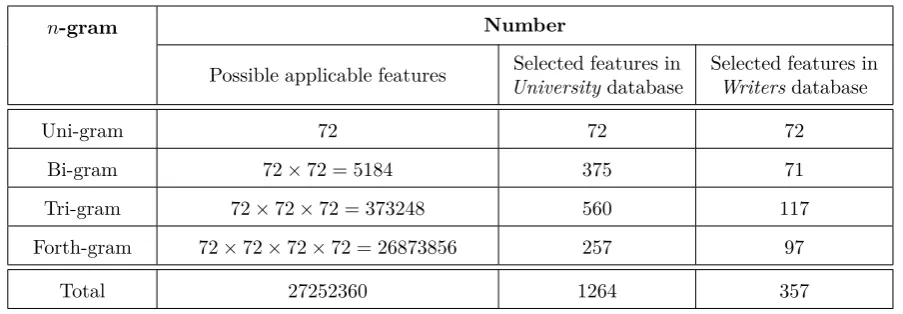
The number of possible bi-grams, tri-grams and forth-grams is very large and obtaining the distribu-tion of their occurrences in the texts would result in features with too many dimensions and too many small values close to zero. Thus, in this paper only the bi-grams, tri-grams and forth-grams that the number of their occurrences is more than10% of the most rep-etitious possible bi-grams,5% of the most repetitious possible tri-grams and 10% of the most repetitious possible forth-grams in the databases introduced in Section 5.3are used. These threshold values are cal-culated considering measures such as the number of authors and the length of the texts and by experi-ence. The number of possible and selected bi-grams, tri-grams and forth-grams are listed in Table1. Lexical Features
In order to benefit from the lexical information as much as possible, the following lexical features are used
• The average number of characters used in words
• The average number of characters used in sen-tences
• The average number of words used in sentences
• The number of all short words equal or shorter than3characters
• Distribution of Persian characters in the text
• Distribution of paragraphs in the text
• Distribution of words with the length of1to30 in the text
• Distribution of English characters in the text
• Distribution of numeric characters in the text
• Distribution of half space character in the text 5.1.2 Syntactic Features
These features find the rules of sentence generation. Features that are extracted from this structure in-clude noun, adjective and adverbial phrases. In this paper, a POS tagger (Part-Of-Speech tagger) is used for extraction of the number of nouns, adjectives and adverbial phrases. This POS tagger relates every word to one of these tags.
POS Tagger for Persian Language
POS taggers are language related tools that recognize and label words based on their role in the sentence. Due to lack of a suitable software tool for automatic identification of nouns, adjectives and adverbs in a Persian text, such tool is designed to complete the research.
According to Tabatabaee [55], the structure of noun, adjective and adverbial phrases can be sim-ple or comsim-plex. If the structure is a simsim-ple one, there is no other way of identification than listing all possible nouns, adjectives and adverbs and then comparing the words with this list. However, if the structure is complex, the structural methods men-tioned By Tabatabaee [55] will be used. In this paper, the method recommended by Sadeghi and Zandi-Moghadam [56] for dividing the words is followed. For instance, an adjective like “ﺎﺒﯾز” (beautiful) has a simple structure and it should be put in a list to be identified; but a noun like “ﺮﮔرﺎﮐ” (worker) has a complex structure and it consists of “رﺎﮐ” and “ﺮﮔ” whereas “رﺎﮐ” is a noun and “ﺮﮔ” is a noun suffix. Some of the composing structures of noun, adverb and adjective are as follows:
Noun: (noun±ﺮﮔ) / (noun±نﺎﺑ) / (noun±رﺎﮐ). . .
Adjective: (noun±s) / (noun±كﺎﻧ) / (noun±راو). . .
Adverb: (adjective±ﻪﻧآ) / (ﻼﺑ+noun). . .
Table 1. The number of possible applicablen-grams used in each database.
n-gram Number
Possible applicable features Selected features in
Universitydatabase
Selected features in
Writersdatabase
Uni-gram 72 72 72
Bi-gram 72×72 = 5184 375 71
Tri-gram 72×72×72 = 373248 560 117
Forth-gram 72×72×72×72 = 26873856 257 97
Total 27252360 1264 357
one of the known and collected structures for nouns, adverbs and adjectives, then it will be labeled appro-priately.
Function Words
In Persian language, a set of922words are introduced by Davarpanah et al. [57] as the function words which include the most repetitious pronouns, verbs, conjunc-tions, prepositions and articles and they are used in this paper. The number of occurrences of each type of function words, “ﺖﺳا” (is), “ﻦﻣ” (me/I) and. . .in each text is found and used as a feature.
Punctuation Characters
The number of punctuation characters in the text is one of the syntactic features that can differentiate people’s writing styles. In Persian language, the num-ber of usage of punctuation marks, such as “?” and “!”, by each author in each text is extracted and
uti-lized.
5.1.3 Semantic Features
The way authors use conjunctions can differentiate the texts written by them. According to classification of Persian conjunctive adjuncts and based on the the-oretical framework of Hildi and Mason [37], the ad-juncts are categorized in three groups. In this study, based on this classification, the type of adjuncts in each text was determined and the number of occur-rences of each was calculated and the results were used as semantic features. In any case, to have more prepositions, each group was expanded by adding the synonyms so that each preposition would fit in one of the categories.
5.1.4 Application-Specific Features
Considering the type of texts in the available databases, including books and articles, some of the application-specific features used in this paper, were the distribution of tab, enter, space and line feed characters in the text.
5.1.5 Summary of Extracted Features
More than1500features introduced in Sections 3–5 along with the number of their occurrences collected from the databases, are listed in Table 2 (Features extracted from texts).
5.2 Pre-Processing of Information Collected from Texts
Data pre-processing includes all conversions that are done on the preliminary data and changing them to a form simpler and more effective for the next processes such as classification.
There are different tools and methods for data pre-processing for classification such as normaliza-tion, which converts data to a new one with suitable changing of confine and distribution, and dimension reduction, which is used for elimination of the repet-itive, overflow or irreverent data [58, 59]. Features with larger values have greater effect on the classifi-cation cost function, although it does not necessarily mean they are more important, so it is considered a diverse effect. In this study the normalization and correlation reduction methods introduced in the next section, are used.
5.2.1 Normalization of Features’ Values
Normalization maps data to[−1,1]confine through a linear conversion. For this purpose, ifµi is the
es-timation of the average of the ith feature and σi is
Table 2. Features extracted from the texts.
Features Sub Features Number of
Used Features
Lexical
Lexical Richness 7
n-gram
Depends on text’s length and number of
authors
average length or words 1
average number of characters in sentences 1
average number of words in sentences 6
number of short words with 3 characters or less 3 distribution of alphabet characters in texts 72 distribution of Persian characters in texts 1 distribution of the number of paragraphs in texts 1 distribution of words with the length of 1 to 30 in texts 30 distribution of English characters in texts 1 distribution of numerical characters in texts 1 distribution of half space character in texts 1
Syntactic
distribution of occurrences of noun, adjective and adverbial phrases
4
distribution of function words 922
distribution of punctuation characters 1
Semantic distribution of adjuncts in Persian 36
Application-Specific
distribution of tab character 1
distribution of enter character 1
distribution of space character 1
distribution of empty lines 1
then theith feature is normalized [60] using
yij =
xij−µi
σi
(8) where the mean of converted data in each dimension (feature) is0and its variance is1.
When normalizing the data, it should be taken into consideration that the data extracted from the train-ing texts (the classification design data) and the data extracted from the test texts must be normalized through the same method. Also, the normalization of test data should be done with the mean and variance resulted from the training data.
The dimension of the data must be reduced after normalization. The reason for this dimension reduc-tion can be considered as simplificareduc-tion of the next analyses, performance improvement of the classifica-tion methods funcclassifica-tionalities based on better display of features in feature space, elimination of repetitive information or an attempt for detection of basic struc-ture by obtaining the graphical display of the data. 5.2.2 Eliminating Highly Correlated Features
subset of features is considered suitable if they have a low correlation. In this study, in order to reduce the correlation and thus reducing the repetitive features, the correlations were calculated and one of two fea-tures that had a correlation equal or more than95% with each other was eliminated.
5.3 Databases
Author identification is often used when the author of an anonymous text is searched in a small set of authors. For example, to identify the poet of a poem that is supposed to belong to Hafez.
A suitable training and test sets for an author iden-tification case shall be studied with regard to type and subject so that the identity of the author is the only or the most important dividing factor of the texts [61]. Ideally, all the texts of the training set shall be ex-actly related to one subject; however there are very few sets with this characteristic. Age, education and nationality are other factors that should be closely studied in preparation of ideal evaluation sets. This would reduce the probability of selection of the style of a wide group of people to the writing style of the desired author. In addition, all the texts must be writ-ten during the same period of time so that the prob-ability of style changes is eliminated [62]. Due to the lack of a standard database [61] for Persian writers that can meet these requirements, a database from Bu-Ali Sina University (Universityfor abbreviation) was constructed. To prepare the database, texts with the exact length of 2009 words, (1500words for train-ing and 509 words for test,) were collected from20 junior undergraduate engineering students from the university on a specific subject.
Since the texts of theUniversitydatabase were in-formal, (this would result in inaccuracy of many fea-tures such as the distribution of function words,) and also because these texts were short (this would reduce the validity of some measuring features [63], another database, calledcontemporary writersdatabase, con-sisted of texts from books and articles written by eight recent Persian authors (Ali Ashraf Sadeghi, Moham-mad Ali Forughi, Mojtaba Minovi, Abolhassan Na-jafi, Mohammad Amin Riahi, Ahmad Samiee, Fathol-lah Mojtabaee and Hussein Masumi Hamedani) on subjects in literary field and literary text analysis was constructed (Writersfor abbreviation). For each writer, two documents were collected, with at most 7750words from which5000words were assigned to training and the remaining for test.
According to the profile-based method, in this pa-per, for each author 70% of the texts are selected for training and30% for test. In another evaluation, using a sample-based method, each writer’s profile is
randomly divided intoKsub-samples. To make each sub-sample, that is a set of words, the value ofKwas increased to such extent that the pieces of the text which are used for training and testing are able to demonstrate the stylistic features. The value ofKcan be obtained by experience. From this number of sub-samples, one is used for test andK−1 sub-samples are used to train the classification models. Then the whole process is repeatedKtimes, so that each one of theseKsamples are used only once for the test. Then the average of all outputs resulted fromKtests is cal-culated. This method is calledK-fold cross validation. In this study both methods are used for evaluation.
6 Evaluation and Comparison of
Ma-chine Learning Methods in Persian
Author Identification
In this section, the results of implementation of au-thor identification system in Persian language are pre-sented and in the end, the results are compared with one another.
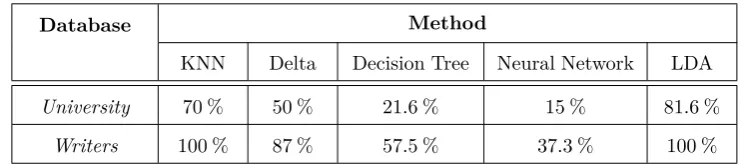
Table 3 indicates the precision of 5 classification methods in identification of the author of an anony-mous text on each database separately.
As mentioned before, University database would not provide much precision due to the texts’ short length and informality of the texts. This result can be observed in all classification methods. As shown in Table 3, KNN method, is displaying high precisions on both databases. As expected and shown in Table3, the statistical method of Delta, which is specifically developed for author identification applications, pro-vides acceptable results. However since it uses only function word feature which is a syntactic feature, it generates less precision in comparison with KNN which uses all features. Since Decision tree method trims the branches in order to prevent heightening and therefore eliminates features important in the de-cision making process, it does not provide a suitable precision in comparison with other methods, as indi-cated in Table3.
Ta-Table 3. Comparison of Classification Methods on two Databases.
Database Method
KNN Delta Decision Tree Neural Network LDA
University 70 % 50 % 21.6 % 15 % 81.6 %
Writers 100 % 87 % 57.5 % 37.3 % 100 %
Table 4. Comparison of the average precision of classification methods versus features types on both databases.
Classification Methods Feature
Lexical and Characteristic Syntactic Semantic Application-Specific
KNN 80 % 66.5 % 49.5 % 49.5 %
Decision Tree 25 % 21.88 % 18.75 % 12.5 %
Neural Network 11 % 12.5 % 16 % 8.75 %
LDA 38.12 % 29.37 % 30 % 39.37 %
Average Precision 38.53 % 32.56 % 28.56 % 27.53 %
ble3, LDA method which uses all kinds of features is showing high precisions on both databases. The rea-son can be the high linear coherency of the extracted features of the texts. The studies conducted in this paper suggest that this method generates better re-sult comparing to other methods if only this kind of features is eliminated from it.
The features in the root of decision tree which was implemented on our databases included distribution of adverbs in the texts which is a syntactic feature, the average of character distribution in the sentences and the number of desired bi-gram occurrences in the texts that are the lexical features. The level one fea-tures included the feature of distribution of adjective phrases from syntactic features and distribution of desired conjunctions in texts which is a semantic fea-ture. The selected feature for the second level is also distribution of the punctuation characters, which is a syntactic feature. This concludes that the mentioned features have the most separating ability among all features and can be used as the important features in author identification applications.
In order to study the effect and the role of different types of features in author identification more closely, in another implementation, the mean of precision of all kinds of features in author identification in two databases of Writers and University are calculated and categorized based on the classification methods. The results are shown in rows3to5of Table4 (Com-parison of the average precision of classification meth-ods versus feature types on both databases). Delta
method that only uses function words is not addressed in this table. The last row of the table presents the mean of the precision of all four classification meth-ods on all features. This table expresses that the set of lexical features has the higher precision and greater separating ability than the other sets. Table3also in-dicates that the next features in the ranking belong to the syntactic, semantic and application-specific fea-tures respectively. The result of this comparison is consistent with the result obtained from the decision tree as well.
7 Discussion and Conclusion
In this study, in addition to design and implement-ing a system for automatic Persian author identifi-cation of an anonymous text, a comparison study is conducted on machine learning methods for identifi-cation of a Persian author using two databases.
In this research, five classification methods includ-ing K-Nearest Neighbors (KNN), Delta, Linear Dis-criminant Analysis, Decision Tree and Neural Net-works are implemented and compared. The results show that implementation of LDA method on the databases, results in more precise results compared to other methods.
The results of implementation of these methods show that the shorter the training and test texts are, the less accurate the author identification will be. However, for short texts, the extracted features shall be selected carefully in order to present the writing style of the author [64]. Thus, texts fromUniversity
database do not generate acceptable precision due to the texts’ short length and being informal.
As mentioned in Section6, the most discriminant features in the collected databases in Persian lan-guage include the distribution of adverbs and adjec-tives in the texts (the output of the software designed for this paper to recognize nouns, adverbs and adjec-tives in the text), the average of distribution of char-acters in sentences, the number of desired bi-gram oc-currences in the text, distribution of conjunctions and distribution of punctuation characters in the text.
The success rate of the system designed in this study on Persian literature is 90% in average. Con-sidering the fact that the current study is the first at-tempt for presenting an automatic/machine learning based method for identification of an anonymous Per-sian author, the obtained precision seems to be quite promising and encouraging.
Due to lack of accurate available processing tools for Persian language, we encountered some problems in the author identification and thus we designed and implemented a number of these tools such as a POS tagger. However, some other tools were not available and so we were not able to use them. The usage of those tools would definitely increase the precision of the system.
References
[1] F Mosteller and D L Wallace. Inference and Disputed Authorship: The Federalist. Springer-Verlag, New York, 1964.
[2] C E Chaski. Who’s at the keyboard? authorship
attribution in digital evidence investigations. In-ternational Journal of Digital Evidence, 4(1):1– 13, 2005.
[3] J Li, R Zheng, and H Chen. From fingerprint to writeprint. Communications of the ACM, 49(4): 76–82, 2006.
[4] H Van Halteren, H Baayen, F Tweedie, M Haverkort, and A Neijt. New machine learning methods demonstrate the existence of a human stylome. Journal of Quantitative Linguistics, 12 (1):65–77, 2005.
[5] G U Yule. On sentence-length as a statistical characteristic of style in prose: With application to two cases of disputed authorship. Biometrika, 30(3-4):363–390, 1938.
[6] G U Yule. The Statistical Study of Literary Vo-cabulary. Cambridge University Press, 1944. [7] G Kingsley Zipf. Selected Studies of the
Princi-ple of Relative Frequency in Language. Harvard University Press, 1932. ISBN 9780674432048. [8] D I Holmes. Authorship attribution.Computers
and the Humanities, 28(2):87–106, 1994.
[9] D I Holmes. The evolution of stylometry in hu-manities scholarship. Literary and Linguistic Computing, 13(3):111–117, 1998.
[10] J Rudman. The state of authorship attribution studies: Some problems and solutions. Comput-ers and the Humanities, 31(4):351–365, 1997. [11] J Burrows. ’delta’: A measure of stylistic
differ-ence and a guide to likely authorship. Literary and Linguistic Computing, 17(3):267–287, 2002. [12] D L Hoover. Delta prime?Literary and
Linguis-tic Computing, 19(4):477–495, 2004.
[13] A Abbasi and H Chen. Applying authorship analysis to extremist-group web forum messages.
Intelligent Systems, IEEE, 20(5):67–75, 2005. [14] T D Grant. Quantifying evidence for forensic
authorship analysis. International Journal of Speech, Language and the Law, 14(1):1–25, 2007. [15] G Frantzeskou, E Stamatatos, S Gritzalis, and
S Katsikas. Effective identification of source code authors using byte-level information. In
Proceedings of the 28th international conference on Software engineering, pages 893–896. ACM, 2006.
[16] J F Burrows. Word-patterns and story-shapes: The statistical analysis of narrative style. Liter-ary and Linguistic Computing, 2(2):61–70, 1987. [17] D I Holmes. A stylometric analysis of mormon
scripture and related texts. Journal of the Royal Statistical Society. Series A (Statistics in Soci-ety), pages 91–120, 1992.
[19] F J Tweedie, S Singh, and D I Holmes. Neural network applications in stylometry: The federal-ist papers. Computers and the Humanities, 30 (1):1–10, 1996.
[20] O De Vel. Mining e-mail authorship. InIn Pro-ceeding of KDD-2000 Workshop on Text Mining, Sixth ACM SIGKDD International Conference on Knowledge Discovery and Data Mining, 2000. [21] O De Vel, A Anderson, M Corney, and G Mo-hay. Mining e-mail content for author identifica-tion forensics.ACM Sigmod Record, 30(4):55–64, 2001.
[22] F Peng, D Schuurmans, Sh Wang, and V Ke-selj. Language independent authorship attribu-tion using character level language models. In
Proceedings of the Tenth Conference on Euro-pean Chapter of the Association for Computa-tional Linguistics - Volume 1, EACL ’03, pages 267–274, Stroudsburg, PA, USA, 2003. Associa-tion for ComputaAssocia-tional Linguistics. ISBN 1-333-56789-0.
[23] G Tambouratzis, S Markantonatou, N Haire-takis, M Vassiliou, G Carayannis, and D Tam-bouratzis. Discriminating the registers and styles in the modern greek language-part 2: Ex-tending the feature vector to optimize author dis-crimination.Literary and Linguistic Computing, 19(2):221–242, 2004.
[24] E Stamatatos, N Fakotakis, and G Kokkinakis. Computer-based authorship attribution without lexical measures.Computers and the Humanities, 35(2):193–214, 2001.
[25] E Stamatatos. Author identification: Using text sampling to handle the class imbalance problem.
Information Processing & Management, 44(2): 790–799, 2008.
[26] R Zheng, J Li, H Chen, and Z Huang. A frame-work for authorship identification of online mes-sages: Writing-style features and classification techniques. Journal of the American Society for Information Science and Technology, 57(3):378– 393, 2006.
[27] E Stamatatos, N Fakotakis, and G Kokkinakis. Automatic text categorization in terms of genre and author. Computational Linguistics, 26(4): 471–495, 2000.
[28] S Fabrizio. Machine learning in automated text categorization. ACM Computing Surveys, 34:1– 47, 2002.
[29] J Grieve. Quantitative authorship attribution: An evaluation of techniques. Literary and Lin-guistic Computing, 22(3):251–270, 2007.
[30] W B Cavnar and J M Trenkle. N-gram-based text categorization. InProceedings of SDAIR-94, 3rd Annual Symposium on Document Analysis and Information Retrieval, pages 161–175, Las
Vegas, US, 1994.
[31] R S Forsyth and D I Holmes. Feature-finding for text classification. Literary and Linguistic Computing, 11(4):163–174, 1996.
[32] J Houvardas and E Stamatatos. N-gram fea-ture selection for authorship identification. In
AIMSA, volume 4183 ofLecture Notes in Com-puter Science, pages 77–86. Springer, 2006. ISBN 3-540-40930-0.
[33] H Baayen, H Van Halteren, and F Tweedie. Out-side the cave of shadows: Using syntactic annota-tion to enhance authorship attribuannota-tion. Literary and Linguistic Computing, 11(3):121–132, 1996. [34] Sh Argamon and Sh Levitan. Measuring the use-fulness of function words for authorship attribu-tion. In In Proceedings of ACH/ALLC Confer-ence 2005, 2005.
[35] J F Burrows. Not unless you ask nicely: The interpretative nexus between analysis and infor-mation. Literary and Linguistic Computing, 7 (2):91–109, 1992.
[36] Sh Argamon, C Whitelaw, P Chase, S R Hota, N Garg, and Sh Levitan. Stylistic text classifi-cation using functional lexical features. Journal of the American Society for Information Science and Technology, 58(6):802–822, 2007.
[37] A Jafari. The study of persian adjuncts based on functional and formal approaches.Especial Issue of Name-ye Farhangestan, 5:128–156, 2008. [38] Ph M McCarthy, G A Lewis, D F Dufty, and D S
McNamara. Analyzing writing styles with coh-metrix. In FLAIRS Conference, pages 764–769. AAAI Press, 2006.
[39] Ch Fellbaum. Wordnet: An electronic lexical database, 1998.
[40] S Deerwester, S T Dumais, G W Furnas, T K Landauer, and R Harshman. Indexing by la-tent semantic analysis. Journal of the American Society for Information Science, 41(6):391–407, 1990.
[41] G-F Teng, M-Sh Lai, J-B Ma, and Y Li. E-mail authorship mining based on svm for computer forensic. In Machine Learning and Cybernetics, 2004. Proceedings of 2004 International Confer-ence on, volume 2, pages 1204–1207. IEEE, 2004. [42] K Fukunaga. Introduction to Statistical Pattern
Recognition. Academic Press, New York, 1990. [43] Sh Argamon. Interpreting burrows’s delta:
Ge-ometric and probabilistic foundations. Literary and Linguistic Computing, 23(2):131–147, 2008. [44] F Rosenblatt. The perceptron: a probabilistic model for information storage and organization in the brain. Psychological Review, 65(6):386, 1958.
the works of shakespeare and marlowe. Literary and Linguistic Computing, 9(1):1–6, 1994. [46] R A J Matthews and Th V N Merriam. Neural
computation in stylometry i: An application to the works of shakespeare and fletcher. Literary and Linguistic Computing, 8(4):203–209, 1993. [47] J R Quinlan. Induction of decision trees.
Ma-chine Learning, 1(1):81–106, 1986.
[48] Ö Uzuner and B Katz. A comparative study of language models for book and author recogni-tion. InIJCNLP, volume 3651 ofLecture Notes in Computer Science, pages 969–980. Springer, 2005. ISBN 3-540-29172-5.
[49] S Balakrishnama and A Ganapathiraju. Linear discriminant analysis-a brief tutorial. Institute for Signal and Information Processing, 1998. [50] R Ramezani, N Sheydaei, and M Kahani.
Evalu-ating the effects of textual features on authorship attribution accuracy. In Computer and Knowl-edge Engineering (ICCKE), 2013 3th Interna-tional eConference on, pages 108–113. IEEE, 2013.
[51] F J Tweedie and R H Baayen. How variable may a constant be? measures of lexical richness in perspective. Computers and the Humanities, 32(5):323–352, 1998.
[52] A Honoré. Some simple measures of richness of vocabulary. Association for Literary and Lin-guistic Computing Bulletin, 7(2):172–177, 1979. [53] H S Sichel. On a distribution law for word
fre-quencies.Journal of the American Statistical As-sociation, 70(351a):542–547, 1975.
[54] E H Simpson. Measurement of diversity.Nature, 163(4148):688, April 1949.
[55] A Tabatabaee. Word formation and grammati-cal category: The identification of grammatigrammati-cal categories of persian words, based on morpholog-ical characteristics, 2009.
[56] A A Sadeghi and Z Zandi-Moghadam. Orthogra-phy of Persian Script, Based on Directions from Academy of Persian Language and Literature. Academy of Persian Language and Literature, Tehran, Iran, 2008.
[57] M R Davarpanah, M Sanji, and M Aramideh. Farsi lexical analysis and stop word list.Journal of Library Hi Tech, 27:435–449, 2009.
[58] H T Bao. Introduction to knowledge discovery and data mining. Hanoi, Vietnam, 2002. Insti-tute of Information Technology National Center for Natural Science and technology.
[59] S M M Takamy. Data preprocessing and pattern recognition methods. Technical Report KNTU-AADCL-05, Khaje Nasir Toosi University, 2005. [60] S Theodoridis and K Koutroumbas. Pattern
Recognition. Academic Press, New York, USA, 1999.
[61] E Stamatatos. A survey of modern authorship attribution methods. Journal of the American Society for information Science and Technology, 60(3):538–556, 2009.
[62] F Can and J M Patton. Change of writing style with time. Computers and the Humanities, 38 (1):61–82, 2004.
[63] K Luyckx and W Daelemans. The effect of au-thor set size and data size in auau-thorship attribu-tion. Literary and Linguistic Computing, 26(1): 35–55, 2011.
[64] G Hirst and O Feiguina. Bigrams of syntactic la-bels for authorship discrimination of short texts.
Literary and Linguistic Computing, 22(4):405– 417, 2007.
Zeinab Farahmandpourreceived her BSc and MSc degrees in Software Engineering and Artificial Intelligence Engineering both from University of Bu-Ali Sina, Hamedan, Iran, in 2009 and 2012, respectively. She used to be lecturing at University of Bu-Ali Sina, Univer-sity College of Omran and Toseeh and Azad University (Parand branch) for several years. Her main research interests are data mining, software and network security, artificial intelligence and natural language processing.