Please cite this article as: A. Soltani Khaboushan, M. Osanloo, An Uncertainty-based Transition from Open Pit to Underground Mining, International Journal of Engineering (IJE), IJE TRANSACTIONS B: Applications Vol. 32, No. 8, (August 2019) 1218-1224
International Journal of Engineering
J o u r n a l H o m e p a g e : w w w . i j e . i rAn Uncertainty-based Transition from Open Pit to Underground Mining
A. Soltani Khaboushan, M. Osanloo*
Department of Mining and Metallurgical Engineering, Amirkabir University of Technology, Tehran, Iran
P A P E R I N F O
Paper history:
Received 17 May 2019
Received in revised form 15 July 2019 Accepted 23 July 2019
Keywords:
Transition Depth Geological Uncertainty Production Scheduling
A B S T R A C T
There are some large scale orebodies that extend from surface to the extreme depths of the ground. Such orebodies should be extracted by a combination of surface and underground mining methods. Economically, it is highly important to know the limit of upper and lower mining activities. This concern leads the mine designers to the transition problem, which is one of the most complicated problems in mining industry. The transition problem is categorized as a strategic one and is formulated in the form of long-term production scheduling problems. This implies that the transition problem is highly affected by the uncertainties that are rooted in the quantity and quality of an explored orebody. The current study aims to evaluate the effects of geological uncertainty on transition depth. To this aim, an integer programming (IP) model was executed on different simulations of an orebody. The results indicate that the net present value (NPV) of the deterministic solution is greater than that of the basic alternative. However, the uncertainty-based solutions show that the NPV of the whole mining operation is lower than the basic and deterministic solutions mostly (more than 72% of the simulations). Nevertheless, there are some rare cases in which the NPV of the operation may increase ideally up to 2.5 % due to development of the pit bottom downward. Finally, because of a negligible difference between the average NPV of the simulations and that of basic alternative, it is expected that the primitive pit bottom would play the role of transition depth.
doi: 10.5829/ije.2019.32.08b.19
1. INTRODUCTION
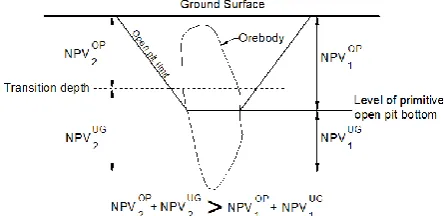
A combination of open pit and underground mining methods may be applied in a mining project where the shallow and deep portions of an orebody are worth mining out. In such projects, it is important for shareholders to know how much of the orebody should be extracted by each mining method. Logically, there must be a depth at which the border of each mining method is determined. It is ideal to find an optimum depth at which the maximum NPV of the entire mining project is achieved. This optimization problem, through which the optimum transition depth from open pit to underground mining is determined, is called "transition problem". Figure 1 coveys the traditional concept of transition problem schematically. As it can be inferred, there may be a depth above the level of primitive pit bottom at which the highest NPV of the whole operation could be achieved.
Determining the optimum transition depth during feasibility studies is important to mine designers, because
they are eager to have a realistic estimation of the capital costs that are required for each mining portion. They emphasize the importance of the subject because of the capital cost estimation is a major part of each mining study phase [1]. It is also worth noting that mining projects are considered as capital intensive adventures.
In spite of the above-mentioned importance, not fully known characteristics of the orebodies put millions of invested dollars at risk. Normally, the geological characteristics of an orebody are estimated by integrating the exploration data that are gathered from a network of deep and shallow excavations. Due to the restrictive impacts of exploration costs, a limited amount of information is usually accessible for these estimations, so that geological estimations differ from the in-situ properties of mineralized zones. The existing difference between the required and available data are defined as uncertainty of data [2].
Nowadays it is a well-known fact that many mining projects have failed due to neglecting geological uncertainties [3], so that in recent mine studies the contribution of geological uncertainty to different aspects of open pit optimization problems can be traced [4-9]. The transition problem is also affected by geological uncertainty due to the increment of uncertainty amount in geological information downward.
2. LITERATURE REVIEW
Popover [10], Soderberg and Rausch [11] were the earliest researchers who have documented the early models of transition problem. The model that is presented by them determines the transition depth by balancing the open pit and underground mining costs. The mathematical form of this balancing method was used by Chen et al. [12], Chen and Guo [13]. The main disadvantage of the transition cost models is that they do not consider the grade variability through different parts of the orebodies. In 2012, Bakhtavar et al. [14] assimilated the transition problem to the open pit scheduling problem. They tried to find the optimum transition depth through maximizing the NPV of the entire mining production plans. Their efforts lead only to a two-dimensional integer programming model which should be executed on vertical sections. Hence, their method failed to present an optimum solution. Newman et al. [15] modelled the transition problem in the form of a network flow. Their method determines the transition depth by scheduling the horizontal sections of the orebody. Their method is horizontally two-dimensional and does not present an optimum solution. Dagdelen et al. [16] used a series of the Lerchs and Grossman [17] pits as transition scenarios. The authors applied a mixed integer linear programming optimizer on the successive scenarios in order to find the optimum solution. This predefining of the scenarios may cause a loss of optimality. Whittle et al. [18] used Whittle’s opportunity cost approach [19] in order to embed a crown pillar between open pit and underground mining portions. They first used a graph theory approach and later modified its structure [20]. Chung et al. [21] tried to use a Mixed Integer Programming (MIP) model for determining the optimum transition depth. They incorporated their model with conditional simulation techniques in order to capture
grade uncertainty in their study. They did not present the mathematical formulation of their model. Besides, the authors did not determine the mining method of the underground portion. In 2017, King et al. [22] applied a combination of Linear Programming (LP) and a rounding technique in order to provide integer solutions for transition problems. Their two-step solution approach presents near optimal solutions. Considering the importance of geological uncertainties, Macneil et al. [23] tried to solve the transition problem stochastically. They used a scenario-based approach to solve the problem. This approach does not guarantee the solution's optimality. Recently, Bakhtavar et al. [24] applied Gholamnejad et al.’s [25] stochastic scheduling model, which had been developed for open pit long-term production scheduling, in order to determine the optimum transition depth. Their economic block model, as the input data, was calculated based on Whittle's opportunity cost approach [19]. However, according to the opportunity cost approach, the transition depth is determined without optimizing the underground portion.
As it can be seen, there is not a uniform model for optimizing the transition depth between open pit and underground portions. The existing models either break the problem down into separate problems or neglect the scheduling of the underground portion. These simplified models cannot truly capture the geological uncertainty of the orebodies. The present study solves the transition problem by applying an integrated model. Furthermore, in order to control grade uncertainty, the model is executed on some equally probable realizations of the orebody. It is determined whether there are some alternatives that can provide more profits than the primitive open pit bottom or not.
3. THE STRUCTURE OF RANSITION MODEL
The transition problem is a type of long-term production scheduling during which the mining method of each block is determined, too. The borders of adjacent blocks that are to be extracted by open pit and preferred underground method play the role of transition depth. This implies that transition depth is not merely in the shape of a horizontal plane. In other words, transition depth is a ragged surface that is revealed through simultaneous production scheduling of the shallow and deep portions of an orebody. Like the common open pit scheduling problems, the main goal of transition problem is maximizing the NPV of the mining adventure. However, here the NPV of the entire operations is maximized (Equation (1)). To better understand the formulations, the notations are defined as following:
Sets and indices
b B bis a member of block set B
t T t is a member of time period set T
UG stands for underground operations p indicator of a block under evaluation
q indicator of a time period in which a block is under evaluation
Parameters
op b
R Revenue of block mining b when it is extracted by open pit
UG b
R Revenue of block underground b when it is extracted by
OP b C
Mining, processing, and all costs expended to produce the salable harvest if block b is extracted by open pit mining
UG b
C
Mining, processing, and all costs expended to produce the salable harvest if block b is extracted by underground mining
t
Discount factor
r Discount rate
,
OP UG
b b
O O Tonnage of ore in block bwhich may be extracted
by open pit or underground method ,
OP UG
b b
g g Average grade of block b
OP UG Max
G + Maximum allowable grades of combined mining operations
OP UG Min
G + Minimum allowable grades of combined mining operations
,
OP OP
Min Max
O O Minimum and maximum allowable ore mining capacities of the open pit portion
,
UG UG
Min Max
O O Minimum and maximum allowable ore mining capacities of the underground portion
1
t b
n − All blocks that should be removed before block b
if it is mined by open pit 1
t b
m − All blocks that should be removed before block b
if it is mined by underground method
Variables
0,1 t bx Open pit binary decision variables
0,1 t by Underground binary decision variables
(
)
1 1
1
( ) ( )
(1 )
B T
t t
OP OP UG UG
t b b b t b b b
t
b t
Max R C x R C y
r
= =
− + −
+
(1)Equation (1) is the objective function of the transition problem that should be optimized subject to the following physical and operational constraints:
Reserve constraint: this constraint ensures that every block is mined only once (Equation (2)). According to this constraint, only one of the two possible mining methods is assigned to each specified block (b).
1 1
1
T T
t t
b b
t t
x y b B
= =
+ =
(2)Sequencing constraints: these constraints regard the physical dependencies of scheduling units (blocks) to each other in a way that is consistent with the essence of each mining method. Equations (3) and (4) represent the sequencing constraints of open pit and underground
portions, respectively.
1
1 1
1 1
0 &
t b
n t
t t q
b b p
p q
n x x b B t T
− −
−
= =
−
(3)1
1 1
1 1
0 &
t b
m t
t t q
b b p
p q
m y y b B t T
− −
−
= =
−
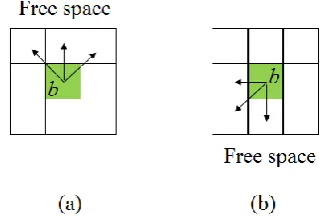
(4)Suppose in Figure 2 that block bis to be mined by either open pit or underground method. Thus, the precedence of blocks' removal differs for each case.
Quality constraint: when the open pit and the underground portions of an orebody are extracted simultaneously, the extracted ore can be mixed and used in process plant. Thus, the quality of all extracted blocks during each mining period should be controlled within a range. However, the required quality may be provided form just one portion in some periods. Equations (5) and (6) define the upper and lower bounds of the required quality ( t T ), respectively.
1 1
( ) ( )
B B
OP OP t UG UG t OP UG OP t UG t
b b b b b b Max b b b b
b b
O g x O g y G + O x O y
= =
+ +
(5)1 1
( ) ( )
B B
OP UG OP t UG t OP OP t UG UG t
Min b b b b b b b b b b
b b
G + O x O y O g x O g y
= =
+ +
(6)Capacity constraint: the total amount of required ore should be within a predefined range (Equation (7)). According to this equation, the possible lack of extracted ore from each portion can be compensated for by the other portion, so that the upper and lower bounds are satisfied.
1
( )
B
OP UG OP t UG t OP UG
Min Min b b b b Max Max
b
O O O x O y O O
t T
=
+ + +
(7)As mentioned previously, constraints (2) to (7) imply that the mining activities in upper and lower portions are executed simultaneously. However, in some mining periods mining activities may be halted in one portion and the required materials be extracted from the other portion.
4. PROBABILITY OF NPV IMPROVEMENT
Conditional simulation is a generally accepted method for evaluation of geological uncertainty. According to this method, some equally probable geological models of orebody should be prepared [26]. Using the economic factors, these geological models are converted to the economical block models. Then, a deterministic optimization model of the aimed problem is executed on every block model. This way, a range of solutions are achieved, which can be compared with each other or with a basic one.
In this study, the probability of NPV improvement is evaluated by comparing the achieved solutions from integrated transition model with a basic alternative. It is determined how portion of solutions present an NPV greater than this alternative. The basic alternative is defined as the bottom of optimized pit limit, which has been determined previously. According to the basic alternative, underground mining is commenced whenever the open pit mining is terminated. In other words, the predefined open pit bottom plays the role of transition depth. In this case, the NPV of the whole mining operation is calculated by summing the NPV of open pit and underground portions, which are derived from separate production scheduling of each portion. In contrast to this method, the integrated transition model calculates the NPV of the entire mining operation by scheduling the upper and lower portions simultaneously. As a case in point, the Anguran lead and zinc deposit in Iran, which is currently extracted simultaneously by open pit and cut and fill methods can be cited.
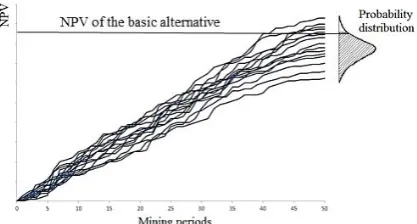
By executing the proposed integrated model on all simulations, if the majority of the solutions present a NPV greater than the total NPV of the basic alternative, the primitive transition depth should probably be displaced in order to provide more profits (Figure 3). It seems that selecting an alternative the NPV of which is close to the mean of all values would be reasonable, especially when the suggested displacements are in the same direction. On the other hand, if most of the solutions present minor NPVs (Figure 4), the displacement of the primitive transition depth will not probably result in higher profits. It seems that the primitive NPV has been overestimated. In case of considering the geological uncertainty, a probabilistic transition zone can be determined. Then, the probability of transition between two elevations can be defined based on the solutions which are a portion of whole transition zone and locate between these elevations. The probability of transition can be determined with a confidence level. In this paper, the probability of NPV improvements are mainly focused.
It is also worth noting that depending on the physical configurations of the solutions (3D transition surfaces), which correspond to the numerical solutions of the problem (decision variables), the predefined open pit bottom may be shifted up or down to a more profitable transition depth
Figure 3. The transition alternatives probably provide more profit than the basic one
Figure 4. The transition alternatives are not probably more profitable than the basic one
(Figure 5). This variability of the physical solutions around the pit bottom is in contrast with the traditional notions. Because, in case of encountering transition problems in a deterministic form, the transition depth is expected to be located above the primitive pit bottom. However, in the stochastic form of the problem, the transition depth may be located beneath the primitive pit bottom. In other words, the open pit is deepened as a result of geological uncertainties. This occurs in simulations in which the block values enhance due to the higher grades that may be estimated for them. The more valuable ore blocks can remove more waste rocks so that the pit bottom and, consequently, the transition depth are deepened. This point of view renews the traditional thoughts about the transition depth.
Figure 6 delineates the approach of uncertainty- based optimization for transition problems. In the current paper, a number of realizations of the orebody are created at first. Then the integrated model is executed on every realization. In the following, the probability of improvement is calculated by comparing the numerical solution of basic alternative with the simulated ones.
Figure 5. Various transition alternatives that may occur due to geological uncertainty
Figure 6. Uncertainty-based optimization of transition depth
5. EMPRICAL RESULTS AND DISCUTION
In order to evaluate the effects of grade uncertainty on transition depth, the transition model was executed according to the proposed approach on a hypothetical block model. The raw data of the hypothetical model was extracted from a critical zone of a real iron deposit, which was potentially capable of transition. At the first stage, a block model was created according to the conventional Ordinary Kriging (OK) method. The NPV of the primitive optimization process was considered as the basic solution. The above-mentioned formulations of the integrated transition model were executed on this model and a deterministic solution was achieved. Then, 12 realizations of the case study were simulated using the Sequential Gaussian Simulation (SGS) method. The same integrated model was executed on each realization. Whenever a scheduling model is run, the transition depth is revealed between decision variables of the open pit and underground
portion. The numerical results of objective function for the basic alternative, deterministic solution, solution of all realizations, and their average are illustrated in Figure 7.
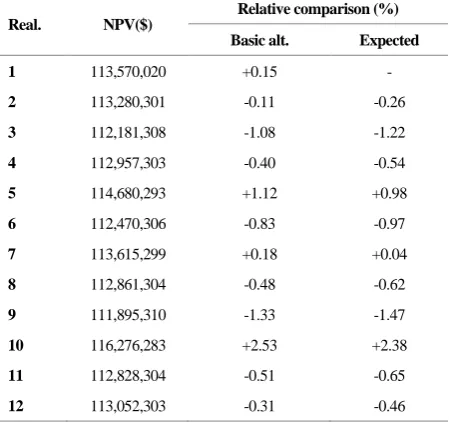
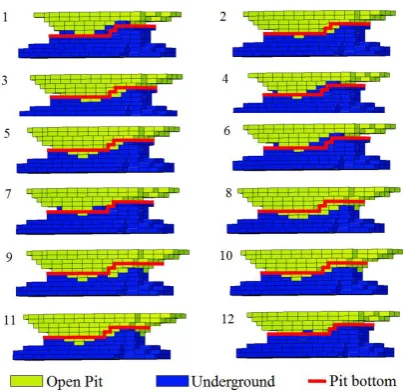
The results indicate that when the integrated model is executed in a deterministic form, the NPV of the whole mining operation is enhanced about 0.15% (Table 1). However, compared to the deterministic and basic alternatives, the uncertainty- based solutions indicate that more than 72% of the transition alternatives present lower NPVs (the improvement probability is less than 28%). This implies that encountering the transition problems according to the traditional scheduling problems may show a deceptive increment in NPV of the entire mining operation. The average NPV of the realizations is less than that of the basic alternative, although their difference is negligible (<0.1%). On the other hand, the graphical results show that scenarios 1, 4, 6, 7 and 12 trespass toward the primitive open pit area (Figure 8). However, only scenarios 1 and 7 present higher NPV values in contrast to the basic alternative. This disharmony occurs due to the grade variability of different
Figure 7. Results of integrated transition model
TABLE 1. Comparing the solutions with the results of expected and basic alternative
Real. NPV($)
Relative comparison (%)
Basic alt. Expected
1 113,570,020 +0.15 -
2 113,280,301 -0.11 -0.26
3 112,181,308 -1.08 -1.22
4 112,957,303 -0.40 -0.54
5 114,680,293 +1.12 +0.98
6 112,470,306 -0.83 -0.97
7 113,615,299 +0.18 +0.04
8 112,861,304 -0.48 -0.62
9 111,895,310 -1.33 -1.47
10 116,276,283 +2.53 +2.38
11 112,828,304 -0.51 -0.65
Figure 8. Graphical results of different realizations
scenarios. It can be seen that the majority of scenarios trespass toward the underground portion. Most of them present lower NPV values in contrast to the basic alternative. However, the two highest values exist among these series. This implies that due to the grade uncertainty it is viable for primitive open pit bottom to be extended downward beneficially. In this case, the NPV of the entire mining operations may increase ideally up to 2.5%.
Compared to similar studies conducted by Newman et al. [15] and Chung et al. [21]; this paper presents a ragged surface as the border of open pit and underground mining activities instead of a horizontal plane. Besides, it was shown that the transition alternatives could fluctuate around the primitive pit bottom when the uncertainties are considered.
6. CONCLUSION
When a combination of open pit and underground mining methods is applied to extract an orebody, an optimum transition depth should be determined between them inevitably. On the other hand, it is ideal for mining complexes to extract the shallow and deep portions of an orebody with the highest profit. Having a comprehensive production schedule of the entire orebody can determine the border of mining activities meanwhile providing them with a perspective of total future mining profits. Incorporating the resources’ uncertainties into such scheduling problems provides more realistic results.
The present study incorporated the grade uncertainty into the transition problem in order to capture the effects of such uncertainty on the transition decision. In this regard, an integrated scheduling model was executed on some realizations of an orebody as a transition model. The results
were noticeable because although the deterministic solution of the transition problem uplifts the primitive open pit bottom for enhancing the total NPV, the probabilistic solutions indicate that the highest NPV may be achieved by developing open pit bottom downwards. Furthermore, it can be concluded from the results that the NPV of the whole mining operation is probably less than the NPV of the basic alternative. However, because of a negligible difference between the average NPV of the realizations and the basic alternative, the primitive pit bottom can be considered as the transition depth.
7. REFERENCES
1. Nourali, H., Osanloo, M., "A New Cost Model for Estimation of Open Pit Copper Mine Capital Expenditure", International Journal of Engineering, Transactions B: Applications Vol. 32, No. 2, (2019), 184-191.
2. Mula, J., Poler, R., Garcia-Sabater, J. and Lario, F.C., "Models for production planning under uncertainty: A review", International Journal ofProduction Economics, Vol. 103, No. 1, (2006), 271-285. 3. Vallee, M, "Mineral resource + engineering, economic and legal feasibility = ore reserve", Canadian Mining and Metallurgy Society Bulletin Vol. 93, (2000), 53–61.
4. Jamshidi M, Osanloo M., "Reliability analysis of production schedule in element deposits under grade-tonnage uncertainty with multi-destinations for the run of mine material". International Journal of Mining Science and Technology (2018). https://doi.org/10.1016/j.ijmst.2018.04.016.
5. Groeneveld, B., Topal, E., "Flexible open-pit mine design under uncertainty", Journal of Mining Science, Vol. 47, No. 2, (2011), 212-226.
6. Rahmanpour, M., and M. Osanloo. "Resilient decision making in open pit short-term production planning in presence of geologic uncertainty." International Journal of Engineering, Transactions A: Basics, Vol. 29, No. 7 (2016), 1022-1028.
7. Montiel, L., Dimitrakopoulos, R., " A heuristic approach for the stochastic optimization of mine production schedules", Journal of Heuristics, Vol 23, (2017), 397–415, DOI 10.1007/s10732-017-9349-6.
8. Azimi, Y., Osanloo, M. and Esfahanipour, A., "An uncertainty based multi-criteria ranking system for open pit mining cut-off grade strategy selection", Resources Policy, Vol. 38, No. 2, (2013), 212-223. 9. Gholamnejad, J., Osanloo, M. and Khorram, E., "A chance constrained integer programming model for open pit long-term production planning", International Journal of Engineering, Transactions A: Basics, Vol. 21, No. 4, (2008), 307-318.
10. Popover, G. (1971). The working of mineral deposits (Translated from the Russian by Shiffer, V.). Mir publishers, Moscow, (1968), 458-461.
11. Soderberg, A., Rausch, D.O. Surface Mining (Section 4.1). Pfleider, E.P., (ed.). AIMM, New York. 142–143.
12. Chen J. Li, J., Luo, Z., Guo, D. Development and Application of Optimum Open-Pit Limits Software for the Combined Mining of Surface and Underground. CAMI, (2001), 303−306.
13. Chen, J., Guo, D., Li, J. Optimization Principle of Combined Surface and Underground Mining and Its Applications. Journal of Central South University of Technology, Vol. 10, No. 3, (2003), 222−225. 14. Bakhtavar, K. Shahriar, K., Mirhassani A. Optimization of the
African Institute of Mining and Metallurgy Vol. 112, No. 12, (2012), 1059-1064.
15. Newman, A., Yano, C., Rubio, E. Mining above and below ground: timing the transition. IEE Transactions. Vol. 45, No. 8, (2013), 865-882.
16. Dagdelen, K. Open pit transition depth determination through global analysis of open pit and underground mine production scheduling. in Proceedings Orebody Modelling and Strategic Mine Planning (2014). 17. Lerchs, H. and Grossman, I.F., Optimum Design of Open Pit Mines, Joint CORS and ORSA Conference, Montreal: Canadian Institute of Mining and Metallurgy (1965).
18. Whittle, D., Brazil, M., Grossman, P. A., Rubinstein, H., Thomas, D. A. Deter- mining the open pit to underground transition: A new method. In Proceedings of the 2016 seventh international conference & exhibition on mass mining (MassMin 2016), 731–741.
19. Whittle, J. Allowing for underground mining. in Four-D Four Dimenstional Open Pit Optimization Package, Melbourne, Australia: Whittle Programming Pty Ltd. (1990), 65-67.
20. Whittle, D., Brazil, M., Grossman, P. A., Rubinstein, H., Thomas, D. A. Combined optimisation of an open-pit mine outline and the transition depth to underground mining. European Journal of Operational Research Vol. 268, (2018), 624–634. DOI: 10.1016/j.ejor.2018.02.005.
21. Chung, J., Topal, E. and Erten, O. "Transition from open-pit to underground –using Mixed Integer Programming considering grade
uncertainty" In Paper Presented to the 17th annual conference of the International Association for Mathematical Geosciences (IAMG 2015), Freiberg, Germany.
22. King, B., Goycoolea, M., Newman, A. Optimizing the open pit-to-underground mining transition, European Journal of Operational Research. Vol. 257, No. 1, (2017), 297-309. http://dx.doi.org/10.1016/j.ejor.2016.07.021.
23. MacNeil, J., Dimitrakopoulos, R. A stochastic optimization formulation for the transition from open pit to underground mining, Optim Eng 18, (2017), 793–813. https://doi.org/10.1007/s11081-017-9361-6.
24. Bakhtavar, E., Abdollahisharif, J., Aminzadeh, A. A stochastic mathematical model for determination of transition time in the non-simultaneous case of surface and underground mining. Journal of the Southern African Institute of Mining and Metallurgy, Vol. 117, No.
12, (2018), 1059-1064.
http://dx.doi.org/10.17159/24119717/2017/v117n12a9.
25. Gholamnejad, j., Osanloo, M., Khorram, E. A chance constrained Integer programming model for open pit long-term production planning. Scientific information database, Vol. 21, (2008), 407-418. 26. Dimitrakopoulos, R., Farrelly, C.T., Godoy M. Moving Forward from
Traditional Optimization: Grade Uncertainty and Risk Effects in Open-Pit Design. Mining Technology Vol. 111, No. 1, (2002), 82-88.
An Uncertainty-based Transition from Open Pit to Underground Mining
A. Soltani Khaboushan, M. Osanloo
Department of Mining and Metallurgical Engineering, Amirkabir University of Technology, Tehran, Iran
P A P E R I N F O
Paper history:
Received 17 May 2019
Received in revised form 15 July 2019 Accepted 23 July 2019
Keywords: Transition Depth Geological Uncertainty Production Scheduling هدیکچ ریاخذ یندعم گزرب یسایقم دوجو دنراد هک زا حطس ات قامعا رایسب دایز نیمز شرتسگ هتفای دنا . نینچ یریاخذ ار دیاب اب یبیکرت زا شور یاه یراکندعم یحطس و ینیمزریز جارختسا دومن . هب ظاحل ،یداصتقا زرم نتسناد ره کی زا تیلاعف یاه یراکندعم رایسب ینیمزریز و یحطس مهم تسا . نیا هغدغد ثعاب یم دوش هک ناحارط ندعم هب تمس هلأسم راذگ هک یکی زا هدیچیپ نیرت لئاسم رد تعنص یراکندعم یم دشاب قوس هداد دنوش . هلأسم راذگ رد هرمز لئاسم کیژتارتسا میسقت یدنب هدش و هب لکش لئاسم همانرب زیر دیلوت دنلب تدم لومرف یدنب یم ددرگ . نیا نادب ینعم تسا هک هلأسم راذگ هب تدش تحت ریثأت مدع تیعطق ییاه تسا هک هشیر رد تیمک و تیفیک هریخذ یندعم فاشتکا هدش دنراد . هلاقم شیپ ور رد رظن دراد ات ریثأت مدع تیعطق یاه نیمز یسانش ار رب هلأسم راذگ یبایزرا دیامن . یارب نیا روظنم کی لدم همانرب یزیر ددع حیحص رب یور هیبش یزاس یاه فلتخم زا کی هریخذ ارجا دش . جیاتن نیا یسررب ناشن یم دهد هک NPV تسدب هدمآ یارب تلاح یعطق رتشیب زا NPV
هنیزگ هب طوبرم هیاپ تسا . ،دنچره باوج یاه ینتبم رب مدع تیعطق ناشن یم دنهد هک NPV لک تیلاعف یاه یراکندعم رتمک زا باوج یاه هیاپ و یعطق دنتسه ( شیب زا 72 دصرد باوج اه .) اب نیا ،لاح یدراوم کدنا زین دوجو دنراد هک رد اهنآ NPV تیلاعف یراکندعم نکمم تسا اب هعسوت فک تیپ هب تمس نییاپ روطب هدیا یلآ ات 5 / 2 دصرد شیازفا دبای . رد ،تیاهن رطاخب دوجو کی فلاتخا لباق ضامغا نیب نیگنایم NPV هیبش یزاس اه و NPV هنیزگ ،هیاپ راظتنا یم دور هک فک تیپ شقن قمع راذگ ار افیا دیامن .