Please cite this article as: A. Sezavar, H. Farsi, S. Mohamadzadeh, A Modified Grasshopper Optimization Algorithm Combined with CNN for Content Based Image Retrieval, International Journal of Engineering (IJE), IJE TRANSACTIONS A: Basics Vol. 32, No. 7, (July 2019) 924-930
International Journal of Engineering
J o u r n a l H o m e p a g e : w w w . i j e . i r
A Modified Grasshopper Optimization Algorithm Combined with CNN for Content
Based Image Retrieval
A. Sezavar, H. Farsi*, S. Mohamadzadeh
Department of Electrical and Computer Engineering, University of Birjand, Birjand, Iran
P A P E R I N F O
Paper history: Received 17 March 2019
Received in revised form 17 April 2019 Accepted 03 May 2019
Keywords:
Content-based Image Retrieval Deep Learning
Convolutional Neural Network Grasshopper Optimization
A B S T R A C T
Nowadays, with huge progress in digital imaging, new image processing methods are needed to manage digital images stored on disks. Image retrieval has been one of the most challengeable fields in digital image processing which means searching in a big database in order to represent similar images to the query image. Although many efficient researches have been performed for this topic so far, there is a semantic gap between human concept and features extracted from the images and it has become an important problem which decreases retrieval precision. In this paper, a convolutional neural network (CNN) is used to extract deep and high-level features from the images. Next, an optimization problem is defined in order to model the retrieval system. Heuristic algorithms such as genetic algorithm (GA) and particle swarm optimization (PSO) have shown an effective role in solving the complex problems. A recent introduced heuristic algorithm is Grasshopper Optimization Algorithm (GOA) which has been proved to be able to solve difficult optimization problems. So, a new search method, modified grasshopper optimization algorithm (MGOA) is proposed to solve modeled problem and to retrieve similar images efficiently, despite of total search in database. Experimental results showed that the proposed system named CNN-MGOA achieves superior accuracy compared to traditional methods.
doi: 10.5829/ije.2019.32.07a.04
1. INTRODUCTION1
With progress in digital imaging and internet usage, the size of images stored on disks is rapidly increasing. Thus, traditional algorithms are unable to manage these big databases and so robust and fast methods are needed. Among the different fields of image processing, image retrieval has achieved more attention during recent years. Image retrieval which means searching in a big database to find nearest images to the query image, has been introduced since 1970 by text-based image retrieval (TBIR) in which, system takes a query text from user and searches images with the text. The concept of an image is more complex than a few words. Therefore, the accuracy of TBIR is low. Although TBIR is still used in such search engine and researches such as Keyvanpour et al. [1] have introduced a retrieval system which uses visual features of images to compare and retrieve. Thus, content-based image retrieval (CBIR)
*Corresponding Author Email: [email protected] (H. Farsi)
was invested in 1990. The CBIR has been used in many fields such as medical imaging [2], biodiversity, digital albums, video processing [3], crime preventing and other areas which need image recognition [4-5].
Feature extraction has been an important task in signal processing areas, image, video and speech processing [6-7]. Also, the main part of any image retrieval system is feature extraction. Some low-level features are considered for clustering and retrieving images, mainly color-based features, texture features and shape features. In color-based features, the value of pixels in RGB, HSV and other color spaces are extracted and represented as feature vector of the image. The color is unable to describe the content of an image completely. Thus, acceptable accuracy could not be achieved by using color features individually. So, texture features are needed in order to compare images. Some suitable texture features can be extracted from images by using discrete Fourier transform, wavelet transform, discrete cosine transform or by combining them. Nowadays, retrieval systems usually use a
mixture of color, texture and shape of images and they can achieve efficient accuracy [8-9].There is a semantic gap between low-level features (color, shape and texture) and human concept. Thus, it is needed to extract better features to reduce this gap and improve retrieval performance. Although it may be able to extract more complicate low-level features from images, the size of feature vector will increase and retrieval speed will decrease by increasing the computation time. Therefore, it requires extracting appropriate abstracted features to increase retrieval precision with low possible retrieval time. One method which has been proofed to reduce semantic gap, is deep learning [10]. So we use CNN as a successful subfield of deep learning to extract deep and appropriate features.
After extracting features, an efficient algorithm is needed to search among huge amount of features and complete retrieval task. This search can be performed by solving a desired optimzation problem. Since engineering optimization tasks have been complex, heuristic algorithms have achieved more attention during recent years. Two basic natural-inspired algorithms are genetic algorithm (GA) and particle swarm optimization (PSO) [11]. Many intelligence particle swarm algorithms have been introduced in recent years such as inclined Planes optimization (IPO) [12], gravitational search algorithm (GSA) and other methods which have been successful in optimization tasks. Grasshopper optimization algorithm (GOA)[13] is one of the new-introduced methods which is able to successfully solve complex optimization problems [13]. In this paper, a modified version of grasshopper optimization algorithm (MGOA) is introduced and is used to retrieve nearest images to query image. Meanwhile, more similar images are represented by minimizing the proposed cost function.
The rest of the paper is organized as follows: related works are presented in section 2. The motivation of this paper is presented in section 3. Deep learning is reviewed in section 4 as theoretical background in which, GOA is presented as well. Section 5 represents the proposed system and experimental result can be observed in section 6. Finally, conclusion is illustrated in section 7.
2. RELATED WORKS
In this section, some researches which use heuristic algorithms for image retrieval are indicated. Jeyakumar et al. [14] proposed a system for medical image retrieval by using Ant Colony Optimization (ACO). They extracted features such as Tamura, Gabor filter features, global texture features and etc. from each image in database. Therefore, totally 199 features were extracted for each image. After that, the ACO was used to select best subset from features in order to decrease the size of
the feature vector. Then similarity measure was performed between the extracted subset of features. They demonstrated that using ACO could help system to choose best features and increase precision. Rashno et al. implemented a CBIR system which extracted color and texture features in which, ACO was used to find the most relevant features from all extracted features. For this task, they considered the minimum number of features which tends to the maximum retrieval accuracy as the cost function. So, they found the path which minimized the cost function by using ACO. They illustrated that the accuracy was increased by using more relevant features by ACO.
Younus et al. [15] presented a CBIR system by combination of K-means clustering and PSO. First they extracted color histogram and moment, co- occurrence matrices and wavelet transform features. Then, they proposed a hybrid clustering algorithm in which, appropriate clusters were determined by PSO. Therefore, the performance of the CBIR system was improved. Kushwaha and Welekar [16] used GA in order to select efficient features from color moment, gray level co-occurrence matrix and edge histogram features. They demonstrated that using optimal features by GA reduced retrieval time and increased precision of retrieval. There are many other researches which use the heuristic methods to select optimal features from large dimension low-level extracted features and reduce the complexity of CBIR systems [17-21].
As a critical view to the works discribed above, it is important to notice that, most of them use color features such as color histogram in and [15], color moment in [16] and so on. Although color features have been important in researches, they are unable to describe images efficiently for databases with image in same colours. So, the use of these approaches is limited to the databases with just color features. Also, these methods use heuristic algorithm to abstract feature vectors. Thus, some features and information will be lost through them.
3. THE MOTIVATION
to solve either unimodal or multimodal real optimization difficult problems. Thus, we propose a modified GOA algorithm in order to solve the proposed CBIR optimization task. Therefore, the proposed system converts the CBIR to an optimization problem and the modified GOA is used to solve it.
4. THEORETICAL BACKGROUND
4. 1. Deep Learning Deep learning is a new
branch of machine learning in which, system learns to extract deep features through a hierarchical algorithm [10]. Some researches show that the deep learning can be used successfully in image and video processing, pattern recognition and natural language processing [22]. Among many existing deep learning algorithms, convolutional neural network is used in this paper as a common branch of deep learning algorithms; because it has developed exactly for 2D input data and is suitable for image and video processing.
The basic CNN algorithm is AlexNet which has been developed by Alex et al. [23]. It consists of many layers in which, three layers including convolutional layer, pooling layer and fully-connected layer are important. First layer is convolution that includes many filters with learnable coefficients. By convolving each filter with image, a feature map is created. After that, pooling layer is used to reduce the dimension of feature map. After several convolution and pooling layers, three fully-connected layers are considered to convert 2D feature maps to a feature vector and a classifier is usually used to classify input features. Through learning step, coefficients and parameters of the filters are updated to obtain best values. Therefore, the system learns to extract appropriate features from input image. An example of convolutional neural networks for image classification is represented in Figure 1.
4. 2.Grasshopper Optimization Algorithm (GOA)
GOA is a new heuristic optimization algorithm that mimics grasshoppers swarm to solve optimization problem. In nature, these insects fly in a group in which, each grasshopper has a particular distance to the others and their movement can be modeled as Equation (1) [13]
Figure 1. Example of a convolutional neural network for
classifying images [24]
(1)
where the position of the i-th grasshopper is social interaction is represented by and shows the wind influence. Interaction is the main part of this algorithm which is denoted by Equation (2) [13]
(2)
In which, is distance between the i-th and the j-th grasshopper with unit vector , and s is function for demonstrating social force, calculating by Equation (3) [13]
(3)
Where is the intensity of attraction, is the attractive length scale and is distance between the grasshopers . The behavior of grasshoppers in swarm is shown in Figure 2 (a) and the relationship between distance and s function is illustrated in Figure 2 (b). Although an appropriate model for grasshopper movement is denoted, for solving optimization problem Equation (4) will be used which is a modified version of grasshopper model to solve the problem more efficiently [13]
(4)
Where , and are the upper bound, lower bound and target position in the D-th dimension, respectively. While is a volume for controlling exploration and exploitation, it should be decreased by increasing iteration number. An efficient method for reducing is using Equation (5) [13].
(5)
5. THE PROPOSED SYSTEM
5. 1. Feature Extraction The proposed retrieval
(a)
(b)
Figure 2. Grasshoppers behavior in swarm (a) and diagram of s(d) function (b) [13]
In the online image retrieval step, a query image which is asked by user goes through the trained CNN. The last layer’s values of CNN for query image are extracted as query feature vector. So, similar images to the query image should be found from database and represented for user. For this task, the retrieval system is formulated as an optimization problem. In order to solve this problem, a heuristic model is proposed to search and retrieve by using modified GOA.
5. 2. Modi2ied GOA Although a multidimensional
fitness function can be described to retrieve some images, to reduce computation cost and required time, one dimensional function is proposed and then K best particles represent K images in order to retrieve. In addition, the GOA is used for continuous variables while we need a discrete algorithm because of the discrete indexes of images. Thus, we convert variables to discrete. Meanwhile, each discrete grasshopper refers an image index in database. As a fitness function, a simple Euclidian distance is considered between query image features and the features presented by grasshoppers as:
(6)
In which, refers to the number of dimensions of images, Query feature vector is demonstrated by and represents i-th feature vector in the feature matrix. The parameter is the index of image in database which is a rounded situation of i-th grasshopper.
(7)
In which, [.] indicates integer part and j is the place of grasshopper in the GOA.
As same as other heuristic algorithms, exploration and exploitation in the GOA is important to perform a proper search in feasible space and find the best answer which minimizes the fitness function. We propose grasshoppers model as follow:
(8)
In which, is as same as Equation (4) where d is considered to be one.
(9)
In Equation (8), rand is a random normal variable belongs to [0, 1]. Thus, 10*rand provides random number between 0 and 10. The parameter is a volume that controls the trade-off between exploration and exploitation. This causes appropriate search and exploration when iteration number is less than and exploits for best answer in next iterations. When this modified GOA converges to best solution, we select k best grasshoppers in last iteration as the k nearest images to the query image. Pseudo code of the proposed retrieval system is presented as follow.
Pseudo code for image retrieval with modified GOA
A: Offline step
1. Resize all images in each database, fed them to the CNN and start training.
2. Save optimum parameters.
3. Creating feature matrix by feeding all images to the trained CNN.
B: Offline retrieval
1. Resize the query images to 224×224 and fed it to the CNN. 2. Extract query features from fc-8.
3. Initialize MGOA
Distribute particles randomly
Cmax=2; Cmin=0.004; max-iteration=100; 4. Calculate the fitness of all particles using eq.6 While < max-iter , Do:
5.Sort particles 6. Update c using eq.5
7. Compute for each particle. 8. If
Update each particle position by else
update each particle position by end
9. Return particles to boundaries if they left. End while
10. Select K best particle which achieved in last iteration. 11. Round K best position by
6. EXPREMENTAL RESULTS
6. 1. Evaluation Metrics Precision and recall are
two important metrics in most retrieval systems which are commonly used in researches. Precision means percent of the true retrieved images among K retrieved images and recall is defined as percent of the true retrieved images between total relevant images in database.
(10)
(11)
Although these metrics have been used much for evaluating retrieval systems, two better measures which are a combination of precision and recall are used in this paper to illustrate the performance of the system completely [25].
P(0.5), precision at 50% recall (i.e. precision after retrieving of the relevant images)
P(1), precision at 100% recall (i.e. precision after the retrieving all of the relevant images)
Since using precision and recall separately is not meaningful, using a combination of them is efficient to represent the performance of the systems. Also, the evaluation is more accurate when the number of retrieved images increases. Therefore, reported performance is more reliable when these metrics are used. When P(1) is computed, the number of retrieved images is equal to the number of all images in relevant category.
6. 2. Databases Three well-known and widely used
databases are selected to evaluate the proposed method compared to other state-of-the art methods. The first one is Corel database that consists of 1000 images in 10 classes including African people, beach, monuments, buses, dinosaurs, elephants, flowers, horses, mountains and food [26]. Another database is Amsterdam Library of Object Images (ALOI) which includes 4608 images in 64 classes of color object images [27]. For each object in ALOI database, there are several images from different views and rotations. Thus, using this database is useful to evaluate robustness of the system against rotation. Another database is MPEG-7 [28] which has been widely used in image recognition and retrieval and consists of 1400 images in 70 classes, where each class includes shape similar images. Thus, it can be used for evaluating retrieval systems against shape similarities. As mentioned above, these three databases are used in this paper and numerical results are shown in next subsection.
6. 3. Numerical Results In order to compare the
proposed method with other early methods, the obtained
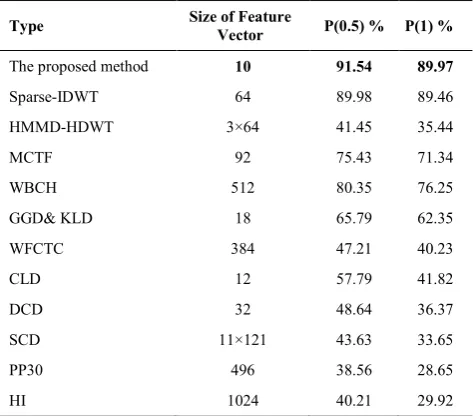
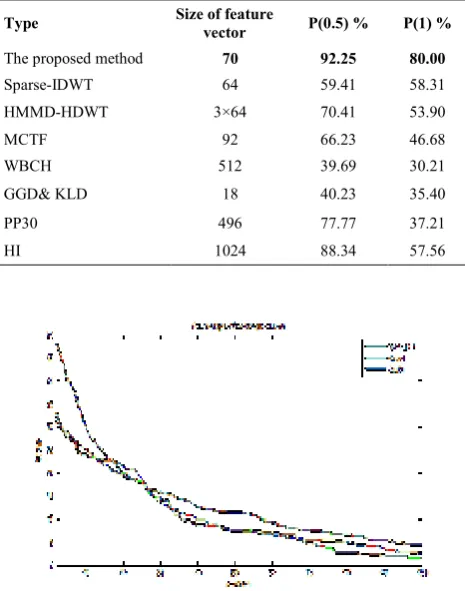
results for P(0.5), P(1) on Corel database for the proposed method, fc8 features and fused features of different CNN’s [29], sparse IDWT [30], HMMD-HDWT [8], multiresolution color and texture features (MCTF) [31], wavelet-based color histogram (WBCH) [32], generalized Gaussian density and Kullback– Leibler distance (GGD and KLD) [33], wavelet-based features for color texture classification (WFCTC) [34], color layout descriptor (CLD) [35], dominant color descriptor (DCD) [36], scalable color descriptor (SCD) [37], Padua point (PP) and histogram intersection (HI) [25] are listed in Table 1 and the average of converge curves of the proposed system for three databases can be found in Figure 4 which is plotted by computing average of converge curves in all images of each database. It can be observed in Figure 4 that the
proposed modified GOA algorithm converges
efficiently on different databases.
Observing Table 1, it can be seen that the proposed method has achieved 91.54% of P(0.5) and 89.97% of P(1), while the best operation between other methods is 89.98% of P(0.5) and 89.46% of P(1) for sparse-IDWT. Thus, the performance of the proposed system is better than the others. Another considerable point is the size of feature vector which is equal to 10 for the proposed method on Corel, while it is equal to 64 for sparse-IDWT. Since the size of feature vector has a direct relation with the speed of the algorithm, it can be noticed that the proposed system provides a fast retrieval.
Such results for ALOI database are listed in Table 2; in which, it can be observed that the proposed system has achieved 96.69% of P(0.5) which is the best among other methods, despite of achieving 79.56% of P(1) which is less than sparse-IDWT and more than other methods.
TABLE 1. The experimental results on Corel database
Type Size of Feature
Vector P(0.5) % P(1) %
The proposed method 10 91.54 89.97
Sparse-IDWT 64 89.98 89.46
HMMD-HDWT 3×64 41.45 35.44
MCTF 92 75.43 71.34
WBCH 512 80.35 76.25
GGD& KLD 18 65.79 62.35
WFCTC 384 47.21 40.23
CLD 12 57.79 41.82
DCD 32 48.64 36.37
SCD 11×121 43.63 33.65
PP30 496 38.56 28.65
Simulation results on MPEG-7 database is illustrated in Table 3 in which, it is observed that the best score of P(0.5) and P(1) is achieved in 92.25 and 80%, respectively by the proposed method. The best results after the proposed method is achieved by HI whose vector size is 1024, while the proposed method with better performance has feature vector with size of 70.
TABLE 2. The experimental results on ALOI database
Type Size of feature
vector P(0.5) % P(1) %
The proposed method 64 96.69 79.56
Sparse-IDWT 64 89.99 89.89
HMMD-HDWT 3×64 82.29 66.68
MCTF 92 81.60 63.33
WBCH 512 61.59 50.11
GGD& KLD 18 64.73 55.29
WFCTC 384 43.03 30.45
CLD 12 19.49 17.56
DCD 32 50.21 41.87
SCD 11×121 53.21 43.55
PP30 496 37.79 7.71
HI 1024 36.26 6.77
TABLE 3. The experimental results on MPEG-7 database
Type Size of feature
vector P(0.5) % P(1) %
The proposed method 70 92.25 80.00
Sparse-IDWT 64 59.41 58.31
HMMD-HDWT 3×64 70.41 53.90
MCTF 92 66.23 46.68
WBCH 512 39.69 30.21
GGD& KLD 18 40.23 35.40
PP30 496 77.77 37.21
HI 1024 88.34 57.56
Figure 4. The average converge curves of the proposed
method on Corel, ALOI and MPEG-7 databases in 100 Iterations
7. CONCLUSION
In this paper, a new method for image retrieval was proposed which consists of a convolutional neural network and a proposed modified GOA, to search in database efficiently and retrieve images that are similar to query image. The proposed method was evaluated on three common databases, Corel, ALOI and MPEG-7; then two important metrics including P(0.5) and P(1) which are a combination of precision and recall, were calculated. Experimental results showed that the proposed system has achieved superior performance despite of small size of feature vector in comparison to some other state-of-the-art methods. This means that, using CNN as an appropriate kind of deep learning algorithms causes extracting meaningful, proper and high level features from images, and by using the proposed modified GOA, retrieving similar images could be robustly performed.
6. REFERENCES
1. Contreras, I., Hub location problems, in Location science, G.
Laporte, S. Nickel, and F. Saldanha da Gama, Editors. 2015, Springer International Publishing: Cham. 311-344.
2. Campbell, J.F., "Integer programming formulations of discrete
hub location problems", European Journal of Operational
Research, Vol. 72, No. 2, (1994), 387-405.
3. Karimi, H. and Bashiri, M., "Hub covering location problems with different coverage types", Scientia Iranica, Vol. 18, No. 6, (2011), 1571-1578.
4. Hwang, Y.H. and Lee, Y.H., "Uncapacitated single allocation
p-hub maximal covering problem", Computers & Industrial
Engineering, Vol. 63, No. 2, (2012), 382-389.
5. Jabalameli, M.S., Barzinpour, F., Saboury, A. and
Ghaffari-Nasab, N., "A simulated annealing-based heuristic for the single
allocation maximal covering hub location problem",
International Journal of Metaheuristics, Vol. 2, No. 1, (2012), 15-37.
6. Ebrahimi-zade, A., Sadegheih, A. and Lotfi, M.M., "A modified
nsga-ii solution for a new multi-objective hub maximal covering
problem under uncertain shipments", Journal of Industrial
Engineering International, Vol. 10, No. 4, (2014), 185-197.
7. Pasandideh, S.H.R., Niaki, S.T.A. and Sheikhi, M., "A
bi-objective hub maximal covering location problem considering time-dependent reliability and the second type of coverage",
International Journal of Management Science and
Engineering Management, Vol. 11, No. 4, (2015), 195-202. 8. Bashiri, M. and Rezanezhad, M., "A reliable multi-objective
p-hub covering location problem considering of p-hubs capabilities", International Journal of Engineering-Transactions B: Applications, Vol. 28, No. 5, (2015), 717-729.
9. Karimi, H., Bashiri, M. and Nickel, S., "Capacitated single allocation p-hub covering problem in multi-modal network using
tabu search", International Journal of
Engineering-Transactions C: Aspects, Vol. 29, No. 6, (2016), 797-808. 10. Ebrahimi-zade, A., Sadegheih, A. and Lotfi, M.M., "Fuzzy
11. Janković, O. and Stanimirović, Z., "A general variable neighborhood search for solving the uncapacitated r-allocation p-hub maximal covering problem", Electronic Notes in Discrete Mathematics, Vol. 58, (2017), 23-30.
12. Janković, O., Mišković, S., Stanimirović, Z. and Todosijević, R., "Novel formulations and vns-based heuristics for single and multiple allocation p-hub maximal covering problems", Annals of Operations Research, Vol. 259, No. 1-2, (2017), 191-216. 13. Madani, S.R., Shahandeh Nookabadi, A. and Hejazi, S.R., "A
bi-objective, reliable single allocation p-hub maximal covering location problem: Mathematical formulation and solution approach", Journal of Air Transport Management, Vol. 68, (2018), 118-136.
14. Gelareh, S., "Hub location models in public transportation planning", Kaiserslautern University of Technology, Ph.D, Thesis (2008),
15. Ebrahimi-zade, A., Hosseini-Nasab, H., zare-mehrjerdi, Y. and Zahmatkesh, A., "Multi-period hub set covering problems with
flexible radius: A modified genetic solution", Applied
Mathematical Modelling, Vol. 40, No. 4, (2016), 2968-2982. 16. Campbell, J.F. and O'Kelly, M.E., "Twenty-five years of hub
location research", Transportation Science, Vol. 46, No. 2, (2012), 153-169.
17. Balaman, Ş.Y., Matopoulos, A., Wright, D.G. and Scott, J., "Integrated optimization of sustainable supply chains and transportation networks for multi technology bio-based production: A decision support system based on fuzzy ε-constraint method", Journal of Cleaner Production, Vol. 172, (2018), 2594-2617.
18. Yu, H. and Solvang, W.D., "An improved multi-objective programming with augmented ε-constraint method for hazardous
waste location-routing problems", International Journal of
Environmental Research and Public Health, Vol. 13, No. 6, (2016), DOI: 10.3390/ijerph13060548.
19. Emami, S., Moslehi, G. and Sabbagh, M., "A benders decomposition approach for order acceptance and scheduling problem: A robust optimization approach", Computational and Applied Mathematics, Vol. 36, No. 4, (2017), 1471-1515.
20. Saharidis , K.D., Minoux , M. and Ierapetritou , G., "Accelerating benders method using covering cut bundle
generation", International Transactions in Operational
Research, Vol. 17, No. 2, (2010), 221-237.
21. O'Kelly, M.E., "A quadratic integer program for the location of interacting hub facilities", European Journal of Operational Research, Vol. 32, No. 3, (1987), 393-404.
22. Alumur, S.A., Nickel, S., Saldanha-da-Gama, F. and Seçerdin, Y., "Multi-period hub network design problems with modular capacities", Annals of Operations Research, Vol. 246, No. 1, (2016), 289-312.
23. Gelareh, S., Neamatian Monemi, R. and Nickel, S., "Multi-period hub location problems in transportation", Transportation Research Part E: Logistics and Transportation Review, Vol. 75, (2015), 67-94.
24. Silva, M.R. and Cunha, C.B., "A tabu search heuristic for the uncapacitated single allocation p-hub maximal covering problem", European Journal of Operational Research, Vol.
262, No. 3, (2017), 954-965.
A Modified Grasshopper Optimization Algorithm Combined with CNN for Content
Based Image Retrieval
A. Sezavar, H. Farsi, S. Mohamadzadeh
Department of Electrical and Computer Engineering, University of Birjand, Birjand, Iran
P A P E R I N F O
Paper history: Received 17 March 2019
Received in revised form 17 April 2019 Accepted 03 May 2019
Keywords:
Content-based Image Retrieval Deep Learning
Convolutional Neural Network Grasshopper Optimization
!
" #$ %
& ' ( )* . " ) (, -
./ ) 0 ( (1 ' ) ( % 2 & 34
/
& 5 6 7 ( %
8 - % (1 9 1 : 7 7; / . ' < 2
(=> / ' "
)!? @ 5 ) 0
A )0 5 B ( " C D '
'
) ( # " ) E F ( )
. " )!? (4 7 %
(*G" H ' E IJ' K LB
K LB %" 4 1 )G B
(CNN)
(4 . MN' " C D ' (4 . O 5 B ( )
( A
) P 0 '
. "
&4
O Q &4 R GF *
(GA)
: $ )0L/ &4
(PSO)
- (4 . R R*
( A
1 RLB ) # ( '
)* .
( A &4 ' 1 RLB K RS . R- (1 #
'
' T=
(GOA)
./ O % .
(4 . R- 5 B ( / /
) " P 0 ' ( A
( 3 &4
( A
T= '
(MGOA)
5 R 1 / ./ UV# % ' " ) 0
( G" W . ' " H ' ) / ./ 5 B ( % &
A 5 '
' ( G. E F
. ' # 8 '
![Figure 1. classifying images [24]Example of a convolutional neural network for](https://thumb-us.123doks.com/thumbv2/123dok_us/18102.2001874/3.595.72.270.637.734/figure-classifying-images-example-convolutional-neural-network.webp)