Publisher: Centre of Excellence for Scientific & Research Journalism Online Publication Date: 1st October 2014
Online Issue: Volume 3, Number 4, October 2014 http://www.centreofexcellence.net/J/JSS/JSS Mainpage.htm
THE CREATION OF THE INTERNATIONAL STUDENT’S
COMPLEX, AS THE WAY OF IMPROVING THE INTEGRATION
OF FOREIGN STUDENTS IN LATVIA, USING THE EXAMPLE OF
UNIVERSITIES OF LATVIA
MG.OEC. KRISTINE GOLUBKOVABALTIC INTERNATIONAL ACADEMY, RIGA, LATVIA
Abstract:
The integration of the foreign students as the research issue becomes today particularly topical in Latvia. It is determined by the considerable increase of the foreign students, who come to study in Latvian higher educational institutions. The integration process is closely related to allocation and further adaptation of the foreign students in the Latvian environment that is the problem at the preset stage and is not solved in the Latvian Republic. The given problem is capable to solve the creation of the new organization International Student City Life – «ICS Life», the introduction of which is offered in one geographical segment of the Riga city, in the capital of Latvia in the Vidzeme suburb, in the place of the greatest concentration of the higher educational institutions.
Keywords:
Integration of the foreign students, training, target audience, project, student’s complex – organization, strategies, competitiveness.
Citation:
463 General Overview of Area
The goal is to determine the role and significance of theoretical propositions of marketing in the process of integration of foreign students as consumers and come up with a decision of a problem of integration on a specific example on the establishing of a new organization, offering a product as an object of exchange to consumer.
Objectives (suggested):
To analyze the industry, offering the product at the present stage in Latvia and to reveal the availability of a suitable model, promoting the creation of a new product in the model that will meet the demand of consumer – a foreign student:
To identify the market segment of the potential consumer who wants to get a product, satisfying his needs. To evaluate the demand for this product and its customer value. And the main thing is to establish the need of establishing of an organization – a subject which offers to the potential consumer – foreign student a desired product – goods for commitment the act of an exchange and place/territory, where will be committed the act of exchange of product between the consumer – a foreign student and an organization, offering the product.
To identify the marketing concept which will offer goods - the product to consumer to a foreign student.
To develop the product portfolio – the product, goods, satisfying the needs of consumer – a foreign student as a result for commitment the act of exchange between the organization and the consumer – a foreign student.
To evaluate the competitive environment in the territorial segment, in the place of establishing of an organization. To identify the competitors, to evaluate the competitiveness and prospects for the development of an organization, offering the product to the potential consumer – a foreign student in the territorial segment. To give an estimate of impact of external factors and competitors on it.
To give an estimate of possibility of establishing of an organization – the subject of the industry, offering the desired product for the implementation of an act of exchange with the consumer – a foreign student.
The statement of the problem: the investment of investments of the European Union in the Latvian state institutions and it is more than 5.5. million lats was a result of flow increase of foreign student. For today in the Latvian higher educational institutions are studying foreign students from more than 62 countries. As a result of constant increase of foreign students in Latvia, appears the problem of improvement of their integration into the European and Latvian society that for today is unsolved problem. The identified problem should be solved, using the theoretical basis of marketing, justifying their use on a specific example. The relevance of the chosen topic is determined by this.
464
The main results of the research. The integration of foreign students as a topic is studied in the modern practices of social and humanitarian disciplines and is considered from the perspective of intercultural education and geopedagogics. However, this topic should not be limited only by these frameworks i.e. the integration process occurs in the result of exchange. Consider the theoretical basis of the put forward problem. For this purpose, let’s define what an exchange from the theoretical point of view is, in marketing.
“The exchange is defined as an act of getting of a certain object the desired product, instead of proposed the certain goods to it”. [1, p 10]
A desired product is all that can contribute to the improvement of integration process of foreign student in the Latvian society.
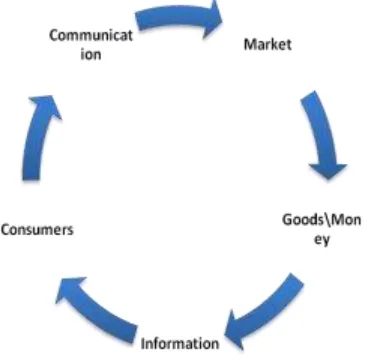
Being a key concept that is the basis for marketing, the exchange leads to the concept of the market. From the perspective of economic theory, the market it is a collection of buyers and sellers. But from the perspective of marketing theory, the collection of sellers is called industry and buyers –market. Then the market is defined as the collection of the potential consumers – foreign students, who have particular needs or wishes – to improve the integration process, ready and willing to the exchange for the purpose of their satisfaction. Represent this understanding into visual form (See. Figure 1).
Figure 1 The interaction of the market and industry.
465
scheme of interaction (See Figure 1.). Marketing does not create the needs, but satisfy them, in this regard, let’s make sense of understanding of the nature of our market. Therefore, having examined the theoretical bases of marketing for the implementation of the stated goal, at the beginning let’s decide with the field of interaction i.e. market of the research.
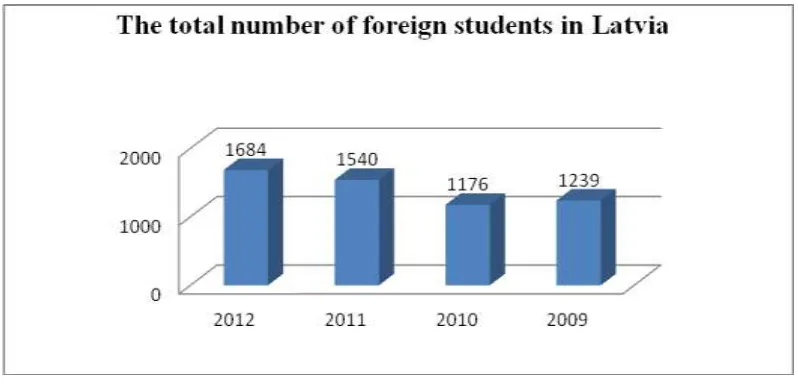
The market are the foreign students – consumers, coming for training and determined with the choice of educational institutional in Latvia, where they will meet their training needs. Such consumers – foreign students from year to year are growing. It confirms visually represented diagram of dynamics of foreign students for 2009 – 2012, studying in the Latvian universities which are located in the territory of Riga, reflected in the Figure 2.
Figure 2 The total number of foreign students in Latvia (The source: the development of the author)
From the visually presented Figure 2, it can be noted that since 2012 the growth constitutes more than 400 people per year. The given aspect confirms the presence of consumer – a foreign student. In order to speed up the process of integration into the society, besides the training of consumer – a foreign student arise the needs in food, accommodation, affections, self-realization, solution of the simple household problems. All the above mentioned is the need in the theoretical understanding of marketing categories.
“Needs it is senses of insistent need of satisfaction of basic needs of an individual” [3, p 8].
The human needs are simple and not too diverse. To our consumer – a foreign student is needed something more that determines the appearance of wishes that create a demand.
466
In this regard, appears the need to offer to our market the product that will satisfy its need. “The product (commodity, service is defined as all that the firm offers for the satisfaction of needs or wishes to the consumer [4, page 54].
Such product as good getting, taking part in the exchange, the product is able to satisfy the needs of the consumer – a foreign student, besides improving the integration process for today in Latvia is lacking. Having determined the necessity of offer of such product in the chain of interrelations (See Figure 1), the question arises about the industry – organization that offers the given product to the consumer – a foreign student. For solving this issue, you should:
A) To analyze the industry, offering the product at the present stage in Latvia and to identify the presence of a suitable model, promoting the creation of new product in the model that will meet the demand of consumer of foreign student???
B) To determine the market segment - a potential consumer who wishes to get a product, satisfying his needs. To evaluate the demand for the given product and its consumer value. And the main thing is to determine the necessity of establishing of an organization – a subject which offers to the potential consumer – a foreign student the desired product – goods for the commitment of an act of exchange of a product between – a foreign student and an organization, offering the product.
C) To determine the marketing concept that will offer goods – a product to consumer – a foreign student.
D) To develop a product portfolio – a product, goods, satisfying the needs of consumer – a foreign student as a result for commitment of an act of exchange between the organization and consumer – a foreign student.
E) To evaluate the competitive environment in the territorial segment, the place of establishing of an organization. To identify the competitors, to evaluate the competitiveness and development prospects of an organization, offering the product to the potential consumer – a foreign student, in the territorial segment. To give an estimate of influence of external factors and competitors on it.
F) Give an estimate of possibility of establishing of an organization – the subject of the industry, offering the desired product, for commitment of an act with the consumer – foreign students.
Consider the position A
467
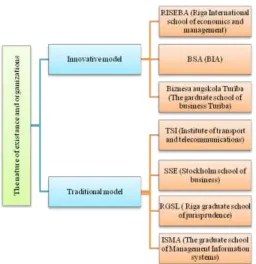
Figure 3 The nature of the forming criteria of the modern models of the Latvian universities in the industry.
The represented figure allows distinguishing three types of forming criteria by nature of existence of an organization, orientation of the educational process and belonging to the government regulation, acting as a type of social procurement.
The first type, determining the model by nature of existence and organization, includes the innovative and traditional model.
1. An innovative model includes the forming criteria based on the idea of creation scientific and technological parks, incubators, educational, scientific, industrial, financial complexes. This model suggests such mechanism of interaction of science, education and production wherein the initiator of the system of forming criteria acts an university – organization. And the implementation of an idea of the created product is carried out due to the linking elements in the form of concluded agreements of the different legal force. Thus, the chain of serial lines silhouettes: “an university –
organization – industry – territory”1. It should be noted that in spite of the attractiveness of the created product by an organization in this model for the consumer – a foreign student, the given product does not fully meet the expected effect. Namely: - a) The industrial and scientific organizations unwillingly accept the foreign students for an internship because of an existing legislation specified time constraints in the terms of 20 hours a week; - b) the integration process of the consumer – a foreign student occurs mainly within the frameworks of educational process i.e. very slowly.
2. The traditional model includes the forming criteria of interaction of between the university – organization in the industry (Figure 1) and the enterprise outside the industry (manufacturing enterprises, firms, etc.). In this model as in previous one, as a rule, the initiator of embodiment of forming criteria acts an university – organization and program which requires the adherence of chain links. And the enterprise in this chain acts as a party, agreeing to the participation in this chain links. In this regard, the participation
1
Beketov N.V Denisova, A.S. The modern model of the innovative development of the national and educational system/The University in the system of continuing education: materials Inter. Scientific – method. Conferences (Perm, Perm State University, 14th
-15th of October 2008.)/ Perm State University – Perm, 2008, P 65.
468
of this party is limited by passing practical training. However, there are examples as an exception, when as the initiator of the forming criteria acts an enterprise, providing the financing of education at the universities of their employees what naturally is not popular for foreign investors, wishing to invest in the education of their protégés in the Latvian universities. And for this reason and above mentioned reason, i.e. temporary restrictions on work, the created product by the given organization can’t be attractive for the consumer – a foreign student. And its integration process will occur even slower than in innovative model.
The second type, determining the model by the nature of orientation of educational process includes the research and humanitarian model.
1. The research model of the university – organization in the industry includes the forming criteria, based on the combination of scientific and research activity and the activity on the enterprise/in the organization on a continuous basis. In this communication system that is a positive fact is traced the interest of both parties, i.e. the connection of higher institution – organization in the industry and outside the enterprise. Such connection denotes as chain link – “the integration of the research activity of student with the professional one”2
. The product offered by an industry organization of this model can be interested for the consumer – a foreign student by the reason of close cooperation of the chains of links, but no more. The integration process as in the previous cases will be implemented extremely slowly.
2. The humanitarian model includes the forming criteria, in essence, determining the activity, related to the generalization, preservation and broadcasting of the cultural experience of mankind. This model “allows to demonstrate the deep basis of the professional ethics and to teach student to evaluate the usefulness of the made professional decision by him/her”3
. In this model, it is difficult to determine the chain of interrelations. The product offered by an organization of an industry of this model is less attractive than in the previous cases for consumer – a foreign student and in the case of its consumption, the integration process also will occur extremely slowly.
The type of social procurement as a model of forming criteria is third in the system of education includes two directions. Among them: “The university – firm”4is a model oriented to the training of specialists on the modern situation which is formed under the influence of the market, i.e. demand and supply and “University – society”5 – the model is focused on the fundamental researches which are defined by the social needs (economic, political, social and etc.). In this model, in the chain of interrelations the initiator of formation of forming criteria in education is the state, where the higher
2
Titovec T.E. The modern models of universities: state, problems, the prospects of integration/ The University in the system of continuing education: materials Inter. Scientific – method. Conferences (Perm, Perm State University, 14th -15th of October 2008.)/ Perm State University – Perm, 2008, P. 53.
3
See in the same place. P. 54.
4
Yaroma O.V. The basic approaches to the university education in the XXI century/ The University in the system of continuing education: materials Inter. Scientific – method. Conferences (Perm, Perm State University, 14th -15th of October 2008.)/ Perm State University – Perm, 2008, P.61.
5
469
education institution acts as an intermediate both in the first and second case. Consequently, the chain of links has the following form: - a) State – university – organization industry – enterprise; b) Sate – university – industry enterprise – society.
It is important to understand that each of the above mentioned types of models include the social and psychological base as a base on which are built the basic elements of the higher educational institution in each country separately. I.e. the main role in the formation of the forming criteria in the education in the existing models belongs to the organization in the industry that forms a product, meeting the demand and expresses a desire to join in the process of educational system of the existing models. But how fits in the mentioned models the consumer – a foreign student? Is the product offered by an organization in the industry which is in demand or will be in demand with the consumer – a foreign student and whether there is a model in which the organization functions in the industry, meeting the requirements of the consumer – a foreign student for satisfaction of needs? In this regard, it should be added that in the presented types of models is traced the determining initiative of the forming criteria of education which belongs as a rule to one of the parties that disturb the process of interrelation within the industry and is not a positive and promising in the solution of integration process of consumer – a foreign student and violation of the chain of interrelations (Figure1).
The carried out analysis of the theoretical aspects of the existing models of the higher educational institutions allows to analyze the universities of Latvia and to determine their belonging to the type of the model of the forming criteria of the education system.
As an object of the research are organizations in the industry (Figure 1), are chosen the leading private universities of Riga city. The rationale for choosing is the fact that the given territorial segment includes the greatest number of universities, namely 16 higher educational institutions, not including colleges. The objects of the research are:
TSI (Institute of Transport and Telecommunications); SSE (Stockholm School of business);
RGSL (Riga Graduate school of Jurisprudence);
ISMA (The graduate school of Management Informational systems); BSA (The Baltic International Academy);
RISEBA (Riga International School of economics and management)
Biznesa augskola Turība (The Graduate School of Business Turiba).
To carry out the research were used the various sources, including the statistical data and data are published in Latvijas Avīze6
on the 8th of May 2013.
By the nature of existence of an organizations in the industry visually, in the form of scheme represent the above mentioned universities and determine their belonging to the types of models (See Figure 4).
6
470
Figure 4 The analysis of belonging to the models of the private universities of Riga city by the nature of existence and organization.
From figure 4 it can be seen that the innovative models as to the types of forming criteria hold only three universities, namely, RISEBA, BIA and BS Turiba. In this context it can be seen an innovative attitude towards the approach of education in the education institutions, namely the active use of Internet technologies in education, the availability of opportunities for the professional growth (business incubator), the carrying out of scientific and practical conferences, seminars and so on. It should be added that the mentioned facts and the fact that in the given universities actively implemented the programs of teaching in English, are positive for attracting a consumer – a foreign student, but not contributing to the solution or improvement of their integration that confirms marked in the theory.
To the traditional model as to the type of forming criteria of educational system it is possible to refer: ITT, SSB, RGSJ, GSMIS. And despite the implementation of programs of teaching in English, in fact of its traditional characteristics and organizations can’t offer a product that meets the demand of consumer – a foreign student and can’t contribute to the improvement of the integration process that also confirms the conclusions made in the theory.
471
In order to determine which should be the model of an organization in the industry which would be able to offer an attractive product for the consumer – a foreign student and contribute to the improvement of integration process, let’s consider the modern state of the education system in Latvia and the conditions in which it is implemented.
The traditional understanding of the modern model suggests that “An ideal model” of the university – organization – it is first of all a cultural and historical model according to which an university/institution – organization depends on the sociocultural environment and macro environment of the country determines the priority areas. The society and culture in which appears an university – an organization determine its form, tasks, functions specify to them the certain requirements i.e. determines the industry. And it would be fairly and justified for the creation of models of organizations in the industry and if in the modern conditions, to the consumer – a foreign student would be enough to settle for the offered product by the organizations. But for the complete satisfaction of their needs to the consumer – a foreign student is necessary some mechanism in the system of interaction which will contribute to the improvement of the integration process in the society and acceptance of the culture of the country of education.
The fact that the globalization also directly affects the higher educational institutions as the organizations form the industry makes the particular topical the task of distribution of the national cultures and contributes to the standardization of education, (Scott P. Globalization and university// Alma mater. M., 2000. № 4. P.3- 8). For example in Latvia, a large share of market of the higher education is concentrated between the state universities, in its turn the private sector occupies a smaller share.
The higher education in Latvia develops due to the participation of the European Union by the means of different, both general and private structural funds. Unfortunately, the political peculiarities of the country do not allow using the financing for the improvement of the higher education in general and target funds for modernization are sent exclusively to the state universities. A striking example is the fact that in the period from 2004 to 2006 the different European and state funds (ERAF, VF) funded the renovation and improvement of technological support of the public higher education institutions for the attraction of improving the level of training of students (See Figure 5). The total funding in 2011 made more than 5.5 million lats7.
18%
78% 3% 1%
The state universities
RTU
LU
LLU
DU
7
472
Figure 5 the percentage ratio of getting funding for the technological support of the public higher education institutions.
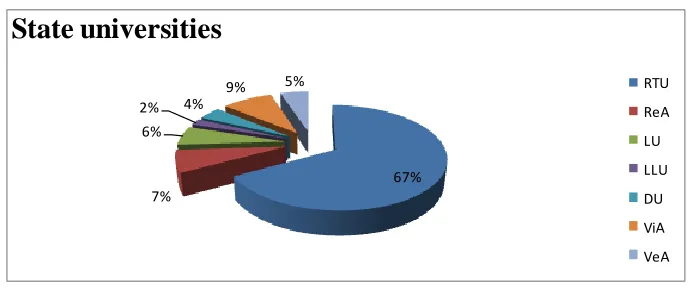
The ratio of getting the financing between all state universities differed according to certain criteria, including the technical equipment, condition of buildings and etc. For example, if the maximum financial support 78% (seventy –eight percent) got the Latvian university for the technological support (See Figure 5), then the renovation of premises Riga Technical university got 67% (sixty – seven percent) of the total financing (See Figure 6)8.
Figure 6 The percentage ratio of getting funding for renovation of premises of the public higher education institutions.
Marked, positive reflects on the creation of conditions for offering the rival product, but not for the improvement of integration process of foreign student, studying in these universities. The private sector of the higher education – industry which simply is obliged to form the rival product, can rely only on your own strengths and means. But if there are available means, allows them to create an organization, offering the rival product that is in high demand with the consumer – a foreign student. It is a product that provides the training in the conditions of integration.
Thus, basing on the results of carried out research; the author suggests introducing the “complete” generalized model of the higher education, where the main goal will be the connection of 6 types of forming criteria in the system of forming of models (innovative, traditional, research, humanitarian, university – firm, university – society). I.e. connecting the available criteria in a single whole is created a new model with the newly formed criteria of education. In the author’s opinion for the creation of a single, correct, modern model it is necessary to bring into compliance the theoretical aspects of determination and distribution of the forming criteria of education, to determine the possibility of their implementation in practice, in the examined segment.
Let’s represent the scheme of “complete” generalized model of the higher education, the mixed model of the University of the 21st century (See Figure 2.3.).
8
Ministry of Education and Department of Higher Education – A review of Latvian higher education in 2011.
67% 7%
6%
2% 4%
9% 5%
State universities
473
Figure 2.3 The scheme of “complete” generalized model of the higher education, the mixed model of the University of the 21st century
As it can be seen from the figure, it is offered to combine the concept of university – firm and society. The given model will allow making and implementing the forming criteria of education so that in the scheme of educational process will be involved the objects necessary for complete education.
It seems that along with the existing requirements for the educational process and programs, the educational plan will be drawn up with the help of employers. The given measure is necessary for getting complete professional education as the final result of education, besides the general education is employment. Also the necessary condition is close cooperation with the employers and the attraction of practicing lecturers and/or each of the specific educational models on specializations. For example, such division of disciplines will provide an opportunity to the higher educational institution to be competitive not only in the market of the higher education, but also in the market of the additional education for the employee training and education of different enterprises, including the state organizations. Such method of division of the training modules into directions will allow to connect both traditional and innovative model models of types of forming criteria that will allow students to study not only the theoretical basis of disciplines, but also to implement gained knowledge into practice. A discrete role in the suggested scheme belongs to the place of practice. The time cycle of interning should be at least 2 months at that, at the enterprise which is interested in a particular candidate/student, selected on a competitive basis.
As a result, it may be noted that the suggested model based on the integral chain of interrelations, will allow to make and implement the forming criteria of the higher education so that in the scheme of educational process will be involved the objects which are necessary for the complete education with the determining criterion – the quality that will allow the new organizational structure to take a worthy niche in the field of education at the modern stage.
Let’s consider the position B
The target market – the consumer is determined by the combination of available, similar needs. As it was determined, those are foreign students, studying in the Latvian higher educational institutions in Riga (See Figure 2). After determining the total combination and its scope, we identify the market segment. Such is the segment, where is concentrated the greatest number of universities, where is studied the potential consumer – a foreign student.
“The market segment is a group of consumers, who have particular, essential characteristics for the development the marketing strategies”. (4.57.).
474
BSA ISMA EKA BPMA TSI
3845
2372
1305 571
2927
The number of students
Кол-во студентовFigure 3 The number of students in universities in one territorial segment. The determination of the market segment allowed distinguishing the potential consumer, organizations – industry. And the obtained results, thus, revealed the territorial segment – a place of establishing of this organization.
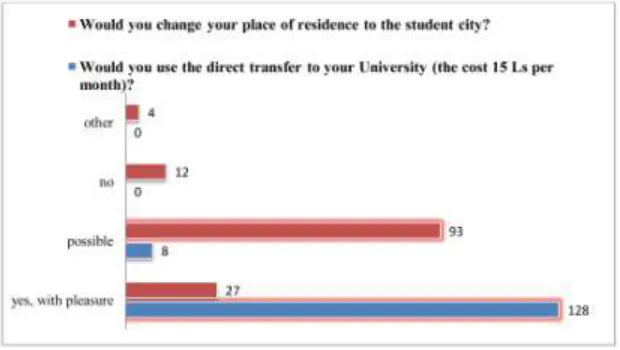
Having defined the potential consumer in one territorial segment, it is necessary to identify the needs of these consumers – foreign students, goods which they wish to get. To identify the needs of consumer – foreign student allows the carrying out of marketing researches by the means of survey on the basis of developed questionnaire [3, p. 176.]. The questionnaire is in Russian and English languages, including 20 questions has been distributed in the social networks, hotels, hostels of the researched territorial segment and in the Baltic International Academy, at the university, where are studying the largest number of foreign students. The sampling of respondents constituted 136 potential consumers – foreign students from 13 countries. The results of carried out questionnaire allowed determining the demand for the desired product, its customer value and the necessity of creation of organization “O”, is determined by the industry. In figure 4 is represented the diagram of results of respondent responses of foreign student.
Figure 4 The answers of respondent audience.
475
meets the needs and demands of consumer – a foreign student. But the mission of the given organization is contributing to the improvement of integration of foreign student – a potential customer into the Latvian society. In this regard, we pass to the research of position B [11, p. 2].
The establishing of an organization as a subject that offers the desired product – goods to the determined potential customer – a foreign student, satisfying their needs and promoting the improvement of their integration into the Latvian society prefaces the formation of marketing concept and the strategy of administrative management.
One of the elements of marketing concept it is a successful achievement of goals of an organization [5, page 147.]. For this purpose, let’s define the purpose and mission of an organization which will determine the development of its activity both at the present stage and in prospect. The goal of an organization will be “The maximization of the economic and social effect in the result of activity of an organization”. And the mission is “to satisfy the needs of consumers by the means of providing the high quality services in the industry of placement and integration of foreign students into the European society”.
As it can be seen the suggested goal and mission of an organization are oriented to the consumer – a foreign student. Consequently, the success of the firm is considered as a result of satisfaction of their needs.
B.
Having considered the key decisions on the formation of strategy of administrative management, the main thing in the organization – subject is the proposed product – goods and for the commitment of an act of an exchange between the organization and consumer – a foreign student, the product should satisfy the consumer – a foreign student and contribute to the improvement of their integration. For this purpose is developing the concept of formation of product portfolio on the basis of its balanced structure. As well as for the determination of competitiveness of product portfolio is carried out its diagnosis for establishing of prospects offered in the product portfolio of services. The diagnosis is carried out, using the forecasting method of portfolio and dynamics of product life – cycle curve (PLCC) on the basis of indices of diffusion and substitution [12, p.2.].
The search process of balanced structure of product portfolio of an organization must be complex. In figure 5 is reflected the scheme of formation process of balanced product portfolio of the organization “O”.
476
It should be noted that the degree of structuring of portfolio in the search process of the balanced structure should be optimal, i.e., on the one hand – for the correct statement of the problem of the optimization of composition and structure of portfolio, to provide a sufficient degree of separation of different services, on the other hand – to take into the consideration too deep structuring may be in the future a major obstacle. For this purpose is required a continuous diagnosis of product portfolio. Let’s present a list of offered services of an organization, formed on the basis of obtained results of the carried out questionnaire in figure 6.
Figure 6 The list of offered services of the organization “O”.
The diagnosis of the product portfolio is implemented along with the forecasting of dynamics of each type of services on the market in prospect. Let’s divide all types of services into two main types, namely: the rent of spaces; - the provision of services. As a basis of diagnosis of prospects of services, included in the product portfolio, the forecasting method of profile and dynamics of curve of PLCC, on the basis of models of diffusion and substitution is applied. As a result, it appears the forecasting series of dynamics of sales volume of each type of services and expected time of their stay on the market. The forecasting of PLCC on the basis of models of diffusion and substitution, divide into two stages, where at the first – we build a reference curve (the curve of maximum level) for the given commodity group, at the second we carried out the construct on the basis of forecasting curve, taking into the consideration the possible dynamics of volumes of sales, evolving under the influence of factors of competitive struggle on the basis of use of models of competitive substitution. They in general terms represent the improvement models of diffusion. The modeling of the smoothed curve of PLCC is carried out on the basis of models of binary substitution. The basic variables that appear in the model, these values are: - f*(t) and F*(t), characterizing the dynamics of forecasting volumes of sales of services and planned annual and accumulated to the beginning of the year under planning the volume of consumption of services of the organization: - f*(t) and F*(t) are the similar indices of volume of consumption, relating to the competitors, considered as a whole.
477
the indices of consumption forecast, defined by the reference curve. Let’s consider the system of equations of model of binary substitution on the basis of model of inhomogeneous influence (See formulas 1 and 2):
) (1) ) (2)
Where q and are the coefficients of imitations and inhomogeneous influence – the model parameters of diffusion, аp’ and p’’- are the real coefficients of innovations, characterizing the level of initial consumption of cervices. At the complete substitution of coefficient of immitation of a reference curve is obtained the following: p = p '+ p'' similarly to the value f.
The carried out forecast of strategic planning of product portfolio has shown that the given portfolio is competitive. The gotten life cycle of product portfolio as a reference and forecasting curve coincides with the economic forecasts of Latvia until 2017, made by the specialists of banking sector, Latvian economists and the Ministry of Finance of the Republic of Latvia [12, p.5].
The formation of alternative strategies is based on the results of the previous stage and carried out in parallel in each direction. The direct influence on the formation of portfolio of strategic alternatives have only parameters (factors) of the internal environment of an organization, namely knowledge, experience of the management and employees of the organization (mechanisms) whose abilities will show the effectiveness of the formed, alternative strategies. As the result of carrying out of the first four sub-stages, the leadership of the organization must be a preliminary portfolio of alternative strategies which in the future is subjected to the qualitative analysis. After carrying out an analysis the product portfolio of an organization is formed. The observance of the principles of financial security of the formed product portfolio will allow successfully implementing the product, worthily entering the Latvian market for the purpose of getting economic and social effect. And most importantly such product portfolio product will be in demand with the consumer – a foreign student, satisfying his/her needs, to improve the process of his/her integration as well as will be the result of exchange between the consumer – a foreign student and the organization. This fact allows passing to the research of the position G.
The management of competitiveness of the organization „O” means not only giving the consumer properties to the service of the formed product portfolio, but also a continuous evaluation of segment of conusmer market on which is supposed to implement the made decision in the field of marketing, i.e., the response to the existing competitors. For this purpose, let’s define the direct competitors.
With the increase of foreign students, coming to study in Latvia is increased the demand for subjects, satidfying their needs and requirements. As such subjects act hotel facilities. In the defined, in the result of carried out analysis, territorial segment, 5 km away from the mentioned higher educational institutions in the figure 3 are located 5 objects adapted for living of foreign students, these are: Hotel Apalenis; Prima Hotel; Dodo Hotel; Sala Apartments; Prusu Nams. Let’s consider the main features of competitiveness which are visually represented in table 2.
Table 2
The main features of competitiveness
Name Hotel
Apalenis
Prima Hotel
Dodo Hotel
Sаlа Apartments
478 The territorial proximity Х
Price policy Х
The conditions of accommodation Х
Technical capabilities Х
Infrastructure Х
Proximity to the public transport Х
Medical service Х
Capacity (persons) 348 369 218 105 98
From the represented table it is possible to emphasize the object Prima Hotel which is the leader in the price policy that is not unimportant aspect in choosing the place of residence by the foreign students. And also the given hotel is able to contain more students for accommodation than the other hotel subjects available in this territorial segment.
The carried out analysis allowed determining the competitors and the availability of accessible place of residence in relation to the higher education institutions located in the designated territorial segment – Vidzeme suburb. However, the given subjects – competitors don’t solve the problem of integration of foreign students into society. That proves the necessity of creation of competitive organization with a balanced product portfolio – product which are in demand with the consumer – a foreign student and able to solve problem of their integration. In this regard, for the development of competitive strategy of the organization – industry, it is required the deeper study of the competitive environment. And because in the result of research revealed the competitors, providing only the accommodation for foreign students (the rent of residential accommodations according to the product portfolio – See figure 6) for the assessment of segment of consumer market, use as the subjects of analysis namely them, represented in the table 2. The analysis is carried out, using the method of “Parametric coefficient” the essence of which is to identify the positive and negative parameters on formula (3):
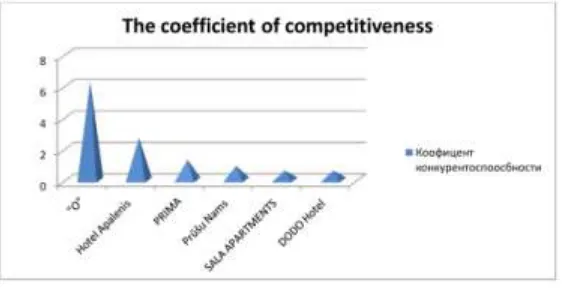
Whereᵦ - are positive parameters, ᵦ- are negative parameters, ᵦ- the number of analyzed parameters, – is Sharpe ratio in the researched area. The obtained results during the analysis, using the “Parametric coefficient” showed that the coefficient of competitiveness was: 2,7-Hotel Apalenis; - 1, 3 - PRIMA; - 0, 6-SALA APARTMENTS; - 0, 6-DODO Hotel; - 0, 9-Prūšu Nams; - 6,3- the organization "O". Exponential i.e., the best with the considerable separation from the subjects – competitors is the gotten coefficient of the new organization which is represented visually in figure 8.
479
Figure 8 The final evaluation of analysis of competitiveness, using the method “Parametric coefficient”.
After carried out an analysis of competitiveness of subjects – competitors in the segment of the consumer market, namely in the territorial segment – Vidzeme suburb, it should be paid the attention to the forecasting of the activity of prospective development of the organization “O”. For this purpose is given the assessment of its potential, taking into the consideration the changes of market trends and the factors are identified that have a direct impact on its strategic decisions, using a matrix of SWOT- analysis, reflected in the table 3.
Table 3
The SWOT – analysis of the organization “O”
480 Table 3
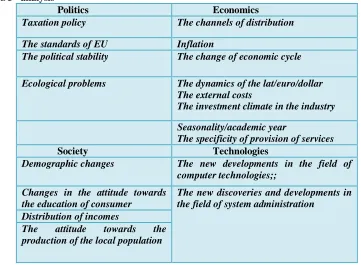
PEST –analysis
Politics Economics
Taxation policy The channels of distribution
The standards of EU Inflation
The political stability The change of economic cycle
Ecological problems The dynamics of the lat/euro/dollar The external costs
The investment climate in the industry
Seasonality/academic year
The specificity of provision of services
Society Technologies
Demographic changes The new developments in the field of computer technologies;;
Changes in the attitude towards the education of consumer
The new discoveries and developments in the field of system administration
Distribution of incomes
The attitude towards the production of the local population
The presented matrix revealed the factors of external environment of the firm. First of all it should be noted that the absence of restrictions in the taxation policy of Latvia doesn’t contribute to the development of the entrepreneurial activity and the intense competition between the political parties provokes the taking of unpopular economic and political decisions. In this regard, it is necessary to develop such a competitive strategy that will allow implementing the entrepreneurial activity of the organization “O” under the current conditions. Analyzing the available basic types of competitive strategy was made the conclusions that none of the four existing organizations was suitable. Therefore, was developed a new type corresponding to the activity of the organization – “Commutator – explerent” strategy. The given strategy is a type generalizing the Commutator and explerent strategies separately.
A distinctive feature of Commutator – explerent strategy is the adaptation to the local scales, ever-changing needs and consumer needs – foreign students and timely response to the decision on the improvement of services of product portfolio. Thus, the given estimation of competitiveness of the organization and the suggested for it competitive strategy allow to determine the prospects of development of idea on the improvement of the integration process of foreign students into the European and Latvian society. However, taking into the consideration that the given organization will do business activity that requires the investment of money both at the initial stage and during the further economic management, the question of financial security and the possibility of establishing organization arises.
Therefore, proceeding to the position D
481
and demands of consumers – a foreign student and contributing to the improvement of their integration into the European and Latvian society. Highly relevant is represented the question of the possibility of establishing of such organization. For this purpose, let’s analyze the payoff of establishing of an organization – industry.
For the analysis of payoff of establishing of an organization – industry, let’s make the calculation of cover ratio of profit (QIR, Engl. Quick Income Ratio). This method involves the report analysis of movement of funds made, using indirect method. The volume of received income, in the cost units is determined by the subtraction of accounts receivable of accrued revenue (See formula 4).
(4)
Where: CFFO – cash flow from the main activity, CFS – received revenue, S – accrued revenues, paid interests, Тp – paid taxes, Ip – paid interests, NI — net profit, , Ie – accrued interests, Te – accrued taxes, Dep – amortization.
From the developed balance of the organization “O” the following indices are stood out:
CFFO — 506005, 00; Ip– 0; Тp – 13777,00 ; NI - 78073,00;Ie – 10; Te – 13777,00.
QIR= (506005+0+10928) (78073+10+13777+2000) = 5,51.
The coefficient of cash cover of the future profit of the organization is high rate. We forecast the cash flow for an investment period in 10 years, as well as the discount rate and discount cash flow which visually represented in table 4.
Table 4
The forecasting discount cash flow
№
Year CF (Ls)
% per
year D dCF (Ls)
1
2015 506005,00 4 0,96 486543,27
2
2016 566725,60 4 0,92 523969,67
3
2017 634732,67 4 0,89 564275,03
4
2018 537909,04 4 0,85 459806,91
5
2019 455855,12 4 0,82 374679,68
6
2020 495781,63 4 0,79 391823,42
7
2021 585022,32 4 0,76 444568,88
8
2022 690326,34 4 0,73 504414,70
9
2023 814585,08 4 0,70 572316,67
1
0 2024 585022,32 4 0,68 395220,12
After the calculation of discount cash flow of the organization, it may be noted that the discount cash flow of the organization “O” will be relatively stable.
482
Summing up, it is possible to draw the following conclusions:
1. At the present stage in Latvia, there is no scientifically based study of the problem of integration of foreign students from the prospective of the theoretical aspects of marketing – management;
2. The carried out analysis of the industry allowed to determine the absence of a new model of higher educational institution, allowing to reduce the time of integration of consumer – a foreign student;
3. The carried out analysis of territory of the greatest concentration of higher educational institutions in Riga, defined the market segment – potential consumers – foreign students, studying in these universities and the territorial segment – the place of establishing of an organization;
4. The carried out analysis of the potential target audience reveled the necessity of establishing of an organization – industry, contributing to the improvement of integration of foreign student into the European and Latvian society, offering a product that meets his/her needs and demands;
5. The carried out marketing researches by the means of questionnaire of foreign students from 13 countries showed the high customer value of the product which is required to meet their needs;
6. The suggested mission and goal of the organization “O” are able to solve the revealed problems in the integration of foreign students, providing the economic and social benefit both of the organization itself and Latvia as a whole;
7. The developed strategy of administrative management in the organization “O”, the organizational structure will allow to give up on the standard forms of government and come to more modern, allowing flexibly to respond to ever-changing processes;
8. The developed multifunctional product portfolio will allow to pretend to monopoly in the form of absence of direct competitors and suggest the probability of its high demand;
9. The diagnosis of prospects of services included in the product portfolio by the forecasting method of profile and dynamics of PLCC on the basis of models of diffusion and substitution have shown that the profile is competitive and the curve of life cycle of services coincides with the economic forecasts of Latvia until 2017;
10. The carried out forecast of strategic planning of the product portfolio, the evaluation of its competitiveness by the new method “Parametric coefficient” has shown its high reliability and competitiveness;
11. The valuation of characteristics of the enterprises, providing the accommodation to the foreign students, i.e., supposed competitors, identified their main advantages and disadvantages in the researched territorial segment, allowed to evaluate their competitiveness in relation to the new organization “O”. And carried out SWOT – analysis, the prospects for the future development of the organization;
12. Identified in the result of PEST – analysis the negative factors, influencing on the external environment of the organization have became the reason for the development of new type of competitive, - Commutator - explerent strategy that will allow the organization “O” to implement the entrepreneurial activity, at that occupying the worthy position in the market of services in the Vidzeme suburb;
483
Thus, the combination of theoretical basis with the obtained results during the research, allowed creating a competitive product in the form of balanced product portfolio, offered by the new organization – subject to the consumer – a foreign student, who wishes to get it in the result of an act of an exchange. The basis of satisfying factors of needs, forming the demand for developed product of exchange is the improvement of integration of foreign student into the Latvian and European society. This proves, eventually, the great significance and role of basis of marketing – management in the decision of improvement of integration process of foreign students.
Methodology (Research types):
1. Desk researches (the collection of the secondary data); 2. Field researches (the collection of the primary data); 2.1. Observation;
2.2. Interview methods; 2.3. Panel method of research; 3. Social researches;
4. Expert evaluations;
4.1. The method of collective generation of ideas; 5. Experimental methods;
5.1. Standard testing; 5.2. Controlled testing; 5.3. E –testing; 5.4. Imitation testing.
6. Economic and mathematical methods;
6.1. Statistical methods of information processing;
6.1.1. Descriptive analysis (statistical measures – the comparison of values); 6.1.2 Conclusion analysis (checking of hypothesis);
6.1.3. The analysis of differences (the comparison of results of research of groups); 6.2. Multidimensional methods (factor and cluster analysis);
6.3. Regression and correlation methods;
6.4. The methods of statistical decision – making theory; 6.7. Deterministic method;
7. Author developed an analytical method: the method of parametric coefficient
Timescale/Research Planning
Type of the research Сountry Time period Timescale
Desk researches (the collection of the secondary data);
Latvia/UK 2 mounths 1 semester
Observation Latvia/UK 4 mounths 1-2 semester
Interview methods Latvia/UK 1 mounths 2 semester
Panel method of research Latvia ½ mounths 2 semester
Social researches Latvia ½ mounths 2 semester
The method of collective generation of ideas;
Latvia 1 mounths 3 semester
Standard testing; Latvia/UK 3 mounths 3 – 4 semester
Controlled testing; Latvia/UK 1 mounths 4 semester
E –testing; Latvia/UK 1 mounths 4 semester
Descriptive analysis (statistical measures
484 hypothesis);
The analysis of differences (the comparison of results of research of groups);
Latvia ½ mounths 5 semester
Multidimensional methods (factor and cluster analysis);
Latvia 1 mounths 5 semester
Regression and correlation methods; Latvia 1 mounths 5-6 semester
To summarize all data to PhD work 6 - … semester
Bibliography:
1.Akulich, I.L. Marketing // I.L. Akulich, V.V. Tarelko. – Minsk : Sovrem.Shk., 2007. – 304 s. [Akulich, IL Marketing // IL Akulich VV Plate. - Minsk: Sovrem.Shk., 2007. - 304.pages] 2.Golubkov, E.P. The marketing researches. – 4-e edition. – Publisher «Finpress», 2008. – 496
s. [Golubkov E.P. Marketing Research: Theory, Methods and Practice. - 4th ed., Rev. and add. - M. Publisher "Finpress", 2008. - 496.]
3.Golubkova T., Rotanova I. Marketing. Riga, BMA, 2007 – 114 s. [Golubkova T., I. Rotanova Marketing. Course - notes. Riga, BMA, 2007 - 114 p.]
4.Doyl' P., Shtern F. Marketing menedzhment i strategii. 4-e izd. / Per. s angl. – SPb.: Piter, 2007. – 544 s.[ Doyle, P., F. Stern, Marketing Management and Strategy. 4th ed. / Per. from English. - St. Petersburg.: Peter, 2007. - 544.]
5.Kapon N, Kolchanov V, Makkhalbert Dzh. Upravlenie marketingom: Per. s angl. – SPb.: Piter. 2010. – 832 s. [Capon H, Kolchanov B Makhalbert J. Marketing Management: Per. from English. - St. Petersburg.: Peter. 2010. - 832 sec.]
6.Kotler F., Keller K.L. Marketing-menedzhment. 12-e izd. – SPb.: Piter, 2010. – 816 s. [F. Kotler, Keller, KL Marketing management. 12th ed. - St. Petersburg.: Peter, 2010. - 816.] 7.Krevens, Devid, v. Strategicheskiy marketing, 6-e izd. : Per. s angl. – M. : Izdatel'skiy dom
«Vil'yams», 2003. – 752 s. [Krevens, David, c. Strategic Marketing, 6th ed. : Per. from English. - Moscow: Publishing house "Williams", 2003. - 752 p.]
8.Malkhotra, Neresh K. Marketingovye issledovaniya. Prakticheskoe rukovodstvo, 3-e izdanie.: Per. s angl. – M.: Izdatel'skiy dom «Vil'yams», 2003. – 960 s. [Malhotra, Naresh K. Marketing Research. A Practical Guide, 3rd edition.: Trans. from English. - Moscow: Publishing house "Williams", 2003. - 960.]
9.Ministerstvo Vysshego obrazovaniya i departament vysshego obrazovaniya - otchet o latviyskom vysshem obrazovanii 2011 [Ministry of Education and Department of Higher Education - A Review of Latvian higher education 2011.]
10.Ministerstvo inostrannykh del Latvii URL:http://www.latviaspb.ru/ru/eu/Latvia-in-EU/ (data promostra 04.03.2013)
11.T.Golubkova, «Strukturnye izmeneniya i mobil'nosti inostrannykh studentov v vysshikh uchebnykh zavedeniyakh strany Baltii"
12.Martins Kazakhskom «Ekonomika Latvii, glavnyy ekonomicheskiy ekspert Ivashchenko N.S., Vybor struktury portfelya syr'evykh kompaniy na osnove analiza ego balansa,
zhurnal "Marketing"