
Geochemistry and Tectonic Setting of Pleistocene Basaltic
Lava Flows in the Shahre-Babak Area, NW of Kerman,
Iran: Implication for the Evolution of
Urumieh-Dokhtar Magmatic Assemblage
S.Z. Hosseini,
1,*M. Arvin,
1R. Oberhansli,
2and S. Dargahi
11Department of Geology, Shahid Bahonar University of Kerman, P.O. Box
76175-133 Kerman, Islamic Republic of Iran
2Department of Geology, Potsdam University, P.O. Box 601553-14415 Potsdam, Germany
Received: 2 February 2009 / Revised: 29 August 2009 / Accepted: 29 November 2009
Abstract
Pleistocene basaltic lava flows, consisting of trachybasalt and basaltic
trachyandesite, cover an area north-northwest of Shahre-Babak in southeastern
Iran. The whole rock chemistry indicates that the lavas are dominantly alkaline
and mildly calc-alkaline. Variation diagrams of SiO2 with major and trace
elements are consistent with fractional crystallization processes involving olivine,
pyroxene, plagioclase, ± hornblende and Fe-Ti oxides. In both rock types trace
element variations show similar high LILE/HFSE ratios, which along with their
similar fractionation trend, implying a common magma source but different
degrees of evolution. Their MORB normalized incompatible trace element
concentrations show enrichment in LILE (e.g., Sr, K, Rb, Ba) and LREE (e.g.,
Ce), but depletion in HFSE (e.g., Ta, Nb, Ti, Zr, Hf, Y) and HREE (e.g. Yb). The
Shahre-Babak alkaline basalts show characteristics of subduction related (active)
continental margins, OIB and within-plate tectonic environments. Regarding the
Late Miocene collision time between Arabia and Central Iran, the Shahre-Babak
alkaline basaltic lavas should be collision related (post-collisional). Their
enrichment in LILE and LREE relative to Ta and Nb can be explained either by:
(a) presence of a subduction component or addition of an LILE-enriched, Nb-Ta
poor fluid component to the mantle wedge or (b) crustal contamination of
mantle-derived magmas during their ascent to the surface through assimilation and
fractional crystallization (AFC) and or MASH (melting, assimilation, storage and
homogenization). The magma erupted in a post-collisional tectonic setting and
formed in a within-plate environment between two north-south running faults and
is closely related to deep lithospheric fractures.
Keywords: Basalt; Collision zone volcanism; Pleistocene; Iran; Shahre-Babak
*
Corresponding author, Tel.: +98(341)3222035, Fax: :+98(341)3222035, E-mail: [email protected] Introduction
The Cenozoic geodynamic evolution of Iran has been
Eocene to Miocene caused extensive subduction related volcanism in the Urumieh-Dokhtar Magmatic Assem-blage (UDMA), a part of the Zagros orogenic belt in Iran (e.g., [25, 34, 10, 2, 4, 55] and references there in). Magmatism in the UDMA started in Early Eocene and continued until Pleistocene with peak of volcanism occurred in Middle to Upper Eocene [9,3]. The volcanism has been followed by continental collision between the Iranian and Arabian plates either during or before the Late Miocene time which led to crustal shortening and thickening in the western edge of the Iranian plate with a NW-SE trend compressional regime that continues today [43]. The thickness of the crust is about 45-50 km in western edges of Iranian plate in the Sanadaj-Sirjan zone [46]. Following the collision event volcanism continued in some parts of UDMA markedly as Pleistocene basic volcanism in Shahre-Babak area, NW of Kerman. It has been advocated that the source and affinity of basaltic lavas can be used for better understanding of tectonic evolution [49]. In this study we present for the first time the petrography and geochemical characteristics of the Pleistocene basaltic lava flows in the Shahre-Babak area and discuss their geochemical affinity, their magma source, and the relationship to the regional tectonic patterns.
1-Tectonic History of the Region
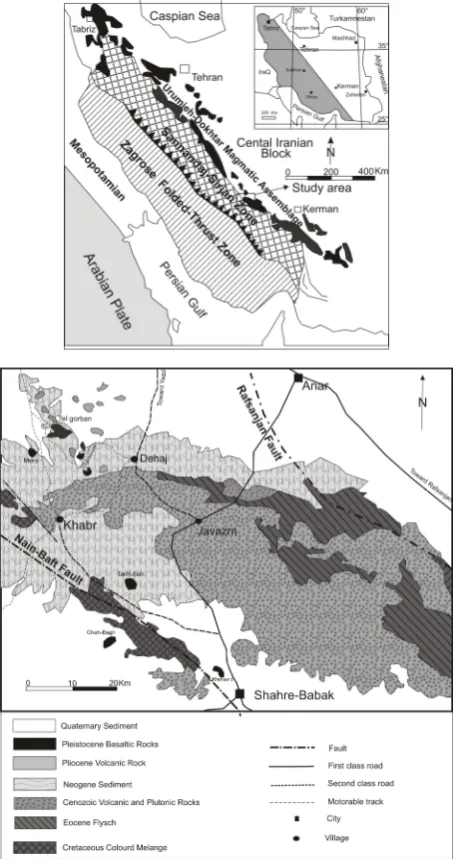
The geological and tectonic history of Iran is linked to the evolution of Tethyan Ocean. The Central Iranian microcontinent was detached from Gondwanaland during Permian to Early Triassic time and subsequently attached to Eurasia along the Alborz and Kopeh-Dagh sutures during the Triassic closure of the Paleo-Tethys Ocean [59, 23, 60]. As a result, the Late Paleozoic ophiolites were emplaced in the North and Northeast of Iran (Fig. 1). As the Paleo-Tethys Ocean was closing, rifting along the present Zagros thrust zone took place on the continental plate. This eventually led to the opening of the Neo-Tethys Ocean [8]. The new ocean was expanded during Late Triassic-Early Jurassic, while pelagic marine carbonates were deposited in Zagros orogenic belt. The Zagros orogenic belt of Iran belonging to the extensive Alpine-Himalayan orogenic system, formed as a result of the separation of Arabia from Africa and its subsequent collision with Eurasia. Structurally the Zagros orogenic belt consists of three parallel NW-SE trending units (Fig. 1a). 1. The Zagros fold-thrust belt (ZFTB) is bounded to the northeast by the Main Zagros reverse fault and is proposed to be the suture zone between the Arabian plate and Eurasia. The ZFTB contains a thick and almost continuous sequence of shelf sediments deposited on the 1-2 km thick
Infra-Camberian Hormoz salt formation. These sediments, of Paleozoic to Late Tertiary age, are believed to be separated from the Precambrian metamorphic basement by the Hormoz salt layer [3, 1]. 2. The Sanandaj-Sirjan zone (SSZ; [59]) is made of mainly Jurassic, interbedded phyllites and metavolcanics showing a moderate metamorphic imprint except close to large-scale Mesozoic calc-alkaline plutons. These metamorphic rocks are unconformably overlain by the Barremo-Aptian Orbitolina limestones, typical of
Central Iran sedimentation [59]. During most of the second half of the Mesozoic, the SSZ represented an active Andean-like margin whose calc-alkaline magmatic activity progressively shifted northward [9, 54]. 3. The Urumieh-Dokhtar volcanic zone of Schroder [53] or the Urumieh-Dokhtar magmatic assemblage (UDMA) of Alavi [4] is a 150 km wide magmatic assemblage. This magmatic assemblage has been interpreted to be a subduction related Andean type magmatic arc that has been active from the Late Jurassic to present [9, 10]. The UDMA is composed of voluminous tholeiitic, calc-alkaline, and K-rich alkaline intrusive and extrusive rocks (with associated pyroclastic and volcaniclastic successions) along the active margin of the Iranian plates. The oldest rocks in the UDMA are calc-alkaline intrusive rocks, which cut across Upper Jurassic formations and are overlain nonconformably by Lower Cretaceous fossiliferous limestone. The youngest rocks in the UDMA consist of lava flows and pyroclastics that belong to Pliocene to Quaternary volcanic cones of alkaline and calc-alkaline composition [8].
The final closure of Neo-Tethys and collision between Arabian and Central Iranian plates took place before or during Late Miocene [8, 10, 16]. The collision has been purely continental for the past 5 Ma [60, 43, 1]. The convergence velocity of Arabia with respect to Eurasia is approximately 22 ± 2 mm yr−1 in the direction N8±°E [67], which has been accommodated by crustal shortening, folding and thrusting deformation in the Zagros, Alborz and Kopeh-Dagh regions and also by lateral displacements of Central Iran blocks along major strike-slip faults [37]. After collision in Late Miocene and as a result of shortening and thickening, volcanic activity continued well into Pleistocene in some parts of UDMA (e.g., basaltic lava flows in Bijar and Shahre-Babak regions, Fig. 1b), leading to formation of alkaline, calc-alkaline volcanic and subvolcanic rocks.
2- Geological Setting
The study area is located on the north-northwest of Shahre-Babak, in the Rafsanjan-Saveh depression which is bounded between two NW-SE running right lateral strike slip faults (Anar and Dehshir faults) and covers about 250 km2 areas (Fig. 1). According to the Moho map of Dehghani and Makris [18] the crustal thickness of the study area ranges from 48 to 50 km. The Shahre-Babak Pleistocene basaltic lava flows are outcropped to the south of spilitic agglomerates of the ophiolitic "colored mélange" and between the ophiolite and Eocene flysch deposites (Fig. 1). The Tertiary magmatism in the area comprises of two distinct
episodes: 1- the Paloegene volcanics which consists of basaltic andesites, latites, analcime rich tephrites, some nepheline phonoliths and volcanicclastic rocks and 2-Oligo-Miocene plutonic rocks consisting of granodiorites, porphyric diorites and porphyric quartz diorite. Late Miocene-Pliocene magmatic activity comprises of some dacitic-andesiic domes and lava flows. In the Shahre-Babak area Pliestocene basaltic lavas, covering Quaternary terraces, were formed through monogenetic volcanic activity and occur as mesa-forming flows. Those confined to the south of UDMA in Chah-Bagh, Takhte-Siah and Khorsand localities are trachybasalts, whereas those to the north and inside UDMA in Chah-Breshk and Tale-Ghorban are basaltic trachyandesites (Fig. 1b).
3- Analytical Methods
About 80 thin sections from the volcanic rocks of the study area were examined under the microscope. Of these a total of twenty selected samples were analyzed for mineral chemistry, whole rock major, trace and rare earth element composition at the Institute of Geosciences of Potsdam University and Geo Forschungs Zentrum (GFZ). Mineral compositions were determined using a Cameca Microbeam electron microprobe on carbon-coated polished sections. The wave dispersive system with crystal spectrometers and for energy dispersive analyses (EDS) a link system with beryllium window, Si (Li) detector and XP3 pulse processor were used. Acceleration voltage was 15 KV. Counting time for individual elements and sample currents were 80s and 7nA, respectively. Whole rocks major and trace element compositions were determined on fused discs using an automated Philips PW1400 XRF spectrometer with a rhodium anode tube. REE content were analyzed by ICP-MS from pulps after 0.25 g samples of rock powder were dissolved by four acid digestions at University of Potsdam. Loss on ignition (LOI) is by weight different after ignition a 1000 °C. Detection limits range from 0.01 to 0.1 wt% for major oxides, 0.1 to 10 ppm for trace elements and 0.01 to 0.5 ppm for the rare earth elements.
Results
4-1 Petrography
hyalo-microlitic porphyric, glomeroporphyritic, fluidal, intergranular and rarely intersertal textures. Pyroxene is by far the most abundant phenocryst phase, followed by olivine. Trachybasaltic rocks consist of clinopyroxene and olivine phenocrysts and contain rare xenoliths consisting an olivine and clinopyroxene cumulate. Basaltic trachyandesitic rocks consist of olivine, clinopyroxene, opacitized amphiboles phenocrysts and few quartz xenocrysts (1-3mm) mantled with clinopyroxene (<0.5 mm wide), the composition of which is similar to those of clinopyroxene phenocrysts of host basalts. Quartz xenocrysts are derived from a separate source and interprted as an evidence of magma mixing or crustal contamination [30, 22]. In both rock types phenocrysts are enclosed within a glassy or fine grained groundmass that contains microlitic plagioclase, Fe-Ti oxide, and opaque minerals. Plagioclase, andesine to labradorite in composition (An45-60), is by far the most
abundant phase and occurs mainly as subhedral laths and microlites in the groundmass. The clinopyroxene phenocrysts are euhedral to subhedral Ca-rich crystals, fairly homogeneous in composition (Wo40-47En43-51Fs
6-10) and can be classified as diopsitic-augite. They are
commonly zoned with core rich in MgO and TiO2, up to
2 and 0.8 wt% respectively and depleted in FeO typically 2 wt% relative to their rims [32]. In a (Ca+Na) versus Ti diagram (Leterrier et al., 1982) that determine alkaline, tholeiitic and calc-alkaline basalts, pyroxenes of both rock types plot in the alkaline field (Fig. 2). AlVI/AlIV in pyroxenes indicates low crystallization pressures [58]. Olivine phenocrysts are typically subhedral, fractured and occasionally show absorbed rims with forsterite contents ranging from 80 to 92 mol%. Some phenocrysts contain small glass and Cr-spinel inclusions and show sign of idingitizitation near the rims (Hosseini, in preparation). The Fe-Ti oxides are magnetite.
4-2 Whole Rock Major and Trace Elements
Rock samples with SiO2 (45.1-50.6) fall in the
trachybasalt, whereas samples with SiO2 (52.0-54.9) fall
in the basaltic trachyandesite on the total alkalis versus silica diagram (TAS diagram, Le Maitre [36], Fig. 3). The volcanic rocks are of mainly alkalic with some tendency toward subalkalic character, based on the classification of Miyashiro [45] (Fig. 3). In P2O5 versus
Zr diagram for basalts [72] (Fig. 4), all samples plot in the field of alkali basalt. Trachybasalt with high MgO, Cr and Ni contents are less evolved ne-normative olivine basalts, whereas basaltic trachyandesite with higher SiO2 and Al2O3 contents are more evolved
hy-normative olivine basalt.
Figure 2. Ti versus (Ca+Na) diagram for clinopyroxene of Shahre-Babak Pleistocene basaltic rocks (after [37]).
Δ=Trachybasalt,▲=Basaltic trachyandesite.
Figure 3. Total alkali vs. silica (TAS) diagram for the Shahre-Babak Pleistocene basaltic rocks (according to [35]) and alkali-subalkali discrimination (curved line according to [44]). Symbols as in Fig. 2.
Figure 4. Zr versus P2O5 diagram for the Shahre-Babak
Pleistocene basaltic rocks illustrating their classification as alkali basalt (after [71]). Symbols as in Fig. 2.
In the Shahre-Babak trachybasalt the MgO, MnO, CaO, FeO and TiO2 contents are higher than those in
basaltic trachyandesites, the total alkali content in both groups are similar (Table 1). However, the basaltic trachyandesites have higher Al2O3, SiO2 and to some
extent Na2O contents than the trachybasalt. There are
also pronounced differences between some of the oxide contents in each rock group (Table 1). This can be explained by fractionation of common mineral phases such as clinopyroxene, olivine, hornblende and to minor amounts magnetite. In trachybasalts rocks SiO2 and
Al2O3 contents (to some extent Na2O) increases whereas
P2O5 and K2O contents (to some extent MgO and CaO)
decrease from Tale-Siah to Khorsand into Chah-Bagh (Table 1). In Khorsand also TiO2 is higher. In the
basaltic trachyandesites TiO2, CaO and FeO content
decreases from Tale-Ghorban to Chah-Breshk (Table 1). High contents of highly incompatible elements (e.g. Th and Zr) in basaltic trachyandesites relative to trachybasalts and between different outcrops in each group could be due to either differences in degree of partial melting of the source rock and/or a function of fractionation. There is a decrease of FeO, TiO2, MgO,
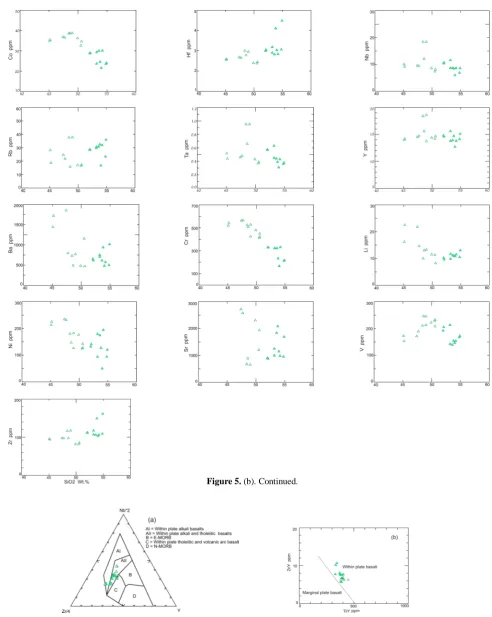
CaO, MnO, Co, Nb, Ta, and Cr contents, while Al2O3,
Na2O, K2O, P2O5, Sr, Ba, Zr, Hf, and Th contents
increase with increasing SiO2 in the basaltic
trachyandesites (Fig. 5). In trachybasalts FeO, MgO, CaO, TiO2, K2O, P2O5, Sr, Zr, Co, Hf, Th, Ba, Nb, Ta,
and Cr contents decrease, whereas Al2O3, Na2O,
increase with increasing SiO2 (Fig. 5). In general,
increasing concentrations of lithophile elements such as K2O, and Rb, and decreasing concentrations of
compatible elements such as MgO, Ni, and Cr with increasing SiO2 are related to removal of olivine,
clinopyroxene and to minor extent hornblende. Decreasing P2O5, TiO2 and Sr with increasing SiO2 are
probably related to apatite, titanomagnetite, and plagioclase fractionation, respectively [63].
In order to determine the geotectonic environment, trace-element contents of the trachybasalts and basaltic trachyandesites are plotted on Zr/4-Nb*2-Y [44] and Zr/Y versus Ti/Y [49] diagrams. The samples mostly plot in the within-plate field (Fig. 6).
MORB normalized incompatible trace element concentration diagrams for both rock types have been plotted as multi-element pattern in Fig. 7. They show enrichment in large ion lithophile elements (LILE; e.g., Sr, K, Rb and Ba) and light rare earth elements (LREE; e.g., Ce), but depletion in high field strength elements (HFSE; e.g., Ta, Nb, Ti, Zr, Hf and Y) and heavy rare earth elements (HREE; e.g. Yb). Their trace element variations show similar high LILE/HFSE ratios, suggesting that they may be derived from similar parental magma (Fig. 7a, b). Nb, Ta and Ti depletion compares to pattern from subduction related (active) continental margins, where a mantle source can be selectively enriched in LILE by metasomatism of a subduction component and /or crustal contamination and crystal fractionation [47, 50, 65, 11, 63] or post-collisional magmatic rocks [70]. Remarkably, the Shahre-Babak basaltic lavas have Ba/Nb>28 which is the most diagonestic geochemical feature of arc magmas [24].
However, the tectonic evolution of the Zagros orogenic belt of Iran indicate that Late Cenozoic-Early Quaternary volcanism in UDMA took place in a collision setting following the Early Jurassic to Late Miocene NE subduction of the Neo-Tethys (Bitlis-Zagros oceanic crust, [5]) beneath the Sanandaj-Sirjan
active continental margin which led to final closure of the Neo-Tethys and finally collision between the Arabian and Central Iranian plates along the Zagros Suture Zone. Regarding the collision related (post-collisional) and within-plate setting of the Shahre-Babak alkaline basalts possible explanations of the enrichment in LILE and LREE relative to Ta and Nb are: (a) presence of a subduction component or the addition of an LILE-enriched, Nb-Ta poor fluid component to the mantle wedge [24, 51], or (b) crustal contamination of mantle-derived magmas during their ascent to the surface through assimilation and fractional crystallization (AFC) and or MASH (melting, assimilation, storage and homogenization) [64, 71, 13, 5, 6]. A plot of Th/Y versus Nb/Y (Fig. 8) is used in order to identify the different source components which have been involved in the petrogenesis of the magmas [70, 62]. Samples from Shahre-Babak Pleistocene basaltic lava flows mostly define a coherent trend, with Th/Nb ratio close to 1.0, which may be attributed to the combined effects of crustal assimilation and fractional crystallization (i.e., AFC). The lack of higher Th/Y ratios similar to those of the oceanic basalt array (MORB+OIB) is strongly indication that metasomatism of the mantle source by subduction fluids carrying a trace element signature of a crustal component did not occur. The increase of Zr/Nb ratio with increasing of silica indicates a progressive magmatic differentiation from trachybasalt towards basaltic trachyandesite and may suggest that crustal contamination has played a significant role in their petrogenesis [70, 62].
4-3 Rare Earth Elements
Chondrite-normalized REE patterns of trachybasalt and basaltic trachyandesite lavas are illustrated in Figure 9. The REE, especially light rare earth elements (LREEs) of all samples are highly enriched, compared to chondrite. Their REE patterns are parallel to each other with (La/Lu)N=11-40, indicating a common origin for
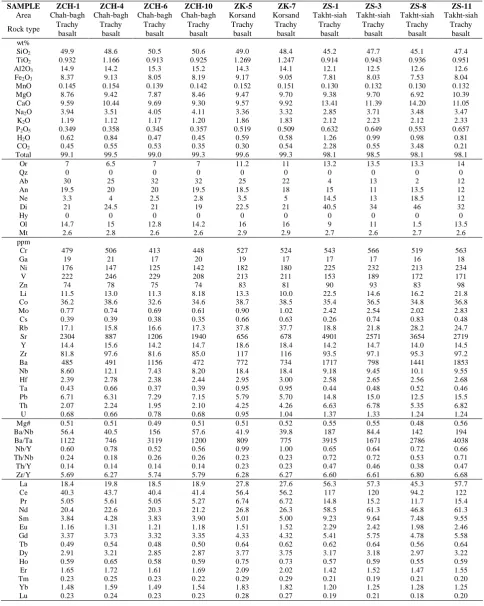
Table 1. Representative whole rock analyses of the Shahre-Babak Pleistocene basaltic rocks. ( Note: total Fe as Fe2O3)
SAMPLE ZCH-1 ZCH-4 ZCH-6 ZCH-10 ZK-5 ZK-7 ZS-1 ZS-3 ZS-8 ZS-11
Area Chah-bagh Chah-bagh Chah-bagh Chah-bagh Korsand Korsand Takht-siah Takht-siah Takht-siah Takht-siah
Rock type Trachy basalt
Trachy basalt
Trachy basalt
Trachy basalt
Trachy basalt
Trachy basalt
Trachy basalt
Trachy basalt
Trachy basalt
Trachy basalt wt%
SiO2 49.9 48.6 50.5 50.6 49.0 48.4 45.2 47.7 45.1 47.4
TiO2 0.932 1.166 0.913 0.925 1.269 1.247 0.914 0.943 0.936 0.951
Al2O3 14.9 14.2 15.3 15.2 14.3 14.1 12.1 12.5 12.6 12.6
Fe2O3 8.37 9.13 8.05 8.19 9.17 9.05 7.81 8.03 7.53 8.04
MnO 0.145 0.154 0.139 0.142 0.152 0.151 0.130 0.132 0.130 0.132
MgO 8.76 9.42 7.87 8.46 9.47 9.70 9.38 9.70 6.92 10.39
CaO 9.59 10.44 9.69 9.30 9.57 9.92 13.41 11.39 14.20 11.05
Na2O 3.94 3.51 4.05 4.11 3.36 3.32 2.85 3.71 3.48 3.47
K2O 1.19 1.12 1.17 1.20 1.86 1.83 2.12 2.23 2.12 2.33
P2O5 0.349 0.358 0.345 0.357 0.519 0.509 0.632 0.649 0.553 0.657
H2O 0.62 0.84 0.47 0.45 0.59 0.58 1.26 0.99 0.98 0.81
CO2 0.45 0.55 0.53 0.35 0.30 0.54 2.28 0.55 3.48 0.21
Total 99.1 99.5 99.0 99.3 99.6 99.3 98.1 98.5 98.1 98.1
Or 7 6.5 7 7 11.2 11 13.2 13.5 13.3 14
Qz 0 0 0 0 0 0 0 0 0 0
Ab 30 25 32 32 25 22 4 13 2 12
An 19.5 20 20 19.5 18.5 18 15 11 13.5 12
Ne 3.3 4 2.5 2.8 3.5 5 14.5 13 18.5 12
Di 21 24.5 21 19 22.5 21 40.5 34 46 32
Hy 0 0 0 0 0 0 0 0 0 0
Ol 14.7 15 12.8 14.2 16 16 9 11 1.5 13.5
Mt 2.6 2.8 2.6 2.6 2.9 2.9 2.7 2.6 2.7 2.6
ppm
Cr 479 506 413 448 527 524 543 566 519 563
Ga 19 21 17 20 19 17 17 17 16 18
Ni 176 147 125 142 182 180 225 232 213 234
V 222 246 229 208 213 211 153 189 172 171
Zn 74 78 75 74 83 81 90 93 83 98
Li 11.5 13.0 11.3 8.18 13.3 10.0 22.5 14.6 16.2 21.8
Co 36.2 38.6 32.6 34.6 38.7 38.5 35.4 36.5 34.8 36.8
Mo 0.77 0.74 0.69 0.61 0.90 1.02 2.42 2.54 2.02 2.83
Cs 0.39 0.39 0.38 0.35 0.66 0.63 0.26 0.74 0.83 0.48
Rb 17.1 15.8 16.6 17.3 37.8 37.7 18.8 21.8 28.2 24.7
Sr 2304 887 1206 1940 656 678 4901 2571 3654 2719
Y 14.4 15.6 14.2 14.7 18.6 18.4 14.2 14.7 14.0 14.5
Zr 81.8 97.6 81.6 85.0 117 116 93.5 97.1 95.3 97.2
Ba 485 491 1156 472 772 734 1717 798 1441 1853
Nb 8.60 12.1 7.43 8.20 18.4 18.4 9.18 9.45 10.1 9.55
Hf 2.39 2.78 2.38 2.44 2.95 3.00 2.58 2.65 2.56 2.68
Ta 0.43 0.66 0.37 0.39 0.95 0.95 0.44 0.48 0.52 0.46
Pb 6.71 6.31 7.29 7.15 5.79 5.70 14.8 15.0 12.5 15.5
Th 2.07 2.24 1.95 2.10 4.25 4.26 6.63 6.78 5.35 6.82
U 0.68 0.66 0.78 0.68 0.95 1.04 1.37 1.33 1.24 1.24
Mg# 0.51 0.51 0.49 0.51 0.51 0.52 0.55 0.55 0.48 0.56
Ba/Nb 56.4 40.5 156 57.6 41.9 39.8 187 84.4 142 194
Ba/Ta 1122 746 3119 1200 809 775 3915 1671 2786 4038
Nb/Y 0.60 0.78 0.52 0.56 0.99 1.00 0.65 0.64 0.72 0.66
Th/Nb 0.24 0.18 0.26 0.26 0.23 0.23 0.72 0.72 0.53 0.71
Th/Y 0.14 0.14 0.14 0.14 0.23 0.23 0.47 0.46 0.38 0.47
Zr/Y 5.69 6.27 5.74 5.79 6.28 6.27 6.60 6.61 6.80 6.68
La 18.4 19.8 18.5 18.9 27.8 27.6 56.3 57.3 45.3 57.7
Ce 40.3 43.7 40.4 41.4 56.4 56.2 117 120 94.2 122
Pr 5.05 5.61 5.05 5.27 6.74 6.72 14.8 15.2 11.7 15.4
Nd 20.4 22.6 20.3 21.2 26.8 26.3 58.5 61.3 46.8 61.3
Sm 3.84 4.28 3.83 3.90 5.01 5.00 9.23 9.64 7.48 9.55
Eu 1.16 1.31 1.21 1.18 1.51 1.52 2.29 2.42 1.98 2.46
Gd 3.37 3.73 3.32 3.35 4.33 4.32 5.41 5.75 4.78 5.58
Tb 0.49 0.54 0.48 0.50 0.64 0.62 0.62 0.64 0.56 0.64
Dy 2.91 3.21 2.85 2.87 3.77 3.75 3.17 3.18 2.97 3.22
Ho 0.59 0.65 0.58 0.59 0.75 0.73 0.57 0.59 0.55 0.59
Er 1.65 1.72 1.61 1.69 2.09 2.02 1.42 1.52 1.47 1.55
Tm 0.23 0.25 0.23 0.22 0.29 0.29 0.21 0.19 0.21 0.20
Yb 1.48 1.59 1.49 1.54 1.83 1.82 1.20 1.25 1.28 1.25
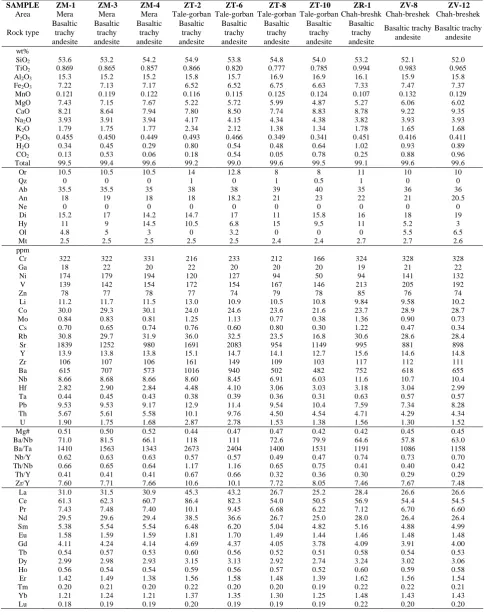
Table 1. Continued
SAMPLE ZM-1 ZM-3 ZM-4 ZT-2 ZT-6 ZT-8 ZT-10 ZR-1 ZV-8 ZV-12
Area Mera Mera Mera Tale-gorban Tale-gorban Tale-gorban Tale-gorban Chah-breshk Chah-breshek Chah-breshek
Rock type
Basaltic trachy andesite
Basaltic trachy andesite
Basaltic trachy andesite
Basaltic trachy andesite
Basaltic trachy andesite
Basaltic trachy andesite
Basaltic trachy andesite
Basaltic trachy andesite
Basaltic trachy andesite
Basaltic trachy andesite
wt%
SiO2 53.6 53.2 54.2 54.9 53.8 54.8 54.0 53.2 52.1 52.0
TiO2 0.869 0.865 0.857 0.866 0.820 0.777 0.785 0.994 0.983 0.965
Al2O3 15.3 15.2 15.2 15.8 15.7 16.9 16.9 16.1 15.9 15.8
Fe2O3 7.22 7.13 7.17 6.52 6.52 6.75 6.63 7.33 7.47 7.37
MnO 0.121 0.119 0.122 0.116 0.115 0.125 0.124 0.107 0.132 0.129
MgO 7.43 7.15 7.67 5.22 5.72 5.99 4.87 5.27 6.06 6.02
CaO 8.21 8.64 7.94 7.80 8.50 7.74 8.83 8.78 9.22 9.35
Na2O 3.93 3.91 3.94 4.17 4.15 4.34 4.38 3.82 3.93 3.93
K2O 1.79 1.75 1.77 2.34 2.12 1.38 1.34 1.78 1.65 1.68
P2O5 0.455 0.450 0.449 0.493 0.466 0.349 0.341 0.451 0.416 0.411
H2O 0.34 0.45 0.29 0.80 0.54 0.48 0.64 1.02 0.93 0.89
CO2 0.13 0.53 0.06 0.18 0.54 0.05 0.78 0.25 0.88 0.96
Total 99.5 99.4 99.6 99.2 99.0 99.6 99.5 99.1 99.6 99.6
Or 10.5 10.5 10.5 14 12.8 8 8 11 10 10
Qz 0 0 0 1 0 1 0.5 1 0 0
Ab 35.5 35.5 35 38 38 39 40 35 36 36
An 18 19 18 18 18.2 21 23 22 21 20.5
Ne 0 0 0 0 0 0 0 0 0 0
Di 15.2 17 14.2 14.7 17 11 15.8 16 18 19
Hy 11 9 14.5 10.5 6.8 15 9.5 11 5.2 3
Ol 4.8 5 3 0 3.2 0 0 0 5.5 6.5
Mt 2.5 2.5 2.5 2.5 2.5 2.4 2.4 2.7 2.7 2.6
ppm
Cr 322 322 331 216 233 212 166 324 328 328
Ga 18 22 20 22 20 20 20 19 21 22
Ni 174 179 194 120 127 94 50 94 141 132
V 139 142 154 172 154 167 146 213 205 192
Zn 78 77 78 77 74 79 78 85 76 74
Li 11.2 11.7 11.5 13.0 10.9 10.5 10.8 9.84 9.58 10.2
Co 30.0 29.3 30.1 24.0 24.6 23.6 21.6 23.7 28.9 28.7
Mo 0.84 0.83 0.81 1.25 1.13 0.77 0.38 1.36 0.90 0.73
Cs 0.70 0.65 0.74 0.76 0.60 0.80 0.30 1.22 0.47 0.34
Rb 30.8 29.7 31.9 36.0 32.5 23.5 16.8 30.6 28.6 28.4
Sr 1839 1252 980 1691 2083 954 1149 995 881 898
Y 13.9 13.8 13.8 15.1 14.7 14.1 12.7 15.6 14.6 14.8
Zr 106 107 106 161 149 109 103 117 112 111
Ba 615 707 573 1016 940 502 482 752 618 655
Nb 8.66 8.68 8.66 8.60 8.45 6.91 6.03 11.6 10.7 10.4
Hf 2.82 2.90 2.84 4.48 4.10 3.06 3.03 3.18 3.04 2.99
Ta 0.44 0.45 0.43 0.38 0.39 0.36 0.31 0.63 0.57 0.57
Pb 9.53 9.53 9.17 12.9 11.4 9.54 10.4 7.59 7.34 8.28
Th 5.67 5.61 5.58 10.1 9.76 4.50 4.54 4.71 4.29 4.34
U 1.90 1.75 1.68 2.87 2.78 1.53 1.38 1.56 1.30 1.52
Mg# 0.51 0.50 0.52 0.44 0.47 0.47 0.42 0.42 0.45 0.45
Ba/Nb 71.0 81.5 66.1 118 111 72.6 79.9 64.6 57.8 63.0
Ba/Ta 1410 1563 1343 2673 2404 1400 1531 1191 1086 1158
Nb/Y 0.62 0.63 0.63 0.57 0.57 0.49 0.47 0.74 0.73 0.70
Th/Nb 0.66 0.65 0.64 1.17 1.16 0.65 0.75 0.41 0.40 0.42
Th/Y 0.41 0.41 0.41 0.67 0.66 0.32 0.36 0.30 0.29 0.29
Zr/Y 7.60 7.71 7.66 10.6 10.1 7.72 8.05 7.46 7.67 7.48
La 31.0 31.5 30.9 45.3 43.2 26.7 25.2 28.4 26.6 26.6
Ce 61.3 62.3 60.7 86.4 82.3 54.0 50.5 56.9 54.4 54.5
Pr 7.43 7.48 7.40 10.1 9.45 6.68 6.22 7.12 6.70 6.60
Nd 29.5 29.6 29.4 38.5 36.6 26.7 25.0 28.0 26.4 26.4
Sm 5.38 5.54 5.54 6.48 6.20 5.04 4.82 5.16 4.88 4.99
Eu 1.58 1.59 1.59 1.81 1.70 1.49 1.44 1.46 1.48 1.48
Gd 4.11 4.24 4.14 4.69 4.37 4.05 3.78 4.09 3.91 4.00
Tb 0.54 0.57 0.53 0.60 0.56 0.52 0.51 0.58 0.54 0.53
Dy 2.99 2.98 2.93 3.15 3.13 2.92 2.74 3.24 3.02 3.06
Ho 0.56 0.54 0.54 0.59 0.56 0.57 0.52 0.60 0.59 0.58
Er 1.42 1.49 1.38 1.56 1.58 1.48 1.39 1.62 1.56 1.54
Tm 0.20 0.21 0.20 0.22 0.20 0.20 0.19 0.22 0.22 0.21
Yb 1.21 1.24 1.21 1.37 1.35 1.30 1.25 1.48 1.43 1.43
Figure 5. (a). Variation diagrams of selected (a) major and (b) trace elements versus silica for the Shahre-Babak Pleistocene basaltic rocks. Symbols as in Fig. 2.
Discussion
It is generally argued that Urumieh-Dokhtar magmatic assemblage represents the magmatic arc overlying the slab of Neo-Tethyan ocean lithosphere which was subducted northwards beneath the Iranian plate. Generation of magmas from a depleted mantle source and/or their emplacement within continental crust with variable degrees of contamination and fractional crystallization has been related to a detached sinking slab following Miocene continental collision along the Zagros Suture Zone [8, 3]. However different origins have been proposed for the Pleistocene alkaline and calc-alkaline volcanism in the UDMA of Iran. Slab breakoff, the detachment of oceanic lithosphere from continental lithosphere during or after continental collision can explain the presence of mantle signatures in plutonic and volcanic rocks by input of heat from the asthenosphere (e.g., [26, 16]). This can be confirmed by presence of adakitic magmatism in UDMA [16]. This thermal consequence allows sufficient thermal perturbation to melt metasomatised mantle lithosphere [17]. Additionally Berberian and King [9] related them this thermal perturbation to deep sited strike slip faulting. According to major, minor and trace element concentrations, the Shahre-Babak alkaline basaltic rocks
Figure 5. (b). Continued.
Figure 7. Multielement spider patterns for the Shahre-Babak Pleistocene basaltic rocks, normalized to MORB (normalization constants from [46]). Symbols as in Fig. 2.
Figure 8. Th/Y versus Nb/Y for the Shahre-Babak Pleistocene basaltic rocks compared to the range of variation in mid-ocean ridge basalts (MORB) and ocean island basalts (OIB) (after [61]). Symbols as in Fig. 2.
Figure 9. Chondrite-normalized REE diagrams for the Shahre-Babak Pleistocene basaltic rocks. Symbols as in Fig. 2.
formation of the Shahre-Babak Pleistocene alkaline basaltic rocks. They formed from magmas originated in the mantle and were affected by assimilation and contamination processes during ascent through the crust. The fact that Shahre-Babak Pleistocene alkaline basaltic rocks situated between two NW-SE running right lateral strike slip faults (Rafsanjan and Dehshir faults) point to the fact that ascent and eruption of these magmas, originated in the mantle, and was probably controlled by the fault zone, which probably reaches deep down to the base of lithosphere.
Acknowledgements
Financial support for all analyses was provided by Department of Geology of Potsdam University in Germany. S. Zia Hosseini would like to express his gratitude to Drs. Uwe Altenberger and Martin Ziemann for their help and advice on interpretation of data. He also thanks Antje Musiol and Christine Frscher of the institute at Potsdam University for their helps in the laboratories.
References
1. Agard, P., Omrani, J., Jolivet, L. & Mouthereau, F. Convergence history across Zagros (Iran): constraints from collisional and earlier deformation,Int. J. Earth Sci., 94: 401-419 (2005).
2. Ahmad, T., Posht Kuhi, M. Geochemistry and petrogenesis of Urumiah- Dokhtar volcanic belt around Nain and Rafsanjan areas: a preliminary study. Treatise on the geology of Iran , Iranian Ministry of Mines and Metals, 90 p (1993).
3. Alavi, M. Tectonics of the Zagros orogenic belt of Iran: new data and interpretations,Tectonophysics., 229: 211-238 (1994).
4. Alavi, M. Regional stratigraphy of the Zagros fold-thrust belt of Iran and its proforeland and evolution,Am. J. Sci., 304: 1-20 (2004).
5. Aldanmaz, E., Pearce, J.A., Thirlwall, M.F., Mitchell, J.G. Petrogenesis evolution of late Cenozoic, post-collision volcanism in western Anatolia, Turkey. J. Volcanol. Geotherm.Res.,102: 67-95 (2000).
6. Alici, P., Temel, A., Gourgaud, A., Vidal, P. & G¨undoˇgdu, M. N. Quaternary Tholeiitic to Alkaline Volcanism in the Karasu Valley, Dead Sea Rift Zone, southeast Turkey: Sr–Nd–Pb–O isotopic and trace element approaches to crust mantle interaction.Int. Geol. Rev., 43(2): 120-138 (2001).
7. Altherr , R., Henjes- Kunst, F., Puchelt, H., and Baumann, A., Volcanic activity in the Red sea axial trough-evidence for a large mantle diapir,
Tectonophysics,150: 121-133 ( 1988).
8. Berberian, F., Berberian, M. Tectono-plutonic episodes in Iran. In: Gupta, H. K., Delany,F.M. (Eds), Zagros, Hindukosh, Himalaya. Geodynamic Evolution. Am. Geophy. Union, Washigton, DC, pp. 5-32 (1981). 9. Berberian, M., King, G.C.P. Towards a paleogeography
210-265 (1981).
10. Berbberian, F., Muir, I.D., Pankhurst, R.J., Berbberian, M. Late Cretaceous and early Miocene Andian type plutonic activitiy in northern Makran and Central Iran.J. Geol. Soc. London, 139: 605-614 (1982).
11. Bindeman, I.N., Eiler, J.M., Yogodzinski, G., Tatsumi, Y., Stern, C., Grove, T., Portnyagin, M., Hoernle, K., Danyushevsky, L. Oxygen isotope evidence for slab melting in modern and ancient subduction zones. Earth Planet. Sci. Lett.,235: 436-480 (2005).
12. Borg, L.E., Clynne, M.A., Bullen, T.D. The variable role of slab derived fluids in the generation of a suite of primitive calc-alkaline lavas from the southern most Cascades, California.Can. Mineral.,35: 425-452 (1997). 13. Buket, E, Temel, A. Major-element, trace-element, and
Sr-Nd isotopic geochemistry and genesis of Varto (Mus) volcanic rocks, Eastern Turkey. J. Volcanol. Geotherm. Res.,85: 405-422 (1998).
14. Churikova, T., Dorendorf, F., Worner, G. Sources and fluids in the mantle wedge below Kamchatka, evidence from across-arc geochemical variation. J. Petrol., 42: 1567-1593 (2001).
15. Clague, D. A. & Frey, F. A. Petrology and trace element geochemistry of the Honolulu Volcanics, Oahu: implications for the oceanic mantle below Hawaii. J. Petrol.,23: 447-504 (1982).
16. Dargahi, S. Post-collisional Miocene magmatism in the Sarcheshmeh-Shahrebabak region NW of Kerman: Isotopic study, petrogenetic analysis and geodynamic pattern of granitoid intrusives and the role of adakitic magmatism in development of copper minralization. Unpublished Ph.D. thesis, Shahid Bahonar University of Kerman, 310 p (2007).
17. Davies, J.H., von Blanckenburg, F. Slab breakoff: A model of lithosphere detachment and its test in the magmatism and deformation of collisional orogens.Earth Planet. Sci. Lett., 129: 85-102 (1995).
18. Dehghani, G. A., Makris, T. The gravity fieldand crustal structure of Iran. Neu. Jahrab.Geol. Palaont. Abh., 168 (2-3): 215-229 (1984).
19. DePaolo, D.J. Trace element and isotopic effects of combined wallrock assimilation and fractional crystal-llization.Earth Planet. Sci. Lett.,53: 189-202 (1981). 20. Dimitrijevic, M.D. Geology of kerman region. Geol.
Surv. Iran, Yu/52, 334 p (1973).
21. Elburg, M.A., Bergen, M.V., Hoogewerff, J., Foden, J., Vroon, P., Zulkarnain, I., Nasution, A. Geochemical trends across an arc continental collision zone: magma sources and slab-wedge transfer processes below the Pantar Strait volcanoes, Indonesia.Geochim. Cosmochim. Acta,66: 2771-2789 (2002).
22. Espinoza, F., Morata, D., Pelleter, E., Maury, R.C., Suárezc, M., Lagabrielle, Y., Polvée,a, M., Bellon, H., Cotton, J., De la Cruz, R., Guivel, C. Petrogenesis of the Eocene and Mio-Pliocene alkaline basaltic magmatism in Meseta Chile Chico, southern Patagonia, Chile: Evidence for the participation of two slab windows. Lithos, 82: 315-343 (2005).
23. Falcon, N. Southern Iran-Zagros Mountains,inSpencer, A. M., editor, Mesozoic-Cenozoic orogenic belts: Geol. Soc. London Spec.Publ.,4: 199-211 (1974).
24. Fitton, J. G., James, D., Kempton, P. D., Ormerod, D. S. & Leeman, W. P. The role of lithospheric mantle in the
generation of Late Cenozoic basic magmas in the western United States. In: Menzies, M.A., Cox, K.G., (Eds.), Oceanic and Continental lithosphere: Similarities and Differences.J. Petrol., Special Lithosphere Issue, pp 331-49 (1988).
25. Forster, H., Fesefeldt, K., Kurster, M. Magmattic and orogenic evolution of the central Iranian volcanic belt. In: 24th International geology congress section 2: 198-210 (1972).
26. Ghasemi, A., Talbot, C.J. A new tectonic scenario for the Sanandaj- Sirjan Zone (Iran).J. Asian Earth Sci.,26: 683-693 (2006).
27. Gibson, S. A., Thompson, R. N., Leat, P. T., Dickin, A. P., Morrison, M. A., Hendry, G. L. & Mitchell, J. G. Asthenosphere-derived magmatism in the Rio Grande rift: implications for continental break-up. In: Storey, B. C., Alabaster, T., Pankhurst, R. J. (Eds.)Magmatism and the Causes of Continental Break-up. Geol. Soc. London Spec.Publ.,68: 61-89 (1992).
28. Gill, J.B. Orogenic andesites and plate tectonic. Springer-Verlag, Berlin, 390 p (1981).
29. Grove, T.L., Kinzler, R.J. Petrogenesis of andesites. Annu. Rev.Earth Planet. Sci.,14: 417-454 (1986). 30. Hibbard, M.J. Petrography to petrogenesis. Englewood
Cliffs, NJ: Prentice Hall, 587 p (1995).
31. Hofmann, A.W., White, W.M. Mantle plumes from ancient oceanic crust. Earth Planet. Sci. Lett., 57: 421-436 (1982).
32. Hosseini, S.Z. Mineralogy, Geochemistry and Petro-genesis evolution of Pleistocene basaltic lava flows in the Shahre-Babak area, NW of Kerman, Iran: Implication for the evolution of Urumieh-Dokhtar Magmatic Assem-blage. Ph.D. thesis, In preparation (2009).
33. Innocenti, F., Manetti, P., Mazzuuoli, R., Pasquare, G., Villari, Anatolia and North-western Iran. In: Thorpe R.S. (Ed.) Andesite. Wiley, Chichester, pp. 315-349 (1982). 34. Jung, D., Kursten, M., Tarkian, M. Post-Mesozoic
volcanism in Iran and its relation to the subduction of the afro-Arabian under the Eurasian plate. In: Pilger, A., Rosler, A. (Eds.), Afar between continental and oceanic rifting. Schweizerbartsche Verlagbuchhand-lung, Stutt-gart, pp. 175-181 (1976).
35. Kay RW, Gast PW. The rare earth content and origin of alkali-rich basalts.J. Geol.,81: 653-682 (1973).
36. Le Maitre, R.W., Streckeisen A., Zanettin, B., Le Bas, .M.J., Bonin, B., Bateman, P. (Eds.), Igneous rocks: A classification and Glossary of Terms: Recommendations of the International Union of Geological Sciences Subcommission on the Systematics of igneous Rocks. Cambridge University Press, Cambridge, 256 p (2005). 37. Lensch, G. (ed.), Plate tectonic, orogeny and
mineralization in the Iranian fold belts.Neu. Jahrab.Geol. Palaont. Abh.,168: 145-568 (1984).
38. Leterrier, J., Maury, R.C., Thonon, P., Girard, D., Marchal, M.Clinopyroxene composition as a method of identification of the magmatic affinities of palaeo-vol-canic series.Earth Planet.Sci. Lett., 59: 139-154 (1982). 39. Marcy, R.C., Defant, M.J., Joron, J.L. Metasomatism of
arc mantle inferred from elements in Philippine xenoliths.
Nature,360: 661-663 (1992).
40. McDonough, W.F. Partial melting of subducted oceanic crust and isolation of its residual eclogitic lithology.
41. McKenzie, D.P., O'Nions, R.K. Partial melt distributionfrom inversion of rare earth element concentrations. J. Petrol.,32: 1021-1991 (1991).
42. McKenzie, D.P., O'Nions, R.K., The source regions of OceanIsland Basalts.J. Petrol.36: 133-159 (1995). 43. McQuarrie, N., Stock, J.M., Verdel, C. & Wernicke, B.P.
Cenozoic evolution of Neotethys and implications for the causes of plate motions, Geophys. Res. Lett., 30: 2036 (2003).
44. Meschede, M. A method of discriminating between different types of mid-ocean ridge basalt and continental tholeiites with the Nb-Zr-Y diagram. Chem. Geol., 56: 207-218 (1986).
45. Miyashiro, Nature of alkalic volcanic rock series.
Contrib. Mineral. Petrol., 66: 91-104 (1978).
46. Paul, A., Kaviani, A., Hatzfeld, D., Vergne, J. & Mokhtari, M. Seismological evidence for crustal-scale thrusting in the Zagros mountain belt (Iran),Geophys. J. Int., 166:227-237 (2006).
47. Pearce, J.A.. Role of the sub-continental lithosphere in magma genesis at active continental margins. In: Hawkesworth, C.J., Norry, M.J. (Eds.), Continental Basalts and Mantle Xenoliths, Shiva. Cheshire, UK, 230±249 (1983).
48. Pearce, J.A., Bender, J.F., DeLong, S.E., Kidd, W.S.F., Low, P.J., Guner, Y., Şaroğlu, F., Yilmaz, Y., Moorbath, S., Mitchell, J.J., Genesis of collision volcanism in eastern Anatolia Turkey. J. Volcanol. Geotherm. Res.,44: 189-229 (1990).
49. Pearce, J.A., Gale G.H. Identification of ore-deposition environment from trace element geochemistry of associated igneous host rocks. Geol. Soc. London Spec. Publ.,7: 14-24 (1977).
50. Pearce, J.A., Peate, D.W. Tectonic implications of the composition of volcanic arc magmas. Annu. Rev. Earth Planet.Sci., 23: 251-285 (1995).
51. Saunders A.D., Norry M.J. and Traney J. Origine of MORB and chemically depleted mantle reservoirs: trace element constraints.J. Petrol., Special Lithosphere Issue, pp 415-445 (1988).
52. Schiano, P., Cloochiatti, R., Shimizu, N., Maury, R.C., Jochum, K.P., Hofmann, A.W. Hydrous, silica rich melts in the sub-arc mantle and their relationship with erupted arc lavas.Nature 377: 595-600 (1995).
53. Schroder, J.W., Essai sur la structure de I'Iran. Ecol. Geol. Helv., 37: 37-81 (1944).
54. Sengor, A.M.C. A new modal for the late Paleozoic-Mesozoic tectonic evolution of Iran and implication for Oman. In: Roberson, A.H.F., Srarle, M.P., Ries, A.C. (Eds.), The Geology and Tectonics of the oman region, Geol.Soc. Londan Spec. Publ., 22: 278-281 (1990). 55. Shahabpour, J. Island-arc affinity of the Central Iranian
Volcanic Belt.J. Asian Earth Sci.,30: 652-665 (2007). 56. Shaw, D.M. Trace element fractionation during anatexis.
Geochim. Cosmochim.Acta., 34: 237-243 (1970). 57. Shimizu N, Arculus, RJ. Rare earth element
concentra-tions in a suite of basanitoids and alkali olivine basalts from Grenada, Lesser Antilles.Contrib.Mineral. Petrol., 50: 231-240 (1975).
58. Simonetti, A., Shore, M., Bell, K. Diopside phenocrysts from nephelinite lavas, Napak volcano, eastern Uganda:
evidence for magma mixing.Can. Mineral.,34: 411-421 (1996).
59. Stocklin, J. Structural history and tectonics of Iran: a re-view:Am. Assoc. Petro. Geol. Bull.,52: 1229-58 (1968). 60. Stoneley, R. The geology of the Kuh-e Dalneshin area of
Southern Iran, and its bearing on the evolution of Southern Tethys, J. Geol. Soc. London, 138: 509-526 (1981).
61. Sun, S.S., McDonough, W.F. Chemical and isotopic systematics of oceanic basalts: implications for mantle composition and processes. In: Saunders, A.D., Norry, M.J. (Eds.), Magmatism in the Ocean Basins.Geol. Soc. London Spec. Publ., 42: 313-345 (1989).
62. Tankut, A; Wilson, M; Yihunie, T. Geochemistry and tectonic setting of Teratiary volcanism in the Güvem area, Anatolia, Turkey.J. Volcanol. Geotherm. Res.,85: 285-301 (1998).
63. Temizel, İ; Arslan, M. Petrology and geochemistry of Tertiary volcanic rocks from the İKizce (Ordu) area, NE Turkey:Implications for the evolution of the eastern Pontide paleo-magmatic arc. J. Asian Earth Sci.,31: 439-463 (2008).
64. Thompson, R.N., Morrison, M.A., Hendry, G.L., Parry, S.J. An assessment of the relative roles of crust and mantle in magma genesis: an element approach. Philos. Trans. Royal Soc. London Ser. A, 310: 549-590 (1984). 65. Turner, S.P. On the time-scales of magmatism at
island-arc volcanoes.Philos. Trans. Royal Soc. London Ser. A,
360: 2853-2871 (2002).
66. Turner, S.P. Some remarks on magmatic processes beneath island arc volcanoes. Advance in Earth Sciences. Imperial College Press, 131-155 (2005).
67. Vernant, P. Contemporary crustal deformation and plate kinematics in Middle East: constrained by GPS measurements in Iran and northern Oman, Geophys. J. Int., 157:381-398 (2004).
68. White, W.M., McKenzie, D.P. Magmatism at rift zones: the generation of volcanic continental margins and flood basalts. J. Geophys.Res.,94: 7685-7729 (1989).
69. White, W.M., Patchett, J. Hf-Nd-Sr isotopes and incompatible element abundances in island arcs: implications for magma origins and crust-mantle evolution. Earth Planet. Sci. Lett., 67: 167-185 (1984). 70. Wilson, M., Tankut, A., Guleç, N. Tertiary volcanism of
the Galatia province, north-west Central Anatolia, Turkey.Lithos,42: 105-121 (1997).
71. Wilson, M. Igneous petrogensis. A global tectonic approach. Springer, 1 edition, 466 p (2007).
72. Winchester, J., Floyd, P.A. Geochemical discrimination of different magma series and their differentiation products using immobile elements.Chem. Geol.,20: 325-343 (1977).
73. Wittke, J.H., Mack, L.E. OIB-like mantle source for continental alkaline rocks of the Balcones province, Texas: trace elements and isotopic evidence. J. Geol., 101: 333-344 (1993).
![Figure 2. Ti versus (Ca+Na) diagram for clinopyroxene ofShahre-Babak Pleistocene basaltic rocks (after [37]).Δ=Trachybasalt, ▲=Basaltic trachyandesite.](https://thumb-us.123doks.com/thumbv2/123dok_us/31049.2003575/4.595.361.491.385.476/figure-clinopyroxene-ofshahre-pleistocene-basaltic-trachybasalt-basaltic-trachyandesite.webp)

![Figure 7. Multielement spider patterns for the Shahre-BabakPleistocene basaltic rocks, normalized to MORB(normalization constants from [46])](https://thumb-us.123doks.com/thumbv2/123dok_us/31049.2003575/10.595.98.244.507.708/figure-multielement-patterns-babakpleistocene-basaltic-normalized-normalization-constants.webp)
