JOURNAL OF MATHEMATICAL NANOSCIENCE
JMNS
Vol. 5, No. 1, 2015, 45-5145
Jou
rn
al o
f Mat
h
emat
ic
al
Nano
S
cie
n
ce
Computing Two Types of Geometric-Arithmetic
Indices of Some Benzenoid Graphs
AMIR LOGHMANAND MAHBOUBEH SAHELI
Department of Mathematics, Payame Noor Universtiy, PO BOX 19395-3697 Tehran, I. R. IRAN.
ABSTRACT. The geometric-arithmetic index is a topological index was defined as
u v uv E G
u v d d GA G
d d
( )
2 ( )
, where du denotes the degree of vertex u in G. By replacingu v u v
δ
~ d instead of du in GA G( ), we have a new version of this index that defined asu v uv E G
u v δ δ GA G
δ δ
5 ( )
2 ( )
. In this paper, we present exact formulas of these indices for some benzenoid graphs.. index 5 rithmetic index, GA a
-benzenoid graph, geometric
Keywords:
1. INTRODUCTION
Let G be a simple connected graph. A graph is a collection of points and lines connecting a subset of them. The points and lines of a graph also called vertices and edges of the graph, respectively. In chemical graph theory, the vertices and edges of a graph also correspond to the atoms and bonds of the molecular graph, respectively. If
e is an edge/bond of G, connecting the vertices/atoms uand v, then we write
46 Jou rn al o f Mat h emat ic al Nano S ci en ce
e uv say "uand v are adjacent". Chemical graph theory is an important branch of
graph theory and Mathematical chemistry, which applies graph theory to mathematical modeling of chemical phenomena [7, 9, 10, 12]. A chemical topological index is a numeric quantity from the structural graph of a molecule and is invariant on the automorphism of the graph. The concept of geometric-arithmetic indices was introduced in the chemical graph theory. These indices generally are defined as:
u v general uv E G
u v Q Q GA G Q Q ( ) 2 ( )
,where Qu is some quantity that in a unique manner can be associated with the vertex u of graph G. The first member of this class was considered by Vukičević and Furtula [11], by setting Qu to bedu, we have:
u v uv E G
u v d d GA G d d ( ) 2 ( )
,in which dudenotes the degree of vertex u in G, i.e., the number of its neighbors in G. The second member of this class was considered by Fath-Tabar et al. [2], by setting
u
Q to be the number nu of vertices of G lying closer to the vertex u than to the vertex v for the edge uv of the graph G,
u v uv E G
u v n n GA G
n n
2 ( )
2 ( )
.The third member of this class was considered by Bo Zhou et al. [14], by setting Qu
to be the number muof edges of G lying closer to the vertex u than to the vertex v for
the edge uv of the graph G,
u v uv E G
u v
m m GA G
m m
3 ( )
2 ( )
.The fourth and fifth members of this class was considered by Ghorbani et al. [3,4], by setting Qu to be εu, the eccentricity of vertex u (the largest distance between u and any other vertex of graphs) and δu, the summation of degree of neighbors of vertex u,
u v uv E G
u v ε ε GA G
ε ε
4 ( )
2 ( )
and u vuv E G
u v δ δ GA G
δ δ
5 ( )
2 ( )
47
Jou
rn
al o
f Mat
h
emat
ic
al
Nano
S
cie
n
ce
For a comprehensive survey of the mathematical properties and chemical properties of these indices see papers series and books [1, 5, 6, 8, 13].
A benzenoid system is a connected graph obtained by arranging congruent regular hexagons in a plane, so that two hexagons are either disjoint or have a common edge. Benzenoid graphs are simple, plane, and bipartite. The vertices lying on the border of the unbounded face of a benzenoid graphs are called external and other vertices, if present, are called internal. In this paper, we focus on the first and fifth geometric-arithmetic indices are compute them for some benzenoid graphs.
2. MAIN RESULTS
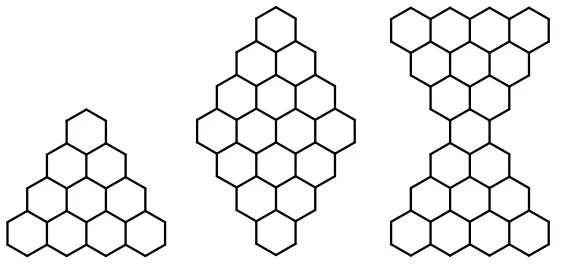
In this section, we compute first and fifth geometric-arithmetic indices for some benzenoid graphs as shown in Figure 1.
Figure 1: The benzenoid graphs T4, R4and X4 from left to right.
The first class of benzenoid graphs we consider is triangular benzenoids such as shown in Figure 1. We denote this graph by Tn in which n is the number of hexagons in the base of graph. Obviously, the total number of hexagons in Tn is n(n+1)/2. Also
n
T has | ( )|V Tn n24n1 vertices and
n
E T 3n n
| ( )| ( 3)
2
edges.
Theorem 1. For graph, T n we have:
n
GA T( ) 3n n( 1) 6 12 6(n 1)
2 5
,
n
GA T5( ) 3n n( 3) 3 35 8 5 12 42(n 2) 9 7(n 1).
2 3 13 8
48
Jou
rn
al o
f Mat
h
emat
ic
al
Nano
S
ci
en
ce
Proof. Let mij is an edge that connects a vertex of degree i to a vertex of degree j .So
in graph Tn for external vertices we have |m22| 6 , |m23| 6( n1) and for internal
vertices that all of them are from degree 3, |m33| 3n n( 1) 2
, then we have:
n
GA T( ) 3n n( 1) 6 12 6(n 1)
2 5
.
For compute GA T5( )n , we partition the edges of graph in 5 subsets. All of m22edges have a vertex uwith δ u( ) 5 and a vertex vwith δ v( ) 6 I .n m23edges, we consider two cases. One set is contain edges with δ u( ) 5 and δ v( ) 7 , that these edges have a common vertex with a m22. So the number of these edges are equal to 6. Other edges with two external vertices have δ u( ) 6 andδ v( ) 7 , that the number of these edges are equal to 6(n2). Edges with an external vertex and an internal vertex are equal to
n
3( 1)and have δ u( ) 7 and δ v( ) 9 . Finally the number of edges with two internal
vertices are 3n n( 3) 3
2 and δ u( )δ v( ) 9 . Then we have:
n
GA T5( ) 3n n( 3) 3 35 8 5 12 42(n 2) 9 7(n 1).
2 3 13 8
Which completes the proof.
A benzenoid rhombus Rn is obtained from two copies of a triangular benzenoid Tn by identifying hexagons in one of their base rows that is shown in Figure 1. Consequently, | ( )| 2 (V Rn n n2) and | ( )| 3E Rn n24n1.
Theorem 2.For graph R we have: n
n
GA R( ) 3n2 4n 7 16 6(n 1)
5
,
n
GA R n2 n n n
5
8 20 4 35 16 42 63
( ) 3 8 7 ( 2) ( 1).
9 3 13 2
Proof.The proof is similar to theorem 1.
49
Jou
rn
al o
f Mat
h
emat
ic
al
Nano
S
cie
n
ce
Theorem 3.For graph X n we have:
n
GA X( ) 3n2 3n 12 8 6(3n 4)
5
,
n
GA X n2 n n n
5
16 20 16 35 24 42 12 63
( ) 3 9 10 ( 2) ( 1).
9 12 13 16
Proof. The proof is similar to Theorem 1.
In Table I, we compute GA G( ) and GA G5( ) for three graphs in Figure 1,(2 n 7).
n GA T( )n GA R( )n GA X( )n n GA T5( )n GA R5( )n GA X5( )n
2 14.879 18.838 25.838 2 14.856 18.832 61.792
3 26.758 37.677 49.596 3 26.814 37.776 103.71
4 41.636 62.515 79.354 4 41.774 62.721 151.63
5 59.515 93.354 115.11 5 59.731 93.667 205.54
6 80.394 130.19 156.87 6 80.691 130.61 265.46
7 104.27 173.03 204.63 7 331.38 173.56 331.38
Table I.
Corollary 4. For benzenoid graphs in Figure 1 we have the following statements:
n n
GA R( )GA T( ) 1.5 n20.5404n0.9596,
n n
GA X( )GA T( ) 1.5 n24.3788n3.798,
8384 . 2 9192 . 4 ) ( )
(X GA R n
50
Jou
rn
al o
f Mat
h
emat
ic
al
Nano
S
ci
en
ce
n n
GA X( ) 2 ( ) GA T 3.9192,
n n
GA T5( )GA T( ) 0.0801 n0.1834,
n n
GA R5( )GA R( ) 0.1074 n0.2193,
n n
GA X5( )GA X( ) 18.160 n0.366.
Corollary 5. Let G n be one of the benzenoid graphsT ,n R or n X , n we have:
n n
n GA G
GA G 1
( )
lim 1
( )
.
REFERENCES
[1] A. R. Ashrafi and H. Shabani, GA index and Zagreb indices of nanocones, Optoelectron. Adv. Mater. Rapid Comm., 4(11)(2010) 1874-1876.
[2] G. H. Fath-Tabar, B. Furtula and I. Gutman, A new geometric-arithmetic index, J. Math. Chem., 47 (2010) 477-486.
[3] M. Ghorbani and A. Khaki, A note on the fourth version of geometric-arithmetic index, Optoelectron. Adv. Mater. Rapid Comm., 4 (2010) 2212-2215.
[4] A. Graovać, M. Ghorbani and M. A. Hosseinzadeh, Computing fifth geometric arithmetic index for nanostar dendrimers, Journal of Math-ematical Nanoscience, 1(2011) 33-42.
[5] A. Iranmanesh and M. Zeraatkar, Computing GA index for some nanotubes, Optoelectron. Adv. Mater. Rapid Comm., 4(11)(2010) 1852-1855.
[6] A. Khaksar, M. Ghorbani and H. R. Maimani, On atom bond connectivity and GA indices of nanocones, Optoelectron. Adv. Mater. Rapid Comm., 4(11)(2010) 1868-1870.
[7] M. Randić, On characterization of molecular branching. J. Am. Chem. Soc., 97 (1975) 6609-6615.
[8] H. Shabani and A. R. Ashrafi, Computing the GA index of nanotubes and nanotori, Optoelectron. Adv. Mater. Rapid Comm., 4(11)(2010) 1860-1862.
[9] R. Todeschini, V. Consonni, Handbook of Molecular Descriptors, Wileyn VCH, Weinheim, 2000.
51
Jou
rn
al o
f Mat
h
emat
ic
al
Nano
S
cie
n
ce
[11] D.Vukičević and B. Furtula, Topological index based on the ratios of geometrical and arithmetical means of end-vertex degrees of edges, J. Math. Chem., 46 (2009) 1369-1376.
[12] H. Wiener, Structural determination of paraffin boiling points, J. Am. Chem. Soc., 69 (1947) 17-20.
[13] L. Xiao, S. Chen, Z. Guo and Q. Chen, The geometric-arithmetic index of Benzenoid Systems and Phenylenes, Int. J. Contemp. Math. Sciences. 5 (45) (2010) 2225-2230.