Previous research on the components of the emotional response employing factor analytic studies has yielded a two-factor structure (Lang, Greenwald, Bradley, & Hamm, 1993; Cuthbert, Schupp, Bradley, Birbaumer, & Lang, 2000). However, the startle blink reflex, a widely employed measure of the emotional response, has not been considered to date. We decided to include two parameters of the startle reflex (magnitude and latency) in order to explore further how this response fits into the two-factor model of emotion. We recorded the acoustic startle blink response, skin conductance response, heart rate, free viewing time, and picture valence and arousal ratings of 45 subjects while viewing 54 pictures from the International Affective Picture System (IAPS; 18 unpleasant, 18 neutral, and 18 pleasant). Factorizations of all measures gave a two-factor solution (valence and arousal) that accounted for 70% of the variance. Although some measurements, including heart rate change, did not behave as predicted, our results reinforce the two-dimension model of the emotion, and show that startle fits into the model.
Keywords: startle reflex, heart rate, skin conductance, emotional response, orienting response
La investigación previa sobre los componentes de la respuesta emocional empleando estudios de análisis factorial ha proporcionado una estructura de dos factores (Lang, Greenwald, Bradley y Hamm, 1993; Cuthbert, Schupp, Bradley, Birbaumer y Lang, 2000). Sin embargo, el parpadeo reflejo de sobresalto, una medida ampliamente empleada de respuesta emocional, no se ha considerado hasta la fecha. Decidimos incluir dos parámetros del reflejo de sobresalto (magnitud y latencia) para explorar si esta respuesta se ajusta al modelo bifactorial de la emoción. Registramos el parpadeo reflejo de sobresalto acústico, la respuesta de conductancia de la piel, la tasa cardiaca, el tiempo de visión, y las evaluaciones de valencia y de arousal de 45 sujetos mientas miraban 54 representaciones del IAPS (18 desagradables, 18 neutrales, y 18 agradables). La factorización de todas las medidas proporcionó una solución de dos factores (valencia y arousal) que explicaban el 70% de la varianza. Aunque algunas medidas, incluyendo el cambio en tasa cardiaca, no se comportaban como se había predicho, nuestros resultados refuerzan el modelo bidimensional de la emoción y demuestran que el sobresalto se ajusta al modelo.
Palabras clave: reflejo de sobresalto, tasa cardiaca, conductancia de la piel, respuesta emocional, respuesta de orientación
Psychophysiological, Behavioral, and Cognitive Indices
of the Emotional Response: A Factor-Analytic Study
Juan Pedro Sánchez-Navarro, José María Martínez-Selva,
Ginesa Torrente, and Francisco Román
Universidad de Murcia (Spain)
This research was supported by a grant from the Spanish Ministry of Education and Science, SEJ2004-06062.
Address correspondence concerning this article to: J.P. Sánchez-Navarro, Departamento de Anatomía Humana y Psicobiología. Facultad de Psicología. Universidad de Murcia. Campus de Espinardo. 30100 Murcia (Spain). Phone: +34 968 367 707. E-mail: [email protected]
This study is aimed at exploring further the two-factor structure of the emotional response employing a factor-analytic methodology (Lang, 1995; Lang, Bradley, & Cuthbert, 1990, 1992, 1998; Lang, Greenwald, Bradley, & Hamm, 1993). We included two parameters of the startle response, magnitude and latency, with the aim of studying how these measurements fit into the two-dimension model. This is an important issue because a large number of studies are being conducted under the assumption that these measurements fit well into the two-dimensional model of the emotion. However, this particular point has not been specifically tested to date.
The “biphasic theory of emotion” proposed by Lang and co-workers (Lang, 1995; Lang et al., 1990, 1992, 1997, 1998) emerges from a motivational perspective that points to the emotion as a behavioral tendency of a subject to approach or avoid/withdraw from a stimulus (Bradley, 2000). From this perspective, the biphasic theory states that emotions are organized in two motivational systems of the brain that respond adaptively to two basic types of stimulation, appetitive and aversive. All emotional expressions (overt and covert) are determined by the dominant motivational system in the subject and by the intensity level of such a system. Hence, emotions can be organized according to this classification as pleasant/appetitive or unpleasant/aversive, and this disposition constitutes the first bipolar dimension of the model—the affective valence. As each motivational system can mobilize energy, and therefore, the activation or intensity level can vary, the model establishes a second bipolar dimension—arousal—whose poles are defined as calm and excitation (Lang et al., 1998). Taking into account these two orthogonal dimensions, a two-dimensional space is defined in which all emotions are located according to their affective valence and arousal (Lang et al., 1992). This affective space supports the biphasic motivational organization (appetitive and aversive) of the emotion (Bradley, 2000).
Other theories have proposed three primary dimensions in their model of emotion (e.g., Osgood, Suci, & Tannenbaum, 1957). Russell and Mehrabian (1977) proposed a structure of the emotion covering the dimensions of pleasure-displeasure, arousal level, and dominance. However, more recently, Russell (1980) and Russell and Feldman Barrett (1999) pointed out that affective valence and arousal level explain the greater variance proportion. Besides, all the additional factors, such as dominance-submission (Russell & Mehrabian, 1977) or social orientation (Svensson, 1978), explain a very low proportion of the variance, which could be more accurately interpreted according to the perceived aspects of both the antecedents and the results of the emotion. Emotional responses manifest at three levels or response systems (Lang, 1968, 1978; Lang, Rice, & Sternbach, 1972): (a) physiological—autonomic responses related to emotions and the brain structures and neural mechanisms supporting them—, (b) behavioral—overt behaviors related to emotions—, and (c) cognitive—subjective experience of the
emotions. The specific psychophysiological, behavioral, and cognitive patterns of the emotional response are manifested in order to adjust the behavioral repertoire of the subject to the demands of the situation (Bradley, Codispoti, Cuthbert, & Lang, 2001; Lang, 1994). In this line, judgments of affective valence and arousal ratings about emotional stimuli, such as pictures, mainly reflect the proposed two-dimension motivational space concept (Lang, Bradley, & Cuthbert, 1999; Moltó et al., 1999; Vila et al., 2001). A third emotional dimension, called dominance, has also been studied (e.g., Greenwald, Cook, & Lang, 1989), but results have shown that this dimension is positively correlated with the affective valence (Bradley & Lang, 1994). Autonomic measurements have been proved to vary as a function of the affective valence and arousal of the stimuli. Skin conductance responses (SCRs) evoked by pictures increase when arousal is high and decrease when it is low, showing a positive relation to picture arousal ratings (Bradley, 2000; Greenwald et al., 1989; Lang et al., 1993). In turn, heart-rate change has shown a significant positive relation to affective valence, with unpleasant pictures prompting slower heart rates than pleasant ones (Greenwald et al., 1989; Lang et al., 1993). However, several studies (e.g., Bradley, Lang, & Cuthbert, 1993; Cuthbert, Bradley, & Lang, 1996; Lang et al., 1993; Navarro, Martínez-Selva, & Román, 2006; Sánchez-Navarro, Martínez-Selva, Román, & Torrente, 2006) have also found a relationship between heart rate and arousal, with the most arousing pictures (pleasant and unpleasant) prompting the highest heart-rate deceleration.
Other measurements employed in the determination of the emotional response have been the electromyographical activity (EMG) of the facial muscles and the electrical activity (EEG) of the brain. Corrugator supercilii muscle activity is negatively related to affective valence ratings of emotional pictures, while zygomaticus major activity is positively related to this affective dimension (Bradley et al., 2001; Greenwald et al., 1989; Lang et al., 1993). Cuthbert, Schupp, Bradley, Birbaumer, & Lang (2000) have also found that late positive evoked brain responses (characterized by a positive shift beginning at 200-300 ms after picture onset and peaking around 1 s after picture onset) are positively related to the arousal ratings of the pictures, with higher amplitude of late positive potentials to pleasant and unpleasant pictures than to neutral ones. Lastly, subjects spend longer times viewing the pictures rated as most arousing in a free viewing task (Bradley, Cuthbert, & Lang, 1990; Bradley, Greenwald, & Hamm, 1993; Lang et al., 1993).
zygomaticus major muscle activity. The second factor, named arousal, accounted for 31% of the variance, and was made up of arousal ratings, interest ratings, viewing time, and SCR. These results, therefore, confirmed the biphasic theory of emotion proposed by Lang et al. (1990). Cuthbert et al. (2000) employed this same factorial methodology, adding EEG measures to autonomic, somatic, behavioral, and subjective indices of the response elicited by emotional pictures. Their results mirrored those of Lang et al. (1993), showing a two-factor solution, with the affective valence accounting for 36% of the variance, and the arousal factor accounting for 40%. Positive slow evoked brain potentials were related to the arousal factor, and all other measures remained as in the Lang et al. (1993) study.
A measure closely related to emotion is the acoustic startle blink reflex (Bradley et al., 1990, 1999; Vrana, Spence, & Lang, 1988). This response is modulated by the affective valence of the picture, with startle magnitudes enhanced during unpleasant pictures and attenuated during pleasant ones. This effect has also been found in the startle latency, with shorter latencies during unpleasant than pleasant pictures (Bradley et al., 1990). Although past research has found an effect of the affective valence on the startle blink reflex, which varies as a function of the affective disposition of the subjects in relation to the emotional stimuli (Cobos, García, Ríus, & Vila, 2002), no study has been carried out to assess how this response fits into the two-factor solution obtained in previous research. Hence, our research includes the magnitude and latency components of the startle reflex in the factor analysis, in addition to autonomic (SCR and heart-rate change), behavioral (picture-viewing time) and cognitive/subjective (affective valence and arousal ratings) indices of the emotional response elicited by pictures.
From previous research, we expected to find a two main factor solution: Affective Valence, comprising affective valence ratings, magnitude, and latency of the startle reflex, and heart-rate change, and Arousal, made up of arousal ratings, SCR, and picture-viewing time.
Methods
Participants
Forty-five subjects (23 male and 22 female), aged between 18-38 years, were recruited from the School of
Psychology of the University of Murcia through class advertisements.
The data of one subject were unavailable for startle blink reflex (n= 44), heart-rate data of one subject were discarded from statistical analysis due to intractable recording artifacts (n= 44), and SCR data of one subject were discarded due to a low rate of responses (< 2; n = 44).
Materials and Design
Fifty-four digital color pictures were selected from the International Affective Picture System1(IAPS; CESEA-NIH, 1999). According to the normative data for the Spanish population (Moltó et al., 1999; Vila et al., 2001), 18 pictures were unpleasant (high arousal), 18 were pleasant (high arousal), and 18 were neutral (low arousal). Furthermore, pleasant and unpleasant pictures did not differ in arousal level (> 6), whereas neutral pictures were low in their arousal level (< 3.5).
The pictures were arranged in six blocks of nine pictures each, so that three pictures of each affective valence type occurred in each block. Following the procedure used by Bradley et al. (1990), three picture-presentation orders were constructed, and participants were randomly assigned to one of them.
Each picture was presented for 6 s (with random intertrial intervals of 20-30 s), and picture offset resulted in a blank screen. Startle probes were presented at two of three pictures of each affective category per block, at a random time between 3500 and 4500 ms after picture onset. Two additional startle probes were delivered during the intertrial intervals in order to ensure unpredictability.
Pictures were generated using a PC-computer, and were presented on a screen (maximum viewing area of 120 ×90 centimeters), located 2 m in front the participants, through a Mitsubishi LVP-S50UX picture projector, with a resolution of 640 ×480 inches.
The acoustic startle stimulus was a 50-ms 105-dB(A) burst of white noise (20 Hz-20 kHz) with instantaneous rise- and fall-times, presented binaurally through Sony MDR-P70 headphones, and generated by a custom-made noise acoustic stimulator from the facilities of the University of Murcia. This stimulator was connected to a PC computer that presented all the pictures and facilitated the parameters programming of the acoustic and visual stimuli. The intensity of the startle stimulus was previously calibrated using a Brüel&Kjaer artificial earphone (4153) and a sound level meter (2231).
1 Pictures selected from the International Affective Picture System: unpleasant (3100, 3102, 3150, 3170, 3350, 3400, 3500, 6230,
Physiological Data Collection and Reduction
Acquisition, amplification, and filtering of the physiological signals were carried out with an ADInstruments PowerLab 8/sp data acquisition system. This system converted analogical signals to digital by means of a 16-bit analog to digital converter. Throughout the recording, all physiological signals were sampled continuously at 1000 Hz.
Startle blink reflex was measured by recording EMG activity from the orbicularis oculimuscle beneath the left eye, using a bipolar placement of 4-mm Ag/AgCl surface electrodes (Fridlund & Cacioppo, 1986). The raw EMG signal was amplified and frequencies below 60 Hz and above 500 Hz were filtered out using an ADInstruments BioAmp-ML132 bioamplifier. The raw signal was full-wave rectified and integrated off-line with a time constant of 15 ms.
Startle data were reduced off-line and peak detection was carried out. Blink magnitude was scored as peak-valley difference within 21-150 ms following startle probe onset. To decrease variability and to establish a common metric across subjects, the raw blink magnitudes were z-score standardized and expressed as Tscores (M= 50, SD= 10) individually for each participant. Magnitude was computed as zero in those trials with no response detected. Startle blink latency was computed as the time (in ms) between the startle acoustic stimulus onset and the startle response onset.
Electrodermal activity was obtained by the bipolar placement of 7-mm Ag/AgCl standard surface electrodes filled with isotonic electrolytic paste on the thenar (C6) and hypothenar (C8) eminences of the non-dominant hand surface (Fowles et al., 1981). The raw signal was amplified and filtered using a Cibertec Biosig-CP1 module.
Skin conductance response was scored as the largest response (peak-valley difference) above 0.02 µSiemens starting in a 0.09-4-s time window following picture onset. All responses below 0.02 µSiemens were computed as zero. To normalize, a log transformation (Log[SCR+1]) was conducted (Venables & Christie, 1980).
Lead I electrocardiogram was recorded using 7-mm Ag/AgCl electrodes filled with hypertonic electrolyte. The signal was amplified with 1mV range, and filtered with cut-offs below 0.3 Hz and above 100 Hz, using an ADInstruments BioAmp-ML132 bio-amplifier.
Heart rate was obtained by an off-line transformation of the R-wave, providing a weighted mean of the beat-to-beat heart rate. This avoided overestimation and lag (Reyes del Paso & Vila, 1998). For each participant and each trial, heart rate was averaged off-line into half-second intervals in beats per minute, and then deviated from a 3-s baseline immediately preceding picture onset. Heart-rate change was computed as the fastest half second value from baseline in the last 3 s of picture viewing, following the procedure employed by Bradley et al. (2001) and Lang et al. (1993).
Procedure
The study was conducted in the Laboratory of Human Psychophysiology of the University of Murcia, in a darkened, sound-attenuated chamber (3.06 ×2.02 ×2.36 m). The data acquisition system, acoustic stimulator, and computers were located in an adjoining room. An intercom system allowed communication with participants, who could be seen through a glass window (0.89 ×0.86 m) in one of the chamber walls. The environmental conditions of temperature and humidity were between 19ºC-24ºC and 68%-80% throughout the experiment.
All sensors were attached once participants were accommodated in a comfortable armchair, located 2 m in front of the screen. After sensor attachment, participants were instructed that a series of pictures would be displayed on the screen, and that they should pay attention to each picture for the whole duration of its exposure. Participants were also instructed that sometimes a brief noise would appear over the headphones and that they should ignore it. After psychophysiological recording, electrodes were removed and participants were asked to view the pictures again for as long as they liked, and to rate affective valence and arousal of each picture, using the Self-Assessment Manikin (pencil and paper version; Hodes, Cook, & Lang, 1985). This instrument is a 9-point rating scale for each dimension, such that 9 represents a high rating (i.e., high pleasure, high arousal), and 1 represents a low rating (i.e., low pleasure, low arousal). Participants were instructed that once they pushed a keyboard button, a picture would appear, and that when they pushed again, the picture would disappear, leaving a blank screen. They should then rate the picture. The presentation order of the pictures was the same as in the psychophysiological session.
Data Analysis
In a first analysis, mixed model, 2 × 3 ×3 repeated measures ANOVAs were performed with Sex (male vs. female) and Presentation Order (1, 2, and 3) as between-subject variables, and Picture Type (unpleasant, neutral, and pleasant) as the within-subject variable. These were conducted for each physiological, behavioral, and subjective measure, averaged over unpleasant, neutral, and pleasant pictures. Trend analyses were performed to assess the effects of affective valence (linear trend) and arousal (quadratic trend) on all the physiological, behavioral, and cognitive measures (Bradley et al., 1990).
startle blink was evoked in 36 of the 54 pictures, the final unit of analysis was 36 pictures2.
Correlation analyses were also carried out to examine the relations between the physiological and behavioral measurements and the subjective evaluations. In addition, in order to control that picture ratings obtained in a second task were not affected either by familiarity with the pictures or by the startling acoustic stimuli, we carried out correlation analyses between the picture ratings of our sample and the normative values of the pictures.
All statistical analyses were performed using the SPSS software. When appropriate, a Greenhouse-Geisser adjustment to the degrees of freedom was used in order to correct any potential inflation of the reported probability values (Bagiella, Sloan, & Heitjan, 2000). All statistical tests used the .05 level of significance. For the sake of clarity, only significant results will be reported.
Results
Subjective Ratings
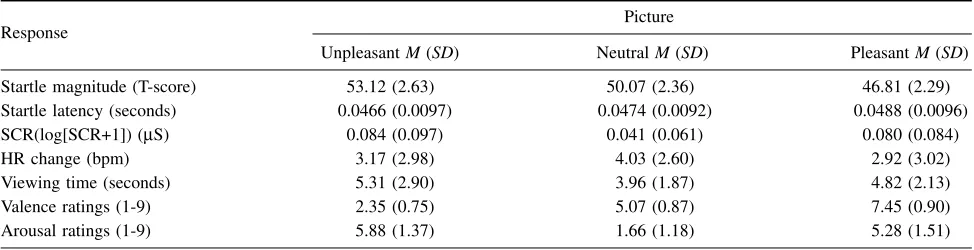
A main significant effect of picture type was found on affective valence ratings, F(2, 78) = 458.19, p< .001, ε=.831. Affective valence ratings varied according to pleasantness of the pictures—linear trend, F(1, 39) = 630.31, p< .001—with subjects rating pleasant pictures with the highest affective valence, followed by neutral and unpleasant pictures (see Table 1). In turn, a main significant effect of picture type was also found on arousal ratings, F(2, 78) = 158.57, p< .001. Unpleasant and pleasant pictures were rated as more arousing
than neutral ones: quadratic trend, F(1, 39) = 232.8, p< .001 (see Table 1).
Startle Reflex: Magnitude and Latency
Startle reflex average probability was 96.15% (SD = 10.06). Statistical analyses showed a significant effect of picture type on startle magnitude, F(2, 76) = 48.69, p < .001, indicating that startle magnitude was modulated by the pleasantness of the pictures, as shown by a significant linear trend, F(1, 38) = 91.36, p< .001. Startle responses during unpleasant pictures were greater than those during neutral and pleasant ones (see Table 1).
A significant effect of picture type was also found on startle latency, F(2, 76) = 8.19, p < .001. Startle latency varied as a function of the pleasantness of the pictures— linear trend, F(1, 38) = 16.09, p < .001. Startles during unpleasant pictures had shorter latencies than those during neutral pictures and pleasant ones (see Table 1).
Autonomic Responses
We found a significant effect of picture type on SCR, F(2, 76) = 30.20, p < .001. SCR magnitude varied as a function of the arousal of the pictures, as shown by a significant quadratic trend, F(1, 38) = 49.83, p< .001, with the more arousing (unpleasant and pleasant) pictures eliciting higher SCRs than the less arousing (neutral) ones (Table 1).
Analyses of the heart-rate change elicited by the pictures showed a significant main effect of the picture type, F(2, 76) = 3.60, p < .05. A significant quadratic trend, F(1, 38)
2 Pictures included in the unit analysis of the factorial analysis: unpleasant (3100, 3102, 3150, 3170, 3350, 3400, 3500, 6230, 6260, 6313, 6350, 6570); neutral (7006, 7009, 7010, 7025, 7035, 7040, 7060, 7080, 7217, 7224, 7235, 7950); and pleasant (4652, 4658, 4659, 4664, 4670, 4800, 5621, 8030, 8180, 8370, 8490, 8496).
Table 1
Mean (and Standard Deviation) of the Psychophysiological, Behavioral, and Cognitive Responses to Unpleasant, Neutral, and Pleasant Pictures
Picture Response
Unpleasant M(SD) Neutral M(SD) Pleasant M(SD)
Startle magnitude (T-score) 53.12 (2.63) 50.07 (2.36) 46.81 (2.29)
Startle latency (seconds) 0.0466 (0.0097) 0.0474 (0.0092) 0.0488 (0.0096)
SCR(log[SCR+1]) (µS) 0.084 (0.097) 0.041 (0.061) 0.080 (0.084)
HR change (bpm) 3.17 (2.98) 4.03 (2.60) 2.92 (3.02)
Viewing time (seconds) 5.31 (2.90) 3.96 (1.87) 4.82 (2.13)
Valence ratings (1-9) 2.35 (0.75) 5.07 (0.87) 7.45 (0.90)
Arousal ratings (1-9) 5.88 (1.37) 1.66 (1.18) 5.28 (1.51)
= 5.94, p< .05, indicated that the more arousing (unpleasant and pleasant) pictures elicited higher heart rate changes than the less arousing (neutral) ones (Table 1)3.
Picture-Viewing Time
A significant effect of the picture type was found, F(2, 78) = 21.47, p< .001, ε=.847. Trend analysis showed both a significant linear effect, F(1, 39) = 5.22, p< .05, and a significant quadratic effect, F(1, 39) = 35.42, p< .001. These results indicated that participants spent more time viewing the more arousing pictures, and, in addition, they also viewed the unpleasant pictures for longer times (see Table 1).
A sex effect was also found, F(1, 39) = 0.04, p < .01, showing that men (5.63 s) spent more time viewing pictures than women (3.72 s).
Correlation Analyses
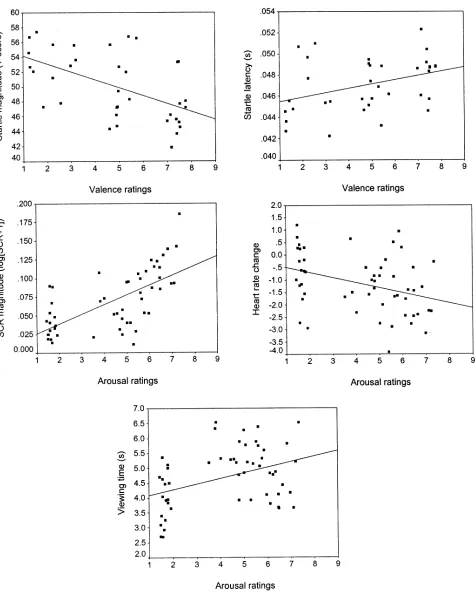
Startle magnitude was inversely related to the affective valence ratings of the pictures, r= –.54, p < .01, but did not correlate with the arousal ratings. Startle latency showed a positive correlation with the affective valence ratings, r= .37, p< .05, and was not related to the arousal ratings.
With regard to autonomic measures, SCR correlated positively with the arousal ratings, r= .663, p < .01, and was not related to the affective valence ratings. Heart rate was negatively correlated with arousal ratings, r= –.34, p < .05, and did not correlate with affective valence ratings.
Viewing time was positively correlated with arousal ratings, r= .39, p< .01, and was not related to the affective valence ratings. Lastly, affective valence ratings positively correlated with the affective valence normative values, r= .95, p< .001, and arousal ratings positively correlated with the arousal normative values, r= .92, p< .001.
Factor Analysis
When all psychophysiological, behavioral, and subjective measures were factorized into principal components, a two-factor solution was reached that accounted for 67.76% of the variance (KMO= 0.606). The factors, labeled Valence and Arousal, accounted for 35.89% and 31.87% of the variance, respectively. Magnitude and latency of the startle reflex, affective valence ratings, and viewing time were related to the Valence factor, whereas arousal ratings, SCR, heart rate, and viewing time were related to the Arousal factor. However, as viewing time was related to both the Valence and Arousal factors with similar loadings (–.59 and .55, respectively), a new factor analysis was conducted that did not include viewing time. Again, a two-factor solution was reached, accounting for 70% of the variance (KMO= 0.59), with the Valence factor accounting for 37% and the Arousal factor accounting for 33%. As shown in Table 2, magnitude and latency of the startle response and affective valence ratings were related to the Valence factor, whereas arousal ratings, SCR, and heart rate were related to the Arousal factor.
3 In order to assess the effect of the arousal on heart-rate changes, we carried out additional analyses following the methodology employed by Bradley et al. (2001). For each subject and each picture, we obtained the maximum deceleration from baseline in the first 3 s of picture viewing (interval 1) and the maximum acceleration from baseline in the last 3 s of picture viewing (interval 2). Statistical analysis was carried out using the Picture Type and the Interval (interval 1 and interval 2) as within subject variables, and Sex and Order as between subject variables. The Picture Type ×Interval interaction did not show a significant effect, F(2,76) = 2.74, indicating that in both intervals, the heart rate evoked by the pictures was similar, with pleasant and unpleasant prompting similar heart-rate responses, which were different from those evoked by neutral pictures. This similarity was manifest in the significant effect of the picture type, F(2, 76) = 4.74, p < 0.02, quadratic trend, F(1, 38) = 8.34, p < .01. By using this methodology, and as expected, we also found an effect of the interval variable, F(1, 38) = 287.36, p < .001, with a lower heart rate in Interval 1 (-5.49) than in Interval 2 (3.38).
Table 2
Loadings of Dependent Measures on Principal Components in our Study and in the Study Conducted by Lang et al. (1993) (Shown in Italics)
Measure Factor 1 (Valence) Factor 2 (Arousal)
Startle magnitude –.92 (n/a) .02 (n/a)
Startle latency .86 (n/a) .07 (n/a)
Valence ratings .71 (.86) –.15 (–.00)
Arousal ratings –.07 (.15) .92 (.83)
Skin conductance –.32 (-.37) .81 (.74)
Heart rate –.16 (.79) –.67 (–.14)
Discussion
The main aim of this research was to test the two-factor model of the emotional response, by including two indices—magnitude and latency of the startle blink reflex— that have not been used in this type of analyses, and by studying how well these indices fit into this model. As in previous research (e.g., Cuthbert et al., 2000; Lang et al., 1993), our data show a two-factor configuration of the emotional response. Our results are also in accordance with other studies that have proposed a dimensional approach to emotion, pointing to a reduced number of large dimensions (e.g., Abelson & Sermat, 1962; Cliff & Young, 1968; Lang et al., 1993; Osgood et al., 1957; Russell & Mehrabian, 1977; Schlosberg, 1954; Watson & Tellegen, 1985; Woodworth & Schlosberg, 1954; Wundt, 1896). For example, Russell and Feldman Barrett (1999) indicate that studies that have employed multidimensional scaling techniques of the affective language show three properties of the affect: (a) the two dimensions, pleasant-unpleasant and calm-excitation, explain the highest percentage of variance, (b) these two dimensions are bipolar, and (c) all affective terms can be defined by the linear combination of these two dimensions of valence and arousal. Overall, our data are in accordance with this structure of the emotion, whose dimensions, affective valence and arousal, respond to two motivational systems that prompt emotional responses which can be measured in the three response systems.
Our data show an affective valence modulation of the startle response, in accordance with past research (e.g., Bradley et al., 1990; Vrana et al., 1988). The startle reflex is a defensive reflex, whose main function is to protect subjects from a potential threat (Graham, 1979). Lang et al. (1990, 1997) have proposed that affective pictures promote the activation of the appetitive and aversive/defensive motivational systems; when one motivational system (either appetitive or aversive/defensive) is engaged, the associations, representations, and action programs related to this system are primed, while those associated to the non-engaged system are inhibited. Hence, an emotional state related to the engagement of the aversive system would lead to prime defensive reflexes, such as the startle reflex, whereas emotional states related to the appetitive system would lead to an attenuation or inhibition of defensive behaviors. Hence, startle reflex is related to the subject’s motivational state and it is reflected in our findings as forming part of the affective valence dimension.
Our data replicate some findings obtained in previous research. In this line, pictures rated as more arousing— pleasant and unpleasant—prompt higher SCRs and are seen for longer times than pictures rated as less arousing— neutral—, as other works have found (Bradley et al., 1990; Bradley, Greenwald, et al., 1993; Greenwald et al., 1989; Lang et al., 1993).
However, two discrepant findings with previous research should be noted. First, we have found that heart-rate change elicited by the pictures is not a function of the affective valence, but depends rather on the arousal of the pictures. Pleasant and unpleasant pictures prompted lower heart-rate accelerations than neutral ones. This result is not in accordance with those obtained by Bradley, Lang et al. (1993), Cuthbert et al. (1996) and Lang et al. (1993), who found a high correlation between affective valence and heart rate, although they did also find a modest correlation of this autonomic index with the arousal of the pictures. In contrast, our results do not show a significant relationship between affective valence and heart rate. On the other hand, different researchers have indicated that cardiac deceleration is the usual response to unpleasant visual stimuli (Cook & Turpin, 1997; Turpin, 1986). Further discussion of this topic by Lang and co-workers (1997) led them to propose that the response to unpleasant visual stimuli is not a homogeneous defensive response but rather a complex pattern, including orienting activity, depending both on the arousal elicited by the stimulus and its affective valence. Heart-rate deceleration has been related to an increase of parasympathetic activity associated with the orienting response (Bernston, Cacioppo, Quigley, & Fabro, 1994; Graham & Clifton, 1966; Quigley & Bernston, 1990). It indicates both attentional processes and incoming of sensory information (Libby, Lacey, & Lacey, 1973). As other authors have pointed out, the orienting response is related to the beginning of the emotion (Öhman, Esteves, Flykt, & Soares, 1992), and attention is more likely to be directed to stimuli with a motivational significance for the subjects than to neutral, nonrelevant stimuli (Lang et al., 1997). Hence, our results seem to indicate that the most arousing pictures evoke greater orienting responses and demand higher amounts of attentional resources than the non-arousing, neutral pictures (Cook, & Turpin, 1997; Graham, 1979; Sokolov, 1963).
Another result to be noted is that picture-viewing time is not present in the factor solution obtained in this research, unlike the results obtained by Lang et al. (1993). Although this measurement only shows a significant correlation with picture arousal ratings, and subjects spend longer times viewing the most arousing pictures, our data also show a significant linear trend with affective valence, indicating that subjects spend more time viewing unpleasant than pleasant pictures. This is not a strong effect, although it is sufficient to appear in the factor analysis result.
References
Abelson, R.P., & Sermat, V. (1962). Multidimensional scaling of facial expressions. Journal of Experimental Psychology, 63,
546-554.
Bagiella, E., Sloan, R.P., & Heitjan, D.F. (2000). Mixed-effects models in psychophysiology. Psychophysiology, 37,13-20. Bernston, G.G., Cacioppo, J.T., Quigley, K.S., & Fabro, V.T. (1994).
Autonomic space and psychophysiological response.
Psychophysiology, 31,44-61.
Bradley, M.M. (2000). Emotion and motivation. In J.T. Cacioppo, L.G. Tassinary and G.G. Bernston (Eds.), Handbook of Psychophysiology (2nded.) (pp. 602-642). Cambridge, UK:
Cambridge University Press.
Bradley, M.M., Codispoti, M., Cuthbert, B.N., & Lang, P.J. (2001). Emotion and motivation I: Defensive and appetitive reactions in picture processing. Emotion, 1,276-298.
Bradley, M.M., & Lang, P.J. (1994). Measuring emotion: The Self-Assessment Manikin and the semantic differential. Journal of Behavior Therapy and Experimental Psychiatry, 25,49-59. Bradley, M.M., Cuthbert, B.N., & Lang, P.J. (1990). Startle reflex
modification: Emotion or attention? Psychophysiology, 27, 513-522.
Bradley, M.M., Cuthbert, B.N., & Lang, P.J. (1999). Affect and the startle reflex. In M.E. Dawson, A.M. Schell, & A.H. Böhmelt (Eds.), Startle modification: Implications for neuroscience, cognitive science, and clinical science(pp. 157-183). Cambridge, UK: Cambridge University Press.
Bradley, M.M., Greenwald, M.K., & Hamm, A.O. (1993). Affective picture processing. In N. Birbaumer & A. Öhman (Eds.), The structure of emotion. Psychological, cognitive and clinical aspects(pp. 48-68). Seattle, WA: Hogrefe & Huber. Bradley, M.M., Lang, P.J., & Cuthbert, B.N. (1993). Emotion,
novelty, and the startle reflex: Habituation in humans.
Behavioral Neuroscience, 107,970-980.
Center for the Study of Emotion and Attention [CSEA-NIHM] (1999). The International Affective Picture System: Digitized photographs.Gainesville, FL: The Center for Research in Psychophysiology, University of Florida.
Cliff, N., & Young, F.W. (1968). On the relation between unidimensional judgments and multidimensional scaling.
Organizational Behavior and Human Performance, 3,269-285. Cobos, P., García, C., Ríus, F., & Vila, J. (2002). Modulación emocional de la respuesta de sobresalto. Psicothema, 14, 106-111.
Cook, E.W., & Turpin, G. (1997). Differentiating orienting, startle, and defense responses: The role of affect and its implications for psychopathology. In P.J. Lang, R.F. Simons, & M. Balaban (Eds.), Attention and orienting: Sensory and motivational processes(pp. 137-164). Mahwah, NJ: Erlbaum.
Cuthbert, B.N., Bradley, M.M., & Lang, P.J. (1996). Probing picture perception: Activation or emotion. Psychophysiology, 33, 103-111.
Cuthbert, B.N., Schupp, H.T., Bradley, M.M., Birbaumer, N., & Lang, P.J. (2000). Brain potentials in affective picture
processing: Covariation with autonomic arousal and affective report. Biological Psychology, 52,95-111.
Fowles, D.C., Christie, M.J., Edelberg, R., Grings, W.W., Lykken, D.L., & Venables, P.H. (1981). Publication recommendations for electrodermal measurements. Psychophysiology, 18,232-239. Fridlund, A.J., & Cacioppo, J.T. (1986). Guidelines for human
electromyographic research. Psychophysiology, 23,567-589. Graham, F.K. (1979). Distinguishing among orienting, defense,
and startle reflexes. In H.D. Kimmel, E.H. Van Olst, & J.F. Orlebeke (Eds.), The orienting reflex in humans(pp. 137-168). Hillsdale, NJ: Erlbaum.
Graham, F.K., & Clifton, R.K. (1966). Heart-rate change as a component of the orienting response. Psychological Bulletin, 65,305-320.
Greenwald, M.K., Cook, E.K., & Lang, P.J. (1989). Affective judgment and psychophysiological response: Dimensional covariation in the evaluation of pictorial stimuli. Journal of Psychophysiology, 3,51-64.
Hodes, R.L., Cook, E.W., & Lang, P.J. (1985). Individual differences in autonomic response: Conditioned association or conditioned fear? Psychophysiology, 22,545-560.
Lang, P.J. (1968). Fear reduction and fear behavior: Problems in treating a construct. In J.M. Shlien (Ed.), Research in psychotherapy (Vol. 3). Washington, DC: American Psychological Association.
Lang, P.J. (1978): Anxiety: Toward a psychophysiological definition. In H.S. Akiskal & W.H. Webb (Eds.), Psychiatric diagnosis: Exploration of biological predictors(pp. 365-389). New York: Spectrum.
Lang, P.J. (1994). The motivational organization of emotion: Affect-reflex connections. In S.H.M. Van Goozen, N.E. Van de Pol, & J.A. Sergeant (Eds.), Emotions: Essays on emotion theory
(pp. 61-93). Hillsdale, NJ: Erlbaum.
Lang, P.J. (1995). The emotion probe. American Psychologist, 50,
372-385.
Lang, P.J., Bradley, M.M., & Cuthbert, B.N. (1990). Emotion, attention, and the startle reflex. Psychological Review, 97, 377-395.
Lang, P.J., Bradley, M.M., & Cuthbert, B.N. (1992). A motivational analysis of emotion: Reflex-cortex connections. Psychological Science, 3,44-49.
Lang, P.J., Bradley, M.M., & Cuthbert, B.N. (1997). Motivated attention: Affect, activation, and action. In P.J. Lang, R.F. Simons, & M.T. Balaban (Eds.), Attention and orienting: Sensory and motivational processes (pp. 97-135). Mahwah, NJ: Erlbaum. Lang, P.J., Bradley, M.M., & Cuthbert, B.N. (1998). Emotion,
motivation, and anxiety: Brain mechanisms and psychophysiology. Biological Psychiatry, 44,1248-1263. Lang, P.J., Bradley, M.M., & Cuthbert, B.N. (1999). International
affective picture system (IAPS): Technical manual and affective ratings. Gainesville: The Center for Research in Psychophysiology, University of Florida.
Lang, P.J., Rice, D.G., & Sternbach, R.A. (1972). The psychophysiology of emotion. In N.S. Greenfield, & R.A. Sternbach (Eds.), Handbook of Psychophysiology(pp. 623-643). New York: Holt, Rinehart & Winston.
Libby, W.L., Lacey, B.C., & Lacey, J.I. (1973). Pupillary and cardiac activity during visual attention. Psychophysiology, 10, 270-294.
Moltó, J., Montañés, S., Poy, R., Segarra, P., Pastor, M.C., Tormo, M.P., Ramírez, I., Hernández, M.A., Sánchez, M., Fernández, M.C., & Vila, J. (1999). Un nuevo método para el estudio experimental de las emociones: El International Affective Picture System (IAPS). Adaptación española. Revista de Psicología General y Aplicada, 52,55-87.
Öhman, A., Esteves, F., Flykt, A., & Soares, J.J.F. (1992). Gateways to consciousness: Emotion, attention, and electrodermal activity. In J.-C. Roy, W. Boucsein, D.C. Fowles, & J.H. Gruzelier (Eds.), Progress in electrodermal research(pp. 137-157). New York: Plenum Press.
Osgood, C., Suci, G., & Tannenbaum, P. (1957). The measurement of meaning.Urbana, IL: University of Illinois Press. Quigley, K.S., & Bernston, G.G. (1990). Autonomic origins of
cardiac responses to nonsignal stimuli in the rat. Behavioral Neuroscience, 104,751-762.
Reyes del Paso, G.A., & Vila, J. (1998). The continuing problem of incorrect heart rate estimation in psychophysiological studies: An off-line solution for cardiotachometer users. Biological Psychology, 48,269-279.
Russell, J.A. (1980). A circumplex model of affect. Journal of Personality and Social Psychology, 39,1161-1178.
Russell, J.A., & Feldman Barrett, L. (1999). Core affect, prototypical emotional episodes, and other things called emotion: Dissecting the elephant. Journal of Personality and Social Psychology, 76,805-819.
Russell, J.A., & Mehrabian, A. (1977). Evidence for a three-factor theory of emotions. Journal of Research in Personality, 11,
273-294.
Sánchez-Navarro, J.P., Martínez-Selva, J.M., & Román, F. (2006). Uncovering the relationship between defence and orienting in
emotion: Cardiac reactivity to unpleasant pictures. International Journal of Psychophysiology, 61,34-46.
Sánchez-Navarro, J.P., Martínez-Selva, J.M., Román, F, & Torrente, G. (2006). The effect of content and physical properties of affective pictures on emotional responses. The Spanish Journal of Psychology, 9,145-153.
Schlosberg, H. (1954). Three dimensions of emotion. Psychological Review, 61,81-88.
Sokolov, E.N. (1963). Perception and the conditioned reflex.Oxford, UK: Pergamon.
Svensson, E. (1978). Mood: Its structure and measurement.
Goteborg Psychological Reports, 8,1-19.
Turpin, G. (1986) Effects of stimulus intensity on autonomic responding: The problem of differentiating orienting and defense reflexes. Psychophysiology, 23, 1-14.
Venables, P.H., & Christie, M.J. (1980). Electrodermal activity. In I. Martin & P.H. Venables (Eds.), Techniques in psychophysiology (pp. 3-67). New York: Wiley
Vila, J., Sánchez, M., Ramírez, I., Fernández, M.C., Cobos, P., Rodríguez, S., Muñoz, M.A., Tormo, M.P., Herrero, M., Segarra, P., Pastor, M.C., Montañés, S., Poy, R., & Moltó, J. (2001). El Sistema Internacional de Imágenes Afectivas (IAPS): Adaptación española. Segunda parte. Revista de Psicología General y Aplicada, 54,635-657.
Vrana, S.R., Spence, E.L., & Lang, P.J. (1988). The startle probe response: A new measure of emotion? Journal of Abnormal Psychology, 97,487-491.
Watson, D., & Tellegen, A. (1985). Toward a consensual structure of mood. Psychological Bulletin, 98,219-235.
Woodworth, R.S., & Schlosberg, H. (1954). Experimental psychology. (2nded.). New York: Holt, Rinehart & Winston.
(Spanish version: Psicología experimental.Buenos Aires: Eudeba, 1971).
Wundt, W. (1896). Outlines of psychology.Leipzig: Englemann.