106 | P a g e
The Impact of Foreign Aid on Education in Pakistan
Muhammad Masood Anwar
Ghulam Yahya Khan
Sardar Javaid Iqbal Khan
Abstract
Foreign Aid (FA) is an important determinant of economic growth in the developing world and especially countries like Pakistan, where development needs could not be financed by the government due to limited domestic resources. FA supplements domestic resources of finance such as savings and also enhances the amount of investment and capital stock in the country. Education is also a one of the major contributors of economic growth. In countries like Pakistan education also plays a vital role in political stability where institutions are not sound enough. The Major objective of the study is to check the effectiveness of foreign aid for education in Pakistan. This study has been primarily conducted using a time series data set for Pakistan over the period 1975 to 2010. The variables of interest are foreign aid and education, other variables are investment and openness to foreign trade. For empirical analysis ARDL techniques of co-integration developed by Pesaran and Shin (Ghorbani & Motallebi, 2009) have been used. The results show positive relationship between foreign aid and education. The study has relevance as far as policy decisions are concerned for foreign aid.
Key words: foreign aid, education in Pakistan, democracy index, education level, primary enrolment, secondary
Introduction
Foreign aid is considered as an important source to contribute in the overall economic development of the developing countries. Developing countries face the problem of the scarcity of economic resources and other natural constraints. Foreign aid is generally used to cover the scarcity of the domestic resources and boost the economy of the developing countries. Foreign aid can be defined as the transfer of money services and goods from one country to another. It started after the World War II. The primary objective of foreign aid was to help rebuild the economies of Western Europe. It was also used for political motives to stop the Soviet expansion and make stronger the countries that stand against the Soviet expansion. With this purpose the U.S with the help of other
Kashmir Institute of Economics, University of Azad Jammu &Kashmir Muzaffarabad, Pakistan,
Email: [email protected]
Kashmir Institute of Economics, University of Azad Jammu &Kashmir Muzaffarabad, Pakistan,
Email: [email protected]
Kashmir Institute of Economics, University of Azad Jammu &Kashmir Muzaffarabad, Pakistan,
107 | P a g e countries established the International Monetary Fund (IMF) and the International Bank for Reconstruction and Development (World Bank) in 1945. With the passage of time foreign aid shifted from Western Europe to all poor countries of the World. Now both institutions are playing an important role in developing and shaping the economies of poor countries (Anup, 2004).
Different organizations and researchers define foreign aid differently, but the standard definition that is used in the majority of literature is the definition of the Development Assistance Committee (DAC) of the Organization for Economic Cooperation and Development (OECD), which states that it is financial flows, technical assistance, and commodities that are, firstly, planned to promote economic development and welfare and secondly, these are given as either grants or loans. A loan is considered as an aid if it has a grant element. The term official development assistance (ODA) has been used as the key measure of aid performance (Radelet, 2006).
The issues of the effectiveness of aid always remain controversial. Some studies show the positive effect of the aid on the growth (Burnside & Dollar, 2000; Dalgaard et al., 2004; Dowling & Hiemenz, 1982; Gupta & Islam, 1983; Hansen & Tarp, 2000; Papanek, 1973). Others show it has no effect on economic growth (Boone, 1996); Jensen & Paldam, 2003Mosley, 1980; Mosley, et al., 1987). Those studies which favor the second thought urge that behind the decisions of donor agencies or countries are political factors, where donor interest is more taken into consideration than recipients’ needs (Anwar, 2006).
Education is necessary for the economic growth and political stability of Pakistan. Due to the lack of resources, Pakistan does not pay necessary attention to education. In recent years Pakistan has reduced the portion of budget for education. Like in other sectors, Pakistan relies on foreign aid for the development of the educational institutions (Anwar & Awan, 2010).
The article aims at studying the impact of foreign aid on education sector in Pakistan.
• The objectives of the study are:
• To evaluate the effectiveness of official foreign assistance in Pakistan.
• To trace the impact of Foreign Aid on education sector in Pakistan.
• To give policy recommendations at the end of the study based upon the conclusion drawn from it.
Literature Review
108 | P a g e that aid in primary education for poor countries will provide fruitful results. On the one hand, it increases the economic growth, but on the other hand, it also helps the poor countries to achieve the millennium development goal of universal primary education (Asiedu & Nandwa, 2000).
Foreign assistance is an essential component of US foreign policy. The US is the largest aid donor country in the world, but the contribution of aid is the smallest part of its G DP. After the end of the cold war the US have significantly changed the size and the purpose of foreign assistance. The nine-eleven events are also one reason to bring change in the US foreign policy for assistance to poor countries. The US are providing foreign assistance to about 150 countries. With the passage of time ups and downs come in the US foreign assistance policy, but for the last few years it has been growing. The US foreign assistance has many objectives. After terrorist attacks foreign aid has been given for strategic purpose - for contributing to the war on terror (Azam & Thelen, 2007). War on terror is the top priority of the US foreign aid policy. World health problem is also the US objective of foreign aid. US aid program is designed in such a way as to minimize the attraction of communism, to block the soviet military technology and economic development. There are also many other objectives of the US foreign assistance, but these are secondary objectives and sometime emerging foreign aid priority objectives (Tarnoff & Nowels, 2004).
The role of donor agencies / countries in education sector has been increasing for the last two decades. According to political economists (Allard & Molina, 2008; Oya, 2006), the donor agencies / countries have influence on shaping the education policies according to their own interest in developing countries. Pakistan is the seventh number in the list of twenty countries who receive foreign aid for education. Primary education is the responsibility of the government, however, due to the shortages of the resources, the government takes assistance from donors for education. Moreover, the lack of the political leadership will mislead the allocation of resources. The Constitution of Pakistan is in favor of free primary and secondary education. Pakistan is not as aid-dependent as some other developing countries. The country has allocated a significant portion of its budget for social sector, but it is not sufficient to fulfill the social needs. Due to the changes in the political system of Pakistan, the level of aid has always oscillated the effects of development in the social sector. In spite of that, donors are playing an important role in education sector via direct or indirect financing (Malik & Haq, 2007).
The Michaelowa and Weber (2004) paper analyzed the impact of foreign aid on primary school enrolment of the developing countries. As a control variable the expenditure of the country on education has been used. Primary enrolment has been used as a dependent variable. The result has shown the positive impact of foreign aid on education, but the relationship between the national expenditure on education and its output has been shown as negative. The impact of other variables like political governance and effective governance show a positive relationship with primary education. The impact of aid on education is positive, but not significant (Michaelowa & Weber, 2004).
109 | P a g e aid flows twice is a worldwide challenge. It is better to increase the effectiveness of using the aid and then to increase the size of foreign aid (Sachs, 2005).
The relationship between two very important variables: education level and foreign aid - have a strong impact on democracy index. The study results have proved a negative relationship between foreign aid and democracy index, which suggests that Pakistan should rely on local resources instead of foreign aid or loans to protect the quality of political institutions. Secondly, there is negative relationship between primary school enrollments and democracy index and positive relationship between high school enrollments and democracy index. So there is need to enhance the level of education as well to promote democracy, which will ensure the good quality of political institutions in Pakistan (Mahmood, Siddiqi, Iqbal & Tabassum, 2010).
Materials and Methods
Data Collection
The present study used the data over the period of 1975-2010. The data on primary and secondary enrollment, the assistance amount, the openness to trade and the investment figures for these years were collected from different secondary resources like World Development Indicators (WDI), International Financial Statistics (IFS), Economic Survey, Federal Bureau of Statistics (FBS) and the Handbook of Statistics for Pakistan Economy.
Estimation Methods
To evaluate the effectiveness of official foreign assistance the given below ARDL formula for education efficiency was used.
110 | P a g e
Econometric Model for Education
The ARDL model for education is expressed as:
Results and Discussion
Empirical studies depend upon sound data set. The estimations have been carried out by estimating two models and applying the Auto Regressive Distribute Lag (ARDL) model of estimation. The enrollment to education was used as the measure of success in investments in education. The soundness and correctness of the data set is judged by applying unit root test for testing the stationarity of data. It is important to decide for forecasting whether the time series are in level or different. Non-stationary data mean that more differences are required to make them stationary. The data is stationary when its mean and variance are constant over the time (Dickey, 2004).
111 | P a g e
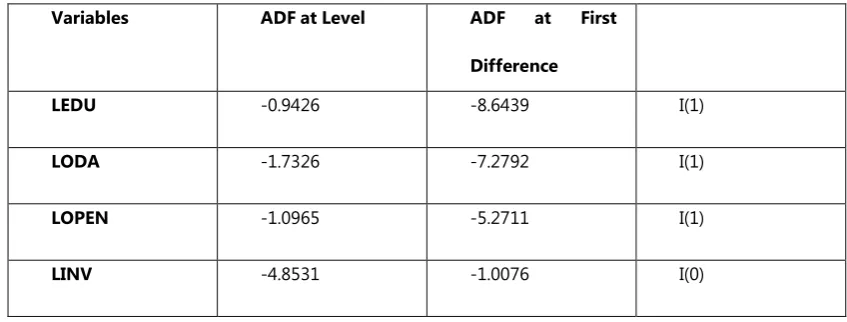
Table 1: Unit Root Test Results
Variables ADF at Level ADF at First
Difference
Decision
LEDU -0.9426 -8.6439 I(1)
LODA -1.7326 -7.2792 I(1)
LOPEN -1.0965 -5.2711 I(1)
LINV -4.8531 -1.0076 I(0)
The results show that education indicator as represented by the long-term primary and secondary enrollment to education (LEDU), long-term official development assistance (LODA) and long-term openness to trade (LOPEN) are non-stationary at level, while they become stationary when taken their first difference and investment (LINV) is stationary at level. The mixed order of integration gives a justification for the use of Autoregressive Distributed Lag (ARDL) model.
The next step is the application of F-Test to find the co-integration among the variables included in the model. The result of F test - 9.31 - is greater than the upper-bound critical value 5.73 at 5 percent level of significance shows the co- integration, which shows the co- integration among the variables.
Table 2: F-Statistics
Dependent
Variables
F-Statistics Probability
Education 9.31 0.00623
Education
112 | P a g e
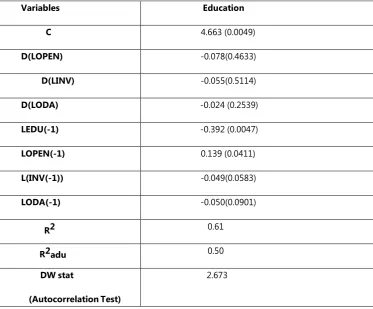
Table 4: Results of ARDL Approach (Education as Indicator of Institution)
Variables Education
C 4.663 (0.0049)
D(LOPEN) -0.078(0.4633)
D(LINV) -0.055(0.5114)
D(LODA) -0.024 (0.2539)
LEDU(-1) -0.392 (0.0047)
LOPEN(-1) 0.139 (0.0411)
L(INV(-1)) -0.049(0.0583)
LODA(-1) -0.050(0.0901)
R2 0.61
R2adu 0.50
DW stat
(Autocorrelation Test)
2.673
P values are shown in brackets. The R2 shows the goodness of fit of the model. The value of the R2 is 0.61 in the model which shows 61 percent variation in the dependent variable is due to the independent variables included in the model. Durban Watson (DW) test is used to check the autocorrelation. The value of the DW shows that there is no problem of the autocorrelation.
In the next step we normalized the coefficients of the lagged level variable by dividing on the coefficient of LEDU, taking all other coefficients as zero and hence obtained the long run relationship. Normalized equation is given below.
LEDU = -11.89 - 0.35 LOPEN +0.14LINV + 0.13LODA --- (4.2)
LODA
113 | P a g e in t h e long run. This sho ws that for the improvement of educational institutions official development assistance is very important in the long run. It has been found that the Investment on education is useful. Human capital investment in the form of tangible capital like buildings generates a stream of future benefits. Benefits of investment on education are a life-time activity (Jorgenson & Fraumenia, 2006).
In the long run openness to trade (LOPEN) has a negative and significant effect on educational institutions (-0.078). These results also correlate with the study of Oostendrop and Quang (2010).
Conclusion
The basic objective of the study was to examine the effectiveness of foreign aid on institutional development in Pakistan. Foreign aid started from the creation of Pakistan as an independent state in 1947 with the perception that aid is helpful in developing countries. However, the issue of the effectiveness of aid is controversial. According to some economists, aid fuels corruption, ineffective economic management and negatively affects country GDP and institutions. Another viewpoint is that foreign aid reduces the gap of budget deficit and enhances the economic growth in the country. The effectiveness of aid depends on how the recipient country uses it.
Within these hopes and doubts this study analyzes the effectiveness of foreign aid on educational institutions in Pakistan over the period of 1975 to 2010. The results indicate that there is no short-run effect of official development assistance on educational institutions, but in the long run there is a positive and significant relationship between the foreign aid and institutional development in Pakistan. Educational institutions grow with the foreign aid. But the effect of foreign aid on institution is quite low.
Policy Recommendations
114 | P a g e
References
Alard, G. & Molina, M.D. (2008). The Influence of Government Policy and NGOs on Capturing Private Investment.
VII OECD Global Forum on International Investment. OECD. Retrieved September 3, 2017 from
4http://www.oecd.org/investment/globalforum/40400836.pdf
Anup, S. ( 2004). A brief history of US foreign aid program. Retrieved June 20, 2017 from www.bcps.org/offices/lis/models/foreignaid/history.html.
Anwar, M. & Awan, S. (2010). Aid effectiveness in education sector of Pakistan. Pakistan Journal of Social Sciences, 30, p. 355-371.
Anwar, M. ( 2006). The political economy of US aid to Pakistan. Review of Development Economics, 10, p. 195-209.
Asiedu, E. & Nandwa, B. (2000). On the impact of foreign aid in education on growth: How relevant are the heterogeneity of aid flows and the heterogeneity of aid recipients. Review of World Economics, 143, 4, p. 631-649.
Azam, P. J. & Thelen, V. (2007). The role of foreign aid and education in the war on terror. Public Choice, 135, p. 375-397.
Boone, P. (1996). Politics and the effectiveness of foreign aid. European Economic Review, 40, p.289–329. Burnside, C. & Dollar, C. (2000). Aid, policies, and growth. American Economic Review, 90, p.847–868.
Dalgaard, C. J., Hansen, H., & Tarp, F. (2004). On the empirics of foreign aid and growth. Economic Journal, 114, p.191–216.
Dickey, A. (2004). Stationarity issues in time series model. Statistics and Data Analysis. SUGI conference, 30, p. 192-230. Available at http://www2.sas.com/proceedings/sugi30/192-30.pdf
Dowling, M. & Hiemenz, U. (1982), Aid, Savings and Growth in the Asian Region. Manila: Economic Office Report Series 3, Asian Development Bank.
Ghatak, S. & Siddiki, J. (2001). The use of ARDL approach in estimating virtual exchange rates in India. Journal of Applied Statistics, 28, p. 573-583.
Ghorbani, M. & Motallebi, M. (2009). Pesenaran & Shin Method for estimating Iran’s import demand function. Journal of Applied Sciences, 9, p. 1175-1179.
Gupta, K.L. & Islam, M.A. (1983). Foreign Capital, Savings and Growth - An International Cross-Section Study. Dordrecht: Reidel Publishing Company.
115 | P a g e Jensen, P. S. & Paldam, M. (2003). Can the New Aid-Growth Models Be Replicated? Economic Working Papers,
paper No.2003–17. Retrieved September 5, 2017 from https://econpapers.repec.org/paper/aahaarhec/2003-17.htm
Jorgenson, D.W & Fraumeni, B.M. (1992). Investment in education and U.S. economic growth. Scandinavian Journal of Economics, 94, p. 51-70.
Malik, R. and M.U. Haq. (2007). An effectiveness and the role of donor intervention in the education sector in Pakistan. A Review of Issues and Literature, Human Development Center, RECOUP ,Working Paper 6: 23. Mahmood, H., Siddiqi, M.W., Iqbal, A. & Tabassum, M.A. (2010). Impact of foreign aid and levels of education on
democracy in Pakistan. International Journal of Human and Social Sciences, 5, p.206-209.
Michaelowa, K. & Weber, A. (2007). Aid effectiveness in primary, secondary and tertiary education. United Nation Educational, Scientific and Cultural Organization. Retrieved March 25, 2017 from http://unesdoc.unesco.org/images/0015/001555/155559e.pdf
Mosley, P. (1980), Aid, savings and growth revisited. Oxford Bulletin of Economics and Statistics, 42, 2, p.79–95. Mosley, P. Hudson, J. & Horrell, S. (1987). Aid, the public sector and the market in less developed countries.
Economic Journal, 97, 387, p. 616–641.
Oya, C. (2006). The Political Economy of Development Aid as Main Source of Foreign Finance for Poor African Countries: Loss of Policy Space and Possible Alternatives from East Asia. 2nd International Forum of Comparative Political Economy of Globalization. Beijing, China. Retrieved September 3, 2017 from http://citeseerx.ist.psu.edu/viewdoc/download?doi=10.1.1.584.776&rep=rep1&type=pdf
Papanek, G.F. (1973). Aid, foreign private investment, savings, and growth in less developed countries. Journal of Political Economy, 81, 1, p.120-130.
Radelet, S. (2006). A primer of foreign aid Center for Global Development. Working paper, 22. Retrieved June 13, 2017 from https://www.cgdev.org/files/8846_file_WP92.pdf
Sachs, J. (2005). The End of Poverty: Economic Possibilities for Our Time. New York: Penguin
Tarnoff, C. & Nowels, L. (2004).Foreign aid: An introductory overview of U.S. programs and policy. CRS report for congress. Congressional research service. Retrieved June 25, 2017 from