Research Journal
Volume 8, No. 24, Dec. 2014, pages 66–71
DOI: 10.12913/22998624/570 Original Article
INTERNET TOOLS IN EDUCATION AT DIFFERENT LEVELS OF TEACHING
Dorota Wójcicka-Migasiuk1, Arkadiusz Urzędowski1
1 Faculty of Fundamentals of Technology, Lublin University of Technology, Nadbystrzycka 38, 20-618 Lublin, Poland, e-mail: [email protected]
ABSTRACT
Modern education opens up broad prospects for the use of the Internet and its applica-tions. Global computer network helps us to cross all limits allowed for the develop-ment and transfer of knowledge and to stimulate and create personal skills. Time and distance are no longer an obstacle. Recently, it has also been popularized in the use of online tools for professional work and intellectual and to the education at all levels of education. In this way, teachers are able to adapt teaching tools to the students’
indi-vidual needs. Moreover, the aspects of graphical visualization can be more efficient
and interesting for students from previously used resources. This paper presents vari-ous methods of the Internet in education, and in particular the use of software to solve advanced problems in the art, for example, to calculate transient states. These tools
are not only used for training skills or to solve specific tasks but also to shape attitudes
and social behavior.
Keywords: modern education, training software, e-learning, research software.
INTRODUCTION
Modern information technology, which is based on computers, has a huge impact on stu-dents, teachers and on the whole process of ed-ucation. The era of ubiquitous access to mobile devices absorbs standard teaching techniques. Increasingly, traditional student’s books and handbooks are less popular nowadays as they are replaced by e-books, tablets and smartphones. The methodology of teaching must keep up with the rapidly changing environment. Teachers at all levels, starting from primary school, through middle school, high school and ending at univer-sities should adapt to the needs of their pupils. Nowadays when, even a four-year deals well with a tablet type toy or an interactive pen, the Internet aided education might be more understandable, interesting and above all more fruitful. The conse-quence of this situation is a continuous need to im-prove skills of teachers. They can not close them-selves or ignore increasing technological prog-ress. They should make use of the vast resources of information and opportunities that the internet
brings. And on the other hand the teaching pro-cesses with the use of software and their applica-tions should be modern and necessarily valid. The role of the teacher is not only to explore innova-tions of taught subjects but also the corresponding transmission of information which is a message to the students. It is a huge challenge for the teachers because they need to keep up with technological advances and sometimes learn the programs or ap-plications from a scratch. What sense for students would be to transfer knowledge about the “archa-ic” technology - not usable to the world today. In order to effectively and interestingly convey mes-sages many methods and means are used during teaching process but the best of them turned out to be the use of information technology.
AIDED EDUCATION AT DIFFERENT
LEVELS IN RELATION TO THE REFERENCE
Lublin University of Technology actively participated in numerous tests in computer net-work applications in education. The Faculty of
Technology is leading in the research on applied computer science. The tests show that internet mainly provides educational material for 90% in higher primary schools, for 55% in secondary schools and 25% at higher levels – academic, for
example. That is because we can find especially
some basic information in the internet. The
pro-cess to find high-technology (specialized) infor -mation is a much more sophisticated task and thus more complex.
Internal research carried out at the Faculty
(in different research, groups reached about 100 students) show that during daytime activity, de -scribed by most of the stationary students as 18 hrs, even 90% of them are connected continu-ously to any of computer systems for all the time
(including mobile phones) but more than 50%
time i.e. 9 hrs. and more, systems are actively
used (including different types of entertainment and communication).
Recent studies on the use of the Internet con-ducted by the Public Opinion Research Center in 2014 showed that within 10 years the number of people using the Internet at least once a week has
increased more than double (from 26% to 63%).
Studies have also shown that the accessibility
of the Internet very much influences education.
Most people who use the network has a university
degree (93%) or lower secondary school degree (94%), although in the second case it is due to
their young age. The lowest use of the Internet is
among people with primary education (20%), the
reason for this is that many of them are people who are over 60 years. Age group that is most likely to use the Internet and its applications are
those between 18 and 24 years old (they repre
-sented 96% of the study group). The research
show that it is almost impossible to live without internet nowadays. If we are not at home we use smartphones or tablets to surf in internet, it is al-most like a life style or can be an addiction. The research was carried out in June 2014 on a popu-lation of 1028 people [1].
APPLIED METHODS
Problem solving processes in many areas of
research in all fields of technology take advantag -es form simulation tools of different acc-ess pos-sibilities. Researchers use typical software avail-able in the whole world and particular dedicated software installed on personal computers or in
local networks but also use online software (not only popularly recognized as freeware) which is
very advanced and often requires special license. It is omitted in this consideration if it is permitted free or by payment.
The paper is focused on the methods enabling
the researchers on different level of fluency use
Internet as a tool for serious and advanced
inves-tigations, to solve deep scientific problems and to
generate reliable results.
The first area where such methods can be ap -plied, and that is considered in the paper,
concen-trates in the broad thematic field of energy and
environment which is in the focus of interest in the regional policy of research, education and commerce. The examples that can be used for the description of this method are TRNSYS [2],
CICUITLAB [3], ANSYS Fluent [4], WUFI+
FLUX [5], etc. These are quite well known tools, for specialists, to investigate transient states in energy supply systems for either renewable or conventional systems and, in general, heat and humidity transfer problems.
The first group of problems that can be solved this way, are based on the needs to de-sign concepts, then if user’s skills allow, one can introduce local environment conditions and engineering parameters, and on the top level of advancement, mathematical calculations ac-cording to relevant energy flow formulae and their modifications if they are available. The solving processes, at different levels of visibil-ity, are based on numerical methods, usually represented by Finite Element Method, Circuit Theory methods, Elementary Balance Method, which are the most popular in technology but of course more advanced mathematical tools are also available and used in e.g. neural net-work problems and nanotechnology. All types of simulations e.g. forecasts, behavior in dif-ferent circumstances, application of varied pa-rameters and time changes in transient states form different approaches towards solutions in this group.
There are some increasingly important areas in the design of information systems. These are design systems that allow recognition of this process as a whole, in all aspects of the sys-tem and at all stages of its creation. The main importance is the language i.e.: the notation of the technology integrated, UML software de-sign and project management, which is recog-nized both from the theoretical side as well as through independent performance system
de-signs. The students form a software specifica -tion, i.e.: they establish a theoretical internet enterprise and determine the requirements that the software must comply with [6].
The next step is to design and thus to deter-mine the overall system architecture and require-ments for each of its components. Students work out use case and suitable scenarios and diagrams.
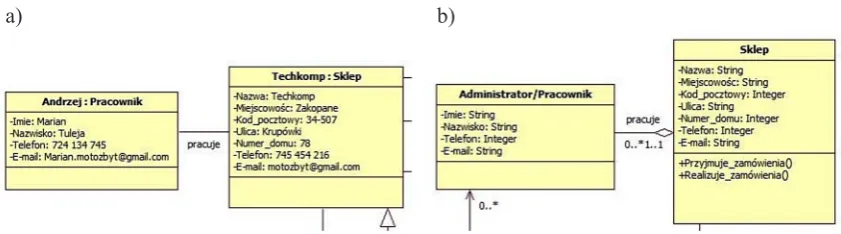
Usually it is sufficient to formulate use case dia -grams, class and object dia-grams, action and state diagrams and time sequence diagrams. The select-ed part of the class diagram is shown in Figure 1a. It contains information about the statistical rela-tionships between elements – classes. The
draw-ing shows, accorddraw-ing to UML rules, classes (as
rectangles divided into names, attributes and
op-erations) and also established links between them (association, aggregation, conjunction). This in -terpretation of the system allows to formalize the
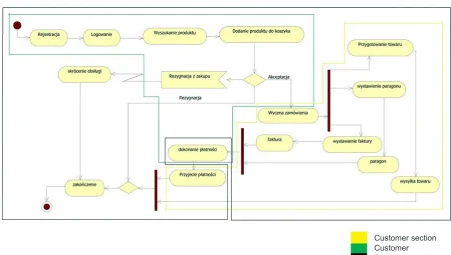
specification of data and methods. Figure 1b pres -ents a diagram of objects that visualizes hypothet-ical actions of the system at the time. Object dia-gram notation uses simpler notation than the class diagram, showing objects that are instances of the classes. There is a diagram in Figure 2 that shows operations that are used to model the dynamic as-pects of the system. It visualizes a gradual course of action. Thanks to the work in Star UMLR it is possible to design the system architecture and any
modification before putting into implementation
and system integration [7].
The aim of teaching in this course is not only to provide knowledge and skills in the program. The process of design and creation of diagrams is only the end result made thanks to the creative ac-tivity of students, preceded by a thorough analysis of the issues, reading the projects already func-tioning in the market, often proposing innova-tive approaches and preparation of use cases sce-narios. Among others, students develop projects for the retail and service systems, fault diagnosis systems, reservation and even electronic bank-ing systems. They are encouraged and stimulated to think independently how project will operate, what mechanisms will guide him and they are suggested to recognize and describe the
relation-ships between employees and beneficiaries. The
last aspect is not the least and it is even very im-portant because it helps student to recognize the service and commercial relations that prevail in companies and institutions. This way, the students acquire the skills of individual and group creative work, instead of frequent copying and pasting in-formation searched over the network. Usage of own ideas based on previously analyzed indepen-dent ventures makes that the systems become less virtual and more strongly associated with life and reality. In the process of teaching many mecha-nisms are being developed which are necessary for conscious functioning in the information soci-ety and some creative skills are trained to engage further graduates in the process of modeling. Sur-prisingly to the learners, computer classes char-acter is based on knowledge of psychology and sociology much more than it could be expected and this way additionally shows the importance of these non technical areas to the students.
The other group for the consideration is the one with the possibility to create and use an in-teractive simulation on a selected platform. This group examples the main focus of interest in the paper because, thanks to these tools, advanced
Fig. 1. The application of the UML Star visualization system architecture in computer sales online:
a) a selection from the class diagram, b) a part of the object diagram
students, still remaining in their process of edu-cation, can show their creative and discursive
abilities and develop them into deep scientific
research.
The first task of young academic researchers
is usually connected with didactic process and that is why it is suggested to stimulate these abilities through the course creation and its development
processes. The configuration of a course starts this
process and it is presented in the paper by means of an example of a course entitled “Training ser-vice in the area of renewable energy sources on the basis of theses elaborated in the Department
of Technology Fundamentals”. The configuration
procedures make that creators take the position of a decisive person and make possible for new users to set up their account on their own through
a confirming e-mail to activate the account and to
enable the enrollment.
For the purpose of the particular course three course subcategories have been developed, i.e.: photovoltaics, solar thermal and biofuels. Activity
modules that should be available for an efficient
course are: Registration, Tasks/Problems, Forum, Reply information, Questionnaire, Survey, Lesson, Quiz, Workshop. These modules make that courses are not only delivered but also their effectiveness can be checked, students can be evaluated and the system can evaluate different levels of usage and give the information to an administrator who at the
same time serves the role of a remote teacher. All such surveys are necessary even currently in real time when e-learning is used.
It is also worth to remember that graphic vi-sualization aspects can be adjusted and they are especially important if higher perception need is considered. If engineers are evolved it can be as-sumed that they represent good imaginative skills
but the wide range of future teachers can benefit
from standard graphic styles which are also avail-able but need additional download, unpack and installation. Afterwards, personal skills in HTML, CSS, PHP and optional use of software such as for
instance as Gimp[8] and Notepad++[9] are trained.
Because e-learnig procedures allow for the
diversification of time boundaries, the character
of courses can be adjusted to educational effects that should be achieved. One can decide whether one of the following approaches is advantageous:
• Weekday – administrators can define exact time
boundaries when a course is to be carried out.
• Social – courses are carried as the exchange of knowledge on established problems.
• Thematic – subsequent lessons are available as long as administrator decides.
Another methodological aspect is the decision if all sections of a course should be hidden or vis-ible, as for example marks or activity reports. It is dependent not only on privacy aspects but on the Fig. 2. Visualization of dynamic sequence of steps in the modeled sales system,
shown in diagram steps by means of UML Star
course content. Let’s take the example of a lesson named “Characteristics of operation of photovol-taic cells” in Photovolphotovol-taic course. This is the in-troductory and fundamental lesson in this course but not the simplest. The administration of further material depends on proper considerations and memorizing of this lesson and it is understand-able that successful test after this lesson enabling the entrance to the next one does not guarantee that a student will remember its content all along the whole course. The possibility to return to the content of the previous lesson should be available but should not be visible or a subject to control,
to let the students use it freely for their benefit but
their activity during the lesson before the
success-ful evaluation should be under control (including time control). It is important to activate a section for lesson flow control which stimulate students
to increase their self-control.
It is justified that lessons created in this course
are linear. Students can go back to the previous lesson and enter the next one if the test is suc-cessful. Wrong answers can be corrected but the number of corrections is registered and can cause relevant reaction from the course or its adminis-trator remotely. Lessons consist of text, graphics, voice and video. The introduction of these ele-ments is possible thanks to HTML graphic editor
or YouTube imports. Tests can be diversified in
their forms as the following:
• multiple choice questions,
• true/false decisions,
• short answers,
• numerical answers,
• select-and-drop the right answer type,
• text answers with no possibility of copy/paste function.
Another method, which can serve as an exam-ple of usage either in research or in didactics, is a mutimedial course. This can be used to explore and test students’ creativeness and to train others. Although the effectiveness testing is typical then, the creativeness exploration is worth mentioning and can be different in the variety of science and
even art fields.
Let’s maintain the focus of Faculty of Tech-nology Fundamentals practice. New educational string has been developed related to labor safety and thus new courses appear continuously. Re-gional safety inspection practice is of course of
long history and students can frequently benefit
from, but also can add quite stantial values to
it. This is possible in a kind of synergy system when regional bodies cooperate well with re-search and educational centers. This process can be traced on the example of the below presented course for the work at height, its problems and requirements.
Such comparatively typical course requires and should be elaborated in a kind of discursive way, let’s say just at the level of Master’s thesis. At this level, students acquires the knowledge but also become co-creators of multimedia con-tent adaptation and thus training not only tech-nical skills but also psychological methods and tools to adapt the course of safe behavior in the workplace, to their colleagues and potential learners using available tools. The use of anima-tion and slide transianima-tions is a good practice to add
expression and influence students’ skills in the
hidden way under the course content. It is par-ticularly important when safety intuitive behavior is trained and at the same time content apprecia-tion, understanding and also professional layout matters. Articulate storyline software product are
flexible with the library of animation ins and outs,
available for images, motion pictures etc.[10]. It is also useful if Record Screen tool can be used to add multimedia to the course without ne-cessity to engage additional software. Creative-ness resulting from own production of motion pictures cannot be overestimated and the
possi-bility to insert a motion file or record a movie is
helpful.
Typical course units should have average content comparative to one full lecture if the gen-eral purpose of e-learning is to be maintained. In the series of trial the author has established this within the following frame: 40 multimedial slides
+ 80 layers composing the whole content, 4 quiz -zes to memorize the knowledge, 10 problems to
be solved in the final test [11].
CONCLUSIONS
The elaborated tool was tested in two target groups: students in the regular curriculum and
em-ployees of regional inspection office who are regu -larly involved with their activity with client enter-prises. The student group consisted of equal pro-portion between men and women and the level of knowledge assimilation after 1 hour trial was 60%,
Both groups had earlier knowledge in the subject but students did not treat this activity as an opportunity to extend their knowledge. This was in the contrary to the employees who,
how-ever not involved in this field of professional life (not engineers), showed much more responsible
attitude to their obligations. Majority of students reported that the course was boring but the major-ity of employees were pleased with this form of education.
This research, however estimative only, can be indicative that the appreciation of e-learning is very strongly vulnerable to personal motivation. The previous research conclusions published by many authors and presented in the introduc-tion of this paper are very dependent on general conditions usually not envisaged by such simple questionnaires as they report. The general accep-tation of e-learning by academic environment is
somehow not justified when only brought up as
-pects matter, partially justified when education
-al aspects are important and well justified only
when economical aspects are leading in front of personal brought up and high quality processes. Personal motivations can be comprehensively raised when proper brought up processes extend far beyond school and high school education.
Universities train not only employees, but also, often, not their own researchers and thus, academic institutions should not limit their high quality methods only to the target group of their further most promising individuals. The other as-pect of conclusions refers to the applicability of software tools in training of research skills and this is positive.
Moreover, the aspect of researcher’s personal responsibility is again a problem to be solved not by means of computer software. The continuous positive feedback between e-learning and person-al tutor’s relation towards students is impossible to overestimate.
REFERENCES
1. Feliksiak M.: Internauci 2014. Fundacja Centrum
Badania Opinii Społecznych, Warsaw 2014, http://
www.cbos.pl/SPISKOM.POL/2014/K_082_14. PDF, June 2014.
2. http://www.trnsys.com, July 2014.
3. https://www.circuitlab.com, July 2014. 4. http://www.ansys.com/, July 2014. 5. http://www.wufi-pro.com, July 2014.
6. Socha K.: Inżynieria oprogramowania. Wydawnic -two Naukowe PWN, Warsaw 2010.
7. Hnatkowska B., Huzar Z.: Inżynieria opro -gramowania – metody wytwarzania i wybrane za-stosowania, Wydawnictwo Naukowe PWN, War-saw 2008.
8. http://www.gimp.org, May 2014. 9. http://notepad-plus-plus.org, May 2014. 10. http://www.articulate.com, June 2014.
11. Wójcicka-Migasiuk D.: Regional research on In-ternet aided educational processes at different levels. Issues of Global Education, Vol. 7, Lublin
2013, 53–65.