Research Journal
Volume 11, Issue 2, June 2017, pages 198–204
DOI: 10.12913/22998624/71147 Research Article
THE EFFECT OF PROCESS PARAMETERS ON THICKNESS DISTRIBUTION IN
THERMOFORMING
Olcay Ekşi1, Sencer Süreyya Karabeyoğlu2
1 Kırklareli University, Engineering Faculty, Mechanical Engineering Department, Kayali Campus, Kırklareli, Turkey, e-mail: [email protected]
2 Kırklareli University, Engineering Faculty, Mechanical Engineering Department, Kayali Campus, Kırklareli, Turkey, e-mail: [email protected]
ABSTRACT
In this study, cylindrical, conical and hemispherical molds were used to form flat ther
-moplastic sheets which are 1.5 mm in thickness. The effect of plug assist on thickness distribution was investigated. The sheets were formed with and without plug assist.
Then thickness distributions on thermoformed products were obtained for two
experi-mental procedures by a digital caliper (Resolution: 0.01 mm). As a result, plug assist thermoforming provides more uniform thickness distributions than negative forming.
Keywords: thermoforming, plug-assist, thickness distribution, mold.
INTRODUCTION
Thermoforming is a manufacturing process that uses heat and air pressure to form a flat plastic sheet or film in to a product. The plas -tic material is heated to the correct temperature
depending on the kind of plastic material. Then the heated plastic sheet or film is formed in to a negative or positive mold. Plug assist may be
used. Generally a vacuum or positive air
pres-sure is employed after the forming of the plastic sheet or film. After forming, the plastic is cooled
and trimmed in desired dimensions. It is
possi-ble to summarize the thermoforming process as
mentioned above.
There are wide application areas of the
ther-moforming process. One of the most important of these sectors is the packaging industry among
the other sectors such as automotive, electronics, biomedical and pharmaceuticals.
Thermoform-ing has differences from the other competitive processes including injection molding, blow molding, rotational molding and extrusion. The most advantageous aspect of thermoforming is forming ability by roll-fed machines compared
to the others. With roll-fed machines, high-vol
-ume, continuous thermoforming of thin-gauge products is possible[3, 10, 11, 12]. But, by using sheet-fed thermoforming machines, production is
slow and productivity is low. Sheet-fed
thermo-forming machines are usually used in thick gauge thermoforming applications. So this phenomenon makes it labor intensive compared to thin gauge thermoforming applications.
Process parameters can affect both the total forming process and product quality. So, form
-ing temperature, type of plastic (amorphous or crystalline), shape of mold (positive or nega
-tive), air pressure (positive or nega-tive), shape,
type and number of heaters play a critical role
throughout the process [4, 5, 7, 8]. One of the leading factors that affects the product quality is plug assist. By using plug assist in thermoform
-ing, wall thickness distribution in thermoformed products can be adjusted more uniformly[2, 6]. If a negative mold is used, the bottom of the part
becomes the thinnest and if a positive mold is used the bottom of the part becomes the thick-est. In order to balance the wall thickness distri-bution in the bottom and sidewalls of the
ucts. The plug shape is determined according to
product and mold shape.
In this study, aluminum is selected as a plug material. Aluminum is easy to find and suitable for machining. It is relatively cheaper than the other metals. Three different thermoforming
molds have been employed. Cylindrical, coni-cal and hemisphericoni-cal molds were used to form flat thermoplastic sheets which are 1.5 mm in
thickness. PS sheets which were cut into 15x15 cmdimensions were used in thermoforming op
-erations. The effect of plug assist on thickness distribution was investigated. The sheets were formed with and without plug assist. Then
thickness distributions on vacuum formed and
plug assisted thermoformed products were obtained by a digital caliper (resolution: 0.01 mm). Thickness profiles obtained from ther -moformed products which are produced by
plug assist thermoforming are different from
the thickness distribution results obtained from
without plug assist thermoforming. As a result, plug assist thermoforming provides more uni -form thickness distributions on thermo-formed products.
MATERIALS AND METHODS
In this study, commercially available PS res
-in, SABIC PS 825E (High Impact Polystyrene) was used in thermoforming. Lab-scale vacuum thermoforming machine was designed, produced and used in thermoforming operations. In Fig.1. designed and final (produced) view of thermo
-forming machine can be seen clearly. The ther
-moforming machine has three ceramic infrared heaters, which are designed for operating temper
-atures of up to 750oC. These heaters have a
heat-ing area of 25x25 cm2. Each of the panel heaters
has 500 watt power and 1500 watt in total. Firstly, sample preparation is carried out.
Thermoplastic sheets are cut to have a dimen-sion of 15x15 cm. Sheets which have the correct dimensions are placed between the mold and
the clamping ring. Then heaters are operated by bringing them to the correct position. The sheet is heated equally. PS resin, which is used in this study, has a wide forming temperature window. Forming temperature range is approximately
30oC. Maximum forming temperature is about
150oC. Temperature distribution was obtained
by using a thermal imaging camera (Testo). Vac
-uum was measured during forming. The magni -tude of vacuum was obtained from the vacuum
display, which was 730 mmHg. After forming, the heaters were turned off and pushed back to their first position. After a couple of minutes the thermoformed semi-finished part was released
from the mold.
Three different thermoformed semi-finished samples (Fig. 3) were obtained from the ther
-moforming molds (Fig. 4). Quarter sections
were cut and taken from conical, cylindrical and hemispherical samples. Thickness distributions
were measured along the cut sections on quar
-ter samples by a digital caliper (resolution: 0.01 mm). These measurements were achieved for
three types of thermoformed samples. Measure-ment operations were repeated on three samples
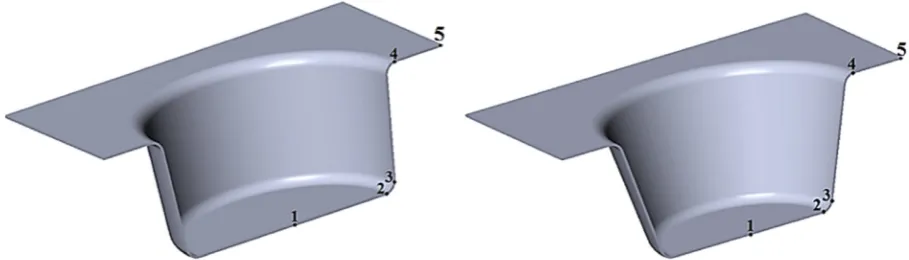
for those which were formed by using male and female molds. Measured thickness profiles were compared to each other. The profiles in which the thicknesses were measured, is shown in Fig. 2. Thickness measurements were repeated in 20 points from point 1 to point 5 for all semi-finished
thermoformed products.
RESULT AND DISCUSSION
In this study, the effect of plug assist and the
other process parameters on thickness
distribu-tion has been investigated. In order to analyze the effect of process parameters, firstly temperature
distribution has been detected on the heater
ele-ments. As seen in Fig. 5 and Fig. 6 heater ele
-Fig. 3. Thermoformed hemispherical and cylindrical products
Fig. 5. Temperature distribution along the length of the heaters
Fig. 6. Temperature distribution along the width of the heaters
ments have non-uniform temperature
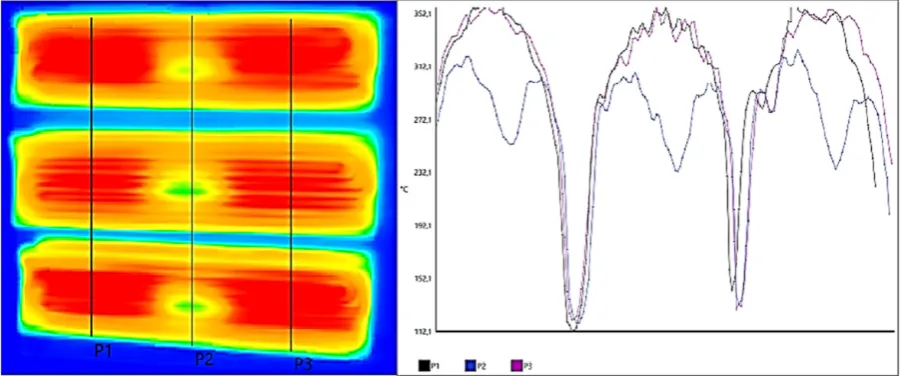
distribu-tion. When the temperature has been adjusted to 350oCin the heater, the temperature has changed
between 250oC and 350oC along the length and
width of heater elements. However, temperature
distribution on the heater is supposed to be the same at every point. Non-uniform temperature
distribution on heater elements affects the tem
-perature distribution on the sheet before forming. As understood from Fig. 7 a heated sheet has non-uniform temperature distribution too. A ther
-mal imaging camera showed that the temperature has approximately a 30oC variation range on the
heated sheet after a heating time of 4 minutes.
Normally, it is hard to thermoform a sheet which has a non-uniform temperature distribution in
which temperature changes from 120oC to 150oC.
However, PS which is an amorphous polymer, has a wide forming temperature window. That phenomenon makes PS possible to be thermo
-formed under 30oC temperature change.
One of the leading factors that affects the thickness distribution, is plug assist. In order to analyze its effects in detail, a male mold has
been used in addition to female mold
applica-tions. Thickness distributions in different ther
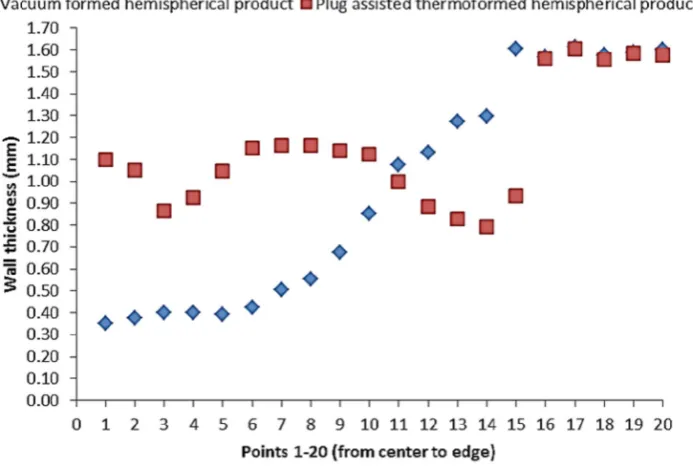
-moformed products can be seen in Fig. 8, Fig. 9, and Fig. 10.
Thickness distributions obtained in hemi-spherical products and compared to each other. Thickness measurements have been performed on
a profile that starts at the the center and bottom of the product, and the ends on the outer edge of
20 points in total. As a result of vacuum forming (female mold), thickness has an increasing trend
outward from the center of the product. Minimum
thickness was measured as 0.35 mm at the center
of the bottom of the vacuum formed
hemispheri-cal product at point 1. On the other side, min. thickness was measured as 0.79 mm at point 14 by plug-assisted thermoforming (male mold).
Minimum thickness was measured as 0.13 mm at point 6 by vacuum forming and 0.29 mm at point 6 by plug assisted forming in conical product. By vacuum forming, thickness distri
-bution exhibits a constantly increasing trend. On the contrary, there is an unstable tendency
for thickness distribution on the plug assisted
thermoformed products. It is understood from
the male mold applications that thickness firstly decreases then increases and decreases again on the sidewalls of the conical product (points 7-15). This is an indication of thickness accumu -lation on the sidewalls of the product. That phe-nomenon can be explained as a result of multiple
causes. Before forming, the male mold touches the heated sheet firstly. Part of the heated sheet
that touches the cold male mold, cools and hard-ens. That part of the sheet cannot deform any-more. Thickness accumulation on the sidewalls can be accepted as a result of this action.
Fig. 7. Temperature distribution of the heated sheet before thermoforming
Minimum thickness was measured as 0.09 mm at point 7 in cylindrical products by vacu
-um forming. Point 7 is located on the radius at
the bottom of the cylindrical product. Contrarily,
minimum thickness value was measured as 0.24 mm at point 8 by plug assisted thermoforming. Point 8 is located near the radius where point 7
is located. Thickness distribution obtained from vacuum formed cylindrical samples has an
in-creasing tendency from point 1 to point 15, same
as vacuum formed conical products. The decrease
and increase in thickness from point 7 to point
15 in cylindrical products can be seen in conical products too.
Fig. 9. Comparative thickness distribution in conical product
CONCLUSIONS
The effect of some process parameters on thickness distribution in thermoforming has been investigated in this study. Temperature
distribution on heaters has been detected as an
affecting parameter because the heaters have
non-uniform temperature distribution. Non-uniform temperature distribution on heaters has caused non-uniform temperature distribution on heated sheet. Undesired temperature
distri-bution on the heated sheet affected deformation and forming so affected thickness distribution too. But, the most important factor was deter
-mined as the type of forming process. Using plug assist increased the minimum thickness
value in conical, cylindrical and hemispherical thermoformed products. In addition to this,
us-ing plug assist in thermoformus-ing provided more uniform thickness distributions than negative (female mold) forming.
Acknowledgements
We would like to give our special thanks to Trakya University Engineering Faculty for the possibility of using Solidworks software.
REFERENCES
1. Farrington T., Coward T., Pearson G.O., Taylor R.L., Ear P., Winwood K.: An investigation into
the relationship between thickness variations and
manufacturing techniques of mouth guards. Dental Traumatology, 32, 1, 2016, 1-84.
2. Hosseini H., Berdyshev B.V., Zeinabad A.M.: A
solution for warpage in polymeric products by plug-assisted thermoforming. European Polymer Journal, 42, 8, 2006, 1836-1843.
3. Klein P.W.: Fundamentals of Plastics Thermoform
-ing, Morgan&Claypool Publishers, USA, 2009. 4. Kojima I., Takeda T., Nakajima K., Narimatsu
K., Konno M., Ozawa T., Ishigami K.: Thinning factors influence on custom-made mouth guards thermoforming. Dental Traumatology, 31, 2, 2015, 103-112.
5. Lee R.E.,Guo Y., Tamber H., Planeta M.,Leung S.N.S.: Thermoforming of Polylactic Acid Foam Sheets: Crystallization Behaviors and Thermal Stability. Industrial & Engineering Chemistry Re
-search, 55, 3, 2016, 560–567.
6. Martin P.J., Duncan P.: The Role of Plug Design in Determining Wall Thickness Distribution in Ther
-moforming, POLYMER ENGINEERING AND SCIENCE, 47, 6, 2007, 804–813.
7. Takahashi M., Koide K., Satoh Y., Iwasaki S.: Heat
-ing methods for reduc-ing unevenness soften-ing of mouth guard sheets in vacuum–pressure formation. Dental Traumatology, 32, 4, 2016, 316-320.
8. Takahashi M., Koide K., Satoh Y., Iwasaki S.: Shape change in mouth guard sheets during ther
-moforming. Dental Traumatology, 32, 5, 2016, 379–384.
9. Tangpornprasert P., Virulsri C.: Factors Affecting Thickness of Prosthetic Socket in Thermoform
-ing Fabrication. Applied Mechanics and Materials, 751, 2015, 159-163.
10. Throne J.L.: Thermoforming, Hanser Publishers, GERMANY, Munich, 1987.
11. Throne J.L.: Technology of Thermoforming, Han
-ser/Gardner Publications Inc., USA, 1996. 12. Throne J.L., Understanding Thermoforming, Han