Determination of Intermolecular Interactions in Polar
and Non-polar Organic Molecules by Optical
(Refractive Index) Method
SHAUKAT A. SHAHa, JAVED KHANb, MAQDOOM FAROOQUIb, S. H. QUADRIb, and A. J. PATHANc
a
Department of Chemistry,
Anand Niketan College, Anandwan, Warora, Dist. Chandrapur, Maharashtra, INDIA.
b
Department of Chemistry,
Maulana Azad College & Research Centre,
Dr. Rafiq Zakaria Campus, Rauza Bhag, Aurangabad, Maharashtra, INDIA.
c
Department of Electronic,
Maulana Azad College & Research Centre, Dr. Rafiq ZakariaCampus, Rauza Bhag, Aurangabad, Maharashtra, INDIA.
(Received on: February 15, 2013)
ABSTRACT
Refractive indices and densities have been experimentally determined for the binary mixtures of Toluene -Benzene, Ethanol-Benzene, Toluene-Ethanol and Water-Ethanol systems at room temperature over the entire range of mole fraction. The experimental values of refractive index and densities are utilized to calculate excess refractive indices, molar refractions, excess molar refractions, excess molar volume and calculated molar refractions. Results obtained indicate that the optical method is more accurate over the volumetric method. A strong association was observed in polar-polar solvent system and polar - non-polar systems.
Keywords: Refractive index, Excess refractive indices, Molar
refractions, Excess molar volume, Optical, Volumetric, Polar, Non-polar.
INTRODUCTION
Refractive index measurement is an essential part of the thermodynamic studies
binary liquid mixtures2. Complex formation in liquid mixtures has been extensively studied using optical and ultrasonic technique by many workers3. The formation of hydrogen bond in solutions and its effect on the physical properties of the mixtures have gained much attention4,5. In particular, relevance does the nature of interactions of solvent with solute species, the behavior of solvent medium in presence of other species affect the structural properties of both solvent and solute molecules. Therefore, excess properties of solutions have proven to be very useful tool in elucidating the structural interactions occurring in solution and to study solute-solvent interactions6.
In our present study, we select polar molecules as water and ethanol, and non polar molecules as benzene and toluene. These molecules are very important in various fields of chemical sciences like, solvent as reaction medium, in solvent extraction processes, in chromatographic techniques and in drug formulation. In our present research work, refractive indices and densities of binary liquid-liquid mixtures of Toluene -Benzene, Ethanol-Benzene, Toluene-Ethanol and Water-Ethanol at room temperature over the entire range of mole fraction have been determined. Along with refractive index and density, deviation in refractive indices, molar refractions, deviation in molar refractions and excess molar volume have been calculated7-10 and correlation have been established in terms of intermolecular interactions present amongst the components of mixtures.
MATERIALS AND METHODS
All the chemicals used were of A. R. grades. The chemicals were purified by
distillation and only middle fraction was used. Solutions were prepared by mole fraction method. The weighing was done by using electronic balance with precision of ± 0.1 mg. Refractive indices (at 589.5 nm sodium line) were measured by using Abbe’s Refractometer with constant temperature thermostat with precision of ±0.001 and values provided here are the mean values from three independent readings for each sample. Densities were measured using specific gravity bottle at constant temperature (298.15K).
RESULTS AND DISCUSSION
The change in refractive indices on mixing (∆nD), excess molar volumes (V
E
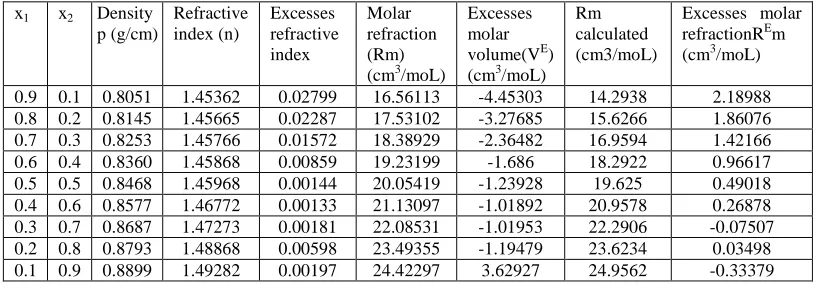
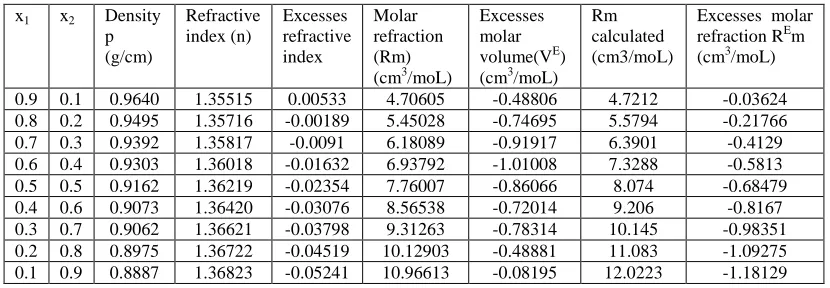
), excess molar refraction (REm), calculated molar refraction, also densities , refractive indices of pure liquids and entire range of mixtures of liquid listed in table no. 1, 2, 3, 4 and 5.
The values of), excess refractive indices (∆nD), excess molar volumes (V
E
), excess molar refraction (REm) for binary mixtures of toluene-benzene, ethanol-benzene toluene-ethanol and water-ethanol were calculated from data of the density ,refractive index and molar mass using following equations.
∆n = nD-(x1nD1+x2nD2) (1)
In this equation, x1, x2 are mole fractions. nD,
nD1, nD2 are the refractive index of mixture,
pure components 1 and2 respectively (Ku et al.,2008).
VE = [(x1M1+x2M2)/p– (x1M1/p1+x2M2)/p2)]
(2)
In this equation x1,x2 are mole
p2 are the densities of mixtures, pure
components of 1 and 2 respectively (Li
et al., 2007).
REM = RM – (x1RM1+x2RM2 ) (3)
In this equation x1,x2 are mole
fractions. RM molar refraction of binary
mixtures, RM1 and RM2 are molar refractions
of pure components.
Table no. : 1 - For Pure Liquids
Compound Molar
mass
Density p (g/cm3)
Refractive index(n)
Molar refraction (cm3/moL)
Calculated molar refraction (cm3/moL)
Benzene 78.0 0.879 1.499 26.05495 26.289
Toluene 92.14 0.8736 1.497 30.86323 30.78
Ethanol 46.08 0.8873 1.41748 13.07307 12.961
Water 18.0 0.9954 1.3426 3.81665 3.574
Table no. : 2- Toluene-Benzene System
x1 x2 Density p (g/cm)
Refractive index (n)
Excesses refractive index
Molar refraction (Rm) (cm3/moL)
Excesses molar volume (VE)
(cm3/moL)
Rm calculated (cm3/moL)
Excesses molar refractionREm (cm3/moL)
0.9 0.1 0.8168 1.45564 -0.04156 30.17329 -11.3227 30.3309 -0.20911 0.8 0.2 0.8189 1.46066 -0.02234 29.9082 -9.36278 29.8818 0.00663 0.7 0.3 0.8195 1.46268 -0.02232 29.52418 -7.39929 29.4327 0.10344 0.6 0.4 0.8200 1.46369 -0.02331 29.08606 -5.44507 28.9836 0.14615 0.5 0.5 0.8215 1.46972 -0.01928 28.87715 -3.56027 28.5345 0.41806 0.4 0.6 0.8271 1.47274 -0.01826 28.36037 -1.99172 28.0854 0.38211 0.3 0.7 0.8493 1.48076 -0.01224 27.5459 -1.82729 27.6363 0.04847 0.2 0.8 0.8596 1.48879 -0.00621 27.12841 -1.06418 27.1872 0.11181 0.1 0.9 0.8637 1.49682 -0.00018 26.89716 0.08158 26.7381 0.36139
Table no. : 3 - Ethanol-Benzene System
x1 x2 Density p (g/cm)
Refractive index (n)
Excesses refractive index
Molar refraction (Rm) (cm3/moL)
Excesses molar volume(VE) (cm3/moL)
Rm calculated (cm3/moL)
Excesses molar refractionREm (cm3/moL)
Table no. : 4 - Toluene-Ethanol System
x1 x2 Density p (g/cm)
Refractive index (n)
Excesses refractive index
Molar refraction (Rm) (cm3/moL)
Excesses molar volume(VE) (cm3/moL)
Rm calculated (cm3/moL)
Excesses molar refractionREm (cm3/moL) 0.9 0.1 0.8762 1.49682 0.00804 29.22441 -11.3227 28.9981 0.1402 0.8 0.2 0.8642 1.48779 0.00723 27.63685 -9.36278 27.2162 0.33166 0.7 0.3 0.8571 1.47572 0.00339 25.76101 -7.39929 25.4343 0.23483 0.6 0.4 0.8428 1.46570 0.000159 24.21118 -5.44507 23.6524 0.46402 0.5 0.5 0.8371 1.46506 0.000917 22.82594 -3.56027 21.8705 0.85779 0.4 0.6 0.8247 1.45506 0.00739 21.22362 -1.99172 20.0886 1.03449 0.3 0.7 0.8174 1.44059 0.00114 19.33515 -1.82729 18.3067 0.92504 0.2 0.8 0.8046 1.43545 0.00423 17.9481 -1.06418 16.5248 1.317 0.1 0.9 0.7943 1.42647 0.00347 16.36602 0.08158 14.7429 1.51394
Table no. : 5 - Water-Ethanol System
x1 x2 Density p (g/cm)
Refractive index (n)
Excesses refractive index
Molar refraction (Rm) (cm3/moL)
Excesses molar volume(VE) (cm3/moL)
Rm calculated (cm3/moL)
Excesses molar refraction REm (cm3/moL)
0.9 0.1 0.9640 1.35515 0.00533 4.70605 -0.48806 4.7212 -0.03624 0.8 0.2 0.9495 1.35716 -0.00189 5.45028 -0.74695 5.5794 -0.21766 0.7 0.3 0.9392 1.35817 -0.0091 6.18089 -0.91917 6.3901 -0.4129 0.6 0.4 0.9303 1.36018 -0.01632 6.93792 -1.01008 7.3288 -0.5813 0.5 0.5 0.9162 1.36219 -0.02354 7.76007 -0.86066 8.074 -0.68479 0.4 0.6 0.9073 1.36420 -0.03076 8.56538 -0.72014 9.206 -0.8167 0.3 0.7 0.9062 1.36621 -0.03798 9.31263 -0.78314 10.145 -0.98351 0.2 0.8 0.8975 1.36722 -0.04519 10.12903 -0.48881 11.083 -1.09275 0.1 0.9 0.8887 1.36823 -0.05241 10.96613 -0.08195 12.0223 -1.18129
From table no 2, 3, 4 and 5, it is found that values of excess molar volume, are negative for entire range of compositions, which represents a decrease in the overall volume of the binary mixture. These values of excess molar volume indicate specific intermolecular force of interactions. This is further confirmed from the fact that experimental values are smaller than ideal values of binary mixtures. The experimental findings suggest that in mixtures, packing of molecules is more compact than in pure liquids.
The values of excess refractive index are negative for entire range of compositions, which represents strong intermolecular forces of interaction (table no 2 and 4). It also indicates that like nature molecules (polar-polar and non polar- non polar) are associated strongly. The values of excess refractive index are positive (table no 3 and 5) for polar and non –polar system, suggesting that their molecular associations are weak.
refraction, it is further verified that molar refraction is an additive and constitutive property.
The excess molar volume and excess refractive index values of binary mixtures show that optical (refractive index) method is more refined over volumetric method.
CONCLUSIONS
From above results and discussions, it is concluded that like nature (polar-polar and non polar- non polar) molecules are strongly associated and dislike nature (polar-non polar) molecules are weakly associated. Optical method is more accurate than volumetric method.
REFERENCES
1. D. S. Wankhede, Acta Chim. Slov., 59, 258-263 (2012).
2. Rita Mehra, Proc. Indian Acad. Sci.
(Chem. Sci.), Vol.115,No.2,pp 147-154
April (2003).
3. B. Gonzalez, A. Dominguez, Jose Tojo, R. Cores, J. Chem. Eng. Data 49, 1225 (2004).
4. J. Wu, Z. Xu, Z. Liu, B. Wang, J. Chem.
Eng. Data 50, 966 (2005).
5. U. B. Kadam, A. P. Hiray, A. B. Sawant, M. Hassan, J. Chem. Eng. Data 51, 60 (2006).
6. Piyush Thakur, Sandhya Patre, and Rama Pande, International Journal of
Bioscience, Biochemistry and Bioinfor-matics, Vol.1, No.4, November (2011).
7. Arthur I. Vogel, A Text book of Practical Organic Chemistry including Qualitative Analysis, New impression with corrections and additions, 3rd edition,1031.
8. Samuel H. Marron and Carl F. Prutton, Principle of Physical Chemistry, 4th edition, Amrind Publishing Co. Pvt. Ltd, 691.