Knowledge Management in the BRICS
Eduardo TOMÉ European University of Lisbon
Quinta do Bom Nome, Estrada da Correia, 53 1500–200 Lisbon, PT [email protected]
Abstract. The purpose of this paper is to make sense of the situation of Knowledge Management in the BRICS countries: Brazil, Russia, India, China, and South Africa. The question is important because we believe that in the current world economy the emergence of any country will be done first and foremost by using knowledge and by managing knowledge. Using an analogy from the Human Resources national studies we believe there are low, medium and high equilibria regarding the knowledge economy. We analyze the five BRICS according to the following methodology: 1 Context background; 2 Broad KM systems; 3 Institutional actors; 4 Political contexts; 5. KM systems at the national level; 6. Organizational KM; 7. Impact; and 8. Summary. We concluded that KM is a good investment for the BRICS, but it is still a very rare one. South Africa stands a cut above the other countries being benefited by the smaller dimension and the relations with the Western UK, and the USA led investments; also the fact that the regime change happened when the Knowledge economy was beginning, helped. China, Russia, India, and Brazil are four giants that will emerge stronger and faster the more and the better they will use KM. So as implications, we expect a bright future of KM in the 21st century, as bright as the BRICS future! The BRICS emergence will only be consolidated by KM. and KM will dominate the world with the BRICS emergence. The study is only the first step in what could be a major field of research, and that its limitation and suggestion for research.
Keywords: knowledge management; BRICS; 21st century; economic development; knowledge dynamics.
Introduction
technology, the second on people and the third, and current on routines and practices.
In the aforementioned context this paper wants to analyze the situation on KM in the BRICS. The question is important by a quantity of reasons. First the BRICS need KM
to become world powers (O’Neill, 2001). Second, the emergence of the BRICS may
give KM a second breath and a bigger importance in the world (Andreeva & Kianto, 2012). In consequence, this paper will be constituted by the following five sections: Theories, Methodologies, Results, Discussion, and Conclusions.
Theories
In the 21st century with the emergence of services economy, intangibles became the main production factor in advances economies, giving rise to a knowledge-based and services driven society (Tomé, 2011b, 2012). Knowledge is the most important of those intangibles being defined as understood information, information being organized data, and wisdom being automatic knowledge according to a well-known scale (Maurer, 1999). Knowledge is basically studied by Knowledge Management (KM). Knowledge workers, knowledge companies, and knowledge cities, are three of the main concepts in the analysis. The basic model over KM was presented by Nonaka and Takeuchi and establishes the existence of four phases, oscillating between tacit and explicit knowledge in the framework of the knowledge flow, that put together generate the SECI model (Nonaka & Takeuchi, 1995). A debate has been existing over how knowledge is created (Kianto, 2008) and how knowledge is forgotten (Cegarra Navarro & Moya, 2005). Also important analysis has been done about knowledge dynamics (like in the IFKAD conferences) and the knowledge cycle of live – creation, sharing, transferring, stocking and unlearning (Tomé, 2011b).
With more relation to this paper, the analysis on Knowledge has been done with the following perspectives:
a) as an asset or a market; most of the analysis tend to consider knowledge an asset which has to be managed; however, particularly when we aim to analyze Knowledge and KM in a national perspective we believe it is fundamental to address the question of the market of knowledge. Following (Tome. 2011b; Tomé & Goyal, 2015) we believe the analysis of the market of knowledge should be made in four broad stages, as the following; a) stocks, investments and outcomes; b) supply, demand, price and quantity; c) needs; d) market forces. We will use this approach in the Results section, number 8 and Table 8, see below.
classified as low, middle or high in knowledge, as in skills, and also in KM. In a low equilibrium few knowledge workers and few knowledge companies exist, because
people don’t learn and companies don’t create vacancies for knowledge workers and
vice versa. In a high equilibrium exactly the opposite occurs. Low equilibria exist in developing countries, high in developed countries (Ashton & Green, 1996). Economic integration may be a factor of transforming a low equilibrium into a high one, but social policies are also another important factor (Tomé, 2004, 2008). A societal agreement is also important (Ashton & Green, 1996). Emerging countries are the ones that are transforming themselves from low to high equilibrium regarding knowledge. We will see that these ideas are very important to analyze the BRICS as knowledge economies.
Methodology
Following and adjusting Tomé (2016), we ask several questions about each one of the five BRICS: 1 Context background; 2 Broad KM systems; 3 Institutional actors; 4 Political contexts; 5. KM systems at national level; 6. Organizational KM; 7. Impact; and 8. Summary.
Results
In this section, we present the results of the application of the methodology defined in the previous section.
Context background
History and Politics
The five BRICS have very different histories, China and Russia being heirs of the two of the biggest and long-lasting empires, India a mosaic of cultures also with millennial ancestry, with Brazil and South Africa old colonies from European empires. In political terms, India is a democracy since independence in 1947, South Africa since the end of the apartheid in 1990, Russia since the end of Communism in 1989, Brazil since the end of the military dictatorship in the eighties of last century and China is still a single party regime. It is worth mentioning that all the five BRICS had eventful political histories in the last years, India, Russia, Brazil and South Africa being in the stage of democracy building and China not yet there (Tomé, 2004).
Economy
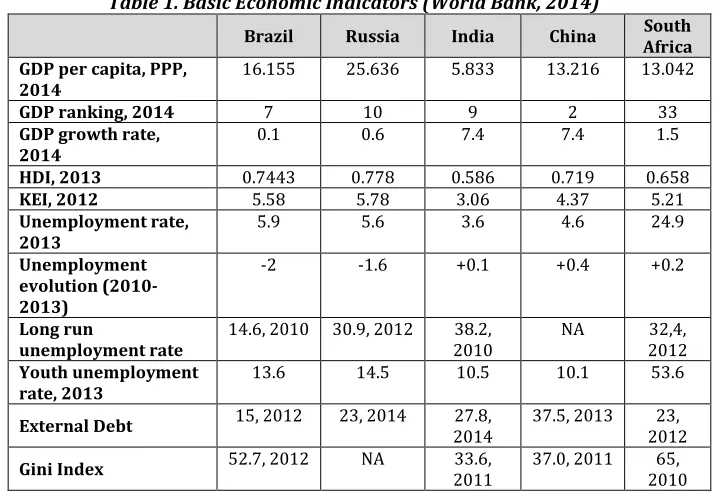
somehow the GDPph ones, even if Russia’s advantage over the other countries is less
clear. On unemployment, South Africa stands out for all the wrong reasons with a rate five times bigger than that of the other countries in general terms and four-time regarding the youth. Brazil has a smaller proportion of unemployed as long-run unemployed, and had a slightly better evolution in the recent times. China has a higher external debt in relation with the GDP than the other countries and Brazil a
smaller one; on average the levels are small and sustainable. South Africa and Brazil’s
Gini Index values are stratospheric and indicate massive inequalities, China and India have middle and low levels of inequality.
Table 1. Basic Economic Indicators (World Bank, 2014)
Brazil Russia India China Africa South GDP per capita, PPP,
2014 16.155 25.636 5.833 13.216 13.042
GDP ranking, 2014 7 10 9 2 33
GDP growth rate,
2014 0.1 0.6 7.4 7.4 1.5
HDI, 2013 0.7443 0.778 0.586 0.719 0.658
KEI, 2012 5.58 5.78 3.06 4.37 5.21
Unemployment rate,
2013 5.9 5.6 3.6 4.6 24.9
Unemployment evolution (2010-2013)
-2 -1.6 +0.1 +0.4 +0.2
Long run
unemployment rate 14.6, 2010 30.9, 2012 2010 38.2, NA 32,4, 2012 Youth unemployment
rate, 2013 13.6 14.5 10.5 10.1 53.6
External Debt 15, 2012 23, 2014 2014 27.8, 37.5, 2013 2012 23,
Gini Index 52.7, 2012 NA 2011 33.6, 37.0, 2011 2010 65,
Institutions and culture
A common feature of all the five countries is the immense cultural background that they have to show: Portuguese and native heritage in Brazil, Slav and Asiatic traditions and works of art and culture in Russia, Confucianism in China, Hinduism and many other creeds and traditions in India, a mix of pre-colonial and colonial cultures in South Africa also known as the rainbow nation. Also the five countries have different lead institutions: family in Brazil, clan in Russia, the communist party in China, the tribe in South Africa and the caste in India,
Society
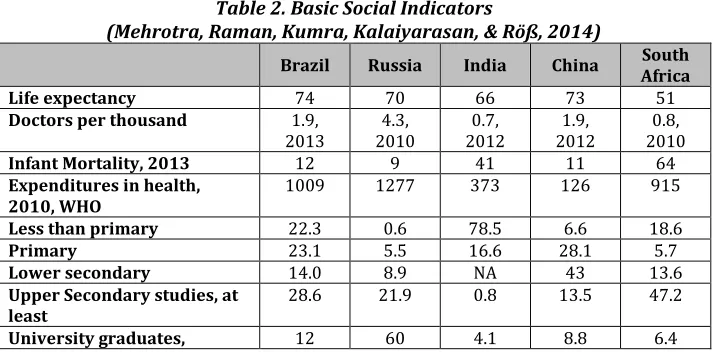
less in health than the other four countries. Finally regarding education, Russia has high levels with a dominance of higher education graduates, South Africa has middle levels with a dominance of secondary school graduates, China and Brazil low levels with a dominance of primary school graduates. And India is by far the country with lower levels of education.
Table 2. Basic Social Indicators
(Mehrotra, Raman, Kumra, Kalaiyarasan, & Röß, 2014)
Brazil Russia India China Africa South
Life expectancy 74 70 66 73 51
Doctors per thousand 1.9,
2013 2010 4.3, 2012 0.7, 2012 1.9, 2010 0.8,
Infant Mortality, 2013 12 9 41 11 64
Expenditures in health,
2010, WHO 1009 1277 373 126 915
Less than primary 22.3 0.6 78.5 6.6 18.6
Primary 23.1 5.5 16.6 28.1 5.7
Lower secondary 14.0 8.9 NA 43 13.6
Upper Secondary studies, at
least 28.6 21.9 0.8 13.5 47.2
University graduates, 12 60 4.1 8.8 6.4
Broad KM systems
The major figures related to this section are shown in Table 3, above. Knowledge and KM depends highly on the educational base of countries. The main features of the educational and vocational training systems of the five BRICS are depicted in Table 3 above. Russia, closely followed by South Africa have considerable values on the completion of compulsory education, followed by China and then by Brazil. Again, about India, and according to Tomé and Goyal (2015), the score is much lower. Importantly Russia relied almost exclusively, as China does in public schools, whereas Brazil, South Africa and India have more mixed systems, in which the private agents play a bigger part. The influence of the communist experience is certainly a cause for this divergence. When we come to tertiary education however, the situation is quite different because Russia stands in a different platform of all the other BRICS with a level of completion at least of more fifty percentage points that Brazil, who comes ranked in second place.
Table 3. Broad general educational base for KM (Mehrotra et al., 2014) Brazil Russia India China Africa South Secondary Compulsory
education number of years
8 10 9 9 9
Year CE definition 2006 2007 2008 2007 2007 % of total population
Higher Education / Tertiary Studies
% of population with
HE (25-64) 12 60 4.1 10 6
The investment in lifelong education is small by comparison with the more advanced countries, a fact that is explained both by the gigantism of 4 of the five BRICS and also by the relatively lower standards of economic development of all the five countries in relation to the world leaders like the major part of the OECD countries. Quite strikingly all the countries have comparatively high levels of public expenditure in labor market policies even if the causes for that happening are different – Brazil the current government desire to develop the country and a certain level of historic tradition, Russia the communist tradition, India the government intention to implement a nationwide training scheme, in China the communist ideology and p system, in South Africa the idea of balancing the country.
Institutional actors
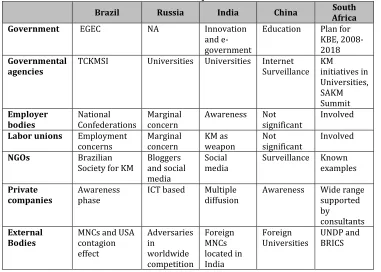
The main ideas about this section are expressed in Table 4, below.
In Brazil the Technical Committee of Knowledge Management and Strategic Information (TCKMSI) was created in 2003 within the Electronic Government Executive Committee (EGEC), which had been created in 2000, to promote KM and more specifically e-government in the Brazilian Federal Government. The EGEC formally stated that KM had become a strategic governmental strategic asset. However quite recently a research work for the National Industry found that 62% of the managers consider that the degree of innovation is low or too low, something which prompted an expert to defend the collaboration of government, private bodies and academia to foster a strategy of innovation. This finding is consistent with other from a recent survey on KM practices in Brazil (Milano, Giostri, & Hatakeyama, 2015); these authors found that basically the implementation of KM in Brazil are obsolete, not having gone much further than the awareness phase, as it happened
with the OECD countries ten years ago; Brazilian companies need to “identify their practices of KM and work towards them effectively” (Milano et al., 2015, p.1306).
Finally, Brazil has lots of labor unions, and even if they are keen to promote education and training, they are generically more concerned with protecting the employment; and it is not very clear that these unions perceive KM as a way of securing and developing or increasing the employment prospects of workers. To be fair the unions have not been asked to participate in a National KM strategy in Brazil. Finally, Brazil has essentially received external influence on KM by the presence of MNCs and by the neighboring of the United States, both serving as contagion forces.
For what we came across, in Russia there is no public policy for KM. This fact may be explained by the singularity of the Russian political system, which is very focused in tangible matters, civil liberties and foreign affairs. Another factor is the change
Russia in undergoing and the fact that culturally KM is a very “Western” topic.
debating the problem of KM implementation with the support of bloggers and the social media. Due to its novelty, and scarce formal implementation, KM has also been
absent from the discussions between workers’ representatives and employers.
Finally, the external presence has been felt nonetheless because within Russia’s
identity, is the notion of being a world leader – and KM is a tool to achieve and maintain that leadership.
In India, the national Government has promoted a view of KM based in innovation and e-government. Universities have been studying more and more the implementation and use of KM practices in companies. The same scholars have pointed out the possibility of KM being used as a powerful by unions (Malhan & Rao, 2008). Employers have also become more and more aware of the importance of
Knowledge, Information and innovation to India’s companies (Pillania, 2006). This
has to do with the size of the country and the relative size of India in relation to the world, and the enormous possibilities a company may have in India alone. Another
interesting aspect of KM in India is the intense use of IT by India’s youth, and how
these people have become experts in social media, transforming the country from a rural and inner-looking society to a more urban, connected and international one. Finally, MNCs have had an important role in developing KM in India, at least by locating in the number of subsidiaries, from call-centers to ICT development centers that effectively promote and build the foundations of a KM culture in the country.
Table 4. Main institutions for KM in the BRICS
Brazil Russia India China Africa South
Government EGEC NA Innovation
and e-government
Education Plan for KBE, 2008-2018 Governmental
agencies TCKMSI Universities Universities Internet Surveillance KM initiatives in Universities, SAKM Summit Employer
bodies National Confederations Marginal concern Awareness Not significant Involved Labor unions Employment
concerns Marginal concern KM as weapon Not significant Involved NGOs Brazilian
Society for KM Bloggers and social media
Social
media Surveillance Known examples
Private
companies Awareness phase ICT based Multiple diffusion Awareness Wide range supported by
consultants External
Bodies MNCs and USA contagion effect
Adversaries in
worldwide competition
Foreign MNCs located in India
Foreign
In China, the government has not issued specific laws regarding knowledge, or KM. The public investment in the Knowledge society has been done essentially by developing the education system. Tong and Mitra (2009), pointed out the culture specifics of China, as modesty and fear to lose face and therefore propensity to keep knowledge implicit. and Peng, Li-Hua, and Moffet (2007), demonstrated that China was still in the awareness phase considering the use of KM by companies. Quite interesting those studies were made by scholars studying abroad and we believe
these small elite of people will be very important in China’s development of a KM
strategy. An important point regarding China is the known surveillance by authorities on the use of the internet, which besides being a civil rights or regime
problem may also inhibit KM practices. Finally, China’s labor relations have been
adjusting within the scope of the transition system, but KM has not been a significant issue in the strategies of unions and employers.
Last but not the least, in South Africa some sketch of KM policy at national level was drafted by the government at national level, encompassing education, training, e-government, digital e-government, use of KM practices in the public sector and support for KM implementation in the private sector. One interesting policy in this context was the introduction of an indigenous Knowledge System (IKS) regarding the preservation and diffusion of traditional knowledge with a link to property rights. All this was compiled in 2008 in the plan “Innovation towards a Knowledge Based
Economy” (2008-2018). There is no doubt that the South African Universities have
tried to promote KM, by developing KM related programs in its various forms as well as other initiatives as forums, conferences, congresses, having its peak in the South Africa KM Summit. That effort has been followed by the implementation in a wide range of private and public companies with the support of a very important network of universities and NGOs. There is also evidence in the literature and information on
the web about the involvement of SA’s NGOs in KM. All the social movement aforementioned resulted in that workers’ unions perceive KM as an instrument for
change and employer’s organizations as a powerful skill. With regard to external
bodies, South Africa has benefited from the support of the United Nations Development Program; also South Africa has tried to develop KM operations and co-operations on KM within the BRICS framework.
Political context
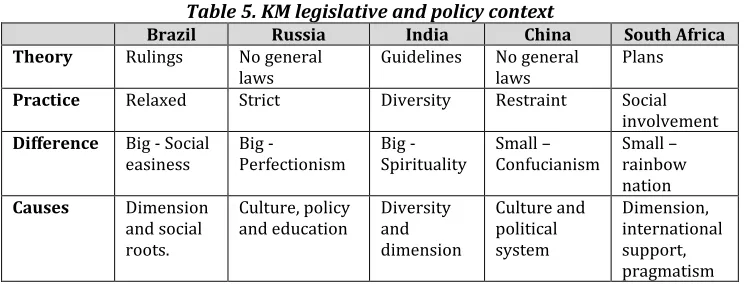
The ideas regarding this subsection are summarized in Table 5.
Table 5. KM legislative and policy context
Brazil Russia India China South Africa
Theory Rulings No general
laws Guidelines No general laws Plans Practice Relaxed Strict Diversity Restraint Social
involvement Difference Big - Social
easiness Big - Perfectionism Big - Spirituality Small Confucianism – Small rainbow – nation Causes Dimension
and social roots.
Culture, policy
and education Diversity and dimension
Culture and political system
Dimension, international support, pragmatism
In China, there are still no general laws on KM, and the practice is governed by a culture of restraint within a very particular political system. Confucianism is also important to understand the situation, India is much more like Brazil than like Russia and China. Central based guidelines and plans exist, that are put into place in the subcontinent, by the absolutely diverse myriad of peoples that inhabit the land. Some spirituality where actions are more important than results also explains the India’s
specificity. South Africa stands out as the bright student within the five cases; plans exist and are carried out by the society. Smaller dimension is certainly a factor, but also the support from the UNDP, the master of the English language and also some cultural pragmatism inherited from the British colonizers.
KM systems at the national level
In Brazil the main programs that promote KM relate to basic education and digital government and they are promoted by the State. In Russia the biggest investment in on higher education and is also promoted by the State. In India educational based programs are yet at the literacy phase, whereas in China the situation is a little better than in Brazil. In South Africa education is at a secondary school level.
Table 6. Major Knowledge-based programs and systems Brazil Russia India China Africa South Main
programs Basic education and e-governance
Higher
education Literacy Middle education Secondary school
Provision Public Public Public Public Public
Organizational level developments in KM
The basic situation we detected is described in the following Table 7. It is worth mentioning the importance of the public sector and of the international connections for the development of KM in the BRICS. South Africa seems to be in a more advanced of implementation.
Table 7. Main Characteristics of Organizational KM in each country
Brazil Russia India China South Africa
Positive Large
companies Public and international International Public and International Transversal and maturing Negative Elitism and
lack of strategy
Secrecy and too much rigor
Anarchic and
disperse Control Lack of general evaluations
Impact
For Brazil (Ferraresi, Santos, Frega, & Pereira, 2012) it was found that KM directly contributes to market orientation, but it requires a clearly defined strategic direction to achieve results and innovativeness. It was also concluded that knowledge, as a resource, leverages other resources of the company, while it requires a direction in relation to the organizational goals in order to be effective. About Russia and China (Andreeva & Kianto, 2012) show that HRM and ICT practices for managing knowledge are quite strongly correlated and have a statistically significant influence on both financial performance and competitiveness of the firm; also ICT practices improve financial performance only when they are coupled with HRM practices. For South Africa, (Plessis, 2007) the creation of a shared understanding of the concept of
knowledge management, identifying the value of co‐creation of the knowledge
management strategy, and positioning of knowledge management as strategic focus area in the organization. Finally, for India, (Chawla & Josh 2011) show that and most of the KM dimensions have a positive impact on LO. However, the impact is shown only in Vision and Strategy (VS) and Performance Improvement Process (PIP).
Summary
problems regarding KM even if the Government is well aware of the importance of KM in the country; the educational basis is very low, demand is made by the companies that use IT professionally which are small fraction, with significant results – and in consequence the need is extremely high. China has not Russia’s educational base and has India’s dimension, even if its educational base is much better than India’s; therefore, supply and demand already exist, above all in the
internationalized sectors, and needs are very large, and supported by recent empirical studies. Finally, in South Africa, supply seems to be important, even if not as in Russia, but demand is also interesting at least in the externalized companies, which have had significant results, making SA the most advanced of the BRICS on KM, even if the dimension is an advantage.
Table 8. Summary – KM in the various countries in a nutshell
Brazil Russia India China South Africa Supply Modest Important Very small Medium Important Demand Small Important Very small Medium Important Needs Very large Large Enormous Very large Large Impacts Significant Significant Significant Significant Significant
Discussion
One strong limitation of this paper is that it the work of a solitary scholar. We would like to have time to contact colleagues and contacts we already have in each one of the five BRICS in order to check and update the information we provide for each one of the countries. In that line of thought a possibility of future research would be to make surveys, to researchers, educational institutions and KM bodies, political bodies, labor unions, companies and even elites of all the five countries in order to analyze how KM is implemented, lived, perceived and rewarded in each one of the five BRICS. That would be a mammoth task but the outcome of that study would be considerable. On second thoughts, if the cooperation of the BRICS organization could be obtained the study might be feasible. Let’s see what the future brings, having in
mind that the importance of the five countries in the world economy is sensed to grow and KM is a decisive instrument for that growth to occur.
Conclusions
References
Andreeva, T., and Kianto, A. (2012). Does knowledge management really matter? Linking knowledge management practices, competitiveness and economic performance. Journal of Knowledge Management, 16(4), 617-636.
Ashton, D., and Green, F. (1996). Education, Training and the Global Economy. Cambridge, UK: Edward Elgar.
Cegarra Navarro, J.G., and Moya, R.B. (2005). Business performance management and unlearning process. Knowledge Process and Management, 12(3), 161-170. Chawla, D., and Joshi, H. (2011). Impact of Knowledge Management on Learning
Organization Practices in India: An Exploratory Analysis. Learning Organization, 18(6), 501-510.
Edwards, J.S. (2011). A process view of knowledge management: it ain't want you do, it's the way that you do it. Electronic Journal of Knowledge Management, 9(4), 297-306.
Ferraresi, A., Santos, S., Frega, J., and Pereira, J. (2012). Knowledge management, market orientation, innovativeness and organizational outcomes: a study on companies operating in Brazil. Journal of Information Systems and Technology Management, 9(1), 89-108.
Kianto, A. (2008). Assessing Knowledge Renewal Capabilities. International Journal of Innovation and Regional Development, 1(2), 115-129.
Kianto, A., Andreeva, T., and Shi, X. (2011). Knowledge management across the globe – An international survey of KM awareness, spending, practices and performance. In Lehner, F., and Bredl, K. (Eds.), Proceedings of the European Conference on Knowledge Management (pp.514-523). Reading: ACPI.
Malhan, I.V., and Rao, S.K. (2008). Perspectives on Knowledge Management. Lanham: Scarecrow Press.
Maurer, H. (1999). The Heart of the Problem: Knowledge Management and Knowledge Transfer. In Rämö, E. (Ed.), Proceedings of ENABLE99: Enabling Network-Based Learning (pp.8-17). Helsinki: Vanta Institute of Technology. Mehrotra, S., Raman, R., Kumra, N, Kalaiyarasan, A., and Röß, D. (2014). Vocational
Education and Training Reform in India Business Needs in India and Lessons to be Learned from Germany. Retrieved from https://www.bertelsmann-stiftung.de/fileadmin/files/BSt/Publikationen/GrauePublikationen/GP_Voca tional_Education_and_Training_Reform_in_India.pdf.
Milano, M.C.D., Giostri, E.C., and Hatakeyama, K. (2015). Practices of Knowledge Management analysis in companies located in Brazil, Retrieved from http://www.iamot2015.com/2015proceedings/documents/P168.pdf. Nonaka, I., and Takeuchi, H. (1995). The Knowledge-Creating Company. Oxford:
Oxford University Press.
O’Neill, J. (2001). Building Better Global Economic BRICs. Retrieved on February 13,
2015 from https://www.goldmansachs.com/insights/archive/archive-pdfs/build-better-brics.pdf.
Peng, J., Li‐Hua, R., and Moffett, S. (2007). Trend of knowledge management in
China: challenges and opportunities. Journal of Technology Management in China, 2(3), 198-211.
Pillania, R. (2006). State-of-Art of Knowledge Storage and Access in Indian Industry.
Plessis, M. (2007). The role of knowledge management in innovation. Journal of Knowledge Management, 11(4), 20-29.
Polyani, M. (1966). The Tacit Dimension. London: Routledge.
Tomé, E. (2004). Intellectual capital, social policy, economic development, and the world evolution. Journal of Intellectual Capital, 5(4), 648-665.
Tomé, E. (2008). The Hidden Face of Intellectual Capital: Social Policies. Journal of Intellectual Capital, 9(3), 499-518.
Tomé, E. (2011a). HRD in the 21st century Knowledge based and Services driven economy: An Introduction. Journal of European Industrial Training, 35(6), 524-539.
Tomé, E. (2011b). Intellectual Capital Reporting: Conceptual Study with Application to the Portuguese Case. International Journal of Learning and Intellectual Capital, 8(4), 436-458.
Tomé, E. (2012). Knowledge Management. In Wilson, J.P. (Ed.), International Human Resource Development: Learning, Education and Training for Individuals and Organizations (pp.93-112). London: Kogan Page.
Tomé, E. (2016). Human Resource Development in Southern Europe. In Garavan, T. McCarthy, A., and Morley, M. (Eds.), Global Human Resource Development: Regional and Country Perspectives (pp.368-390). London: Routledge. Tomé, E., and Goyal, A. (2015). Human Capital, HRD and VET: The case of India.
European Journal of Training and Development, 39(7), 586-609. Tong, J., and Mitra, A. (2009). Chinese cultural influences on knowledge
management practice. Journal of Knowledge Management, 13(2), 49-62. World Bank (2014). Economy & Growth. Retrieved from
https://data.worldbank.org/topic/economy-and-growth.