Heat: An Inquiry-based Physics
Laboratory for Life Sciences Students
Margaret J. Wegenera, Marianne Doyle-Pegga, and Timothy J. McIntyrea
Corresponding author: [email protected]
aSchool of Mathematics and Physics, The University of Queensland, Brisbane QLD 4072, Australia
Keywords: inquiry learning, undergraduate experiment, heat transfer
International Journal of Innovation in Science and Mathematics Education, 23(5), 18-31, 2015.
Abstract
We have developed an inquiry-based first-year undergraduate experiment to investigate heat transfer. Students consider the real-world problem of how the temperature inside a building is influenced by various factors. Students develop their understanding of heat transfer through scaffolding experiments, and then construct a simple model house, and monitor its internal temperature when exposed to ambient conditions over a 24-hour period. In a following session, based on their acquired knowledge, teams design and test a model building according to their own chosen goal (constant-temperature house, greenhouse, etc.). As an extension, students also examine the insulating characteristics of animals. Class observation, analysis of student responses and survey data show that the activity successfully engages students, better motivating them to understand the physics involved. They have to deal with problems that arise during the experiments and discuss solutions with their group members. They encounter other interesting questions as they try to achieve their goal, and learn more science in the process. The aspects of this activity that work particularly well are the realism of the scenario, a degree of student ownership of experiments, and controlled variation in what students do through the design choices possible.
Introduction
Undergraduate laboratory experiments at first-year level often consist of a set of directed tasks which students work through to develop their understanding of the processes involved. While beneficial for learning simple processes such as mirror alignment or oscilloscope use, such an approach often leaves the student proficient at the task but with no deep understanding of the science involved. In an inquiry-based laboratory experiment, students are given the framework and general goals of the experiment but must develop their own approach to the problem. This gives them control of the experiment and forces them to think more carefully about what has to be achieved in the experiment, how it is done and why.
Introducing students to the culture of doing science has long been recognised as a major learning objective for laboratory activities, along with supporting the learning of concepts, and teaching specific, common laboratory skills (Read 1969); the design of activities to achieve these objectives has been an active area of work for the field. In particular, and since at least the 1980’s and Toothacker’s scathing critique of introductory physics laboratories (Toothacker 1983), the trend has been to move from ‘verification’ to ‘investigative’ experiments in physics teaching laboratories. In efforts to aid student engagement and deep learning at university, the practices of collaborative projects, undergraduate research, active involvement in systematic investigations, access to modern technologies, and working to answer ‘real’ (contested) research questions – all of which can be representative of inquiry-oriented learning - have been found to have high impact (Kuh 2008). To successfully engage
students and promote learning outcomes, each laboratory session needs to be both reasonably ambitious and targeted (Millar, Le Maréchal and Tiberghien 1998). However, using arguments of cognitive science, more-than-minimal guidance is desirable, especially for novices (Kirschner, Sweller and Clark 2006).
Our particular interest for this paper was the laboratory class of an introductory physics course for students in the life sciences. An Australian national study discovered that for students in such physics service courses, laboratory activities were generally not positive learning experiences (Kirkup, Mendez, Scott, Sharma, O’Byrne and Quinton 2008). Research in the biological sciences has become increasingly quantitative and more integrated with other sciences (National Research Council 2003) and this has prompted considerable international soul-searching regarding biological scientists’ undergraduate education. Movement to design introductory physics courses specifically for life-sciences students (Redish and Hammer 2009) includes strategies of large-scale structural changes to courses, emphasising different content compared to what has been traditionally covered in these courses, and laboratory activities that reflect the process of science.
Some notable experiments developed for physics in the context of life sciences make use of education research’s findings to date. For example, a real-world investigation of human gait (Ellermeijer and Heck 2003) exploits relatively low-cost video technology to enable inquiry involving considerable data and analysis. Introductory activities in that investigation make students proficient with the enabling software. Freedom to choose a particular gait pattern to investigate can add personal interest for the student, and hence motivation. Another examplar utilises items familiar from biology or everyday life - in an experiment on bending a ‘beam’ the physical property of Young’s modulus of elasticity is measured for carrot, celery and plastic spoons (Pestka 2014).
Based on these previous studies, we were motivated to introduce into our course an inquiry-based laboratory activity to replace several directed experiments that students had previously completed. We chose the topic of the experiment to relate to the course module on heat transfer, and were inspired to develop an activity about heat conduction in houses by an experiment for advanced physics students developed at the Australian National University (Bachor 2011). The case study about heat transfer in houses by Bowman and Tande (2009) and a commercial teaching laboratory setup to measure heat conduction (PASCO Scientific 1987) were also useful to us. Elements of all these educational resources were incorporated into our extended, inquiry-based activity. The experiments focus on the physics of how the temperature inside a structure varies over time, influenced by heat from the sun, atmospheric conditions, and the way it’s built. Our goal was for students to develop conceptual understanding of heat transfer, initially as applied to a simple model house, and later extended to thermal regulation in animals. For this scenario we created original experiments. Our learning goals also included the transferable scientific and practical skills of dealing with digital data, interpreting graphs, and experimental design. Here we describe how the laboratory module was developed, implemented and evaluated, and some of the challenges and successes in conducting this activity.
The Thermal Regulation Laboratory Activity
The course cohort consists of students with a wide variety of backgrounds and, since high school physics is not a prerequisite, we were very aware that students might have had only a limited prior exposure to a physics laboratory environment. We also have to cater for a
relatively large course enrolment, with over 250 students enrolled each semester. We therefore designed an experiment in which students working in small groups are first provided with some guidance on taking measurements and analysing data relating to heat flux before being tasked with designing and implementing a more open-ended experiment. The activity is done over two of the usual three-hour laboratory classes, in the latter part of the semester, after students have had some laboratory experience, and shortly after lectures and tutorials on heat. That theoretical content comprises conceptual and quantitative treatment of heat, temperature, heat capacity, modes of heat transfer and the laws of thermodynamics.
In the first week of the activity students investigate temperature measurement and heat transfer. To gain familiarity with the modern digital temperature sensors (thermocouples) provided, students are asked to devise and conduct three short, simple experiments of their own about any form of heat transfer (conduction, radiation and convection). Examples of the experiments that students have devised are investigating the response of the sensor to human touch, to placement in direct sunshine or near an incandescent light, and to immersion in water.
Students also complete a more guided but longer experiment to become familiar with heat transfer via conduction, exploring the importance of the thermal conductivity and thickness of a small range of building materials. Using a commercial heat conduction experiment apparatus (PASCO Scientific 1987), students place a piece of material of measured thickness between a volume of steam and a block of ice. As energy flows through the material from the steam to the ice, the ice melts; the melt rate of ice is measured and used to determine the heat conducted through the material per unit time, and hence the thermal conductivity of the material.
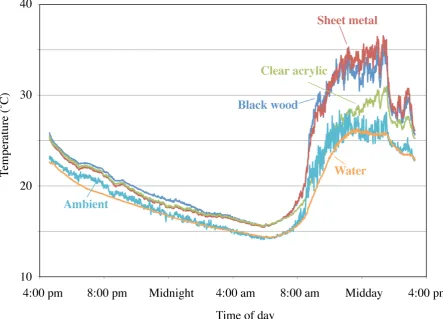
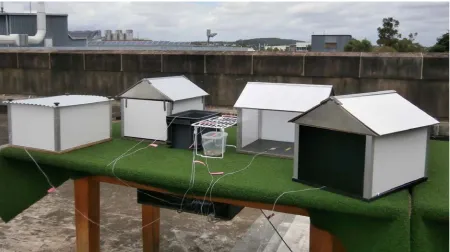
Teams then build a simple model house for testing over a night and day. In this experiment students are asked to ‘keep it simple’ – constructing a box-like structure approximately 350 x 250 x 300 mm3 with slide-in walls and a flat roof all of one material, chosen from a limited range. Students are able to select from panels of steel (zinc/aluminium alloy coated or painted silver), acrylic (clear or white opaque), painted timber (white, 3mm thick or black, 10mm thick) and polystyrene foam. Variation amongst the structures built by different teams within a class is encouraged as a useful prompt for whole-group discussion. Each group is asked to discuss their expectations for temperature variations inside their house over 24 hours. The houses are placed together in a safe location on the flat roof of the Physics building, each instrumented internally with a temperature sensor. A data acquisition system (PASCO) is used to record the temperature every minute from the houses, along with the ambient temperature and the temperature in a similarly-scaled container of water (representing a swimming pool). Measurements are taken over a period of close to 24 hours, capturing diurnal variation in temperature. To enable students to monitor the progress of their experiments, a live graph of the measurements is streamed to the internet, along with live images recorded with a web-cam. After an experimental run, the data set is uploaded to a website so students can access it.
A typical arrangement of the simple model houses and the modular system used to create them is shown in Figure 1. Sample results are shown in Figure 2.
In the second week of the experiment, students begin by discussing the results from the various structures within their class, examining and attempting to explain observed variations. This includes the thermal lag of the ‘swimming pool’.
Figure 1. Modular frames and simple box-like structures built of one material
Figure 2. Sample data for the house experiments, showing distinct variations in internal temperatures over 24 hours, for simple model houses constructed from different materials, and for a comparably-sized body of water
At this point the laboratory activity becomes fully inquiry-based. Student teams must decide their own goal, and set about designing and building a structure to optimise the thermal conditions in line with their chosen aim. Students are encouraged to make further measurements of thermal conductivity of the building material samples provided, to assist them in their design choices. The investigations that students have generated include situations of constant-temperature, a greenhouse, as hot/cold as possible, a beach house with large windows to capture the view, and on a somewhat different scale, an infant incubator. There is the capability to model the traditional local architecture of a timber house with corrugated iron roof. Figure 3 illustrates a variety of experiments set up. As before, the model structures are placed outside and tested, with online monitoring available (Figure 3).
Figure 3. Structures built for various goals, showing variation in materials and orientation, and use of roof cavity
In novel ‘animal experiments’, students are also asked to investigate how body tissue thickness and outer covering of humans or other animals affect their internal body temperature. The same fundamental physics of conduction through multiple layers, as for a building ‘skin’ and insulation, applies. Thus students are prompted to transfer their knowledge to another situation, which is also of biological importance. In each possible pathway for the later experiments, students are investigating regulation of internal temperature in their model structure (animal or building) while it is exposed to a varying external environment.
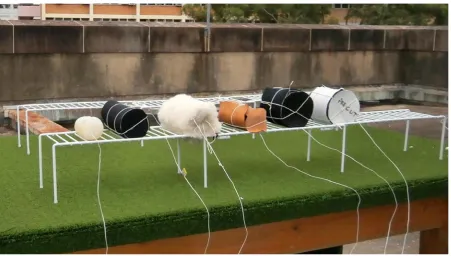
To simulate animal bodies, pre-made simple geometric shapes (e.g., cylinders) of bulk agar are provided. A temperature sensor is inserted into the agar to monitor the internal body temperature. Students are asked to do one investigation from a list of options – to explore the effect of body size, shape or covering, or insulation by multiple layers – and are given some guidance as to how to approach this. Generally, students compare two situations with model animals. For example, students might choose to compare a ‘naked’ animal and an animal with
a body covering - created by wrapping the cylinder with a realistic material. The insulating materials supplied are neoprene (material used for wetsuits), with both black and white surfaces, and tanned sheepskin with and without fleece attached. A variety of model animals
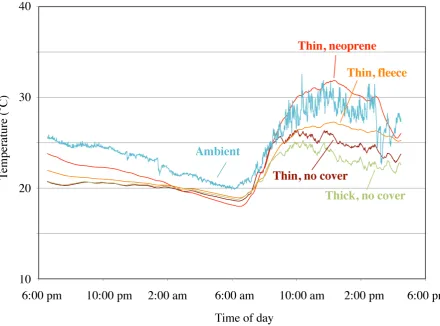
is shown in Figure 4. As for the houses, the model animals are exposed to the weather over a
night and day, and the internal temperature and outside conditions are recorded – see Figure 5.
Figure 4. Example animal models, showing variation in size and covering
After completion of each laboratory session, students must download their data and individually prepare, outside class time, a formal report detailing their experiments and outcomes. Thanks to researchers on campus, our students can access local weather and solar irradiance data to use when analysing their experiments. The assessment is quite different from that of the directed activities earlier in the semester, which consists of a workbook completed during the laboratory session, with calculations and short answer questions. The first session’s report allows students to be assessed on technical skills such as using modern sensors, dealing with digital data and interpreting graphs, as well as ability to design and to conduct simple investigations. This report is marked and returned to students before they do the second part of the practical. In the second report, students are required to interpret their data, justify design choices, and make critical evaluations, discussing the performance of their structures with respect to their aims. In common with our shorter experiments, in this assessment students are expected to make judgements and back up reasoning with reference to experimental results.
Figure 5. Sample data for the animal experiments, showing distinct variations in internal temperatures over 24 hours, for model animals (cylinders) of different dimensions and covered in different materials – black-surfaced neoprene and sheepskin with fleece attached
Development of Inquiry-Based Laboratory Activity
Our approach to the challenges of designing the inquiry-based laboratory activity was to do development in stages. The concept was first discussed and then prototype apparatus tested amongst academic staff, the laboratory manager and senior tutors. The initial stage of the development of apparatus was to do feasibility experiments with sample sensors and materials. A fundamental criterion was that the apparatus demonstrate the relevant physics – that it was able to produce measurable, distinguishable experimental results for different experimental configurations. Measurably different temperatures were obtained inside structures made of various materials, and the expected trends were apparent. The temperature variation of the ‘swimming pool’ was noticeably limited because of water’s high heat capacity compared with other common materials. Also, the usual requirements of robust experimental apparatus for first-year laboratories and practicalities such as issues of Occupational Health and Safety were applied during development. With a working prototype, we designed the learning activity, refined the design of the experimental equipment, and ensured that remote data-gathering and access worked reliably.
In a guided laboratory, students are presented with a clear set of steps to achieve a pre-defined goal. An inquiry-based laboratory often has open-ended goals – indeed the students here are required to set their own specific goals – so there needs to be both the scope of
scenarios and the equipment available for this to happen. From the point of view of the designers of this laboratory activity, it was important that there was not just one clear scenario that most students would follow. A variety of options must be feasible and accessible. We began with only a few, but markedly different, building materials, and introduced more choices over time. (We extended the library of samples for the thermal conductivity experiment to include all of our building materials on offer.) This approach has been successful. The laboratory activity has now been running for a number of years. There is sufficient variety to promote a range of investigations. During development, staff identified at least several goals that could be set, and students have come up with more of their own. A wide variety of equipment has now been assembled and there is an almost unlimited range of designs that can be put in place. Furthermore, the multi-week nature of the experiment allows students to reflect on their design goals and supply further equipment of their own if desired.
The range of materials necessitated by the open-ended nature of the activity, combined with the large numbers of students, mean that logistics are important. We designed the model houses as modular structures with easily interchangeable components of pre-cut wall and roof panels. A frame has slotted posts to hold slide-in wall panels of two thicknesses, students can attach a flat or sloped roof with thumbscrews, and there are clips to attach various insulation components to walls and roof. Organised storage, with components in labelled containers, and stackable frames, on a multi-tier trolley, make for ease of choice and access to the multitude of equipment options.
The authenticity of the inquiry-based activity means that the experiment has to be able to cope with real weather, so there is an extra requirement of weatherproofing for the apparatus and data-gathering equipment compared to experiments that simply exist inside a laboratory. On the other hand, the capability to operate unmanned data collection means that, on the few rare but authentic occasions when there has been an insurmountable problem with an experiment, a data run could be redone for students over a weekend so they could catch up.
Some extra thought was required in preparing the laboratory manual for this experiment – it needs sufficient guidance to enable students to make progress, but not so much detail as to be prescriptive. We used an explicit list of learning aims as a tool for designing the lab activity and lab manual.
The model house experiment was trialled on a smaller student cohort before being fully implemented in a larger class. We evaluated that student experience and made some modifications, particularly to have greater emphasis on class discussion, and to slightly readjust the tasks to be done in the time available. Staff members evaluate the activity after each semester of the course and make improvements as appropriate.
Only after a number of iterations of the house experiments were the animal experiments developed and added. A variety of problems needed to be overcome to have an animal model suitable for rooftop measurements. First, we wanted simplifications of animal bodies (though not quite a spherical cow!) and had to identify a suitable material and method to make them. The solution was to mould body shapes from agar (a protein-based substance used in petri dishes in biology). Since animals have legs, we placed the agar bodies on stands. The body covering is attached to the animal with string, like trussing a roast. This simple method does not significantly affect heat transfer. To meaningfully investigate the internal temperature of these model animals, reasonably realistic coverings were needed that would show a significant difference between naked and covered animals. A second-hand wetsuit provided
material for our first experiments in this direction. To replicate animal skin, tanned sheepskin was used. This conveniently provided options of with and without a layer of wool. The agar bodies can be eaten by ants, become mouldy, or crack with drying, depending on conditions on the roof, so they need to be reasonably freshly prepared. This is time-intensive preparation compared to traditional first-year physics laboratories where equipment may be used, with only minimal maintenance, for years (a reflection, perhaps, of the interdisciplinary nature of the investigation; consumables are more familiar to the chemistry or biology laboratory). We wanted the students to be able to determine the thermal conductivity of the insulating materials for the model animals. The non-waterproof nature of these materials presented a problem, as the experimental method involved melting ice. We adapted a strategy used in the commercial kit. Samples were wrapped in thin, highly-conductive aluminium foil, to waterproof them without significantly affecting their thermal conductivity. Development of the animal experiments involved considerable scientific problem-solving.
The implementation of the inquiry-based laboratory has presented some challenges to the teaching staff involved. It is more demanding of tutors, both during the class, and in marking afterwards, compared to short, guided experiments. This is partly because of the range of situations tutors face with a group of students pursuing different experiments. However, the controlled variation through design constraints, and the fact that the same fundamental physics applies to insulating layers in model buildings and animals, make the activity’s supervising and marking load workable. There is also a challenge because these activities are higher-order than ‘recipe labs’ where what students should do is written in the laboratory manual; particularly for tutors less experienced in this type of learning activity, there may be the temptation to simply ‘tell’ the students how the experiment should be done, based on the tutor’s own expectations, in effect, converting the inquiry laboratory into a directed one. To overcome this issue we ensured that there was appropriate training for the tutors at the start of each semester. Tutors are encouraged to do the experiment themselves as a student, as in the ASELL evaluation protocol (ASELL 2015). Laboratory tutors as a group have worked through the experiment, spending considerable time discussing the apparatus and theory. A particularly effective training strategy was to ask each experienced tutor to share with everyone one useful thing they had learned about the activity, as this prompted discussion amongst the group. Experienced tutors’ advice ranged from subtleties of the equipment, to how to deal with questions posed by students. This discussion, including the tutors’ experiences, was very valuable in thoroughly preparing the tutors, and some refinements have been made to how students were directed in the laboratory, and in the marking scheme, as a result of their feedback.
A further challenge we faced involved the assessment of the laboratory activity. The assessment of a directed laboratory can look at whether the students have completed the tasks assigned, made the correct calculations and drawn appropriate conclusions. The report style assessment for our inquiry laboratory has fewer constraints on content and is also much more time-consuming to mark. Here the assessment criteria include more of the scientific process – how appropriate was a chosen goal, how well did students conduct their experiments to reach that goal, and how well were the results communicated to the reader. One issue raised by students is guidance in writing the laboratory reports. Students were able to clearly see what was expected for the reporting of the guided experiments but have been less certain about expectations for the reports for the inquiry-based laboratory. This is an aspect of the experiment that we aim to improve in coming semesters, with training to be provided to the students and tutors about addressing marking criteria.
In many ways, the tutors are an excellent resource for the laboratory. In the development process, tutors provided informal and structured feedback. Their input helped in the design of the experiment and in identifying issues likely to arise. During the practical classes tutors can enhance the inquiry-based environment by encouraging students to think more deeply about the approaches that could be taken.
Student Engagement and Learning
The effectiveness of this inquiry-based laboratory has been assessed via: • observation and analysis of students at work, and their reports • focus group of the first student users
• survey and reflections of staff involved in delivering the activity • standard institutional course surveys.
The very first time that the practical ran, an external evaluation was conducted, as part of an ALTC National Teaching Fellowship on Inquiry-Oriented Learning (Kirkup 2013). An important aspect of this was a focus group discussion of the experiment, immediately afterwards, with a group of eight students representative of enrolments in the course – half male, half female; half who’d done physics at school; half majoring in Biomedical Science. At that stage the students thought the activity stressful but enjoyable. Encouragingly these students were positive about the experiment itself:
“One of the best experiments we have done interest-wise”
and the inquiry-based approach:
“It is multi-dimensional and multi-faceted”;
“designing your own inquiry is good; it gets you to take control and make choices”;
“You wonder ‘why’ and ‘why’ is a way of improving on what you know and consolidating what you brought into the experiment.”
However the experiment wasn’t without issues, with some discontent on tutoring style: “They
go too far in not giving the answers”. Feedback from external observers, particularly about
the use of class discussion, was very useful in development for later implementations.
An anonymous evaluation survey was filled out by tutors and other laboratory staff who had experience with early implementations of the activity. Asked to rate this activity as a learning experience, all staff involved agreed that the experiment is ‘valuable’ (the group judging its quality as 4 on a scale of 5). 100 % agree that ‘Students were actively engaged in inquiry and problem-solving’. In terms of teaching operations, staff all agreed or strongly agreed that ‘The experiment worked’, ‘The laboratory manual had sufficient detail’, and ‘Assessment was manageable’.
Staff agreed or strongly agreed that ‘The experiment is interesting’. Students concur. All focus group participants agreed that the experiment was involving. The relationship to the real world was valued, and very successful in engaging students. In class, students were amused with the idea of identifying these simple structures as related to their lives, eg: during the part of the session on the one-material structures some announced they were going to build a “metal shed” or “esky” (cooler box of polystyrene foam).
Students were interested in the novel experience of monitoring progress of their experiments remotely: “Normally everything in the prac stays in the prac, in this one you can look at it at
home on the internet; that is pretty neat.” Usage statistics show that students engaged online
with the experiments well beyond the bare minimum of downloading their data. Usage was
significantly greater for the later part of the module when students designed their own experiments. While we do not know exactly what students were doing when they visited the website (since statistics for live monitoring of the experiment and downloading data are combined), a common pattern of usage by individuals is consistent with a behaviour of checking on their own experiments while they are running, and returning later for the data when they are writing their reports.
Positive student attitudes to the activity were apparent in the way that students were confident (and correct) in their reasons for design choices based on the physics of heat transfer. Staff judged that major learning aims were achieved - ‘Students developed their conceptual understanding of physics’, ‘The experiment assists students to develop experimental skills’ and ‘The experiment encourages students to think critically’ (100% agreement or strong agreement on each aspect).
Most students did not originally appreciate the importance of constraining the first experiments to using one material so results would be simpler to analyse, showing a novice’s grasp of experimental design.
The strategy of telling students that they had to design to achieve their own particular aims works well. The activity engaged students through a feeling of some ownership of design:
“There was more room and control that made it different, it made it fun”. The sense of
ownership of their experiments is notable. Students quite commonly give their experiments nicknames. A few groups have been sufficiently motivated to bring in their own materials to use. Students’ self-determined goals for the later experiments are quite diverse. (Most aim to make a house comfortable for humans.) A wide variety of designs to achieve their goals have been used. The degree of variation in the structures that students build is significant. The strategies that students have used show a range of effort. Some are straightforward applications of physics principles: e.g., adding a ceiling insulation layer. While plenty of students choose to use the rather obvious strategy of insulating walls and roof with polystyrene foam, many other more complex or original strategies are seen, eg: house built of double-layer walls with air gap; clear Perspex wall oriented to afternoon sun. Some students imaginatively used the fleece provided for the animal experiments to mimic wool insulation in a house ceiling. Overall, only a few design choices have been questionable.
A good degree of student engagement has been observed with the animal experiments as well as with the house experiments. Animal experiments that investigate thermal conduction through different materials seem to students to be a natural extension to the earlier experiments; investigations comparing otherwise-identical model animals wrapped in materials of different expected rates of conduction are frequently done. The opportunity to focus on other modes of heat transfer is also taken up by students: e.g., radiation, by comparing neoprene-clad models that differ only in surface colour (as shown on the far right-hand side of Figure 4). Students showed enthusiasm for carving agar up to make model animals of different sizes, and hence different thermal properties. Occasionally this has needed to be guided towards making easily-analysed, idealised forms preferable from an experimental design perspective, rather than more representational models. An experiment option which is prompted in the laboratory manual about investigating conduction through multiple layers as a combination of conduction through equivalent single layers has not been taken up with much enthusiasm by students. It can be done relatively quickly, without using model animals to monitor how body temperature responds over time to changes in temperature in the surrounding environment. We conjecture that this lack of apparent appeal
is due to students feeling that they would miss out on the more engaging model animals, that the verification aspect is less interesting, or that the more abstract and quantitative nature of this investigation is offputtingly challenging.
Feedback given by students in end-of-semester university-administered surveys is generally very positive about the course. One aspect of appreciation is “Learning relevant physical
concepts that were integrated into the biological aspects I’m interested in.” A number of
students have included positive comments specifically about the laboratory experiments and this is supported by comments from students during the laboratory sessions. After having experienced the mature practical module, including animal experiments, survey respondents nominated practicals as one of the best aspects of the course:
“enjoyable and just the right amount of challenging”
“The extended experiments were well-designed and a lot of fun”
“I really liked the pracs – I usually hate them! I was able to take the time to learn, absorb concepts and be intellectually challenged in a safe learning environment (ie no undue time pressures, tutor approachable). Actually enhanced my understanding of physics and maths by having to manipulate and derive some equations in the pracs – I enjoyed this.”
Student work provides evidence of learning, via students successfully using the physics knowledge that they had gained. Some final designs were informed by results of the first simple experiments: e.g., finding that clear Perspex traps heat. Use of material of low thermal conductivity, and significant thickness, was informed by their measurements of conductivity, and what they knew of theory. They were able to apply the physics: e.g., using a triple layer of one material. Decisions about orientation of the structure, and choice of wall surfaces, eg: white and black walls to manage reflection and absorption of sunlight, showed some understanding of relevant theory.
Students are conscious that learning occurs during the process of analysis and reflection on their experimental results: “I will get all the linkages there when I am writing the report.”
According to staff evaluation, guidance on assessment was the weakest aspect of the early implementation, with 60% agreement that ‘Assessment requirements were clear’. When inquiry-based practicals were introduced for all students, the class average mark for laboratory assessment dropped by 10%, while the top performance in the five years before, during and after implementation was consistently full marks. From this it can be concluded that the assessment for the inquiry-based activity is more discriminating than that for the short guided experiments. Average laboratory marks later climbed about 5% as the marking scheme was revised slightly, and assessment requirements were made clearer. Regarding an early implementation of the activity, 80% of staff either agreed or strongly agreed that ‘Students were able to complete the experiment in the allocated time’, ‘Class discussions were beneficial’ and ‘The pre-lab work was helpful’. Each of these aspects has been refined in later iterations.
Incidental learning happened during the practical classes. Evidence of understanding occurred unexpectedly when students spontaneously identified from other students’ structures what their design aims had been (i.e., they successfully interpreted the physics).With some students, thinking about the optimum orientation of their structure and shadowing prompted discussion of seasonal variations in the path of the sun across the sky, and so they learned more physics than was actually intended.
Conclusions
We have developed an inquiry-based laboratory activity about biologically relevant situations involving heat - the study of heat transfer processes as applied to house construction and animal thermal regulation. The experiment gives students a contemporary experimental experience, with remote monitoring, modern sensors and digital data. It has been implemented and evaluated in a large first-year service course for students in the life sciences.
Students start by being guided through a number of experiments to develop their understanding of core content and to improve their experimental skills. Students then take an inquiry-based approach in setting goals and designing, conducting and analysing independent experiments according to those goals.
Reflecting on the development and implementation process, staff were very happy with the inquiry-based experiment. As with any new experiment, there was a significant time input required to develop the concept and accumulate and assemble the appropriate equipment. An inquiry-based experiment has an added aspect in that staff need to carefully assess possible directions that the experiment can take. Not every outcome has to be foreseen, but it is important that the experimental design be framed so that students have sufficient scope to develop their experiments in different directions that can have a successful outcome. The experimental design in this case was very successful in achieving this. Development of the experiment and learning activity involved both leveraging the previous work of others and using our own ingenuity.
An experiment of this type has the potential to be much more fun, not just for the students, but also the staff and tutors. The open-ended nature often leads to students developing ideas for experiments not previously seen. The types of experiments conceived can challenge even the most experienced tutors and lead to interesting outcomes.
The aspects of this activity that worked particularly well were the semi-realism of the scenario, student ownership of experiments, and controlled variation in what students did through the design choices possible. These provided engagement, motivating students to understand the physics involved, and a range of opportunities for learning, while being sustainable in terms of the activity’s operational, supervising and marking load.
Student learning is evidenced by the quality of work produced, and in students successfully applying knowledge that they had gained. This assessment of outcomes is paired with overwhelmingly positive evaluation by a range of staff.
By doing this module in an introductory course, students are engaged in real scientific activity at the start of their university study. They are interested in their experiments. They have to deal with problems that arise. They come across other interesting questions as they try to achieve their goal, and learn some more science in the process. Therefore the inquiry-based activity has been very effective in engaging students in science.
Inquiry-based laboratories are more interesting and more challenging than directed laboratories for everyone involved – the students, tutors and staff. The extra challenge is worth the effort.
Acknowledgements
The authors would like to acknowledge the input from the Physics Workshop staff and, in particular, Evan Jones. The input of various tutors in providing feedback and suggestions for improvement is also gratefully acknowledged. The development and evaluation of the experiment was greatly aided by Professor Les Kirkup as part of his National Teaching Fellowship on Inquiry-Oriented Learning. Financial assistance was provided by the School of Mathematics and Physics at the University of Queensland.
References
ASELL: Advancing Science by Enhancing Learning in the Laboratory. (2015). Retrieved 23 February, 2015, from http://www.asell.org/homepage
Bachor, H. (2011). Personal communication
Bowman, F., & Tande, B. (2009). A Tale of Two Houses: A Case Study in Heat Transfer. National Center for Case Study Teaching in Science, University at Buffalo, State University of New York. Retrieved 23 February, 2015, from http://sciencecases.lib.buffalo.edu/cs/collection/detail.asp?case_id=255&id=255 Ellermeijer, A. L., & Heck, A. (2003). Walk like a Physicist: An example of Authentic Education. In: Electronic
Proceedings of GIREP Conference: Physics in New Fields, Lund, Sweden, July 2002. Retrieved 23 February, 2015, from https://staff.fnwi.uva.nl/a.j.p.heck/Research/walking/GIREP2002.pdf
Kirkup, L., Mendez, A., Scott, D., Sharma, M., O’Byrne, J., & Quinton, J. (2008). Do students’ experiences of a service subject correspond to their expectations? In A. Hugman & K. Placing (Eds.), Symposium
Proceedings: Visualisation and Concept Development, UniServe Science (pp. 35–40). Sydney, NSW: The University of Sydney.
Kirkup, L. (2013). Inquiry-oriented learning in science: transforming practice through forging new
partnerships and perspectives (ALTC National Teaching Fellowship Final Report). Retrieved 23 February, 2015, from http://www.olt.gov.au/resource-kirkup-les-uts-altc-national-teaching-fellowship-final-report-2013
Kirschner, P. A., Sweller, J., & Clark, R. E. (2006). Why minimal guidance during instruction does not work: an analysis of the failure of constructivist, discovery, problem-based, experiential, and inquiry-based teaching.
Educational Psychologist, 41(2), 75-86.
Kuh, G. D. (2008). High Impact Educational Practices: What They Are, Who Has Access to Them, and Why They Matter. American Association of Colleges and Universities (AAC&U).
Millar, R., Le Maréchal, J.-F., & Tiberghien, A. (1998). Labwork in Science Education. European Commission Targeted Socio-Economic Research Programme Project PL 95-2005 Working Paper 1: A Map of The Variety of Labwork. Retrieved 23 February, 2015, from
http://gric.univ-lyon2.fr/GRIC3/recherche/Labwork/wp1/LSE-WP1.html
National Research Council (US) Committee on Undergraduate Biology Education to Prepare Research Scientists for the 21st Century (2003). Bio2010: Transforming Undergraduate Education for Future Research Biologists. Washington DC: National Academies Press.
PASCO Scientific (1987). Instruction Manual and Experiment Guide for the PASCO scientific Model TD-8561 Thermal Conductivity Apparatus. Retrieved 23 February, 2015,
from http://www.pasco.com/file_downloads/product_manuals/Thermal-Conductivity-Apparatus-Manual-TD-8561.pdf
Pestka, K. A. (2014). Interdisciplinary cantilever physics: Elasticity of carrot, celery, and plasticware. American Journal of Physics, 82(5), 484-489.
Read, F. H. (1969). New techniques for the teaching of practical physics. Physics Education4(2), 77-81. Redish, E. F., & Hammer, D. (2009). Reinventing college physics for biologists: Explicating an epistemological
curriculum. American Journal of Physics, 77, 629-642.
Toothacker, W. S. (1983). A critical look at introductory laboratory instruction. American Journal of Physics,
51, 516-520.