ISSN 2324-805X E-ISSN 2324-8068 Published by Redfame Publishing URL: http://jets.redfame.com
Different Types of Resources Used by Master Students Considering Their
Thinking Styles
Menekse Seden Tapan-Broutin1, Sirin Ilkorucu2 1
Asst. Prof. Dr., Uludag University, Faculty of Education, Mathematics Education Department, Turkey
Received: October 2, 2018 Accepted: October 27, 2018 Online Published: November 29, 2018 doi:10.11114/jets.v6i11a.3796 URL: https://doi.org/10.11114/jets.v6i11a.3796
Abstract
The aim of this research is to determine the different types of resources, regarding the thinking styles, used by
Keywords: thinking styles, minecraft, documentation approach, mathematics teachers, master's degree students
1. Introduction
Recent years, studies have been conducted to analyse the resources that students use for their learning and the process of documentation genesis from these resources (Schacht 2015, Ruthven 2017, Gueudet & Pepin 2018). The documentation approach to the didactics of mathematics (Gueudet & Trouche, 2010) focuses on the analysis of the document development process for teaching and learning, using a set of resources. According to this theoretical framework, the genesis and the construction of documents are realised by the use of the resources and thus by the schemes of use of these resources. The concept of the document can be expressed as follows:
Document = Resource + Utilisation Schemes.
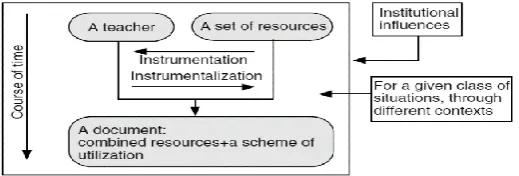
The process of construction of document is dynamic. A document contains as many resources like links to each other and can generate many other documents. The utilisation schemes can be a fixed organisation for certain conditions, or they can be recreated during documentation genesis. The utilisation schemes can also be transferred to other contexts, adapted to new situations, and combined with other schemes. (Gueudet & Trouche, 2009). The documentation genesis process is shown in the theoretical framework in Figure 1.
Figure 1. A representation of documentation genesis (Gueudet & Trouche, 2009)
The documentation approach, analysing the transformation process of resource into documents for teachers, supports the idea that the document construction process has a significant effect on teachers' professional development. The role mathematics teachers to create an a-didactical situation using a video-game from an essential resource. In this research embedded mixed method was used. Participants were ten teacher-student-researchers, studying at the master degree program at a university in Turkey. The data obtained is analyzed regarding thematic analysis and descriptive statistic. The assignments were analysed in three categories; teacher resources, student resources, and researcher resources. It was found that assignments were used two types of resources, namely "teacher resources" and "student resources". There were no assignments that used "researcher resources. Also, it was also found that the legislative forms, hierarchic and monarchic forms, local levels, external scopes and liberal leanings were dominant among the students. It is suggested to increase the work to put forward the researcher identities in teacher-students‟ education at the Universities. 2Assoc. Prof. Dr., Uludag University, Faculty of Education, Science Education Department, Turkey
of the teacher is no longer to be the holder of the knowledge but to be a conductor who will organise activities during which the learner will carry out actions with a goal, actions in which he will build himself know it. In this perspective, in the didactics of mathematics in the late 90s, Brousseau sublimates constructivism in the didactics of mathematics with his theory of didactic situations. His theory was based on several key elements. He first considers the notion of an environment, which is in a way all that is interacting with the learner in the classroom. "The middle is all about who or what the learner is acting on. The "milieu" is everything that acts on the learner. The "milieu" is everything with whom or what the learner is acting on."(Brousseau, 1998). The second key notion is the notion of situation. It determines three types of situations: the didactic situation, a situation whose purpose is to teach, a non-didactic situation, i.e. a situation devoid of any teaching intention, and the a-didactic situation, i.e. a situation where the intention of teaching is not explicit at first sight for the learner. Thus in the a-didactic situation, the teacher will set up fun activities whose objective is defined by the nature of the game itself. The third key notion is the concept of the didactic contract which "describes the implicit or explicit rules governing the sharing of responsibilities, relative to mobilised or structured knowledge, between the teacher and the student. It is, therefore, a representation of expectations on both sides."(Marc, 2014, p.40). This didactic contract limits the actions of learners to ensure the smooth running of activities. Since the advent of video games in three dimensions, many studies have focused on studying the contributions of the integration of video games in pedagogical sequences using a constructivist approach (Pelay, 2011).
According to the constructivist approach, all knowledge is constructed through a state of instability in real problems' situations. The subject of constructivism in higher education is even more complex when it comes to a postgraduate degree in the formation of teacher-researchers. This complexity stems from the fact that teacher-students have a triple institutional status: the status of the teacher in an educational institution, the status of student and learner in the third cycle in which they pursue their studies and the status of a researcher. The work of the student-teachers is on the one hand to meet the expectations of the institution of 3rd degree at the university and on the other hand to enrich their teaching practices in their profession of "teacher"; it is also to be able to develop schemes related to educational research in order to write a master thesis. In this problematique, we pay special attention to the interrelationships between thinking styles and the types of resources preferred by teacher-students in the institution "master's course". The resources used by both teachers and students are crucial to improve themselves in their profession and to achieve the goals they have set for themselves. There exist various studies in the literature, on resources that teachers use spontaneously during their lessons or on resources used during the preparation process of their lessons before their classes (Drijvers & Trouche 2008; Bueno-Ravel & Gueudet, 2009; Aldon, 2010; Shaaban, 2014; Pepin 2015; Gonzalez-Martin, Nardi & Biza 2018; Wang 2018,). In the digital age, the technology that has become a part of our everyday life is in education as digital-based learning (DBL). According to Erhel and Jamet (2013), digital game-based learning (DGBL) is a competitive activity that determines the educational objectives that will encourage learners to acquire knowledge. However, learning with play can be designed to encourage the development of cognitive skills, or it can be in the form of simulations that allow students to practice in the virtual environment. The potential of learning from games as instructional tools continue to be acknowledged by a diverse range of educators, educational researchers. Because it is known that computer games have a positive effect on students' performance in such as social sciences and mathematics (Annetta, Mangrum, Holmes, Collazo & Chang 2009; Huizenga, Admiraal, Akkerman, & ten Dam, 2009; Chang, Evans, Kim, Norton & Yavuz Samur, 2015). Sqire (2005) notes that teachers need to know how to use digital games to support education, as well as know how to make effective use of changing favourite games as an educational tool. Freitas (2018) emphasise that considering games do enhance student motivation, are engaging and can be associated with behavioural change, more active design studies are needed to ensure that the best interests of the learner are met in different contexts. This media is all the more suitable for setting up a didactic situation since it has rules predefined by programmers. The player will have the feeling of freedom, but it will be freedom limited by the characteristics of the game and also by the constraints defined by the learning activity prepared by the teacher. Thus, in any video game used for didactic purposes, there is, on the one hand, a tacit contract, on the rules, which one feels obliged to respect by the game; and on the other hand, a didactic contract related to the expectations of the teacher proposing the didactical situation in the ludic environment.
(liberal and conservative styles) (Zhang 2002). Sternberg and Zhang (2005) stated that the theory of styles applies to education but also to other domains of personal and professional life.
If one of the objectives of the "university" institution is to train university students, another objective is to train researchers engaged in scientific research in the field. Even though there is research on university teachers' resources and documentation work (Biza, Giraldo Hochmuth, Khakbaz & Rasmussen, 2016; Geudet, 2017), these studies are limited to analysis of resources that they use for their teachings. In this context, a study on the use of resources concerning the "scientific research work" of researchers' subject to the "university" institution and the analysis of these resources in the context of the documentation approach, was not found in the literature. Given the universities' mission to train researchers, the analysis of resources used by master and doctoral students constitutes a field with gaps in educational research. It is also thought that the literature will contribute to the study of the effect of thinking styles in the context of the process of constructing the documents. In this context, the aim of this research is to determine the relations between thinking styles and different types of resources used by mathematics teachers studying in the third cycle of the university to create a ludo-educative a-didactic situation using a video game from an essential resource. Problem statements
How is the distribution of thinking styles of teacher-students given the assigned task? How do teacher-students use resources related to the assigned task?
How do the teacher-students use resources related to the assigned task according to their thinking styles??
2. Method
2.1 Method of the Research
In this research, the mixed method was used, and the embedded mixed method design was adopted. The mixed method is defined as an approach that concludes by combining qualitative and quantitative data to understand the research problem (Creswell, 2017). The data in this type of study could be gathered, or it could be ordered sequentially. Its primary function is to embed the quantitative or the qualitative data in a larger frame, yet the data source plays a supporting role in the overall design (Creswell, 2014, p.16). In this study, the qualitative dimension was used to determine teacher-students‟ resources to set up a didactic situation, and qualitative data was used to determine the teacher-students preferred teaching skills.
2.2 Participants
Participants were 10 (2 male and 8 female) teacher-student with a 1-3 year experience in mathematics education, studying at the master degree program in a university in Turkey. The participants were chosen from the 20 students following a training module entitled "Approaches of teaching and learning in the didactics of mathematics" in master degree. Participants were selected on a voluntary basis. The research was carried out during the fall semester of the 2017-2018 academic year and corresponds to the first semesters of the participants in the master program.
2.3 Procedure
Table 1. Participants' levels of Minecraft game‟s usage Participant Binomials Beginners Level of
Minecraft Usage
Medium Level of Minecraft Usage
Advanced Level of Minecraft Usage
Binomial 1 x x
Binomial 2 x x
Binomial 3 x x
Binomial 4 x x
Binomial 5 x x
2.4 Data Collection Tools
In this research Teacher-students‟ assignments and Thinking Styles Inventory was used to explore the relation between teacher-students thinking styles and the use of different resources.
Student-teachers’ assignments. Homework was given to the participants of this master degree course where it was necessary to construct a teaching document that respects the didactical situations theory (TDS). They have been asked to construct a teaching document that is consistent with the TDS, in which it is a matter of an a-didactic environment and where the notion of play is present in Minecraft environment.
Thinking Style Inventory. Thinking Styles Inventory, developed by Stenberg and Wagner (1991) adapted to Turkish by Sünbül (2004) were utilized. The scale consists of thirteen dimensions that fall within the five dimensions. According to the dimensions, people can be understood in terms of functions (legislative, executive, and judicial styles), forms (hierarchic, oligarchic, monarchic, and anarchic styles), levels (global and local styles), scopes (internal and external styles), and leanings (liberal and conservative styles). Each item is scored through a 5 point scale with 5 denoting that the statement does describe the participant extremely well and 1 denoting that the statement does not describe the participant at all. The internal consistency coefficient of the sub-groups was between .70 and 86.
2.5 Analysis Techniques
The data obtained were analyzed concerning descriptive statistic and thematic analysis. In the qualitative dimension, the thematic analysis was selected to examine the data gathered from the document provided from teacher-students' assignments. The goal of the thematic analysis is to identify themes, i.e., patterns in the data that are important or interesting and use these themes to address the research or say something about an issue (Maguire & Delahunt, 2017). The participants of this study being ten teacher-students who worked in binary groups, five assignments constituted the qualitative data. The themes determined by researchers employing a-prior analyses, and they were the bases of the teacher-students' assignments' analyses. This theme was "Teacher" resources, "Student" resources and "Researcher" resources. In this study, «teacher resource» refers to all kinds of resources that teacher-students bring from their teaching professions (classroom decisions, students' classroom experiences, official and assistive books, etc.) and the reflection of these resources as a document to their homework. The «student resource» refers to resources originating from the master course given to the teacher-students on TDS and the «Race to 20», which is the essential resource for this research. The «researcher resource» indicates the resources as scientific research papers or thesis that the teacher-students reached through internet databases, libraries, etc. and that they used in the construction of their documents, in addition to the resources given in the master course. Teacher-students' assignments coded as Assignment 1, Assignment 2 and Assignment 3. The data was presented in its original form. In the quantitative dimension, the descriptive statistic was used and presented using tables.
2.6 Reliability and Validity
Information on the validity and reliability of the quantitative data collection tools we use in our study was derived from the literature used. Detailed information about the research process was also presented for qualitative data collection tools. In the qualitative dimension, the findings were interpreted by two researchers, and an agreement was reached on these interpretations. Çepni (2012) mentioned that in qualitative researches, it is necessary to share the reports obtained by the researcher with individuals involved in the study and to receive their opinions. In this study, the participants were informed in detail about the aim of the research, how the data would be used and analyzed.
3. Findings
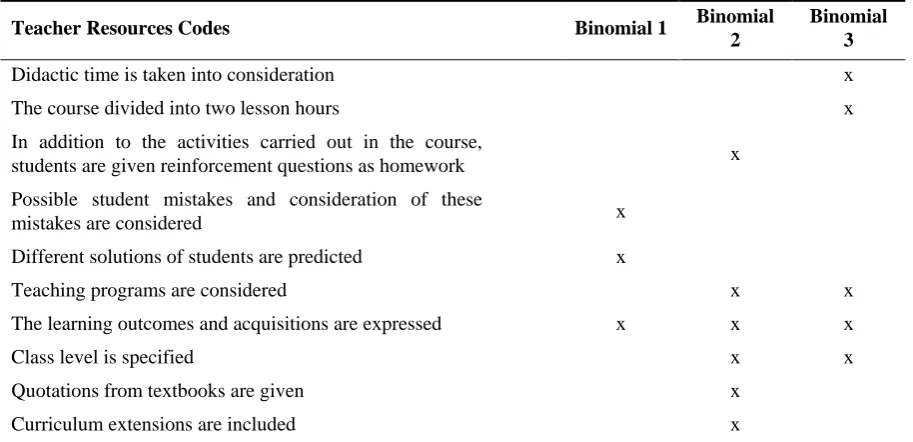
The analyses showed that two types of resources, namely "teacher resources" and "student resources," were used by the teacher-students. No "researcher resource" was encountered. In their assignments, binomials 2 and three used "teacher resources", binomials 4 and five used "student resources" and binomial 1 used "teacher and student resources" together. The following paragraphs present the results of groups categorised according to the use of different resources. Concerning the teacher-students' assignments using "teacher resources", thematic analyzes were performed, and coding was realised as a result of these analyses. The codes were resulting from the analysis of the three assignments using "teacher resources" were given in Table 1.
Table 2. Teacher resources codes obtained from thematic analyses
Teacher Resources Codes Binomial 1 Binomial
2
Binomial 3
Didactic time is taken into consideration x
The course divided into two lesson hours x
In addition to the activities carried out in the course,
students are given reinforcement questions as homework x
Possible student mistakes and consideration of these
mistakes are considered x
Different solutions of students are predicted x
Teaching programs are considered x x
The learning outcomes and acquisitions are expressed x x x
Class level is specified x x
Quotations from textbooks are given x
Curriculum extensions are included x
When the assignments of teacher-students using "teacher resources" are analyzed, all binomials consider and express the learning outcomes in their scenarios. Also, there are two assignments indicating the classroom level and curriculum; these two assignments were using only teacher resources. It was seen that the assignments of Binomial 2 and 3 were constructed in line with the expectations of the institutions that they worked as teachers. A part of the assignment of the binomial 3 prepared by the institution's expectations was presented in Figure 1.
Lesson: Mathematics Grade 6th
class
Learning context:
Geometry and Measurements
Time: 2 hours (40+40 minutes)
Students achievements/ Goals, behaviours:
* Different rectangles with a given volume form their unit prisms with their prisms.
* They explain because the volume is multiplied by the floor area and height.
Activities: Alex completes his home
Tools: Computer
Figure 1. A part of the binomial 3‟s assignment and its translation
dialogues of the teacher and pupils etc. have not been considered in their scenarios. A section of the Group 2 scenario was given in Figure 2.
o Students will create a few rectangles using a certain number of blocks.
o The students will form a few rectangles within a certain distance.
o The students will make two blocks of adjacent figures. (rule)
o The students will have several rectangles with a certain frame and they will have to calculate the area of each rectangle.
o Students will have to create several rectangles with a certain area and calculate the circumference of each rectangle.
o Students will have two rectangles with a specific area. These two rectangles must have a maximum, and minimum circumference. (rule)
The students will make at least 3 numbers (everything except the rectangle) with a certain number of blocks and will calculate the circumference of each digit. They have to calculate the perimeter and area of the different figures and then write on a board that reflects the perimeter and field of all the figures. (Institutionalization and association).
Figure 2. A part of the binomial 2‟s scenario and its translation
On the other hand, the binomial 2, unlike the other binomials, prepared a 5-question worksheet for students to do at home after class. It has been found that the effects of the "teacher resources" on the documentation are mainly at the level of the structural expectations of the institutions in which teachers work. The concept of didactic time, the anticipation of pupil errors and strategies for solving the problem also occurs during the construction phase of the document. Concerning the teacher-students' assignments using "student resources" in the institution "The teaching and learning approaches in mathematics didactics" course, thematic analyzes were made, and coding was realised as a result of these analyses. The codes resulting from the analysis of the three assignments using "student resources" were given in Table 2.
Table 2. Student resources codes obtained from thematic analyses
Student Resources Codes Binomial 1 Binomial 4 Binomial 5
The content of the module of formation and the points that have been processed during the module are included
x
The phases of TDS are considered x x x
A similar structure to the structure of the article «Race to 20» is present x x x
Group 4, using “student resources”, designed a game with electrical circuits in Minecraft. It was found that they designed their assignment with elements similar to the game Race to 20. They also divided their gameplay according to the stages of the theory of didactical situations. The goal of the game expressed by the group 4 is: "The player who fills the boards of the logical connectors found in the electrical circuits wins". An example of screenshots that teacher-students have placed in their assignments was shown in Figure 3.
For the «student resources» in the teacher-students‟ assignments, it can be said that they are strictly related to the essential resource. Indeed, the teacher-students take the essential resource as a model and produce a document resembling the essential resource imposed. They do a didactic analysis of the essential resource and apply the conclusions of these analyses to the teaching document. The analyses showed that one binomial (binomial 1) used teacher and student resources together in their assignment. A synthesis of the resources‟ use for this binomial‟s assignment was realised. Table 3 presented the codes obtained by the analyses of the binomial 1‟s assignment.
Table 3. Codes obtained by the analyses of the binomial 1‟s assignment
Binomial 1 Teacher Resources Codes Student Resources Codes
Possible student mistakes and consideration of these mistakes are taken into consideration
The phases of TDS are taken into account
Different solutions of students are predicted A similar structure to the structure of the article «Race to 20» is present
The learning outcomes and acquisitions are expressed
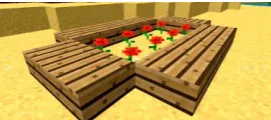
From the view of the theory of situations; the binomial 1 has chosen to teach the notion of the perimeter in the ludo-educative environment Minecraft. The instruction of the game written by the teacher-student is: "You are landscapers. At each turn of the game, you will be asked to guess in advance the number of cubes needed to build the barriers protecting the flowers. You will then check the answer by building the barrier on the software." (Cf. Figure 4).
Figure 4. Teacher and student resources binomial example
The analyses showed that the binomial 1 created a problem-solving situation where an eight-step problem-solving strategy is used and where, in their opinion, the estimations of blocks for steps 6, 7, 8 would lead to the construction of the formula for calculating the perimeter of a rectangle; depending on the dimensions of its sides. The earlier easier steps (1, 2, 3) are supposed to allow learners to initiate for the construction of the formula when they cannot "count by the head" one by one the cubes in steps 6, 7, 8. The successive dimensions of the flowers‟ rectangles and the number of play turns constituted the didactical variables. The victory condition was clearly defined, and the rules of the game were established. To build the didactic activity and integrate all the components of the environment, the teacher-students were strongly inspired by Brousseau‟s “The Race to 20”.
Concerning the "researcher resources", contrary to the expectation on a prior analysis, "researcher resources" were not found in the assignments. Because teacher-students may be thought that, to do their assignments, they should use the "teacher resources" they took out of the educational institution about the teaching profession, and that they should use the "student resources" to meet the requirements and expectations of the master course. Although this was one of the main courses at the master's level, it may be thought that teacher-students had not used the "researcher resources", such as scientific research and scientific knowledge reached through the Internet or in books, to do their assignments because they were still in the school year when they were only taking master courses, and they have not started writing their master thesis yet.
In the quantitative part of this research descriptive analysis of learning styles of teacher-students was done.
Table 4. The teacher-students assignments regarding to the categories of their thinking styles
Constitute Functions Form Levels Scopes Leanings
Assignment 1 Teacher- students resources Legislative/ Judicial Hierarchic/ Monarchic
Local External Liberal
Assignment 2 Teacher resources
Executive/ Judicial
Hierarchic/ Oligarchic
Local Internal Liberal Assignment 3 Teacher
sources Legislative/ Executive Hierarchic/ Monarchic Global/ Local Êxternal/ Internal Liberal/ Conservative Assignment 4 Student
sources
Legislative Hierarchic/ Monarchic/ Oligarchic
Global/ Local
External Liberal/ Conservative Assignment 5 Student
sources Legislative/ Judicial Hierarchic/ Monarchic/ Anarchic
Local Êxternal/ Internal
Liberal
According to the Table 4, it was deduced that the assignments‟ groups were seen to have every thinking style.
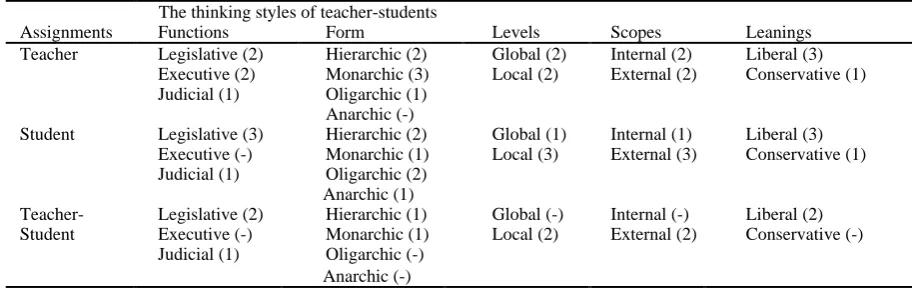
The thinking styles of teacher-students are analyzed and their distribution regarding the categories in resources were presented in Table 5.
Table 5. The teacher-students thinking styles regarding to their assignment resources The thinking styles of teacher-students
Assignments Functions Form Levels Scopes Leanings
Teacher Legislative (2) Hierarchic (2) Global (2) Internal (2) Liberal (3) Executive (2) Monarchic (3) Local (2) External (2) Conservative (1) Judicial (1) Oligarchic (1)
Anarchic (-)
Student Legislative (3) Hierarchic (2) Global (1) Internal (1) Liberal (3) Executive (-) Monarchic (1) Local (3) External (3) Conservative (1) Judicial (1) Oligarchic (2)
Anarchic (1) Teacher-
Student
Legislative (2) Hierarchic (1) Global (-) Internal (-) Liberal (2) Executive (-) Monarchic (1) Local (2) External (2) Conservative (-) Judicial (1) Oligarchic (-)
Anarchic (-)
Concerning the teacher-students‟ thinking styles regarding to their use of resources in their assignments, it can be said that the legislative forms (7), hierarchic (5) and monarchic forms (5, local levels (7), external scopes (7) and liberal leanings (8) were dominant among the teacher-students whereas executive functions (2), oligarchic (3) and anarchic (1) forms, global levels (3), internal scopes (3) and conservative leanings (2) were minimum.
3. Results, Conclusions and Recommendations
In this study, the assignments analysis revealed that one of the assignments uses two types of resources, namely “teacher resources”, and “student resources”, two assignments uses “teacher resources” and two assignments used “student resources”. There were no assignments that used “researcher resources”. As a result, it can be said that the effects of “the teacher resources” on the documentation process might mainly at the level of the expectations of the institutions that the teachers are subjects. Teacher-students were free on the choise of mathematical topics in their assignments. The use the Minecraft and the design of a-didactical environment in accordance with the constructivism were required from them. However, it was seen that the teacher-students did not reflected in “the researcher resources” into their assignements. This migt be interpreted as the fact that they do not yet have enough schemes to use the “researcher resources” for the construction of documents in a documentional process. Ruthven (2013) finds that teachers use their previous experience as one of the most important schemes in the process of constructing documents. In this study, participants did not have previous experiences as researchers, and the fact that they could not use researcher resources in the process of constructing documents parallel when evaluated in terms
behavior. People with dominant Type II thinking styles including executive, monarchic, local, and conservative thinking styles show a dominant tendency to engage themselves in more simple information processing and rule following activities. Type III thinking styles including oligarchic, anarchic, internal, and external thinking styles are inclined to act in a more situational-dependent manner (Zhang 2004; Zhu 2013). According to results of our research executive and monarchic thinking, the style was dominant at the teacher resources group whereas oligarchic and external were dominant at the student resources. Zhu (2013) found that Type II thinking styles seemed to have higher associations with dominant teacher interpersonal behaviours. Also, Zhang (2004) mentioned that Type II teaching styles about encourage rule following and simplistic information processing was almost exclusively favoured by students with Type II thinking styles. And he added that except for the oligarchic thinking style (a Type III style) was significantly predictive of the executive and monarchic teaching styles (Type II styles) as well. In this case, it might be considered that teacher resources are Type II, and student resources are type III. Zhu (2013) explained that Type III thinking styles including oligarchic, anarchic, internal and external were associated with freedom and strict interpersonal behaviours but this not significant for students. So, Sternberg (1990) stated that teachers need to flexible in their teaching in order to reach possible number of students. In addition, some tasks require one style, some require another and still others allow the doer some options such as when students need to complete worksheet that due to the next day, if their preference is legistrative/hiyerarchic, they will sometimes have to act in an executive/monarch manner.
As a result, in this study, researcher resources were not identified within the scope of documentation theory in the assignments of teacher-students. Also, it could be thought that students thinking style affect student documentation process. In this context, it is suggested to increase the work to put forward the researcher identities in teacher-students‟ education at the 3rd degree Universities.
References
Aldon, G. (2010). Handheld calculators between instrument and document. Mathematics Education, 42(7), 733-745. https://doi.org/10.1007/s11858-010-0275-4
Annetta, L., Mangrum, J., Holmes, S., Collazo, K., & Cheng, M. (2009). Bridging realty to virtual reality: Investigating gender effect and student engagement on learning through video game play in an elementary school classroom. International Journal of Science Education, 31, 1091–1113. https://doi.org/10.1080/09500690801968656
Brousseau, G. (1998). Théories des situations didactiques. La pensée Sauvage, Grenoble.
Bueno-Ravel, L., & Gueudet, G. (2009). Online resources in mathematics, teachers‟ geneses and didactical techniques. International Journal of Computers for Mathematical Learning, 14(1), 1-20. https://doi.org/10.1007/s10758-009-9143-0
Creswell, J. W. (2014). Araştırma deseni: Nitel, nicel ve karma yöntem yaklaşımları. (S. B. Demir, Trans.) Ankara: Eğiten kitap.
Creswell, W. (2017). Karma yöntem araştırmalarına giriş. (M.Sözbilir, Trans.) Ankara: Pegem akademi.
de Freitas, S. (2018). Are Games Effective Learning Tools? A Review of Educational Games. Educational Technology &Society, 21(2), 74–84.
Çepni, S. (2012). Araştırma ve Proje Çalışmalarına Giriş (Geliştirilmiş 6. Baskı), Trabzon.
Duman, B. & Celik, O. (2011). The relationship between the elementary school teachers‟ thinking styles and the teaching methods they use. Elementary Education Online, 10(2), 785-797.
Drijvers, P., & Trouche, L. (2008). From artefacts to instruments: A theoretical framework behind the orchestra metaphor. In G. W. Blume & M. K. Heid (Eds.), Research on technology and the teaching and learning of mathematics (Cases and perspectives, Vol. 2, pp. 363–392). Charlotte: Information Age.
Erhel, S., & Jamet, E. (2013). Digital game-based learning: Impact of instructions and feedback on motivation and learning effectiveness. Computers & Education, 67, 156-167. https://doi.org/10.1016/j.compedu.2013.02.019 Gueudet, G. (2017). University Teachers‟ Resources Systems and Documents. International Journal of Research in
Undergraduate Mathematics Education, 3, 198-224. https://doi.org/10.1007/s40753-016-0034-1
Huizenga, J., Admiraal, W., Akkerman, S., & ten Dam, G. (2009). Mobile game-based learning in secondary education: Engagement, motivation and learning in a mobile city game. Journal of Computer Assisted Learning, 25, 332–344. https://doi.org/10.1111/j.1365-2729.2009.00316.x
Gueudet, G., & Pepin, B. (2018). Didactic Contract at the Beginning of University: a Focus on Resources and their Use. International Journal of Research Undergrad Mathematics Education. 4(1), 56-73. https://doi.org/10.1007/s40753-018-0069-6
González-Martín, Alejandro & Nardi, Elena & Biza, Irene. (2018). From resource to document: scaffolding content and organising student learning in teachers‟ documentation work on the teaching of series. Educational Studies in Mathematics. https://doi.org/10.1007/s10649-018-9813-8
Marc, J. (2014). Le recours aux formations à distance (e. learning) dans la formation professionnelle des salariés. Présentation, influence sur les acteurs et éléments de vigilance (Doctoral dissertation, Institut National de Recherche et de Sécurité (INRS)), France.
Maguire, M., & Delahunt, B. (2017). Doing a thematic analysis: a practical, step-by-step guide for learning and teaching scholars. All Ireland Journal of Teaching and Learning in Higher Education, 9 (3), 3351 – 33514. Pelay, N. (2011). Jeu et apprentissages mathématiques : Élaboration du concept de contrat didactique et ludique en
contexte danimation scientifique, thèse de didactique des mathématiques de l‟université, Lyon I, France.
Pepin, B. (2015). From Text to “Living” Resources:Mathematics Teachers‟ Work and Interaction with Resources, Actes du Colloque du Groupe de didactique des mathématiques du Québec 2015, Université de Sherbrooke, Quebec.
Ruthven, K. (2013). From design-based research to re-sourcing „in the wild‟: Reflections on studies of the co-evolution of mathematics teaching resources and practices. ZDM, 45(7), 1071-1079. https://doi.org/10.1007/s11858-013-0547-x
Ruthven, K. (2017). Researching instructional activity and student interaction with digital resources, Proceedings of the 13th International Congress on Mathematical Education ICME-13, Hamburg, Germany
Shaaban, E. (2014). The Interactions between Resources, Particularly Digital Resources, and Biology Teachers' Conceptions during their Documentary Work: Case of Teaching Genetic Determinism at Secondary Level, PhD Thesis, Faculté de Pédagogie, Université Libanaise, Beyrouth Lebanon
Schacht, F. (2015). Student documentations in mathematics classrooms using digital tools: theoretical considerations and empirical findings. Electronic Journal of Mathematics & Technology, 9(5), 320-339. 20p.
Sqire, K. (2005). Changing the game: What happens when video games enter the classroom? Innovate: Journal of Online Education, 1(6), Article 5. Retrived from https://nsuworks.nova.edu/innovate/vol1/iss6/5
Sternberg, R. J. (1990). Thinking styles: Keys to understanding student performance. The Phi Delta Kappan, 71(5), 366-371.
Sternberg, R. J., & Zhang, L. F. (2005). Styles of thinking as a basis of differentiated instruction. Theory into practice, 44(3), 245-253. https://doi.org/10.1207/s15430421tip4403_9
Wang C. (2018). Mathematics Teachers‟ Expertise in Resources Work and Its Development in Collectives: A French and a Chinese Cases. In: Fan L., Trouche L., Qi C., Rezat S., Visnovska J. (eds) Research on Mathematics Textbooks and Teachers‟ Resources. ICME-13 Monographs. Springer, Cham. https://doi.org/10.1007/978-3-319-73253-4_9 Zhang, L. (2002). Thinking styles and cognitive development. The Journal of Genetic Psychology, 163(2), 179–195.
https://doi.org/10.1080/00221320209598676
Copyrights
Copyright for this article is retained by the author(s), with first publication rights granted to the journal.