Issues
ISSN: 2146-4138
available at http: www.econjournals.com
International Journal of Economics and Financial Issues, 2015, 5(Special Issue) 85-92.
The Spatial Transformation of the Urban Environment in the Conditions of Post Industrial Development of Society: Dedicated to the 100th Anniversary of Jean Gottmann, Immanuel Kant Baltic Federal University, 23-26 August 2015, Russia.
Scientific Notation of Technology Park Structure on the Basis of
Stakeholders’ Environment Models
Anna Maltseva*
Lurye Scientific and Methodological, Center for Higher School Innovative Activity, Tver State University, Tver, Russian Federation.
*Email: [email protected]
ABSTRACT
The paper is focused on the development of scientific and theoretical concepts of technology park structures (TPS) as main subjects of modern innovative regional economy. The author suggests using the concept of environmental in conjunction with the stakeholders’ theory, which allows to create possibilities for determination of the position and significance of a variety participants of TPS for management purposes. This ensures the balance of priorities in the activities of TPS to meet the needs of different stakeholders. Based on the methodology the main stakeholders groups and their objectives in relation to the TPS are identified; the importance of the Mitchell’s model is allocated; the structure of resource relations between the stakeholders of TPS in accordance with the Rowley’s network model is shown. The author proposes a strategic model of stakeholders’ management, which allows developing a unified approach to manage stakeholder groups, as well as a matrix model with the application of certain aspects of the Savage’s model. Using obtained results in practical activities of TPS enables to create significant benefits for the expansion of the stakeholders network
and their involvement in joint activities and special management system based on the principle of “soft power.”
Keywords: Technology Park Structure, Science and Technology Park, Stakeholders, Internal Environment, Innovative Environment, Innovative
Company, Anchor Resident JEL Classifications: O3, O14, R1
1. INTRODUCTION
The current stage of development of the Russian economy is characterized by ambiguity. Using improved methods of the socio-economic management designed mostly on basis of the formal synthesis of the various economic and theoretical schools provides essential changes in the economy in recent years. The
current significant reduction of economic growth determines
the position of the country at some point of bifurcation which requires a qualitative leap primarily for further development due to changes in the organization and management of economic actors. Nowadays a fundamentally new approach to the problems of methodology of management in the innovative sphere is required. It should be a source of overcoming the national economy crisis caused by the deformation of its individual parties. Tools and methods of modern regional economy in some causes impact only
on surface forms of socio-economic relations while maintaining the effect of the problem on deep social and economic processes at the micro level. This problem is called “subjectlessness
management” (Lepsky, 2010).
The features of the present stage of economic development
in the innovative sphere are significant institutional changes
the result of which is the formation of fundamentally new
for Russia’s economy institutions (development institutions,
innovative infrastructure, venture capital ecosystem and so
on). In 2007-2014 about 680 billion rubles were given from the
federal budget for the formation of an innovative infrastructure, about 70 billion rubles were spent for the development of its regional components. At the moment the federal authorities are
concerned with the target use of the incurred expenses as well
The studies show that low effectiveness of the innovative infrastructure in the majority of cases is not associated with the
lack of resources, physical infrastructure, developed approaches to management but with the lack of well-functioning communication
between the participants of the innovative process at all levels,
the insufficient design of the main characteristics of content of innovative infrastructure objects for a specific territory (Löfsten and Lindelöf, 2002, Bania et al., 1992, Westhead and Storey, 1995). The problems of technology park structures (TPS) which include scientific, technology parks, innovative business incubators are particularly marked. Many of them were created spontaneously by the administrative guidelines and now, in fact, do not fulfill their
mission or are not cost-effective as the subjects of the economy.
2. THEORETICAL OVERVIEW
The development of TPS management methodology identified
a new vector of scientific and theoretical understanding of their nature and the internal structure which is not simply a set of participants but special reality which promises to create effective development of innovative activity in their territories
and demonstrates the essential proximity of the considered methodology to environmental concept. Westhead and Batstone (1998) wrote about the presence of a special TPS’ environment
catalyzing the incubation process of innovative companies. Poon
(1998) pointed to the need of effective interaction of TPS with the
environment, the formation of relationships with universities and
research institutes, inter-firm network. Pfirrmann (1995) claims that all of this will lead to an increase of the efficiency of R and D,
the development of technological spillover.
The scientific basis for the development of ideas about innovative environments is reflected in the works of the Russian and foreign scientists, among them the works by Lepsky (2010) who developed
interdisciplinary foundation of “environmental paradigm” according to the basic precepts of postnonclassical rationality and
justified subject-oriented approach to the innovative development
environments creation stand out. On the basis of the systematization
of the views of various authors (Lepsky, 2010, Camagni, 1991, Boschma, 2005) it was stated that the innovative environment is a set (in case of its higher development it is a system) of the subjects,
their relationships and conditions of innovation. It is characterized with its unique principles, norms, values and other attributes that distinguish it from the environment as a community.
Transforming the above research thesis on the problem of TPSs it is noted that they have these essential characteristics. Thus, TPSs as integrated elements of innovative infrastructure have a mission to create conditions for innovative activity and its development support in a particular area. The central element of TPS is a management company which forms the resident structure, engages for cooperation with the outsourcing service companies to facilitate the creation of high-quality and most popular services
for innovative companies and provides interaction with the expert
and the investment communities.
According to the modern research the impact of innovative activities
having a creative basis often depends on the environment influence
on innovators. Exactly an opportunity to be in the community of
“similar” in some cases attracts innovative companies to the TPS.
Thus, the analysis of the International Association of Science Parks
data conducted by the author has shown that only 26% of TPS in the world provide the residents with space for rent at lower than
market rate and in 32% of these structures the rents for residents is higher than the average one outside (Maltseva and Chevychelov, 2012). This proves the thesis about the presence not only and not
so much the formal conditions for innovation in well-functioning
TPS but also a special community (environment) which creates
prerequisites for the development of its own innovation.
The territorial proximity of the TPS subjects correlates with the thesis of Camagni (1991) about a limited geographical area of innovative environment which functioning, in this case, does
not fully find its confirmation because of the well-functioning
virtual TPSs organizing of innovative activities of entities through innovative environment in the Internet space. Thus, it is advisable
to consider proximity concept of Boschma (2005) in relation to the subject and the object of research. He highlights the cognitive,
geographical, organizational, social and institutional proximity
of subjects. The scientist proved that the geographical proximity itself does not accelerate the transfer of knowledge and innovation
but only indirectly affects this process demonstrating the priority
of cognitive, organizational, social proximities to success in
innovative sphere. The subjects of innovation activity in the TPSs
are characterized with rationally organized cognitive proximity representing individuals (companies) that are at a certain (close) level of development, belong to the same field of activity, have
similar goals and are in need of information on the possibilities of the project implementation, success stories and so on.
Belonging to the number of residents of TPS or affiliated persons or organizations (expert and investment communities) provides an organizational proximity between the subjects which not only allows their quick and consistent connection but also enhances
their monitoring, control and hierarchy which are some of the
functions of the management company. Social proximity of TPSs could emerge (or be purposefully formed) due to organizational
and geographical proximity as a result of the establishment of formal and very close (or) informal relationships between actors
of innovation. The generation of the innovative cycle chains involving several residents, formation of their own particular
corporate culture in TPS contribute to social proximity.
Exactly, the initial strategic objective of the formation of TPS
as an innovative environment can provide the further effective
management of innovation processes based on it. In the context of
post-nonclassical rationality management is not hard determination
of systems but ‘soft form of governance’ that is creation of
conditions for their further development. For the purposes of fundamentally new management paradigm design for innovative infrastructure objects this approach involving various mechanisms of social impacts such as management, organization, moderation,
mediation, support, promotion is the most expedient (Lepsky, 2010).
Indeed, experience shows that some fairly large-scale regional
conceptual and methodological and technological level. Lack
of basic values of TPS as a center of innovative development contributes to the so-called strain which transforms its main
idea (a comprehensive support to start-up companies) in fundamentally different activities (organization of TPS as rent-oriented business center, attracting budget co-financing of major regional investment projects). Formation of TPS is expedient only within territories with a high level of innovative
susceptibility and specific mentality of society, which, in interaction with innovative environment TPS, can provide not only harmonious development of the structure as a whole but also its individual entities. These subjects of the economy as
the participants of TPS themselves make significant influence
on the development of innovative environment on its basis, so
their innovative ideological level, in fact, defines a vector of
further development of TPS.
Using the concept of stakeholders firstly proposed by Freeman (1984) allows to formalize the approach to the management of internal and external environments of TPS by segmenting its participants’ relations. For the purposes of the research the basis of the stakeholders’ approach application is the idea that the success of TPS measures the degree of satisfaction (effectiveness)
of not only its members but also of all the interested parties
(stakeholders). As noted by a number of authors (Post et al., 2002) relations with stakeholders are the “most important asset that
should govern management and organizational ultimate source of wealth.”
The stakeholders’ theory application is one of the most effective tools for the research and development of TPSs’ management
methodology because of their polystructural essence, the large number of participants both in the structure and outside it as well as an active impact on the socio-economic processes in the
region. Integration of environmental and stakeholders’ approaches can provide greater result for TPSs’ methodological foundations development and their subsequent practical using. Moore (1996)
introduced the concept of business ecosystems involving the
company together with its stakeholders. For management systems there are two large groups of governance tasks: Management of the interactions network “one-to-many” and the administration of multilateral networking interactions in the business. The first group of tasks relates to the relationship management of the economy agent with its stakeholders some of which have a complex structure but are considered as “relatively indivisible.”
In the second case, the main challenge lies in the fact that the vital
force (competitiveness) of the ecosystem depends on the state and behavior of all its elements, and all of them are stakeholders in
view of common strategic goals achieving. In fact, one can say that there are three levels of goals: The goals of the company,
the goals at the dyads level and the goals at the network level (Sheresheva and Palt, 2014).
Thus, in the process of TPSs’ efficient management system design one should take into account the network nature of the
interactions of all participants as well as the purposeful vector of development as balancing of needs and resources of internal and
external stakeholders.
Using stakeholders’ methodology as a basis for the simulation of TPS’ environment demanded its theoretical understanding. So, one of the most significant stages is the identification of main stakeholders and their classification. As shown above, the TPS is a special subject of the region’s economy. There are different approaches to the definition of its essential characteristics which also can be divided into narrow and broad (Post et al., 2002, Clarkson, 1995, Freeman, 1984). With regard to the stakeholders’
theory the differences between them lie in the point of inclusion of various participants. It is proposed to use some average approach to understand TPS as the subject of the regional economy and to
provide both external and internal stakeholders’ environment. This will allow to identify the tasks of participants in relation with TPS and external environment as well as to highlight the interests of stakeholders from the environment with respect to TPS as a whole
and to individual participants.
Thus, level approach can be traced in understanding the essence of TPS: At the micro level the interests and relationships of TPS individual participants among themselves and with the subjects of the environment are determined and at the meso level TPS in general become the subject of the relationship. This approach is
the basis for the stakeholders’ classification and for constructing models for the interested parties’ significance assessing.
The modern researches contain numerous approaches to the
stakeholders’ classification which are essential for their clear identification and formulation of their average interests in relation to the investigating company (Freeman, 1984, Savage et al., 1991, Newbould and Luffman, 1989, Petrov, 2004). The methodological foundations of the stakeholders’ theory that serve as the basis for
the formation of the organization management system are the
most important. One of the first widely well-known concepts of stakeholder management was proposed by Mitchell (1997). The essence of Mitchell’s model is to identify the stakeholders with the most significant attributes for the company (“power,” “legitimacy,” “urgency”) and, therefore, depending on the class of importance a
special approach to the management of relations with each group
of stakeholders is required (Mitchell et al., 1997).
Improved knowledge of the importance of stakeholders for the TPSs’ purposes is a model of resource relationships (Rowley, 1997). The model is based on the identification and evaluation of resource sharing between the stakeholders and the company which
may be asymmetrical in favor of the target element, equivalent or asymmetrical to the detriment of the target element. For the
purposes of efficient functioning the company should support the first and second types of resource sharing with stakeholders, in the third case it is in the “flawed” position, i.e. it gives more resources than receives. The development of the Rowley’s model was representation of a network of relationships with stakeholders
as part of the resource sharing which introduced the main
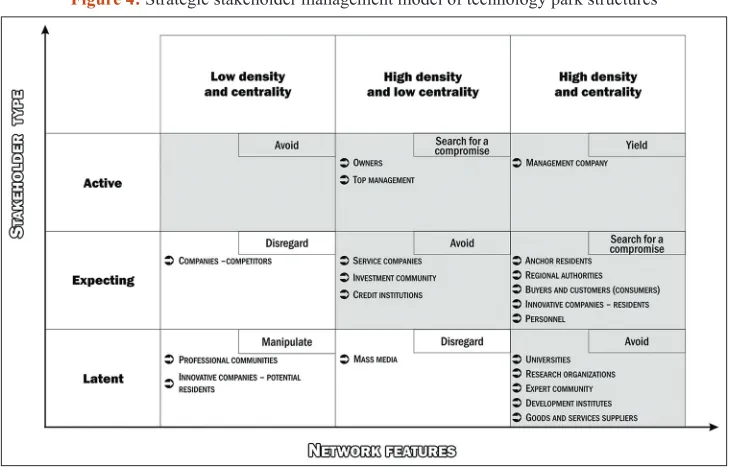
features of the network density and centrality of element. Their application in conjunction with the Mitchell’s model provides creation of strategic stakeholders’ management model that is matrix in accordance with which relationships with stakeholders’
groups could be managed. Data of figure reveal the stakeholders’
(“to yield”) or with regard to their interest in the interaction (“compromise”). It also provides the possibility of excluding from consideration in the network model of the stakeholders’ groups which appear in the lower left corner of the matrix because of their level of network performance and availability of attributes of Mitchell’s model.
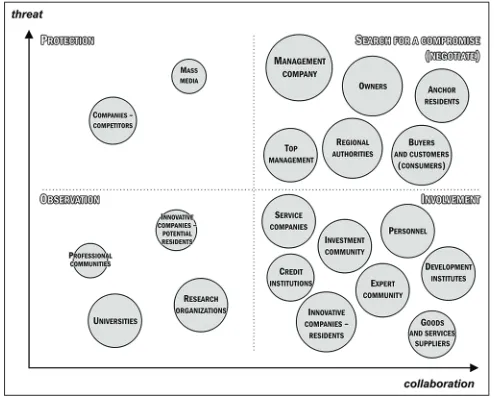
Other approach that can be used to develop TPSs’ strategic stakeholders’ management is the Savage model (Savage et al., 1991). The basis of the management matrix is stakeholders’
classification based on the determination of their potential
(probability) to bring damage to the organization and its capacity (readiness) to cooperate. Besides considered methodological
approaches for determining strategic priorities in relation with
main stakeholders’ groups matrix “force-dynamic” and “power-interest.” SWOT and VRIO-analysis and others can be used.
Thus, a theoretical overview creates the necessary basis for the formation of the methodological foundations of the development
of the TPSs’ stakeholders’ environment.
3. RESEARCH METHOD
The methodological basis of the study was the theoretical analysis,
content analysis, compilation, systematization, classification, expert assessment and several others. The conceptual and
methodological aspects of the theory of innovative environments,
the theories of stakeholders and business ecosystems were used.
For the purposes of the study theoretical and methodological
aspects of the theory of stakeholders were systematized and later transformed to the problem of the TPSs’ management.
The foundations proposed in the literature were used through conceptual basis of environmental paradigm that eventually gave rise to a special new approach to the problem which is substantially similar to the methodology of functioning and management of business ecosystems.
The algorithm of a theoretical construct of TPSs’ environment models using stakeholders’ approach includes the following steps: 1. Identification of main stakeholders’ groups using different
types of classifications.
2. Setting goals (interests) of stakeholders’ groups in relation to
TPS.
3. Evaluation of the stakeholders’ importance on the basis of Mitchell’s model.
4. Formation of network representation of resource stakeholders’ relations based on the balance and Rowley’s network model.
5. Development of recommendations for using models in TPS
practice in the framework of monitoring the main stakeholders’ groups’ dynamics and development the foundations of the strategic management of each stakeholders’ groups.
The design of the models in accordance to the given algorithm is the theoretical basis for the further implementation. During the study empirical testing of the following theoretical considerations
was not carried out due to the lack of technical capabilities that,
in this case, determines the way forward but does not diminish
their scientific and methodological significance. The practical
implementation of the models is available in concrete place
and time, for specific groups of stakeholders, so the resulting classification and network representations of stakeholders’ groups
are applicable only for the considered case that reduces the possibility of their translation into other circumstances.
4. RESULTS OF THE RESEARCH AND THE
DISCUSSION
On the basis of grouping mentioned in the theoretical review the
classification of TPSs’ stakeholders was proposed taking into
account the above sound level approach.
1. External stakeholders • Management company • anchor residents
• innovative companies - residents • Service companies.
2. Internal stakeholders • Universities
• Research organizations • Expert community • Investment community • Regional authorities • Development institutes • Goods and services suppliers • Buyers and customers (consumers) • Credit institutions
• Innovative companies – potential residents • Mass media
• Professional communities.
An important group of TPSs’ stakeholders are the owners which
can be regional authorities, universities or private persons who are, in most cases, the founders of the management company.
Depending on the TPSs’ owner the vector of its development and, accordingly, the interests of owners as a stakeholders’ groups are defined while level of responsibility, the degree of influence
and their interaction with TPS increase. The regional authorities as the initiator of project and owner of TPS, in most cases, are guided with the objective of creating of favorable conditions for innovative development of the territory, increasing of employment
and self-employment, the growth of tax revenues from resident
companies. Universities as TPS founders aim the most complete and effective commercialization of their created research and
development. Private parks mostly operate as business providing a
pool of services to starting innovative entrepreneurs, and therefore
their main goal is to maximize profits and to preserve financial stability. The list of stakeholders does not include ones of nano
level that are the staff and the top management of the management company, service and resident companies which, in this case,
make a very significant impact on their functioning and should be presented as stakeholders within their level’ submission.
participants (management company (Figure 1) and innovative companies-residents (Figure 2) was conducted. It allows to regard
the problem of formation of effective relationships between entities
of external and internal environment of TPS more profoundly.
For the formation of the block diagrams the basic interests of
the main stakeholder groups were highlighted. Ranking their
importance for the management company and innovative
companies-residents was carried out with the help of expert approach based on empirical studies of modern TPS’ functioning. In accordance of comparison of TPS’ stakeholders’ groups and its
main participants there are some differences between the level of
importance and stakeholders that shows no contradiction between
the models. It is characterized with different level of depth study of relationships between individual actors in the regional social and economic system.
The design of models of TPS as a stakeholder company was conducted on the basis of known models proposed in the works of Mitchell et al. (1997) and Rowley (1997). During the study the average expert assessment of attributes for main TPS’ stakeholders’
groups was carried out. In accordance with level approach they
include some stakeholders that interact with the most active TPS’
participants: The management company and residents. The result
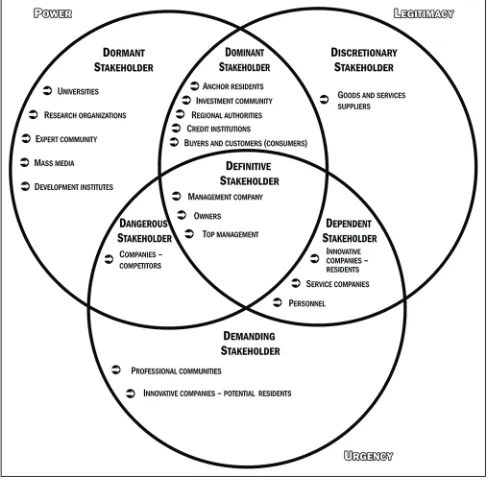
is the model identifying the importance of TPS’ stakeholders (Figure 3).
The most significant stakeholders’ group for TPS’ management system is definitive one represented by the management company, owners and top management. Indeed, these stakeholders’ groups make the most important impact on the TPS development vector,
are associated with it with very close formal and informal relationships and are highly dependent on the results of its operations. Attention is drawn to the dominant group which includes anchor residents, the investment community, regional
authorities, credit institutions, buyers and customers (consumers). With a strong attribute of power in conjunction with legitimate interest they can make a significant impact on TPS in general
and on individual participants which requires the development
of mutually beneficial relationship with them. A dangerous group
includes both individual competitors of residents and management company and TPS as a whole. At the present stage in the Russian Federation mainly the prevalence of supply over demand in the
market of TPSs’ services due to the emergence of this form of
innovative activity development is observed. In stable conditions management of a dangerous group can easily convert it into the partner allowing to concentrate joint efforts on the production of a particular innovative product or provide a wide pool of services
to residents and, ultimately, its positive impact on the final result.
So, a balance of interests can be provided instead of available directly opposite objectives.
For the TPS’ resource model it is appropriate to consider the balance of relations between it and the main stakeholders. However, the presence of level structure is a prerequisite of
analysis of the resource sharing between its main participants.
The final resource model can be obtained using the transitive
characteristic and includes all possible resource relations arising
Figure 1: Stakeholders’ map of technology park structures’
management company
Figure 2: Stakeholders’ map of technology park structures’ innovative
companies-residents
Figure 3: Universal Mitchell’s model for technology park structures
with individual participants and the structure as a whole. It
participants, too. For the purposes of harmonization of the TPS’
internal environment in accordance with the concept of innovative environments it is necessary to achieve the equivalent of resource sharing between the participants, or eventually one of them will
seek to adjust or eliminate such relationships. For the balance of the TPS’ resource with the external environment the target vector of development of relations with stakeholders will ensure a positive
resource balance.
For the purposes of the study of TPS as stakeholders’ organization
levels of density and centrality of its resource sharing with its main
stakeholders were assessed using the average expert estimates. As a result a strategic stakeholder management model was drafted (Figure 4). It includes not only the matrix of stakeholders’ groups depending on the position in Mitchell’s model and network
characteristics of resource sharing but also the most appropriate
format of relations between TPS and concrete stakeholder.
The network model of TPS’ resource sharing which shows the direction of flow of resources with the help of arrows is below (Figure 5).
It is noted that this study does not include quantitative assessment of applicants and received resources due to the need of more
clear specification of the research object and implementation of numerous measurements of the interaction with stakeholders.
The figure also highlights features of the TPS’ network resource
model resulting in some cases in one-sided interaction between
different stakeholders and TPS’ participants. This explains the fact
that the central element of the model is the management company
which, in some cases, receives resources from stakeholders and
transforming them passes to residents. They, in turn, pass other
types of resources in favor of this group of stakeholders.
The author has investigated the main features of the Savage’s model with respect to TPS’ stakeholders (Savage et al., 1991). As a result the following matrix model was obtained (Figure 6).
Its graphical representation was based on the methodological
approach of Grabar and Salmakov (2014).
The design of the system of TPS’ relations with stakeholders
is possible relying on the directions proposed in the model. In
some cases, it is noted that such classification is conditional and a mutually reinforcing effect of the individual stakeholders’
interaction is possible. So, in general, the investment community
and credit institutions due to their diversification do not represent a particular threat to TPS but in conditions of financial and economic crisis and sharp reduction in the proposed financial and investment
resources are they can both cause substantial damage to suspend
the residents’ innovative projects implementation due to lack of financial resources. These models and the following from them basis of management on the basis of stakeholders’ theory are
provisional and should be adapted for the purposes of the particular TPS. This should be considered as a stage of the life cycle of the structure as a whole and its individual members, ownership, the
predominant profile of residents. In this case there are significant
deviations from the proposed models which can become the basis of a particular practice research.
The importance of the TPS’ study through the paradigm of innovative
environments is noted because of its operation at both regional and
micro levels. Ensuring maximum involvement of regional actors in
the innovative economy as the most important strategic objective to create such structures in the Russian Federation requires soft forms of governance associated with agitation, gradual involvement in
the activities of cooperation and compromise. Exactly, these tools provide achievement of TPS’ goals and its high efficiency.
5. CONCLUSION
Using the stakeholders’ theory for management of specialized
structures that contributes to the development of innovation is
quite justified in the frameworks of this article. Existing problems
in their functioning on the meso and micro levels can be solved
with the use of advanced management tools. Stakeholders’ theory does not simply describe the existing situation and predict the
cause-effect relationships. It also recommends the installation of
the structure and practice that taken together define stakeholders’ management (Donaldson and Preston, 1995).
As shown in other works of the author (Maltseva, 2015) TPS’
management should be transferred to the non-material basis due
to the probabilistic nature of the risky innovative activity and
high role of intellectual assets in its development. It emphasizes the closeness of the developed methodology to the concept of organizational wealth which is the most important basis of
the theory of stakeholders (Post et al., 2002). In fact, the well-established relations with stakeholders are the so-called relations
capital. They not only create a competitive advantage for companies operating in the innovative sphere but they themselves can provide the necessary strategic vector of development based
on the involvement of other organizations with both material
and intangible assets the lack of which hampers its harmonious development inside TPS. According to Post et al. (2002) organizational wealth is a summary measure of the organization’s ability to generate benefits for all of its stakeholders over a
long time. The system of interactions in which the formation and use of organizational wealth occurs is sharing of resources. The organizational wealth generation is aimed not only on
achieving their own goals but also on the benefit of stakeholders. There is connection with the proposed concept of network and environmental paradigms. From the viewpoint of network resource
sharing organizational wealth can be accumulated not only due to
the direct flow of resources from stakeholders but also indirectly, i.e. within specially formed network of stakeholders of the
organization. They are able to multiply the incoming resources to organization from various channels by coordinate efforts.
The paradigm of innovative environments shows significant advantages to expand the network of stakeholders and to involve
them in joint activities with the help of the principle of “soft
power.” Precisely taking the value and balancing their own interests with the interests of the target segment stakeholders
become generators of wealth together with the considered organization. For the implementation of the mission of TPS the
level of involvement of stakeholders in the TPS’ activities, the
development of new innovative companies based on the success stories of residents, increase of the innovation active economic actors will demonstrate its effectiveness at the meso level and promote growth of its organizational wealth.
In the framework of this article predominantly one-sided consideration of interactions with stakeholders incoming from TPS is marked. In actual practice each TPS stakeholder may also be
considered as a target segment actively forming relationships with
stakeholders, i.e., for the purposes of effective management the
most suitable instrument can be dynamic simulation. Stakeholders’
theory largely allows to formalize the management system of the relationship with the outside of the company which, however,
may not always lead to positive results. For example, some group of stakeholders can include economic actors with very different
interests in relation to the investigation of the company and, in this case, the use of standard approaches to interaction with them
is not justified. But the theory allows to identify their interests and
develops solutions to meet their balance with the interests of the
company as quickly as possible.
The unified approach to dealing with external and internal environment of TPS surely requires clarification of detail in the
case of its practice application due to general methodological
orientation of this work.
6. ACKNOWLEDGMENTS
The study was performed in the framework of the project
“methodology of intellectual capital management of TPS and
scientific structures with fixed state status” under the state order of the Ministry of Education and Science of the Russian Federation
to Tver State University.
Figure 6: Savage’s model of technology park structures’ stakeholders
REFERENCES
Bania, N., Calkins, L.N., Dalenberg, D.R. (1992), The effects of regional
science and technology policy on the geographic distribution of industry R and D laboratories. Journal of Regional Science, 32, 209-228.
Boschma, R. (2005), Proximity and Innovation: A critical assessment. Regional Studies, 39(1), 61-74.
Camagni, R., editor. (1991), Introduction: From the local «milieu» to innovation through cooperation networks. Innovation Networks:
Spatial Perspectives. London: Bedhaven Press. p1-9.
Clarkson, M.E. (1995), A stakeholder framework for analyzing and evaluating corporate social performance. Academy of Management Review, 20(1), 92-118.
Donaldson, T., Preston, L.E. (1995), The stakeholder theory of the
corporation: Concepts, evidence and implications. Academy of
Management Review, 20(1), 65-92.
Freeman, R.E. (1984), Strategic Management: A Stakeholder Approach.
Boston: Pitman.
Grabar, V.V., Salmakov, M.M. (2014), Stakeholder analysis of the project: Methodology, methods, tools. Ars Administrandi, 2, 36-44. Lepsky, V.E. (2010), Reflective-Active Environment of Innovation.
Moscow: Publishing House Cogito Center. Available from: http:// www.reflexion.ru/Library/Lepsky_2010a.pdf.
Löfsten, H., Lindelöf, P. (2002), Science parks and the growth of new technology-based firms: Academic-industry links, innovation and markets. Research Policy, 31, 859-876.
Maltseva, A.A. (2015), Management of intellectual capital of technology park structure as a factor of effective management. Financial Magazine of NIFI, 1, 60-71.
Maltseva, A.A., Chevychelov, V.A. (2012), Global trends in the development of technology park structures: Selective analysis. Problem Analysis and Public Management Design, 2(5), 29-42. Mitchell, R.K., Agle, B.R., Wood, D.J. (1997), Toward a theory of
stakeholder identification and salience: Defining the principle of who and what really counts. Academy of Management Review, 22(4), 853-886.
Moore, J.F. (1996), The death of Competition: Leadership and Strategy in the Age of Business Ecosystems. New York: Harper Business. Newbould, G., Luffman, G. (1989), Successful Business Politics. London:
Gower.
Petrov, M.A. (2004), Stakeholder theory: The practical application.
Bulletin of St. Petersburg State University. Socio-Economic Review,
2(16), 51-68.
Pfirrmann, О. (1995), Path analysis and regional development: Factors affecting R and D in West Germany small and medium size firms.
Regional Studies, 29, 605-618.
Poon, T.S.C. (1998), Inter-firms networks and industrial development in
the global manufacturing system: Lessons from Taiwan. Economic and Labor Relations Review, 9, 262-284.
Post, J.E., Preston, L.E., Sachs, S. (2002), Redefining the Corporation: Stakeholder Management and Organizational Wealth. Stanford, CA:
Stanford University Press.
Rowley, T.J. (1997), Moving beyond dyadic ties: A network theory of stakeholder influences. Academy of Management Review, 22(4),
887-910.
Savage, G.T., Nix, T.W., Whitehead, C.J., Blair, J.D. (1991), Strategies for assessing and managing organizational stakeholders. Academy of Management Executive, 5(2), 61-75.
Sheresheva, M.Y., Palt, M.M. (2014), The alignment of stakeholders’ interests in interfirm networking. IKBFU’s Vestnik, 3 (Economics and legal sciences), 17-23.
Westhead, P., Batstone, S. (1998), Independent technology-based firms: The perceived benefits of a science park location. Urban Studies, 35(2), 2197-2219.