Issues
ISSN: 2146-4138
available at http: www.econjournals.com
International Journal of Economics and Financial Issues, 2015, 6(1), 179-184.
Formalization of Sustainable Innovative Development Process in
the Model of Innovations Diffusion
Marina V. Shinkevich
1*, Aleksey I. Shinkevich
2, Alexey D. Chudnovskiy
3, Irina V. Lushchik
4,
Gulnara N. Kaigorodova
5, Izida I. Ishmuradova
6, Svetlana A. Bashkirtseva
7, Ludmila V. Marfina
8,
Tatiana A. Zhuravleva
91Kazan National Research Technological University, Kazan, Russia, 2Kazan National Research Technological University, Kazan,
Russia, 3Moscow State University of Management, Moscow, Russia, 4Moscow University Named by S.Y. Witte, Moscow, Russia, 5Kazan (Volga Region) Federal University, Kazan, Russia, 6Kazan (Volga Region) Federal University, Kazan, Russia, 7Kazan
National Research Technological University, Kazan, Russia, 8Kazan State University of Architecture and Engineering, Kazan,
Russia, 9Financial University under the Government of the Russian Federation, Moscow, Russia. *Email: [email protected]
ABSTRACT
The relevance of the study is reasoned by the fact that the sustainability of innovative development cannot be fully estimated by using the parameters
which are traditionally observed by the official statistical bodies, so it suggests the need to improve methodological solutions and technology economic interpretation as well as scaling of indicators’ values in this field. At the macro level there is a small number of indicators on the basis of which we can
conclude about the stability of innovative development of economic systems at the meso - and macro level. In this regard, this article aims to formalize the process of sustainable innovation development on the basis of the parameters’ set formation of the innovations’ diffusion model and diagnosis of major economic systems’ development level. The leading method is the parameters’ set formalization of the quantitative model to estimate the level of economic systems’ innovative development based on managerial interpretation of descriptive statistics’ indicators of innovation activity in the framework of economic activities. A set of quantitative parameters of 9 parametric model of economic systems’ innovative development level is formalized in the article, allowing to diagnose the impact of cyclical factors and the institutional environment that are not fully implemented in the existing macro-systems assessing the level of economic macro-systems’ innovative development; methods of diagnosis and economic interpretation of the relevant indices and indicators’ levels are proposed. The material of this paper is of practical value for enterprises’ innovative activities regulators and monitoring agencies, for regional innovation infrastructure and transfer technology entities, for innovation-active enterprises, because on the basis of the obtained model the optimal solutions in the development of strategies for the upgrading of industries, regions, macro-economic system as a whole are possible.
Keywords: Innovation Development, Innovations’ Diffusion Model, Cycling, Institutional Environment, Formalization of Parameters
JEL Classifications: O31, O34, Q01
1. INTRODUCTION
The sustainability of innovative development in the conditions of periodicity (of crisis) of economic phenomena and processes because of import submission is becoming an important factor to maintain and increase the economic growth and the gradient of the added value into the national economic system and its inter-industry spillover.
In the Russian context the innovative factors of sustainable
economic development are manifested insufficiently, relevant one
becomes the theme of their institutionalization and development of management technologies to form prospective trajectories of development, to create incentives for innovation by enterprises, industries and the national economy as a whole. In this regard, noteworthy are the works (Williamson, 1985; Silverberg and
Verspagen, 1995; Kleiner, 2006; Lazonick, 2006; Shinkevich, 2012; Krugman and Venabies, 1995; Mensch, 1985).
To modernize the Russian economy normal organization of business processes are necessary, not only through technological, but also
This provides a substantially greater return than investment in R and D (research and development) and in acquisition of new technologies (such investments, typically, have no meaning and
will be unprofitable, if the business processes in the country are
not normally supplied).
At the macro level there is a small number of indicators on the basis of which it is possible to make conclusion about the stability of innovative development of economic systems at the meso - and macro-level. So, as indicators of innovative activity are considered indicators of industrial enterprises engaged in technological innovation; share of organizations which carried out innovation activities in the total number of organizations; the relative indicators of innovative development - the share of innovative products in total revenue of enterprises, the share of R and D expenditures in the revenues of enterprises; rate of expenditure on technological innovations to the volume of shipped products.
The use of indicators, traditionally observed by the official statistics do not fully evaluate the sustainability of innovative development, which suggests the need to improve methodological solutions and technology of economic interpretation and scaling
of the indicators’ values in this field.
2. METHODOLOGICAL FRAMEWORK
2.1. Theoretical Base of the Research
As theoretical basis of the article the control theory, theory of innovation, new institutional theory, the evolutionary theory of innovation, the theory of cyclical behavior of innovative development, the theory of transaction costs, the theory of the effectiveness of economic phenomena and processes can serve.
The objectives of this research are: Theoretical justification of the
institutional component of innovations’ diffusion in manufacture systems at meso-level; the choice of an original system of
indicators which fully reflect the effectiveness of innovations’
diffusion; trends and patterns’ research of a number of economic activities’ innovative development.
2.2. Methods of the Research
When obtaining scientific results the general scientific and specific
methods of knowledge were used: The method of formalization, the dialectical method, the method of analogies, analysis and synthesis, methods of systemic, structural-functional, economic-mathematical modeling, simulation modeling, multivariate statistical analysis, comparison, index methods, matrix methods, forecasting methods.
2.3. Stages of the Research
The study was conducted in three stages:
• At the first stage - economic mechanism of institutionalization
of sustainable innovative development on the basis of a
dynamic model of innovation diffusion was justified.
• At the second stage - the formalization of sustainable innovative development process based on the formation of parameters’ set of the innovations’ diffusion model and diagnose of major economic systems’ development level was carried out.
• At the third step the approbation of 9 parametric model to assess the level of economic systems’ innovative development was carried out, the managerial interpretation of the received data was given.
3. RESULTS
3.1. Economic Mechanism of Sustainable Innovative Development’s Institutionalization
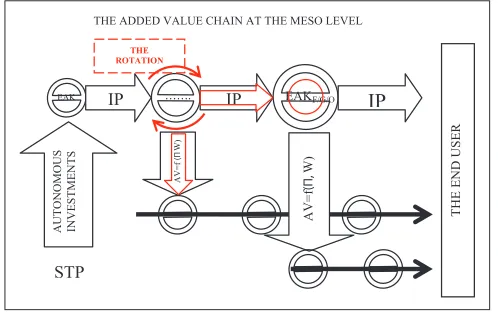
As the basis of the economic mechanism to institutionalize the sustainable innovative development the so-called “dynamic model of innovations’ diffusion” is proposed which is presented in Figure 1.
The original theoretical basis of the model is the theory of added value chains. The phenomenon of the chains’ existence becomes the growth of competitiveness of meso-systems. The theory of added value chains contains a high, but not fully realized the potential to explain and manage the innovative changes, primarily in the form of co-compete management model. The proposed model is formed on the base of the study of the “autonomous
investment” influence’s nature on the diffusion of an innovative
product along macro-technologies, taking into account the allocation of institutional factors of innovation (Shinkevich and
Shinkevich, 2011).
“Autonomous investments” (Hansen, 1951), the main cause of
which is scientific and technical progress (in Russian conditions
- state injection), triggering the mechanism of the multiplier and accelerator effect, cause the growth of income (added value) not
only in definite industry but in all connected with it industries
(supply chain of innovative products), as there goes the momentum proposals within the framework of macro-technology. The result is maximizing of added value at the meso-level. This model of interdependence (over-cumulative process, or “over-multiplied” system by Hansen) at greater extent allow to formalize the “origin” of the economic cycle and manage it, rather than from the standpoint of the theory of technological paradigms. In its turn,
the demand for innovation within this model is sufficient for full
Figure 1: A dynamic model of innovations’ diffusion at the meso
level. STP: Scientific and technical progress, AV: The gross added value of the industry, W: Wages; P: Profit; IP: Innovative product of
diffusion of innovations in case of innovation’s effect exceeding over the alternative effect in the form of savings on manpower in terms of traditional business models. The greater proportion of the income arising from “Autonomous investment,” will be consumed (the higher the marginal propensity to consumption, stimulated by the increase in the share of wages in the cost structure and added value), the greater impulse to the growth will be got by the involved industries (and, hence, the demand for innovations will be increased).
The importance of the institutionalization of sustainable innovative development in this model is associated with the transformation from “autonomous” investments along macro technology into stimulated as a result of the acceleration of innovation, which are endogenous in their economic nature, because they are not
only radical, but also enhance technologies. Such clarification is
necessary from the standpoint of the importance of sustainable economic development providing, implemented on the basis of innovation, and a dynamic model of innovation allows to manage the transformation of exogenous factors (autonomous investment) into endogenous factors (conversion of radical innovations into improving and pseudo innovations as a result of the mechanism of the multiplier and accelerator effect).
Institutionalization of innovative development in this case is necessary for compensation of “mechanism (point) of rotation” from rise to decline and, as a result, the damping of the innovations’ diffusion, due to several factors: (1) Depletion of autonomous investment by reducing the marginal efficiency of capital investments according to Hansen, the increase of rates and rising prices for capital goods in the phase of overheating of the economy; reduction in the marginal propensity to consume as a result of the action of the basic psychological law of Keynes on the recovery phase (with increasing income the propensity to consume falls and the propensity to save increases); (2) negative “transaction effect of innovative development;” (3) the lack of enterprises in the Russian conditions of “underlying incentives to innovate.”
Under the transactional effect of innovative development is understood the inverse relationship between the share of transaction costs related to the creation/purchase of innovation and the magnitude of transaction costs in innovation’s implementation and market power. In the situation of ready-made technologies’ buying, the investment cost of the project is less than investment expenses in the case of contracts for the development and implementation of the new R and D project. However, the share of sector on development of R and D at the meso-level, as well as market sector, which may represent the products - decreases. The company has to eventually carry a greater load in the form of transaction costs after signing of the sale contract of the technology. Therefore, in the management of innovation it is necessary to take into account negative externalities of the incomplete cycle of innovation activity at the meso level. This is manifested in the absence of strong preconditions to innovations’ diffusion in the chain from high-tech to medium and low-tech industry: In the structure of R and D expenditures of domestic enterprises there is virtually no cost on improving innovations.
As it is believed in the “handout economy” conditions (in contrast to the market economy it is characterized by the transfer of government funds to institutions for innovation development), autonomous investments in innovation in high-tech industries may not lead to super multiplier, including because the income of employees of industries in added value and the share of added value is the basis for the accelerator, in the medium - and low-technology industries they are low and very high in natural resource industries.
Institutionalization of sustainable innovative development in the conditions of circularity consists in forming of perspective institutional trajectories. Recent economic history demonstrates macroeconomic systems’ different exit strategies from the crisis, which is undoubtedly due to the difference in the patterns of institutionalization of their most important reproductive processes. Moreover, a number of concepts of economic development, on the contrary, is associated with opportunities for developing countries in the cyclical economy (for example, the concept of “technological windows of opportunities” (Perez, 1985), the concept of “import substitution” (Prebish, 1981) and others. The diagnosis of innovative development sustainability of the manufacturing economic activities shows that the institutionalization manifested at the meso-level in balanced proportions of innovations’ investment and in the formation of a high share of added value, routinizing by enterprises of high-tech industries, allows to ensure the sustainability of innovation processes in the preservation of added values’ high share in conditions of crisis, while medium industries lost their positions according to this indicator, primarily
in the decline of the profits of the rental nature to their normal level.
3.2. Formalization of the Parameters’ Set to Assess the Level of Innovative Development of Economic Systems’ Innovative Development
The totality of the revealed patterns of sustainable innovative development in the cyclical economy allows create a system (set) of parameters and evaluation methods which extend the existing methodological decisions and formalize the diagnosis of institutional factors of innovations. On the basis of the obtained results of database calculations on innovative activities in the framework of economic activities the modern technologies of economic and mathematical modeling are used, which allowed to test the main hypothesis of the research.
To identify drivers of sustainable innovative development the following groups of indicators are formed and diagnosed: 1. Sustainability indicators’ group of enterprises’ innovation
activeness in terms of regions and economic activities kinds.
2. The group of indicators by market efficiency of innovation
activities.
3. The group of indicators by efficiency of reproduction innovation process.
4. Indicators’ group by performance/resource recoil for different level of innovative activity of economic activities.
5. The group of indicators by resource support of innovative activity.
7. The indicators’ group by institutional similarity of innovative sectors of economic activities and territorial production complexes.
8. The indicators’ group of industries’ innovative potential development based on the diagnosis of innovation externalities and transaction costs.
9. Modeling technologies’ group of institutional trajectories of innovation development.
This 9 parametric model to assess the level of innovative development of economic systems, allows to diagnose the impact of cyclical factors and the institutional environment that are not fully implemented in the existing system of assessing the level of innovative development of economic systems.
3.3. Approbation of the Parameters’ Set Assessing the Level of Economic Systems’ Innovative Development
Stability estimation in indicators’ behavior of innovatively active enterprises’ activity was estimated on the base of the indicators
of a descriptive statistics. On the example of specific kinds of
economic activities the managerial interpretation of the data was carried out.
1. Group of sustainability indicators of enterprises’ innovation activity in terms of regions and economic activities’ kinds derived from the share indicator of innovatively active enterprises in their total number, according to the analysis result of which the conclusion was made about the need in two types of models for the institutionalization of regional
economic systems and about the inefficient local optimum.
It was recommended to interpret the distribution character’s gravity of innovation activity level by type of economic activity to a normal distribution as a sign of primitivism of
innovation activity, taking into account the a priori-the defined industry-specific of the technological level of economical
industries.
The resilience index of innovative activity (Formula 1) as an alternative assessment variant of the innovative development’s sustainability effectiveness is proposed for calculation and tested:
I Kurtosis
x
IA= ∆
(1)
2. Indicators’ group of market efficiency of industrial innovative
activity, based on indicators derived from the indicator of the innovative products’ share (IP) in revenues (R) of the company
(or in general for the kind of economic activity). The figures indicate the levels’ standardization of market efficiency of
innovation activities in the pre-crisis period that is treated as
an inefficient process.
3. The indicators’ group of reproductive innovation process’s
efficiency, defined by the correlation of the resources’ volume
of a capital nature, focused by the industrial enterprises on the funding of the development or its implementation, either for the purchase and implementation of new technologies, with the industrial indicators of revenue. The use restrictions is shown of such indicators in the Russian context to diagnose the effectiveness of innovative development because of its leadership on indicators among the medium, and not high-tech economical industries. It should be noted that in conditions
of base’s absence to ration of this index the diagnostics of reproductive processes’ stare is possible in the dynamics and on the basis of interregional comparisons.
Index to master the created at the meso-level advanced manufacturing technologies (AMT) in the total number of applied AMT, designed in the regional context was proposed for use and tested to measure the characteristics of the institutional environment in implementing of the domestic R and D developments (Formula 2):
I AMT
Applied AMT
AppAMT= (2)
4. Group performance/resource recoil indicators for different levels of innovative activity of economic activities’ kinds. Methodologically important is the comparison of dynamics of indicators in the second and third groups in the conditions of crisis phenomena in the economy. The indicators are estimated
on the basis of the modified index of investments’ return, (R
and D return) calculated by the Formula (3):
R D& ret IP * % R&D
= 100
(3) Where, IP - innovative products of the industry, Rub., R and D - the amount of industrial R and D expenditures, Rub (3). In the Formula it is possible to consider a time lag, or, assuming that the process of innovative changes is a continuous process, to abstract from the moment of implementation of investments, taking into account that the data are considered at the meso-level. Such diagnostics in the context of enterprises allows conclude that the costs on technological innovations are not a driver of sustainable innovative development in the Russian context. Development sustainability is determined primarily by the indicators of the Group 2, that is positive from the position of the factors’ better management to institutionalize the process of innovation for the sector of organizational,
marketing, financial innovations. For a number of Russian
industries with high potential for import substitution the situation is marked of innovations’ indicators improving in the crisis, which is equivalent to the theory of “technological window of opportunities.”
5. The group of indicators of resource provision of innovative activities, including structural indicators of capital expenditure
of enterprises on activities in the field of R and D. The
proposed methodological solutions are aimed at identifying of
innovative profile of the enterprise in the market. Within this
group of indicators method to determine capital expenditure on R and D transactional in nature is proved, along with major transformational costs. To transaction costs of a capital nature are related the investment costs of the company connected with the cost of R and D, acquisition of new technologies, industrial design, education and training, market research. Transformational costs are proposed to be interpreted in the context of the acquisition of machinery and equipment and acquisition of software. Such a gradation allowed identify the nature of transaction effect of innovative development for economic activities’ kinds.
institutionalization of sustainable innovative development at the meso level. The article evaluated the excess of the average industrial enterprises activities’ scope (in terms of revenues’ indicator, related to the number of enterprises, which is also the criterion in the study of the competitive environment of the industrial market) above the average industrial size of innovative industrial subsystem (estimated by revenue conversion of innovation subsystem using the share indicator of innovative products in the sector’s revenue and its correlation with the number of industrial enterprises) in terms of types of economic activity. It is also a way to assess the sustainability of innovative development at the meso level, since the growth of this indicator means reduce in innovation and Vice versa. Change’s trend and inter-sectorial proportions of the observed indicator allow draw a conclusion about the competitiveness of an industry in the framework of the macroeconomic system as a whole. On the overall economy in crisis and post-crisis period a negative trend of innovation activity reducing was watched.
7. Indicators’ group of institutional similarity in innovative sectors of economic activities’ kinds and territorial production complexes. The indicators are relevant when developing general models of management actions in the framework of the institutionalization of sustainable innovative development. The basis of grouping is the use of technology of multivariate cluster analysis. While research of cluster linkages between economic activities’ kinds by the share of R and D expenditures in industry revenue has shown the existence in the Russian context of the institutional groupings of industries in the composition of high-, medium-, and low-tech industries, cluster analysis of innovative activity of regional economic systems leads to thoughts about the absence of distinct groups of regional innovation systems. In the Russian context there is a need to ensure universal perspective institutional trajectories to overcome the technological stalemate, as the majority of regional subsystems in the framework of the Russian national innovative system are similar and are about at the same level of development. The institutionalization of innovative
development of economic activities’ kinds requires specific
models of development institutions.
8. The group of indicators of industries development’s innovative potential based on the diagnosis of innovations’ externalities and transaction costs. Based on the above decisions, the universal method to formalize the innovations’ externalities is the comparison of added value’s share in the revenue of economic activities and the share of wages in the structure of added value in normal and crisis conditions in terms of high, medium and low-tech industries. The group of indicators includes indicators of operational transaction costs different by level of adaptability of economic activities’ kinds, estimated on the basis of the developed methods of allocation within the enterprise’s operating costs of transformation costs and expenses associated with the implementation of market transactions.
9. Technologies’ group for innovative developments’ institutional trajectories’ modeling. The proposed diagnostic technology - the technology of three-dimensional modeling using of innovational development’s sustainability based on the matrix
comparing of 1-8 groups’ indicators. A defining condition for
the innovations’ sustainability in the crisis was not expenditure on R and D but the share of innovative products in industry revenue (in crisis conditions sharply decreases the R and D share in the revenue, but the share of innovative products decreases noticeably less). There is a worsening of the negative effect of transaction innovation development (limits by realization markets of innovative products from competitors’
side in terms of crisis) that actualizes the increased efficiency
of transactions through the institutionalization of sustainable innovative development and internalization of the positive
effect of innovations by the firm.
Sustainability factors of innovative development (SID) can be reduced to economic and mathematical model (Formula 4):
SID=f(IA,EM,ER,R&Dret,R&Dstr,AV,TAC,IAE,InsT) (4) Where, IA - innovative activity of economic systems, EM
- market effectiveness of innovative activity, ER - efficiency
of reproduction of innovations at the meso-level, R & Dret
- the rate of return of R & D expenditures, R & Dstr - structure of R & D expenditures, AV - sectorial proportions of added value, TAC - composition and structure of transaction costs of innovative activity; IAE - indicators of demography of innovatively active enterprises; InsT - characteristics of the institutional trajectories of innovative development.
On the basis of the obtained model optimization solutions are possible in the development of strategies for the upgrading of industries, regions, macro-economic system as a whole.
4. DISCUSSION
To the study of innovative developmental models of countries, regions and individual companies a significant number of fundamental and applied research papers are devoted (Aghion and
Howitt, 1992; Asheim and Coenen, 2004; Freeman et al., 1982; Grossman and Helpman, 1991; Leydesdorff, 2005; Lazonick, 2006; Lundvall, 1992; Mensch, 1985; Perez, 1985; Silverberg and
Verspagen, 1985; Krugman and Venabies, 1995). Some of them are based on the provisions of neo-institutional theory (Nelson and
Winter, 1982; Shinkevich, 2005; Williamson, 1985). Considerable
scientific interest belongs to methodological development of approaches to evaluate the effectiveness and manage the institutionalization of sustainable innovative development. Among them fragmentary studies or the objectives’ formulation by the
economists that can be adapted to solve this scientific problem are known. They include the findings and results of scientific research (Etzkovitz and Leydcsdorff, 2000; Wallerstein, 1979; Williamson, 1985; Polterovich, 2009; Tatarkin and Romanova, 2008; Katkalo, 2003).
However, while there is availability of extensive methodological and theoretical data and practical solutions a uniform methodology is still hasn’t been developed to institutionalize the sustainable innovative development and formalize quantitative approaches which combine the latest achievements of modern management
science and incorporate the essential specifics, deformation and
5. CONCLUSION
The importance of innovative development’s sust ainability management in the periodicity (of crisis) conditions of economic phenomena and processes are obvious. In the Russian context the innovative factors of sustainable economic development are
manifested insufficiently, topical issues of institutionalization and
the development of management technologies to form prospective trajectories of development, to create incentives for innovation at all levels are very actual. For Russian economy’s modernization the normal organization of business processes is important, not only through technological, but also organizational and managerial innovations. However, the sustainability of innovative development cannot fully be estimated using existing indicators, which suggests the need to improve methodological solutions and technologies of economic interpretation and scaling of the
values of indicators in this field. At the macro level there is a small
number of indicators on the basis of which we can conclude about the stability of innovative development of economic systems at the meso - and macro level.
Therefore, the study was conducted to formalize the process of sustainable innovative development based on the formation of the parameters’ set of the innovations’ diffusion model and diagnose the major economic systems’ developmental level. Quantitative 9 parametric model of economic systems’ innovative development level allow diagnose the impact of cyclical factors and the institutional environment that are not fully implemented in the existing system of assessing the level of innovative development of economic systems; methods of diagnosis and economic interpretation of the levels of the relevant indices and indicators are proposed.
The material of this paper are of practical value for regulators and monitoring agencies of enterprises’ innovative activities, entities of regional innovation infrastructure and technology transfer for innovatively active enterprises, because on the basis of the obtained model optimization solutions in the development of strategies for the upgrading of industries, regions, macro-economic system as a whole are possible.
REFERENCES
Aghion, P.H., Howitt, P.A. (1992), Model of creative destruction.
Econometrica, 60, 323-351.
Asheim, B.T., Coenen, L. (2004), Knowledge bases and regional
innovation systems: Comparing Nordic Clusters. Research Policy,
34, 1173-1190.
Campbell, E.G., Powers, J.B., Blumenthal, D., Biles, B. (2004), Inside
the triple helix: Technology transfer and commercialization in the life sciences. Health Affairs, 23, 64-76.
Etzkovitz, H., Leydcsdorff, L. (2000), The dynamic of innovations:
From national system and to a Triple helix of
university-industry-government relations. Research Policy, 29, 109-129.
Freeman, C., Clark, J., Soete, L. (1982), Unemployment and Technical
Innovation: A Study of Low. London: Frances Printer.
Grossman, G., Helpman, E. (1991), Innovation and Growth in the Global Economy. Cambridge: MIT Press.
Hansen, A.H. (1951), Business Cycles and National Income. New York: Norton.
Katkalo, V.C. (2003), The original concept of strategic management and their timely evaluation. Russian Management Journal, 1, 7-30. Kleiner, G.B. (2006), New institutional economics: Towards a “supernew”.
Russian Management Journal, 4(1), 113-122.
Krugman, P., Venabies, A. (1995), Globalization and the inequality of
nations. Quarterly Journal of Economics, 110(4), 857-880. Lazonick, W. (2006), The theory of innovative enterprise. Economic
Bulletin of the Rostov State University, 4(3), 7-32.
Leydesdorf, L. (2000), The triple helix: An evolution model of
innovations. Research Policy, 29, 243-255.
Leydesdorff, L. (2005), The triple helix model and the study of
knowledge-based innovation systems. International Journal of Contemporary Sociology, 42, 1-16.
Lundvall, В.A. (1992), National Systems of Innovation: Towards a Theory of Innovation and Interactive Learning. London: Printer Publishers.
Mensch, G. (1979), Stalemate in Technology: Innovations Overcome the Depression. Cambridge, Massachusetts: Ballinger Publishing Co. p241.
Nelson, R., Winter, S. (1982), An Evolutionary Theory of Economic Change. University of Illinois at Urbana-Champaign’s Academy
for Entrepreneurial Leadership Historical Research Reference
in Entrepreneurship. Available from: http://www.ssrn.com/ abstract=1496211.
Perez, C. (1985), Toward a Comprehensive Theory of Long Waves. Long Waves, Depression and Innovation: Implication for National and Regional Economic Policy. Laxenburg, Austria: International
Institute for Applied Systems.
Polterovich, V., Popov, V. (2007), Economic Policy, Quality of Institutions
and Mechanisms of Resource Curse. Moscow: Publishing House of
SU HSE. p98с.
Prebish, P. (1981), Peripheral Capitalism: Are There Alternative/Abridged Translation from Spanish. Mexico: Fondo de Cultura Economica. 1981.
Shinkevich, M.V. (2012), Management of efficiencydevelopment of
meso-systems on the basis of the institutional approach. Management in Russia and abroad, 1, 38-44.
Shinkevich, А.I. (2005), Improvement of the Institutional System of
Innovation Development of the Regional Industrial Complex (on the Example of Republic of Tatarstan). Kazan: Publishing House of Kazanski. University. p244.
Shinkevich, М.V., Shinkevich, А.I. (2011), Institutionalization of
Sustainable Innovative Development of Meso-Systems: Models and Management Technologies. Kazan: Publishing House of Kazan, Natural Resource Technology University. p333.
Silverberg, G., Verspagen, B. (1995), Evolutionary Theorizing on Economic Growth. Maastricht: Merit.
Tatarkin, A.I., Romanova, О.А. (2008), Industrial policy: A theoretical
framework, the regional experience of development and implementation. Industrial Policy in the Russian Federation, 7.
Available from: http://www.prompolit-press.ru/0807.files/doc/3.doc.
Wallerstein, I. (1979), The Capitalist World-Economy. New York: Cambridge.